www.earth-syst-dynam.net/6/287/2015/ doi:10.5194/esd-6-287-2015
© Author(s) 2015. CC Attribution 3.0 License.
Uncertainty in temperature response of current
consumption-based emissions estimates
J. Karstensen, G. P. Peters, and R. M. Andrew
Center for International Climate and Environmental Research – Oslo (CICERO), P.O. Box 1129, Blindern, 0318 Oslo, Norway
Correspondence to: J. Karstensen ([email protected])
Received: 17 July 2014 – Published in Earth Syst. Dynam. Discuss.: 9 September 2014 Revised: 8 April 2015 – Accepted: 13 April 2015 – Published: 27 May 2015
Abstract. Several studies have connected emissions of greenhouse gases to economic and trade data to quantify
the causal chain from consumption to emissions and climate change. These studies usually combine data and models originating from different sources, making it difficult to estimate uncertainties along the entire causal chain. We estimate uncertainties in economic data, multi-pollutant emission statistics, and metric parameters, and use Monte Carlo analysis to quantify contributions to uncertainty and to determine how uncertainty prop-agates to estimates of global temperature change from regional and sectoral territorial- and consumption-based emissions for the year 2007. We find that the uncertainties are sensitive to the emission allocations, mix of pol-lutants included, the metric and its time horizon, and the level of aggregation of the results. Uncertainties in the final results are largely dominated by the climate sensitivity and the parameters associated with the warming effects of CO2. Based on our assumptions, which exclude correlations in the economic data, the uncertainty
in the economic data appears to have a relatively small impact on uncertainty at the national level in compari-son to emissions and metric uncertainty. Much higher uncertainties are found at the sectoral level. Our results suggest that consumption-based national emissions are not significantly more uncertain than the corresponding production-based emissions since the largest uncertainties are due to metric and emissions which affect both perspectives equally. The two perspectives exhibit different sectoral uncertainties, due to changes of pollutant compositions. We find global sectoral consumption uncertainties in the range of±10 to±27 % using the Global Temperature Potential with a 50-year time horizon, with metric uncertainties dominating. National-level uncer-tainties are similar in both perspectives due to the dominance of CO2over other pollutants. The consumption
emissions of the top 10 emitting regions have a broad uncertainty range of±9 to±25 %, with metric and emis-sion uncertainties contributing similarly. The absolute global temperature potential (AGTP) with a 50-year time horizon has much higher uncertainties, with considerable uncertainty overlap for regions and sectors, indicating that the ranking of countries is uncertain.
1 Introduction
Many studies have shown that national greenhouse gas (GHG) emission accounts can be viewed from either a production (territorial) or consumption perspective (Davis and Caldeira, 2010; Hertwich and Peters, 2009; Wiedmann, 2009; Peters and Hertwich, 2008). While the production view only looks at territorial emissions, the consumption view in-cludes emissions from the production of imported products and excludes emissions from the production of exports. It
has been shown that territorial emissions have decreased in most developed countries since 1990, but consumption-based emissions have increased (Peters et al., 2011c). This indicates that growth in consumption and international trade may un-dermine the effectiveness of climate policies that only limit emissions in a subset of countries, such as in the Kyoto Pro-tocol (Wiebe et al., 2012; Kanemoto et al., 2013).
Consumption
Production
Emissions
Temperature change
0
1
2
3
4
5
0
1
2
3
4
5
0
1
2
3
4
5
Metrics Economic data
Emissions data
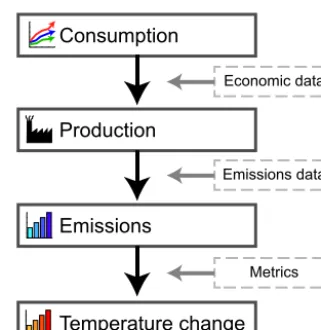
Figure 1.Flow chart of activities (bold boxes) and the data sets that determine transitions between them (dashed boxes).
global warming (Fig. 1). This is an important complement to the established territorial (Kyoto Protocol) viewpoint, par-ticularly in that it links more directly to consumption as a key driver of emissions. More recent studies have broadened this concept to look at further consequences of increased global demand for traded products, such as deforestation (Karstensen et al., 2013), biodiversity loss (Lenzen et al., 2012b), dependency on traded fossil fuels (Andrew et al., 2013), land-use change (Weinzettel et al., 2013), and water footprints (Hoekstra and Mekonnen, 2012).
In the estimation of consumption-based emissions ac-counts, various data sets and models are combined in the cal-culations, and thus uncertainties and errors may arise in a number of data sets and models: emission data, metric data, economic data, etc. There are also uncertainties in assump-tions and study design that can be more difficult to explicitly quantify, including which metric and time horizon to use for comparing pollutants, and how economic data for one spe-cific year can be relevant to other years.
The uncertainty of many aspects of the cause–effect chain have been investigated previously (Höhne et al., 2010; Prather et al., 2012), but the link to consumption has not been made. There is a growing literature on the uncertainty in input–output (IO; economic) models used to estimate consumption-based emissions (Wilting, 2012; Lenzen et al., 2010; Peters et al., 2012; Moran and Wood, 2014; Inomata and Owen, 2014). Uncertainty in economic models, such as computable general equilibrium models, has also received at-tention recently (Elliott et al., 2012). However, the literature on uncertainty in economic data and models is still relatively small, and large knowledge gaps remain (IPCC, 2014).
A number of studies have investigated uncertainty in emis-sions (European Commission, 2011; UNEP, 2012; Marland et al., 2009; Macknick, 2011), both regionally and globally, but surprisingly there is still no emission data set with spec-ified uncertainties at the country level across all
climate-relevant species. In addition, there are almost no estimates of uncertainty at the sector level. Many aspects of uncertainty have been investigated in the climate system (Skeie et al., 2013; Prather et al., 2012; Myhre et al., 2013b), but there is little literature on the uncertainties in emissions metrics (Olivié and Peters, 2013; Shine et al., 2007; Reisinger et al., 2010). We are not aware of any studies that have estimated the uncertainty introduced by each model and data set (e.g., metric and IO uncertainties), or how uncertainty propagates when estimating climate change from consumption as a so-cioeconomic driver.
We extend the uncertainty analyses done by Prather et al. (2009), Höhne et al. (2010), and den Elzen et al. (2005) by including consumption-based emissions for a single year and using a temperature-based emission metric, which is ar-guably a more policy-relevant method of weighting emis-sions. We use Monte Carlo analysis and draw on previous studies of uncertainties to perturb and highlight the different contributors: economic data, emissions, and metric parame-ters, and then compare our results with the previous studies.
2 Methods
We consider the propagation of uncertainty from the point of consumption of goods and services (products), to the pro-duction of products where emissions occur, to the climate im-pacts caused by those emissions (Fig. 1). This can be thought of as a causal chain where consumption is assumed to be the primary driver, in turn driving production, which in turn leads to emissions, which then lead to temperature change. These components of the cause–effect chain are linked by calcu-lation methodologies, each requiring parameterization, and we break the analysis into those three components: economic data, emission statistics, and emission metrics. We estimate the uncertainty for each of the components individually and finally connect the components to determine how uncertainty propagates through the cause–effect chain.
con-sumption, which are potentially geographically separated, and estimates the consumption that is driving current produc-tion emissions and hence future global temperature response. All data sets and models introduce uncertainties in the analysis, and thus we estimate uncertainties in the economic data, the emissions data, and metric parameters in order to es-timate uncertainties in the final results. We undertake the un-certainty analysis using Monte Carlo (MC) analysis, in which data sets and parameters are randomly perturbed according to predetermined distributions, and then sub-models are run se-quentially to obtain distributions of the results (Granger Mor-gan et al., 1990). We isolate the individual contributions to uncertainty in the final results by perturbing individual com-ponents independently, before running everything together to estimate total uncertainty. The analysis considers paramet-ric uncertainties for the components, as opposed to structural uncertainties, which would include the comparisons of dif-ferent models and data sets (Peters et al., 2012). The next section lists the background data, and shows how uncertain-ties are estimated, before running the models and discussing the results.
2.1 Data sets and models
We use multi-regional input–output (MRIO) analysis to link economic activities from production to consumption, cap-turing global supply chains at the sectoral level (Davis and Caldeira, 2010; Wiedmann, 2009). We source our economic input–output data from the Global Trade Analysis Project (GTAP) database version 8, which comprises domestic and trade data for the entire world economy in 2007 divided into 129 regions and 58 sectors (Narayanan et al., 2012). We use these data to construct an MRIO model with the same regional and sectoral resolution, connecting all regions at the sector level (Andrew and Peters, 2013; Peters et al., 2011b). While GTAP does not provide uncertainty estimates for the economic data sets, it is possible to generate realis-tic uncertainty estimates for the GTAP database from proxy data. Since an MRIO database is an aggregation of multiple data sets, it inherits uncertainties from a number of sources, including source data, base year extrapolations, balancing and harmonization procedures, allocations, and aggregations (Wiedmann, 2009; Weber, 2008).
We use emissions data for the year 2007 from the Emis-sions Database for Global Atmospheric Research (EDGAR) for a number of pollutants (see Table 1), mapping these data to the regions and sectors of the GTAP database. Uncertain-ties in emission statistics for each pollutant are derived from multiple sources, e.g., for CO2: the amount of fuel that is
actually consumed, its carbon content, and how much of it is combusted. Additionally, to be consistent with top-down estimates, statistics are subject to adjustments and harmo-nization, and aggregated and grouped to economic sectors. Although national uncertainty may in some cases be large, global emissions are dominated by a small number of
coun-10−3
10−2
10−1
100
101
102
103 101
102 103 104 105
R2 of initial values: 0.94549
Uncertainty (%
)
Sector size (billion dollars) R2 of final values: 0.99662
Uncertainty relative to initial value Trendline relative to initial values Uncertainty relative to final value Trendline relative to final values
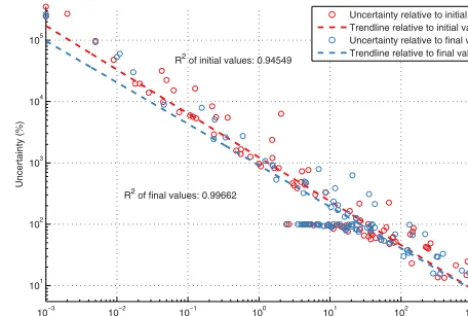
Figure 2.Error distribution of selected GTAP input–output data (taken from Table 19.6 in McDougall (2006) and shown as colored circles), and trend lines showing the fit of the general functional relationship explained by Eq. (1). Red and blue circles differ due to different methods of estimating the difference between unbalanced and balanced data. See the discussion in the text.
tries, and thus the global uncertainty is mostly a reflection of these countries’ data quality (Andres et al., 2012).
The estimated global temperature impact of emissions are calculated using the global temperature change potential (GTP) metric (Aamaas et al., 2013; Shine et al., 2005), which is essentially a parameterization of more complex climate models. The metric uses pollutant characteristics (atmo-spheric lifetime, radiative forcing (RF)) as input, and unlike the more commonly used global warming potential (GWP) which only relates to RF, the GTP also includes estimates of climate temperature response (sensitivity) to changed RF in the atmosphere, which adds additional layers of uncertain-ties (Reisinger et al., 2010). We base our pollutant parameters on the ATTICA (European Assessment of Transport Impacts on Climate Change and Ozone Depletion) assessment (Fu-glestvedt et al., 2010) and IPCC (2007, 212–213), and cli-mate sensitivity and CO2uncertainties on the latest CMIP5
data (Olivié and Peters, 2013). The uncertainties of the other pollutants are drawn from several sources, but mostly follow-ing the IPCC Fifth Assessment Report (Myhre et al., 2013a).
2.2 General uncertainty relationships
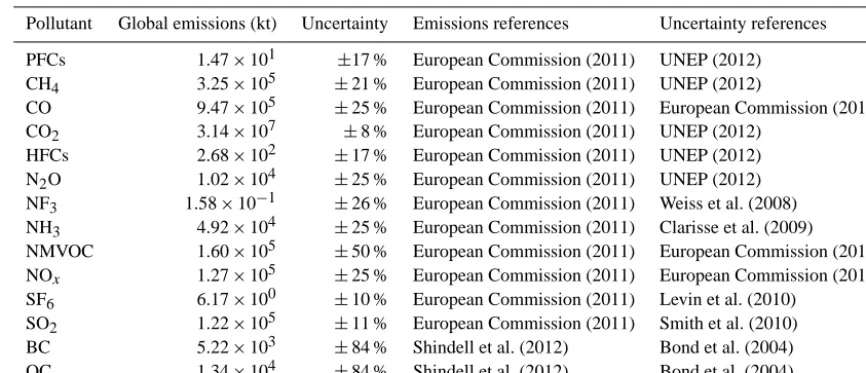
Table 1.Global emissions and uncertainties. The uncertainties indicate the 5–95 % (90 %) percentile range. PFCs include C2F6, C3F8, C4F10, C5F12, C6F14, C7F16, CF4, and c-C4F8. HFCs include 125, 134a, 143a, 152a, 227ea, 23, HFC-236fa, HFC-245fa, HFC-32, HFC-365mfc, and HFC-43-10-mee, following UNEP (2012).
Pollutant Global emissions (kt) Uncertainty Emissions references Uncertainty references
PFCs 1.47×101 ±17 % European Commission (2011) UNEP (2012)
CH4 3.25×10⁵ ±21 % European Commission (2011) UNEP (2012)
CO 9.47×10⁵ ±25 % European Commission (2011) European Commission (2011) CO2 3.14×10⁷ ±8 % European Commission (2011) UNEP (2012)
HFCs 2.68×10² ±17 % European Commission (2011) UNEP (2012) N2O 1.02×10⁴ ±25 % European Commission (2011) UNEP (2012)
NF3 1.58×10⁻¹ ±26 % European Commission (2011) Weiss et al. (2008)
NH3 4.92×10⁴ ±25 % European Commission (2011) Clarisse et al. (2009)
NMVOC 1.60×10⁵ ±50 % European Commission (2011) European Commission (2011) NOx 1.27×105 ±25 % European Commission (2011) European Commission (2011) SF6 6.17×100 ±10 % European Commission (2011) Levin et al. (2010)
SO2 1.22×10⁵ ±11 % European Commission (2011) Smith et al. (2010)
BC 5.22×10³ ±84 % Shindell et al. (2012) Bond et al. (2004) OC 1.34×10⁴ ±84 % Shindell et al. (2012) Bond et al. (2004)
database together with a first-order regression (R2>0.9). These differences result from the GTAP harmonization and balancing process and values are only published for a sample of “large sectors in large regions with large relative changes” (McDougall, 2006). As a consequence of this data selection bias, it is not possible to convert these differences directly to more general sectoral uncertainties. Other uncertainty as-sessments in MRIO analysis have also taken this inverse rela-tionship as the starting point (Lenzen et al., 2013; Moran and Wood, 2014; Lenzen et al., 2012a). Furthermore, a similar re-lationship is found with emissions data, based on a previous study of the UK Greenhouse Gas Inventory, where uncer-tainties were found using an error propagation model (Jack-son et al., 2009). The underlying mechanisms for this inverse relationship are, however, unclear. The uncertainties may re-flect conflicting data sources, unreliable measurements, bias in the source data, allocations and aggregations, base year extrapolations, estimates, and assumptions, etc. (Wiedmann, 2009; Weber, 2008; Lenzen, 2000), and it is unclear if all these uncertainties will lead to a clear inverse relationship with data values. It may be that the method of generating the data through some sort of optimization process leads to the relationship.
The data sets allow for the parameterization of a func-tion mapping relative uncertainties to the magnitude of the data points. Following previous studies (Lenzen et al., 2010; Wiedmann et al., 2008), we assume the data follows a power function
rx=a xb, (1)
where a and b are coefficients. As there is very little data available to parameterize Eq. (1), we parameterize the rela-tionship using two extreme data points (generally the
uncer-tainty in the minimum and maximum values)
a= rmin vb
max
, (2)
b= rmax−rmin vmin−vmax
. (3)
It is generally argued that developed countries have lower uncertainty than developing countries due to the strength of institutions (Narayanan et al., 2012; Andres et al., 2012). The termsrminandrmaxdefine the smallest and largest relative
er-rors, respectively, and are functions of developed and devel-oping regions (using the Kyoto Protocol groupings of Annex B and non-Annex B countries). We assume that developing countries have double the uncertainties of developed coun-tries, based on estimates for CO2emissions (Andres et al.,
2012; see further discussion in Sect. 2.4). This range is also sector and region dependent for the economic and emissions data, which we define below. The termsvmin andvmax
re-fer to fixed minimum and maximum data values for sectors in a specific region given the uncertainty ofrmaxandrmin,
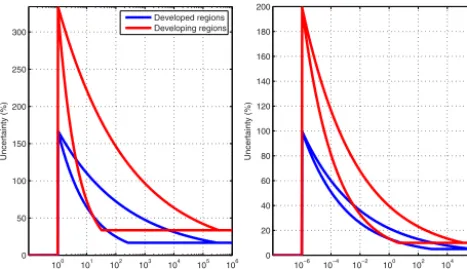
respectively. Figure 3 shows the functional relationship be-tween sector sizes and uncertainties for economic and emis-sions data.
The lower thresholdvminis fixed for all regions in the
eco-nomic and emissions data sets, giving sectors of the same size the same uncertainty, as the smallest sectors do not con-tribute much to the national totals. The upper thresholdvmax
100 101 102 103 104 105 106 0
50 100 150 200 250 300
Uncertainty (%
)
Sector size (kt emissions) Developed regions Developing regions
10−6 10−4 10−2 100 102 104 106 0
20 40 60 80 100 120 140 160 180 200
Uncertainty (%
)
Sector size (M dollar)
Figure 3.Functional relationship between sector sizes on the hor-izontal axes (in kt CO2and million US dollars) and relative
uncer-tainty on the vertical axes. The red lines outline the range of devel-oping regions, while the blue lines show the range of developed countries. Each region has been estimated using a single unique curve, and all sectors, depending on their size, will fall on this curve. The form of this relationship is established independently for each pollutant.
to the regions’ GDP and total emissions, for the respective data sets, so that the sectors’ importance in different regions is reflected by their uncertainties. Sectoral values larger than vmaxare given the same uncertainty as values equal tovmax,
to ensure that single large sectors do not affect the uncertainty in other large sectors (see details below).
To help illustrate the effects of the methodology, we show two examples: (1) one of China’s largest economic sectors is the public administration, defense, education, and health sec-tor, worth nearly USD 340 billion in 2007. Large sectors are given small uncertainties, and this sector is a substantial part of China’s GDP (around 10 %). The uncertainty is therefore assumed to be one of the lowest in the country, but scaled up relative to other countries since China is not an Annex-B country. (2) One of the USA’s smallest direct CO2-emitting
sectors is the production of electronic equipment. Emitting roughly 1 Mt CO2, this is on the lower-end of the scale,
con-tributing little to the national total of nearly 5000 Mt CO2.
This sector is therefore given higher relative uncertainty. We expand on these examples with specific numbers in the next sections, after we define the uncertainty ranges for the eco-nomic and emissions data.
The estimated uncertainties are used to create distribu-tions of perturbadistribu-tions. We impose lognormal distribudistribu-tions so that distributions with small relative spreads closely resem-ble normal distributions, while distributions with large rela-tive spreads are skewed but avoid negarela-tive values (Fig. 4). The distributions are characterized using reported data as medians, and the spreads are (in order of decreasing pref-erence) taken directly from the literature, derived from pub-lished analyses, or estimated. We define uncertainties as the 5–95 % confidence interval (90 % CI; equivalent to 1.64 stan-dard deviations of a normal distribution).
0 1 2 3 4 5 6
Figure 4.Distributions depending on median values and uncer-tainty. Both distributions have a median of 1, while the near-normal distribution (green) has a relative uncertainty of 100 %, the skew distribution has a relative uncertainty of 500 %. The green and red shaded areas indicate the 5–95 % (90 %) confidence intervals.
By randomly perturbing each data point, we assume no correlation in the uncertainties of economic and emissions data, which might not be accurate for some sector combina-tions (Peters et al., 2012). Implementing correlacombina-tions in such an analysis is a major difficulty due to the size of the system under investigation and the lack of uncertainty data, but this may also have significant effects on the results. We discuss this further in Sect. 4. We do, however, undertake a simple sensitivity analysis on the parameter choices by comparing the final results on MRIO uncertainty with uncertainty from the GTAP table showing extreme observations.
Aggregations of the results (from sectors to regions and from regions to the globe) usually decrease the relative un-certainty, so that the national uncertainty is lower than indi-vidual sectors, and global uncertainty is in some cases lower than national uncertainty. This is a result of the summation effect, and the relationship between sector sizes and uncer-tainties. The largest sectors are given the lowest uncertain-ties, so that the national uncertainty is largely a reflection of the uncertainty of the largest sectors. As an example of the summation effect, the relative uncertaintyrof addingM±S, ntimes, is
r=S/M√
n , (4)
assuming no correlations. To illustrate this effect, we show the uncertainty results at multiple levels.
2.3 Economic data (multi-regional input–output model)
The total sectoral outputxof a region’s economy (a vector) is the sum of intermediate consumption Ax and final con-sumption,y(Miller and Blair, 1985):
x=Ax+y, (5)
We solve for the total output
x=(I−A)−1y, (6)
where (I−A)−1is the Leontief inverse L. Emissions are es-timated for a givenyby first estimating the output, and then linking to sectoral emission intensities,F. This gives the di-rect and indidi-rect emissions (supply chain) emissions
f =FLy. (7)
The economic data from GTAP is represented in a multi-regional input–output (MRIO) model, which is constructed from a number of smaller data sets. The GTAP data set itself is based on a large number of smaller data sets (such as na-tional IO tables and trade data from the UN’s COMTRADE database), which are harmonized to remove inconsistencies (Andrew and Peters, 2013; Peters et al., 2011b; Narayanan et al., 2012). The construction of an MRIO table from the GTAP data is explained in detail elsewhere (Peters et al., 2011b). In the MC analysis, we perturb the components of the GTAP database (e.g., domestic IO data and international trade data) and not the resulting MRIO. In other words, we estimate the uncertainty of the MRIO data based on the un-certainty in the data used to construct it (Peters et al., 2011b), which consists of all data points in the GTAP database used to construct the MRIO model. This ensures that the uncer-tainties of the final model reflect the underlying unceruncer-tainties of the various input data. We construct the perturbed L and
y, before allocating the direct emissionsF (which are also perturbed) to consuming regions and sectors.
We calibrate the uncertainty relationship (Eq. 1) for the GTAP data using several data sets. From the trend lines cre-ated from the GTAP table (Fig. 2), we find the smallest un-certainty of the largest sectors to be at approximately 5 %. We therefore let 90 % of perturbed values fall within 5 % of the median, and setrmin=5 % for the largest sectors (where
vmaxapplies).
The upper thresholdvmaxis defined by the regions’ GDP
so that a sector of a specific size will have a larger impor-tance (and hence a lower uncertainty) in a small region than in a large region. We use the UK data provided by Lenzen et al. (2010) to explain the range of uncertainties in a single economy. In this data set the largest sectors have the small-est error, and following the trend line we find that the largsmall-est value is about 4 % of UK GDP. We use this to define the up-per thresholdvmax=4 %×GDPr, which means that sectors
at or above this value will be given the lowest national un-certainty (rmin). Figure 3 shows the result of the
implemen-tations, where the lines indicate the range of developing and developed regions’ sector sizes and uncertainties.
For the smallest sectors we set vmin equal to USD 1 and
assume rmax=100 % (following Wiedmann et al., 2008),
due to the lack of more precise regional uncertainty data. The USD 1 relates to a small value often used in the GTAP database (Peters, 2006). These parameters may seem some-what arbitrary, but these choices are not overly important.
A value of USD 1 in an input–output table (IOT) is exceed-ingly small (it represents the economic relationship between two sectors over 1 year). Indeed, analysis shows that remov-ing small values has a negligible effect on the estimates’ consumption-based emissions (Peters and Andrew, 2012). Thus, USD 1 is effectively zero in our data set. It could also be argued that the value of USD 1 is highly uncertain and should have large uncertainty. Giving values smaller than this higher relative uncertainty causes highly skewed log-normal distributions for the perturbations (see Fig. 4). The GTAP data set has values as low as 7×10⁻³⁵causingrto be 6×10⁶%. Such highly skewed distributions for data points with small medians (USD 1) can lead to large imbalances in the table.
An IO model is balanced so that gross input equals gross output, a fundamental characteristic of input–output models (Leontief, 1970). The same applies for a multiregional model (MRIO). When perturbing the coefficients in an IO table, it ultimately upsets the balance. In principal, the IO table can be rebalanced, but given the size of the systems (about 7500×7500 matrices), rebalancing is prohibitively compu-tationally expensive, and may reduce uncertainties as the per-turbed values are changed. We therefore choose not to rebal-ance, which effectively causes the “unbalanced” component to be shifted to the value added. A concern is that the value added may become unrealistic (e.g., negative) as a conse-quence. The MC algorithm specifically outputs value added components to allow crosschecking imbalances with the raw data, and we find the distributions of the value added at the sector level to be within expected uncertainty bounds given the size of the value added. This is partially because of the pa-rameterization of uncertainty we have used, and partially be-cause the perturbations tend to cancel out (the sum of random numbers). Thus, we can justify not rebalancing our perturbed IOTs and assume the imbalances are allocated to the value added (without having a large effect on the value added). Implementing this general methodology has also led to rel-atively small regional uncertainties in other studies (Lenzen et al., 2010; Wiedmann et al., 2008). Structural uncertain-ties have also been found to be relatively small for major economies (Moran and Wood, 2014). As a simple sensitivity analysis of the input uncertainties, we also run the MC model with uncertainties according to the fit of the GTAP table un-certainties (trend line relative to final values, due to better fit; Fig. 2). This vastly increases the uncertainties of all sec-tors, and we do not constrain the upper or lower uncertainties, meaning that very small sectors will be given unrealistically large uncertainties (USD 1 givesr=109%). This exercise is only valid for the data it represents, large sectors in large countries, but is useful for facilitating a discussion about un-certainties in economic data. We discuss these results when exploring MRIO uncertainties, but do not include this when combining uncertainties.
now calculate the uncertainty. Each data point in our MRIO model consists of inputs from several different GTAP data sets. When these data sets are combined, together with the uncertainties, the MRIO model and its uncertainty are ob-tained. In the MC analysis, all data sets are given uncertain-ties and perturbations (according to the inverse relationship) before constructing the MRIO model. The Chinese public ad-ministration, defense, education, and health sector, which is a single sector in the final GTAP–MRIO model, is built up from several data sets (bilateral trade, intermediate demand, and final demand of households, governments, and capital in-vestments). In our example, we choose to focus on one of the most significant contributors to this sector: domestic govern-ment consumption expenditure. This sub-data set has a sec-toral range from<1 to USD 420 billion, which, when cal-culating the uncertainty, is constrained in the calculations by the lower and upper thresholdvmin=USD1 andvmax=4 %
of national GDP=USD 130 billion. For the uncertainty, the general sectoral range isrmin=5 % tormax=100 %. GTAP
estimates the value added in the sector in this sub-data set to be around USD 340 billion, which is 10 % of national GDP. This is well above vmax, giving this sector a relative
uncertainty equal tormin(5 %). Since China is a non-Annex
B country, this is doubled, leading to a final uncertainty of 10 % for this sector in this sub-data set. The uncertainties for the other data points in the other sub-data sets that make up the Chinese public administration, defense, education, and health sector will be estimated similarly, and together explain the overall uncertainty of this sector in the GTAP–MRIO model.
2.4 Emission statistics
The pollutants considered are listed in Table 1, which cover anthropogenic emissions for the year 2007 which have an ef-fect on the climate. We do not include emissions from short cycle biomass burning, as this is considered to have a short lifetime in the atmosphere due to regrowth. The data set originally includes CO2emissions from forest fires and
de-cay, which is a mix of natural and anthropogenic emissions. Extracting the anthropogenic emissions and mapping them to agricultural sectors would require crude assumptions. We therefore do not include emissions related to forest loss, but acknowledge that it would increase global CO2 emissions
by roughly 12 % (van der Werf et al., 2009). The EDGAR data set only provides crude information on uncertainty at the global level for some species (European Commission, 2011). Therefore, global and regional uncertainties in emissions are taken from a variety of sources (Table 1). Global fossil fuel CO2emissions statistics are independently produced by
sev-eral organizations, but they gensev-erally agree with each other within about 5 % for developed countries and 10 % for de-veloping countries (Andres et al., 2012). The CO2emission
estimates are all based on energy data, and globally the emis-sions are thought to have an uncertainty of ±10 % using a
95 % CI (UNEP, 2012). Global SO2emissions have an
esti-mated uncertainty of between±8 and±14 %, while regional uncertainties may be as large as±30 % (Smith et al., 2010). For CH4, N2O, and F gases, the uncertainty of global
emis-sions have been estimated as±21,±25, and±17 %, respec-tively (UNEP, 2012).
Table 1 shows parameters and uncertainties for each pol-lutant used as median values in the perturbations. Very little data exist on the uncertainty of emissions by sector, espe-cially on a pollutant and regional level. Lenzen et al. (2010) used a table of selected sectors of UK CO2emissions to find
uncertainties, originating from Jackson et al. (2009). Accord-ing to the regression of the data points, within the limits of the data points, there is a spread of uncertainties by roughly a factor of 10 (Fig. 2 in Lenzen et al., 2010). We therefore esti-mate sectoral uncertainty using the same general relationship as with the economic data (Eq. 1), where the uncertainty of global emissions is used as a proxy for the lowest uncertainty estimate of the largest sectors (rmin) and the smallest sectors’
uncertainty is scaled by 10 times (rmax=10rmin).
We assign developing countries anrminandrmaxwhich are
double those of developed countries. We definevmin=1 kt
andvmax=5 % of regional emissions. This dependence on
total regional emissions shifts the function so that a sector of a specific size will have a larger importance (and hence a lower uncertainty) in a smaller region than in a larger region (Fig. 3). We do not distinguish between different sources of the same pollutant, due to a lack of information at the sec-tor level. This is, in some cases, a crude simplification (e.g., when comparing uncertainties in emissions of certain pol-lutants from the agricultural sector and power generation). Similarly, for the emissions data, we setvminequal to 1 kt of
emissions. Values below this (as with economic data) have little impact on the footprint of regions and sectors, and are therefore given zero uncertainty.
Expanding on our previous example of emissions from the USA’s electronic equipment sector, we can now cal-culate the uncertainty. The USA’s sectors have a range of CO2 emissions from 0.3 kt to 2500 Mt, which is then
con-strained in the calculations by the lower and upper thresh-oldvmin=1 kt CO2andvmax=5 % of national total CO2=
247 Mt CO2. For CO2uncertainty, the general sectoral range
is fromrmin=16 % (or±8 %), taken from Table 1, tormax=
10×rmin=160 %. The emissions in the electronic equipment
sector are 1.2 Mt CO2, which is 0.02 % of total emissions.
This is in betweenvminandvmax, giving the CO2emissions
from this sector a relative uncertainty of 43 %. Since the USA is an Annex B country, this is not doubled.
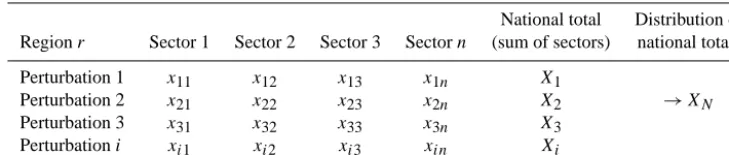
With every sector data point having an uncertainty, we create perturbations which we can sum to get a bottom-up estimate of the national uncertainty. Table 2 shows several perturbations of sectors (xin) for regionr. Each perturbation ileads to a new national total (Xi). However, independent
Table 2. Example of perturbations of sectors for a single regionr, and the resulting distribution of the national total. This bottom-up uncertainty estimate may not be consistent with top-down uncertainty estimates.
National total Distribution of Regionr Sector 1 Sector 2 Sector 3 Sectorn (sum of sectors) national totals
Perturbation 1 x11 x12 x13 x1n X1
Perturbation 2 x21 x22 x23 x2n X2 →XN Perturbation 3 x31 x32 x33 x3n X3
Perturbationi xi1 xi2 xi3 xin Xi
with our bottom-up distributions of the national totals (XN).
When summing the perturbed sectorsxin for a region, it is
unlikely that the distribution ofXN will be the same as the
known uncertainty inX.
Additionally, the uncertainty in XN will depend on the
number of elements contributing to the sum, according to standard propagation of uncertainty rules (RSS, root sum square; see earlier discussion on the summation effect). In practice, the uncertainty ofXmay be based on several lines of evidence, which may even exclude sector-based data. To ensure that we can reproduce the top-down uncertainty estimates of X, we use constrained optimization (using a quadratic programming (QP) methodology) to minimally ad-just the perturbations ofxinto a given distribution of theXN
(Table 2).
Given that we can adjust one iteration so that it sums to a fixedX, we then giveXa distribution based on known na-tional uncertainties, and thus, each iteration ofX is used to balance the same iteration of the disaggregated sector data (xin). This ensures that the sum of sectors (Xi) always gives
aXNwith a known uncertainty. The cost of this adjustment is
that the spread of the large values in each region (e.g., a large sector) are adjusted to fit the constraints. To meet the criteria of, e.g., a narrower distribution of the aggregated values, the large values have to be given a narrower distribution as well. This methodology allows us to give realistic uncertainties for eachxinleading to anXN with a known uncertainty. We do
not perform such balancing on the MRIO input data (previ-ous section) as it is too computationally expensive, and there is little top-down data on uncertainties in economic data.
2.5 Emission metrics
To link emissions to temperature change, we use the global temperature change potential (GTP) as a metric to compare and aggregate pollutants (Shine et al., 2007). This gives an estimate of the global-mean surface temperature change due to a pulse of emissions from a specific pollutant, and is a simple way of modeling the much more complex climate system and its response. Uncertainties in metric values can arise from a number of factors, including pollutant parame-ters (RF and lifetime) and the response of the climate system. Although it has been shown that the GTP may have larger rel-ative uncertainties than the alternrel-ative metric global
warm-ing potential (GWP) (Aamaas et al., 2013; Reiswarm-inger et al., 2010) and it has been criticized for some of its characteris-tics (Pierrehumbert, 2014), the GTP directly links to global temperature change and is thus arguably more policy relevant (Shine et al., 2005). In addition, the physical interpretation of the GWP is less clear and the metric has been criticized by many authors (Peters et al., 2011a; Shine, 2009; Pierrehum-bert, 2014). The GTP metric is calculated using impulse re-sponse functions, which explain the interaction of pollutanti in the atmosphere (impulse response function; IRFi) and the
climate system (temperature) response to a pulse emission (IRFT) with specific RF and atmospheric lifetime.
We briefly describe the metric equations here, and refer to existing literature for more details (Aamaas et al., 2013; Fuglestvedt et al., 2010; Olivié and Peters, 2013; Myhre et al., 2013b). The absolute GTP (AGTP) for each pollutantiis defined as
AGTPi(H)= H
Z
0
RFi(t) IRFT(H−t) dt, (8)
where the RF for a pulse emission is
RFi(t)=RE×IRFi =Ai exp
−t τi
, (9)
wheretis time (years),H is the time horizon (years),Ai is
the radiative efficiency for pollutanti(W (m−2kg)), andτ
iis
the decay time for pollutanti (years). The AGTP metric is dependent on the IRF of temperature, which incorporates the climate system response in global-mean surface temperature to a given RF. The climate response is modeled using two decaying exponential functions representing (1) the relative fast response of the atmosphere, the land surface, and the ocean mixed layer, and (2) the relative slow response of the deep ocean (Peters et al., 2011a),
IRFT = J
X
j=1
cj dj
exp
− t dj
, (10)
whereJ is the number of decay terms (usually two),cj is
a component of the climate sensitivity (K (Wm−2)), where the total climate sensitivityλ=P
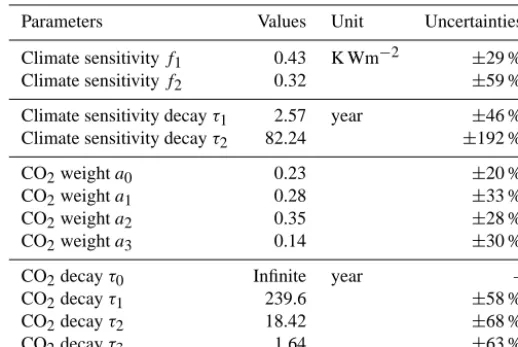
Table 3.Metric parameters with uncertainties. Note that the uncertainties are derived from CMIP5 data and Joos et al. (2013), but we use the corresponding distributions listed in Table 5 and 6 in the study by Olivié and Peters (2013) to account for correlations.
Parameters Values Unit Uncertainties
Climate sensitivityf1 0.43 K Wm−2 ±29 %
Climate sensitivityf2 0.32 ±59 %
Climate sensitivity decayτ1 2.57 year ±46 %
Climate sensitivity decayτ2 82.24 ±192 %
CO2weighta0 0.23 ±20 %
CO2weighta1 0.28 ±33 %
CO2weighta2 0.35 ±28 %
CO2weighta3 0.14 ±30 %
CO2decayτ0 Infinite year –
CO2decayτ1 239.6 ±58 %
CO2decayτ2 18.42 ±68 %
CO2decayτ3 1.64 ±63 %
time (years) of component cj. These two functions are
ex-plained by lifetime and climate sensitivity for the individual components (Table 3). The λ explains the change in equi-librium global-mean temperature due to forcing by a pollu-tant in the atmosphere. We parameterize the IRF according to the results from CMIP5 covering 15 different climate models (Olivié and Peters, 2013). This data set is parameterized by relatively short climate runs (140–150 years), and thus it is more representative of the short-term climate response (less than 100 years) compared to the equilibrium response (see Olivié and Peters, 2013 for details). Nevertheless, the data set leads to a medianλ=0.75 K Wm−2(equivalent to 2.8◦C global-mean temperature increase), which is consistent with the climate response (sensitivity) of a doubling of CO2
con-centration in the atmosphere within the range of 1.5 to 4.5◦C (IPCC, 2013).
As CO2has a more complex interaction in the atmosphere
and can not be sufficiently modeled with a single exponential decay, we define the RF for CO2as a sum of exponentials
(Aamaas et al., 2013):
RFCO2(t)=ACO2
(
a0+
I
X
i=1
ai
1−exp
−t τi
)
, (11)
whereai is the weight of each exponential, which by
defi-nition has to sum to one (P
ai=1), andI is the number of
exponentials. We follow Joos et al. (2013) and use four ex-ponentials and weights, and randomize the multiple lifetimes and coefficients so that the coefficients always sum to 1, fol-lowing Olivié and Peters (2013). The use of four different timescales was found to be sufficient to model CO2
behav-ior in the atmosphere compared to advanced climate models (Olivié and Peters, 2013). Correlations between the param-eters were implemented for CO2 and IRFT, also based on
Olivié and Peters (2013), but the effect of the correlations on
temperature results was found to be small (less than 1 % of AGTP50 value for CO2).
Estimates from the literature are used as the median (Fu-glestvedt et al., 2010) and estimates of uncertainty as spread of the distributions (Tables 4 and 5). For the non-reactive pollutants, we randomized the single RF and lifetime val-ues, as these are represented by only a single decay func-tion. The RF used in the calculations includes the indirect effects of chemical reactions from the ozone precursors (CO, NOx, and NMVOC), which were perturbed similarly as the
other pollutants. This accounts for three indirect forcing ef-fects: formation of O3(causing positive RF by CO, NOx, and
NMVOC), changing CH4levels (causing positive RF by CO
and NMVOC, and negative RF by NOx), and CH4-induced
O3effects (causing positive RF from CO and NMVOC, and
negative RF from NOx) (Aamaas et al., 2013). The indirect
effect of SO2is included by scaling the metric value, where
the indirect effect of SO2is estimated to be about 175 % of
the direct effect (Aamaas et al., 2013). This is a crude es-timate, and while the indirect effect may be more uncertain than the direct effect, we use the same uncertainty for the di-rect and indidi-rect effects due to lack of pollutant specific data (Boucher et al., 2013).
Our analysis of uncertainty contributions from emissions and metric parameters uses absolute GTP (AGTP) values with units of temperature change (in Kelvin or◦C). When later allocating temperature data in the economic model, we also use GTP values in units of CO2-equivalent (eq.)
emis-sions for comparison. The GTP values are calculated by nor-malizing the AGTP values with reference to the AGTP val-ues for CO2. When we connect the components for a full MC
Table 4.RF values and uncertainties. Note that CO, non-methane volatile organic compound (NMVOC) and NOx are precursors, which have an effect on O3and CH4concentrations. Because of this, no single RF value can be given. The uncertainties indicate the 5–95 % (90 %)
percentile range. Parameters from IPCC (2007, Table 2.14, p. 212–213).
Pollutant RF (Wm−2kg−1) Uncertainty RF references Uncertainty references
PFCs 6.40×10⁻¹²–1.06×10⁻¹¹ ±10 % IPCC (2007) Myhre et al. (2013a) CH4 1.82×10⁻¹³ ±17 % Fuglestvedt et al. (2010) Myhre et al. (2013a)
CO – ±24 % Derwent et al. (2001) Myhre et al. (2013a)
CO2 1.81×10⁻¹⁵ ±10 % Fuglestvedt et al. (2010) Myhre et al. (2013a)
HFCs 6.74×10⁻¹²–1.53×10⁻¹¹ ±10 % Fuglestvedt et al. (2010), IPCC (2007) Myhre et al. (2013a) N2O 3.88×10⁻¹³ ±17 % Fuglestvedt et al. (2010) Myhre et al. (2013a)
NF3 1.66×10⁻¹¹ ±10 % IPCC (2007) Assumed
NH3 −1.03×10⁻¹⁰ ±123 % Shindell et al. (2009) Myhre et al. (2013a)
NMVOC – ±41 % Collins et al. (2002) Myhre et al. (2013a) NOx – ±120 % Wild et al. (2001) Myhre et al. (2013a) SF6 2.00×10⁻¹¹ ±10 % Fuglestvedt et al. (2010) Myhre et al. (2013a) Sulphate −3.20×10⁻¹⁰ ±50 % Fuglestvedt et al. (2010) Myhre et al. (2013a)
BC 1.96×10⁻⁹ ±66 % Fuglestvedt et al. (2010) Myhre et al. (2013a)
OC −2.90×10⁻¹⁰ ±68 % Fuglestvedt et al. (2010) Myhre et al. (2013a)
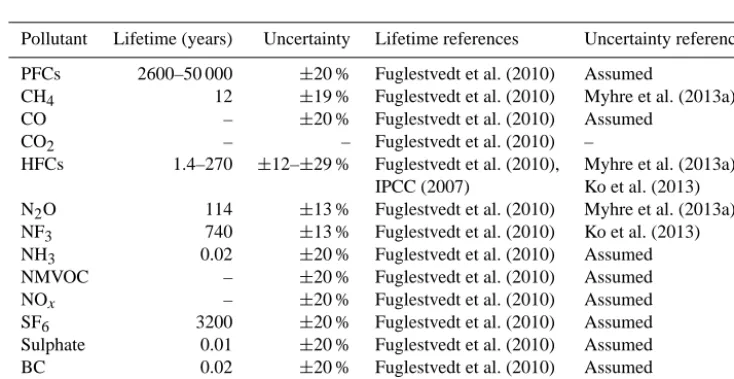
Table 5.Lifetimes and uncertainties. Uncertainties for several gases’ lifetimes are assumed, but a sensitivity analysis revealed that a change of this uncertainty will not have a large impact on the results (see metric results section below). Note that CO, NMVOC, and NOx are precursors, which have an effect on O3and CH4concentrations. Because of this, no single lifetime can be given. Values and uncertainties
for CO2are given in Table 3. The uncertainties indicate the 5–95 % (90 %) percentile range. Parameters from IPCC (2007, Table 2.14,
p. 212–213).
Pollutant Lifetime (years) Uncertainty Lifetime references Uncertainty references
PFCs 2600–50 000 ±20 % Fuglestvedt et al. (2010) Assumed
CH4 12 ±19 % Fuglestvedt et al. (2010) Myhre et al. (2013a)
CO – ±20 % Fuglestvedt et al. (2010) Assumed CO2 – – Fuglestvedt et al. (2010) –
HFCs 1.4–270 ±12–±29 % Fuglestvedt et al. (2010), Myhre et al. (2013a), IPCC (2007) Ko et al. (2013) N2O 114 ±13 % Fuglestvedt et al. (2010) Myhre et al. (2013a)
NF3 740 ±13 % Fuglestvedt et al. (2010) Ko et al. (2013)
NH3 0.02 ±20 % Fuglestvedt et al. (2010) Assumed
NMVOC – ±20 % Fuglestvedt et al. (2010) Assumed NOx – ±20 % Fuglestvedt et al. (2010) Assumed SF6 3200 ±20 % Fuglestvedt et al. (2010) Assumed
Sulphate 0.01 ±20 % Fuglestvedt et al. (2010) Assumed BC 0.02 ±20 % Fuglestvedt et al. (2010) Assumed
OC 0.02 ±20 % Fuglestvedt et al. (2010) Assumed
the impact at 50 years (AGTP50 and GTP50), as this is both consistent with current literature (Myhre et al., 2013b), and within reasonable time for when to expect global warming to exceed 2◦C (Joshi et al., 2011; Peters et al., 2013).
3 Results
Estimated uncertainties are used to create distributions of all data points. To analyze how various stages of the cause– effect chain contribute to overall uncertainty, we introduce uncertainty separately in each part of the chain before
3.1 MRIO uncertainty
In this section, we assume there are no uncertainties in the territorial emissions data or emission metrics, and thus the MRIO model uses unperturbed median estimates of GTP50 values for all pollutants when allocating emissions to con-sumers, and uncertainties are purely dependent on parametric uncertainty in the input data into the MRIO. In our analysis, each of the 129 countries has 57 producing sectors (not in-cluding households as they are considered final demand in the model, and therefore not included in the processing), and thus the MRIO table has 7353 rows and columns. We em-phasize here, but discuss later, that we consider parametric uncertainties and not structural uncertainties.
Table 6 shows uncertainties in emissions embodied in im-ports and exim-ports, as well as consumption, due to pertur-bations only on the economic data set. The exports indi-cate goods that are produced domestically but consumed abroad, while the imports indicate goods produced abroad but consumed domestically. The uncertainties in exported emissions are solely due to uncertainties in domestic eco-nomic data, thus reflecting the pattern of developed countries having higher uncertainties. Uncertainties in imported emis-sion are generally higher than exported emisemis-sions, as the im-ports come from a number of different regions of which many may have high uncertainties (e.g., emerging and developing economies).
For the largest consumption paths, the consumption per-spective is not substantially more uncertain than the cor-responding territorial view due to economic uncertainties. Following the largest international fluxes embodied in trade from Davis and Caldeira (2010) aggregated over all sectors, we find 2 % uncertainty in emissions embodied in products exported from China to the USA, 2 % uncertainty from China to western Europe, 3 % from China to Japan, and 1 % from the USA to western Europe from economic uncertainties only. These fluxes are mainly dominated by the largest sec-tors, to which our method has assigned the smallest uncer-tainties. The export from China to the USA mainly originates in the manufacturing sectors, which combined is one of the largest Chinese sectors, therefore with relatively low uncer-tainties. Annex B countries are assigned lower uncertainties than non-Annex B countries, which explains the relatively low uncertainty from the USA to western Europe.
For smaller paths, there are much higher economic uncer-tainties. More than 20 % of the international trade routes have a higher uncertainty than 10 % (total number of trade routes is 128 regions×128 regions), while the median of all is 6 % uncertainty. The uncertainties in consumption emissions for the top emitters are very low for two reasons: (1) the effect of summations and aggregations reduce the uncertainties on the national level (Eq. 4; much higher values are seen on a sec-toral level), and (2) the distributions we give the perturbed data in the larger sectors are relatively small.
Since we start from the raw GTAP data to construct the MRIO table, and normalize and invert the MRIO table, a vast number of summations and multiplications are done with the initial perturbed data (an inversion in a single MC ensem-ble requires more than 1012operations, which was estimated using the Lightspeed Matlab toolbox; Minka, 2014). Follow-ing RSS uncertainty propagation, the relative uncertainty will decrease when adding equally sized numbers with equally sized uncertainty (not an unrealistic assumption for input– output analysis). Thus, the relative uncertainty of the sum of a row in the MRIO (the output) will depend on the number, n, of large data points (Eq. 4). This problem can be avoided by using a quadratic programming approach to rebalance the sum to a given uncertainty (as we do for the emissions data), but we do not do this as (a) it is too computationally expen-sive, and (b) it would require balancing the entire MRIO table to get consistent sums. This problem is difficult to negotiate given the size of the database we are using, and consequently this exerts a downward pressure on MRIO uncertainties. Be-cause of this, and beBe-cause uncertainty ranges of input values are small for the largest and most important sectors, the final results have small uncertainties. A valid question is then how reliable the uncertainties are.
The “unfitted” and “fitted” data from Table 19.6 in the GTAP documentation (Fig. 2) act as a simple sensitivity anal-ysis to our applied uncertainties; however, since this table only samples the very largest deviations, it is not represen-tative of the uncertainties in the entire database. When we use these, we find that the uncertainties are much larger for the largest emitters (between 160 and 400 % uncer-tainty for consumption-based emissions), and for small- and medium-sized countries the uncertainties becomes unrealisti-cally large. Thus, the results are clearly sensitive to the input uncertainties. This is expected as the input uncertainties are outliers in the GTAP database, and thus the uncertainties are known to be large. As a consequence, the vastly perturbed values lead to ill-defined MRIO tables (outside of machine precision), which will compromise the accuracy of the final results (see discussion on skew distributions and small data points in the Methods section). However, as discussed ear-lier, using the difference between input and output values as a proxy of uncertainty is not straightforward. For example, the first data point in Table 19.6 indicates an input values of USD 2 billion and an output value of USD 132 billion, where the difference (relative to the initial value) can be interpreted as a change of 6500 %. This uncertainty is vast, and many data points have much larger differences. Because of these difficulties, and since the results are only valid for specific sectors, we do not show regional results from this analysis, but only use it for illustrative purposes.
Table 6.Uncertainties in allocated emissions due to uncertainties in the economic data set, by top 10 emitters. The territorial emissions are not perturbed, and thus they have no uncertainty.
Region Territorial Exports Uncertainty Imports Uncertainty Consumption Uncertainty
T
op
10
emitters
globally
1 China 7269 1966 1.7 % 400 2.1 % 5703 0.7 % 2 United States of America 6380 744 1.1 % 1411 1.2 % 7047 0.3 % 3 Russian Federation 2027 600 1.0 % 216 1.3 % 1642 0.5 %
4 India 1812 232 2.0 % 186 2.6 % 1766 0.5 %
5 Japan 1381 257 1.3 % 471 1.4 % 1595 0.5 %
6 Germany 957 324 0.9 % 498 1.0 % 1130 0.6 %
7 Brazil 750 127 2.1 % 116 3.1 % 739 0.7 %
8 Canada 626 194 1.0 % 209 1.5 % 641 0.7 %
9 United Kingdom 616 134 1.0 % 410 1.1 % 892 0.6 %
10 Korea 547 158 1.9 % 214 2.4 % 602 1.2 %
100
101
102
103
104
Relative uncertainties (%
)
CO2 CO CH4NMVOC NOX SO2 NH3 OC N2O BC HFCs PFCs SF6 NF3 Sectoral distributions
Regional distributions Global aggregations
Figure 5.Relative uncertainties (90 % CI) in emissions of all pollu-tants for all sectors (red box plots), for national aggregates (blue box plots) and global aggregates (green dots). The edges of the boxes indicate the 25th and 75th percentiles, and the whiskers include ex-treme data points, but not outliers. The blue target symbols indicate the median value of the distributions. Pollutants are sorted accord-ing to global emissions in tons.
making the uncertainty estimates for the end results less ro-bust. Although our results are supported by other studies that have performed parametric uncertainty analysis (Lenzen et al., 2010; Bullard and Sebald, 1988; Peters, 2007), structural uncertainties in MRIO analysis are found to be larger (Pe-ters et al., 2012). Thus, we suggest that MRIO uncertainty may be best evaluated using a combination of structural un-certainties (model comparisons) and parametric Monte Carlo uncertainties.
3.2 Emissions
At the global level, uncertainties in emissions are known from previous studies (Table 1), which are used to estimate uncertainties of emissions occurring from production at the sectoral and regional level. Figure 5 shows the uncertainty of all data points (7482 sectors and 129 regions and global
aggregations) for all pollutants. Each data point’s uncer-tainty is dependent on the sector size, the region’s GDP, and whether the region is a developed or developing country. Dif-ferent activities are associated with difDif-ferent emissions, and thus not all sectors in all regions include emissions from all pollutants. Additionally, the perfluorinated chemical (PFC) and hydrofluorocarbon (HFC) groups are aggregates of sev-eral pollutants, and thus the spreads are based on different amounts of data.
The red box plots in Fig. 5 shows the sectoral distribu-tions of the relative uncertainties, not including data points with zero uncertainties. Aggregations of sectors to individ-ual countries (blue box plots) lower the uncertainty ranges, depending on the sectors’ impact on national totals (NF3is a
special case, where only one sector in each region has emis-sions, and thus sectoral and regional uncertainties are the same). The median values for the box plots indicate the skew-ness of the distributions. The distributions often have two dis-tinct peaks (not visible in the box plots), which are developed and developing countries, where the latter group has higher uncertainty. The global aggregations are results of national totals, which are dominated by large regions (e.g., China and the USA). The bottom-up global uncertainties are not con-strained by top-down estimates, as we are not using aggre-gated global emissions in the end results. They are, however, all (except NF3due to few data points) lower than the input
estimates from Table 1 due to the aggregation effect. Small regions with low emission and high uncertainties thus have little effect on the global uncertainties.
The well-mixed GHGs (WMGHGs; CO2, CH4, N2O,
HFCs, PFCs, SF6, NF3) generally have lower emission
un-certainties (9 % uncertainty for the aggregated sum) than the short-lived pollutants (black carbon (BC), organic car-bon (OC), SO2, NH3; 14 % uncertainty) and precursors
(CO, NMVOC, NOx; 19 % uncertainty). The WMGHGs
ac-counted for 39.4±1.5 Gt CO2-eq. emissions (using GTP50),
while the short-lived pollutants accounted for−4.6±0.6 Gt CO2-eq. and the precursors accounted for 0.4±0.1 Gt CO2
cooling effects). Uncertainties in pollutant aggregates for emissions (in tons) and GTP50 (CO2-eq.) values only
in-clude emission uncertainties, but are different due to the dif-ferent weighting of pollutants and due to mixing of cooling and warming effects. Uncertainties of territorial emissions from developing countries (54 % of global emissions using GTP50) have a median value of 32 %, while developed re-gions have a median uncertainty of 16 %. These numbers are dominated by the uncertainty of CO2, and usually only small
variations are seen due to other pollutants.
Globally, most emissions occur in the electricity gener-ation (28 % of global emissions using GTP50) and man-ufacturing sectors (25 %) (see Supplement for sector ag-gregations). Uncertainties in emissions (in tons) from elec-tricity range from 19 % for CO2, to 27 % for SO2 and to
60 % for NOx, which are the most important pollutants (with
the largest contributions to the sectoral GTP50 value). For energy-intensive manufacturing, CO2(7 % uncertainty), SO2
(8 %), and CH4(52 %) are the most important pollutants. In
the non-energy-intensive manufacturing sectors, CO2 (8 %
uncertainty), SO2(16 %), and HFCs (21 %) dominate.
For agriculture, CH4(21 % uncertainty) and N2O (26 %)
are equally important to the GTP50 value, while CO (37 %) comes third. CH4has less uncertainty coming from
agricul-ture than energy-intensive manufacturing, since for CH4the
agriculture sector is much larger, which is consistent with top-down estimates (Kirschke et al., 2013). The household sector emits mainly CO2(8 % uncertainty), BC (156 %) and
OC (140 %) due to household fuels and private transporta-tion. The transport sectors consists mainly of CO2 (5 %),
SO2(9 %), and NOx(17 %). Mining, services, and food
sec-tors are small in a production view, and consist mainly of CO2(4 %), CH4(16 %), and SO2(9 %). These estimates are
aggregates of sectors and regions (and gases for HFCs and PFCs), and thus disaggregated data have larger uncertainties.
3.3 Emission metrics
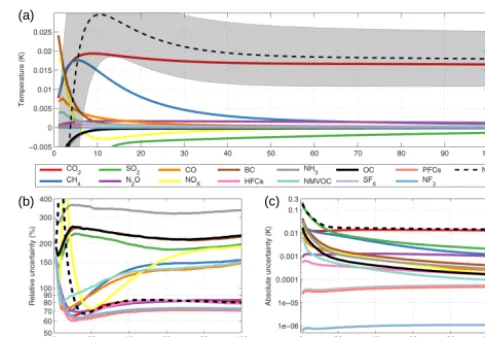
Metric (temperature) values have an uncertainty range for the different pollutants and different time horizons, due to the perturbed metric parameters (RF, lifetime, and climate sensitivity). This includes uncertainties from mapping emis-sions to atmospheric concentrations through the global car-bon cycle, which is represented by the relatively uncertain climate sensitivity. Figure 6 shows all pollutants on the same scale using AGTP for 2007 global emissions, with both rela-tive and absolute uncertainties. The net temperature response (black dotted line) goes from negative to positive over the first few years, before the short-lived species decay, and the net effect becomes dominated by CO2in the long run. The
relative and absolute uncertainty of the net effect is largest in the first few years, and becomes roughly stable from 50 to 100 years. The strong temperature effects of short-lived climate forcers (SLCFs), and thus the high absolute uncer-tainties of the mix of pollutants increase the net uncertainty
(a)
(b) (c)
Figure 6.(a) The AGTP for a range of pollutants, with (b) relative
and (c) absolute uncertainties due to metric parameters. Pollutants are sorted in the legend according to absolute temperature impact at 50 years. The shaded area around the net effect in subplot (a) indicates the 90 % CI uncertainty. Subplot (b) is on the log scale, showing relative uncertainties. Subplot (c) (also using the log scale) shows the absolute uncertainty for a 90 % CI, of which half is the upper shaded area in (a) and the other half is the lower shaded area.
in the first few years, but CO2dominates the uncertainty after
20 years.
The top contributors to absolute uncertainties in the first year are SO2, BC, and NH3. BC and SO2 have similar
relative uncertainties, but since the emissions of SO2 are
much larger, it has 5 times the absolute uncertainty. OC, BC, and SO2 have the largest uncertainties after approximately
10 years (except for NH3due to its significantly larger RF
uncertainty), as the uncertainties are dominated by RF and climate sensitivity uncertainties. NOx has a very high
rela-tive uncertainty after 7 years because its temperature effect goes from positive to negative around this time.
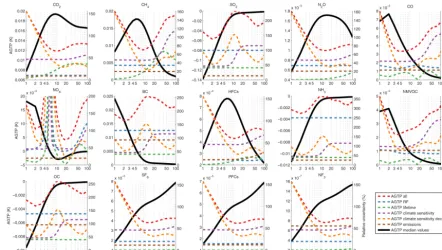
Figure 7 shows a breakdown of the parameters contribut-ing to relative uncertainty of the AGTP values by pollutant. MC runs with separate metric components were individually perturbed to isolate the individual contributions to uncertain-ties. For comparison, uncertainties in global emissions are also included in the graph, although not included when per-turbing all components. Uncertainties in emissions and RF do not depend on the time horizon, and thus they are straight lines. However, as the precursors have combined effects (see methods) the uncertainty of RF on CO, NMVOC, and NOx
actually changes with time due to the different effects having different lifetimes.
For the first 3 years, the total uncertainty for most pollu-tants (except the SLCFs: BC, OC, SO2, and NH3) is
Figure 7.AGTP values (black lines) for all pollutants (sorted by absolute temperature impact at the 50-year time horizon) and relative uncertainties (dashed lines) for metric parameters, on the right vertical axis. AGTP median values use parameters from the literature, while AGTP values all show uncertainty with all parameters perturbed (excluding emissions). Uncertainties indicate the 90 % CI range of the median values. Global emission uncertainties are derived from sector aggregations, and are the same as shown in Fig. 5.
uncertainty of the climate sensitivity component takes over and continues to dominate to at least 100 years. Between them they explain the largest contributions of uncertainties to the metric values for all time horizons. While the decay parameter explains the large uncertainties in the first years, the climate sensitivity parameter explains the increasing rela-tive uncertainties towards 50 and 100 years. The climate sen-sitivity parameters are highly sensitive to the time horizon since they have different effects at different times. For SO2
and NH3, the first years are also effected by high
uncertain-ties from RF. Other short-lived pollutants (BC and OC) have large contributions from both emissions and RF values.
At 50 years, CO2and CH4have additional significant
con-tributions to uncertainties from lifetimes. Since they both have lifetimes within the ranges of the graph, they show variability depending on the time horizon. The shorter- and longer-lived pollutants show little variations in lifetime un-certainties over the different time horizons, as lifetimes are either too short or too long to have any effect within 100 years at this scale. The uncertainty of several gases’ life-times are assumed (Table 5); however, the small impact from lifetime uncertainties in the metric values indicate that small changes of the median lifetimes will for most pollutants have very little effect. At 50 years, the short-lived pollutants have uncertainties ranging between±95 and±165 %, while the WMGHGs have uncertainties ranging between±35 and ±70 %. The precursors have uncertainties around±65 %.
After 100 years, only the WMGHGs still have a signif-icant temperature effect, which means that the SLCFs do not contribute with absolute uncertainties. In relative terms, shorter-lived pollutants have a rise in uncertainties from 50 to 100 years, while the opposite is true for the longer-lived pol-lutants. The last group is then completely dominated by cli-mate sensitivity uncertainties. Most pollutants have relatively low uncertainty contributions from emissions as the global estimates are low, except for BC and OC. On a regional and sectoral level, the uncertainties from emissions are usually much more dominant, shifting the total uncertainties at all time horizons.
The literature consists of both studies which allocate emis-sions using the absolute metric (AGTP) and those that use the normalized metric (GTP). The GTP metric values are scaled with the AGTP values for CO2. When running the MC
analy-sis, we create AGTP values for every iteration, which implies that CO2always will be normalized by itself (by definition,
GTPCO2=1). Therefore, the uncertainties of total emissions
using GTP values are quite different to AGTP uncertainties since the dominant species (CO2) has no metric uncertainty,
and the uncertainties in other species are potentially ampli-fied due to the uncertainty of AGTPCO2 values.
uncer-Table 7.Metric values uncertainties for the 20-, 50-, and 100-year time horizons. All metric parameters (excluding emissions) were perturbed. The uncertainties indicate the 5–95 % (90 %) percentile range, where the plus–minus notation is half of the 90 % CI. Numbers are rounded to nearest 5 %, as multiple MC runs would give slightly different results (usually within 1–2 %).
Pollutants AGTP20 AGTP50 AGTP100 GTP20 GTP50 GTP100 GWP20 GWP50 GWP100
PFCs ±30 % ±35 % ±35 % ±20 % ±20 % ±20 % ±15 % ±15 % ±15 %
CH4 ±45 % ±70 % ±75 % ±35 % ±55 % ±70 % ±25 % ±30 % ±30 %
CO ±45 % ±65 % ±75 % ±35 % ±45 % ±65 % ±20 % ±20 % ±25 % CO2 ±35 % ±40 % ±40 % ±0 % ±0 % ±0 % ±0 % ±0 % ±0 %
HFCs ±30 % ±40 % ±40 % ±20 % ±20 % ±20 % ±15 % ±15 % ±20 %
N2O ±35 % ±40 % ±40 % ±25 % ±25 % ±30 % ±20 % ±25 % ±25 %
NF3 ±35 % ±35 % ±35 % ±20 % ±25 % ±25 % ±15 % ±20 % ±20 %
NH3 ±180 % ±165 % ±170 % ±165 % ±150 % ±165 % ±125 % ±130 % ±130 %
NMVOC ±50 % ±65 % ±75 % ±35 % ±45 % ±65 % ±20 % ±20 % ±25 % NOx ±35 % ±65 % ±95 % ±35 % ±50 % ±80 % ±295 % ±150 % ±125 % SF6 ±35 % ±35 % ±35 % ±20 % ±20 % ±25 % ±15 % ±20 % ±20 %
SO2 ±110 % ±95 % ±100 % ±100 % ±80 % ±100 % ±55 % ±55 % ±55 %
BC ±125 % ±110 % ±110 % ±110 % ±95 % ±110 % ±70 % ±70 % ±70 % OC ±125 % ±110 % ±115 % ±110 % ±95 % ±110 % ±70 % ±75 % ±75 %
tainties than AGTP values (i.e., uncertainties are correlated). Table 7 illustrates the difference between uncertainties in AGTP, GTP, and GWP values. GTP uncertainties are typi-cally ±10–15 percentage points below those of AGTP, and since the AGTPCO2 uncertainties are not strongly
depen-dent on the time horizon, they do not affect the uncertainties over different time horizons for other pollutants’ GTP values much. GWP calculations use the same parameters as GTP, and although we do not use GWP in our results, we include the uncertainties in the table for comparison. Overall, we find less uncertainty using GWP than the other metrics (Reisinger et al., 2010), except for NOx. The GWP calculations are not
dependent on the highly uncertain climate sensitivity, since it does not relate to global temperature change. Thus, it is expected to have lower uncertainties. NOx has overlapping
indirect effects, with highly uncertain RF values, which sug-gest that the GWP20 values can be both negative and posi-tive, with a median close to zero. Thus, it has very high un-certainty.
A few other studies have investigated the uncertainties of AGTP and GTP values, but it is difficult to compare those as there are many different sources of uncertainties from many different models and data sets. Our GTP uncertainty results are generally higher than the Olivié and Peters (2013) es-timates since we also include uncertainties in lifetime and RF values of non-CO2 species. Their GTP50 uncertainties
for BC (−62 to+67 %), CH4 (−38 to+48 %), N2O (−16
to +25 %) and SF6 (−17 to+25 %) are higher than their
GWP uncertainties, mainly due to the dependence on the un-certain climate response (Olivié and Peters, 2013). Another study (Fuglestvedt et al., 2010) found similar uncertainties for GTP50 values for BC (around 200 %) and smaller val-ues for CH4(50 %) compared to our results, and essentially
zero for N2O, when only looking at sensitivity to the
cli-mate response. N2O is a special case as it has a similar
av-erage lifetime to CO2, and thus it has similar climate
sen-sitivity uncertainty as CO2, which can be seen in Fig. 7 for
AGTP values. The normalization of GTP therefore cancels out the climate sensitivity effect. Based on an evaluation of several studies (including Reisinger et al., 2010), Myhre et al. (2013b) assessed the uncertainty of CH4 for GTP100 to
be±75 %, which is close to our estimate. Furthermore, Joos et al. (2013) found uncertainties for CO2AGTP values at 50
(±45 %) and 100 years (±90 %), based on the spread of mul-tiple climate models. Overall, we find the uncertainties to be consistent with other studies, but highly variable depending on data sets and choices.
3.4 Uncertainty of all components