https://doi.org/10.5194/tc-13-1233-2019
© Author(s) 2019. This work is distributed under the Creative Commons Attribution 4.0 License.
A key factor initiating surface ablation of Arctic sea ice: earlier and
increasing liquid precipitation
Tingfeng Dou1,2, Cunde Xiao3,2,4, Jiping Liu5, Wei Han6, Zhiheng Du2, Andrew R. Mahoney7, Joshua Jones8, and Hajo Eicken8
1College of Resources and Environment, University of Chinese Academy of Sciences, Beijing 100049, China
2State Key Laboratory of Cryospheric Sciences, Cold and Arid Regions Environmental and Engineering Research Institute,
Chinese Academy of Sciences, Lanzhou 730000, China
3State Key Laboratory of Earth Surface Processes and Resource Ecology, Beijing Normal University, Beijing 100875, China 4Institute of Polar Meteorology, Chinese Academy of Meteorological Sciences, Beijing 100081, China
5Department of Atmospheric and Environmental Sciences, University at Albany, State University of New York,
Albany, NY, USA
6Beijing Meteorological Observation Center, Beijing 102600, China
7Geophysical Institute, University of Alaska Fairbanks, Fairbanks, AK 99775-7320, USA
8International Arctic Research Center, University of Alaska Fairbanks, Fairbanks, AK 99775-7340, USA
Correspondence:Cunde Xiao ([email protected])
Received: 31 October 2018 – Discussion started: 12 November 2018
Revised: 6 February 2019 – Accepted: 11 March 2019 – Published: 15 April 2019
Abstract.Snow plays an important role in the Arctic climate system, modulating heat transfer in terrestrial and marine environments and controlling feedbacks. Changes in snow depth over Arctic sea ice, particularly in spring, have a strong impact on the surface energy budget, influencing ocean heat loss, ice growth and surface ponding. Snow conditions are sensitive to the phase (solid or liquid) of deposited precip-itation. However, variability and potential trends of rain-on-snow events over Arctic sea ice and their role in sea-ice losses are poorly understood. Time series of surface observations at Utqia˙gvik, Alaska, reveal rapid reduction in snow depth linked to late-spring rain-on-snow events. Liquid precipita-tion is key in precondiprecipita-tioning and triggering snow ablaprecipita-tion through reduction in surface albedo as well as latent heat release determined by rainfall amount, supported by field observations beginning in 2000 and model results. Rainfall was found to accelerate warming and ripening of the snow-pack, with even small amounts (such as 0.3 mm recorded on 24 May 2017) triggering the transition from the warming phase into the ripening phase. Subsequently, direct heat input drives snowmelt, with water content of the snowpack increas-ing until meltwater output occurs, with an associated rapid decrease in snow depth. Rainfall during the ripening phase
can further raise water content in the snow layer, prompting onset of the meltwater output phase in the snowpack. First spring rainfall in Utqia˙gvik has been observed to shift to ear-lier dates since the 1970s, in particular after the mid-1990s. Early melt season rainfall and its fraction of total annual precipitation also exhibit an increasing trend. These changes of precipitation over sea ice may have profound impacts on ice melt through feedbacks involving earlier onset of surface melt.
1 Introduction
Maslanik et al., 2007, 2011; Nghiem et al., 2007; Notz, 2009; Laxon et al., 2013). Snow over sea ice plays an important role in the growth and melt of Arctic sea ice (Maykut and Untersteiner, 1971; Maykut, 1986; Blazey et al., 2013; Per-ovich and Polashenski, 2012). Snow has a lower thermal con-ductivity and higher albedo (∼0.7–0.9 for wet to dry snow) than sea ice, which limits the absorption of solar energy by sea ice as well as by the ocean beneath sea ice (Eicken et al., 2004; Perovich and Polashenski, 2012). Screen and Sim-monds (2012) showed that the fraction of Arctic summer pre-cipitation occurring as snow has declined in recent decades due to lower-atmosphere warming, and this change of precip-itation has likely contributed to the decrease in sea ice extent by reducing the area of snow-covered ice and the resulting surface albedo during summer.
In spring, changes in the amount of snow can either curb or foster sea ice melt. Thick snow helps maintain high sur-face albedos during the melt season (Eicken et al., 2004) and reduces solar heating of ice and upper ocean (Sturm et al., 2002). In contrast, thin snow melts back earlier in spring and promotes the formation of melt ponds (Eicken et al., 2004; Petrich et al., 2012), which absorb approximately 1.7 times more solar radiation than bare ice and approximately 5 times more than cold, snow-covered sea ice (Perovich et al., 2002; Perovich and Polashenski, 2012; Webster et al., 2014), ac-celerating ice decay and solar heating of the upper ocean in spring.
Spring snow depth on sea ice is very sensitive to the phase of precipitation. Solid precipitation increases snow depth, protecting sea ice from melt. Conversely, liquid precipita-tion heats the snowpack, changes snow grain morphology and lowers albedo, decreasing snow depth. Data from Opera-tion IceBridge flights (2009–2013) indicate an average snow depth on Arctic sea ice of ∼20 cm (22.2 cm in the west-ern Arctic and 14.5 cm in the Beaufort and Chukchi seas) (Webster et al., 2014), which renders the thin sea-ice snow-pack particularly susceptible to earlier surface ablation and shorter duration as a result of liquid precipitation. An assess-ment based on 37 state-of-the-art climate models indicated that in the future rain is projected to become the dominant form of precipitation over the Arctic region (Bintanja and Andry, 2017). Rain-on-snow events over Arctic sea ice are likely to have profound impacts, particularly in late spring when the snowpack has warmed. However, to date no such investigation has been completed over Arctic sea ice.
In order to determine how liquid precipitation affects the surface ablation of sea ice and to assess its quantitative con-tribution to the reduction in snow depth over sea ice, here, we investigate the role of liquid precipitation in initiating snowmelt and the sea ice ablation season based on field mea-surements in the coastal Chukchi Sea. An energy balance model was adopted to help develop a mechanistic interpre-tation of the observations. The variability of rain-on-snow events over sea ice and the timing of first spring rain are
analysed using long-term meteorological records available at Utqia˙gvik, Alaska.
2 Data and methodology 2.1 Data
2.1.1 Micrometeorological observations at the MB site A snow and ice mass balance (MB) site has been deployed on undeformed landfast first-year ice in the Chukchi Sea north of Utqia˙gvik since 1990s. At this location the ice is ho-mogeneous, and it forms primarily through in situ freezing rather than advection and deformation and provides ice and snow data representative of level, undeformed ice (Drucken-miller and Haas, 2009). The relative humidity was measured with a Campbell CS500 instrument in 2013 and a Campbell HMP155A instrument from 2014 to 2016. Air temperature was measured 2 m above the ice with a shielded Campbell CS500 sensor in 2013 and with a Campbell HMP155A from 2014 to 2016. The shielded Rotronic HC2S3 that measured air temperature in 2017 also measured relative humidity. Wind direction and speed were measured by two R.M. Young and Campbell 5108-L anemometers, one 2.1 m above the ini-tial snow surface and the other 4.1 m above the iniini-tial snow surface. Data were recorded every 15 min and transferred via FTP to the University of Alaska Fairbanks, where they were processed (Druckenmiller and Haas, 2009; Eicken et al., 2012). We used the data for 2013–2017 (https://arcticdata.io/ catalog/\T1\textbackslash#view/doi:10.18739/A2D08X, last access: 15 March 2018).
2.1.2 Radiation, albedo, surface temperature and snow depth near the MB site
From April through June 2017, we conducted radiation and surface albedo measurements near the MB site. The distribu-tion of snow depth at this locadistribu-tion is the same as that at the MB site. Radiation was measured using a CNR4 net radiome-ter that records the upwelling and downwelling shortwave and longwave radiation. The surface albedo was derived from the upward solar radiation divided by the incident solar radia-tion. The surface temperature was measured with a SI-111 in-frared radiometer. The sensors were fixed on a bracket 1.5 m above the snow surface. Data were recorded every 5 min and collected by LoggerNet 4.0 (CR1000). Snow depth was mea-sured with a Campbell SR50 sonic ranger fixed to a mast ex-tending through the ice. The accuracy is about±1 cm. 2.1.3 Air temperature and precipitation at Utqia˙gvik
WSO AP station
located near the coast of the Chukchi Sea at Utqia˙gvik (available from the Alaska Climate Research Center; http: //climate.gi.alaska.edu/acis_data, last access: 2 September 2018). The snowfall data are given as snow water equiva-lent (cm w.e.). The snowfall amount is subtracted from the total precipitation to obtain the rainfall amount (also in units of cm w.e.).
2.2 Methodology
2.2.1 Modelling of snow depth, snow density and snow water equivalent (SWE)
The surface energy balance for the snowpack overlying sea ice can be defined as
Qnet=Q∗+Qs+Ql+C+R, (1)
whereQnetis the net energy flux at the snowpack on sea ice, Q∗is the net radiative flux,Qsis the turbulent sensible heat
flux,Ql is the turbulent latent heat flux,Cis the conductive
heat flux and R is the heat input by rain. Each component of the surface energy budget is expressed in the unit W m−2. The net radiative flux is composed of the net shortwave and longwave components, which are derived from the observed incoming and outgoing radiative fluxes with a CNR4 net ra-diometer (see more details in the Data and methodology sec-tion). The sensible heatQsand latent heatQlwere calculated
by
Qs= −ρacpCH(Ts−Ta) Vz (2)
Ql= −ρarlCE(qs−qa) Vz, (3)
whereVzis the mean wind speed (m s−1)in 1 h at a heightz
andρa(unit: kg m−3)andcp(unit: J (kg K)−1) denote the air
density and the specific heat capacity of air.rlis the
vapor-ization enthalpy.(Ts−Ta)and(qs−qa)are the differences
in temperature and specific humidity between the snow sur-face and atmosphere at the height z. The temperature and humidity are respectively expressed in the unit K and g m−3. CH and CE are the bulk transfer coefficients estimated
from a simple non-iterative algorithm (Launiainen and Chengm, 1995) based on the Monin–Obukhov similarity the-ory.
The conductive heat fluxCwas estimated as
C= −k (Ts−Ti) /Hs (4)
k=0.138−1.01ρs+3.233ρ2s{0.156≤ρs≤ 0.6} (5) k=0.023−1.01ρs+0.234ρ2s{ρs ≤0.156}, (6)
where k is the thermal conductivity of snow in W m−1K, andTs is the snow surface temperature in K. The observed
ice surface temperature Ti was applied in this study. Hs is
snow depth in m. k varies with snow density according to the regression in Eqs. (5) and (6), as suggested by Sturm et al. (2002).
For heat input by rain, two settings need to be considered. If rain falls on snowpack that is at the freezing point,
R=ρwCwr (Tr−Tm) , (7)
whereCw is the heat capacity of water in J (kg K)−1,r is
the rainfall rate (m s−1)andTr is the rain temperature (K).
Rain is cooled to the freezing point, giving up sensible heat to warm the snowpack.
If rain falls on a snowpack below the freezing point, R=ρwCwr (Tr−Tm)+ρwLmr, (8)
whereLmis the latent heat of fusion in J kg−1, andTmis the
freezing point in K. Rain first cools to the freezing point, giv-ing up sensible heat. Thereafter the rain will freeze, releasgiv-ing latent heat, which can heat the snowpack effectively.
Once the snowpack reaches the warming phase, the pos-itive energy budget is used to melt snow. The amount of snowmelt 1SWE (snow water equivalent in m) was esti-mated as
1SWE= −Qnet/ (ρwLm) , (9)
whereQnet is the net energy flux derived from Eq. (1), and ρwdenotes water density in kg m−3.
The snow density changes were modelled based on 1ρs=ρsC1SWE exp(−C2ρs)exp(−0.08(T0−Ta))1t, (10)
where C1 and C2 are empirical coefficients, which are
7.0 m−1h−1 and 21.0 cm3g−1 according to the field mea-surements in Yen et al. (1981).T0is the freezing point
tem-perature. Here,1tis equal to 1 h. The snow depthHswas modelled by
Hs=
(SWE+1SWE) ρw ρs
+SWEnewρw/ρsnew, (11)
where SWE is snow water equivalent in m,ρsis snow
den-sity in kg m−3, and SWEnewis new deposited snow in snow
water equivalent (m). The density of new fallen snowρsnewis
102 kg m−3 on average derived from the field measurement in Chukchi Sea 2017.
The energy required to reach the isothermal state was calculated according to [ciρw SWE (Tave−Tm)] by
Ding-man (2015), whereCI is the heat capacity of snow or ice
(2.1 kJ kg−1◦C−1), T
ave is the average temperature of the
snowpack,Tmis the freezing point of snow,ρwis the density
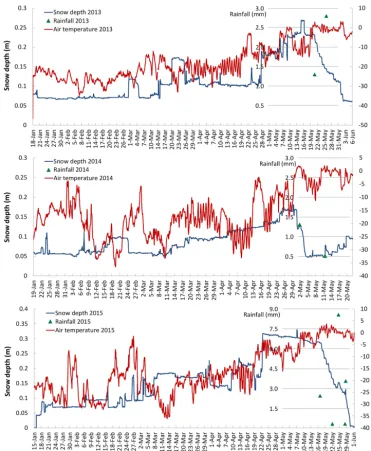
Figure 1.Rainfall and variations in air temperature and snow depth recorded near Utqia˙gvik, Alaska. The data were observed at the MB site on Chukchi Sea landfast ice between January and June in 2013, 2014 and 2015. Amount (mm w.e.) and timing of rainfall are indicated by blue triangles.
2.2.2 Model experiments
Two experiments were conducted to quantitatively estimate the contribution of rain to snow ablation. In the control run, we applied the meteorological observations to drive the model and simulate the snow depth, snow density and SWE. These observations include wind, air temperature, relative humidity, snow surface temperature, upward and downward longwave radiation, incoming solar radiation, surface albedo, rainfall, snowfall, snow temperature and snow–ice interface temperature. The measured snow depth and snow density were used to validate the model results. In the sensitivity
experiment, we excluded the impacts of rain by lowering albedo and eliminating the latent heat and sensible heat terms contributed by rainfall.
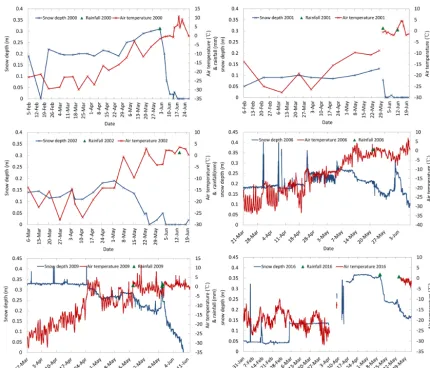
lin-Figure 2.Observed air temperature, snow depth and liquid precipitation over coastal Chukchi Sea ice in 2000, 2001, 2002, 2006, 2009, 2016.
early extrapolated based on the observations of the previous 3 days using the method of Perovich et al. (2017) for the period 24 May–3 June (also see their Figs. 2 and 3). In con-trast, the control experiment includes all impacts of rainfall on surface properties and fluxes and therefore draws on the observed albedo time series from the same period. The ob-served downwelling solar irradiance was applied to calculate the absorbed solar radiation with and without rain.
2.2.3 Significance testing
We calculated the significance value of a linear trend for first rainfall date, rainfall in May, total precipitation and rain-fall : total precipitation ratio in May using Student’s t test. The trend is significant whenp≤0.05 with 95 % confidence.
3 Observed evidence of rapid reduction in snow depth associated with liquid precipitation
Figure 3.Energy balance of snow over sea ice during the early stage of melt season. Observed net solar radiation, albedo, net longwave radiation and timing of rainfall from 22 May through 1 June 2017 (local time). Calculated sensible heat, latent heat, heat conductive flux and energy budget during the same period are also shown. Rain heat includes the heat that rain directly brings into the snowpack and the latent heat release when the rain freezes within the snowpack. Grey shading shows the timing of rainfall.
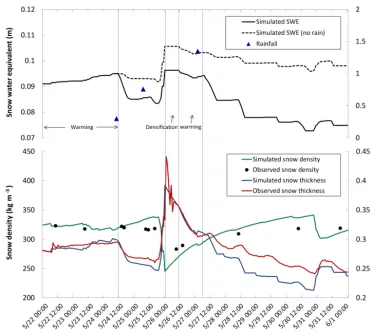
Figure 5.Observed and modelled snow density, thickness and snow water equivalent (SWE) at different stages of snowmelt. A sensitivity experiment without rain was conducted for the same time period, and the corresponding SWE is also shown. Rainfall, snow density and depth were observed at the surface of Chukchi Sea landfast ice from 22 May through 1 June 2017. A detailed description of the ablation process is provided in the “Observations and model simulations of key processes” section.
Arctic surface melt season is linked to pronounced synoptic events, rather than through gradual heating processes (Alt, 1987; Persson et al., 1997; Stone et al., 2002; Wang et al., 2005; Sharp and Wang, 2009; Persson and Ola, 2012).
4 Observations and model simulations of key processes A primary mechanism for the acceleration of surface melt and ablation is the rain-induced rapid lowering of surface albedo. In order to evaluate this impact, we conducted field measurements of surface albedo in conjunction with charac-terization of the state of the snow and ice cover on Chukchi Sea ice in April and June 2017. Observations showed that surface albedo decreased sharply on 24, 25 and 27 May by 0.12, 0.10 and 0.13, respectively, coinciding with the occur-rence of rain-on-snow events (Fig. 3). The observed snow morphology (Fig. 4) and water content (Table 1) indicated significant melt of the snowpack after rainfall for these 3 days, corresponding to a decrease in snow depth (Fig. 5). Comparison with the earlier two warming events (15 and
18 May), with temperatures at or above the freezing point, demonstrates that the warming events alone did not result in such a rapid decrease in albedo but that liquid precipita-tion plays a key role. Consistently, two earlier studies also supported that a sharp drop in surface albedo by over 0.05 within a single day was associated with a rain-on-snow event, different from the gradual decline in surface albedo associ-ated with seasonal surface warming and individual warm-ing events (Perovich et al., 2002, 2017). Such rapid decrease in surface albedo may result in a significant increase in the absorbed shortwave flux. In addition, the rain can directly bring heat into the snow layer and heat the snowpack interior through the release of latent heat during refreezing of rain-water in the early stages of snow warming.
Table 1.Water content of snowpack at different depths observed over ice in the Chukchi Sea north of Utqia˙gvik during 23 May through 27 May 2017. Units: cm3water 100 cm−3snow.
Date (local time)
23 May 24 May 25 May 26 May 27 May
Snow depth (cm) 14:45 14:50 16:55 15:30 17:10 15:30 15:00
2.5
1.7 5.8 5.3 4.8 6.0 2.3 12.3 1.8 5.8 5.5 5.0 6.0 2.4 12.3 5.5 6.4 4.7 5.1 1.9 12.3
5.0 4.4 2.4 10.4
5.0
3.2 3.5 2.7 5.8 1.8 11.1 2.4 3.5 2.8 5.6 1.4 10.5 3.6 3.4 3.4 5.8 1.7 5.5
3.7 5.7 2.0 6.7
7.5
2.1 2.7 5.0 4.7 3.8 11.3 1.7 5.4 5.1 4.0 10.9
2.1 5.4 4.4
5.7 5.6
10.0
5.9 4.4 8.7 2.3 5.3 7.6
4.7 4.6
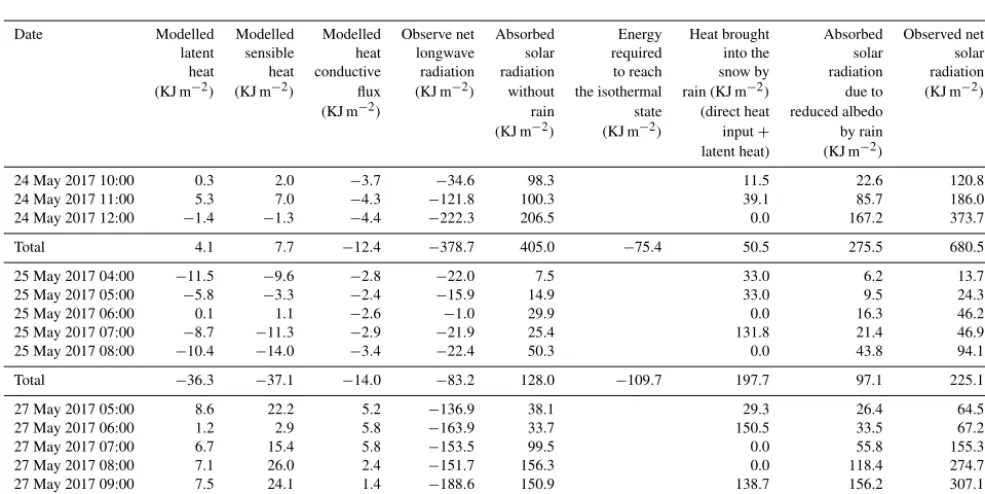
Table 2.Components of the surface energy budget, required for the snowpack to reach the isothermal state (warming phase).
Date Modelled Modelled Modelled Observe net Absorbed Energy Heat brought Absorbed Observed net
latent sensible heat longwave solar required into the solar solar
heat heat conductive radiation radiation to reach snow by radiation radiation (KJ m−2) (KJ m−2) flux (KJ m−2) without the isothermal rain (KJ m−2) due to (KJ m−2)
(KJ m−2) rain state (direct heat reduced albedo
(KJ m−2) (KJ m−2) input+ by rain latent heat) (KJ m−2)
24 May 2017 10:00 0.3 2.0 −3.7 −34.6 98.3 11.5 22.6 120.8
24 May 2017 11:00 5.3 7.0 −4.3 −121.8 100.3 39.1 85.7 186.0
24 May 2017 12:00 −1.4 −1.3 −4.4 −222.3 206.5 0.0 167.2 373.7
Total 4.1 7.7 −12.4 −378.7 405.0 −75.4 50.5 275.5 680.5
25 May 2017 04:00 −11.5 −9.6 −2.8 −22.0 7.5 33.0 6.2 13.7
25 May 2017 05:00 −5.8 −3.3 −2.4 −15.9 14.9 33.0 9.5 24.3
25 May 2017 06:00 0.1 1.1 −2.6 −1.0 29.9 0.0 16.3 46.2
25 May 2017 07:00 −8.7 −11.3 −2.9 −21.9 25.4 131.8 21.4 46.9
25 May 2017 08:00 −10.4 −14.0 −3.4 −22.4 50.3 0.0 43.8 94.1
Total −36.3 −37.1 −14.0 −83.2 128.0 −109.7 197.7 97.1 225.1
27 May 2017 05:00 8.6 22.2 5.2 −136.9 38.1 29.3 26.4 64.5
27 May 2017 06:00 1.2 2.9 5.8 −163.9 33.7 150.5 33.5 67.2
27 May 2017 07:00 6.7 15.4 5.8 −153.5 99.5 0.0 55.8 155.3
27 May 2017 08:00 7.1 26.0 2.4 −151.7 156.3 0.0 118.4 274.7
27 May 2017 09:00 7.5 24.1 1.4 −188.6 150.9 138.7 156.2 307.1
Total 31.1 90.6 20.5 −794.5 478.5 −449.5 318.5 390.4 868.9
energy transformed effectively into snowmelt, initiating the snowpack ripening phase, which in turn leads into the melt-water output phase.
Based on our latest and most comprehensive field mea-surements, the surface energy budget and contribution from
ob-Figure 6. Comparison of air temperature observed at WSO AP (Utqia˙gvik Weather Service Office airport weather station) and the MB site during January–June 2013(a), 2014(b)and 2015(c).
served snow temperature showed that the upper layers of the snowpack (16 cm) became isothermal after 2 h. The observed snow particle size and water content data indicate that the upper 10 cm began to melt immediately (Fig. 4 and Table 1). Interestingly, the modelled shortwave radiation absorbed by the snow layer without rainfall (405 KJ m−2)could offset the heat loss (−391 KJ m−2)from longwave radiative loss and heat conduction, but the residual – which includes latent and sensible heat – was too small to increase the temperature of the snow layer to the freezing point. During this period, rain changed the energy balance, initiating the warming phase of snowmelt in two ways: (1) increasing the absorption of solar radiation (275.47 KJ m−2) by lowering surface albedo and
(2) transferring heat into the snowpack. At the same time, such rain events may exceed the storage capacity of water in the snowpack since the snow temperature was still low at this time. As a result, water drains downward, forming ice layers in the lower part of the snowpack and releasing latent heat (contributing in total 50.5 KJ m−2). Therefore, rainfall is believed to be the main factor in rapidly warming the snow layer to an isothermal state in this case.
From the night of 24 May to the morning of 25 May, the snow temperature fell below the freezing point (−1.0◦C),
and then rainfall occurred at 04:00 on 25 May. The snow temperature observations demonstrated that the snow layer reached an isothermal state after 5 h. During this period, the solar radiation absorbed by the snow cover would have been 128 KJ m−2 if there were no rainfall, which is not enough to make up for the total energy loss (171 KJ m−2) mainly from the longwave loss (−83 KJ m−2) and from sensible (−36 KJ m−2) and latent heat transfer (−37 KJ m−2) and heat conduction (−14 KJ m−2). Due to the occurrence of rainfall and the resulting albedo reduction, the snowpack ab-sorbed an additional 97 KJ m−2 of solar radiation, and the rain also brought 198 KJ m−2 into the snowpack, mainly through latent heat release and direct heat input. Most of the rain-induced energy transfer was used to warm the snow-pack; once the snowpack reached the warming phase, the re-maining energy was used to melt the snow further, pushing the snowpack into ripening phase.
A heavy snowfall occurred during the evening of 25 May through the morning of 26 May. A constant SWE and re-duced snow thickness indicated that there was significant snow densification during the daytime on 26 May, which was confirmed by the increase in snow density (Fig. 5). From the evening of 26 May to the morning of 27 May, the snow temperature decreased to−2.9◦C. Subsequently, rainfall oc-curred at 05:00 on 27 May, and the entire snowpack reached an isothermal state within 5 h after the rainfall, as observed in the snow temperature record. During this period, the heat loss from longwave radiation was larger than other compo-nents of the heat budget (−795 KJ m−2). The absorbed solar radiation (479 KJ m−2), latent heat (31 KJ m−2)and sensible
heat (91 KJ m−2)were far from enough to offset this part of
the energy budget in the absence of rainfall. The rainfall con-tributed 390 KJ m−2to the energy balance by reducing the surface albedo and contributed 318 KJ m−2by bringing heat directly into the snowpack and releasing latent heat (the latter accounted for the main contribution).
The model results shown above demonstrate that liquid precipitation can lead to completion of the warming phase within several hours, subsequently initiating the melt season (Fig. 5 and Table 2). Once the warming phase is reached, the remaining energy is used to further melt the snow, pro-ducing significant meltwater flow and contributing to snow-pack ripening, together with the subsequent absorption of so-lar radiation (some of which was also contributed by rain-on-snow). According to Table 2, the remaining energy was 377 KJ m−2 on 24 May. For this period, 534 KJ m−2 was
oc-Figure 7.Timing of air temperature exceeding 0◦for the first time and the timing of first rainfall in spring at the WSO AP site, 1952–2015. The dashed red line(a)corresponds to the first instance of air temperature above 0◦C. The solid red line(b)indicates the first warming event continuing for at least 4 days.pdenotes the significance value of the linear trend.
Figure 8.The variation trend of rainfall, total precipitation andR:P ratio at Utqia˙gvik for May, 1952–2015.pdenotes the significance value of the linear trend.
curred, with an associated rapid decrease in snow depth. If rainfall occurs during the ripening phase, it increases wa-ter content in the snow layer, pushing the snowpack into the meltwater output phase. This is confirmed by the model sim-ulations showing that SWE decreased significantly within a few hours after each rainfall. In the absence of rainfall, warm-ing is mostly sluggish, and the snow depth reduction is much more gradual as snowmelt proceeds, as was the case in 2002 (Fig. 2). A comparison of modelled SWE for the cases with and without rainfall demonstrates that in the case in which the longwave radiant flux is kept consistent with the
observa-tions, in the absence of rain, the snowpack does not undergo such rapid ablation (Fig. 5).
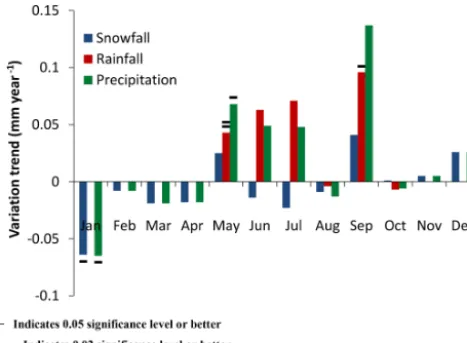
Figure 9.The variation trends of rainfall, snowfall and precipitation for each month at Utqia˙gvik from January 1952 to December 2015. The trend is characterized by the slope of the linear regression equa-tion of the time series (−indicates 0.05 significance level or better; =indicates 0.02 significance level or better).
even at low temperatures due to the high salinity of the brine (Geldsetzer et al., 2009). Previous work in the Arctic, includ-ing at the location studied here, has established that for Arctic snowpack (in contrast with the Antarctic) typically only the lowermost centimetres of the snowpack exhibit higher salt content (Domine et al., 2004; Douglas et al., 2012). There-fore the presence of brine-wetted snow may accelerate the transition of the lowermost snow layers into the ripening phase during ablation but does not impact the onset of melt in the surface layers of the snowpack.
In addition, in our field work, we found depth hoar to be commonly present at the bottom of the snowpack. Depth hoar is a typical stratigraphic element of the basal layers of the Utqia˙gvik snowpack during the spring season, widely con-firmed in previous studies (e.g. Hall et al., 1986; Domine et al., 2012). Depth hoar is conducive to discharge of meltwater and subsidence of the snow cover surface, thereby promot-ing rapid reduction in snow depth. In theory, the presence of both depth hoar and brine-wetted snow supports the rapid re-duction of snow depth through the process outlined in this study, though further observations are required to establish the relative importance of this process.
5 Variability of rain-on-snow events
Having demonstrated the profound impact of rainfall on snow depth and ablation, we explore variability in the tim-ing of first rain-on-snow events since the start of the avail-able record. Due to the lack of long-term continuous obser-vations over sea ice, we employ obserobser-vations from Utqia˙gvik WSO AP station, which is close to the MB site. Precipita-tion and surface air temperature have been measured at WSO
AP since 1902 with large data gaps prior to 1952. Here we use air temperature and precipitation data from 1952 to 2017. A comparison of surface air temperature between WSO AP and the MB site shows close correspondence (Fig. 6). The amount of liquid precipitation was not recorded at the MB site, but we did record the timing of rainfall on sea ice or at the laboratory near the MB site from April through June in the field expedition of 2015 and 2017. This timing is in good agreement with the records from WSO AP. Hence, me-teorological conditions at WSO AP are representative of the MB site.
As shown in Fig. 7, the first rain-on-snow events of the year have been shifted to earlier dates over the past 60 years (2.8 days decade−1, P <0.01). This trend towards earlier spring rainfall has been more pronounced since the early 2000s (26.9 days decade−1 during 2000–2015, P <0.01), which is consistent with the accelerated decline of Arctic sea ice since the early 2000s. Meanwhile, the timing of surface air temperature rising above the freezing point has also been occurring earlier for the past 60 years (3.0 days decade−1; P <0.01; Fig. 7). There is a clear relationship between the timing of first rainfall and the timing of air temperature ris-ing above the freezris-ing point (r=0.66). After removing the linear trend, the correlation is 0.57 (p <0.01). On average, the timing of air temperature rising above the freezing point is earlier than the first rainfall event by 9.1 days, suggest-ing that air temperature exceedsuggest-ing the freezsuggest-ing point is not in and of itself a driver of rain-on-snow events. Further anal-ysis indicates that in some years (32 %), after the warming events continued for 1–2 days, air temperature dropped again without occurrence of recorded rainfall. Similarly, warming events of 3 days’ duration without rainfall account for 21 % of all cases. Hence, we recalculate the timing of warming events that persisted for at least 4 days. Results show that these two measures of spring warming are highly positively correlated (r=0.96). After removing the linear trend, the correlation is still strong (r=0.95, p <0.01), suggesting that the year-to-year variability of the timing of first spring rainfall is closely tied to the timing of persistent warming events (Fig. 7), which might be associated with large-scale weather events.
Prior to the mid-1990s there was almost no rainfall in May (Fig. 8). Since then, the amount of rainfall has increased, es-pecially in the past 10 years. Rainfall amount in May has been increasing significantly over the past 60 years (Fig. 9), with a linear trend of 0.43 mm decade−1during 1952–2015 (p <0.01) and 1.4 mm decade−1since the mid-1990s (p <
6 Discussion and conclusions
Snow on sea ice strongly impacts the surface energy bud-get, driving ocean heat loss, ice growth and surface ponding. While the role of snow depth and snowfall variations is well understood, this study demonstrated that rain-on-snow events are a critical factor in initiating the onset of surface melt over Arctic sea ice, primarily through reduction in surface albedo as well as latent heat release. By pushing the snowpack into the isothermal, ripening and meltwater output phase, liq-uid precipitation can sharply reduce snow depth and initiate the onset of rapid surface ablation. The increases in down-welling longwave fluxes through cloud warming associated with rainfall events contribute to warming of the snowpack to the melting point but are not sufficient to drive the tem-perature of the entire snow layer into an isothermal state on short timescales. In contrast, the occurrence of liquid precip-itation can induce a quick transition of the snow temperature from diurnally varying to an isothermal state. The observa-tions at Utqia˙gvik and in the offshore Chukchi Sea ice pack suggest that at least in some years rain-on-snow events act as an effective, mostly irreversible trigger for the transition into the surface ablation season. In cases in which melt onset occurred in the absence of rain, increases in downward long-wave fluxes largely offset the longlong-wave radiation heat loss of snow and are thus key to melt initiation (Mortin et al., 2016). However, as shown from our observations and model results, snowmelt triggered by increases in net longwave radiation is much slower than that driven by liquid precipitation. This study deepens the understanding of the trigger mechanism of sea ice ablation, which is helpful in improving the modelling and seasonal prediction of Arctic sea ice extent.
This study assembles process studies and long-term ob-servations at an important coastal site in North America for the first time, showing that onset of spring rainfall over sea ice has shifted to earlier dates since the 1970s, in particu-lar since the mid-1990s. Early melt season rainfall and its fraction of total annual precipitation also exhibit an increas-ing trend. Based on the observational evidence and model results, we speculate that earlier and increasing liquid pre-cipitation leads to earlier and more rapid melt of snowpack over sea ice, allowing for earlier formation of melt ponds. This strengthens the ice–albedo feedback, leading to greater ice mass loss in summer (Perovich et al., 1997; Stroeve et al., 2014), with the resulting thinner ice in turn reducing the ice pack in September (Notz, 2009). This inference needs further confirmation in future studies.
Data availability. The micrometeorological observations (air tem-perature, relative humidity) at the MB site data can be accessed at https://doi.org/10.18739/A2D08X (Eicken, 2016). Air temperature and precipitation at Utqia˙gvik WSO AP station are available from the Alaska Climate Research Center at http://climate.gi.alaska.edu/ acis_data (last access: 2 September 2018).
Author contributions. TD, CX, JL and HE jointly conceived the study and wrote the paper with additional input from WH, ZD, AM and JJ. AM, HE and TD conceived field measurements and gen-erated in situ data and associated products used in this study. TD performed the analyses. All of the authors discussed the results and contributed to interpretations.
Competing interests. The authors declare that they have no conflict of interest.
Acknowledgements. This study is funded by the National Key Re-search and Development Program of China (2018YFC1406103, 2018YFA0605901), the National Nature Science Foundation of China (NSFC 41425003 and 41401079), the key project of CAMS “Research on the key processes of cryospheric rapid changes” (KJZD-EW-G03-04) and the Climate Program Office, NOAA, U.S. Department of Commerce (NA15OAR4310163 and NA14OAR4310216). MB site data at Utqia˙gvik were collected through support of the U.S. National Science Foundation, grant PLR- 0856867. We thank Chris Polashenski and Nicholas Wright for providing the snow temperature profile data at the MB site in 2017, funded under NSF grant ARC-1603361, the “Snow, Wind and Time” project.
Review statement. This paper was edited by John Yackel and re-viewed by three anonymous referees.
References
Alt, B. T.: Developing synoptic analogs for extreme mass balance conditions on Queen Elizabeth Island ice caps, J. Clim. Appl. Meteor., 26, 1605–1623, 1987.
Bintanja, R. and Andry, O.: Towards a rain-dominated Arctic, Nat. Clim. Change., 7, 263–267, 2017.
Blazey, B. A., Holland, M. M., and Hunke, E. C.: Arctic Ocean sea ice snow depth evaluation and bias sensitivity in CCSM, The Cryosphere, 7, 1887–1900, https://doi.org/10.5194/tc-7-1887-2013, 2013.
Comiso, J. C. and Nishio, F.: Trends in the sea ice cover using enhanced and compatible AMSR-E, SSM/I, and SMMR data, J. Geophys. Res., 113, C02S07, https://doi.org/10.1029/2007JC004257, 2008.
Dingman, S. L.: Physical hydrology, 3rd edition, Waveland Press, Inc. 223–226, 2015.
Domine, F., Sparapani, R., Ianniello, A., and Beine, H. J.: The ori-gin of sea salt in snow on Arctic sea ice and in coastal regions, Atmos. Chem. Phys., 4, 2259–2271, https://doi.org/10.5194/acp-4-2259-2004, 2004.
Domine, F., Gallet, J. C., Bock, J., and Morin, S.: Structure, specific surface area and thermal conductivity of the snow-pack around Barrow, Alaska, J. Geophys. Res., 117, D00R14, https://doi.org/10.1029/2011JD016647, 2012.
grow-ing in the Arctic ocean-atmosphere-sea ice-snow interface: 1. Chemical composition, J. Geophys. Res., 117, D00R09, https://doi.org/10.1029/2011JD016460, 2012.
Druckenmiller, M. L. and Haas, C.: Integrated Ice Observation Pro-grams, Book Chapter, Sea-Ice Handbook, edited by: Eicken, H., University of Alaska Press, 2009.
Eicken, H.: Automated ice mass balance site (SIZONET), Arctic Data Center, https://doi.org/10.18739/A2D08X, 2016.
Eicken, H., Grenfell, T. C., Perovich, D. K., Richter-Menge, J. A., and Frey, K.: Hydraulic controls of summer Arc-tic pack ice albedo, J. Geophys. Res., 109, C08007, https://doi.org/10.1029/2003JC001989, 2004.
Eicken, H., Gradinger, R., Heinrichs, T., Johnson, M. A., Love-craft, A. L., and Kaufman, M.: Automated ice mass balance site (SIZONET), UCAR/NCAR – CISL – ACADIS, Dataset, https://doi.org/10.5065/D6MW2F2H, 2012.
Geldsetzer, T., Langlois, A., and Yackel, J. J.: Dielectric properties of brine-wetted snow on first-year sea ice, Cold Reg. Sci. Tech-nol., 58, 47–56, 2009.
Giles, K. A., Laxon, S. W., and Ridout, A. L.: Circumpo-lar thinning of Arctic sea ice following the 2007 record ice extent minimum, Geophys. Res. Lett., 35, L22502, https://doi.org/10.1029/2008GL035710, 2008.
Hall, D. K., Chang, A. T. C., and Foster, J. L.: Detection of the depth-hoar layer in the snow-pack of the Arctic coastal plain of Alaska, U.S.A, using satellite data, J. Glaciol., 32, 87–94, 1986. Kwok, R. and Untersteiner, N.: The thinning of Arctic sea ice, Phys.
Today, 64, 36–41, 2011.
Kwok, R., Cunningham, G. F., Wensnahan, M., Rigor, I., Zwally, H. J., and Yi, D.: Thinning and volume loss of the Arctic Ocean sea ice cover: 2003–2008, J. Geophys. Res., 114, C07005, https://doi.org/10.1029/2009JC005312, 2009.
Launiainen, J. and Chengm B. A.: simple non-iterative algorithm for calculating turbulent bulk fluxes in diabatic conditions over water, snow/ice and ground surface, Rep. Ser. Geophys., 33, p. 16, 1995.
Laxon, S. W., Giles, K. A., Ridout, A. L., Wingham, D. J., Willatt, R., Cullen, R., Kwok, R., Schweiger, A., Zhang, J., Haas, C., Hendricks, S., Krishfield, R., Kurtz, N., Far-rell, S., and Davidson, M.: CryoSat-2 estimates of Arctic sea ice thickness and volume, Geophys. Res. Lett., 40, 732–737, https://doi.org/10.1002/grl.50193, 2013.
Martin, S.: A field study of brine drainage and oil entrapment in first-year sea ice, J. Glaciol., 22, 473–502, 1979.
Maslanik, J., Drobot, S., Fowler, C., Emery, W., and Barry, R.: On the Arctic climate paradox and the continuing role of atmo-spheric circulation in affecting sea ice conditions, Geophys. Res. Lett., 34, L03711, https://doi.org/10.1029/2006GL028269, 2007. Maslanik, J., Stroeve, J., Fowler, C., and Emery, W.: Distribution and trends in Arctic sea ice age through spring 2011, Geophys. Res. Lett., 38, L13502, https://doi.org/10.1029/2011GL047735, 2011.
Maykut, G. A.: The surface heat and mass balance, in: The geo-physics of sea ice, edited by: Untersteiner, N., New York, Plenum Press, 395–463, 1986.
Maykut, G. A. and Untersteiner, N.: Some results from a time de-pendent thermodynamic model of sea ice, J. Geophys. Res., 76, 1550–1575, 1971.
Mortin, J., Svensson, G., Graversen, R. G., Kapsch, M. L., Stroeve, J. C., and Boisvert, L. N.: Melt onset over Arctic sea ice con-trolled by atmospheric moisture transport, Geophys. Res. Lett., 43, 6636–6642, 2016.
Nghiem, S. V., Rigor, I. G., Perovich, D. K., Clemente-Colón, P., Weatherly, J. W., and Neumann, G.: Rapid reduction of Arctic perennial sea ice, Geophys. Res. Lett., 34, L19504, https://doi.org/10.1029/2007GL031138, 2007.
Notz, D.: The future of ice sheets and sea ice: Between reversible re-treat and unstoppable loss, P. Natl. Acad. Sci. USA, 106, 20590– 20595, 2009.
Perovich, D. K. and Polashenski, C.: Albedo evolution of seasonal Arctic sea ice, Geophys. Res. Lett., 39, L08501, https://doi.org/10.1029/2012GL051432, 2012.
Perovich, D. K., Bruce, C. E., and Richter-Menge, J. A.: Observa-tions of the annual cycle of sea ice 824 temperature, Geophys. Res. Lett., 24, 555–558, 1997.
Perovich, D. K., Grenfell, T. C., Light, B., and Hobbs, P. V.: Sea-sonal evolution of the albedo of multiyear Arctic sea ice, J. Geo-phys. Res., 107, 8044, https://doi.org/10.1029/2000JC000438, 2002.
Perovich, D., Polashenski, C., Arntsen, A., and Stwertka, C.: Anatomy of a late spring snowfall on sea ice, Geophys. Res. Lett., 44, 2802–2809, https://doi.org/10.1002/2016GL071470, 2017.
Persson, P. and Ola, G.: Onset and end of the summer melt season over sea ice: thermal structure and surface energy perspective from SHEBA, Clim. Dynam., 39, 1349–1371, 2012.
Persson, P., Ola, G., Ruffieux, D., and Fairall, C. W.: Recalculations of pack ice and lead surface energy budgets during LEADEX 92, J. Geophys. Res., 102, 25085–25089, 1997.
Petrich, C., Eicken, H., Polashenski, C. M., Sturm, M., Harbeck, J. P., Perovich, D. K., and Finnegan, D. C.: Snow dunes: A controlling factor of melt pond distribu-tion on Arctic sea ice, J. Geophys. Res., 117, C09029, https://doi.org/10.1029/2012JC008192, 2012.
Screen, J. A. and Simmonds, I.: Declining summer snow-fall in the Arctic: Causes, impacts and feedbacks, Clim. Dynam., 38, 2243–2256, 2012.
Sharp, M. and Wang, L.: A five-year record of summer melt on Eurasian Arctic ice caps, J. Climate, 22, 133–145, 2009. Stone, R. S., Dutton, E. G., Harris, J. M., and Longenecker,
D.: Earlier spring snowmelt in northern Alaska as an in-dicator of climate change, J. Geophys. Res., 107, 4089, https://doi.org/10.1029/2000JD000286, 2002.
Stroeve, J., Holland, M. M., Meier, W., Scambos, T., and Serreze, M.: Arctic sea ice decline: Faster than forecast, Geophys. Res. Lett., 34, L09501, https://doi.org/10.1029/2007GL029703, 2007. Stroeve, J. C., Holland, M. M., Kay, J. E., Malanik, J., and Barrett, A. P.: The Arctic’s rapidly shrinking sea ice cover: A research synthesis, Clim. Change, 110, 1005–1027, 2012.
Stroeve, J. C., Markus, T., Boisvert, L., Miller, J., and Barrett, A.: Changes in Arctic melt season and implications for sea ice loss, Geophys. Res. Lett., 41, 1216–1225, 2014.
Tucker III, W. B., Perovich, D. K., Gow, A. J., Weeks, W. F., and Drinkwater, M. R.: Physical properties of sea ice relevant to re-mote sensing, in: Microwave Rere-mote Sensing of Sea Ice, edited by: Carsey, F., Geophysical Monograph, American Geophysical Union, 9–28, Chapter 2, 1992.
Wang, L., Sharp, M. J., Rivard, B., Marshall, S., and Burgess, D.: Melt season duration on Canadian Arctic ice caps, 2000–2004, Geophys. Res. Lett., 32, L19502, https://doi.org/10.1029/2005GL023962, 2005.
Webster, M. A., Rigor, I., Nghiem, S. V., Kurtz, N. T., Farrell, S. L., Perovich, D. K., and Sturm, M.: Interdecadal changes in snow depth on Arctic sea ice, J. Geophys. Res., 119, 5395–5406, https://doi.org/10.1002/2014JC009985, 2014.