DOI: 10.30954/2249-6637.08.2018.2
©2018 New Delhi Publishers. All rights reserved
From Passive to Active Learning: Experience from
INES-Ruhengeri, a University of Applied Sciences in the
Republic of Rwanda
Ndishimye and Habineza
INES-Ruhengeri, Department of Biomedical Laboratory Sciences, Ruhengeri, Rwanda
Corresponding author: [email protected] / [email protected]
ABSTRACT
The aim of this study was to explore students and lecturers’ attitudes and views towards active learning strategies (ALS) implemented at the Institutd’Enseignement Supérieur de Ruhengeri (INES-Ruhengeri), an Institute of applied sciences in Rwanda. Each class was taught in an active (non-traditional) manner for one course and in a passive (traditional) manner for another course. Several active learning methods (Think-Pair-Share, Card for Active Learning, Cooperative Learning, Supporting all the students, and Expert group) have been implemented during student teaching sessions. Questionnaires and interviews were administrated to students and lecturers, and then data were analysed. The results have shown that 78% of students learn better when the lesson involves ALS and it helps them to understand things better. 58% said that they enjoy lessons more if they involve ALS. It has also been reported (56%) that ALS helps students to communicate and to have better relationships with other classmates. The study has also found that over 82% of the lecturers agree that using ALS have a positive effect on students’ performance. This is very encouraging as it will help to improve the teaching and learning of students at INES. About 75% of the lecturers agreed that ALS methods ensure that total participation of students is achieved, integrate the learners’ experience and makes students interact in class. Some lecturers (15%) indicated that the class size of students and workload can affect the ability to use ALS. The different findings of this research will probably be useful for other institutes about the best ALS that the academic staff members in developing countries need for their teaching work, especially in the context of applied sciences.
Keywords: Passive Learning, Active Learning, University of applied sciences, INES-Ruhengeri
Since the beginning of higher education, the main teaching method used has been the traditional didactic lecture (Lujan & DiCarlo, 2006). This method establishes an instructor-centered classroom setting in which students are passive listeners (Michael, 2006; Ernst & Colthorpe, 2007; Richardson, 2007; Lom, 2012). Wilke (2003) has shown that passive learning does not incorporate open student interactions and focuses more on simply exposing students to predetermined course material.
However, over few last years, many academicians and researchers have been urging lecturers to promote
other alternative teaching methods that can enhance the performance levels and qualitative experiences of students (Yew et al. 2009). Those teaching methods are variously grouped under the terms active learning and
Silberman (1996) has shown that to learn something well, students need to hear it, see it, ask questions about it, discuss it with others, and to act on it. Today many organizations are seeking individuals who exhibit both effective communication and analytical, critical, and creative problem-solving skills as drivers of success in today’s ever-changing conditions. These skills and abilities can be cultivated in the educational setting if students are given the opportunity to engage in learning more actively (O’Brien & Hart, 1999; Merritt, 2001). Most high learning institutions in developing countries still teach their classes in the traditional lecture mode (Faust, 1998). Rwanda is one of those countries where the education system is influenced by a traditional system where the lecturers have a central position while students are passive and do not have a chance to express their opinions. Thus, to fill that research gap, INES-Ruhengeri has recently promoted a climate of active learning and student engagement by training its lecturers in active didacticst hrough joint efforts with its partners (INES-Ruhengeri, 2016).
It is in this perspective that selected lecturers from 4faculties have beneficiated a 6 month-training at AERES University, Wageningen-Netherlands in order to reinforce the practical component of teaching and learning in an Applied Sciences University. Upon completion of this training, they have in turn trained other academic staff to initiate ALS in the context of applied sciences.
Some INES-Ruhengeri Faculty have initiated researches in this area of Education (Habineza, 2017, 2018; Nsanzumuhire, Habineza, Nahimana, & Mpakaniye, 2018) and I would like to join their efforts in order to improve the teaching and learning at INES-Ruhengeri in the framework of a University of Applied Sciences. In fact, I judged it is important to evaluate the admissibility and practicability of that active teaching approach and its impact on student learning outcomes. Therefore, the main aim of this study was to investigate the level of attitudes and perceptions that students and lecturers have towards active learning strategies recently implemented at INES-Ruhengeri.
METHODS
Study site and participants
This study included 120 male and female students from INES-Ruhengeri (20 students per lecturer) and structure observation of 12 different subjects taught by 6 different lecturers. Six subjects have been taught using active learning strategies (Think-Pair- Share, Card for AL, Cooperative Learning, Supporting all the students, and Expert group) and 6 other subjects in a passive way to the same students and by the same lecturers. The study was conducted from September to November2017 at INES-Ruhengeri.
Data collection and processing
To collect the required data, questionnaires,interviews and observation were used to explore student and lecturer attitudes and views on using ALS. The questionnaire was prepared in English language and then administered to students and lecturers. The purpose of the interview was to generate in-depth information about the practice of lecturers and promoting factors to implement active learning. To make the communication more effective, the interviews were made both in Kinyarwanda and English language. Classroom observationswere also conducted to see how lecturers were implementing active learning methods. This complementary technique was used to check the interaction, concentration,and accountability.
Ethical Consideration
This research was undertaken based on the full consent of agreement of all the participants. For the purpose of anonymity, researchers did not attribute quotations to individuals. Participants were also informed that the data to be generated through the questionnaires and interviews would be used only for the purpose of research and they were at liberty to ask any question about the study before as well as during the data collection. The study did not explore the other aspects of the activities of the institute.
Statistical analysis
responses of the interviews conducted with the students and the Lecturers.
RESULTS AND DISCUSSION
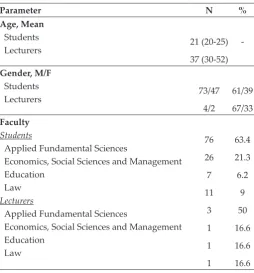
The demographic data and faculty of affiliation of all 126 respondents (students and lecturers)are presented in the following Table 1.
Table 1: Demographic data of the respondents (n = 120 students and 6 lecturers)
Parameter N %
Age, Mean Students
Lecturers 21 (20-25)
37 (30-52)
-Gender, M/F Students
Lecturers 73/47
4/2
61/39 67/33 Faculty
Students
Applied Fundamental Sciences
Economics, Social Sciences and Management Education
Law Lecturers
Applied Fundamental Sciences
Economics, Social Sciences and Management Education
Law
76 26 7 11
3 1 1 1
63.4 21.3 6.2
9 50 16.6 16.6 16.6
As indicated in Table 1, 61% of 120 students who participated in the study were males and 39% were females. For lecturers, 67% were males and 33% were females. The largest portion of the respondents was from the faculty of applied fundamental sciences (63.4% of students and 50% of lecturers), about 21.3% and 16.6% of the respondents were from the faculty of economics, social sciences and management, and few others were from the faculties of education and law.
As shown in the Fig. 1, the results of this study have revealed that 78% of students learn better when the lesson involves ALS and it helps them to remember things better (58% of participants agreed and 20.3% strongly agreed).
Fig. 1: Students’ responses about how they learn better when the lesson involves ALS.
The results of this study have also shown that 67% of students enjoy lessons more if they involve ALS (Fig. 2).
Fig. 2: Students’ responses about how they enjoy lessons more when active learning is involved
As shown in Fig. 3, about lecturer’s views on using different active learning strategies, it has been reported that “Think-Pair-Share” was the most method preferred, followed by “Expert group”, “Supporting all the students”, and finally “Card for AL”.
In the literature, the use of active-learning strategies has resulted in mixed effects on students’ achievement. Some studies show that active learning can improve student’s achievement vs. traditional, didactic lecture, whereas others show no difference at all (Wilke, 2003). This study has found that, using active learning strategies, 78% of students learn better when the lesson involves active learning and that active learning helps students to remember their courses better. 58% of students have reported that they enjoy lessons more when active learning is involved. It has also been reported (56%) that ALS help students to communicate and to have better relationships with other classmates.
About 82% of the lecturers agreed that using ALS has a positive effect on students’ performance. This is very encouraging and it can help to improve the teaching and learning of Sciences at INES-Ruhengeri. About, 81% of the lecturers indicated that active learning strategies improve students’ communication and enhanced their motivation. The results revealed that about 80% of the lecturers were in favor of the idea that active learning strategies can give students a sense of participation and integrate their experiences. On the significance of the use of ALS, about 75% of the lecturers agreed that ALS methods ensure that total participation of students is achieved, integrate the learners’ experience, and makes students interact in class. If students participate well in the class, there will be morelecturer-students’ interaction and integration. At that point, teaching/ learning becomes interesting and meaningful (Abdel & Collins, 2017).
Because active-learning strategies used during this study were encompassed within the realm of constructivist thinking, it is easy to predict why those ALS produced these results. Constructivist teaching is a strategy that engages students in activities, encourages them to think and reflect on their learning experience, considers their prior knowledge, and provides feedback during the learning process (Yager, 1991).
The different opinions of students and lecturers have shown that a constructivist approach to teaching produces positive outcomes of learning, including achievement. It was also found that students are
motivated to learn and discover new things with the use of ALS. The study revealed that ALS enhances students learning experiences by providing the collaborative and supportive environment, enables students to resolve problems using knowledge from previous experiences, enhances motivation, enables students to learn sufficient content and improves interaction in the classroom. About 85% of the lecturers noted that students can express their opinions when active learning strategies are applied. About lecturer’s views on using different active learning strategies in the context of applied sciences, the lecturers reported that “Think-Pair-Share” was the most method preferred, followed by “Expert group”, “Supporting all the students”, and finally “Card for AL”.
Think-Pair-Share is an effective strategy to help participants frame their thoughts and prepare them for sharing. In its simplest form, learners think about a particular question or prompt and then pair up to discuss their ideas. The next stage is to share their results with a larger group, which might be another pair of learners or the whole large group. Think-pair-sharing forces all learners to attempt an initial response to the prompt, which they can then clarify and expand as they collaborate. This process should take five to ten minutes, depending on the question’s complexity (Sampsel, 2013). Some lecturers indicated that the class size of students (15%) and workload (23%) can affect the ability to use ALS. The strategies of engaging and supporting all students are based on a model of learning that refines the popular notion of ‘scaffolding’. The idea of scaffolding is that a teacher or lecturer provides support for a learner to ‘build’ skills, and then removes the support as skills develop, and the learner becomes independent (David, 2016).
This study is in the same perspective as what is suggested by Nsanzumuhire et al. (2018) as far as Problem-based learning is concerned and proposed by INES-Ruhengeri (2016)
CONCLUSION
world. This study revealed that students and lecturers from INES-Ruhengeri have a positive attitude towards learning based on ALS even if they are encountering some problems inhibiting its usage (not enough materials, workload, etc.). The study also revealed that applying activity-based learning positively affect students’ performance in many ways. Based on those findings, some recommendations are made: firstly, to provide all necessary instructional materials to all departments to facilitate the utilization of ALS at INES-Ruhengeri; secondly, to organize workshops and seminars for the training and re-training of lecturers on how to use ALS in applied sciences; and finally, all high learning institutions should ensure that lecturers are properly prepared on the use of ALS.
ACKNOWLEDGEMENTS
The research team would like to acknowledge “MDF Training & Consultancy” for the financial support, AERES University of applied sciences, Wageningen / Netherlands for the assistance and INES-Ruhengeri for the facilitation, help and guidance.
REFERENCES
Abdel, M.E. and Collins, M. 2017. Students’ perceptions of lecturing approaches: Traditional versus interactive teaching. Advances in Medical Education and Practice, 8: 229–241.
Carvalho, H. and West C.A. 2011. Voluntary participation in an active learning exercise leads to a better understanding of physiology. Adv. Physiol. Educ., 35: 53-58.
David, R. 2016. Engaging and supporting all our students to read and learn from reading. Primary English Teaching Association Australia.
Ernst, H. and Colthorpe, K. 2007. The efficacy of interactive lecturing for students with diverse science backgrounds. Adv. Physiol. Educ., 31: 41–44.
Faust, J.L. and Paulson, D.R. 1998. Active learning in the college classroom. Journal on Excellence in College Teaching, 9(2): 3-24. Habineza, F. 2016. An exploratory survey of Students’ attitudes
towards Mathematics at INES-Ruhengeri in Rwanda, Ines Scientific Journal, 11(3): 83-99.
Habineza, F. 2018. An exploratory Survey of Undergraduate Students’ attitudes towards Research at INES-Ruhengeri in Rwanda, International Educational Applied Scientific Research Journal, 3(3): 1-5.
INES-Ruhengeri 2016. INES-Ruhengeri as an Institute of Applied Sciences: Education Handbook for Lecturers, Musanze: INES-Ruhengeri.
Lom, B. 2012. Classroom activities: simple strategies to incorporate student centered activities within undergraduate science lectures. J. Undergrad. Neurosci. Educ., 11: A64–A71.
Lujan, H.L. and DiCarlo, S.E. 2006. Too much teaching, not enough learning: what is the solution? Adv. Physiol. Educ., 30: 17–22.
Merritt, J. 2001. MBA programs are going back to school: A new crop of deans faces pressure to improve the way b-schools prepare grads for a complex workplace. Business Week. Michael, K. 2006. Where’s the evidence that active learning works?
Adv. Physiol. Educ., 30: 159–167.
Miller, C.J. and Metz, M.J. 2014. A comparison of professional-level faculty and student perceptions of active learning: its current use, effectiveness, and barriers. Advances in Physiology Education, 38(3): 246-252.
Nsanzumuhire, U.S., Habineza, F., Nahimana, M. and Mpakaniye, J.P. 2018. Identification of possible strategies for implementing PBL at INES-Ruhengeri: A preliminary study, Education India Journal: A Quarterly Refereed Journal of Dialogues on Education, 7(3): 3-24.
O’Brien, E.M. and Hart, S. 1999. Action Learning: The link between academia and industry? Education Research, 41. Richardson, D. 2007. Don’t dump the didactic lecture, fix it. Adv.
Physiol. Educ., 32: 23–24.
Sampsel, A. 2013. “Finding the Effects of Think-Pair-Share on Student Confidence and Participation”. Honors Projects. Paper 28.
Silberman, M. 1996. Active learning: 101 Strategies to teach any subject. Boston: Allyn and Bacon.
Yager, R.E. 1991. The constructivist learning model. The Science Teacher, 58(6): 52.
Yew, T.M., Dawood, F.K.P., Narayansany, K.S., Manickam, K.P., Jen, L.S. and Hoay, K.C. 2009. Learning to stimulate Active Learning in Classroom Settings: An Action Research Project. Proceedings of the 2nd International Conference of Teaching and
Learning (ICTL), INTI University College, Malaysia.