Emperor International Journal of Finance and Management Research
ISSN: 2395-5929
www.eijfmr.com
©
Mayas Publication
A Study on Banking Reforms and Effect on Economic
Development of India
D. Kum.Chaithra
SSK Degree College , Chandra Layout , Bangaluru -72.
I.INTRODUCTION
Banking began with the first prototype banks of merchants of the ancient world, which made grain loans to farmers and traders who carried goods between cities and this system is known as a barter system. Gradually the goldsmiths began to lend the money out on behalf of the depositor, which led to the development of modern banking practices; promissory notes (which evolved into banknotes) were issued for money deposited as a loan to the goldsmith
A Bank is a financial institution that accepts deposits from the public and creates credit.[1] Lending activities can be performed either directly or indirectly
The Indian government, when nationalizing all the larger Indian banks in 1969, argued that banking was “inspired by a larger social purpose” and must “sub serve national priorities and objectives such as rapid growth in agriculture, small industry and exports.1”
A retrospect of the events clearly indicates that the Indian banking sector has come far away from the days of nationalization. The Narasimham Committee laid the foundation for the reformation of the Indian banking sector. Constituted in 1991, the committee submitted two reports in 1992 and 1998, which laid significant thrust on enhancing the efficiency and viability of the banking sector. As the international standards became prevalent, banks had to unlearn their traditional operational methods of directed credit, directed investments and fixed interest rates, all of which led to deterioration in the quality of loan portfolios, inadequacy of capital and the erosion of profitability.
The recent international consensus on preserving the soundness of the banking system has veered around certain core themes. These are: effective risk management systems, adequate capital provision, sound practices of supervision and regulation, transparency of operation, conducive public policy intervention and maintenance of macroeconomic stability in the economy. Until recently, the lack of competitiveness vis global standards, low technological level in operations, over staffing, high NPAs and low levels of motivation had shackled the performance of the banking industry.
However, the banking sector reforms have provided the necessary platform for the Indian banks to operate on the basis of operational flexibility and functional autonomy, thereby enhancing efficiency. Productivity and profitability. The reforms also brought about structural changes in the financial sector and succeeded in easing external constraints on its operation, i.e. reduction in CRR and SLR reserves, capital adequacy norms, restructuring and recapitulating banks and enhancing the competitive element in the market through the entry of new banks.
Received : 4th January 2019
Accepted : 25th January 2019
Published : 28th January 2019
Reviewer : Dr.S.R.Keshava Dr. BharatiPathak
The reforms also include increase in the number of banks due to the entry of new private and foreign banks, increase in the transparency of the banks‟ balance sheets through the introduction of prudential norms and increase in the role of the market forces due to the deregulated interest rates. These have significantly affected the operational environment of the Indian banking sector.
To encourage speedy recovery of Non-performing assets, the Narasimham committee laid directions to introduce special tribunals and also lead to the creation of an asset reconstruction fund. For revival of weak banks, the verma committee recommendations have laid the foundation. Lastly, to maintain macroeconomic stability, RBI has introduced the Asset Liability Management System.
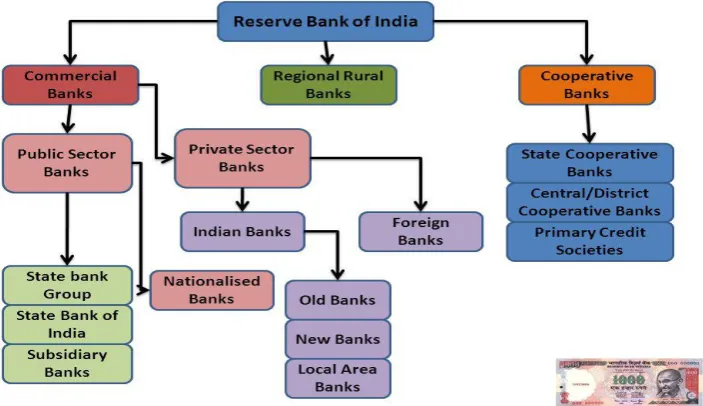
Fig 1: Banking Sector in India
1.1 Background
the final analysis, to social control and nationalization. Between 1969 and 1980, the number of private branches grew more quickly than public banks, and on April 1, 1980, they accounted for approximately 17.5 percent of bank branches in India. In April of 1980, the government undertook a second round of nationalization, placing under government control the six private banks whose nationwide deposits were above Rs. 2 billion, or a further 8 percent of bank branches, leaving approximately 10 percent of bank branches in private hands. The share of private bank branches stayed fairly constant between 1980 to 2000. Nationalized banks remained corporate entities, retaining most of their staff, with the exception of the board of directors, who were replaced by appointees of the central government. Since 1980, has been no further nationalization, and indeed the trend appears to be reversing itself, as nationalized banks are issuing shares to the public, in what amounts to a step towards privatization. India has also seen the entry of over two dozen foreign banks in 1989.
In the rest of the paper, we use recent evidence on banking in India to shed light on the relative costs and benefits of nationalized banks. Throughout this exercise, it is important to bear in mind that the Indian banking sector is going through something like a transformation. Thus, it is potentially a dangerous time to evaluate its performance using historical data. Nevertheless, data from the past is all we have, and we believe things are not changing so quickly that the lessons learned are not useful.
1.2 Reforms in Banking Sector
As the real sector reforms began in 1992, the need was felt to restructure the Indian banking industry. The reform measures necessitated the deregulation of the financial sector, particularly the banking sector. The initiation of the financial sector reforms brought about a paradigm shift in the banking industry. In 1991, the RBI had proposed to from the committee chaired by M. Narasimham, former RBI Governor in order to review the Financial System Viz. aspects relating to the structure, Organizations and functioning of the financial system. The Narasimham Committee report, submitted to the then finance minister, Manmohan Singh, on the banking sector reforms highlighted the weaknesses in the Indian banking system and suggested reform measures based on the Basle norms. The guidelines that were issued subsequently laid the foundation for the reformation of Indian banking sector.
1.3 The main recommendations of the Committee were
Reduction of statutory liquidity ratio (SLR) to 25% over a period of five years Progressive reduction in cash reserve ratio (CRR)
Phasing out of directed credit programmers and redefinition of the priority sector Deregulation of interest rates so as to reflect emerging market conditions
Stipulation of minimum capital adequacy ratio of 4% to risk weighted assets by March 1993, 8% by March 1996, and 8% by those banks having international operations by March 1994
Adoption of uniform accounting practices in regard to income recognition, asset classification and provisioning against bad and doubtful debts
Imparting transparency to bank balance sheets and making more disclosures Setting up of special tribunals to speed up the process of recovery of loans
Setting up of asset reconstruction funds(ARFs) to take over from banks a portion of their bad and doubtful advances at a discount
Abolition of branch licensing
Liberalizing the policy with regard to allowing foreign banks to open offices in India Rationalization of foreign operations of Indian banks
Speedy liberalization of capital market
Several recommendations have been accepted and are being implemented in a phased manner. Keeping in view the need of further liberalization the Narashimham Committee II on banking sector reform was set up in 1997. This committee constituted submitted its report in April 1998.
II.LITERATURE REVIEW
Joshi (1986) in his study of all scheduled commercial banks operating in India analyses the profitability and profit planning relating to the period 1970 – 1982. The study discusses and trends in profits and profitability of commercial banks nationalization. The factors leading to the deterioration of profitability are highlighted.
Minkshi and Kaur (1990) attempted to measure quantitatively the impact of the various instruments of monetary policy on the profitability of commercial banks. The study empirically proves that pre-liberalization banking being highly regulated and controlled industry, has suffered a lot so far as profitability concerned. The bank rates and reserve requirements ratio had played a significant role in having a negative impact on the bank‟s profitability.
Ojha (1992) in his study attempts to measure the productivity of public sector commercial banks in India. After identifying various measures of productivity like total assets per employee, total credit per employee, total deposits per employee, pre-tax profits per employee, net profit per employee, working funds per employee, ratio of establishment expenses to working funds and net interest per employee, comparison is made with the banks at the international level. The study concludes the Indian banks have very less productivity ratio compared with western countries. Since in his study a comparison has been made of India public sector banks, which have to perform other social functions unlike western commercial banks.
Abhijit V.Banerjee, Shawncole and Esther Duflo (2014) In his study focus on lending policies, bank ownership and speed of financial development and with final issues of rural branches and NPAs as well as bailouts. He stated the following to conclude his study that lending procedure is liberalized with a intention to utilization of money for the development of economy activity and find out the ways for reduction of NPAs. RAO (2007) studies how these reforms would help the banks, specially the private sector ones. He stated the following to conclude his study:
The response of the banks to the reforms has been impressive. The bans have been adjusting very well to the new environment though gradually. The reforms have not only enhanced the opportunities for banks but at the same time through challenges as well. As a result of entry of new generation private sector banks. The competitive pressures are constantly on the increase.
3.1 Objective
The objective of the research paper is as follows
1. Assessment of the banking sector reforms in India. 2. Impacts of reform and the future prospects.
3. The study will be confined to the impacts of reforms upon credit delivery, market shared of the banks, profitability and prudential regulations, and the economy.
3.2 Scope of the Study
III.RESEARCH METHODOLOGY
The term research methodology can be defined as a process used to collect data and information for the purpose of making business decisions. The methodology may include publication research, interviews, surveys and other techniques.
3.1 Data collection
The type of data that is used in the study is stated here:
Primary Data :
For this study, we have collect data from PRIMARY sourced though questioner and interview conducted in industrial area (peenya) and Educational institution (SSK Degree College)
Secondary Data
Secondary data was collected from annual reports and statistical hand book of central bank and economic survey India, research paper and various articles.
IV.DATA ANALYSIS AND INTERPRETATION 4.1 Recduction in CRR & SLR
The Narasimham Committee had argued for reductions in SLR on the grounds that the stated government objective of reducing the fiscal deficits will obviate the need for a large portion of the current SLR. Similarly, the need for the use of CRR to control secondary expansion of credit would be lesser in a regime of smaller fiscal deficits. The recommendations regarding reduction of Statutory Liquidity Ratio (SLR) and Cash Reserve Ratio (CRR) has been vigorously implemented. The effective SLR has been brought down to 25% The CRR also has been brought down several times. It is now being used more frequently as a tool of monetary policy.
4.2 Higher Interest Rates on SLR AND CRR
One of the reasons for low profitability of the banks was a high pre-emption of funds through SLR and CRR and that too at very low return. The Government of India used these funds as financing of its own operations at low cost, the return to the banks was lower than the cost of raising these funds. Through number of steps the return on these funds have been improved. The direction of reforms is that Govt. will be paying at least the cost of raising of such funds.
4.3 Income Recognition
The regulation for income recognition states that the Income on NPAs cannot be booked. Interest income should not be recognized until it is realized. An NPA is one where interest is overdue for two quarters or more. In respect of NPAs, interest is not to be recognized on accrual basis, but is to be treated as income only when actually received. Income in respect of accounts coming under Health Code 5 to 8 should not be recognized until it is realized. RBI has advised the banks to evolve a realistic system for income recognition based on the prospect of reliability of the security. On non-performing accounts the banks should not charge or take into account the interest.
4.4 Asset Classification
4.5 Regulations for Asset Classification
Standard Assets: It carries not more than the normal risk attached to the business and is not an NPA
Sub-standard Asset : An asset which remains as NPA for a period exceeding 24 months, where the current net worth of the borrower, guarantor or the current market value of the security charged to the bank is not enough to ensure recovery of the debt due to the bank in full.
Doubtful Assets: An NPA which continued to be so for a period exceeding two years (18 months, with effect from March,2001, as recommended by Narasimham Committee II)
Loss Assets: An asset identified by the bank or internal/external auditors or RBI inspection as loss asset, but the amount has not yet been written off wholly or partly.
4.6 Provisioning Norms
Banks will be required to make provisions for bad and doubtful debts on a uniform and consistent basis so that the balance sheets reflect a true picture of the financial status of the bank. The Narasimham Committee has recommended the following provisioning norms
100% of loss assets or 100% of out standings for loss assets.
100% of security shortfall for doubtful assets and 20% to 50% of the secured portion. 10% of the total out standings for substandard assets.
4.7 Mobilizing Savings For Capital Formation
The banks help in mobilizing savings through network of branch banking. People in developing countries have low incomes but the banks encourage them to save by introducing variety of deposit schemes to suit the needs of individual depositors. They also mobilize idle savings of the few rich. By mobilizing savings, the banks channelize them into productive investments. Thus they help in the capital formation of a developing country.
4.8 Financing Industry And Agriculture
In generally they provide short-term, medium-term and long-term loans to industry as well as to traders in agricultural commodities. They provide finance directly to farmers for the marketing of their produce, for the modernization and mechanization of their farms, for providing irrigation facilities, for developing land etc. they also provide financial assistance for animal husbandry, dairy farming, sheep breeding, poultry farming and .
4.9 New Capital Instruments
In Jan 2006, RBI allowed Indian banks to augment their capital funds by issue of innovative perpetual debt instruments eligible for inclusion as Tier I capital; debt capital instruments eligible for inclusion as Upper Tier II capital.
4.10 Disclosure Norms
Banks should disclose in balance sheets maturity pattern of advances, deposits, investments and borrowings. Apart from this, banks are also required to give details of their exposure to foreign currency assets and liabilities and movement of bad loans. These disclosures were to be made for the year ending March 2000.
4.11 Rationalisation of Foreign Operations
Liberalizing the policy with regard to allowing foreign banks to open offices in India or rather Deregulation of the entry norms for private sector banks and foreign sector.
6.12 Asset Liability Management System
The basic ALM process involves identification, measurement and management of risk parameters. The RBI in its guidelines has asked Indian banks to use traditional techniques like Gap Analysis for monitoring interest rate and liquidity risk. However RBI is expecting Indian banks to move towards sophisticated techniques like Duration, Simulation, VaR in the future.
6.13 Customer Services
Banking Ombudsman Scheme 1995 was introduced for speedy settlement of customer disputes.
6.14 Reduction of Government Stake in Psbs
Banking is a business and not an extension of government. Banks must be self-reliant, lean and competitive. The best way to achieve this is to privatize the banks and make the managements accountable to real shareholders. If “privatization” is a still a dirty word, a good starting point for us is to restrict government stake to 33%.
6.15 Deregulation of Interest Rates
The interest rate regime has also undergone a significant change. For long, an administered structure of interest rate has been in vogue in India. The 1998 Narasimam Reforms suggested deregulation of interest rates on term deposits beyond a period of 15days. At present, the Reserve Bank prescribes only two lending rates for small borrowers. Banks are free to determine the interest rate on deposits and lending rates on all lending‟s above Rs. 2, 00,000
Income and Expenses Profile of Banks
Interest Income Interest Expenses
Interest/discount on
advances/bills
Interest on investments Interest on balances with RBI
and other interbank funds
Others
Interest on deposits Intereston
Refinance/interbank borrowings
Others
Other Income Operating Expenses
Commission, Exchange and
Brokerage
Profit on sale of investments
Profit on revaluation of
investments
Profit on sale of land, building and other assets
Profit on exchange transactions
Income earned by way of
dividends, etc. Miscellaneous
Payments to and provision for employees
Rent , taxes and lighting Printing and stationery Advertisement and publicity
Depreciation on Bank‟s
property
Director/Auditor‟s fees and expenses
Law charges, postage, etc. Repairs and Maintenance Insurance.
6.16 The major delineations of the financial sector reforms in India were found as under
Till January 2015, RBI had kept the policy rated unchanged. As inflationary condition eased, RBI softened the monetary policy by cutting the Repo rates by 25 basis points
Removal of the erstwhile existing financial repression.
Creation of an efficient, productive and profitable financial sector.
Enabling the process of price discovery by the market determination of interest rates that improves allocate efficiency of resources.
Providing operational and functional autonomy to institutions.
Preparing the financial system for increasing international competition. Opening the external sector in a calibrated manner.
Promoting financial stability in the wake of domestic and external shocks.
Capital base of the banks were strengthened by recapitalization, public equity issues and subordinated debt.
Prudential norms were introduced and progressively tightened for income recognition, classification of assets, provisioning of bad debts, marking to market of investments.
Pre-emption of bank resources by the government was reduced sharply.
New private sector banks were licensed and branch licensing restrictions were relaxed. Credit delivery was shifted away from cash credit to loan method.
6.17 Following are Various Charts to Show the Changes in the Bnaking Sector as Well as the Economy due to the Reforms Undertaken
Changes in Interest Rates
Changes in Rate of Inflation
Credit Outflow
Financial Inclusion
Gross Domestic Product Rate
The above graph shows the changes in GDP growth in India.
Forex Reserves
The above graph shows the change and growth in the FOREX reserve in India. The amounts are in US $ billions. The latest reserves stand at 409.4 billion at the end of the week ending March 31st, 2018.
As of 2018 Rates are as Follows
Indicator Current Rate
Inflation 4.96%
Bank Rate 6.75%
Crr 4%
Slr 19.50%
Repo Rate 6.50%
Reverse Repo Rate 6.25%
Marginal Standing Facility Rate 6.75%
V.FINDINGS
7.1 The Effects of the Reforms on the Economy
According to the National Sample Survey Organization 59th round (Jan-Dec 2017), 45.9 million farmer households in the country (51.4%) out of a total of 89.3 million households did not have access to credit from institutional or non-institutional sources.
Only 39% and 9.5% of the adult rural population have bank accounts and loan accounts, as compared with 61% and 14% respectively in urban areas.
Consolidation of banks may be encouraged to increase the size of the balance sheet and to provide better services, to reduce cost and to face global competition
Risk management covering all aspects of risk including credit risk, market risk and operational risk should receive more attention.
New methodologies for assessing credit risk in lending to services and housing sectors and consumers need to be evolved.
Flow of credit to agriculture, allied activities and micro, small and medium enterprises should be stepped up on a continuous basis for achieving inclusive growth.
Financial inclusion and larger flow of credit to rural population should receive higher priority.
Larger Public shareholding needed in Public Sector Banks for better price discovery through Stock Exchanges and for improving Corporate Governance.
Besides, Foreign Direct Investment in private sector banks up to 74 percent was allowed. Number of Bank branches in rural areas increased from 1443 (17.6% to total) in December,
1969 to 30,572 (44.5% to total) in March, 2006. Total number of Bank Branches including Regional Rural Banks increased from 8187 in December, 1969 to 68,681 in March, 2006. The induction of technology has led to fast processing of transactions in banks.
Transmission of funds to customers is faster now. ATMs provide easy access to cash to depositors. Prudential regulation and supervision of banks have improved.
No-performing loans to total loans of commercial banks declined to 3.3 percent at end-March 2006 from the level of 15.7 per cent at end end-March, 1997.
The share of the public sector banks in total banking assets has come down from 90 percent in 1991 to around 75 percent in 2006.
Banking sector reforms have resulted in greater efficiency and productivity through increased competition.
The extent of penetration of the banking system in India as measured by the proportion of bank assets to GDP has increased from 50 per cent in the second half of 1990‟s to over 80% a decade later.
VI.CONCLUSION
VII.SUGGESTIONS
1. Suitable interest rates to generate deposits which will fulfill the requirement of investments 2. Managing Uncertainties during Reform: Reforms in the financial sector had to be implemented
keeping in view not only the desirable directions and appropriate measures carefully sequenced, but also the emerging uncertainties, both in domestic and global arena.
3. To enhance competition, establishment of new banks in the private sector was allowed and foreign banks were also permitted more liberal entry.
4. Better credit appraisal procedures need to be followed to avoid bad debts. Strict CIBIL and appraisal norms should be implemented.
5. A streamlining of services needs to be done by the banks to raise the quality of the service they provide.
6. Banks should tap more into the service sector to earn income thus depending less on the interest income. This helps the banks to give more to the customers and save more for investments. Services like issuance of more credit and debit cards, mutual funds and provide more agency functions like trustee, trade credit, providing various loans etc.
VIII.BIBLLIOGRAPHY Magazine and Article
Business Today Banking Frontiers
Reserve Bank of India bullet in Times of India
Web Site
www.google.com
www.slideshare.com
www.scribd.com
www.rbi.org.in www.wikipedia.org
www.indiatimes.com
Research Papers
1. Reforms In Indian Banking Sector – An Evaluative Study
Of the performance of commercial banks By Dr. Suryachandra Rao.
2. BANKING SECTOR REFORMS AND IT‟S IMPACT ON INDIAN ECONOMY AN OVER