1535-9778/05/$08.00⫹0 doi:10.1128/EC.4.1.63–71.2005
Copyright © 2005, American Society for Microbiology. All Rights Reserved.
Tor and Cyclic AMP-Protein Kinase A: Two Parallel Pathways
Regulating Expression of Genes Required for Cell Growth
Sara A. Zurita-Martinez and Maria E. Cardenas*
Department of Molecular Genetics and Microbiology, Duke University Medical Center, Durham, North Carolina
Received 22 October 2004/Accepted 10 November 2004
In the budding yeast Saccharomyces cerevisiae, the Tor and cyclic AMP-protein kinase A (cAMP-PKA) signaling cascades respond to nutrients and regulate coordinately the expression of genes required for cell growth, including ribosomal protein (RP) and stress-responsive (STRE) genes. The inhibition of Tor signaling by rapamycin results in repression of the RP genes and induction of the STRE genes. Mutations that hyperactivate PKA signaling confer resistance to rapamycin and suppress the repression of RP genes imposed by rapamycin. By contrast, partial inactivation of PKA confers rapamycin hypersensitivity but only modestly affects RP gene expression. Complete inactivation of PKA impairs RP gene expression and concomitantly enhances STRE gene expression; remarkably, this altered transcriptional pattern is still sensitive to rapamycin and thus subject to Tor control. These findings illustrate how the Tor and cAMP-PKA signaling pathways respond to nutrient signals to govern gene expression required for cell growth via two parallel routes, and they have broad implication for our understanding of analogous regulatory networks in normal and neoplastic mammalian cells.
The Tor kinases are central components of a signal trans-duction cascade primarily associated with linking amino acid and growth factor availability to translational control in organ-isms as diverse as flies, nematodes, and humans (reviewed in references 18, 28, and 38). Recent studies have shown that this
is also the case for the yeastSaccharomyces cerevisiae, in which
Tor interacts, via TAP42 and the type 2A related protein phosphatase (PP2A) Sit4, with the general amino acid control response to regulate translation (9, 26, 42, 59).
The Tor kinases are also the targets of the antiproliferative drug rapamycin. The high specificity of rapamycin to inhibit Tor activity has facilitated the dissection of the transcriptional programs regulated by Tor signaling. Inhibition of Tor by rapa-mycin induces genes required for utilization of poor-quality nutrients and adaptation to environmental stress and concom-itantly represses genes that promote growth, such as those involved in ribosome biogenesis (2, 7, 20, 25, 37). Under rich nutrient conditions, Tor activity represses the expression of the nitrogen catabolite-repressed (NCR), retrograde response (RTG), and stress-responsive (STRE) genes. Concomitantly, Tor activity sustains the expression of genes required for ribo-some biogenesis, including the ribosomal protein (RP) genes (reviewed in references 41 and 43). Control of Tor-repressed, rapamycin-inducible genes is exerted by alterations in the phosphorylation state and thereby the nuclear import of the corresponding transcription factors.
Less is known about the mechanisms by which Tor regulates RP gene expression; however, it is known that this mechanism does not involve Sit4 (11, 42). Coordinate expression of RP genes is associated with recruitment of the NuA4 histone
acetylase catalytic subunit Esa1 to the promoters of these genes (39). RP gene expression is thought to be largely con-trolled by the Rap1 and Abf1 transcription factors (for reviews, see references 61 and 62). We have shown previously that Tor signaling recruits the Esa1 histone acetylase to RP gene pro-moters without affecting Rap1 or Abf1 promoter occupancy (44).
The extraordinary diversity of genes that are affected by Tor signaling implies that, in almost every case, these genes are also regulated by other signal transduction cascades. A major ques-tion, then, is how the Tor pathway interacts with these other pathways to regulate common gene targets. Tor and cyclic AMP-protein kinase A (cAMP-PKA) are two prominent, evo-lutionarily conserved signal transduction cascades that couple nitrogen and carbon source availability, respectively, to regu-late diverse cell responses that ultimately drive cell growth and proliferation. Remarkably, Tor and the cAMP-PKA pathways control a number of common functions, including ribosome biogenesis and responses to stress. In addition, Tor and PKA signaling converge on the Rim15 kinase to control distinct transcriptional and metabolic traits required for proper entry
into Go, a key developmental transition in yeast (36). Given
these myriad functions, it is not surprising that these pathways converge to regulate the expression of a panoply of genes, such as the RP and STRE genes and the Gcn4-regulated genes that are involved in amino acid metabolism (2, 7, 16, 17, 24, 32, 34, 37). Evidence has been presented recently to suggest that the Tor pathway might even signal via the PKA pathway to control several functions, including RP gene expression (47).
InS. cerevisiae, the PKA pathway responds to glucose and regulates resistance to stress, glycolysis, and gluconeogenesis.
PKA is composed of a regulatory subunit encoded by theBCY1
gene and three catalytic subunits encoded by theTPK1,TPK2,
andTPK3genes (6, 55, 56). In resting cells, PKA is an inactive
tetramer consisting of two regulatory subunits in complex with
* Corresponding author. Mailing address: Department of Molecular Genetics and Microbiology, Duke University Medical Center, 322 CARL Bldg., Box 3546, Research Dr., Durham, NC 27710. Phone: (919) 684-2809. Fax: (919) 684-5458. E-mail: [email protected].
63
on September 8, 2020 by guest
http://ec.asm.org/
two catalytic subunits. In response to external signals, such as glucose, adenylyl cyclase is activated, cAMP levels rise, and cAMP binding to the PKA regulatory subunit triggers confor-mational changes that release the PKA catalytic subunits in an active form. Adenylyl cyclase is activated via two independent glucose-sensing modules. In the first, the glucose receptor
Gpr1 is coupled to the G␣ protein Gpa2 and functions to
activate cAMP production in response to ligand binding (for a review, see reference 19). In the second module, Ras1 and Ras2 function in conjunction with their positive regulators, the guanine nucleotide exchange factors Cdc25 and Scd25, to ac-tivate adenylyl cyclase in response to glucose and other un-known stimuli (33). The overexpression of a dominant active
RAS2V19allele results in increased levels of cAMP (57). Ras is
also negatively regulated by the GTPase-activating proteins (GAP) Ira1 and Ira2 (52), and the levels of cAMP and PKA activity are negatively controlled by the cAMP phosphodies-terases Pde1 and Pde2.
In this study, we have further investigated the interplay be-tween the Tor and cAMP signaling cascades that regulate gene expression required for cell growth. Mutations that hyperacti-vate the cAMP-PKA pathway were found to render growth resistant to rapamycin and, moreover, to prevent rapamycin-induced repression of RP genes. However, RP gene expression is still sensitive to Tor signaling in strains that completely lack PKA activity or the PKA-related kinases Yak1 and Sch9. We conclude that the Tor and cAMP-PKA cascades function co-ordinately but independently of one another to govern appro-priate RP gene expression. This regulatory network likely func-tions to provide cells flexibility in fine tuning translational capacity in response to distinct inputs from two global nutrient sensors.
MATERIALS AND METHODS
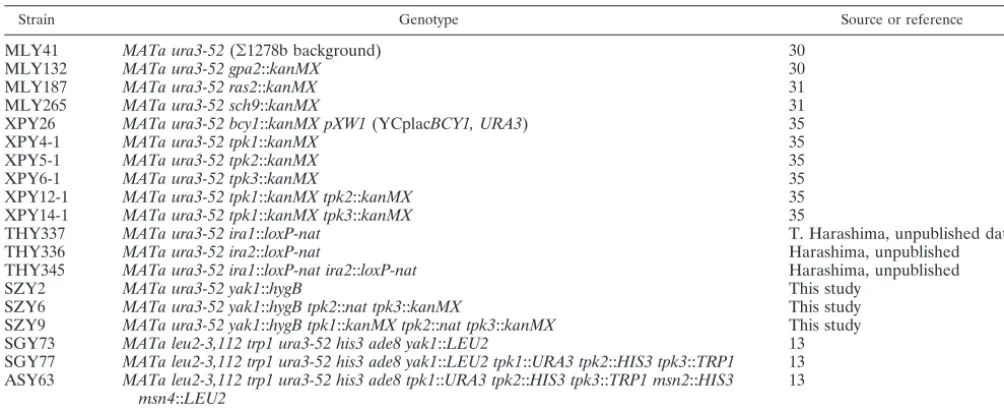
Yeast strains and media.Strains used in this study are listed in Table 1. With the exceptions indicated below, all strains are isogenic derivatives of MLY41 (⌺1278b background) (30). Strains SGY73, SGY77, and ASY63 are derived from S288c and were kindly provided by Stephen Garrett. Yeast media were prepared
as described previously (14, 48). Rapamycin was added to the media from concentrated stock solutions in 90% ethanol–10% Tween 20. Yeast transforma-tions were performed by the lithium acetate method (46). Unless noted other-wise, mutant yeast strains were constructed by PCR-mediated gene disruption, replacing the entire open reading frame of the targeted gene with the G418 resistance gene cassette derived from template plasmid pFA6-kanMX2, the nourseothricin (nat) resistance gene cassette derived from plasmid pAG25, or the hygromycin B (hygB) resistance gene cassette derived from plasmid pAG32 (15, 29). All gene deletions were confirmed by PCR. Strain SZY9 was con-structed by crossing SZY6 to XPY14-1. The resulting diploid was sporulated, and the progeny were dissected and genotypes were verified by PCR analysis. Loss of plasmid pXP1 (containing theBCY1gene) from strain XPY26 was selected on 5-fluoroorotic acid medium. Plasmids pRS316 (CEN URA3) and pMW2 (CEN URA3 RAS2V19
) were previously described (49, 60).
Northern blotting.RNA isolation and Northern blot analysis were performed as described previously (7). DNA probes hybridizing toRPS26,RPS28B,ACT1,
MEP2,GAP1,CIT2, andSOD2genes were PCR amplified from yeast genomic DNA with specific primers. Signals were quantified with a Typhoon 9200 variable mode imager by using Image Quantifier 5.2 software (Molecular Dynamics).
cAMP assay.Cell cultures were grown to exponential phase in yeast extract-peptone (YP)-glucose medium, harvested, washed three times in YP medium, transferred to YP medium, and incubated for 2 h to deplete glucose. Cell cultures were divided in two, the cultures were treated with 50 nM rapamycin or drug vehicle alone, and incubation was continued for 15 min. Cell aliquots were removed at 0 (no glucose), 0.5, 1, and 3 min after the addition of 2% glucose, and cAMP was determined as described earlier (23).
Glycogen staining.Exponentially growing cells were treated with 100 nM rapamycin and incubated at 30°C. After 4 h of treatment, samples containing 5 optical densities of cells were harvested on Millipore HA filters and exposed to iodine vapors for 2 min.
RESULTS
Mutations that activate the PKA pathway confer resistance to rapamycin and largely prevent rapamycin-induced inacti-vation of RP genes. The Tor and cAMP-PKA signaling cas-cades are known to regulate the expression of RP genes in response to nutrients; in this study, we sought to determine whether the two pathways signal via independent or interde-pendent mechanisms to execute this function. To establish if the PKA pathway is linked to Tor signaling, we investigated whether mutations that activate PKA alter the sensitivity of cells to rapamycin. As shown in Fig. 1A, mutant strains lacking
TABLE 1. Yeast strains
Strain Genotype Source or reference
MLY41 MATa ura3-52(兺1278b background) 30
MLY132 MATa ura3-52 gpa2::kanMX 30
MLY187 MATa ura3-52 ras2::kanMX 31
MLY265 MATa ura3-52 sch9::kanMX 31
XPY26 MATa ura3-52 bcy1::kanMX pXW1(YCplacBCY1, URA3) 35
XPY4-1 MATa ura3-52 tpk1::kanMX 35
XPY5-1 MATa ura3-52 tpk2::kanMX 35
XPY6-1 MATa ura3-52 tpk3::kanMX 35
XPY12-1 MATa ura3-52 tpk1::kanMX tpk2::kanMX 35
XPY14-1 MATa ura3-52 tpk1::kanMX tpk3::kanMX 35
THY337 MATa ura3-52 ira1::loxP-nat T. Harashima, unpublished data
THY336 MATa ura3-52 ira2::loxP-nat Harashima, unpublished
THY345 MATa ura3-52 ira1::loxP-nat ira2::loxP-nat Harashima, unpublished
SZY2 MATa ura3-52 yak1::hygB This study
SZY6 MATa ura3-52 yak1::hygB tpk2::nat tpk3::kanMX This study
SZY9 MATa ura3-52 yak1::hygB tpk1::kanMX tpk2::nat tpk3::kanMX This study
SGY73 MATa leu2-3,112 trp1 ura3-52 his3 ade8 yak1::LEU2 13
SGY77 MATa leu2-3,112 trp1 ura3-52 his3 ade8 yak1::LEU2 tpk1::URA3 tpk2::HIS3 tpk3::TRP1 13 ASY63 MATa leu2-3,112 trp1 ura3-52 his3 ade8 tpk1::URA3 tpk2::HIS3 tpk3::TRP1 msn2::HIS3
msn4::LEU2
13
64 ZURITA-MARTINEZ AND CARDENAS EUKARYOT. CELL
on September 8, 2020 by guest
http://ec.asm.org/
the Ras negative regulator Ira1, Ira1 and Ira2, or the PKA negative regulatory subunit Bcy1, are all more resistant to rapamycin than the wild-type strain. Similarly, the expression
of the dominant activatedRAS2V19 allele leads to increased
rapamycin resistance.
We have previously shown that the Rpd3 histone deacety-lase operates at RP gene promoters and enables repression of RP genes in response to rapamycin. Accordingly, we found that Rpd3 was bound to RP genes, and mutations affecting three different Rpd3 subunits conferred resistance to rapamy-cin and partially prevented RP gene repression induced by rapamycin (44). Based on these observations and the known action of PKA in regulating RP genes, we reasoned that the PKA-activating mutations that increase rapamycin resistance do so by preventing RP gene repression. To test this hypoth-esis, we examined the expression of the RP genes and com-pared it to that of other Tor-regulated genes in the different PKA-activating mutant strains.
As shown previously, in wild-type cells RP gene transcripts decreased to almost undetectable levels within 1 h of treatment with rapamycin (Fig. 1B) (7). Concomitantly, the expression of
the NCR genesMEP2and GAP1, and of the retrograde
re-sponse geneCIT2 also known to be under Tor control, was
rapidly induced after exposure to rapamycin (Fig. 1B). It is known that both Tor and PKA activity antagonize induction of the general stress response genes regulated by Msn2 and Msn4 (2, 16, 17). Therefore, we examined the transcription levels of
theSOD2gene, which is induced by oxidative stress and
nu-trient deprivation. As expected,SOD2was strongly induced in
response to rapamycin (Fig. 1B).
In accord with previous studies, we found that expression of the RP genes was slightly increased in the different PKA-activated mutants compared to the wild-type strain (24).
Inter-estingly, PKA activation by thebcy1orira1 ira2mutations, and
more prominently by expression of RAS2V19, partially
pre-vented rapamycin-induced repression of the RP genes (Fig. 1B
and C). The fact that in theira1 ira2andbcy1mutants some RP
gene expression was still responsive to Tor inhibition by rapa-mycin, although to a lesser magnitude than that observed with the wild-type strain, argues that the two pathways must be at least partially independent. The PKA-activating mutations
im-paired expression of the STRE geneSOD2seen in response to
FIG. 1. Hyperactivating mutations of the PKA pathway confer resistance to rapamycin and prevent rapamycin-induced RP gene repression. (A) Isogenic wild-type (MLY41a),ira1(THY337),ira2(THY336),ira1 ira2(THY345), andbcy1(XPY26) mutants, wild-type strain transformed with empty vector, and a plasmid carrying theRAS2V19allele were grown overnight at 30°C in YP-glucose medium. Equivalent numbers of cells
were serially diluted and aliquots were spotted onto plates of YP-glucose medium with and without 50 nM rapamycin. After 3 days of incubation at 30°C, plates were photographed. (B) Actively growing cultures of the strains indicated in panel A were treated with 50 nM rapamycin for 0, 30, 60, and 120 min. Total RNA was isolated, and 15g of RNA was analyzed by Northern blotting. Individual RNAs were detected by using radioactive oligonucleotide probes corresponding to the genes indicated at the left. (C) The graph shows the quantification of Northern blot signal for theRSP26gene normalized to the signal for theACT1loading control. Northern blot results presented in all figures are representative of at least two independent experiments. WT, wild type; ND, not determined.
on September 8, 2020 by guest
http://ec.asm.org/
rapamycin and did not have significant effects on the rapamy-cin-induced expression of the NCR or RTG-regulated genes analyzed in this study (Fig. 1B).
Our results show that mutations that activate the PKA path-way confer resistance to rapamycin, and this resistance corre-lates with the ability of these mutations to prevent rapamycin-induced repression of the RP genes. These results are in agreement with a recent study demonstrating that PKA acti-vation overcomes rapamycin hypersensitivity conferred by mu-tation of Gln3 and prevents RP gene repression (47).
Partial inactivation of the cAMP-PKA pathway confers ra-pamycin-hypersensitive growth and has modest effects on RP gene expression.Next, we tested the effect of mutations that inactivate PKA signaling on Tor-regulated gene expression. Interestingly, deletion of any of the three PKA catalytic sub-units resulted in hypersensitivity to rapamycin, and this effect
was more marked in thetpk1 tpk2 double mutant strain. In
addition, deletion ofRAS2orGPA2, which leads to defects in
PKA activation, also conferred rapamycin hypersensitivity (Fig. 2A and data not shown).
We next analyzed whether the increased sensitivity to rapa-mycin of the PKA defective strains is correlated with changes
in RP gene expression. Deletion of eitherRAS2orGPA2did
not alter RP gene expression; however, strains with a deletion
of theTPK1gene alone or in combination withTPK2orTPK3
showed decreased levels of RP gene expression compared to
the wild-type strain (Fig. 2B and C; data not shown forGPA2).
Moreover, the PKA-inactivating mutations had little impact on the rapamycinduced repression of RP genes or on the
in-duction of theGAP1,MEP2,CIT2, andSOD2genes.
Ras-cAMP PKA and Sch9 appear to stimulate growth via parallel pathways, as hyperactivation of either signaling cas-cade suppresses loss of the other (54). To test if the Sch9 kinase might be involved in the PKA pathway, we tested whether Tor signals via Sch9 to regulate RP gene expression. We found that mutation of Sch9 had no effect on Tor-regu-lated RP gene expression (data not shown). These results do not support models in which Tor regulates RP gene expression via Ras2, Gpa2, a specific PKA catalytic subunit, or the Sch9 kinase. However, our results do not rule out a redundant role for the three TPK subunits in regulating RP gene expression downstream from Tor.
Tor signaling regulates RP gene expression by a PKA-inde-pendent mechanism.To test whether there is redundancy be-tween the three TPK subunits to regulate RP gene expression, we constructed a strain lacking all three subunits.
Simulta-FIG. 2. Mutations that partially inactivate the cAMP-PKA pathway confer rapamycin-hypersensitive growth and impair RP gene expression. (A) Isogenic wild-type (MLY41a),ras2(MLY187),tpk1(XPY4-1),tpk2(XPY5-1),tpk3(XPY6-1), andtpk1 tpk3(XPY14-1) mutant strains were grown, serially diluted, and spotted onto plates of YP-glucose medium with and without 50 nM rapamycin as indicated in legend to Fig. 1A. Cultures were photographed after 3 days of incubation at 30°C. (B) Exponentially growing cultures of isogenic wild-type (MLY41a),ras2
(MLY187),tpk1(XPY4-1),tpk1 tpk2(XPY12-1), andtpk1 tpk3(XPY14-1) mutant strains were treated with 50 nM of rapamycin for 0, 30, 60, and 120 min. RNA was prepared and analyzed by Northern blotting with radioactive probes that hybridize to the genes indicated at the left. (C) The graph shows the quantification of the Northern blot-specific signal for theRPS26gene normalized to theACT1loading control signal. WT, wild type.
66 ZURITA-MARTINEZ AND CARDENAS EUKARYOT. CELL
on September 8, 2020 by guest
http://ec.asm.org/
neous deletion of all three PKA catalytic subunits is lethal (5). However, suppression of the stress response, either by muta-tion of Msn2 and Msn4 or by mutamuta-tion of the PKA-related
kinase Yak1, restores viability oftpk1 tpk2 tpk3mutant cells
(50). The tpk1 tpk2 tpk3 yak1 deletion strain exhibited slow
growth when compared to either wild-type or theyak1strain.
In addition, thetpk1 tpk2 tpk3 yak1mutant strain exhibited a
dramatic hypersensitivity to rapamycin; the MIC at which 100% of the isolates are inhibited was 10 nM for this mutant
strain, compared to⬎100 nM for the wild type (Fig. 3A). For
comparison, we also tested the effects of these PKA mutations
in a different strain background. As shown in Fig. 4A, theyak1
single,tpk1 tpk2 tpk3 yak1quadruple, andtpk1 tpk2 tpk3 msn2
msn4 quintuple mutant strains in the S288c genetic
back-ground showed rapamycin sensitivity patterns similar to those
observed with the PKA mutant strains of the ⌺1278b
back-ground (Fig. 3A).
Deletion of the three TPKgenes resulted in a marked
re-duction in RP gene expression compared with the wild-type
strain or the yak1mutant strain. Moreover, in the tpk1 tpk2
tpk3 yak1 mutant cells from the two different strain back-grounds, RP gene expression was still repressed by rapamycin and thus was responsive to Tor signaling (compare Fig. 3B and C with Fig. 4B and C). PKA mutation did not have any signif-icant effect on the rapamycin-induced expression of the NCR
geneMEP2. As expected, PKA deletion resulted in
derepres-sion of the stress response geneSOD2, and this derepressed
level of expression was further increased by rapamycin treat-ment (Fig. 3B; quantified in Fig. 3D). These results lend fur-ther support to an earlier model proposed by two previous reports indicating that while PKA activity regulates the nuclear
FIG. 3. PKA catalytic activity is not required for Tor regulation of RP genes. (A) Isogenic⌺1278b wild-type (MLY41),yak1(SZY2), and
tpk1 tpk2 tpk3 yak1 (SZY9) strains were serially diluted onto YP-glucose medium with or without 50 nM rapamycin, grown for 3 days at 30°C, and photographed. (B) Strains were grown to exponential phase and treated with 50 nM rapamycin for 0, 30, 60, and 120 min as indicated. RNA was prepared and analyzed by Northern blotting with radioactive probes that hybridize to the genes indicated at the left. The
RPS26(C) andSOD2(D) gene-specific Northern blot signals were quantified and normalized to the ACT1 gene-specific signal. The graphs show theRPS26/ACT1and SOD2/ACT1 ratios, respectively. WT, wild type.
FIG. 4. PKA catalytic activity is not required for Tor regulation of RP genes. (A) Isogenic wild-type,yak1(SGY73),tpk1 tpk2 tpk3 yak1
(SGY77), andtpk1 tpk2 tpk3 msn2 msn4(ASY63) strains from the S288c genetic background were serially diluted onto YP-glucose me-dium with or without 50 nM rapamycin, grown, and photographed as indicated in the legend to Fig. 1A. (B) The strains indicated in panel A were grown to exponential phase and treated with 50 nM rapamycin for 0, 30, 60, and 120 min as indicated. RNA was prepared and analyzed by Northern blotting with radioactive probes that hybridize to the genes indicated at the left. (C) TheRPS26gene-specific Northern blot signal was quantified and normalized to theACT1gene-specific signal. The graph shows theRPS26/ACT1ratio.
on September 8, 2020 by guest
http://ec.asm.org/
import of Msn2 and Msn4, Tor signaling regulates their nu-clear export in a PKA-independent fashion (11, 17). We con-clude that the PKA catalytic subunits are not required for Tor regulation of either RP or STRE gene expression. Importantly, these studies also indicate that if Tor signaling acts via the cAMP-PKA pathway, the point of cross talk between these two pathways is not at the level of any of the PKA catalytic sub-units.
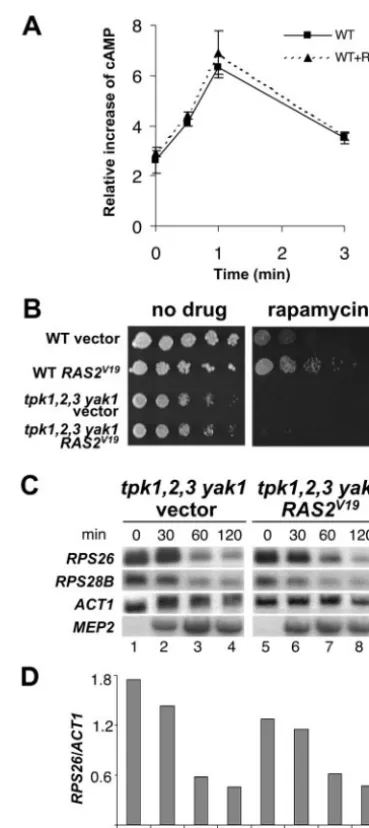
Activated Ras signals via the PKA catalytic subunits to overcome RP gene repression in response to rapamycin. To address whether Tor signaling intercepts the PKA pathway at a component upstream from the three TPK subunits, we first examined the possibility that Tor regulates cAMP levels. We found that rapamycin treatment did not have any effect on the increase of cAMP levels produced in response to glucose ad-dition to glucose-starved, nitrogen-replete cells (Fig. 5A).
Next, we tested whether the expression of theRAS2V19allele in
the tpk1 tpk2 tpk3 yak1 mutant strain overcomes RP gene repression induced by rapamycin. As shown above, wild-type cells become resistant to rapamycin when they are transformed
with the activatedRAS2allele. However, theRAS2V19allele is
unable to confer rapamycin-resistant growth to thetpk1 tpk2
tpk3 yak1quadruple mutant strain (Fig. 5). Similarly,
overex-pression of RAS2V19 requires PKA catalytic activity to
over-come the rapamycin-induced repression of the RP genes in the
tpk1 tpk2 tpk3 yak1mutant strain (Fig. 5C and D).
These data exclude models in which Tor controls the activity of either adenylyl cyclase or cAMP phosphodiesterases. These
results also demonstrate that Ras2V19 signals via the TPK
subunits to overcome rapamycin toxicity. Our results are con-sistent with a model in which the TPK subunits are not re-quired for Tor-regulated RP gene expression. Moreover, these results do not support models in which Tor signals to a PKA component upstream of the TPK subunits.
Tor regulates glycogen accumulation via a PKA-indepen-dent mechanism.It is well established that both the Tor and PKA pathways control glycogen homeostasis (1, 12, 21). In addition, data from our gene array expression analysis revealed that rapamycin treatment induces the expression of genes re-quired for glycogen synthesis (Table 2) (7). This result is con-sistent with several reports indicating that a number of genes required for glycogen synthesis are regulated, at least in part, by the Tor-regulated Msn2 and Msn4 transactivators (45, 50). Recently, it was proposed that rapamycin-induced accumula-tion of glycogen is blocked by high levels of PKA activity, suggesting that Tor signals through the PKA pathway to reg-ulate glycogen homeostasis (47).
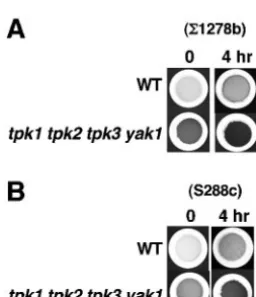
We tested whether Tor signaling regulates glycogen synthe-sis in strains lacking PKA activity. As expected, we observed
that thetpk1 tpk2 tpk3 yak1mutant strain contains higher levels
of glycogen than wild-type cells. Remarkably, after exposure to
rapamycin thetpk1 tpk2 tpk3 yak1mutant strain stained darker
when exposed to iodine vapors, indicating an increase in gly-cogen levels (Fig. 6A). We also tested glygly-cogen accumulation in the presence of rapamycin in the PKA mutant strain from
the S288c genetic background. We observed thattpk1 tpk2 tpk3
yak1mutant cells in this background showed an increased level
of glycogen and that this level increases further in response to rapamycin, as seen in the corresponding PKA mutants in
⌺1278b (compare Fig. 6A and B). These results indicate that
FIG. 5. Rapamycin does not interfere with the ability of cells to synthesize cAMP in response to glucose. (A) A culture of the wild-type strain (MLY41) was grown in YP-glucose medium to exponential phase. The cells were washed with YP medium (no glucose), trans-ferred to YP medium, and incubated for 2 h at 30°C. The culture was divided in two and treated with either drug vehicle alone or 50 nM rapamycin for 15 min, and 2% glucose was added to the cultures. Aliquots of cells were removed at 0 (no glucose), 0.5, 1, and 3 min, and the intracellular cAMP levels were determined. The results shown are the averages of two independent experiments (error bars indicate the standard deviation). (B to D) PKA catalytic subunits are required for theRAS2V19allele to confer rapamycin-resistant growth and to prevent
RP gene repression in response to rapamycin. (B) Exponentially grow-ing cultures of isogenic wild-type (MLY41) transformed with empty vector (WT vector) and with a plasmid carrying theRAS2V19allele
(WTRAS2V19), thetpk1 tpk2 tpk3 yak1mutant strain bearing an empty
vector, and the plasmid pMW2 expressing the activatedRAS2V19allele
were serially diluted, and aliquots were spotted onto plates of YP-glucose medium with or without 50 nM rapamycin. The plates were photographed following 3 days of incubation at 30°C. (C) Thetpk1 tpk2 tpk3 yak1 mutant strain transformed with the empty vector or the plasmid containing the RAS2V19 allele were grown to exponential
phase. RNA was isolated and analyzed by Northern blotting with specific probes of the indicated genes. (D) The graph shows theRPS26/ ACT1ratio.
68 ZURITA-MARTINEZ AND CARDENAS EUKARYOT. CELL
on September 8, 2020 by guest
http://ec.asm.org/
Tor regulates glycogen homeostasis via a PKA-independent mechanism. This conclusion is in accord with a previous report, which suggested that the Tor and PKA signaling pathways act independently since glycogen accumulation in rapamycin-treated cells is not inhibited by hyperactivation of the cAMP-PKA pathway (1).
DISCUSSION
Control of cell growth is a complex process governed by nutrient availability and growth factors that are sensed and transmitted by specialized signal transduction cascades. In many known examples, common pathway components can gen-erate cross talk between different signal transduction cascades. However, despite this cross talk, specialization of these path-ways can be restored further downstream in the pathway by coordinating inputs from other signaling cascades and target-ing different molecular effectors. In other cases, signal trans-duction cascades work strictly independently of one another but converge upon common downstream targets.
The Tor signaling cascade often functions in parallel with the PKA pathway to regulate common biological processes.
Both the Tor and the cAMP-PKA pathways act early in G1
phase to regulate growth, cell cycle progression, entry into Go,
and pseudohyphal differentiation inS. cerevisiae(1, 4, 8, 10, 22,
27, 30, 36, 40, 53, 63).
Cell growth is dependent upon ribosome biogenesis and translation. It is well established that the cAMP-PKA pathway has a positive role in regulating the expression of genes re-quired for cell growth, including the RP genes, while simulta-neously down-regulating genes required for stress responses and carbohydrate storage. The advent of DNA microarray technology and its application to analyze genome-wide gene expression allowed this view to be expanded and has resulted in the characterization of the Tor pathway as a second global nutrient-sensing signal transduction cascade that regulates growth via several of the same gene families governed by the cAMP-PKA cascade (7, 20; reviewed in references 41 and 43). Given the myriad functions shared by the Tor and cAMP-PKA cascades, we reasoned that there could be cross talk between these pathways to execute these biological functions. Remarkably, contrary to this expectation, we find no evidence supporting models in which Tor signals via the cAMP-PKA pathway. First, complete elimination of all PKA activity by deletion of the three Tpk catalytic subunits resulted in a sub-stantial reduction in RP gene expression, yet this reduced level of expression was still sensitive to rapamycin and thus subject
to Tor signaling. Second, we found that tpk1 tpk2 tpk3 yak1
mutant cells accumulate higher levels of glycogen than wild-type cells, and this level increased further upon exposure to
rapamycin. Third, the ability of the activatedRAS2V19allele to
confer rapamycin-resistant growth and to overcome rapamy-cin-induced RP gene repression was found to be dependent upon PKA catalytic activity. This result argues against models in which Tor acts on PKA components downstream of Ras and upstream of the Tpk catalytic subunits. Fourth, because rapa-mycin treatment does not block the ability of the cell to in-crease cAMP levels in response to glucose, we can exclude models in which Tor signaling activates Ras and thereby ad-enylyl cyclase or those in which Tor regulates the activity of cAMP phosphodiesterases. Taken together, these results are in accord with a model in which Tor and cAMP-PKA function as two parallel pathways to independently regulate molecular fac-tors engaged in the expression of RP and STRE genes as well as genes required for glycogen accumulation. While the Tor pathway negatively regulates STRE genes through the Tap42-PP2A effector branch and induces RP genes by a Tap42- Tap42-PP2A-independent mechanism, the cAMP-PKA cascade orchestrates control of both gene families via the Tpk catalytic subunits (11, 42). This model is also consistent with the epistasis observa-tions in this and a previous study that hyperactivation of one pathway can compensate for a block in the other (47). Our findings are in accord with a recent study in which it was demonstrated that Tor and PKA act independently of each other to regulate the Rim15 protein kinase that controls entry
into Go (36). Moreover, our model is also in line with the
observation that while PKA activity prevents the nuclear im-port of the STRE gene transactivators Msn2 and Msn4, Tor signaling controls the nuclear export of these factors (11, 17). Our results are in agreement with a recent study demon-strating that hyperactivation of the PKA pathway increases the
rapamycin resistance ofgln3 gat1mutant cells but has no effect
FIG. 6. Tor signaling regulates glycogen accumulation in mutant cells lacking PKA activity. (A) Isogenic wild-type (WT) strain MLY41 and thetpk1 tpk2 tpk3 yak1(SZY9) strain and (B) isogenic wild-type strain S288c and thetpk1 tpk2 tpk3 yak1(SGY77) mutant strain were grown in YP-glucose medium to exponential phase. Cultures were treated with 100 nM rapamycin for 4 h. Cells were harvested on filters and subsequently exposed to iodine vapors for 2 min.
TABLE 2. Rapamycin induces expression of genes involved in glycogen accumulationa
Gene Function Fold
Induction
GSY1 Glycogen synthase 2.3
GSY2 Glycogen synthase 6.3
GLC3 Glycogen branching enzyme 3.1
GPH1 Glycogen phosphorylase 10.0
TPS1 Trehalose-phosphatase 2.3
TPS2 Trehalose-phosphatase 5.1
NTH2 Neutral trehalase 2.0
aStrain MLY41 was grown to early exponential phase and treated or not
treated with 200 nM rapamycin for 2 h. Cells were harvested and poly(A) RNA was isolated and processed for yeast genome analysis as indicated in reference 7. Note that results shown are gene induction (n-fold) observed for the rapamycin-treated sample with the unrapamycin-treated sample as the baseline.
on September 8, 2020 by guest
http://ec.asm.org/
on wild-type cells of the JK93d genetic background (47). We observed that PKA hyperactivation confers rapamycin
resis-tance to otherwise wild-type cells of the⌺1278b genetic
back-ground. It is known that under normal conditions, the⌺1278b
strain has a hyperactive PKA pathway (51). This fact may
explain in part why the ⌺1278b strain is more resistant to
rapamycin than strains from other genetic backgrounds, in-cluding JK93d (42), and may explain why PKA hyperactivation
in⌺1278b cells can overcome rapamycin toxicity in otherwise
wild-type cells. Recently, it was shown that inactivation of Tor by rapamycin triggers the nuclear localization of the Tpk1 catalytic subunit and the Yak1 kinase (47). This effect was taken as evidence to propose that Tor signals via the PKA pathway to control common effector targets (47). While the functional significance of this nuclear localization event is still not understood, deletion of Tpk1 alone or in combination with
Tpk2 and/or Tpk3 in the context of thetpk1 tpk2 tpk3 yak1and
thetpk1 tpk2 tpk3 msn2 msn4multiple mutant strains did not perturb Tor-regulated expression of the RP and STRE genes or of the genes required for glycogen accumulation in our studies. Our findings therefore support models in which Tor and PKA signal independently of each other and do not sup-port a recent proposal that Tor signals via PKA (47).
A major challenge in the Tor field is to understand how Tor acts in concert with other signaling cascades. In the case of the response to amino acid deprivation, there is cross talk between the Tor and the general amino acid control response pathways from the Tap42-Sit4 effector branch to the Gcn2 kinase and
eIF2␣(9, 26, 42). Here, we show that in contrast, Tor and the
cAMP-PKA pathways act in parallel and converge to globally control the expression of genes involved in tuning the transla-tional capacity of the cell. This model argues that for the regulation of RP, Tor and PKA genes converge to act at a late step, closer to the transcriptional activators of these genes. This convergence provides a molecular mechanism for coordi-nating the sensing of both nitrogen (via Tor) and carbon (via PKA) sources to appropriately drive growth in response to nutrients or restrain it in response to nutrient limitation. By maintaining two separate pathways, the cell also ensures a high fidelity of signal transmission and allows each pathway to in-dividually govern other cellular responses and to coordinate their signal transmission with other global regulatory networks. Given the relevance of Tor and the cAMP-PKA pathways to growth control in yeast, nematodes, flies, and humans, it is not surprising that these pathways are perturbed in a vast number of human malignancies (recently reviewed in references 3 and 58). Understanding the interplay between Tor and other signal transduction cascades furthers knowledge of the molecular events that transpire during the transformation of normal cells to the malignant state and provides insight for clinical appli-cations of rapamycin and its analogs as chemotherapeutic agents.
ACKNOWLEDGMENTS
We thank Joseph Heitman and John Rohde for their continued support and encouragement and for critical reading of the manuscript. We thank Stephen Garrett, Xuewen Pan, and Toshiaki Harashima for strains.
This work was supported by grant CA94925-03 from the NCI (to M.E.C.).
REFERENCES
1.Barbet, N. C., U. Schneider, S. B. Helliwell, I. Stansfield, M. F. Tuite, and M. N. Hall.1996. TOR controls translation initiation and early G1
progres-sion in yeast. Mol. Biol. Cell7:25–42.
2.Beck, T., and M. N. Hall.1999. The TOR signalling pathway controls nuclear localization of nutrient-regulated transcription factors. Nature402:689–692. 3.Bjornsti, M. A., and P. J. Houghton.2004. The TOR pathway: a target for
cancer therapy. Nat. Rev. Cancer4:335–348.
4.Broach, J. R.1991. RAS genes inSaccharomyces cerevisiae: signal transduc-tion in search of a pathway. Trends Genet.7:28–33.
5.Cameron, S., L. Levin, M. Zoller, and M. Wigler.1988. cAMP-independent control of sporulation, glycogen metabolism, and heat shock resistance inS. cerevisiae. Cell53:555–566.
6.Cannon, J. F., and K. Tatchell.1987. Characterization of Saccharomyces cerevisiaegenes encoding subunits of cyclic AMP-dependent protein kinase. Mol. Cell. Biol.7:2653–2663.
7.Cardenas, M. E., N. S. Cutler, M. C. Lorenz, C. J. Di Como, and J. Heitman. 1999. The TOR signaling cascade regulates gene expression in response to nutrients. Genes Dev.13:3271–3279.
8.Cardenas, M. E., and J. Heitman.1995. FKBP12-rapamycin target TOR2 is a vacuolar protein with an associated phosphatidylinositol-4 kinase activity. EMBO J.14:5892–5907.
9.Cherkasova, V. A., and A. G. Hinnebusch.2003. Translational control by TOR and TAP42 through dephosphorylation of eIF2␣kinase GCN2. Genes Dev.17:859–872.
10.Cutler, N. S., X. Pan, J. Heitman, and M. E. Cardenas.2001. The TOR signal transduction cascade controls cellular differentiation in response to nutrients. Mol. Biol. Cell12:4103–4113.
11.Duvel, K., A. Santhanam, S. Garrett, L. Schneper, and J. R. Broach.2003. Multiple roles of Tap42 in mediating rapamycin-induced transcriptional changes in yeast. Mol. Cell11:1467–1478.
12.Francois, J. M., S. Thompson-Jaeger, J. Skroch, U. Zellenka, W. Spevak, and K. Tatchell.1992. GAC1 may encode a regulatory subunit for protein phosphatase type 1 inSaccharomyces cerevisiae. EMBO J.11:87–96. 13.Garrett, S., and J. Broach.1989. Loss of Ras activity inSaccharomyces
cerevisiaeis suppressed by disruptions of a new kinase gene, YAKI, whose product may act downstream of the cAMP-dependent protein kinase. Genes Dev.3:1336–1348.
14.Gimeno, C. J., P. O. Ljungdahl, C. A. Styles, and G. R. Fink.1992. Unipolar cell divisions in the yeastS. cerevisiaelead to filamentous growth: regulation by starvation and RAS. Cell68:1077–1090.
15.Goldstein, A. L., and J. H. McCusker.1999. Three new dominant drug resistance cassettes for gene disruption inSaccharomyces cerevisiae. Yeast 15:1541–1553.
16.Go¨rner, W., E. Durchschlag, M. T. Martinez-Pastor, F. Estruch, G. Am-merer, B. Hamilton, H. Ruis, and C. Schu¨ller.1998. Nuclear localization of the C2H2zinc finger protein Msn2p is regulated by stress and protein kinase
A activity. Genes Dev.12:586–597.
17.Go¨rner, W., E. Durchschlag, J. Wolf, E. L. Brown, G. Ammerer, H. Ruis, and C. Schu¨ller.2002. Acute glucose starvation activates the nuclear localization signal of a stress-specific yeast transcription factor. EMBO J.21:135–144. 18.Hafen, E.2004. Interplay between growth factor and nutrient signaling:
lessons fromDrosophilaTOR. Curr. Top. Microbiol. Immunol.279:153–167. 19.Harashima, T., and J. Heitman.2004. Nutrient control of dimorphic growth inSaccharomyces cerevisiae, p. 131–169.InJ. G. Winderickx and P. M. Taylor (ed.), Topics in current genetics, vol. 7. Springer-Verlag, Berlin, Germany. 20.Hardwick, J. S., F. G. Kuruvilla, J. K. Tong, A. F. Shamji, and S. L. Schreiber.1999. Rapamycin-modulated transcription defines the subset of nutrient-sensitive signaling pathways directly controlled by the Tor proteins. Proc. Natl. Acad. Sci. USA96:14866–14870.
21.Hardy, T. A., D. Huang, and P. J. Roach.1994. Interactions between cAMP-dependent and SNF1 protein kinases in the control of glycogen accumula-tion inSaccharomyces cerevisiae. J. Biol. Chem.269:27907–27913. 22.Heitman, J., N. R. Movva, and M. N. Hall.1991. Targets for cell cycle arrest
by the immunosuppressant rapamycin in yeast. Science253:905–909. 23.Jiang, Y., C. Davis, and J. R. Broach.1998. Efficient transition to growth on
fermentable carbon sources inSaccharomyces cerevisiaerequires signaling through the Ras pathway. EMBO J.17:6942–6951.
24.Klein, C., and K. Struhl.1994. Protein kinase A mediates growth-regulated expression of yeast ribosomal protein genes by modulating RAP1 transcrip-tional activity. Mol. Cell. Biol.14:1920–1928.
25.Komeili, A., K. P. Wedaman, E. K. O’Shea, and T. Powers.2000. Mechanism of metabolic control. Target of rapamycin signaling links nitrogen quality to the activity of the Rtg1 and Rtg3 transcription factors. J. Cell Biol.151:863– 878.
26.Kubota, H., T. Obata, K. Ota, T. Sasaki, and T. Ito.2003. Rapamycin-induced translational derepression ofGCN4mRNA involves a novel mech-anism for activation of the eIF2␣kinase GCN2. J. Biol. Chem.278:20457– 20460.
27.Kunz, J., R. Henriquez, U. Schneider, M. Deuter-Reinhard, N. R. Movva, and M. N. Hall.1993. Target of rapamycin in yeast, TOR2, is an essential
70 ZURITA-MARTINEZ AND CARDENAS EUKARYOT. CELL
on September 8, 2020 by guest
http://ec.asm.org/
phosphatidylinositol kinase homolog required for G1progression. Cell73:
585–596.
28.Long, X., F. Muller, and J. Avruch.2004. TOR action in mammalian cells and inCaenorhabditis elegans. Curr. Top. Microbiol. Immunol.279:115–138. 29.Longtine, M. S., A. McKenzie III, D. J. Demarini, N. G. Shah, A. Wach, A. Brachat, P. Philippsen, and J. R. Pringle.1998. Additional modules for versatile and economical PCR-based gene deletion and modification in Sac-charomyces cerevisiae. Yeast14:953–961.
30.Lorenz, M. C., and J. Heitman.1997. Yeast pseudohyphal growth is regu-lated by GPA2, a G protein␣homolog. EMBO J.16:7008–7018. 31.Lorenz, M. C., X. Pan, T. Harashima, M. E. Cardenas, Y. Xue, J. P. Hirsch,
and J. Heitman.2000. The G protein-coupled receptor Gpr1 is a nutrient sensor that regulates pseudohyphal differentiation inSaccharomyces cerevi-siae. Genetics154:609–622.
32.Marbach, I., R. Licht, H. Frohnmeyer, and D. Engelberg.2001. Gcn2 me-diates Gcn4 activation in response to glucose stimulation or UV radiation not viaGCN4translation. J. Biol. Chem.276:16944–16951.
33.Mbonyi, K., and J. M. Thevelein.1988. The high-affinity glucose uptake system is not required for induction of the RAS-mediated cAMP signal by glucose in cells of the yeastSaccharomyces cerevisiae. Biochim. Biophys. Acta 971:223–226.
34.Neuman-Silberberg, F. S., S. Bhattacharya, and J. R. Broach.1995. Nutrient availability and the RAS/cyclic AMP pathway both induce expression of ribosomal protein genes inSaccharomyces cerevisiaebut by different mech-anisms. Mol. Cell. Biol.15:3187–3196.
35.Pan, X., and J. Heitman.1999. Cyclic AMP-dependent protein kinase reg-ulates pseudohyphal differentiation inSaccharomyces cerevisiae. Mol. Cell. Biol.19:4874–4887.
36.Pedruzzi, I., F. Dubouloz, E. Cameroni, V. Wanke, J. Roosen, J. Winderickx, and C. De Virgilio.2003. TOR and PKA signaling pathways converge on the protein kinase Rim15 to control entry into G0. Mol. Cell12:1607–1613.
37.Powers, T., and P. Walter.1999. Regulation of ribosome biogenesis by the rapamycin-sensitive TOR-signaling pathway in Saccharomyces cerevisiae. Mol. Biol. Cell10:987–1000.
38.Proud, C. G.2004. Role of mTOR signalling in the control of translation initiation and elongation by nutrients. Curr. Top. Microbiol. Immunol.279: 215–244.
39.Reid, J. L., V. R. Iyer, P. O. Brown, and K. Struhl. 2000. Coordinate regulation of yeast ribosomal protein genes is associated with targeted re-cruitment of Esa1 histone acetylase. Mol. Cell6:1297–1307.
40.Reinders, A., N. Burckert, T. Boller, A. Wiemken, and C. De Virgilio.1998.
Saccharomyces cerevisiaecAMP-dependent protein kinase controls entry into stationary phase through the Rim15p protein kinase. Genes Dev.12:2943– 2955.
41.Rohde, J., J. Heitman, and M. E. Cardenas.2001. The TOR kinases link nutrient sensing to cell growth. J. Biol. Chem.276:9583–9586.
42.Rohde, J. R., S. Campbell, S. A. Zurita-Martinez, N. S. Cutler, M. Ashe, and M. E. Cardenas.2004. TOR controls transcriptional and translational pro-grams via Sap-Sit4 protein phosphatase signaling effectors. Mol. Cell. Biol. 24:8332–8341.
43.Rohde, J. R., and M. E. Cardenas.2004. Nutrient signaling through TOR kinases controls gene expression and cellular differentiation in fungi. Curr. Top. Microbiol. Immunol.279:53–72.
44.Rohde, J. R., and M. E. Cardenas.2003. The Tor pathway regulates gene expression by linking nutrient sensing to histone acetylation. Mol. Cell. Biol. 23:629–635.
45.Ruis, H., and C. Schu¨ller.1995. Stress signaling in yeast. Bioessays17:959– 965.
46.Schiestl, R. H., M. Dominska, and T. D. Petes.1993. Transformation of
Saccharomyces cerevisiaewith nonhomologous DNA: illegitimate integration of transforming DNA into yeast chromosomes and in vivo ligation of trans-forming DNA to mitochondrial DNA sequences. Mol. Cell. Biol.13:2697– 2705.
47.Schmelzle, T., T. Beck, D. E. Martin, and M. N. Hall.2004. Activation of the RAS/cyclic AMP pathway suppresses a TOR deficiency in yeast. Mol. Cell. Biol.24:338–351.
48.Sherman, F.2002. Getting started with yeast. Methods Enzymol.350:3–41. 49.Sikorski, R. S., and P. Hieter.1989. A system of shuttle vectors and yeast host strains designed for efficient manipulation of DNA inSaccharomyces cerevisiae. Genetics122:19–27.
50.Smith, A., M. P. Ward, and S. Garrett.1998. Yeast PKA represses Msn2p/ Msn4p-dependent gene expression to regulate growth, stress response and glycogen accumulation. EMBO J.17:3556–3564.
51.Stanhill, A., N. Schick, and D. Engelberg.1999. The yeast ras/cyclic AMP pathway induces invasive growth by suppressing the cellular stress response. Mol. Cell. Biol.19:7529–7538.
52.Tanaka, K., B. K. Lin, D. R. Wood, and F. Tamanoi. 1991. IRA2, an upstream negative regulator of RAS in yeast, is a RAS GTPase-activating protein. Proc. Natl. Acad. Sci. USA88:468–472.
53.Thevelein, J. M.1994. Signal transduction in yeast. Yeast10:1753–1790. 54.Toda, T., S. Cameron, P. Sass, and M. Wigler.1988. SCH9, a gene of
Saccharomyces cerevisiaethat encodes a protein distinct from, but function-ally and structurfunction-ally related to, cAMP-dependent protein kinase catalytic subunits. Genes Dev.2:517–527.
55.Toda, T., S. Cameron, P. Sass, M. Zoller, J. D. Scott, B. McMullen, M. Hurwitz, E. G. Krebs, and M. Wigler.1987. Cloning and characterization of
BCY1, a locus encoding a regulatory subunit of the cyclic AMP-dependent protein kinase inSaccharomyces cerevisiae. Mol. Cell. Biol.7:1371–1377. 56.Toda, T., S. Cameron, P. Sass, M. Zoller, and M. Wigler. 1987. Three
different genes inS. cerevisiaeencode the catalytic subunits of the cAMP-dependent protein kinase. Cell50:277–287.
57.Toda, T., I. Uno, T. Ishikawa, S. Powers, T. Kataoka, D. Broek, S. Cameron, J. Broach, K. Matsumoto, and M. Wigler.1985. In yeast, RAS proteins are controlling elements of adenylate cyclase. Cell40:27–36.
58.Tortora, G., and F. Ciardiello.2002. Protein kinase A as target for novel integrated strategies of cancer therapy. Ann. N. Y. Acad. Sci.968:139–147. 59.Valenzuela, L., C. Aranda, and A. Gonza´lez.2001. TOR modulatesGCN4 -dependent expression of genes turned on by nitrogen limitation. J. Bacteriol. 183:2331–2334.
60.Ward, M. P., C. J. Gimeno, G. R. Fink, and S. Garrett.1995.SOK2may regulate cyclic AMP-dependent protein kinase-stimulated growth and pseudohyphal development by repressing transcription. Mol. Cell. Biol.15: 6854–6863.
61.Warner, J. R.1999. The economics of ribosome biosynthesis in yeast. Trends Biochem. Sci.24:437–440.
62.Woolford, J. L., Jr.1991. The structure and biogenesis of yeast ribosomes. Adv. Genet.29:63–118.
63.Zaragoza, D., A. Ghavidel, J. Heitman, and M. C. Schultz.1998. Rapamycin induces the G0program of transcriptional repression in yeast by interfering
with the TOR signaling pathway. Mol. Cell. Biol.18:4463–4470.