Comparative Genome Analysis of an Extensively
Drug-Resistant Isolate of Avian Sequence Type 167
Escherichia coli
Strain Sanji with Novel
In Silico
Serotype O89b:H9
Xiancheng Zeng,
a,bXuelin Chi,
a,bBrian T. Ho,
c*
Damee Moon,
dChristine Lambert,
eRichard J. Hall,
ePrimo Baybayan,
eShihua Wang,
bBrenda A. Wilson,
dMengfei Ho
b,daKey Laboratory of Fujian-Taiwan Animal Pathogen Biology, College of Animal Sciences, Fujian Agriculture and Forestry University, Fuzhou, China
bCollege of Life Sciences, Fujian Agriculture and Forestry University, Fuzhou, China
cDepartment of Microbiology and Molecular Genetics, Harvard Medical School, Boston, Massachusetts, USA
dDepartment of Microbiology, School of Molecular and Cellular Biology, University of Illinois at Urbana-Champaign, Urbana, Illinois, USA
ePacific Biosciences, Menlo Park, California, USA
ABSTRACT
Extensive drug resistance (XDR) is an escalating global problem.
Esche-richia coli
strain Sanji was isolated from an outbreak of pheasant colibacillosis in
Fu-jian province, China, in 2011. This strain has XDR properties, exhibiting sensitivity to
carbapenems but no other classes of known antibiotics. Whole-genome sequencing
revealed a total of 32 known antibiotic resistance genes, many associated with
inser-tion sequence 26 (IS
26
) elements. These were found on the Sanji chromosome and 2
of its 6 plasmids, pSJ_255 and pSJ_82. The Sanji chromosome also harbors a type 2
secretion system (T2SS), a type 3 secretion system (T3SS), a type 6 secretion system
(T6SS), and several putative prophages. Sanji and other ST167 strains have a
previ-ously uncharacterized O-antigen (O89b) that is most closely related to serotype O89
as determined on the basis of analysis of the
wzm-wzt
genes and
in silico
serotyp-ing. This O89b-antigen gene cluster was also found in the genomes of a few other
pathogenic sequence type 617 (ST617) and ST10 complex strains. A time-scaled
phy-logeny inferred from comparative single nucleotide variant analysis indicated that
development of these O89b-containing lineages emerged about 30 years ago.
Com-parative sequence analysis revealed that the core genome of Sanji is nearly identical
to that of several recently sequenced strains of pathogenic XDR
E. coli
belonging to
the ST167 group. Comparison of the mobile elements among the different ST167
genomes revealed that each genome carries a distinct set of multidrug resistance
genes on different types of plasmids, indicating that there are multiple paths toward
the emergence of XDR in
E. coli
.
IMPORTANCE
E. coli
strain Sanji is the first sequenced and analyzed genome of the
recently emerged pathogenic XDR strains with sequence type ST167 and novel
in
silico
serotype O89b:H9. Comparison of the genomes of Sanji with other ST167
strains revealed distinct sets of different plasmids, mobile IS elements, and antibiotic
resistance genes in each genome, indicating that there exist multiple paths toward
achieving XDR. The emergence of these pathogenic ST167
E. coli
strains with diverse
XDR capabilities highlights the difficulty of preventing or mitigating the
develop-ment of XDR properties in bacteria and points to the importance of better
under-standing of the shared underlying virulence mechanisms and physiology of
patho-genic bacteria.
KEYWORDS
O-antigen, antibiotic resistance, capsular polysaccharide, extensively
drug resistant, genome comparison, insertion sequence, pathogen evolution,
plasmid-mediated resistance, prophage, secretion systems
CitationZeng X, Chi X, Ho BT, Moon D, Lambert C, Hall RJ, Baybayan P, Wang S, Wilson BA, Ho M. 2019. Comparative genome analysis of an extensively drug-resistant isolate of avian
sequence type 167Escherichia colistrain Sanji
with novelin silicoserotype O89b:H9.
mSystems 4:e00242-18.https://doi.org/10
.1128/mSystems.00242-18.
EditorNicola Segata, University of Trento
Copyright© 2019 Zeng et al. This is an open-access article distributed under the terms of theCreative Commons Attribution 4.0 International license.
Address correspondence to Brenda A. Wilson, [email protected], or Mengfei Ho, [email protected].
*Present address: Brian T. Ho, Department of
Biological Sciences, Birkbeck, University of London, London, United Kingdom.
Comparative genome analysis of XDR E. coli strain Sanji with other recently emerged XDR pathogenic ST167 strains reveals novel in silico serotype O89b:H9 and multiple paths toward achieving XDR and highlights difficulty in preventing development of XDR.
Received6 October 2018
Accepted23 January 2019
Published26 February 2019
Host-Microbe Biology
crossm
on September 8, 2020 by guest
http://msystems.asm.org/
T
(XDR) bacterial strains is a global health crisis (1–3). Many currently circulating
intestinal pathogenic
Escherichia coli
strains, such as the well-known O157:H7 strain (4,
5), are still susceptible to antibiotics. However, the threat of pathogenic
E. coli
acquiring
antibiotic resistance genes from environmental reservoirs is of escalating concern (6, 7),
and more-recent O104:H4 clonal lineages have acquired not only Shiga toxin-encoding
phage but also extended-spectrum-

-lactamase (ESBL) resistance (8, 9). To tackle this
problem, it is important to understand not only how multiple antibiotic resistances are
acquired but also how they can be accumulated within a commensal or pathogenic
bacterium.
Certain traits of genomes in transition toward niche or host adaptation include an
increase in mobile genetic elements that imbue the bacteria with the potential to
acquire additional traits that might enhance virulence in the host (10). Mobile genetic
elements, such as plasmids, bacteriophages, insertion sequence (IS) elements, and
transposons, are well-established players in the acquisition of virulence traits leading to
the emergence and evolution of bacterial pathogens. Despite the critical role that
plasmids and other mobile genetic elements play in antibiotic resistance spread (11,
12), we still cannot predict which resistance genes or plasmids will be acquired by a
bacterial pathogen to cause the next XDR superbug to emerge.
Comparative whole-genome sequence analysis of MDR/XDR strains has enabled
phylogenetic studies into the evolutionary mechanisms involved in acquisition and
accumulation of antibiotic resistance genes (12), including studies exploring
evolution-ary trade-offs between virulence and resistance (13–16); tracking the spread of resistant
pathogens (17–19), or monitoring within-host evolution of pathogens (20, 21). One
comparative genomics study revealed the stepwise evolutionary process by which a
highly infectious clone of extraintestinal pathogenic
E. coli
(ExPEC) of sequence type
131 (ST131) gained multiple virulence and antibiotic resistance gene clusters over a
period of about 60 years (22), ultimately leading to its current global dominance as an
XDR pathogen (23). A similar pattern of sequential emergence of increasing virulence
potential and antibiotic resistances over a period of 30 years has been documented for
another pathogenic
E. coli
clonal group, ST393 (24).
We report the comparative genome characterization of pathogenic
E. coli
strain
Sanji, which was isolated from pheasants during a 2011 outbreak of colibacillosis and
was refractory to clinical application of commonly used veterinary antibiotics. Antibiotic
susceptibility testing confirmed that the isolate was XDR. Whole-genome sequencing of
the bacterial genome, including its six plasmids, and comparative multilocus sequence
typing (MLST) revealed that the core genome of Sanji is nearly identical to the genomes
of a number of recently sequenced pathogenic XDR
E. coli
strains belonging to
sequence type ST167.
In silico
serotyping revealed that Sanji, like other ST167 strains,
has a unique capsular polysaccharide gene cluster and a previously unidentified
in silico
serotype, O89b. The presence of numerous antibiotic resistance gene clusters and IS
26
elements accounts for the observed XDR phenotype. Comparison of Sanji to other
members of the ST167 lineage further revealed the extent and diversity of the paths
used by these bacteria to achieve XDR. This group of ST167 strains represents another
emerging pathogenic clonal lineage with XDR.
RESULTS AND DISCUSSION
Antibiotic susceptibility profile of
E. coli
Sanji.
The antibiotic susceptibility profile
of
E. coli
Sanji was compared directly to that of two reference strains:
E. coli
ATCC 25922,
a standard strain used by the CLSI, and
E. coli
MG1655, a prototype K-12 strain chosen
for its genetic similarity to
E. coli
Sanji. As shown in Fig. 1, Sanji has resistance to most
antibiotics, exhibiting sensitivity only to carbapenem (meropenem) and partial
sensi-tivity to a few others (e.g., amikacin, spectinomycin, furazolidone, and nitrofurantoin).
Sanji also exhibits resistance to a

-lactam combination with

-lactamase inhibitor
(piperacillin-tazobactam). All three
E. coli
strains, Sanji, MG1655, and ATCC 25922,
displayed apparent resistance in the Kirby-Bauer assay to polymyxin B, even though
on September 8, 2020 by guest
http://msystems.asm.org/
they do not possess the
mcr-1
gene. Sanji does possess a phosphoethanolamine
transferase (
eptA
) gene with homology to all
mcr
genes, notably, 41% identity with
mcr-3
and 43% identity with
mcr-8
. However, this
eptA
gene is also present in MG1655
and many other
E. coli
strains. When tested against polymyxin B and colistin using the
FIG 1 Antibiotic susceptibility profiles forE. colistrains Sanji, MG1655, and ATCC 25922. Shown are the mean zones of inhibition (in millimeters) recorded for Kirby-Bauer disc diffusion assays (6.5-mm to 7.0-mm disc diameter) for the indicated antibiotics. Open bars,E. coliATCC 25922; hatched bars,E. coli MG1655; black bars,E. coliSanji. Error bars represent means⫾standard deviations of results from three independent experiments. Direct comparison of Sanji with ATCC 25922 and MG1655 showed little or no susceptibility of Sanji to most of the antibiotics listed (black bars), as evidenced by the lack of a zone of inhibition beyond the disk diameter. Note that Sanji and MG1655 were found to be susceptible to polymyxin B and colistin by the broth microdilution method.
on September 8, 2020 by guest
http://msystems.asm.org/
broth microdilution method, the observed MICs for Sanji (0.3
g/ml each for colistin
and polymyxin B) were only 2-fold higher than that of MG1655 and not 10-fold to
100-fold higher (MIC of 3 to 32
g/ml) such as would be expected for
mcr-1
-mediated
resistance (25).
Antibiotic resistance genes in
E. coli
Sanji.
PacBio whole-genome sequencing
revealed that Sanji consists of a 4.9-Mb chromosome and 6 plasmids: pSJ_255
(255.4-kb), pSJ_98 (98.4-(255.4-kb), pSJ_94 (94.7-(255.4-kb), pSJ_82 (82.3-(255.4-kb), pSJ_3 (3.4-(255.4-kb), and pSJ_2
(2.6-kb). Sanji has all of the known drug efflux pump genes belonging to all five classes
of drug transporters found in MG1655 (26). The Sanji chromosome harbors an 8.9-kb
cluster of genes associated with known drug resistance to sulfonamides (
sul2
),
amino-glycosides (
strAB
), tetracycline (
tetRA
), and chloramphenicol (
floR
) (Fig. 2A). In addition
to this locus, we identified a total of 32 distinct antibiotic resistance genes in Sanji
within identifiable mobile elements (Table 1), including 6 genes within the
chromo-some, 1 gene on plasmid pSJ_82, and 27 genes on the large plasmid, pSJ_255, with two
of the genes appearing in both the chromosome and a plasmid. The resistance gene
identified on pSJ_82 encodes a class A extended-spectrum

-lactamase (ESBL),
blaCTX-M-14
(Fig. 2B). CTX-M ESBLs have been implicated in resistance to third-generation

-lactams in multiple
Enterobacteriaceae
species (27). All 27 of the antibiotic resistance
genes on pSJ_255 were localized to an 80-kb region (Fig. 2C). The genes carried on
pSJ_255 included those conferring resistance to

-lactams (
blaOXA-1
), tetracyclines
(
tetM
), aminoglycosides [
aac(6’)-Ib
,
aac(3)-IVa
,
aac(4)-Ia
,
aadA2
,
aadA1
,
aph(3
=
)-Ia
,
aph(
4
)-Ia
, and
aac(3)
], chloramphenicol (
catB3
,
floR
, and
cmlA1
), rifampin (
arr
),
quater-nary ammonium compounds (
qacE
␦
1
and
qacI
), sulfonamides (
sul1
,
sul2
, and
sul3
), and
macrolides (
mphA
,
mrx
,
mphR
, and
glmM
), as well as a known RND multidrug efflux
pump (
oqxABR
).
FIG 2 Antibiotic resistance gene clusters inE. coliSanji. (A) An 8.9-kb resistance gene cluster was found in the 69.2-kb insertion on the chromosome. (B) blaCTX-M14gene plus flanking genes found on plasmid pSJ_82. (C) An 80-kb resistance gene cluster was found on plasmid pSJ_255. In panels A to C, known antibiotic resistance genes are indicated in cyan; IS26elements in magenta; IS4elements in pale blue; IS1006elements in pink; transposase genes in green; and other genes in maroon. The asterisk denotes a gene with a GNAT domain that overlaps a transposase gene.
on September 8, 2020 by guest
http://msystems.asm.org/
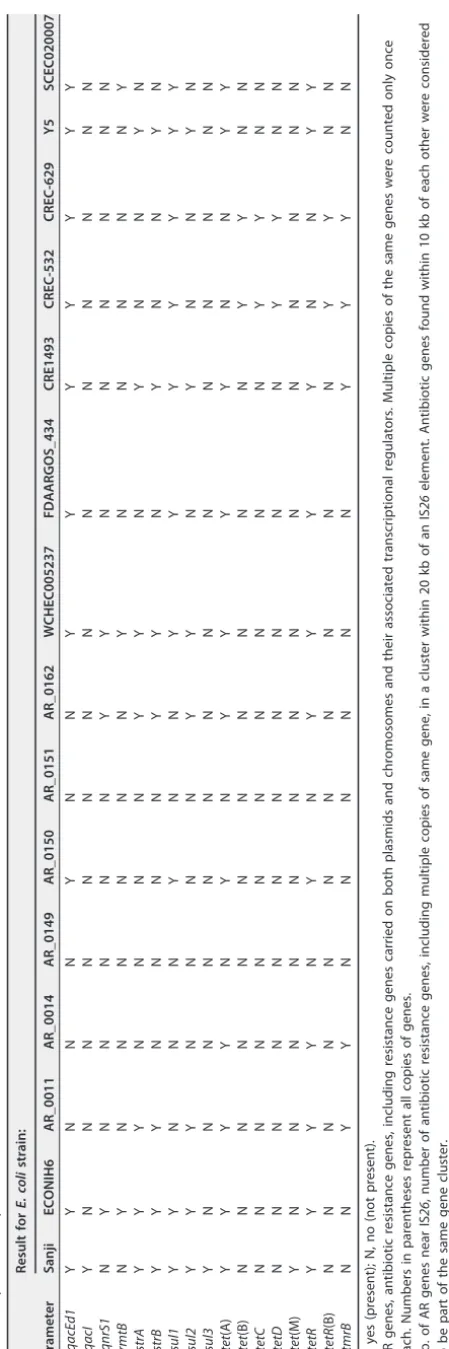
TABLE 1 Antibiotic resistance genes found in ST167 Escherichia coli strains a Parameter Result for E. coli strain: Sanji ECONIH6 AR_0011 AR_0014 AR_0149 AR_0150 AR_0151 AR_0162 WCHEC005237 FDAARGOS_434 CRE1493 CREC-532 CREC-629 Y5 SCEC020007 No. of plasmids 6 2 3223248 1 5 3 3 3 2 Total no. of AR genes b 32 (34) 21 (22) 12 (13) 8 3 14 4 15 21 (28) 15 (24) 30 (36) 19 (25) 19 (23) 25 (43) 16 (24) Chromosome-carried AR genes 6 0 1000000 0 0 6 6 1 2 (20) 0 Plasmid-carried AR genes 28 21 (22) 12 (13) 8 3 14 4 15 21 (28) 15 (24) 30 (36) 17 (19) 17 21 (23) 16 (24) No. of IS 26 elements on plasmids 12 8 6613191 0 5 1 2 1 0 8 1 0 6 No. of AR genes near IS 26 c 24 16 12 8 0 12 2 13 8 24 25 15 8 21 22 Presence of gene: aac(3)-IIa N N Y Y NNNNN N Y N N N N aac(3)-IId N N NNNNNNN N Y Y Y Y N aac(3)-IVa Y N NNNNNNN N N N N N N aac(3) * d Y N NNNNNNN N N N N N N aac(6’)Ib-cr Y N Y Y NNNNY N Y N N Y N aadA1 Y N NNNNNNN N N N N N N aadA2 Y Y NNNNNNN Y Y N N N N aadA5 N N NNNY NNN Y Y Y Y Y Y aadA16 N N NNNNNNY N N N N N Y aph(4)-Ia Y N NNNNNNN N N N N N N aph(3 = )-Ia Y N NNNNNNN N N N N Y N arr-3 Y N NNNNNNY N N N N Y N blaCMY-42 N N N N YYYN N N N N N Y N blaCTX-M-14 Y N NNNNNNN N N Y Y Y N blaCTX-M-15 N Y Y Y NNNY N Y Y N N Y N blaCTX-M-55 N N NNNNNNY N N Y Y N N blaNDM-5 N Y NNNY Y NY Y Y N N N Y blaNDM-7 N N NNY NNY N N N Y Y Y N blaOXA-1 Y Y Y Y NNNNN N Y N N Y N blaTEM-1A N N NNNNNNN N Y N N N N blaTEM-1B N N N N N YYYY N N Y Y N Y ble N Y N N YYYYY Y Y Y Y Y Y catB3 Y N NNNNNNN N N N N N N cmlA1 Y N NNNNNNN N N N N N N dfrA12 N Y NNNNNNN Y Y N N N Y dfrA14 N Y NNNNNNY N N N N N N dfrA17 N N NNNY NNN Y Y Y Y Y Y dfrA27 N N NNNNNNY N N N N Y N eamA N Y YYN YN YY Y Y N N Y Y erm (B ) N Y NNNNNY N N N Y Y N N estX Y N NNNNNNN N N N N N N floR_2 Y N NNNNNNY N Y N N Y N fosA_14 N N NNNNNNY N N N N N N glmM Y N Y NNNNNN N N N N N N mcr-1 N N NNNNNNN N Y N N N N mph (A ) Y Y NNNY NY N Y Y Y Y Y Y mphR Y Y NNNY NY N Y Y Y Y Y Y mrx Y Y NNNY NY N Y Y Y Y Y Y nimC / nimA N N NNNNNNN N Y N N N N oqxA Y N NNNNNNN N Y N N N N oqxB Y N NNNNNNN N Y N N N N oqxR Y N NNNNNNN N Y N N N N psp Y N NNNNNNN N N N N N N (Continued on next page)
on September 8, 2020 by guest
http://msystems.asm.org/
TABLE 1 (Continued) Parameter Result for E. coli strain: Sanji ECONIH6 AR_0011 AR_0014 AR_0149 AR_0150 AR_0151 AR_0162 WCHEC005237 FDAARGOS_434 CRE1493 CREC-532 CREC-629 Y5 SCEC020007 qacEd1 Y Y NNNY NNY Y Y Y Y Y Y qacI Y N NNNNNNN N N N N N N qnrS1 N Y NNNNNY Y N N N N N N rmtB N Y NNNNNNY N N N N N Y strA Y Y Y NNNNY Y N Y N N Y N strB Y Y Y NNNNY Y N Y N N Y N sul1 Y Y NNNY NNY Y Y Y Y Y Y sul2 Y Y Y NNNNY Y N Y N N Y N sul3 Y N NNNNNNN N N N N N N tet (A ) Y Y YYN YN YY Y Y N N Y Y tet (B ) N N NNNNNNN N N Y Y N N tetC N N NNNNNNN N N Y Y N N tetD N N NNNNNNN N N Y Y N N tet (M ) Y N NNNNNNN N N N N N N tetR Y Y YYN YN YY Y Y N N Y Y tetR (B ) N N NNNNNNN N N Y Y N N tmrB N N Y Y NNNNN N Y Y Y N N aY, yes (present); N, no (not present). bAR genes, antibiotic resistance genes, including resistance genes carried on both plasmids and chromosomes and their associated transcriptional regulators. Multiple copies of the same genes were counted only once each. Numbers in parentheses represent all copies of genes. cNo. of AR genes near IS 26 , number of antibiotic resistance genes, including multiple copies of same gene, in a cluster within 20 kb of an IS 26 element. Antibiotic genes found within 10 kb of each other were considered to be part of the same gene cluster. dA gene with a GNAT domain and overlapping with a transposase.
on September 8, 2020 by guest
http://msystems.asm.org/
Comparative genome sequence analysis of the Sanji chromosome.
At the time
of Sanji genome completion, the closest genome available was that of prototypic
E. coli
K-12 strain MG1655. Genome alignment of Sanji chromosome to MG1655 revealed that
77% of the open reading frames in Sanji are shared with MG1655. A synteny plot
generated based on the genome alignment between Sanji and MG1655 showed high
collinearity with 10 major insertions (Fig. 3A). Since then, many additional genomes
within the K-12 clade showing close relationships with Sanji have become available.
Comparison of Sanji with two closely related strains, WCHEC005237 and CRE1493,
revealed even greater collinearity (Fig. 3B).
Multilocus sequence typing (MLST) analysis using seven housekeeping genes (
purA
,
adk
,
icd
,
fumC
,
recA
,
mdh
, and
gyrB
) (28) classified Sanji into the sequence type ST167
group. Genome BLAST searches, using the unique insertions identified in comparisons
with MG1655 as the query, revealed additional genomes that share some of these
unique features, including strains with sequence types ST10, ST167, and ST617. An
MLST-based phylogenetic tree of these strains revealed that these sequence types are
indeed related to each other and fall within the K-12 clade (Fig. S1). Comparative
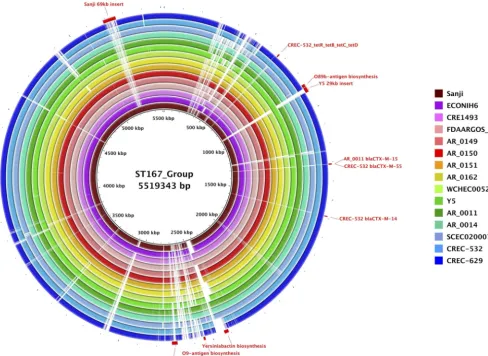
genome sequence analysis of the entire chromosome of Sanji with the other 14 ST167
strains (Fig. 4) further revealed that the ST167 genomes are highly similar beyond the
seven genes used for MLST. Some of these strains contain up to 12 distinct resistance
genes on the chromosome (see Table 1).
In comparison to MG1655, four of the chromosomal insertions in Sanji appear to be
prophages (see Fig. 3A). Three insertions also found in other ST167 strains harbor
specialized secretion systems (SS), namely, a 19.8-kb insertion containing a type 3
secretion system (T3SS), a 30.6-kb insertion containing a T6SS, and a 75.1-kb insertion
containing a T2SS, although in some strains this insertion is truncated. Each of these
insertions contains additional uncharacterized genes.
A 17.5-kb insertion containing an O-antigen biosynthesis cluster, flanked by a pair of
insertion sequence 26 (IS
26
) elements, is shared with other ST167 strains, suggesting
horizontal acquisition. Initial immunoserotyping analysis of the O-antigen gave positive
results for type O6 but was unable to determine the H-type. PCR analysis failed to
confirm the O6 serotype but gave positive results for H9 antigen.
In silico
serotyping
based on the whole-genome sequence assigned the Sanji strain as serotype H9 based
on the presence of the
fliC
gene sequence (98.9%). For the O-antigen, the closest match
was related to serotype O89, based on the presence of
wzm
(94.1%) and
wzt
(93.5%).
This newly determined 17.5-kb O-antigen gene cluster (
ⱖ
99% sequence identity) was
found to be present in all ST167 and ST617 strains examined, as well as in some strains
within the ST10 clonal complex, including ST744, ST44, ST4981, ST1284, and ST10
(Fig. S1) (Table S1). We propose to designate this
in silico
serotype “O89b.” A few of the
O89b-containing strains have additional genes encoding other O-antigen types,
includ-ing O9 (based on genes
wzm
and
wzt
) or O8 (based on a truncated
wzt
gene). With the
exception of a few strains, all of the ST167, ST617, and ST10 complex strains examined
are predominantly H9 or H10 (Table S1).
Maximum likelihood phylogenetic analysis of these O89b-containing strains was
performed using MEGA7 for 6,890 core single nucleotide variants (SNV) across 39
Sanji-related genomes plus 19 ST167 assemblies and MG1655 (Fig. S2). Here, Sanji
clustered with the early isolates of ST167, while later ST167 isolates showed more
diversity. The ST617 isolates examined were less tightly clustered. The ST744, ST44, and
ST10 isolates were more distant than the ST167 and ST617 groups. Using the same core
SNV data set, the molecular evolution of these O89b-containing strains was also
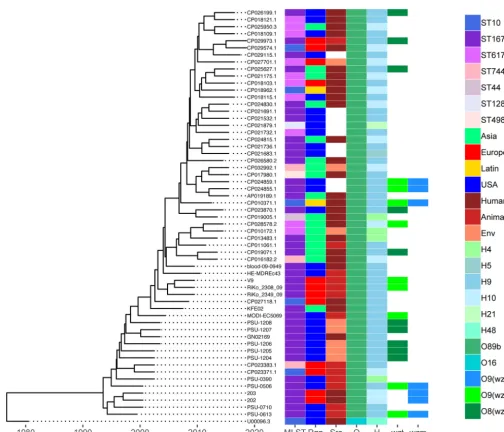
determined by a time-scaled Bayesian phylogenetic analysis in BEAST2 (29). From this
analysis, it was estimated that development of these O89b-containing lineages took
place about 30 years ago (Fig. 5). However, there is no clear geographical location
associated with this emergence since members of this group appear to be dispersed
globally. There also has been no clear time-dependent shifting of these lineages,
on September 8, 2020 by guest
http://msystems.asm.org/
FIG 3 Synteny between the genomes of Sanji and relatedE. colistrains. (A) A pairwise genome comparison plot showing collinearity of genes between Sanji and MG1655. The 10 major insertions in the Sanji genome are labeled. The location of the capsular polysaccharide biosynthesis gene cluster in the Sanji corresponds to that of a lipopolysaccharide biosynthesis gene cluster in MG1655. All other insertions in MG1655 appear to be prophage-related genes. (B) A synteny plot comparing Sanji with two of the ST167 strains, CRE1493 and WCHEC005237. The 69.2-kb insertion is present only in Sanji, while the 30.3-kb insertion conferring yersiniabactin biosynthesis is present only in CRE1493. Each of the strains also has a few unique prophage insertions. The red and blue bands represent the forward and reverse matches, respectively.
on September 8, 2020 by guest
http://msystems.asm.org/
though it appears that ST167 and ST617 are the dominant O89b-containing strains.
ST617 strains are also known to carry many antibiotic resistance genes (30–33).
A 32.7-kb insertion in Sanji contains a capsular polysaccharide biosynthesis (
cps
)
gene cluster at a location that corresponds to a lipopolysaccharide biosynthesis gene
cluster in MG1655. This
cps
gene cluster, flanked by IS elements, is also present in
E. coli
strains 127 and WCHEC005237 and has sequence homology with several K30
Klebsiella
pneumoniae
strains (28) but is truncated in several other ST167 strains (see Fig. 4).
A 69.2-kb insertion, unique to Sanji among the ST167 strains, contains the 8.9-kb
antibiotic resistance gene cluster (see Fig. 2A), a raffinose utilization operon (
rafRABDY
),
two toxin-antitoxin systems (
relE
/
parE
and
yeeV
/
yeeU
), and a number of unidentified
genes. This insertion was also found in the chromosome of six other non-ST167
E. coli
genomes (strains HB-Coli0, CRE1540, H8, MRY15-117, 14EC017, and WCHEC4533)
(Ta-ble S2).
In addition to these major insertions, there are smaller insertions containing
meta-bolic and nutrient acquisition genes, such as a 5.5-kb sucrose utilization operon
(
cscBKAR
) shared with other ST167 strains. There were no other obvious toxins or other
unique virulence factors that distinguished Sanji from the other ST167 strains. However,
Sanji did exhibit
in vitro
growth inhibition against a laboratory strain of
E. coli
TOP10
expressing green fluorescence protein (GFP) (Fig. S3).
Comparative sequence analysis of the Sanji plasmids.
For most ST167 genomes,
including Sanji, the majority of their antibiotic resistance genes were located on various
FIG 4 Comparisons of ST167 chromosomes. Shown is a BRIG circular genome plot for BLASTN comparisons of Sanji and 14 other ST167 strains. The reference sequence was a composite generated by inserting DNA segments into the Sanji chromosome that were absent from Sanji. Selected gene clusters involved in antibiotic resistance, O-antigen biosynthesis, capsular polysaccharide biosynthesis, and virulence are labeled.
on September 8, 2020 by guest
http://msystems.asm.org/
plasmids (Table 1). Interestingly, all of the strains carried distinct sets of plasmids with
different backbones and sizes (Table 2). The IncHI2 plasmid, pSJ_255, is unique to Sanji
among ST167 strains and carries 27 of the 32 distinct antibiotic resistance genes found
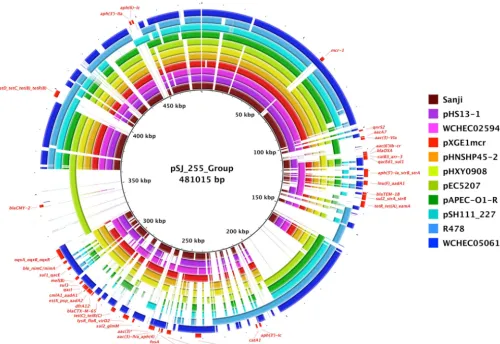
in Sanji (Fig. 2C). This plasmid belongs to a family of plasmids whose prototypical
member is
Serratia marcescens
plasmid R478 (34) (Fig. 6). This family of plasmids
contains the
ter
gene cluster, which has been shown to confer resistance to tellurite,
some bacteriophages, and pore-forming colicins (35, 36). MDR plasmids in this family
differ in the number of antibiotic resistance genes (Table S3). For example, R478 and a
few others carry 4 to 8 antibiotic resistance genes, while others, including pSJ_255,
carry 23 to 30. Additionally, each of these plasmids carries a different but overlapping
set of antibiotic resistance genes.
One explanation for this high variability in the number and types of antibiotic
resistance genes in SJ_255 is the presence of several IS
26
elements (Fig. 2C). IS
26
elements are known to facilitate the horizontal movement and accumulation of
anti-biotic resistance genes at a relatively high frequency (37, 38). Although pSJ_255 does
FIG 5 Time-scaled phylogeny of O89b-containingE. colistrains. Molecular phylogeny based on the HKY85 model was calculated using a BEAST2 MultiTypeTree module of 6,890 core SNVs from 39 Sanji-related complete genomes plus 19 ST167 assemblies isolated between 1999 and 2010, as well as MG1655. The tree shown was generated by using R package ggtree, with associated 7-gene MLST, isolation region, source, andin silicoO-antigen and H-antigen serotypes indicated.
on September 8, 2020 by guest
http://msystems.asm.org/
TABLE 2 Plasmid MLST types associated with ST167 E. coli strains Parameter Value(s) for E. coli strain: Sanji ECONIH6 AR_0011 AR_0014 AR_0149 AR_0150 AR_0151 AR_0162 WCHEC005237 FDAARGOS_434 CRE1493 CREC-532 CREC-629 Y5 SCEC020007 No. of plasmids (PubMLST) 623 2 2 32 4 8 1 53332 Plasmid size (bp) a FIA_4; FIA_20; FII_36 94,712 (0) 117,703 (10) 149,485 (24) 127,772 (15) 124,378 (13) 144,225 (24) FIA_1; FIA_6; FII_22; FII_36 216,181 (17) 176,274 (15) FIA_4; FIA_20; FIB_1; FII_31; FII_36 181,436 (8) 172,588 (8) FIB_24 73,992 (18) FII_2 82,288 (0) 100,989 (12) 84,929 (5) FII_33 70,691 (2) FII_47 100,229 (12) HCM1 178ac_2 IncHI1 33,548 (0) IncHI2 DLST ST 3 255,368 (27) smr0018 IncHI2 2,640 (0) ardA_4; repI1_1; trbA_15; IncI1 61,695 (2) ardA_4; repI1_3; trbA_15; IncI1 50,235 (2) 50,228 (2) ardA_5; repI1_4; trbA_15; IncI1 48,528 (1) ardA_19 IncI1 84,952 (0) ardA_24 IncI1 6,200 (3) trbA_43 IncI1 57,991 (0) repN_6 IncN 76,680 (4) IncA/C ST 3 136,243 (8) A009_11 IncA/C 23,332 (0) 33,858 (1) A157: 6 IncA/C 97,800 (10) 95,850 (8) A165_4 IncA/C 98,436 (1) 96,986 (0) 96,987 (0) 96,990 (0) A165_6 IncA/C 3,373 (0) 3,684 (0) A175_5 IncA/C 46,159 (2) 46,161 (2) 49828 (2) 46,161 (2) 46145 (2) parB_9 IncA/C 46,161 (2) 46137 (2) 46,161 (2) repA_4 IncA/C 121,908 (9) None b 2,959 (0) None 2,444 (0) No. of chromosome- borne resistance genes 601 0 0 00 0 0 0 0662 0 c 0 aNumbers indicate plasmid sizes (bp). Numbers of resistance genes, including replicates and associated transcriptional regulators, are shown in pa rentheses. bNone, no match in PubMLST database. cValue includes 3 copies of a 4-gene cluster.
on September 8, 2020 by guest
http://msystems.asm.org/
not carry genes with resistance to the current “antibiotics of last resort” (e.g.,
blaNDM
or
blaKPC
, conferring resistance to carbapenems, or
mcr-1
, conferring hyperresistance
to colistin), several plasmids in the IncHI2 family have acquired the
mcr-1
gene (Fig. 6;
see also Table S3). Moreover, a recent report identified an IncHI2 plasmid that carries
both
blaNDM-4
and
mcr-1
(39).
Sanji plasmid pSJ_82 belongs to the IncFII family of plasmids, which includes
prototypical member pHK01 (40). Members of this family carry the ESBL-encoding
blaCTX-M-14
gene (41). Sanji, ECONIH6, and AR_0162 all have a plasmid with an FII_2
backbone (SJ_82, tig00008015, and pNDM-d2e9, respectively), carrying 0, 12, and 5
distinct antibiotic resistance genes, respectively (Fig. S4). Sanji plasmid pSJ_94 carries
both IncFIA and IncFII replicons but no identifiable antibiotic resistance genes (Fig. S5).
However, it does contain an IS
26
element. In fact, close relatives of both pSJ_94 and
pSJ_82 carry IS
26
elements and a large number of associated antibiotic resistance
genes (see Fig. S4 and S5).
Among the ST167 strains analyzed, the majority of their antibiotic resistance genes
are associated with IS
26
elements (see Table 1). Sanji pSJ_255 carries 24 IS
26
-associated
antibiotic resistance genes. ST167 strain FDAARGOS_434 carries a plasmid related to
pSJ_94 with 24 IS
26
-associated resistance genes, and strain ECONIH6 carries a plasmid
FIG 6 Comparisons of plasmids related to pSJ_255. Shown is a BRIG circular plot for BLASTN comparisons of pSJ_255 and related plasmids. The reference sequence is a composite generated by inserting sequences into the pSJ_255 sequence that were absent from pSJ_255. Each ring corresponds to a different plasmid, as follows from inner to outer ring: pSJ_255 represents plasmid pSJ_255 fromE. coliSanji; pHS13-1 represents plasmid pHS13-1 fromE. coliHS13-1; WCHEC025943 represents plasmid pMCR1_025943 fromE. coli WCHEC025943; pXGE1mcr represents plasmid pXGE1mcr fromE. coliXG-E1; pHNSHP45-2 represents plasmid pHNSHP45-2 fromE. coliSHP45; pHXY0908 represents plasmid pHXY0908 fromSalmonella entericaserovar Typhimurium strain GDS147; pEC5207 represents plasmid pEC5207 fromE. coliEC5207; pAPEC-O1-R represents plasmid pAPEC-O1-R fromE. coliAPEC O1; pSH111_227 represents plasmid pSH111_227 fromSalmonellaHeidelberg; R478 represents plasmid R478 fromSerratia marcescens; and WCHEC050613 represents plasmid pMCR_WCHEC050613 fromE. coliWCHEC050613. All identifiable antibiotic resistance genes are labeled in red on the outer ring.
on September 8, 2020 by guest
http://msystems.asm.org/
related to pSJ_82 that has 12 IS
26
-associated resistance genes. In Sanji, the ESBL
encoded by
blaCTX-M-14
appears to be mobilized by ISEcp1 and is not associated with
IS
26
elements. However, there has been a report of a
blaCTX-M-14_ISEcp1
gene cluster
that inserted into an IS
26
element in a strain of
Proteus
(42), while there have been
multiple reports of the
blaCTX-M-15
gene being associated with IS
26
elements in
E. coli
(43, 44). Several of the ST167 strain plasmids also contained Tn
3
-mediated insertions of
the
blaCTX-M-15
gene into IS
26
elements (Fig. S5). The existence of these related
plasmids containing IS
26
elements suggests that pSJ_94 and pSJ_82 in Sanji have the
potential to also accumulate multiple antibiotic resistance genes in a manner similar to
that observed for pSJ_255.
Sanji plasmid pSJ_98 appears to be a P1-like enterobacteriophage. Closely related
plasmids can be found in many bacteria, including some ST167 strains, CRE1493,
CREC-532, and CREC-629 (Fig. S7). In rare cases, these plasmids can carry an antibiotic
resistance gene, but there is no evidence for accumulation of multiple resistance gene
clusters such as was observed with the other large Sanji plasmids.
Multiple paths to achieve XDR.
ESBL-producing MDR and XDR
E. coli
isolates with
sequence types ST167 and ST617 and others in the ST10 clonal complex have emerged
over the past 5 years as common isolates from nosocomial sources as well as wild
animal and domestic animal sources, including dairy and livestock sources, in Germany
(45–47), Taiwan (48, 49), Tunisia (50, 51), and the Americas (52). Indeed, ST167 strains
carrying carbapenemase activity have become the second most prevalent sequence
type, behind only ExPEC ST131, among human clinical ESBL-producing
E. coli
isolates
reported in China (27, 53–62), Spain (63, 64), France (65), India (66), Italy (67), Iran (68),
Romania (69), and Tunisia (50).
Because IS
26
elements can be readily exchanged between different DNA molecules
(transposons, phages, conjugated plasmids, transformed DNA chromosomes, etc.),
bacteria that can acquire multiple IS
26
-containing plasmids can facilitate the
genera-tion of expanded gene clusters with multiple antibiotic resistance genes. This process
is accelerated under conditions conducive to the coalescence of diverse bacterial
strains that are also amenable to horizontal gene transfer. The animal gut has been
shown to be particularly conducive to high rates of conjugal transfer between bacteria
under conditions of inflammation or disease (70–72). These disease conditions
fre-quently coincide with administration of antibiotics, creating a strong selective pressure
for accumulation of genes that confer antibiotic resistance.
The observed diversity in the number and type of antibiotic resistance genes and
the diverse mechanisms for their spreading among Sanji and related O89b-containing
E. coli
strains indicate that acquisition of XDR properties can occur through multiple
evolutionary paths. One implication of this observation is that targeted elimination of
any existing XDR strain is unlikely to prevent the emergence of new strains with similar
XDR properties. A second implication is that even the best antibiotic stewardship is
unlikely to be sufficient to prevent or mitigate the development of XDR pathogens.
These potential consequences underscore the urgency of the quest for better
under-standing the shared physiology and virulence mechanisms of pathogenic bacteria, such
as the group identified here with O89b-antigens.
MATERIALS AND METHODS
Isolation and serotyping ofE. colistrain Sanji.E. colistrain Sanji was isolated from the duodenum of a pheasant during a 2011 outbreak of fowl colibacillosis on a farm in Fujian province, China, that had about 400 pheasants. Symptoms included drooping, anorexia, diarrhea, soft feet, and inability to flutter or fly. The disease was refractory to common veterinary antibiotics, including amikacin, which was administered after drug sensitivity testing during the second week of the outbreak. Within 1 month, all of the pheasants became severely ill and died or had to be culled. Serotyping ofE. coliSanji, which formed mucoid colonies on LB agar plates, was performed by the Tianjin Biochip Corporation.
Antibiotic susceptibility profiling of E. coli strain Sanji.Antibiotic susceptibility testing was performed using the Kirby-Bauer disk diffusion method with test discs (6.5-mm to 7.0-mm diameter), according to Clinical & Laboratory Standards Institute (CLSI) M100 guidelines (https://clsi.org). Antibiotic susceptibility to colistin (Arcos) and polymyxin B (Sigma) was assayed using the broth microdilution method, according to EUCAST guidelines (www.eucast.org). ReferenceE. colistrain ATCC 25922 and
on September 8, 2020 by guest
http://msystems.asm.org/
E. colistrain MG1655 was obtained from Miao Ling Bio (Wuhan, China).
Genome sequencing, assembly, and annotation of theE. coliSanji genome.Total genomic DNA was prepared using a Qiagen Genomic-tip kit, according to the manufacturer’s protocol. Illumina sequencing was performed at the Beijing Genomics Institute (BGI; Shenzhen, People’s Republic of China) using a HiSeq 2000 platform with insertions of 484 bp and 6,354 bp. Assembly of the 815 Mb of 90-bp read-length paired-end sequencing data generated from the Illumina platform was unable to close the genome, so we applied a PacBio SMRT sequencing and de novo assembly platform. For PacBio sequencing, library construction, sequencing, assembly, and annotation were performed by Pacific Biosciences (Menlo Park, CA), using a PacBio RS II system. Totals of 518,559,882 and 306,969,330 postfilter bases from the size-selected and non-size-selected libraries were obtained with mean subread lengths of 6,292 and 1,590, respectively. The size-selected library assay was performed using a BluePippin system (SageScience) to remove shorter DNA insertions with a size cutoff ofⱕ15 kb. The non-size-selected library was also included to capture and sequence the smaller 3.4-kb and 2.6-kb plasmids. A total of 839,222,725 bases were assembled using the HGAP (v. 2.3) long-read assembler (73) into 15 polished contigs (maximum contig length of 4,926,777) with mean coverage of 135⫻. The resulting genomes of the single circular chromosome (4,891,769 bp) and six circular plasmids (255,368 bp, 98,436 bp, 94,712 bp, 82,288 bp, 3,373 bp, and 2,640 bp) were annotated using the best-placed reference protein set (GeneMarkS⫹) in the NCBI Prokaryotic Genome Annotation Pipeline (ver. 3.3).
In silicoserotyping, antibiotic resistance gene profiling, and IS element analysis ofE. colistrain
Sanji.Sequence-based bacterial serotyping was performed using SerotypeFinder (ver. 1.1) athttps:// cge.cbs.dtu.dk/services/SerotypeFinder/ (74). Antibiotic resistance genes were identified using blastn against a database generated from the Resfams database at www.dantaslab.org/resfams (75), the ResFinder database atwww.genomicepidemiology.org(76), and information obtained from the review published previously by Roberts et al. (77). A shell script was used to extract the list of antibiotic resistance gene clusters from the blastn output. Insertion sequence (IS) elements were identified using ISfinder athttp://www-is.biotoul.fr(78).
Comparative genome sequence analysis.Genome sequences ofE. coliST167 strains (ECONIH6 [GenBank accession no.CP026199.1], AR_0150 [GenBank accession no.CP021736.1], AR_0151 [GenBank accession no. CP021691.1], AR_0149 [GenBank accession no. CP021532.1], WCHEC005237 [GenBank accession no.CP026580.2], FDAARGOS_434 [GenBank accession no.CP023870.1], CRE1493 [GenBank accession no.CP019071.1], AR_0014 [GenBank accession no.CP024859.1], AR_0011 [GenBank accession no. CP024855.1], AR_0162 [GenBank accession no. CP021683.1], CREC-532 [GenBank accession no. CP024830.1], CREC-629 [GenBank accession no.CP024815.1], Y5 [GenBank accession no.CP013483.1], SCEC020007 [GenBank accession no.CP025627.1], 51008369SK1 [GenBank accession no.CP029973.1], AR435 [GenBank accession no.CP029115.1], M217 [GenBank accession no.AP019189.1), ST617 strains (AR_0114 [GenBank accession no. CP021732.1], MRSN346355 [GenBank accession no.CP018121.1], MRSN346638 [GenBank accession no.CP018115.1], MRSN346595 [GenBank accession no.CP018109.1], MRSN352231 [GenBank accession no. CP018103.1], 5CRE51 [GenBank accession no. CP021175.1], SCEC020023 [GenBank accession no. CP025950.3], H8 [GenBank accession no. CP010172.1], WCHEC005784 [GenBank accession no.CP028578.2], 675SK2 [GenBank accession no.CP027701.1), ST10 strains (1283 [GenBank accession no.CP023371.1], Ecol_422 [GenBank accession no.CP018962.1], 6409 [GenBank accession no.CP010371.1], DA33133 [GenBank accession no.CP029574.1], 26561 [GenBank accession no.CP027118.1), ST744 strains (1223 [GenBank accession no.CP023383.1], EC590 [GenBank accession no.CP016182.2], W5-6 [GenBank accession no.CP032992.1), and other strains (Ecol_AZ155 [GenBank accession no.CP019005.1], CH611_eco [GenBank accession no.CP017980.1], AR_0137 [Gen-Bank accession no.CP021879.1], MG1655 [GenBank accession no.U00096.3), including their plasmids, were used for comparative genome sequence analysis. Multilocus sequence typing (MLST) of the Sanji strain and comparison with sequences of other relatedE. colistrains were based on the use of Achtman’s seven housekeeping genes forE. coli(purA,adk,icd,fumC,recA,mdh, andgyrB) (28) and performed using a shell script based on the Enterobase database at https://enterobase.warwick.ac.uk/species/ecoli/ download_7_gene. Molecular phylogenetic analysis was performed by the maximum likelihood method based on the Tamura-Nei model (79) using MEGA7 (80) with 1,000 bootstrap iterations. Synteny plots were generated using Artemis Comparison Tool (ACT) software (81) and blastn results based on genome alignments. Circular plots for genome comparison were produced using BLAST Ring Image Generator (BRIG) (82). Plasmids were analyzed and typed by plasmid multilocus sequence typing (pMLST) using the PubMLST database (http://pubmlst.org/plasmid) (83). IS26-associated antibiotic resistance genes were defined as resistance genes located within 10 kb of an IS26-like element. Gene graphics were generated with the aid of SnapGene Viewer software (GSL Biotech).
The 39 Sanji-related genomes plus 19 ST167 assemblies, from isolates obtained between 1999 and 2010, and MG1655 were used to generate core single nucleotide variants (SNVs). The sequences of the 19 ST167 assemblies were downloaded from the Enterobase database athttps://enterobase.warwick.ac .ukand concatenated as a continuous fasta file. The recurring regions and unique regions of the 40 complete genome sequences were removed using a shell script. This method is based on genome-to-genome blastn at 99% coverage and 99% identity and subsequent removal of recurring and unique regions. The Sanji genome reference template was used as a query for blastn analysis against another genome. The resulting common regions shared by the two genomes were then joined (as a “stitched” sequence) and used for blastn analysis of another new genome sequence to generate a new stitched sequence until all 40 of the genomes, including Sanji, were compared. This entire process was then repeated 10 times. After 6 iterations, a convergent, consensus stitched sequence of 2,493,769 bp was
on September 8, 2020 by guest
http://msystems.asm.org/
obtained. This consensus stitched sequence was then subjected to blast analysis against each individual genome, followed by the use of a shell script to remove all sites with gapped or identical sequences to generate a string of ungapped 6,890 core SNVs. The consensus core stitched sequence was used similarly to generate a string of 6,890 core SNVs for each of the 19 assemblies. This alignment of SNVs was used for modeling mutation rate estimates and time-scaled phylogeny using MEGA7 and BEAST2.5.1 pack-ages.
The MultiTypeTree module of BEAST2 was used with the following parameters: (i) tip dates were set as the sample isolation dates (or as the database submission date for cases where no isolation date was provided); (ii) tip locations were set as three geographic regions (Americas, Asia, and Europe); (iii) the gamma site model was selected with the HKY85 nucleotide substitution model (84); and (iv) a strict clock model was used with an initial mutation rate set at 10⫺10mutations per site per year. For the priors, a
uniform distribution was selected for clockRate.c with an initial value of 10⫺10and an upper limit of 10⫺7;
exponential distribution was selected for gammaShape.s with an initial value of 1; log normal was selected for kappa.s with an initial value of 2; 1/Xdistribution was selected for popSizes.t; exponential distribution was selected for rate Matrix.t; and equal population sizes and a symmetric migration rate matrix were assumed for the migration model. In trial runs sampling 106Markov chain Monte Carlo
(MCMC) steps, we explored HKY85, TN93, and generalized time-reversible (GTR) nucleotide substitution models with various parameters. The TN93 and GTR models could not accommodate mutation rates lower than 0.001, and even with the clock rate accepted by the module, runs were often terminated prematurely. For those runs that were completed, the models gave results comparable to those obtained with the HKY85 model. Using the HKY85 model, five runs with 108MCMC steps were performed, with
10% discounted as representing burn-in and a tree logging frequency of 105. Tree files were combined
using LogCombiner in the BEAST2 package, followed by the use of TreeAnnotator to annotate the combined trees. The annotated output trees file was used to generate the phylogenetic tree with associated metadata, including 7-gene MLST, isolation region (United States, Latin America, Europe, Asia), source (human, animal, environmental), andin silicoO-antigen and H-antigen serotypes, using the R package ggtree.
Data availability.The complete genome and plasmid sequences ofE. colistrain Sanji have been deposited in the NCBI under accession numbers CP011061.1 (circular chromosome; 4,891,769 bp), CP011062.1 (pSJ_255; 255,368 bp), CP011063.1 (pSJ_98; 98,436 bp), CP011064.1 (pSJ_94; 94,712 bp), CP011065.1 (pSJ_82; 82,288 bp),CP011066.1 (pSJ_3; 3,373 bp), andCP011067.1 (pSJ_2; 2,640 bp).
SUPPLEMENTAL MATERIAL
Supplemental material for this article may be found at
https://doi.org/10.1128/
mSystems.00242-18
.
FIG S1
, PDF file, 0.1 MB.
FIG S2
, PDF file, 0.02 MB.
FIG S3
, PDF file, 1.6 MB.
FIG S4
, PDF file, 0.3 MB.
FIG S5
, PDF file, 0.4 MB.
FIG S6
, PDF file, 0.1 MB.
FIG S7
, PDF file, 0.9 MB.
TABLE S1
, PDF file, 0.1 MB.
TABLE S2
, PDF file, 0.1 MB.
TABLE S3
, PDF file, 0.1 MB.
ACKNOWLEDGMENTS
This work was supported in part by the Research Board of the University of Illinois
at Urbana-Champaign (grant RB18122 to B.A.W.), a Jinsang Scholarship (to M.H.), and
the Science and Technology Innovation Special Foundation of Fujian Agriculture and
Forestry University (grants KFA17221A and KFA17222A to X.Z.). Sequencing and
as-sembly of the
E. coli
Sanji genome were supported by Pacific Biosciences, Inc. (to R.J.H.
and P.B.).
M.H. and X.Z. designed and conceived the experiments. X.Z., X.C., M.H., and D.M.
performed the experiments. C.L., R.H., and P.B. performed the sequencing and assembly
of the genomes. M.H. performed scripting and bioinformatic analysis. M.H., B.T.H., R.J.H.,
and B.A.W. analyzed and interpreted the data. S.W., P.B., and B.A.W. provided reagents,
materials, analytical tools, and support. B.A.W., B.T.H., and M.H. wrote the paper. All of
us read, edited, and approved the final version of the paper.
C.L., R.J.H., and P.B. are full-time employees and shareholders of Pacific Biosciences,
a company developing and commercializing single-molecule DNA sequencing
tech-nologies.
on September 8, 2020 by guest
http://msystems.asm.org/
REFERENCES
1. O’Neill J. 2016. The review on antimicrobial resistance report: tackling drug-resistant infections globally: final report and recommendations. https://amr-review.org/sites/default/files/160518_Final%20paper_with %20cover.pdf. Accessed May 2018.
2. Fukuda K. 2014. World Health Organization: antimicrobial resistance global report on surveillance.http://apps.who.int/iris/bitstream/10665/ 112642/1/9789241564748_eng.pdf?ua⫽1. Accessed May 2018. 3. Frieden T. 2013. Centers for Disease Control and Prevention report:
antibiotic resistance threats in the United States, 2013.https://www.cdc .gov/drugresistance/pdf/ar-threats-2013-508.pdf. Accessed May 2018. 4. Chekabab SM, Paquin-Veillette J, Dozois CM, Harel J. 2013. The
ecolog-ical habitat and transmission ofEscherichia coliO157:H7. FEMS Microbiol Lett 341:1–12.https://doi.org/10.1111/1574-6968.12078.
5. Vidovic S, Korber DR. 2016. Escherichia coli O157: insights into the adaptive stress physiology and the influence of stressors on epidemiol-ogy and ecolepidemiol-ogy of this human pathogen. Crit Rev Microbiol 42:83–93. https://doi.org/10.3109/1040841X.2014.889654.
6. Lerner A, Matthias T, Aminov R. 2017. Potential effects of horizontal gene exchange in the human gut. Front Immunol 8:1630.https://doi.org/10 .3389/fimmu.2017.01630.
7. Szmolka A, Nagy B. 2013. Multidrug resistant commensalEscherichia coli in animals and its impact for public health. Front Microbiol 4:258. https://doi.org/10.3389/fmicb.2013.00258.
8. Boisen N, Melton-Celsa AR, Scheutz F, O’Brien AD, Nataro JP. 2015. Shiga toxin 2a and enteroaggregativeEscherichia coli–a deadly combination. Gut Microbes 6:272–278.https://doi.org/10.1080/19490976.2015.1054591. 9. Fruth A, Prager R, Tietze E, Rabsch W, Flieger A. 2015. Molecular
epide-miological view on Shiga toxin-producingEscherichia colicausing hu-man disease in Gerhu-many: diversity, prevalence, and outbreaks. Int J Med Microbiol 305:697–704.https://doi.org/10.1016/j.ijmm.2015.08.020. 10. Moran NA, Plague GR. 2004. Genomic changes following host restriction
in bacteria. Curr Opin Genet Dev 14:627– 633.https://doi.org/10.1016/j .gde.2004.09.003.
11. Carattoli A. 2013. Plasmids and the spread of resistance. Int J Med Microbiol 303:298 –304.https://doi.org/10.1016/j.ijmm.2013.02.001. 12. Koser CU, Ellington MJ, Peacock SJ. 2014. Whole-genome sequencing to
control antimicrobial resistance. Trends Genet 30:401– 407.https://doi .org/10.1016/j.tig.2014.07.003.
13. Basra P, Alsaadi A, Bernal-Astrain G, O’Sullivan ML, Hazlett B, Clarke LM, Schoenrock A, Pitre S, Wong A. 7 February 2018. Fitness tradeoffs of antibiotic resistance in extra-intestinal pathogenicEscherichia coli. Ge-nome Biol Evolhttps://doi.org/10.1093/gbe/evy030.
14. Beceiro A, Tomas M, Bou G. 2013. Antimicrobial resistance and virulence: a successful or deleterious association in the bacterial world? Clin Mi-crobiol Rev 26:185–230.https://doi.org/10.1128/CMR.00059-12. 15. Durao P, Balbontin R, Gordo I. 2018. Evolutionary mechanisms shaping
the maintenance of antibiotic resistance. Trends Microbiol 26:677– 691. https://doi.org/10.1016/j.tim.2018.01.005.
16. Wilson BA, Garud NR, Feder AF, Assaf ZJ, Pennings PS. 2016. The population genetics of drug resistance evolution in natural populations of viral, bacterial and eukaryotic pathogens. Mol Ecol 25:42– 66.https:// doi.org/10.1111/mec.13474.
17. Brodrick HJ, Raven KE, Harrison EM, Blane B, Reuter S, Torok ME, Parkhill J, Peacock SJ. 2016. Whole-genome sequencing reveals transmission of vancomycin-resistantEnterococcus faeciumin a healthcare network. Ge-nome Med 8:4.https://doi.org/10.1186/s13073-015-0259-7.
18. Nubel U. 2016. Emergence and spread of antimicrobial resistance: recent insights from bacterial population genomics. Curr Top Microbiol Immu-nol 398:35–53.https://doi.org/10.1007/82_2016_505.
19. Snitkin ES, Zelazny AM, Thomas PJ, Stock F, Group NCSP. Henderson DK, Palmore TN, Segre JA. 2012. Tracking a hospital outbreak of carbapenem-resistantKlebsiella pneumoniaewith whole-genome sequencing. Sci Transl Med 4:148ra116.https://doi.org/10.1126/scitranslmed.3004129.
20. Didelot X, Walker AS, Peto TE, Crook DW, Wilson DJ. 2016. Within-host evolution of bacterial pathogens. Nat Rev Microbiol 14:150 –162.https:// doi.org/10.1038/nrmicro.2015.13.
21. Lee AH, Flibotte S, Sinha S, Paiero A, Ehrlich RL, Balashov S, Ehrlich GD, Zlosnik JE, Mell JC, Nislow C. 2017. Phenotypic diversity and genotypic flexibility ofBurkholderia cenocepaciaduring long-term chronic infection of cystic fibrosis lungs. Genome Res 27:650 – 662.https://doi.org/10 .1101/gr.213363.116.
22. Ben Zakour NL, Alsheikh-Hussain AS, Ashcroft MM, Khanh Nhu NT, Roberts LW, Stanton-Cook M, Schembri MA, Beatson SA. 2016. Sequen-tial acquisition of virulence and fluoroquinolone resistance has shaped the evolution ofEscherichia coli ST131. mBio 7:e00347-16.https://doi .org/10.1128/mBio.00347-16.
23. Pitout JD, DeVinney R. 2017.Escherichia coliST131: a multidrug-resistant clone primed for global domination. F1000Res 6:195.https://doi.org/10 .12688/f1000research.10609.1.
24. Olesen B, Scheutz F, Menard M, Skov MN, Kolmos HJ, Kuskowski MA, Johnson JR. 2009. Three-decade epidemiological analysis ofEscherichia coliO15:K52:H1. J Clin Microbiol 47:1857–1862.https://doi.org/10.1128/ JCM.00230-09.
25. Hadjadj L, Riziki T, Zhu Y, Li J, Diene SM, Rolain JM. 2017. Study ofmcr-1 gene-mediated colistin resistance inEnterobacteriaceae isolated from humans and animals in different countries. Genes (Basel) 8:394.https:// doi.org/10.3390/genes8120394.
26. Nishino K, Yamaguchi A. 2001. Analysis of a complete library of putative drug transporter genes inEscherichia coli. J Bacteriol 183:5803–5812. https://doi.org/10.1128/JB.183.20.5803-5812.2001.
27. Zhao WH, Hu ZQ. 2013. Epidemiology and genetics of CTX-M extended-spectrum beta-lactamases in Gram-negative bacteria. Crit Rev Microbiol 39:79 –101.https://doi.org/10.3109/1040841X.2012.691460.
28. Wirth T, Falush D, Lan R, Colles F, Mensa P, Wieler LH, Karch H, Reeves PR, Maiden MC, Ochman H, Achtman M. 2006. Sex and virulence in Esche-richia coli: an evolutionary perspective. Mol Microbiol 60:1136 –1151. https://doi.org/10.1111/j.1365-2958.2006.05172.x.
29. Bouckaert R, Heled J, Kuhnert D, Vaughan T, Wu CH, Xie D, Suchard MA, Rambaut A, Drummond AJ. 2014. BEAST 2: a software platform for Bayesian evolutionary analysis. PLoS Comput Biol 10:e1003537.https:// doi.org/10.1371/journal.pcbi.1003537.
30. Aibinu I, Odugbemi T, Koenig W, Ghebremedhin B. 2012. Sequence type ST131 and ST10 complex (ST617) predominant among CTX-M-15-producingEscherichia coliisolates from Nigeria. Clin Microbiol Infect 18:E49 –E51.https://doi.org/10.1111/j.1469-0691.2011.03730.x. 31. Bagus Wasito E, Shigemura K, Osawa K, Fardah A, Kanaida A, Raharjo D,
Kuntaman K, Hadi U, Harijono S, Marto Sudarmo S, Nakamura T, Shi-bayama K, Fujisawa M, Shirakawa T. 2017. Antibiotic susceptibilities and genetic characteristics of extended-spectrum beta-lactamase-producing Escherichia coli isolates from stools of pediatric diarrhea patients in Surabaya, Indonesia. Jpn J Infect Dis 70:378 –382. https://doi.org/10 .7883/yoken.JJID.2016.234.
32. Seni J, Falgenhauer L, Simeo N, Mirambo MM, Imirzalioglu C, Matee M, Rweyemamu M, Chakraborty T, Mshana SE. 2016. Multiple ESBL-producingEscherichia colisequence types carrying quinolone and ami-noglycoside resistance genes circulating in companion and domestic farm animals in Mwanza, Tanzania, harbor commonly occurring plas-mids. Front Microbiol 7:142.https://doi.org/10.3389/fmicb.2016.00142. 33. Sonda T, Kumburu H, van Zwetselaar M, Alifrangis M, Mmbaga BT,
Aarestrup FM, Kibiki G, Lund O. 2018. Whole genome sequencing reveals high clonal diversity ofEscherichia coliisolated from patients in a tertiary care hospital in Moshi, Tanzania. Antimicrob Resist Infect Control 7:72. https://doi.org/10.1186/s13756-018-0361-x.
34. Gilmour MW, Thomson NR, Sanders M, Parkhill J, Taylor DE. 2004. The complete nucleotide sequence of the resistance plasmid R478: defining the backbone components of incompatibility group H conjugative plas-mids through comparative genomics. Plasmid 52:182–202.https://doi .org/10.1016/j.plasmid.2004.06.006.
35. Whelan KF, Colleran E, Taylor DE. 1995. Phage inhibition, colicin resis-tance, and tellurite resistance are encoded by a single cluster of genes on the IncHI2 plasmid R478. J Bacteriol 177:5016 –5027.https://doi.org/ 10.1128/jb.177.17.5016-5027.1995.
36. Whelan KF, Sherburne RK, Taylor DE. 1997. Characterization of a region of the IncHI2 plasmid R478 which protectsEscherichia colifrom toxic effects specified by components of the tellurite, phage, and colicin resistance cluster. J Bacteriol 179:63–71.https://doi.org/10.1128/jb.179 .1.63-71.1997.
37. Harmer CJ, Hall RM. 2016. IS26-mediated formation of transposons carrying antibiotic resistance genes. mSphere 1:e00038-16.https://doi .org/10.1128/mSphere.00038-16.
38. Harmer CJ, Moran RA, Hall RM. 2014. Movement of IS26-associated antibiotic resistance genes occurs via a translocatable unit that includes
on September 8, 2020 by guest
http://msystems.asm.org/
a single IS26 and preferentially inserts adjacent to another IS26. mBio 5:e01801-14.https://doi.org/10.1128/mBio.01801-14.
39. Liu BT, Song FJ, Zou M, Zhang QD, Shan H. 2017. High incidence of Escherichia coli strains coharboringmcr-1andblaNDMfrom chickens. Antimicrob Agents Chemother 61:e02347-16.https://doi.org/10.1128/ AAC.02347-16.
40. Ho PL, Lo WU, Wong RC, Yeung MK, Chow KH, Que TL, Tong AH, Bao JY, Lok S, Wong SS. 2011. Complete sequencing of the FII plasmid pHK01, encodingCTX-M-14, and molecular analysis of its variants among Esch-erichia colifrom Hong Kong. J Antimicrob Chemother 66:752–756. https://doi.org/10.1093/jac/dkr010.
41. Ho PL, Yeung MK, Lo WU, Tse H, Li Z, Lai EL, Chow KH, To KK, Yam WC. 2012. Predominance of pHK01-like incompatibility group FII plasmids encoding CTX-M-14 among extended-spectrum beta-lactamase-producingEscherichia coliin Hong Kong, 1996 –2008. Diagn Microbiol Infect Dis 73:182–186. https://doi.org/10.1016/j.diagmicrobio.2012.03 .009.
42. He D, Liu L, Guo B, Wu S, Chen X, Wang J, Zeng Z, Liu JH. 2017. Chromosomal location of the fosA3 and blaCTX-M genes inProteus mirabilisand clonal spread of Escherichia coli ST117 carrying fosA3 -positive IncHI2/ST3 or F2:A-:B- plasmids in a chicken farm. Int J Antimi-crob Agents 49:443– 448. https://doi.org/10.1016/j.ijantimicag.2016.12 .009.
43. Cullik A, Pfeifer Y, Prager R, von Baum H, Witte W. 2010. A novel IS26 structure surroundsblaCTX-Mgenes in different plasmids from German clinicalEscherichia coliisolates. J Med Microbiol 59:580 –587.https://doi .org/10.1099/jmm.0.016188-0.
44. Partridge SR, Zong Z, Iredell JR. 2011. Recombination in IS26 and Tn2 in the evolution of multiresistance regions carryingblaCTX-M-15on con-jugative IncF plasmids fromEscherichia coli. Antimicrob Agents Che-mother 55:4971– 4978.https://doi.org/10.1128/AAC.00025-11. 45. Eisenberger D, Carl A, Balsliemke J, Kampf P, Nickel S, Schulze G, Valenza
G. 2018. Molecular characterization of extended-spectrum beta-lactamase-producingEscherichia coliisolates from milk samples of dairy cows with mastitis in Bavaria, Germany. Microb Drug Resist 24:505–510. https://doi.org/10.1089/mdr.2017.0182.
46. Fischer J, Rodriguez I, Baumann B, Guiral E, Beutin L, Schroeter A, Kaesbohrer A, Pfeifer Y, Helmuth R, Guerra B. 2014. blaCTX-M-(1)(5)-carryingEscherichia coliandSalmonellaisolates from livestock and food in Germany. J Antimicrob Chemother 69:2951–2958.https://doi.org/10 .1093/jac/dku270.
47. Irrgang A, Falgenhauer L, Fischer J, Ghosh H, Guiral E, Guerra B, Sch-moger S, Imirzalioglu C, Chakraborty T, Hammerl JA, Kasbohrer A. 2017. CTX-M-15-producingE. coliisolates from food products in Germany are mainly associated with an IncF-type plasmid and belong to two pre-dominant clonalE. colilineages. Front Microbiol 8:2318.https://doi.org/ 10.3389/fmicb.2017.02318.
48. Lee WC, Yeh KS. 2017. Characteristics of extended-spectrum beta-lactamase-producingEscherichia coliisolated from fecal samples of pig-lets with diarrhea in central and southern Taiwan in 2015. BMC Vet Res 13:66.https://doi.org/10.1186/s12917-017-0986-7.
49. Su Y, Yu CY, Tsai Y, Wang SH, Lee C, Chu C. 2016. Fluoroquinolone-resistant and extended-spectrum beta-lactamase-producingEscherichia colifrom the milk of cows with clinical mastitis in southern Taiwan. J Microbiol Immunol Infect 49:892–901.https://doi.org/10.1016/j.jmii.2014.10 .003.
50. Dziri R, Klibi N, Alonso CA, Jouini A, Ben Said L, Chairat S, Bellaaj R, Boudabous A, Ben Slama K, Torres C. 2016. Detection of CTX-M-15-producingEscherichia coliisolates of lineages ST131-B2 and ST167-A in environmental samples of a Tunisian hospital. Microb Drug Resist 22: 399 – 403.https://doi.org/10.1089/mdr.2015.0354.
51. Mani Y, Mansour W, Mammeri H, Denamur E, Saras E, Boujaafar N, Bouallegue O, Madec JY, Haenni M. 2017. KPC-3-producing ST167 Esch-erichia colifrom mussels bought at a retail market in Tunisia. J Antimi-crob Chemother 72:2403–2404.https://doi.org/10.1093/jac/dkx124. 52. Baez J, Hernandez-Garcia M, Guamparito C, Diaz S, Olave A, Guerrero K,
Canton R, Baquero F, Gahona J, Valenzuela N, Del Campo R, Silva J. 2015. Molecular characterization and genetic diversity of ESBL-producing Esch-erichia colicolonizing the migratory Franklin’s gulls (Leucophaeus pipix-can) in Antofagasta, North of Chile. Microb Drug Resist 21:111–116. https://doi.org/10.1089/mdr.2014.0158.
53. Chen D, Gong L, Walsh TR, Lan R, Wang T, Zhang J, Mai W, Ni N, Lu J, Xu J, Li J. 2016. Infection by and dissemination of NDM-5-producing
Esch-erichia coliin China. J Antimicrob Chemother 71:563–565.https://doi .org/10.1093/jac/dkv352.
54. Huang Y, Yu X, Xie M, Wang X, Liao K, Xue W, Chan EW, Zhang R, Chen S. 2016. Widespread dissemination of carbapenem-resistantEscherichia colisequence type 167 strains harboringblaNDM-5in clinical settings in China. Antimicrob Agents Chemother 60:4364 – 4368.https://doi.org/10 .1128/AAC.00859-16.
55. Shen P, Yi M, Fu Y, Ruan Z, Du X, Yu Y, Xie X. 2017. Detection of an Escherichia colisequence type 167 strain with two tandem copies of blaNDM-1in the chromosome. J Clin Microbiol 55:199 –205.https://doi .org/10.1128/JCM.01581-16.
56. Xu M, Fan Y, Wang M, Lu X. 2017. Characteristics of extended-spectrum beta-lactamases-producingEscherichia coliin fecal samples of inpatients of Beijing Tongren Hospital. Jpn J Infect Dis 70:290 –294.https://doi.org/ 10.7883/yoken.JJID.2016.023.
57. Yang P, Xie Y, Feng P, Zong Z. 2014. blaNDM-5carried by an IncX3 plasmid inEscherichia colisequence type 167. Antimicrob Agents Che-mother 58:7548 –7552.https://doi.org/10.1128/AAC.03911-14. 58. Zhang R, Liu L, Zhou H, Chan EW, Li J, Fang Y, Li Y, Liao K, Chen S. 2017.
Nationwide surveillance of clinical carbapenem-resistant Enterobacteri-aceae(CRE) strains in China. EBioMedicine 19:98 –106.https://doi.org/10 .1016/j.ebiom.2017.04.032.
59. Zhang X, Lou D, Xu Y, Shang Y, Li D, Huang X, Li Y, Hu L, Wang L, Yu F. 2013. First identification of coexistence ofblaNDM-1and blaCMY-42 amongEscherichia coliST167 clinical isolates. BMC Microbiol 13:282. https://doi.org/10.1186/1471-2180-13-282.
60. Zhou G, Guo S, Luo Y, Ye L, Song Y, Sun G, Guo L, Chen Y, Han L, Yang J. 2014. NDM-1-producing strains, familyEnterobacteriaceae, in hospital, Beijing, China. Emerg Infect Dis 20:340 –342.https://doi.org/10.3201/ eid2002.121263.
61. Zhu YQ, Zhao JY, Xu C, Zhao H, Jia N, Li YN. 2016. Identification of an NDM-5-producing Escherichia colisequence type 167 in a neonatal patient in China. Sci Rep 6:29934.https://doi.org/10.1038/srep29934. 62. Zong Z, Yu F, McNally A. 2017. New kids on the block: intercontinental
dissemination and transmission of newly emerging lineages of multi-drug resistant Escherichia coli with highly dynamic resistance gene acquisition. bioRxivhttps://doi.org/10.1101/100941.
63. Oteo J, Diestra K, Juan C, Bautista V, Novais A, Perez-Vazquez M, Moya B, Miro E, Coque TM, Oliver A, Canton R, Navarro F, Campos J; Spanish Network in Infectious Pathology Project (REIPI). 2009. Extended-spectrum beta-lactamase-producingEscherichia coliin Spain belong to a large variety of multilocus sequence typing types, including ST10 complex/A, ST23 complex/A and ST131/B2. Int J Antimicrob Agents 34:173–176.https://doi.org/10.1016/j.ijantimicag.2009.03.006. 64. Sánchez-Benito R, Iglesias MR, Quijada NM, Campos MJ, Ugarte-Ruiz M,
Hernández M, Pazos C, Rodríguez-Lázaro D, Garduño E, Domínguez L, Quesada A. 2017.Escherichia coliST167 carrying plasmid mobilisable mcr-1andblaCTX-M-15resistance determinants isolated from a human respiratory infection. Int J Antimicrob Agents 50:285–286.https://doi .org/10.1016/j.ijantimicag.2017.05.005.
65. Cuzon G, Bonnin RA, Nordmann P. 2013. First identification of novel NDM carbapenemase, NDM-7, inEscherichia coli in France. PLoS One 8:e61322.https://doi.org/10.1371/journal.pone.0061322.
66. Devanga Ragupathi NK, Muthuirulandi Sethuvel DP, Gajendiran R, Daniel JL, Walia K, Veeraraghavan B. 2017. First Indian report of IncX3 plasmid carryingblaNDM-7inEscherichia colifrom bloodstream infection: poten-tial for rapid dissemination. New Microbes New Infect 17:65– 68.https:// doi.org/10.1016/j.nmni.2017.01.012.
67. Giufre M, Errico G, Accogli M, Monaco M, Villa L, Distasi MA, Gaudio TD, Pantosti A, Carattoli A, Cerquetti M. 2018. Emergence of NDM-5-producingEscherichia colisequence type 167 clone in Italy. Int J Anti-microb Agents 52:76 – 81.https://doi.org/10.1016/j.ijantimicag.2018.02 .020.
68. Solgi H, Giske CG, Badmasti F, Aghamohammad S, Havaei SA, Sabeti S, Mostafavizadeh K, Shahcheraghi F. 2017. Emergence of carbapenem resistantEscherichia coliisolates producingblaNDMandblaOXA-48-like carried on IncA/C and IncL/M plasmids at two Iranian university hospi-tals. Infect Genet Evol 55:318 –323. https://doi.org/10.1016/j.meegid .2017.10.003.
69. Usein C-R, Papagheorghe R, Oprea M, Condei M, Strãut¸ M. 2016. Molec-ular characterization of bacteremicEscherichia coliisolates in Romania. Folia Microbiol (Praha) 61:221–226.https://doi.org/10.1007/s12223-015 -0427-6.
70. Fu Y, Ho BT, Mekalanos JJ. 2018. TrackingVibrio choleraecell-cell