Interrogation of Internal Workings in Microbial Community
Assembly: Play a Game through a Behavioral Network?
Qian Wang,aXinjuan Liu,bLibo Jiang,aYige Cao,aXiang Zhan,cChristopher H. Griffin,dRongling Wua,c
aCenter for Computational Biology, College of Biological Sciences and Technology, Beijing Forestry University, Beijing, China bDepartment of Gastroenterology, Beijing Chao-Yang Hospital, Capital Medical University, Beijing, China
cDepartment of Public Health Sciences, Penn State Hershey College of Medicine, Hershey, Pennsylvania, USA dApplied Research Laboratory, The Pennsylvania State University, University Park, Pennsylvania, USA
ABSTRACT Increasing evidence shows that the influence of microbiota on biogeo-chemical cycling, plant development, and human health is executed through a com-plex network of microbe-microbe interactions. However, characterizing how mi-crobes interact and work together within closely packed and highly heterogeneous microbial ecosystems is extremely challenging. Here, we describe a rule-of-thumb framework for visualizing polymicrobial interactions and extracting general principles that underlie microbial communities. We integrate elements of metabolic ecology, behavioral ecology, and game theory to quantify the interactive strategies by which microbes at any taxonomic level compete for resources and cooperate symbiotically with each other to form and stabilize ecological communities. We show how the frame-work can chart an omnidirectional landscape of microbial cooperation and competition that may drive various natural processes. This framework can be implemented into genome-wide association studies to unravel the genetic mechanisms underlying micro-bial interaction networks and their evolutionary consequences along spatiotemporal gra-dients.
IMPORTANCE Identifying general biological rules that underlie the complexity and heterogeneity of microbial communities has proven to be highly challenging. We pres-ent a rule-of-thumb framework for studying and characterizing how microbes interact with each other across different taxa to determine community behavior and dynamics. This framework is computationally simple but conceptually meaningful, and it can pro-vide a starting point to generate novel biological hypotheses about microbial interac-tions and explore internal workings of microbial community assembly in depth.
KEYWORDS game theory, competition, cooperation, microbial interaction network
M
icrobial communities affect a wide range of natural processes, frombiogeochemi-cal cycling to plant development and animal and human health (1, 2). Surveys of microbiome composition across various ecological settings from the soil to the human body have consistently revealed that microbes are organized into functional and stable communities through fundamental ecological principles (3, 4). However, the manner in which the structural-functional relationship of polymicrobial communities is estab-lished remains poorly understood, largely because we know little about the ways in which microbes interact with each other.
Different microbes in the same community would compete for resources and space but also cooperate through metabolic exchange or quorum sensing to reach the community’s equilibrium (5, 6). This process proceeds like a game. Game theory, originally developed in economic research (7), enables the formulation of an individual strategy that maximizes payoff by incorporating the strategies of other members (8). Several authors have used pairwise game theory to study the structure of microbial
CitationWang Q, Liu X, Jiang L, Cao Y, Zhan X, Griffin CH, Wu R. 2019. Interrogation of internal workings in microbial community assembly: play a game through a behavioral network? mSystems 4:e00550-19.https://doi.org/10
.1128/mSystems.00550-19.
EditorJack A. Gilbert, University of California San Diego
Copyright© 2019 Wang et al. This is an open-access article distributed under the terms of
theCreative Commons Attribution 4.0
International license.
Address correspondence to Rongling Wu, [email protected].
A rule of thumb is proposed to reveal how microbes interact with each other in microbial community assembly. Received9 September 2019 Accepted23 September 2019 Published
Ecological and Evolutionary Science
29 October 2019
on September 8, 2020 by guest
http://msystems.asm.org/
communities (9–11). However, in microbial community assembly as a densely packed ecosystem, one microbe may interact not merely with a single member but rather with multiple members to form a complex network. Recent attempts have been made to elucidate the architecture of microbial interactions using network tools (12–17), but these tools need difficult-to-collect longitudinal abundance data to infer informative microbial networks.
Here, we build a quantitative framework for interrogating and interpreting the pattern and distribution of microbial interactions within microbial community assem-bly. We expand and scale up game theory to large, complex network systems through a simplified mathematical formulation. Not relying on the availability of longitudinal data, our network game framework constructs microbial networks of any dimension and at any level of phylogenetic taxa. The quantitative feature of the framework enables it to identify and predict the general principles that modulate the alterations of microbial interactions.
RESULTS
Integrating metabolic theory and game theory into microbial networks.
Met-abolic theory states that the physiological, morphological, and life history traits of an organism vary with its size among individuals or species in the power law (18, 19). This theory characterizes a phenomenon that is widespread at all levels of organization from individuals to the biosphere. Here, we use a power equation to describe how the
capacity of a particular microbe to survive and proliferate, broadly defined as fitness (F),
scales with its abundance (N), expressed as
F⫽N0Nb, orF⁄N0⫽Nb (1)
where N0 is a normalized constant and b is the scaling exponent. By taking the
logarithm of the two sides of equation 1 and movingbto the left side, we obtain
log共F/N0兲/b⫽ logN (2)
Here, we defineG⫽ log共F/N0兲⁄bas the fitness index of the microbe. The equality of
equation 2 implies that the abundanceNcan be used as a proxy of the fitness of the
microbe.
Consider a pairwise interaction as a game, in which two microbes, each as a player, tend to maximize their own payoff (fitness) through an action contingent upon the strategy of the counterpart. In a so-called zero-sum game, the interests of the players are in complete conflict; that is, one player’s gain is always another player’s loss. Complete cooperation implies that the two players achieve a maximum gain
simulta-neously. LetG1andG2denote the fitness indices of two microbes A and B, respectively,
whose sum is positively correlated with the strength of their cooperation. This can be proven by the following expression for the “inclusive” fitness of the two microbes:
G1⫹G2⫽logN1⫹logN2⫽logN1N2 (3)
whereN1andN2are the abundance levels of microbes A and B, respectively. Given the
amount of resources shared by the two microbes, i.e., N1 ⫹ N2 is fixed, this sum
(inclusive fitness) achieves a maximum value only whenN1is equal toN2, which implies
that complete mutual cooperation (N1⫽N2) can ensure that both microbes obtain a
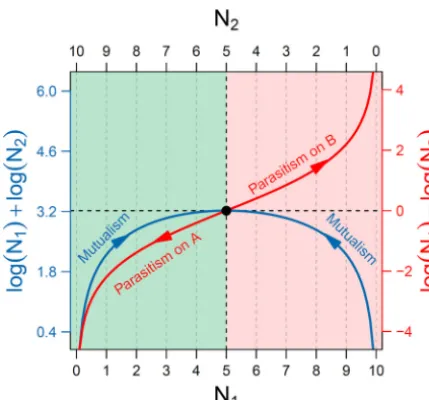
maximum fitness simultaneously and, therefore, a maximum inclusive fitness (Fig. 1).
Any value below this maximum is due to deviation from the equalityN1⫽N2. As such,
the log product of abundances of two microbes, logN1N2, can be used to measure and
quantify the strength of their cooperation, i.e., the amount of mutualism or mutual benefits.
In microbial communities where resources become limited, a microbe will grow at the cost of its conspecific microorganism. The asymmetric form of such a competitive relationship is called predation or parasitism by which one microbe benefits by consuming and damaging the resources of others. We define the difference of fitness of two microbes as exclusive fitness to mathematically describe the strength of parasitism, expressed as
on September 8, 2020 by guest
http://msystems.asm.org/
G1⫺G2⫽logN1⫺logN2⫽log共N1⁄N2) (4)
where the growth of microbe A proceeds at the expense of microbe B, with the extent of such parasitism quantified by the log ratio of the abundances of two microbes, log
(N1/N2). This ratio can be used as a measure for the parasitism of one microbe at the
expense of the other, depending on whether it is larger or less than zero (Fig. 1). For consistency, we stipulate the larger abundance as the numerator and the smaller abundance as the denominator to calculate the ratio.
Plotting log products and log ratios of the abundance of two microbes in the same illustration allows the comparison of mutualism and parasitism as two distinct pro-cesses that govern the microbial community assembly (Fig. 1). The two microbes
approach their highest peak of mutualism when their abundance levels, N1 andN2,
tend to be equal, whereas parasitism becomes predation in the case in which one
microbe completely inhibits the other, leadingN1andN2to have opposite abundance
levels. Between complete cooperation and complete competition are the intermediate processes that not only include cooperation but also implicate competition. In other words, cooperation may contain competition, while competition may also include cooperation. It is likely that cooperation and competition, two different but dynamically related processes, together underlie the overall microbial community behavior.
Interpreting the mathematical descriptors of ecological interactions from
be-havioral ecology. Equations 3 and 4 that quantitatively describe the strengths of
mutualism and parasitism have an ecological basis. In behavioral ecology, collective motion phenomena, such as swarming, flocking, and schooling behavior, are regarded as being ubiquitous in a large variety of animal species ranging from bacteria to humans (20, 21). Under natural selection, such collective animal behavior has been shaped in two important ways. First, animals of roughly similar size in a population tend to cooperate with each other to form group-level coordination under rules of attraction and alignment (22–25). Animals prefer to shoal and cooperate with individuals that resemble themselves, because any shoal member that stands out in appearance will be preferentially targeted by predators, a phenomenon called the “oddity effect” (26). As such, if two animals cooperate mutually, they tend to be of similar body size. In
FIG 1 Quantitative description of mutualism (blue) and parasitism (red). Assume a microbial community in which two microbes A and B, whose abundance is denoted byN1andN2, respectively, interact with
each other. The blue curve, specified by logN1⫹logN2, describes how the two microbes cooperate to
form mutualism, with arrows indicating the increase of mutualism with increasing equality of their abundance. The red curve, specified by logN1– logN2, is indicative of parasitism through competition,
by which one microbe gains by reducing the fitness of the other, with arrows representing the direction of increasing parasitism. The black circle is the position at which mutualism achieves a maximum degree whereas parasitism is minimum.
on September 8, 2020 by guest
http://msystems.asm.org/
mathematics, given that the sum of two variables is fixed, their product reaches a maximum when they have the same value. Thus, since the magnitude of the product is related to how much the two variables are similar in value, we hypothesize that the product of two animals’ body sizes is positively correlated with the strength of cooperation.
Second, dominant animals of large body size tend to be agonistic to subordinates of small body size during a conflict between members of the same population (27, 28). Such agonistic behavior, regarded as an adaptive aggressive and defensive action, plays a pivotal role in resource acquisition, reproductive success, and even survival (29). On the basis of the animal behavioral theory described above, we hypothesize that the ratio of body mass of a larger animal to a small animal in the socialized environment can serve as a surrogate of the strength of parasitism.
Topological landscape of cooperation and competition: a true story from the
gut microbiota.The gut of a healthy human contains symbiotic interactions among
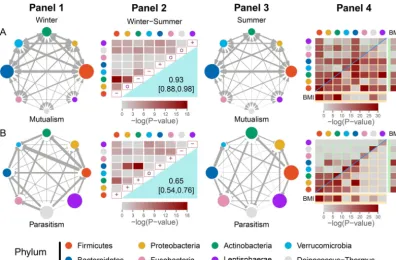
500 to 1,000 bacterial species, belonging to different genera, all the way up through families, orders, classes to phyla (30). All these highly heterogeneous bacteria interact and work together to determine the stability of the microbial community and further impact human health. Davenport et al. (31) reported 16S rRNA gene sequencing data of the gut microbiota at 101 genera and 8 phyla collected from 127 hosts of a founder population, the Hutterites, of which 93 were sampled in winter, 91 in the following summer, and 57 in both winter and summer. We calculated pairwise log products of abundance between different genera and pairwise log ratios of abundance of a bigger genus over a smaller genus, which allowed us to reconstruct 93 winter-specific 101-node networks and 91 summer-specific 101-101-node networks for mutualism and para-sitism, respectively. We merged higher-dimensional genus-level networks into lower-dimensional phylum-level networks by averaging log values over genera from within the same phylum (used as nodes) and those over genus pairs from different phylum pairs (used as edges). Averaged over all hosts from the same season, we reconstructed eight-node mutualism and parasitism networks for winter and summer, respectively (Fig. 2). The significance of mutualism and parasitism within and between phyla was tested using information about sampling variances among hosts. A detailed procedure of reconstructing and testing networks is given in Materials and Methods.
Strong mutualism and parasitism exist in the gut microbiota, but the extent and frequency of these interactions depend on the phylum considered and how phyla are
paired and are also affected by seasonal change. Of all phyla,Firmicutes and
Bacte-roidetes not only display the most intense genus-genus mutualism within their own
phyla but also pursue the most intense cooperation with one another and other phyla as well (Fig. 2A). It seems that the mutualism involving these two phyla dominate the network of mutualism. Many phyla were found to have strong internal competition, although such within-phylum competition mostly increases from winter to the next summer (Fig. 2B). In general, mutualism between pairwise phyla is strongly correlated
between winter and summer (r⫽0.93), with a larger extent than the correlation of
competition between the two seasons (r⫽0. 65). Significance tests discerned different
patterns of how the strengths of mutualism and parasitism vary with season. From
winter to summer, within-phylum mutualism decreases forFirmicutesand increases for
Bacteroidetes, but it is stable for the other phyla, whereas between-phylum mutualism
generally decreases (Fig. 2A). The strength of mutualism involvingFirmicutes,
Actino-bacteria, andProteobacteriadecreases dramatically from winter to summer (P⬍10⫺9).
LentisphaeraeandDeinococcus-Thermus are the two phyla that exhibit weak internal
and weak external cooperation with other phyla, with a slight season-dependent change.
From winter to summer, within-phylum parasitism increases for most phyla,
includ-ingFirmicutesandBacteroidetes, decreases forDeinococcus-ThermusandLentisphaerae,
and is unchanged for Verrucomicrobia. Figure 2B shows the topological network of
directed and weighted between-phylum parasitism. BothFirmicutesandBacteroidetes
tend to parasitize other phyla, such asActinobacteria,Proteobacteria, andFusobacteria,
on September 8, 2020 by guest
http://msystems.asm.org/
but are parasitized byVerrucomicrobiain the two seasons. It is interesting to see that
Firmicutes parasitizes Bacteroidetes in winter, but this relationship changes during
summer. All these above parasitic relationships construct the main sketch of the network. In general, the strength of parasitism between phyla decreases from winter to summer, and this phenomenon may be due to the necessity in winter to favor microbes allowing for higher digestion and absorption of nutrients to store more energy for the cold season as well as to the fact that summer offers a greater nutritional variety which
per seenhances a greater microbial diversity compared to winter.
Our theory can estimate and test the correlations of microbial cooperation and competition with host health risk. The plot of correlation significance tests shows how mutualism or parasitism covaries with the health risk trait of body mass index (BMI) over sampled hosts. Considering all possible pairs, mutualism has a much larger likelihood to correlate with BMI than parasitism (Fig. 2). In general, the correlations of both mutualism and parasitism with BMI are largely consistent over season, except for a few cases. Mutualism within phyla is highly correlated with BMI, especially for some phyla
such asFirmicutes,Bacteroidetes, andActinobacteria, and parasitism within phyla is also
highly correlated with BMI, but with some of these correlations changing over seasons.
A strong correlation of within-phylum parasitism with BMI for Deinococcus-Thermus
occurs in winter, but it decreases dramatically in summer. There is a particular group of phylum pairs that are correlated with BMI through mutualism or parasitism. For
FIG 2 The network of mutualism (A) and parasitism (B) among eight phyla (distinguished by colors) derived from 127 hosts of the Hutterites, including 93 in winter and 91 in summer. (Panels 1 and 3) Mutualism (indicated by double arrowed lines) and parasitism (indicated by T-shaped lines) expressed independently in winter and summer. The size of the circles indicates the strength of mutualism or parasitism among different genera within phyla, whereas the thickness of the lines indicates the strength of pairwise mutualism or parasitism among different genera from different phyla. (Panels 2) On the diagonal of the matrix are the signs of within-phylum mutualism or parasitism changes from winter to summer (⫹for increase, 0 for no change, and – for decrease). The right bottom part reports the correlation coefficient (with its estimated confidence interval) of mutualism or parasitism between the two seasons, representing the season-dependent similarity of the mutualism or parasitism networks. The left top part reports a colored scale representing the results of the significance test of the season-dependent strength difference of mutualism or parasitism between the same phylum pairs. The more intense the color, the higher the degree of mutualism or parasitism. (Panels 4) Cells on the diagonal of the matrix represent the significance tests of correlations of within-phylum mutualism (A) or parasitism (B) with BMI, each of which is separated into two parts for winter (left top) and summer (right bottom). The left top and right bottom portions represent the significance test of the correlations of between-phylum mutualism or parasitism with BMI. The significance tests of the correlations of the microbial abundance of each phylum with BMI are given in the BMI columns (winter) and the BMI rows (summer).
on September 8, 2020 by guest
http://msystems.asm.org/
example,FirmicutesandBacteroideteseach cooperate with all other phyla to relate to
BMI (Fig. 2A).Actinobacteriacooperates with more phyla in summer than in winter to
link to BMI. The parasitism of Firmicutes negatively impacting Actinobacteria and
Proteobacteriais remarkably correlated with BMI in both seasons (Fig. 2B). A similar case
is true for the parasitism ofProteobacteria affectingBacteroidetesandActinobacteria.
BacteroidetesparasitizesVerrucomicrobia, and this interaction is linked to BMI in
sum-mer, but not in winter.
In previous studies, the microbiota impact on host performance was assessed by the correlation analysis of microbial abundance with a host trait (31). However, if we incorporate microbial interactions into such a correlation analysis, we can make new
discoveries. For example, within-phylum mutualism forBacteroidetesis more strongly
correlated with BMI thanBacteroidetesmicrobial abundance in both seasons, especially
in summer (Fig. 2A). A similar phenomenon was observed for other phyla, such as
Verrucomicrobia. Also, parasitism is associated with BMI in a different way than
micro-bial abundance is. For instance, within-phylum parasitism forVerrucomicrobiaexhibits
much stronger correlations with BMI than its abundance in both winter and summer (Fig. 2B). All these data suggest that our theory provides a new view of the influence of microbiota, thanks to dissecting how different microbes interact with each other in a topological network.
Transition from cooperation to competition.There are many biological processes
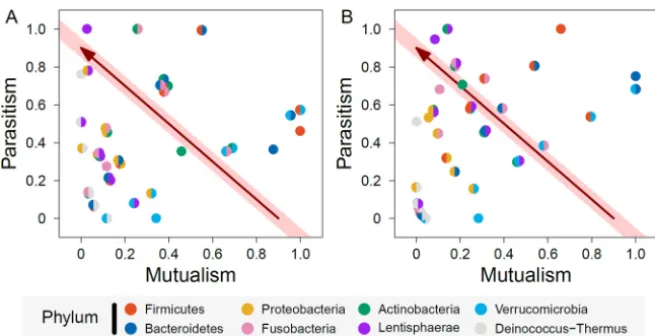
at all levels of organization, where cooperation intertwines with competition (32, 33). In a microbial system like the one shown in Fig. 1, two microbes may strive to cooperate until they achieve a complete level of cooperation. Any incomplete cooperation accompanies competition by which two microbes hinder each other’s fitness. Again, using Davenport et al.’s (31) gut microbiota data, we standardized the values of log products and log ratios among 8 phyla and 28 phylum pairs and plotted standardized log ratios (parasitism) against standardized log products (mutualism) in winter and summer, independently (Fig. 3). The results show that mutualism and parasitism are independent of one another, and therefore, these two interaction states may mutually and reciprocally transit from one state to the other over seasons.
By linking maximum mutualism to maximum parasitism by a line, we can charac-terize how a particular microbe transits from cooperation to competition. The microbes located on or near this line are thought to be in a cooperation-competition steady state. Microbes below this line tend to display milder interactions, whereas those above this
line exert more intense interactions. Genera within Actinobacteriatrigger moderate
strengths of mutualism and parasitism in winter (Fig. 3A), but they are characterized by
FIG 3 Correlations between mutualism and parasitism over phylum pairs in winter (A) and summer (B). Single-colored and double-colored circles are within-phylum and between-phylum mutualism or para-sitism, respectively. The arrowed line on the diagonal shaded area indicates the change of microbial interaction from maximum mutualism to maximum parasitism.
on September 8, 2020 by guest
http://msystems.asm.org/
stronger parasitism and weaker mutualism during summer (Fig. 3B). In general, for
some phyla, such asVerrucomicrobia, the relative importance of mutualism and
para-sitism is stable between the two seasons, but for many phyla and phylum pairs, the relative importance of mutualism and parasitism changes dramatically from winter to summer. A quantitative assessment on how each phylum or phylum pair is apt to cooperate or compete can be seen from Fig. 3, along with its season-dependent change.
DISCUSSION
Of the ecological forces that govern the assembly and stability of microbial com-munities, microbial interactions have proven to be extremely difficult to study because of their high complexity, high heterogeneity, and high dynamics. Although temporal or perturbed data are powerful for inferring microbial networks, they are usually unavail-able and expensive (34). As such, a simple, or even rough, approach that can capture main information about microbial interaction networks from high-dimensional micro-bial consortia becomes highly essential. Results from such an analysis can serve as a starting point to investigate how microbes interact with each other to determine community phenotypes at high resolution. By integrating elements of metabolic ecology, behavioral ecology, and game theory, we proposed a rule-of-thumb frame-work for detecting, testing, and cataloguing microbial interactions. This netframe-work game model enables the reconstruction of microbial networks at any dimension for microbial community assembly with any density and heterogeneity.
Our model found that the greatest amount of mutualism and parasitism occurs
within and between the BacteroidetesandFirmicutes phyla. Using more informative
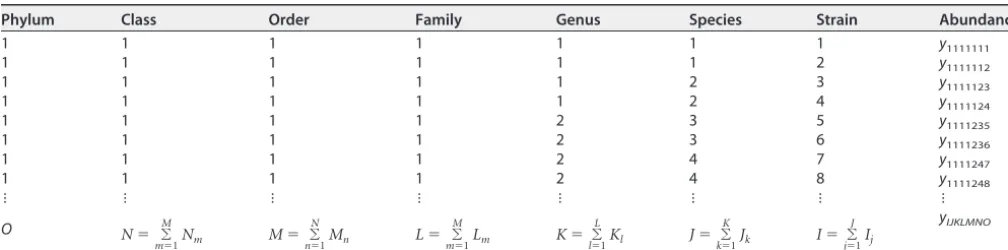
longitudinal abundance data from the gut microbiota, Venturelli et al. (34) identified the critical role of microbial interactions exerted by these two phyla in shaping microbial communities. The consistency of our result with the results from a well-designed experiment suggests the biological relevance of our model. Interactions may occur between different microbes from the same taxon and different taxa. It is also possible that interactions take place across phylogenetic clades. For example, one microbe from a taxon may interact with the entire group of other higher taxa. In Materials and Methods, we describe a full model to characterize microbial interactions at all possible levels of phylogeny. There is some evidence that intraspecific interactions can influence interspecific interactions (5, 17). Similarly, interspecific interactions may affect interac-tions between different genera, and intergenus interacinterac-tions may influence interacinterac-tions between different families, etc. These complex hierarchical patterns of interactions across clades can be identified using a statistical testing procedure outlined in Materials and Methods (Tables 1 and 2).
Although we focus on modeling mutualism and parasitism, our model can be quantitatively generalized to study other types of microbial interactions, such as antagonism (by which two microbes compete against each other), commensalism (where one microbe benefits the second, but the latter has no effect on the former), and ammensalism (in which one microbe harms the second, whereas the second
TABLE 1Data structure of microbial abundance from different strains, species, genera, families, orders, classes, and phyla
Phylum Class Order Family Genus Species Strain Abundance
1 1 1 1 1 1 1 y1111111
1 1 1 1 1 1 2 y1111112
1 1 1 1 1 2 3 y1111123
1 1 1 1 1 2 4 y1111124
1 1 1 1 2 3 5 y1111235
1 1 1 1 2 3 6 y1111236
1 1 1 1 2 4 7 y1111247
1 1 1 1 2 4 8 y1111248
⯗ ⯗ ⯗ ⯗ ⯗ ⯗ ⯗ ⯗
O N⫽
冘
m⫽1 M
Nm M⫽
冘
n⫽1 N
Mn L⫽
冘
m⫽1 M
Lm K⫽
冘
l⫽1 L
Kl J⫽
冘
k⫽1 K
Jk I⫽
冘
j⫽1 J
Ij
yIJKLMNO
on September 8, 2020 by guest
http://msystems.asm.org/
TABLE 2 Reorganized data structure by pairing all strains from different species, genera, families, orders, classes and phyla Pair Strain Phylum Class Order Family Genus Species Undirected mutualism Directed parasitism 1 1111111 ⫻ 1111112 1 ⫻ 11 ⫻ 11 ⫻ 11 ⫻ 11 ⫻ 11 ⫻ 1 y1 ⫹⫽ log y1111111 ⫹ log y1111112 y1 ⫺⫽ log y1111111 – log y1111112 2 1111111 ⫻ 1111123 1 ⫻ 11 ⫻ 11 ⫻ 11 ⫻ 11 ⫻ 11 ⫻ 2 y2 ⫹⫽ log y1111111 ⫹ log y1111123 y2 ⫺⫽ log y1111111 – log y1111123 3 1111111 ⫻ 1111124 1 ⫻ 11 ⫻ 11 ⫻ 11 ⫻ 11 ⫻ 11 ⫻ 2 y3 ⫹⫽ log y1111111 ⫹ log y1111124 y3 ⫺⫽ log y1111111 – log y1111124 4 1111111 ⫻ 1111235 1 ⫻ 11 ⫻ 11 ⫻ 11 ⫻ 11 ⫻ 21 ⫻ 3 y4 ⫹ ⫽ log y1111111 ⫹ log y1111235 y4 ⫺ ⫽ log y1111111 – log y1111235 5 1111111 ⫻ 1111236 1 ⫻ 11 ⫻ 11 ⫻ 11 ⫻ 11 ⫻ 21 ⫻ 3 y5 ⫹⫽ log y1111111 ⫹ log y1111236 y5 ⫺⫽ log y1111111 – log y1111236 6 1111111 ⫻ 1111247 1 ⫻ 11 ⫻ 11 ⫻ 11 ⫻ 11 ⫻ 21 ⫻ 4 y6 ⫹⫽ log y1111111 ⫹ log y1111247 y6 ⫺⫽ log y1111111 – log y1111247 7 1111111 ⫻ 1111248 1 ⫻ 11 ⫻ 11 ⫻ 11 ⫻ 11 ⫻ 21 ⫻ 4 y7 ⫹⫽ log y1111111 ⫹ log y1111248 y7 ⫺⫽ log y1111111 – log y1111248 ⯗⯗ ⯗ ⯗ ⯗ ⯗ ⯗ ⯗ ⯗ ⯗ W ( O –1) ( N –1) ( M –1) ( L –1) ( K –1) ( J –1) ( I –1) ⫻ ONMLKJI O –1 ⫻ ON –1 ⫻ NM –1 ⫻ ML –1 ⫻ LK –1 ⫻ KJ –1 ⫻ J yW ⫹⫽ log y ( O –1) ( N –1) ( M –1) ( L –1) ( K –1) ( J –1) ( I –1) ⫹ log yONMLKJI yW ⫺⫽ log y ( O –1) ( N –1) ( M –1) ( L –1) ( K –1) ( J –1) ( I –1) – log yONMLKJI
on September 8, 2020 by guest
http://msystems.asm.org/
microbe has no effect on the first). Because the log product of abundance of two microbes is proportional to the strength of mutualism, its value may span a range from cooperation to competition. Similarly, the magnitude of the log ratio of abundance of a bigger microbe to a smaller microbe reflects the strength of parasitism, which covers commensal or ammensal relationship. Yet, distinguishing between commensalism and ammensalism needs additional information.
It should be pointed out that our model was derived from the integration of multiple disciplines. Its biological interpretation is founded on the metabolic and behavioral ecology of animal body size, which allows us to reconstruct microbial networks from abundance data. However, predators discern a target from a group of prey not only based on prey size but also prey color or even prey smell (26). It is unclear how to incorporate color- or smell-based oddity effects into our game network model, which presents a topic of great interest deserving further investigation.
By quantifying the inner workings of microbial community assembly, our network game model overcomes the descriptive limitation of empirical approaches for describ-ing the global behavior of microbial communities. The model can be merged with evolutionary studies to investigate the fitness consequences of ecological interactions along a spatiotemporal gradient helping to identify the reason why a particular pattern of microbial interactions is favored by natural selection. In host-microbe interaction studies, this model can find its application in unveiling the genetic and molecular mechanisms underlying microbial interactions and identify genes that play a key role in shaping microbial networks. It can further construct a causal or predictive link of microbial networks within host phenotypes. With these capacities, the model provides a tool to dissect and engineer the interactions within microbial communities.
MATERIALS AND METHODS
Estimating mutualistic and parasitic relationships.Consider a microbial community in which ecological interactions occur at the lowest taxonomic level. Suppose that we use a high-resolution technique that allows constituent microbes to be classified at the strain level. Letyijklmndenote the abundance of strainifrom speciesjfrom genuskfrom familylfrom orderm, classn, and phylumo, with
i⫽1, . . .,Ij,j⫽1, . . .,Jk,k⫽1, . . .,Kl,l⫽1, . . .,Lm,m⫽1, . . .,Mn,n⫽1, . . .,N,o⫽1, . . .,O. To illustrate
the idea of game theory integration, we use a didactic example with the data structure (Table 1), where abundance is shown at hierarchic levels of classification. We describe the mutualism and parasitism of two different strains by the product of the abundances of the two strains and the inverse of the product, respectively, and the reciprocal altruism of two strains by the ratio of the abundance of the two strains. By taking log transformation of these derivatives, we obtain measures of cooperation versus competition and reciprocal altruism by the summation and difference of two log-transformed abundances, respec-tively. To reflect these measures, we reorganize the data by pairing different strains in the format given in Table 2. Since the total number of strains isI, there areW⫽1/2I(I– 1) pairs. Letyw⫹andyw
–
denote the summation and difference of abundance between two strains in pairw(w⫽1, . . .,W), on which we can test the effect of species pairs. Species pairs have 1/2J(J– 1) possibilities. For thesth species pair, the number of strain pairs is denoted byTs.
Testing mutualistic and parasitic interactions.We formulate a multiplicative likelihood at the species pair level, expressed as
Ls(y⫹,y⫺)⫽
写
s⫽1 1 2(J⫺1)J写
w⫽1
Ts
fs(yw⫹,yw⫺) (5)
wherefs共yw⫹,yw⫺兲is a bivariate normal density function of the summation and difference of abundance of strains in pairw, characterized by mean vector共s⫹,s⫺兲and the covariance matrix composed of variance of strain summation⫹2,variance of strain difference⫺2,and their correlation.
After the parameters determining the density function are estimated, we can formulate the following hypotheses:
H0:(s⫹,⫺s)⬅(⫹,⫺)
H1:(s⫹,s⫺)⫽(⫹,⫺) for alls⫽1 , . . . ,1 ⁄ 2J(J⫺1)
The acceptance of H1suggests that species pairs determine ecological interactions among different
strains through the summation and difference of abundance between different strains. Furthermore, by testing H0:s⫹⬅⫹, we can characterize whether mutualism or parasitism exists among microbes at the species level. Similarly, the existence of reciprocal altruism can be characterized by testing H0:s⫺⬅⫺. Similar procedures can be extended to test whether and how microbes interact at the other higher levels, such as genus, family, order, class, and phylum levels. More interesting, the model can test whether and how microbes from a lower level interact with those from a higher level. For example, a
on September 8, 2020 by guest
http://msystems.asm.org/
particular set of species may interact with the microbes at the order level. This can be tested by formulating a certain hypothesis.
Calculating correlations.The following correlations are calculated.
(1) Network correlation. How two networks differ can be assessed by calculating the correlations (r) of nodes and edges between the networks. We calculaterbetween mutualism networks from winter and summer and between parasitism networks from winter and summer. Theservalues allow us to compare how networks change from season to season.
(2) Interaction correlation. How microbial interactions at the phylum level change from winter to summer can be assessed by calculating the correlations of edges of genus-level networks across hosts from each season. These results are given in the upper part of winter-summer matrix in panels 2 (Fig. 2).
(3) Microbial abundance-host trait correlation. We calculated the correlations between microbial abundance at the phylum level and BMI across hosts from a different season. These results are given in the BMI columns and rows in panel 3 (Fig. 2).
(4) Microbial interaction-host trait correlation. We calculate the correlations between microbial interactions within and between phyla and BMI across hosts from a different season. The correlations between microbial interactions within and between phyla and BMI across hosts from a different season are given on the diagonal and top part of matrix, respectively, in panels 3 (Fig. 2).
Data availability. The data used can be downloaded at https://doi.org/10.1371/journal.pone
.0140301. The computer code can be requested from the corresponding author.
ACKNOWLEDGMENTS
Part of this research is supported by NNSFC 7192072 (J.L.), and NSF CMMI-1463482 (C.H.G.).
We declare that we have no conflicts of interest.
REFERENCES
1. Falkowski PG, Fenchel T, Delong EF. 2008. The microbial engines that drive Earth’s biogeochemical cycles. Science 320:1034 –1039.https://doi.org/10
.1126/science.1153213.
2. Human Microbiome Project Consortium. 2012. Structure, function and diversity of the healthy human microbiome. Nature 486:207–214.
https://doi.org/10.1038/nature11234.
3. Sunagawa S, Coelho LP, Chaffron S, Kultima JR, Labadie K, Salazar G, Djahanschiri B, Zeller G, Mende DR, Alberti A, Cornejo-Castillo FM, Costea PI, Cruaud C, d’Ovidio F, Engelen S, Ferrera I, Gasol JM, Guidi L, Hildebrand F, Kokoszka F, Lepoivre C, Lima-Mendez G, Poulain J, Poulos BT, Royo-Llonch M, Sarmento H, Vieira-Silva S, Dimier C, Picheral M, Searson S, Kandels-Lewis S, Bowler C, de Vargas C, Gorsky G, Grimsley N, Hingamp P, Iudicone D, Jaillon O, Not F, Ogata H, Pesant S, Speich S, Stemmann L, Sullivan MB, Weissenbach J, Wincker P, Karsenti E, Raes J, Acinas SG, Bork P. 2015. Structure and function of the global ocean microbiome. Science 348: 1261359.https://doi.org/10.1126/science.1261359.
4. Goldford JE, Lu NX, Bajic D, Estrela S, Tikhonov M, Sanchez-Gorostiaga A, Segre D, Mehta P, Sanchez A. 2018. Emergent simplicity in microbial community assembly. Science 361:469 – 474. https://doi.org/10.1126/
science.aat1168.
5. Hibbing ME, Fuqua C, Parsek MR, Peterson SB. 2010. Bacterial competition: surviving and thriving in the microbial jungle. Nat Rev Microbiol 8:15–25.https://doi.org/10.1038/nrmicro2259.
6. Lozupone CA, Stombaugh JI, Gordon JI, Jansson JK, Knight R. 2012. Diversity, stability and resilience of the human gut microbiota. Nature 489:220 –230.https://doi.org/10.1038/nature11550.
7. von Neumann J, Morgenstern O. 1946. Theory of games and economic behavior. Princeton University Press, Princeton, NJ.
8. Axelrod R, Hamilton WD. 1981. The evolution of cooperation. Science 211:1390 –1396.https://doi.org/10.1126/science.7466396.
9. Wu A, Ross D. 2016. Evolutionary game between commensal and patho-genic microbes in intestinal microbiota. Game 7:26.https://doi.org/10
.3390/g7030026.
10. Zomorrodi AR, Segre D. 2016. Synthetic ecology of microbes: mathe-matical models and applications. J Mol Biol 428:837– 861.https://doi
.org/10.1016/j.jmb.2015.10.019.
11. Kim MS, Zhang H, Shim WB. 2018. Application of game theory to explore the dynamics of host⫺pathogen association in phytobiomes. Phytobi-omes 2:111–116.https://doi.org/10.1094/PBIOMES-04-18-0019-P. 12. Barberan A, Bates ST, Casamayor EO, Fierer N. 2012. Using network
analysis to explore co-occurrence patterns in soil microbial communities. ISME J 6:343–351.https://doi.org/10.1038/ismej.2011.119.
13. Faust K, Raes J. 2012. Microbial interactions: from networks to models. Nat Rev Microbiol 10:538 –550.https://doi.org/10.1038/nrmicro2832. 14. Fisher CK, Mehta P. 2014. Identifying keystone species in the human gut
microbiome from metagenomic timeseries using sparse linear regression. PLoS One 9:e102451.https://doi.org/10.1371/journal.pone.0102451. 15. Stein RR, Bucci V, Toussaint NC, Buffie CG, Rätsch G, Pamer EG, Sander C,
Xavier JB. 2013. Ecological modeling from time-series inference: insight into dynamics and stability of intestinal microbiota. PLoS Comput Biol 9:e1003388.https://doi.org/10.1371/journal.pcbi.1003388.
16. Widder S, Allen RJ, Pfeiffer T, Curtis TP, Wiuf C, Sloan WT, Cordero OX, Brown SP, Momeni B, Shou W, Kettle H, Flint HJ, Haas AF, Laroche B, Kreft JU, Rainey PB, Freilich S, Schuster S, Milferstedt K, van der Meer JR, Grokopf T, Huisman J, Free A, Picioreanu C, Quince C, Klapper I, Labarthe S, Smets BF, Wang H, Isaac Newton Institute Fellows, Soyer OS. 2016. Challenges in microbial ecology: building predictive understand-ing of community function and dynamics. ISME J 10:2557–2568.https://
doi.org/10.1038/ismej.2016.45.
17. Layeghifard M, Hwang DM, Guttman DS. 2017. Disentangling interac-tions in the microbiome: a network perspective. Trends Microbiol 25: 217–228.https://doi.org/10.1016/j.tim.2016.11.008.
18. Voje KL, Hansen TF, Egset CK, Bolstad GH, Pélabon C. 2014. Allometric constraints and the evolution of allometry. Evolution 68:866 – 885.https://
doi.org/10.1111/evo.12312.
19. Brown JH, Gillooly JF, Allen AP, Savage VM, West GB. 2004. Toward a metabolic theory of ecology. Ecology 85:1771–1789.https://doi.org/10
.1890/03-9000.
20. Vicsek T, Zafeiris A. 2012. Collective motion. Phys Rep 517:71–140.https://
doi.org/10.1016/j.physrep.2012.03.004.
21. Jiang L, Giuggioli L, Perna A, Escobedo R, Lecheval V, Sire C, Han Z, Theraulaz G. 2017. Identifying influential neighbors in animal flocking. PLoS Comput Biol 13:e1005822. https://doi.org/10.1371/journal.pcbi
.1005822.
22. Camazine S, Deneubourg JL, Franks NR, Sneyd J, Theraulaz G, Bonabeau E. 2001. Self-organization in biological systems. Princeton studies in complexity. Princeton University Press, Princeton, NJ.
23. Sumpter D. 2006. The principles of collective animal behavior. Philos Trans R Soc Lond B Biol Sci 361:5–22.https://doi.org/10.1098/rstb.2005.1733.
on September 8, 2020 by guest
http://msystems.asm.org/
24. Sumpter DJT. 2010. Collective animal behavior. Princeton University Press, Princeton, NJ.
25. Herbert-Read JE, Perna A, Mann RD, Schaerf TM, Sumpter DJT, Ward A. 2011. Inferring the rules of interaction of shoaling fish. Proc Natl Acad Sci U S A 108:18726 –18731.https://doi.org/10.1073/pnas.1109355108.
26. Hoare DJ, Couzin ID, Godin JGJ, Krause J. 2004. Context-dependent group size choice in fish. Anim Behav 67:155–164.https://doi.org/10
.1016/j.anbehav.2003.04.004.
27. Chance MRA. 1976. Social structure of attention. J Wiley, New York, NY. 28. Desjardins JK, Hofmann HA, Fernald RD. 2012. Social context influences aggressive and courtship behavior in a cichlid fish. PLoS One 7:e32781.
https://doi.org/10.1371/journal.pone.0032781.
29. Pan Y, Xu L, Young K, Wang Z, Zhang Z. 2010. Agonistic encounters and brain activation in dominant and subordinate male greater long-tailed hamsters. Horm Behav 58:478–484.https://doi.org/10.1016/j.yhbeh.2010.05.001.
30. Sommer F, Bäckhed F. 2013. The gut microbiota–masters of host devel-opment and physiology. Nat Rev Microbiol 11:227–238.https://doi.org/
10.1038/nrmicro2974.
31. Davenport ER, Cusanovich DA, Michelini K, Barreiro LB, Ober C, Gilad Y. 2015. Genome-wide association studies of the human gut microbiota. PLoS One 10:e0140301.https://doi.org/10.1371/journal.pone.0140301. 32. Bunge M. 1976. A model for processes combining competition with
cooperation. Appl Math Model 1:21–23.https://doi.org/10.1016/0307
-904X(76)90019-6.
33. Kenworthy L. 1996. Balancing competition and cooperation. Challenge 39:51–58.https://doi.org/10.1080/05775132.1996.11471915.
34. Venturelli OS, Carr AC, Fisher G, Hsu RH, Lau R, Bowen BP, Hromada S, Northen T, Arkin AP. 2018. Deciphering microbial interactions in syn-thetic human gut microbiome communities. Mol Syst Biol 14:e8157.
https://doi.org/10.15252/msb.20178157.