IMPROVİNG THE MALWARE DETECTİON RATİO
USİNG DATA MİNİNG TECHNİQUES
Abhay Pratap Singh
Department of CSE,, Manav Rachana İnternational University, Faridabad (India)
ABSTRACT
In today's word computer security is becomeessential part of internet security. Attacker may execute malware or buffer overflow attacks to gain access system malware is also big concern in computer security, now a days malware analysis is big task for the cyber security expert because over the last two to three years attacker become so smart they are used various kinds of new techniques like armoring, tunneling etc. With the help of these techniques they can easily bypass malware in good anti-virus software. in this paper, we are presenting a data mining approach which improves the malware detection ratio with high precision, whereas current anti-virus detection technologies which is based on signature, code emulation, anomaly based, these are the technologies are failed to detect malware, although some of the technologies are good, but in terms of money they are expensive and one important thing sometimes they also give the false positive results, which is our primary concern in this paper.
Keywords: Computer Security;Advance Escaping Techniques;Malware Detection;Data Mining.
I. INTRODUCTİON
II. RELATED WORK
In this section we discuss about various techniques used for malicious code detection and role of data mining in cyber security.
In [1] author used data mining techniques for extracting variable length instruction sequences that can identify Trojans from clean programs. The analysis is facilitated by the program control flow information contained in the instruction sequences.
In [2] author presents cw sandbox, which executes malware samples in a simulated environment, monitors all system calls, and automatically generates a detailed report to simplify and automate the malware analyst’s task. It monitors all the executed functionality.
In [3] the author has focused on deobfuscation of actual obfuscated code in order to reveal true intent of that piece of code.
In [4] author proposed a statistic-based metamorphic virus detection technique and proves that detection based on statistics is a useful approach in detecting self-mutated malwares. Six statistic feature that include percentage of NOP instruction at the end of subroutines, percentage of NOP instruction in random.
In [5], a behavior based detection approach is proposed to address malware detection. The behaviors of interest are defined as static system call sequences and they are derived by statically analyzing binary code.
In [6], the author talks about role of data mining in cyber security and it is being applied to problem such as intrusion detection and auditing and it also addressed surveillance problem.
III. ADVANCED TECHNIQUES FOR ESCAPING FROM ANTIVIRUSES
Since current antivirus scanner are fail to cope with new malware just because of malware writers apply some obfuscation techniques, some important techniques are listed below:
A. Code Obfuscation
Obfuscation techniques are those that are used by malware writers to avoid detection and analysis becomes so complex ex.-inserting some bunch of junk instruction (NOP).
B. Oligomorphism
These viruses use multiple decryption routines to avoid giving a signature for the antivirus software. The decryption routine is chosen randomly on infection. But, if the antivirus software have signatures for all of the decryption routine, detection is possible.
C. Polymorphism
These viruses change the look of the virus code every time it infects a new file. This is achieved by changing the decryption routine and is much harder to detect using signatures.
D. Metamorphism
These viruses change the virus body instead of appearance. This is possible by using equivalent and unneeded functions or by changing the sequence of statements in the code slightly (as long as the logic remains relevant).This way every specimen looks different and generation of a signature is harder.
E. Armouring
F. Tunneling
Tunneling is mainly used to hide behavior blocking antivirus software. These capture operating system interrupts. So, whenever these interrupts are made, the virus executes first and after that control is passed to the original destination. This way they are at a much deeper level in the operating system than the antivirus software and may avoid detection by it.
G. Stealth
A stealth virus is a type of virus that tries to remain undiscovered by hiding the infection events from everyone, instead of trying to obfuscate its code. It achieves this by restoring certain original properties of the host file. Example: Timestamps
IV PROPOSED METHODLOGY
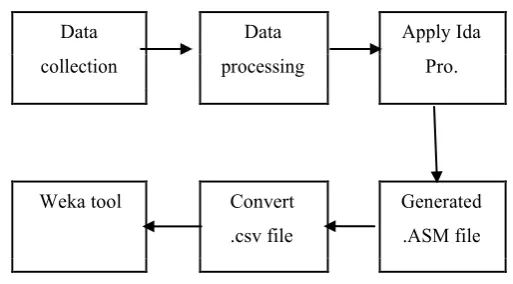
Our research has been performed by some basic steps:
Data Data Apply Ida
collection processing Pro.
Weka tool
Convert Generated
.csv file .ASM file
Fig. 1 Basic Steps of Proposed Methodology
Data collection: First we have downloaded amalicious dark comet Trojan virus from offensive computing,
after that we configured a virus, we selected this malware because in this study our main aim to detection of Trojan virus.
Data processing and preparation: In this section we deal with data processing using reverse engineering
tool like Ida pro as well as PEiD anti-packing tool. First we process the PEiD tool to check whether the file is compressed or packed, encrypted if file is compressed it will not open in Ida pro, so first we have to check file is encrypted or not, afterwards, we give the file as input to disassembler and they get the assembly code of these fields and return the called system functions list from these assembly codes. We just insert some garbage instruction like NOP instruction it will not alter the functionality of code but will increase the size of code.
Analysis of results:In this section we analyze the malware code, IDA pro generated ASM file (automatic
V. EXPERİMENT RESULT
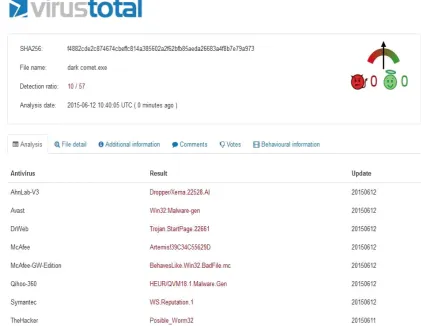
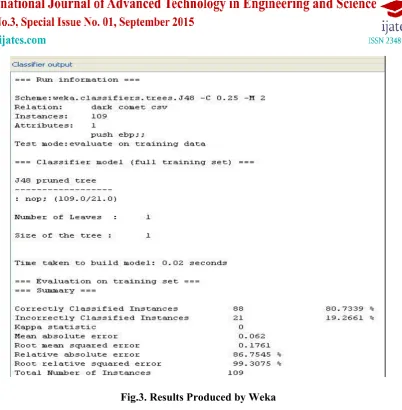
Our proposed methodology can detect the malware along with obfuscation when compared with existing antivirus scanner. The interesting fact our study revealed that when we tested Trojan file in total virus site there is only 10 antivirus scanner detect and all scanner are failed to detect them, but when we applied weka data mining tool and performed j48 algorithm on .csv file then we will get 80% detection ratio which is remarkable rate, fig. shows a graph of data mining operation it clearly indicates that data mining method is far better than traditional based scanners.
Fig.3. Results Produced by Weka
VI. CONCLUSIONS
In this paper we provided an introduction to the malware research using data mining techniques, malwares are becoming widespread and more complex every day. As example of their complexity, we can note the need of using polymorphism techniques; transformation and encryption, the traditional method such as matching some code strings of malwares signatures don’t enough efficiency. Data mining framework which easily detect undetectable computer virus rather than compare to traditional based antivirus.
Table I.Comparison of Proposed and Existing
Work
Malware Traditional based Proposed method
detection
Obfuscated virus
Cannot detect
Can detect
files
Malicious files
Can detect
Can detect.
REFERENCES
[1] D.M.A. Hussain et al. (Eds.): “Detecting Trojans Using Data Mining Techniques”, CCIS 20, pp. 400–411, 2008.Springer-Verlag Berlin Heidelberg 2008.
[2] Carsten Willems, Thorsten Holz, Felix Freiling: “Toward Automated Dynamic Malware Analysis Using CWSandbox”, IEEE Security and Privacy, vol. 5, no. 2, pp. 32-39, Mar/Apr, 2007.
[3] A. Lakhotia, E. U. Kumar, M. Vennable, “A Method for Detecting Obfuscated Calls in Malicious Binaries”, IEEE transactions on Software Engineering, Vol 31, No 11, November (2006).
[4] Govindaraju. A, Faculty, Department of Computer Science, Master Thesis, “Exhaustive Statistical Analysis for Detection of Metamorphic Malware”. San Jose State University, San Jose, CA (2010).
[5] Ding Yuxin*, Yuan Xuebing, Zhou Di, Dong Li, An Zhancha,” Feature representation and selection in malicious code detection methods based on static system calls”Computers & Security (2011) ,article in press, science direct journal.