IJEDR1703130
International Journal of Engineering Development and Research (www.ijedr.org)
914
Hardware Efficient Image Stegnography
1
Somshekhar R Puranmath,
2Vishwas Patil,
3shivaraj S T
1Asst.Professor, 2Asst.Professor, 3Programmer
1Electronics and communication (K.L.E Institute of Technology,Hubballi), 2 Electronics and communication (K.L.E Institute of Technology,Hubballi)
3 VSK University Ballari
________________________________________________________________________________________________________
Abstract—in recent years, communication has become a booming field, where each day new developments are made and
security is of utmost priority. The data needs to be kept secure and safe so that it could be accessed only by the authorized personnel and any unauthorized user cannot have any access of that data. Stenography is defined as the study of invisible communication. In image stenography, secret communication is achieved by embedding a message into cover image and generates a stegno image. The existing implementations have consumed more hardware and hence the area. Stenography is a branch of information hiding and its main goal is to communicate or transit the data securely in a completely undetectable manner. Literally meaning writing in a cover is the practice of hiding messages within other messages in order to conceal the existence of the original. Stenography refers to data or a file that has been concealed inside a digital image, video or audio file. Examples of its use can be found throughout history, dating as far back as ancient Greece. However, with the digital media formats in use for data exchange and communication today providing abundant hosts for Stenography communication, interest in this practice has increased. Couple this fact with the multitude of freely available, easy to use stenography software tools on the internet, the ability to exchange secret information without detection is available to virtually anyone who desires to do so, and provides unique challenges and opportunities for the security professional. This algorithm is compatible for hardware implementation on FPGA.
Index Terms— stenography ,FPGA
________________________________________________________________________________________________________
I. INTRODUCTION
IJEDR1703130
International Journal of Engineering Development and Research (www.ijedr.org)
915
this practice has increased. Couple this fact with the multitude of freely available, easy to use stegnography software tools on the internet, the ability to exchange secret information without detection is available to virtually anyone who desires to do so, and provides unique challenges and opportunities for the security professional.II.SYSTEM ARCHITECTURE
This chapter describes the block diagram and also various modules used in the design.
Figure2.1 Block diagram of the proposed model Hardware Efficient Image Steganography
Address Generator
This block is activated by the enable address signal (ena) by the FSM. It generates the pixel address according to the logic of random number generator. These addresses are written into the memory. The last bit of each pixel has to be embedded with the message bit.
Serial Converter
The serial converter has a 5 character message (here din ) as input .In order to enable the loading of message into the converter there is a load signal .Whenever load signal is high, the message loads into the converter and when load signal is low, the 5 character message flows out of converter in bits. Also, the FSM has complete control over the serial converter. Whenever, the enable message signal is high (enm), the converter is activated.
Encoder
The bit stream from serial converter is fed as an input to encoder. Whenever the read signal (rd) is high, the pixels from the memory are fed in to the encoder. Here each bit of message is embedded into the last bit of pixel .The pixel into which the message has to be embedded is decided by the address generator. The FSM has enable encoder signal (ene) which activates the encoder. The embedded pixels are written into the memory, when write signal (wr) is high.
Decoder
Decoder is used at the receiver side to extract the secret message bits from the stego image. Encoded pixel values of the image are stored in the memory block. When the read signal is high, these pixel values are sent to the decoder. The least significant bit of each pixel is sent to the Serial to Parallel converter to combine the message bits.
Finite State Machine
In order to control entire system, a finite state machine is designed. FSM consists of eight states to embed the secret message bits into the cover image and to extract the same from the stego image. When enc signal is high, it encodes the message bits into the pixel and when enc signal is low, it decodes back and the message is retrieved back from the pixels. Encoding consists of four Hardware Efficient Image Steganography states which include address generation, parallel to serial conversion, read from memory, encode, and write in to memory. Decoding consists of three states which includes address generation, read from memory, decode and serial to parallel conversion. When reset signal is high, it will go back to initial state.
IJEDR1703130
International Journal of Engineering Development and Research (www.ijedr.org)
916
Serial to parallel converter is used at the receiver side to combine all the message bits which are extracted from the encoded pixels. The decoder extracts the message bits from the pixels and sends them to the parallel converter. When a control signal from FSM, i.e, enable parallel converter (enp) is high, parallel converter is activated and it combines the message bits one by one.
Memory Block
It is a storage block. It has pixel values with respect to the addresses. The pixel values whose last bit has to be embedded with message bits are present in memory block and the respective pixel addresses are given to memory block by the address generator. The memory block gives the pixel values to the encoder which embeds the message into pixel and the output from the encoder is again given back to the memory block. Further, the 8-bit pixel values which is embedded with message bits is given to decoder block for decoding.
III.HARDWARE IMPLEMENTATION DESIGN
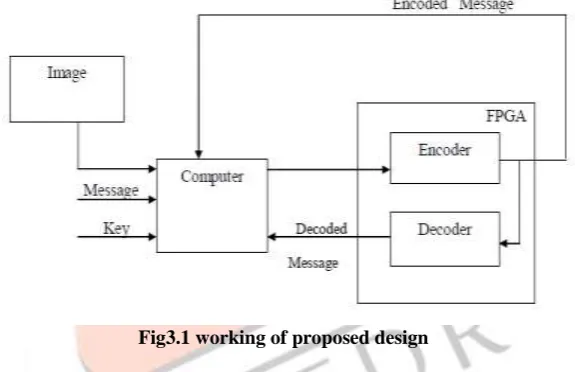
Steganography means hiding the message .Our designed system represents a steganography tool which encrypts a text message in an image using a stego-key. The basic elements of an image are the pixels. Each pixel is of size 8 bits .For example 0d, ae, etc.... The pixels of the image are obtained using the MATLAB tool where only the grayscale image is used. The values of pixels obtained from the MATLAB are in the hexadecimal form. These are stored in the memory block. The message to be encrypted is of size 5 characters, each of size 8 bits. Hence, total size of the message is 40 bits. A stego-key is used to have enhanced security and thus avoid the hacking of message by the unauthorized user. This stego key is known only to the sender and the receiver. According to the block diagram figure, the system is controlled by a control unit called FSM. When enc signal is high, the message to be encrypted must be embedded inside the picture, where the message hidden is invisible to the naked eyes. The algorithm used to embed is LSB-embedding algorithm i.e., the single least bit of the pixel is replaced with the message bit. The pixel to be modified is decided by the address generator. The pixel value of the address Hardware Efficient Image Steganography.
Fig3.1 working of proposed design
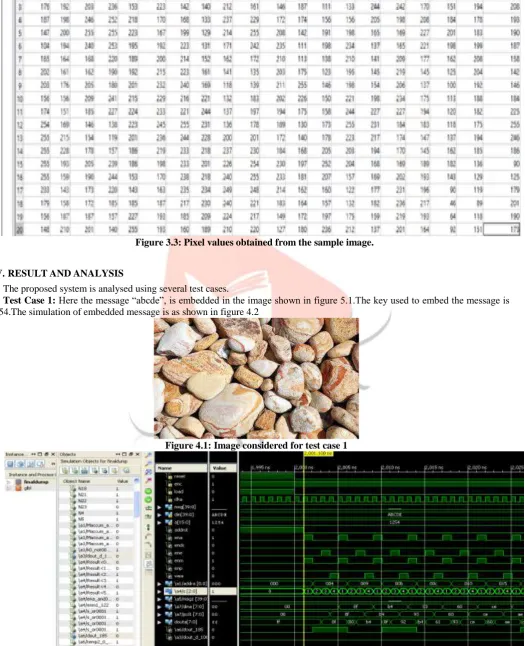
generated is embedded with the message bit & restored in the same address. As only one bit of pixel is getting changed, the disturbance to the image is hardly visible to the naked eyes. In order to retrieve back the message that is transmitted, a decoder is used at the receiving end from the stego image. Along with the decoder, parallel converter is also used. Encoded pixel values of the image are stored in the memory block. The control signal from the FSM, enc is set to binary 0. When the read signal is high, these pixel values are sent to the decoder. The embedded pixels are obtained from the memory and fed as an input to the decoder. The decoder takes only the last bit of pixel and transmits it to the parallel converter. Whenever the enable signal of parallel converter is high, the parallel converter is activated and takes these message bits, combines and provides a parallel output. In order to get pixels values from the image, a MATLAB code is written, where an image is converted to pixel matrix. The pixel matrix has Red, Green, Blue(RGB) values and red values are considered which are stored in co-efficient(coe) file. This file is loaded in BRAM on FPGA. Figure 3.4 depicts the pixel values obtained by considering the image in figure 3.2.
IJEDR1703130
International Journal of Engineering Development and Research (www.ijedr.org)
917
Figure 3.3: Pixel values obtained from the sample image.
IV.RESULTANDANALYSIS
The proposed system is analysed using several test cases.
Test Case 1: Here the message “abcde”, is embedded in the image shown in figure 5.1.The key used to embed the message is
1254.The simulation of embedded message is as shown in figure 4.2
Figure 4.1: Image considered for test case 1
IJEDR1703130
International Journal of Engineering Development and Research (www.ijedr.org)
918
Figure 4.3: Extraction of message1Figure 4.4: Embedding and extraction of message1
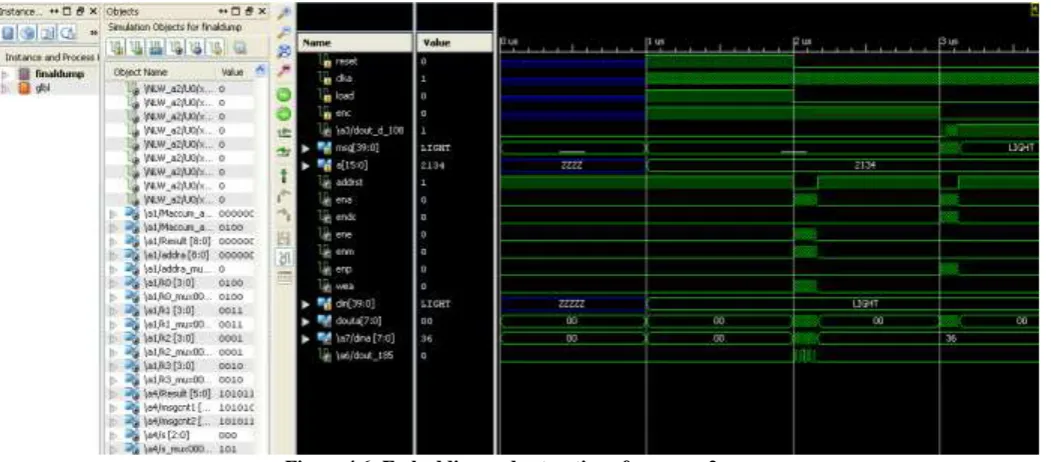
Test Case 4: Here the message “LIGHT”, is embedded in the image shown in figure 5.9.The key used to embed the message is
5164. While retrieving the message a distinct key is used, i.e., 2134.Since the key to embed and retrieve is different the same message is not retrieved. The entire simulation of test case4 is shown in figure 4.6
IJEDR1703130
International Journal of Engineering Development and Research (www.ijedr.org)
919
Figure 4.6: Embedding and extraction of message 2
The security in the field of communication remains as a serious concern whenever new developments occur. Secure data transfer is the need of every time. Data hiding is a popularly used technique for secure communication. Though steganography is not implemented in wider ways but it can be the best security tool. The main problem of today’s world is to secure their data confidentially; the techniques used currently are not considered the best which can only be replaced by steganography.
.
REFERENCES
[1] E. A. Elshazly, Safey A. S. Abdelwahab , R. M. Fikry, S. M. Elaraby , O. Zahran, M. El-Kordy ,“FPGA Implementation of Robust Image Steganography Technique based on Least Significant Bit (LSB) in Spatial Domain”, International Journal of Computer Applications (0975 – 8887) Volume 145 – No.12, July 2016.
[2]. Amritpal Singh, “An Improved LSB based Image Steganography Technique for RGB Images”, Electrical, Computer and Communication Technologies (ICECCT), 2015 IEEE International Conference on. IEEE, 2015., pp 1-4
[3]. Mrs.Manjula.Y, Mr.Jagadeesha.D.H, Dr. K.B ShivaKumar,“FPGA Implementation for Image Steganography Technique Using X-Box Mapping” , International Journal of Computer & Organization Trends –Volume 3 Issue 6 – June 2013.
[4]. Dr. Ahlam Fadhil Mahmood, Nada Abdul Kanai, Sana Sami Mohmmad,” An FPGA Implementation of Secured Steganography Communication System“, Tikrit Journal of Engineering Sciences/Vol.19/No.4/December 2012, (14-23) . [5]. Priyanka More, Pooja Tiwari, Leena Waingankar, Vivek Kumar, A. M. Bagul, “Online Payment System using Steganography
and Visual Cryptography” , International Journal of Computer Engineering In Research Trends, Volume 3, Issue 4, April-2016.
[6]. Mohammed J. Khami, Lemya G. Shehab and Zeynab M. Jawar have designed “Matlab coding for Text Steganography system by using LSB insertion method with key”, Vol.33(2),37-51, 2015.