A COMPARISON ON VECTOR QUANTISATION AND
SMVQ
Simi N
1, Teena Rajan
2 1M.tech, schlor, Dept. of Electronics & Communication
2
Mar Baselios College of Engineering & Technology
Trivandrum, (India)
ABSTRACT
Side match vector quantization (SMVQ) is an image compression scheme that reduces the redundancy of a
digital image. Some data hiding methods utilize SMVQ to embed secret data in an SMVQ-decompressed image,
and reconstruct the original SMVQ code after the secret data have been extracted. It is an advanced form of
Vector Quantisation(VQ). In this paper we are comparing the performance of VQ and SMVQ methods using
LBG algorithm and a random code book design algorithm by evaluating the peak signal to ratio(PSNR) of
compressed images.
Keywords: Image compression,PSNR, side match vector quantization (SMVQ),vector quantisation
(VQ).
I. INTRODUCTION
The advancement in the information and internet technology enable the people to transmit and share digital
contents conveniently. In such a scenario ensuring communication efficiency and save network bandwidth,
compression techniques can be implemented on digital content. In many applications, most digital content,
especially digital images and videos are converted into the compressed forms for transmission.
Vector quantization (VQ) is an effective compression scheme of digital images for the purpose of transmission
and storage [1-5]. The major advantages of VQ are that the compression rate is very high and its design is very
simple. In general,VQ consists of three phases: (1) codebook generation phase, (2) the encoding phase and (3) the
decoding phase. At first, a codebook K, which is composed of the most representative code words, must be
constructed. Then K will be employed in both the encoding phase and the decoding phase. Generating a perfect
codebook from a large amount of training set is a critical work in VQ. Many codebook generation algorithms
have been proposed, and the most famous one is the LBG algorithm that was presented by Linde, Buzo and Gray
in 1980 [6]. Basically, the LBG algorithm is an iterative algorithm that splits the training sets and updates the
codebook iteratively.
As an improved version of VQ, SMVQ[7-10] has been introduced which make use of original VQ codebook
and a sub-codebook to perform compression of digital images, in which both are used to generate the index
values, excluding the blocks in the leftmost column and the topmost row.In this paper a comparison and
algorithm. Experimental results and analysis are given in Section IV, and Section V concludes the paper.
II. CONCEPT OF SMVQ
To improve the compression bit rate, side match VQ was proposed by Kim in 1992 [7]. Kim assumes the pixels
in the top row in the current block are correlated closely with those in the bottom row in the upper block, and the
pixels in the first column in the current block are correlated closely with those in the right column in the left
block, pixels in the fourth column in the current block are correlated closely with those in the left column in the
right block, and that the pixels in the bottom row in the current block are correlated closely with those in the top
row in the lower block.
Based on this assumption, Kim used Side-Match approach to design SMVQ, and successfully reduces the
blocking effect by using local edge information and provides better visual quality and compression ratio than
VQ does. To perform SMVQ, a super codebook is required to encode the blocks in the first row and the first
column, and a state codebook is required to encode the rest of the blocks. The state codebook is a subset of the
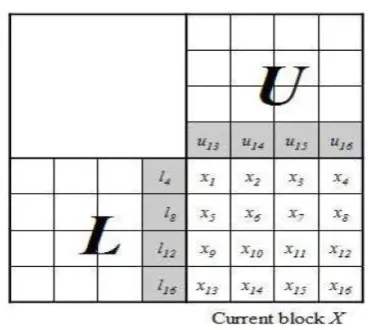
super codebook. Consider the 4x4 image blocks shown in Figure 1, where U and L are image blocks
reconstructed by the traditional VQ, and X is the current processing image block.
Fig 1:Current ,upper ,left and neighbouring blocks
.
The image blocks in the first row and first column are denoted as seed blocks, and they are encoded by using the
traditional VQ technique with super codebook Y sized N. The rest of the blocks are defined as residual blocks,
and they are used in SMVQ encoding. Each residual block is encoded with the assistance of upper, left
neighboring block of the current processing block X.
To encode the residual block, the SMVQ encoding phase consists of four steps. First, the boundary value of
block X is predicted using the values of neighboring values of block U and block L, such as :
(1)
(3)
(4)
(5)
(6)
(7)
Then, the predicted value is used to look up codewords in super codebook Y to generate the corresponding state
code book. A state codebook contains M codewords that are selected from super codebook Y . These M
codewords have the minimum side-match distortion, when compared with the gray areas in Fig. 1. Here, the
minimum side-match distortion is calculated by using Eq. (8). After the state codebook has been generated, the
current residual block is encoded by the best-match codeword of the current residual block, which is obtained by
searching the state codebook instead of the super codebook.
(8)
In the SMVQ decoding phase, first, the indices in the first row and first column are decoded by VQ with the
super codebook as was done in the encoding phase. To reconstruct residual blocks, the previously decoded
upper and left neighboring blocks are used to generate a state codebook that contains M codewords with the
minimum side-match distortion for the current block. Then, the state codebook is searched fully to find the
mapping codeword required for the received index to recover its block. After all received indices have been
processed; the reconstruction of the original image is obtained.
III. LBG ALGORITHM
LBG algorithm is like a K-means clustering algorithm which takes a set of input vectors S = { ∈ | = 1, 2 .
. . n} as input and generates a representative subset of vectors C = { ∈ | j = 1, 2. . . K} with a user specified
K << n as output according to the similarity measure. For the application of Vector Quantization (VQ), K = 256
or 512 are commonly used.
1.Input training vectors S = { ∈ | = 1, 2, · · ·, n}.
2. Initiate a codebook C = { ∈ | = 1, 2, · · ·, K}.
3. Set = 0 and let k = 0.
4. Classify the training vectors into K clusters according to ∈
5. Update cluster centers , = 1, 2, · · ·, .
6. Set and compute the distortion
7. If ( )/Dk > (a small no:), repeat steps 4 -6.
8. Output the codebook C = { ∈ | j = 1, 2, · · ·, K}.
The convergence of LBG algorithm depends on the initial codebook C, the distortion , and the threshold , in
IV. EXPERIMENTAL RESULTS
Experiments were conducted on a group of gray-level images to compare the effectiveness of SMVQ over VQ.
In the experiment, the sizes of the divided non-overlapping image blocks were 4 × 4, i.e., n = 4. Accordingly,
the code book size N was N=256. Six standard, 512 × 512 test images, i.e., Lena, Peppers and Baboon, are
shown in Figure 2.
(a) (b) (c)
Fig 2: Input Images (a) Lena.jpg (b) Peppers_Gray.jpg (c) Baboon.jpg
Both SMVQ and VQ compression has been done in these test input images using LBG algorithm and Random
code book design algorithm. The performance and effectiveness is evaluated using Peak signal to noise
ratio(PSNR). Fig 3 gives the output of images compressed using random code book generation algorithm.
(a) (b) (c)
Fig.3. Output Image using Random code book generation (a) Lena.jpg (b) Peppers_Gray.jpg (c)
Baboon.jpg
Figure 4 shows the compression results of images using LBG algorithm.
(a) (b) (c)
Fig.4. Output Image using LBG Algorithm (a) Lena.jpg (b) Peppers_Gray.jpg (c) Baboon.jpg
(9)
M and N are the height and the width of the images, respectively; I (x, y) and Id (x, y) are the pixel values
atcoordinate (x, y) of the original uncompressed image Iand the decompressed image .Compression ratio was
also evaluated see Equ. 10.
(10)
where L is the length of compressed codes.
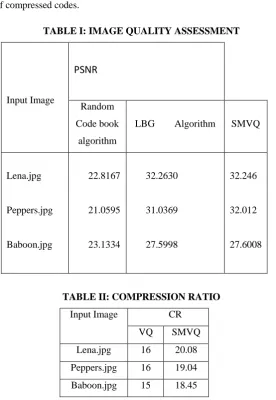
TABLE I: IMAGE QUALITY ASSESSMENT
Input Image
PSNR
Random
Code book
algorithm
LBG Algorithm SMVQ
Lena.jpg
Peppers.jpg
Baboon.jpg
22.8167
21.0595
23.1334
32.2630
31.0369
27.5998
32.246
32.012
27.6008
TABLE II: COMPRESSION RATIO
Input Image CR
VQ SMVQ
Lena.jpg 16 20.08
Peppers.jpg 16 19.04
Baboon.jpg 15 18.45
Comparing Fig .3 and 4 shows that compression using LBG algorithm yields better visual quality of images.
Moreover comparing VQ and SMVQ, it shows that SMVQ considers the correlation between the neighboring
pixels which increase the compression ratio than VQ.
V. CONCLUSION
A comparison on VQ and SMVQ based on LBG algorithm and random code book generation algorithm has been
neighbouring pixels. Here instead of considering all the pixels,each pixel is represented using an index table, thus
improving the compression ratio.
REFERENCES
[1] R. M. Gray, Vector quantization,IEEE ASSP Mag., vol. 1, no. 2, pp. 4-29, 1984.
[2] W. J. Wang, C. T. Huang, and S. J. Wang, “VQ applications in steganographic data hiding upon multimedia
images,” IEEE Syst. J.,vol. 5, no. 4, pp. 528–537, Dec. 2011.
[3] Y. C. Hu, “High-capacity image hiding scheme based on vector quantization,” Pattern Recognit., vol. 39,
no. 9, pp. 1715–1724, 2006.
[4] Y. P. Hsieh, C. C. Chang, and L. J. Liu, “A two-codebook combination and three-phase block matching
based image-hiding scheme with high embedding capacity,” Pattern Recognit., vol. 41, no. 10, pp. 3104–
3113, 2008.
[5] C. H. Yang and Y. C. Lin, “Fractal curves to improve the reversible data embedding for VQ-indexes based
on locally adaptive coding,” J. Vis. Commun. Image Represent., vol. 21, no. 4, pp. 334–342, 2010.
[6] Y. Linde, A. Buzo, and R. M. Gray, An algorithm for vector quantizer design, IEEE Trans. On
Communs., vol. 28, no. 1, pp. 84-95, 1980.
[7] T. Kim, “Side match and overlap match vector quantizers for images,”IEEE Trans. Image Process., vol. 1,
no. 2, pp. 170–185, Apr.1992.
[8] C. C. Chang, W. L. Tai, and C. C. Lin, “A reversible data hiding scheme based on side match vector
quantization,” IEEE Trans. Circuits Syst. Video Technol., vol. 16, no. 10, pp. 1301–1308, Oct. 2006.
[9] C. C. Chen and C. C. Chang, “High capacity SMVQ-based hiding scheme using adaptive index,” Signal
Process., vol. 90, no. 7,pp. 2141–2149, 2010.
[10]P. Tsai, “Histogram-based reversible data hiding for vector quantisation compressed images,” IET Image
Process., vol. 3, no. 2, pp. 100–114,2009.
[11] W. B. Pennebaker and J. L. Mitchell, The JPEG Still ImageDataCompression Standard. New York, NY,
USA: Reinhold, 1993.
[12]A. Gersho and R. M. Gray, Vector Quantization and Signal Compression. Norwell, MA, USA: Kluwer,
1992.
[13]C. Qin, C. C Chang and Yi-Ping Chiu, “A novel joint data-hiding and compression scheme based on
SMVQ and image inpainting,” IEEE Trans. Image Process., vol. 23, no. 3, March. 2014.
[14]S. C. Shie and L. T. Chen, Image compression based on side- match VQ and SOC, ProcceedingsofDigital