6536
Validity and Reliability Construct Tests on The
Intensity Scale of Smartphone Usage
Alifiana Hildarartri, Fatwa Tentama
Abstract: This research aims to illustrate the intensity of smartphone usage in educational context, in order to analyze the validity and reliability construct of the intensity of smartphone usage and to determine the indicator of the intensity of smartphone usage. The data were collected using the intensity scale of smartphone usage. The intensity scale consisted of motivation, duration of activity, frequency of activity, presentation, direction of attitude, and interest. Smart PLS 3.0 program with reflective construct through 2nd Order CFA were also used to assist the research. The data comprised of 69 students of the Faculty of Psychology in University X Yogyakarta. The results show that the dimensions and indicators of the intensity of smartphone usage are valid and reliable. The most-dominant dimension reflecting the construction of the intensity of smartphone usage is the interest. The least-dominant dimension reflecting the construction of the intensity of smartphone usage is the motivation. Those things show that all the dimensions and indicators are able to reflect and form the intensity of smartphone usage. Thus, the measurement model can be accepted since the theory that illustrates the intensity of smartphone usage is in accordance with the empirical data obtained from the subject.
Keywords: direction of attitude, duration of activity, frequency of activity, intensity of smartphone usage, motivation —————————— ——————————
1
INTRODUCTION
Smartphone is one of the primary needs of modern people [1]. Initially, the smartphone was designed with a more compact size and internet connection to substitute modern computers and to facilitate its users [2],[3]. As more and more smartphone features are developed to facilitate activities such as learning, social interaction, character building, and many other services, the intensity of smartphone usage rises rapidly and the stuff is considered to become more and more important [4],[5],[6], especially with the increasingly affordable prices that make this device easy to get [7]. A smartphone offers various applications which enrich the sources of information with its extensive use and sophisticated technological capacity [8]. The smartphone comes with various models and operation systems to support the internet access which facilitates its users in the terms of learning and profession [11].Other benefits of a smartphone are compact information storage system and advanced network management system that also acts as a vital communication channel [12]. If used positively, the smartphone can strengthen anindividual‟s social bond with friends or families which eventually will enhance the quality of life and psychological welfare of an individual [13],[14].The increasing spread of smartphone will deepen and expand the social implication of cellular communication technology [15]. Apart from the great benefits offered by a smartphone, some researchers reported that excessive use of smartphone can inflict negative consequences to our daily life [16], [17],[18],[19]. Excessive use of smartphone is defined as compulsive usage that leads to daily dysfunction in terms of productivity, social relations, physical health, and emotional well-being [20]. A number of researchers correlate the excessive smartphone usage with stress, boredom, and exhaustion [21].
A survey in 2017 showed that some individuals tend to waste their time, lack of sleep, and postpone or even leave their work when playing with their smarphones [22]. Individuals with high intensity of smartphone usage are found to be addicted to smartphones in daily life [23]. The smartphone intensity is a condition where an individual uses his smartphone in a relatively long time that makes him unable to control himself [24].The smartphone intensity refers to the excessive use of smartphone which may disturb the daily life [25]. Smartphone intensity is an individual‟s habit of using his phone repeatedly that it brings negative effect on the welfare of its user [26].The
smartphone intensity illustrates an excessive and
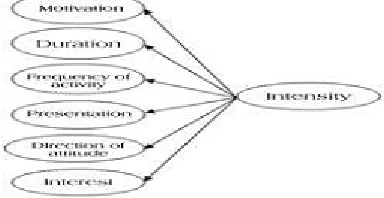
uncontrollable use of smartphone that leads to a series of negative consequences of the user‟s daily life, such as dysfunction in daily activities, insomnia, lack of physical activities, stress, decrease of academic performance, and changes in the social relations [27]. Nuraini [28] stated that intensity has several dimensions such as motivation with an explanation of the basic understanding of motivation is the internal state of an organism(both human and animal) that drives it to do something. Here, motivation is like the power supply to behave or act in a directed manner. There are two kinds of motivation, intrinsic and extrinsic motivation. Intrinsic motivation is a state coming from within an individual who can take action, that includes his love and needs of materials. Meanwhile, extrinsic motivation is the state that drives action due to external stimulation such as compliments, rewards, rules, role model from parents, teachers that encourage a student to get better academic achievements. The second is duration of activity. It is the duration of the ability of carrying out an activity. From this indicator, it can be inferred that motivation can be observed from someone‟s ability in using his time to do an activity. The third is the frequency of activity, which is the frequency of an activity carried out in a certain period. For example, the frequency of smartphone usage by students both inside and outside the campus. The fourth is the presentation, that is related to the great passion, will, or expectation to achieve what is being dreamt of through the activities that someone carries out. It can be seen from a student‟s will to keep using smartphone to get what he/she wants. The fifth is the direction of attitude as someone‟s readiness to take specific actions in responding positive or negative things. In negative forms, someone tends to keep distance, avoid, hate and even detest certain objects. _______________________________________
• Alifiana Hildarartri,, Master in Psychology, Ahmad Dahlan University, Yogyakarta. PH-081215040646. E-mail: [email protected] • Fatwa Tentama, Master in Psychology, Ahmad Dahlan University,
6537 Meanwhile, in positive forms, someone tends to approach,
like, and expect certain objects. The sixth is the aspect of interest, which emerges if an individual is attracted to something because it suits his needs or he feels that something to be cultivated has a meaning for himself. The interest is strongly related to the personality and it always contain affective, cognitive, and determination elements. This gives the understanding that the individual is attracted to and tends to an object continuously, that his other psychological experiences are ignored. Previous research that discussed about the intensity of smartphone usage has been conducted by Farida [29], which subjects were the 7th grade students of SMP Negeri Kembang bahu Lamongan. The research showed an alpha cronbach score of 0.756. On the other hand, this research aims to test the validity and reliability construct on the variable of smartphone usage intensity with different variations of subject and dimension compared to the previous research mentioned above.
Fig 1. Conceptual Framework of the Intensity of
Smartphone Usage
Based on the above explanation, it can be concluded that the intensity of smartphone usage is crucial in an organization. Considering the importance of the intensity of smartphone usage, the problem statements of this research will be: 1). Is the intensity of smartphone usage valid and reliable? And 2). Do the indicators of motivation, duration, frequency of activity, presentation, direction of attitude, and interest form the construct/variable on the intensity of smartphone usage? This research aims to illustrate the intensity of smartphone usage in educational context, to analyze the validity and reliability construct of the intensity of smartphone usage, and to determine the indicators that form the intensity of smartphone usage.
3 RESEARCH METHOD
The participants in this research were 69 students of Faculty of Psychology of University X Yogyakarta. The data collection tool used in this study is the intensity of smartphone use which refers to aspects of the intensity of smartphone usage according to Nuraini‟s theory [28] that consist of motivation, duration of activity, frequency of activity, presentation, direction of attitude and interest. Likert scale is used in this research. The research scale is prepared based on a modified Likert model. The Likert scale has 4 alternative answers: strongly agree (SA), agree (A), disagree (D), strongly disagree (SD). The scale used is the intensity of smartphone usage. The example of the items on the aspect of motivation are “following the latest smartphone trends” and “smartphone makes me more up to date”. The example of the items on the
aspect of duration are “feeling anxious when I go out without a smartphone” and “feeling worried if my smartphone goes low-battery”. Next, the example of the items on the aspect of duration of activity are “seing the notification on my smartphone once every 5 minutes” and “limitting smartphone usage”. The example of the items on the aspect of presentation are “imitating someone's trendy style of dress on social media" and “being ignorant to what happens on social media”. The example of the items on the aspect of direction of attitude are “I never post my activities on social media” and “I am more interested in other activities than playing online games”. Last, the example of the items on the aspect of interest are “I find it easier to channel my hobbies on social media by smartphone” and “I'd rather shop directly than shop online".
TABLE 1
THE BLUE PRINT OF THE INTENSITY OF SMARTPHONE USAGE
Dimension Indicators Item No. ∑
Favo Unfavo
Motivation
a. Feeling of love and need towards the materials or lifestyle.
1 3 2
b. The urge to take actions because of external stimulus, compliments, and rewards.
2 4 2
Durationof activity
The duration of needed to carry out activities (smartphone).
5, 6 7, 8 4
Frequency of activity
The frequency of carrying out the activity within a certain period of time
9, 10 11, 12 4
Presentation
The great passion, will, or expectation to achieve what is being dreamt of through the activities
13, 14 15, 16 4
Direction of attitude
a. Positive behaviors; the tendency to approach, like, and expect certain objects.
17 19 2
b. Negative behaviors; the tendencyto keep distance, avoid, hate and even detest certain objects.
6538 Interest
Gives the understanding that the individual is attracted to and tends to an object continuously, that his other psychological experiences are ignored
21, 22 23, 24 4
Frequency 14 12 26
3.1 Validity and Reliability
This research used the outer model in testing the validity and reliability of the intensity of smartphone usage scale using PLS 3.0 program with reflective construct. The construct validity test is confirmatory to show how well the results obtained from the use of measuring instruments are, based on the theoretical references used in defining a construct. The construct validity test conducted is convergent validity by observing the factor loading >0.5 average variance extracted value (AVE)> 0.5 and discriminant validity by comparing the root average variance extracted (AVE) of a construct that must be higher than the correlation between aspects. Next, the reliability test is done to show the internal consistency of the measuring tool, by observing the composite reliability and cronbach‟s alpha according to Copper which has to be <0.7, and according to Hair et al. [31], 0.6 value is still acceptable [30].
4 RESULT
Based on the outer model test on the construct, the intensity of smartphone usage can be described as follows.
Figure 2. Output of outer Model
Based on the convergent validity test, it can be concluded that the value of the factor loading has met (aspect of variable) >0.5 and it can be seen in the following table.
TABLE 2
THE VALUE OF FACTOR LOADING (aspect of variable)
Aspect Factor of loading
values Information
AS 0.878 Valid
D 0.747 Valid
F 0.600 Valid
MIN 0.878 Valid
MT 0.521 Valid
Interest 0.605 Valid
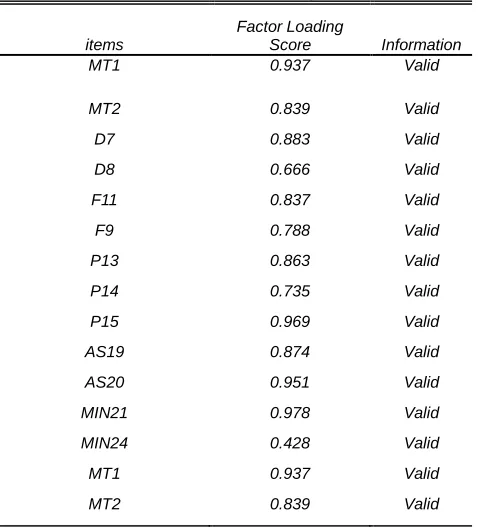
Based on the convergent validity test, it can be concluded that the value of the factor loading (Aspect of indicator) has mettelahmemenuhi> 0,5and it can be seen in the following table.
TABLE 3
THE VALUE OF FACTOR LOADING (ASPECT OF INDICATOR)
items
Factor Loading
Score Information
MT1 0.937 Valid
MT2 0.839 Valid
D7 0.883 Valid
D8 0.666 Valid
F11 0.837 Valid
F9 0.788 Valid
P13 0.863 Valid
P14 0.735 Valid
P15 0.969 Valid
AS19 0.874 Valid
AS20 0.951 Valid
MIN21 0.978 Valid
MIN24 0.428 Valid
MT1 0.937 Valid
MT2 0.839 Valid
AVE Values
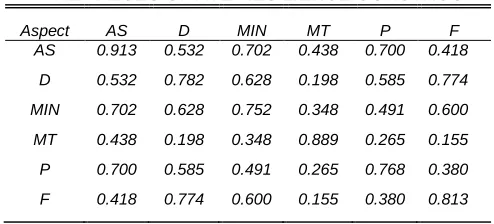
Based on the discriminant validity test, it can be concluded that AE has met a score of > 0.5.The AVE values of the intensity of smartphone usage are
TABLE 4
AVERAGE VARIANCE EXTRACTED (AVE) VALUES OF RESILIENCE CONSTRUCT
items
Factor Loading
Score Information Direction of attitude 0.834 Valid
Duration of Activity 0.612 Valid
Frequency of Activity 0.660 Valid
Interest 0.565 Valid
Motivation 0.791 Valid
Presentation 0.590 Valid
6539 higher than the aspect of duration of activity, which is 0.532;
the interest, with 0.702 value, is higher than the motivation, which only has 0.438 value; the presentation, which has 0.700 value, is higher than the frequency of activity, which only has 0.418.
TABLE 5
THE VALUES OF AVE RESILIENCE CONSTRUCT
Aspect AS D MIN MT P F
AS 0.913 0.532 0.702 0.438 0.700 0.418
D 0.532 0.782 0.628 0.198 0.585 0.774
MIN 0.702 0.628 0.752 0.348 0.491 0.600
MT 0.438 0.198 0.348 0.889 0.265 0.155
P 0.700 0.585 0.491 0.265 0.768 0.380
F 0.418 0.774 0.600 0.155 0.380 0.813
The reliability test on the composite reliability and Cronbach‟s alpha table have met the requirements, with a value of >0.7, even though 0.6 is still acceptable (Hair et al, 2008).
TABLE 6
THE VALUE OF COMPOSITE RELIABILITY AND CRONBACH’S ALPHA OF RESILIENCE CONSTRUCT
Variable Composite reliabelity
Cronbach alpha
Information
Intensity 0.860 0.800 Reliable
4
DISCUSION
The dominant indicators that influences the intensity of smartphone usage are direction of attitude and interest with the same factor loading of 0.878. The most dominant aspect reflecting the intensity of smartphone usage is interest, where its main indicator is that the users feel anxious if they go out without bringing smartphones and they feel worried if their smartphones go low-battery. Based on the results of the analysis of the validity and reliability construct, all aspects and items that make up the intensity of smartphone usage are declared valid and reliable, so all aspects and indicators are able to reflect and shape the intensity of smartphone use.Nuraini [28] stated the intensity has several dimensions such as motivation. Motivation is the internal state of the organism (both human and animal) that drives it to do something. Considering that in this study, it is proven that the highest indicator compared to the other four indicators, i.e. duration of activity which factor loading is 0.747; frequency which factor loading is 0.600; motivation which factor loading is 0.521; and presentation which factor loading is 0.605. The dimension that reflects the lowest intensity of smartphone usage is motivation, which main indicator is the feeling of love dan need toward materials, or lifestyle, as well as the encouragement to take action because of the external stimulation, compliments, praises, and rewards. The factor loading is 0.521. The specific behavior is that the users follow the latest smartphone trends and smartphones make the
users more up-to-date. Supriani and Iqbal‟s research [32]
entitled “The Influence of Smartphone Usage Intensity on Spouse Intimacy” correlated the effect of the intensity of
smartphone usage on partners‟ intimacy. The results of their research supported the theory or concept explained which proved that the intensity of smartphone usage met the reliability requirements with an alpha cronbach‟s value of 0.361. Meanwhile, in this research, the results show that the
intensity of smartphone usage fulfills the reliability
requirements with an alpha cronbach‟s value of 0.800. The
results of this research are expected to give an illustration of the validity and reliability construct of the intensity of smartphone usage of the students of Faculty of Psychology, University X Yogyakarta in order to be used as a reference for furhter researches on the intensity of smartphone usage.
5
CONCLUSION
The construct of the intensity of smartphone usage meets the good validity and reliability. All the elements and indicators are significantly able to form variables of the intensity of smartphone usage, where the indicators having dominant influence on the intensity of smartphone usage are the direction of attitude and interest with equal factor loading of 87.8%. Thus, the results of this research are able the provide theoretical implication for the development of the intensity of smartphone usage and the practical implications of taking the future of teenagers. In addition, the results of this research are also ableto test the model of the intensity of smartphone usage in relation to other variables, expand the research units, or use the context of the intensity of different smartphone usages so that the research results can be generalized.
6 ACKNOWLEDGMENT
The author would like to thank Ahmad Dahlan University and the Master of Psychology Programe University of Ahmad Dahlan for supporting the implementation of this research
7 REFERENCES
[1] H. Falaki, R. Mahajan, S. Kandula, D. Lymberopoulos, R.
Govindan and D. Estrin, “Diversity in Smartphone Usage,” Proceedings of the 8th International Conference on Mobile systems, Applications, and Services, San Francisco, California, 2010.
[2] Ericsson, Smartphone Usage Experience: An Ericsson
Consumer Insight Report. Stockholm.: Ericsson
Publications, 2013.
[3] J. W. Rittinghouse and J. F. Ransome, Cloud Computing:
Implementation, Management, and Security. Boca Raton.: CRC Press, 2017.
[4] N. Pachler, J. Seipold and B. Bachmair, Mobile Learning:
Some Theoretical and Practical Considerations, In K. Friedrich, M. Ranieri, N. Pachler and P. de Theux (Eds.), The „„MyMobile‟‟handbook: Guidelines and scenarios for mobile learning in adult education. Brussels: Media Animation, 2012.
[5] S. Stern, “Producing Sites, Exploring Identities: Youth
Online Authorship,” Youth, Identity, and Digital Media, vol.
6, pp. 95-117, 2008, doi:
10.1162/dmal.9780262524834.095.
[6] T. Soikkeli, J. Karikoski and H. Hämmäinen,
“Characterizing Smartphone Usage: Diversity and End User Context,” International Journal of Handheld Computing Research,vol. 4, no. 1, pp. 15-36, 2013. doi: 10.4018/jhcr.2013010102.
6540 Gasser, Teens & Technology, 2013: Pew Research
Centre Report. Cambridge.: The Berkman Centre for Internet & Society at Harvard University, 2013.
[8] M. Hamer, E. Stamatakis and G. D. Mishra,
,”Television-and Screen-based Activity ,”Television-and Mental Well-being in Adults,” American Journal of Preventive Medicine,
vol. 38, no. 4, pp. 375-380, 2010, doi:
10.1016/j.amepre.2009.12.030.
[9] W. S. Cheung and K. F. Hew, “A Review of Research
Methodologies Used in Studies on Mobile Handheld Devices in K-12 and Higher Education Settings,” Australasian Journal of Educational Technology, vol. 25, no. 2, pp. 153-183, 2019, doi: 10.14742/ajet.1148.
[10]J. Fanning, S. P. Mullen and E. McAuley, “Increasing
Physical Activity with Mobile Devices: A Meta-analysis,” Journal of Medical Internet Research, vol. 14, no. 6, pp. 161-175, 2012, doi: 10.2196/jmir.2171.
[11]C. F. Yen,T. C. Tang, J. Y. Yen, H. C. Lin, C. F. Huang, S.
C. Liu and C. H. Ko,”Symptoms of Problematic Cellular Phone Use, Functional Impairment and Its Association With Depression Among Adolescents In Southern Taiwan,”Journal of Adolescence, vol. 32, no. 4, pp. 863-873, 2009, doi: 10.1016/j.adolescence.2008.10.006.
[12]J. E. Katz, Magic in the air: Mobile Communication and
the Transformation of Social Life . New Brunswick.: Transaction Publishers, 2011.
[13]B. Jin and N. Park,”Mobile Voice Communication and
Loneliness: Cell Phone Use and the Social Skills Deficit Hypothesis,” New Media & Society,vol. 15, no. 7, pp. 1094-1111, 2013, doi: 10.1177/1461444812466715.
[14]N. Park and H. Lee, “Social Implications of Smartphone
Use: Korean College Students' Smartphone Use and Psychological Well-Being,” Cyberpsychology, Behavior, and Social Networking, vol. 15, no. 9, pp. 491-497, 2012, doi: 10.1089/cyber.2011.0580.
[15]H. Pang, ”Is Smartphone Creating A Better Life? Exploring
The Relationships of The Smartphone Practices, Social Capital and Psychological Well-Being Among College Students,” International Journal of Advanced Media and Communication, vol. 7, no. 3, pp. 205-223, 2017. [16]H. J. Kim,J. Y. Min, K. B. Min, T.J. Lee and S. Yoo,
“Relationship Among Family Environment, Self-Control, Friendship Quality, and Adolescents‟ Smartphone Addiction In South Korea: Findings From Nationwide Data,” PloS One, vol. 13, no. 2, pp. 1-13, 2018, doi: 10.1371/journal.pone.0190896.
[17]C. Kuang-Tsan and H. Fu-Yuan,“Study on Relationship
Among University Students‟ Life Stress, Smart Mobile Phone Addiction, and Life Satisfaction,” Journal of Adult Development,vol. 24, no. 2, pp. 109-118, 2017, doi: 10.1007/s10804-016-9250-9
[18]M. Samaha and N. S. Hawi, “Relationships Among
Smartphone Addiction, Stress, Academic Performance, and Satisfaction With Life,” Computers in Human
Behavior, vol. 57, pp. 321-325, 2016, doi:
10.1016/j.chb.2015.12.045.
[19]J. Van Deursen, C. L. Bolle, S. M. Hegner and P. A.
Kommers, “Modeling Habitual and Addictive Smartphone Behavior: The Role Of Smartphone Usage Types, Emotional Intelligence, Social Stress, Self-Regulation, Age, and Gender,” Computers in Human Behavior, vol. 45, pp. 411-420, 2015, doi: 10.1016/j.chb.2014.12.039.
[20]S. Horwood and J. Anglim, “Problematic Smartphone
Usage And Subjective And Psychological
Well-Being,” Computers in Human Behavior, vol. 97, pp. 44-50, 2019, doi: 10.1016/j.chb.2019.02.028.
[21]Y. K. Lee, C. T. Chang, Y. Lin and Z. H Cheng,”The Dark
Side of Smartphone Usage: Psychological Traits, Compulsive Behavior and Technostress,” Computers in Human Behavior, vol. 31, pp. 373-383, 2014, doi: 10.1016/j.chb.2013.10.047.
[22]S. Horwood and J. Anglim, “Problematic Smartphone
Usage And Subjective And Psychological
Well-Being,” Computers in Human Behavior, vol. 97, pp. 44-50, 2019, doi: 10.1016/j.chb.2019.02.028.
[23]J. Roberts, L. Yaya and C. Manolis, “The Invisible
Addiction: Cell-Phone Activities And Addiction Among Male and Female College Students,” Journal of Behavioral Addictions, vol. 3, no. 4, pp. 254-265, 2014, doi: 10.1556/JBA.3.2014.015.
[24]C. Pearson and Z. Hussain, “Smartphone Use, Addiction,
Narcissism, and Personality: A Mixed Methods
Investigation,” International Journal of Cyber Behavior, Psychology and Learning, vol. 5, no. 1, pp. 17-32, 2017, doi: 10.4018/ijcbpl.2015010102.
[25]H. Lee, H. Ahn, S. Choi and W. Choi, ”The SAMS:
Smartphone Addiction Management System and
Verification,” Journal of medical systems, vol. 38, no. 1, pp. 1-10, 2014, doi: 10.1007/s10916-013-0001-1.
[26]J. A. Roberts and S. F. Pirog, ”A Preliminary Investigation
of Materialism and Impulsiveness as Predictors of Technological Addictions Among Young Adults,” Journal of Behavioral Addictions, vol. 2, no. 1, pp. 56-62, 2012 doi: 10.1556/JBA.1.2012.011.
[27]B. Cerit, N. Bilgin and B. Ak, “Relationship Between
Smartphone Addiction of Nursing Department Students and Their Communication Skills,” Contemporary Nurse, vol. 54, no. 4-5, pp. 532-542, 2018, doi: 10.1080/10376178.2018.1448291.
[28]Nuraini, Intensity Learning Student,
http://suaraguru.wordpress.com /2019/10/11/. Akses 11 Oktober 2019
[29]F. A. Farida, S. Suani and Z Zulkardi,,” Improvement of Learning Outcomes of Class XI Grade Material at SMAN 2 Palembang Through the Application of the Discovery
Learning Model,” Jurnal Pendidikan Matematika
RAFA, vol. 5, no. 1, pp. 78-85, 2019 (in Indonesia).
[30]H. M. Jogiyanto, Concept and Aplication Structural
Equation Modeling varians on Bussiness Research (in Indonesia). Yogyakarta.: UPP STIM YKPN.
[31]J..F. Hair, G. Thomas, C. M. Ringle and M. Sartedt, A primer On Partial Least Squares Structural Equation Modeling (SEM-PLS). California.: Sage Publication, 2011.
[32]D. Supriani and M. Iqbal, ”The Influence of Smartphone