PROTEIN ENGINEERING
BY CHEMICAL METHODS
A thesis submitted in partial fulfilment of the requirements of the University of London for the degree of Doctor of Philosophy in the faculty o f Medicine
by
H aydn Lewis Ball,
Batchelor of Pharmacy (Hons), School of Pharmacy (London).
Department of Pharmaceutical Chemistry, School of Pharmacy,
University of London, 29-39 Brunswick Square,
London, WCl
ProQuest Number: U555411
All rights reserved
INFORMATION TO ALL USERS
The quality of this reproduction is dependent upon the quality of the copy submitted.
In the unlikely event that the author did not send a complete manuscript and there are missing pages, these will be noted. Also, if material had to be removed,
a note will indicate the deletion.
uest.
ProQuest U555411
Published by ProQuest LLC(2016). Copyright of the Dissertation is held by the Author.
All rights reserved.
This work is protected against unauthorized copying under Title 17, United States Code. Microform Edition © ProQuest LLC.
ProQuest LLC
789 East Eisenhower Parkway P.O. Box 1346
ABSTRACT
Procedures and methodologies for the routine chemical synthesis and purification o f proteins is reported. Optimised automated protocols of classical stepwise Merrifield solid phase peptide synthesis (SPPS) have been used to synthesise 99 residue M. tuberculosis and 97 residue E. coli Heat Shock lOkD proteins. Since peptide bond formation in stepwise SPPS is not unequivocable and leads to the generation o f a family of chromatographically similar deletion and truncated peptides, a purification system that is independent of sequence length and amino acid composition has been developed. The proposed system is based on the combination of (i) an effective capping protocol after each coupling step and (ii) the addition of a removable protecting group to the N-terminus of the last amino acid, bearing either lipophilic, acidic or basic functions. Purification of the crude cleavage product has been performed on reversed-phase or ion-exchange media, depending on the probe used. After purification the probe m olecule is quantitatively removed from the peptide chain through a base catalysed p-elimination reaction to yield the pure homogeneous product. The potential o f these chromatographic probes is demonstrated by application to model peptides (linear and cyclic) from 17 to 104 residues in length.
ACKNOWLEDGEMENTS
My sincere gratitude goes to Dr. Paolo Mascagni who not only introduced me to this wonderful world of peptide chemistry, but also to my wife. The high standards set by his dedication and scientific ability provided the levels of achievement to which I have tried to aspire.
CONTENTS
page
1 Title Page 2 Dedication 3 Abstract
4 Acknowledgements 5 Contents
8 List O f Figures
1 0 List O f Tables And Schemes 1 2 Abbreviations And Nomenclature
13 C H A P T E R ONE
1 4 ... P eptide Synthesis - An In tro d u ctio n 18 ... Side Reactions In SPPS
28 ... P eptide And P rotein Synthesis 29 ... Optimisation Of Chemical Protocols 31 ... Purification
3 4 ... Fragment Condensation
41 C H A P T E R TW O
4 2 ... P urification O f Synthetic Peptides Using C h ro m ato g ra p h ic P robes Based On T he Fm oc M olecule
4 2 ... In tro d u ctio n
4 6 ... Results And Discussion
4 6 ... Synthesis And Coupling O f Chromatographic Probes
58 ... Purification of synthetic peptides on the basis of lipophilicity 58 ... Purification O f A Seventeen Residue Peptide
6 6 ... Purification O f A Twenty-Five Residue Peptide 6 9 ... Purification O f A Forty-Seven Residue Peptide
7 5 ... Purification O f A One Hundred And Four Residue Protein 83 ... Purification O f Synthetic Peptides O n T h e Basis O f C h arg e 83 ... Purification O f A Twenty-Five Residue Peptide
93 C H A P T E R T H R E E
9 4 ... P eptide Synthesis By F rag m e n t C ondensation 9 4 ... In tro d u ctio n
9 5 ... R esults A nd Discussion 9 8 ... Boc C hem istry
9 8 ... Synthesis Of Protected Peptides Using Boc Chemistry 113... Purification O f Boc Synthesised Protected Peptides 118... Solid Phase Fragment Condensation O f Boc Synthesised
Protected Peptides 121 ... Fm oc C hem istry
121 ... Synthesis O f Protected Peptides Using Fmoc Chemistry 124... Purification Of Fmoc Synthesised Protected Peptides 127... Synthesis Of Peptides Fragments Using Fmoc Chemistry
(Asn/Gln Protected)
129... Purification Of Fmoc Synthesised Peptide Fragments (Asn/Gln Protected)
135... Solid Phase Fragment Condensation O f Fmoc Synthesised Peptides (Asn/Gln Protected)
138... Synthesis of GRF(l-44)+Gly by Fragment Condensation And Its Purification
144... Conclusions
14 9 C H A PT E R FO U R
15 0 ... P ro tein Synthesis - Stepwise Solid P hase A pproach 150... In tro d u ctio n
152... R esults A nd Discussion
152... Optimisation Of Synthetic Protocols 159... E. coli lOkD H eat Shock P rotein 15 9 ... Synthesis
16 0 ... Purification And Analysis
163... M. tuberculosis lOkD H eat Shock P rotein 1 63... Synthesis
16 8 C H A PT E R FIV E 16 9 E xperim ental
169... Materials And Methods
172... General Peptide Synthesis Using Boc Chemistry
175... General Peptide Synthesis Using Fmoc Chemistry
177 ... Synthesis Of Chromatographic Probes
185... Coupling Chromatographic Probes To Peptidyl-Resin
187... Removal O f Side Chain Protecting Groups And Cleavage O f
Peptide From Resin
189... Fragment Condensation
193 A PPEN D IX I
19 4 C h ro m ato g ra p h ic Conditions 19 7 ... A PPEN D IX II
19 8 T he S tru c tu ra l And A ggregation P ro p erties O f T h e S ynthetic C -T erm inal H alf (104-mer) Polypeptide F ro m H IV p24 gag Resem bles Those O f Full-L ength P rotein
2 1 9 PU BLICA TIO N S
LIST OF FIGURES
page
4 1 CHAPTER TWO
4 6 ... Fig. 1 Protecting Groups Used For Fluorene-4-Carboxylic Acid 5 0 ... Fig. 2 RP-HPLC Of FMDV Vpl 141-160 Derivatised With One,
Two And Three a-aminodecanoic Acid Residues 5 8 ... Fig. 3 Ninhydrin Analysis For Synthesis Of FMDV 142-157 61 ... Fig. 4 RP-HPLC Of Crude 4-COR5-Fmoc Derivatised FMDV
141-157 Peptide
6 3 ... Fig. 5 Free Peptide After Treatment With 5% TEA
6 7 ... Fig. 6 Ninhydrin Analysis For Synthesis Of HIV-1 ENV gp l20 6 8 ... Fig. 7 RP-HPLC Of HIV-1 ENV gp l20 Peptide
7 0 ... Fig. 8 Ninhydrin Analysis For Synthesis Of HIV-1 TAT 39-86 71 ... Fig. 9 SDS-PAGE Of Crude 4-COR^-Fmoc Derivatised TAT
39-86 Peptide
7 2 ... Fig. 10 RP-HPLC Of Crude 4-COR-Fmoc Derivatised TAT 39-86 7 3 ... Fig. 11 RP-HPLC Of Pure 4-COR£-Fmoc Derivatised TAT 39-86 7 4 ... Fig. 12 RP-HPLC Of HIV-1 TAT 39-86
7 5 ... Fig. 13 SDS-PAGE Of 4-CORfi-Fmoc Derivatised TAT 39-86 7 7 ... Fig. 14 RP-HPLC Of Crude 4-COR^-Fmoc derivatised 104-mer 7 9 ... Fig. 15 RP-HPLC Of 104 residue HIV-1 p24 270-373 Fragment 8 0 ... Fig. 16 SDS-PAGE Of HIV-1 p24 270-373 Fragment
81 ... Fig. 17 lEF Gel Of HIV-1 p24 270-373 Fragment
8 5 ... Fig. 18 RP-HPLC Of 4-COR%-Fmoc Derivatised gp l20 Peptide 8 8 ... Fig. 19 Chromatographic Analysis Of Cyclic FMDV Fragment
9 3 ... CHAPTER THREE
9 7 ... Fig. 1 Structures Of Resin-Handles Used For Synthesis Of Protected Peptides
102... Fig. 2 RP-HPLC Of Crude Protected Peptides From Handle 21 105... Fig. 3 RP-HPLC Of Crude Protected Peptides From Handle 22 107... Fig. 4 RP-HPLC Of Crude Fragment 1-15 From Handle 22 110... Fig. 5 RP-HPLC Of Crude Protected Peptides From Handle 23 114... Fig. 6 RP-HPLC Of Fragment 16-32 From Handle 23 After
Purification By RP-MPLC
11 6 ... Fig. 7 RP-HPLC Of Crude Fragment 16-32 (23) 11 7 ... Fig. 8 RP-HPLC Of Purified Fragment 16-32 (23)
125 Fig. 10 RP-HPLC Of Fragment 1-15 From Handle 24 After Purification By Gel Filtration
128 .... Fig. 11 RP-HPLC Of Crude Protected Peptides From Handle 24 Using Protected Asn/Gln Residues
130 .... Fig. 12 RP-HPLC Of Fragments 1-15 And 16-32 From Handle 24 After Solvent Extraction
132 .... Fig. 13 RP-HPLC Of Fragment 16-32 From Handle 24 After Purification On Conventional RP Media
134 Fig. 14 RP-HPLC Of Fragment 16-32 From Handle 24 After Purification On Perfusion Chromatographic Media
140 ........ Fig. 15 RP-HPLC Of Crude Fully Deprotected GRF(16-44)+Gly
141 ....... Fig. 16 RP-HPLC Of Crude Fully Deprotected GRF(l-44)+Gly
142 .... Fig. 17 RP-HPLC Of Pure GRF(l-44)+Gly
149 C H A PT E R FO U R
156 ........ Fig. 1 Equation For Calculating Amino Acid Incorporation
160 ........ Fig. 2 Ninhydrin Analysis For Synthesis Of E, coli lOkD Protein
161 ........ Fig. 3 SDS-PAGE Of Crude Synthetic E, ççJi lOkD Protein
162 .... Fig. 4 Size Exclusion Chromatogram Of Crude E. coli lOkD Protein
163 .... Fig. 5 Ninhvdrin Analvsis For Svnthesis Of M. tuberculosis lOkD Protein
10
LIST OF TABLES AND SCHEMES
page
1 3... C H A PTE R ONE
1 7 Table 1 Comparison Of Solution And Solid Phase Peptide
Synthesis
2 1 ... Table 2 Recovery Of Desired Sequence After Stepwise SPPS
2 3 ... Table 3 Side Reactions O f Individual Amino Acids
2 9 Table 4 Optimised Protocol For Stepwise SPPS Using Boc Chemistry
3 1 Table 5 Comparison Of Some Chromatographic Methods For The Purification Of Peptides And Proteins
1 9 ... Scheme 1 Generation Of Deletion And Truncated Impurities During SPPS
2 7 ... Scheme 2 Chemical Synthesis O f Peptides
4 1 ... C H A PT E R TW O
6 4 ... Table 1 Amino Acid Analysis Of Derivatised And Free Peptide
After Purification
8 2 ... Table 2 Amino Acid Analysis o f p24 270-373 Purified With And Without Chromatographic Probe
4 5 ... Scheme 1 General Scheme Showing The Application Of 4-COR-Fmoc Probes To The Purification Of Synthetic Peptides 4 8 ... Scheme 2 Synthetic Procedure For Preparation Of Molecule (1) 51 ... Scheme 3 Outline Of The Synthesis Of Chromatographic Probes,
Their Incorporation Onto The Peptidyl-Resin And Removal
5 2 ... Scheme 4 Outline O f Synthesis O f 'Fatty' Amino Acid Derivatives
9 3 ... C H A PT E R T H R E E
9 9 Table 1 Experimental Analysis Of Resin-Handles For Boc Chemistry
9 9 ... Table 2 Amino Acid Analysis Of Peptidyl-Resins Following Synthesis Of Protected Peptides By Boc Strategy 106 Table 3 Amino Acid Analysis Of Purified Fragments 1-15 And
11
115 Table 4 Amino Acid Analysis And Yields For Fragment 16-32 After Purification
120 Table 5 Fragment Condensation Using Boc/Bzl Protected Peptides
122 Table 6 Amino Acid Analysis Of Peptidyl-Resins Following Synthesis Of Protected Peptides By Fmoc Strategy 130... Table 7 Amino Acid Analysis Of Purified Protected Peptides
From Sasrin Resin
143... Table 8 Amino Acid Analysis Of Fully Deprotected Peptides After Fragment Condensation
146... Table 9 Table Comparing Different Purification Techniques For Protected Peptides
149... C H A P T E R FO U R
153 Table 1 Amino Acid Derivatives Used For Protein Synthesis 164 Table 2 Amino Acid Analysis For Synthetic M. tuberculosis
lOkD Heat Shock Protein
16 7 ... Table 3 Sequence Analysis For Synthetic M. tuberculosis lOkD Heat Shock Protein
157... Scheme 1 General Scheme Of Double Coupling Cycles Performed By The Automated Peptide Synthesiser
16 8 ... C H A PT E R FIV E
171 ... Table 1 Amino Acid Side Chain Protecting Groups
17 2 ... Scheme 1 General Scheme For Stepwise Peptide Synthesis Using Boc Chemistry
12
ABBREVIATIONS AND NOMENCLATURE
SPPS solid phase peptide synthesis
4-COOH-Fmoc 9-(hydroxymethyl)fluorene-4-carboxylic acid
4-COR-Fmoc 9-(hydroxymethyl)fluorene-4-carboxylate derivative 4-CORX-Fnioc-Gly 9-(hydroxymethyl)fluorene-4-carboxylate glycyl
derivative substituted at 4 position with group R=X
Boc t-butyloxycarbonyl
Fmoc fluorenylmethoxycarbonyl
N-terminal N^-amino terminal group
MBHA p-methylbenzhydrylamine PAM phenylacetamidomethyl Bzl benzyl For formyl DNP dinitrophenyl CBZ carbobenzoxy HOBt hydroxybenzotriazole EDC l-ethyl-3-(3-dimethylaminopropyl)carbodiimide DCC dicyclohexylcarbodiimide
DSC disuccinimidyl carbonate
DIEA diisopropylethylamine TEA triethylamine DMF dimethylformamide DMSG dimethylsulfoxide DCM dichloromethane MeOH methanol AcCN acetonitrile
NSu N-succinimidyl carbonate
TEA trifluoroacetic acid
HF hydrogen fluoride
TFMSA trifluoromethylsulphonic acid
MPLC medium pressure liquid chromatography
NMR nuclear magnetic resonance
CDCI3 deuterated chloroform
DM S0-d6 deuterated dimethylsulfoxide
FAB-MS fast atom bombardment mass spectrometry
RP-HPLC reversed-phase high pressure liquid chromatography SDS-PAGE sodium dodecyl sulphate polyacrylamide gel
electrophoresis
lEF iso-electric focusing
13
[Chapter One] 14
PEPTIDE CHEMISTRY - AN INTRODUCTION
The idea that proteins could be best considered as chains o f amino acids linked to eachother through amide bonds was first suggested by Hofmeister [1902] and Fischer [1906]. It was also Fischer [1902] who predicted that the chemical synthesis of synthetic enzymes would become a reality. The discovery o f biologically active peptides and the role which they and peptide hormones play in the regulation of life processes provided the necessary impetus for the development o f synthetic procedures. The pioneering work on oxytocin leading to its total synthesis by du Vigneaud et al [1953] and the elucidation o f the structure of insulin by Sanger [1953] indicated the need for peptide chemistry as a tool o f medicine to produce molecules that were difficult to obtain from natural sources.
Simple amino acids consist o f two functional groups (ie. amino and carboxyl functionalities linked by a substituted alkyl carbon) both of which are involved in the formation o f an amide bond. When the intended reaction is to link one amino acid to another amino acid but avoid any self-coupling the concept of selective "deactivation" or protection o f specific functionalities is introduced to enable controlled bond formation. Further complication results when the side chain o f the amino acid carries a functional group which also requires protection (eg. the side chain COOH of glutamic acid).
[Chapter One] 15
sodium in liquid ammonia [Sifferd and du Vigneaud, 1935] and acidolysis [Ben-Ishai and Berger, 1952]. Importantly, the Z group was able to protect the chiral integrity o f the amino acid, to which it was attached, during amide bond formation. The ability to cleave the protecting group with acid prompted other researchers to develop alternative groups removable under milder conditions using either acids or bases. The more significant acid labile groups to result were the tert-butyloxycarbonyl (Boc) [Carpino, 1957; Anderson and McGregor, 1957; McKay and Albertson, 1957], o-nitrophenylsulphenyl (Nps) [Goerdeler, and Holst, 1959; Zervas et al, 1963] and biphenylisopropyloxycarbonyl (Bpoc) [Sieber and Iselin, 1968] groups. Of the groups sensitive to mild organic bases, 9-fluorenylmethoxycarbonyl (Fmoc) [Carpino and Han,1970 and 1972] deserves special mention since it heralded an alternative approach to the commonly used acidolytic method of peptide synthesis, the Fmoc chemistry protocol.
A c tiv a tio n
To form the amide bond it is necessary to activate the carboxyl group of an amino acid:
R -CO O H ^R-CO -X
where X represents an electron withdrawing group.
[Chapter One] 16
The acylating reagent dicyclohexylcarbodiim ide (DCC) which was introduced by Sheehan and Hess [1955] was used for the synthesis o f active esters and mixed or symmetrical anhydrides for peptide bond formation. Carbodiimide-mediated activation has been widely adopted for SPPS, since when used to activate Boc protected amino acids, little racémisation is observed [Stewart and Young, 1984]. However DCC suffers some drawbacks, namely inducement of racémisation during segment condensation, especially when long reaction times are required [Barton et al, 1973] and the C-terminal amino acid is not a glycine or proline residue. This unwanted side-reaction occurs more often in polar solvents with a high dielectric constant (eg. DMF) and can be reduced upon the addition of mildly acidic HOBt [Konig and Geiger, 1970abc]. Another important side reaction involves the dehydration of the unprotected side chains of aspargine and glutamine [Gish et al, 1956].
In line with the constant desire of scientists to refine and attempt to improve existing methodologies several new activating agents which offer superior reaction kinetics over DCC were developed (eg. HBTU [Dourtoglou et al.,
1984], TBTU [Knorr et al, 1989] and BOP [Castro et al, 1975]). However in the case o f BOP the risk of racémisation [Knorr et al, 1989] during fragment condensation is still a problem in addition to the generation o f a highly carcinogenic byproduct. The application o f BOP and BTU-reagents for the synthesis o f protected peptides on highly acid-sensitive resins such as the trialkoxybenzhydryl based [Rink, 1987] and 2-chlorotrityl based [Barlos et al,
1989] resins have been reported to cleave the peptide prematurely when these reagents are used for coupling. Even the addition o f an excess o f the tertiary base diisopropylethylamine (DIEA) fails to overcome this problem [Florsheimer and Riniker, 1990].
S olid p h a se vs. S o lu tio n p h ase
[Chapter One] 17
following an understanding o f the mechanisms involved in the formation o f the amide bond and knowledge o f the side reactions that can occur during deprotection, activation and coupling. However the preparation o f longer sequences, in solution, was found to be difficult and extremely time consuming. The need for a more eloquent approach was called for and appeared in the guise of solid phase peptide synthesis (SPPS). The technique o f SPPS, from the C-terminus was first suggested by Merrifield [1963] and overcame many o f the problems that were experienced with solution phase methodologies (Table 1).
Synthetic protocol Solution phase Solid phase
Strategy Segment/convergent Stepwise
Side-Chain Protection Maximal Maximal
Solubility Problems Frequent/serious Occasional/minimal
Chemistry Highly specialised Simple/general
Automation No Yes
Yields Low High
Purity Excellent Acceptable
Manpower:
Skill level/Amount High + experience/50x Less/1 X
Table 1. Comparison of solution and solid phase peptide synthesis [Taken from Kent and Clark-Lewis, 1985]
[Chapter One] 18
S ID E R E A C T IO N S IN SPPS
Peptide synthesis, involving the three basic steps o f activation, coupling and deprotection, would ideally result in the formation of an homogeneous product. However, the desired reaction that is based on unequivocal chemistry is reserved for only a few examples in organic synthesis. Peptide synthesis and all the reactions that this entails are usually accompanied by competing undesired side reactions. Although the chemical protocols that have been developed for SPPS are carefully conceived to minimise the occurance o f side reactions, there are however a number of side reactions that can occur at each step in the synthesis. The significance of these extraneous reactions often relate to the amino acid being coupled or correlated to the particular sequence being synthesised. They are particularly problematic when large molecules are prepared, since a high number of repeating chemical steps are involved, thus resulting in the accumulation o f by-products (Fig. 1). Here follow s a list o f the major competing side reactions leading to the generation of impurities which are of particular importance in SPPS:
D ele tio n p e p tid e s
Since coupling reactions generally fail to go to completion, a small but significant proportion of the free amino groups from the penultimate coupling reaction can react with the next amino acid (Fig. 1). The peptide chain that now lacks one residue can then react with the next and subsequent amino acids that follow during the stepwise synthesis. When this undesired side reaction repeats itself, to a lesser or greater extent at every amino acid coupling, the result is that a family o f peptide sequences exist lacking one or more residues. Some residues are particularly susceptible to incomplete reaction due to steric hindrance generated by their bulky side chain groups (eg. isoleucine).
[Chapter One] 19
Target Sequence: @ -A A i-A A2-AAg-AA4
DESIRED PRODUCT
•AA1-AA2
(E)-AAi
+AA2
IMPURITIES
(R)-AAi (Truncated peptide)
•AAj-AA2"AA3
+AA-3
^ -A A i-A A g (Deletion peptide) (S)-A A i-A A2 (Truncated peptide)
4-AA/
- A A 2" A A2-A A g -A A ^ +
(S)-A A i-A A3-AA4 (Deletion peptide) (S)~AAi-AA2“AA3
(^-A A i-A A 2
,
Truncated peptides
[Chapter One] 20
the formation o f benzaldehyde groups on the solid support. The benzaldehyde groups are not stabilised and are released during coupling cycles forming Sch iff s base imines with the neutralised free amino terminus thus preventing acylation by the incoming activated amino acid. Since the S chiff s base imines are reversible the unacylated peptide chain can be released [Kent, 1984] and available for coupling to the next amino acid which results in the generation of a family o f deletion peptides. For longer peptide sequences (>40 residues) these deletion forms, lacking one or more residues, can have similar chromatographic characteristics to the target sequence making purification troublesome.
T e rm in a te d p e p tid e s
During peptide synthesis the N-terminal residue can become terminated ('capped') thus making it unable to react with the next amino acid to be coupled. One possible cause of peptide chain termination is the presence of contaminants in the conunercially available Boc amino acids, usually as secondary urethane-protected compounds.
T r i f lu o r o a c e ty la tio n
Trifluoroacetylation of the free N-terminal amino group can occur due to the instability o f the benzyl ester bond between the resin and the peptide chain to the TEA used to remove the Boc group [Gutte and Merrifield, 1971]. When this occurs the peptide is prematurely cleaved from the resin and replaced by a TEA benzyl ester group. The latter is mildly activated to nucleophilic attack by the neutralised amino group o f the N-terminal residue after treatment with TEA, thus preventing further coupling [Kent et al, 1979].
[Chapter One] 21
Average Number of residues
Yield per step 11 21 31 51 100
96% 66% 44% 29% 13% 1.7%
99.8% 98% 96% 94% 90% 82%
Table 2. Recovery of desired sequence after stepwise SPPS. [Table taken from Kent and Clark-Lewis 1985]
R acém isation
N-[Chapter One] 22
hydroxysuccinimide [Weygand et al, 1966; Wunsch and Drees, 1966] that offer acidic protons more easily abstracted than the proton from a chiral centre can also help maintain chiral integrity of the amino acid.
Loss of chiral purity can also occur through protonation o f the carbonyl oxygen in the presence of strong acids (eg. HF [Sakakibara and Shimonishi, 1965]) used to remove side chain protecting groups and, in SPPS, cleavage of peptide from the solid support. The problem of racémisation at this stage in the synthesis can generally be overcome by performing the cleavage reaction at 0°C.
C y c lis a tio n s
Diketopiperazine (DKP) formation is a particular hazard as a result o f the thermodynamically prefered six-membered ring structure. This undesired side reaction is accelerated by bases and is particularly problematic in SPPS when the C-terminal amino acid is a proline or glycine [Mergler et al, 1988] resulting in premature loss of peptide from the resin [Lukenheimer and Zahn, 1970; Gisin and Merrifield, 1972; Khosla et al, 1972; Rothe and Mazanek, 1974].
Peptide sequences containing Asp-Gly together are notorious for cyclisation due to p-benzyl-aspartyl protonation during treatment with strong acids [Ondetti
et al, 1968]. The advent o f (3-cyclohexyl protection [Tam et al, 1979] for the side-chains o f Asp and Glu has somewhat avoided this particular side reaction.
A lk y la tio n
[Chapter One] 23
C h a in fra g m e n ta tio n
Strong acids like liquid HF or TFMSA are capable o f causing an N -> 0 shift. For example the acyl group, when attached to the nitrogen group o f a serine residue in the peptide chain, can be encouraged to migrate to the hydroxy oxygen on the side chain [Shin et al, 1962; Sakakibara et al, 1962]. This alteration in the peptide chain backbone can be reversed, in solution at pH7-8, with sodium bicarbonate solution, although some hydrolysis can occur leading to fragmentation of the chain.
S id e re a c tio n s asso ciated w ith in d iv id u a l am in o acid s
Table 3 describes the major side reactions that are attributed to the chemical properties o f each amino acid. The reactions leading to these unwanted products can occur at different stages during peptide synthesis (ie. during activation, coupling and final cleavage o f peptide from the resin).
Amino Acid
Side Reaction Consequence and Remedy
Glutamine Dehydration of carboxamide to nitrile.
Hydrolysis o f carboxamide to acid.
Ring closure o f N-terminal residue to pyroglutam yl, catalysed by weak acids eg. Boc amino acids and aided by polar aprotic solvents like DMF.
As described for Asn.
As described for Asn.
Peptide chain termination.
Cysteine/ Cystine
Disulphide interchange in strong acids catalysed by thiols.
Base catalysed ^-elimination. Leads to racémisation. Methionine Oxidation of thioether to a
sulphoxide.
Alkylation of sulphur atom during acidolytic cleavage of protecting groups.
Reversible on addition o f reducing agent.
[Chapter One] 24
Amino Acid
Side Reaction Consequence and Remedy
Lysine e-amino group chemically similar to the N-terminus.
Loss of e-amino protection can be fo llo w ed by e -acylation.
Arginine Intramolecular acylation at either N-group of guanidine during activation.
Total protection against lactam form ation on ly offered when both N-groups are protected.
Serine/ Threonine
Alcoholic -OH susceptible to acid and base catalysed acylation.
N - > 0 acyl migration in strong acids eg. HF.
Limit time o f exposure to catalysing agents.
Rearrangement reversible in aqueous solution of sodium bicarbonate.
Aspartic Acid
T endancy for p - a l k y l aspartyl residues to change to am ino-succinyl groups (catalysed by acids and bases).
Intramolecular nucleophilic attack.
Asp-Pro sequence sensitive to acid.
Ring closure. Succinimide ring can be opened with water or dilute base to give the p-aspartyl impurity. DKP formation.
Peptide chain degradation.
Glutamic Acid
Friedel Crafts acylation o f anisole to the y-carboxyl, by liquid HF.
Cyclisation due to activation o f midchain glutamyl y-carboxyl
Cyclisation due to activation o f N-terminal glutamyl y-carboxyl
Capping o f glutamyl side chains.
Formation o f six membered ring system lead in g to transpeptidation.
C y c lis a tio n in to f iv e m em bered pyroglu tam yl ring system.
Asparagine Dehydration o f side chain c a r b o x a m id e d u r in g activation.
Hydrolysis o f carboxamide to acid especially near Arg or Lys.
C o n v e r sio n to n itr ile suppressed by the addition of H OBt or reversed by hydration with strong acids eg.HF.
[Chapter One] 25
Amino Acid Side Reaction Consequence and Remedy
Glycine The absence o f a bulky side-chain can allow the acylated amino group to accept another acyl group.
The presence of base can promote the formation o f hydantoin rings where Gly is the second residue in the sequence.
Branching of peptide chain.
T erm ination o f peptide chain.
Valine/ Isoleucine
Branching side chain at P-carb on c a u se s ste r ic hindrance.
Poor coupling yields.
0 N m ig r a tio n o f intermediates during DCC activation.
Proline Ring conformation generates steric hindrance.
Particular geom etry o f imine structure.
Secondary amine susceptible to N-alkylation.
F o r m a t io n o f N -acyldicyclohexylurea
derivative.
Aids DKP formation.
Peptide chain terminated. Phenylalanine Aromatic ring possesses no
activating substituents.
No important si de-reactions.
Tyrosine Phenolic hydroxyl group sensitive to electrophilic aromatic substitution.
C -benzylation. Prevented, during cleavage by addition of scavengers or protection o f -OH w ith h a lo g en substituted benzyl groups. Tryptophan Indole ring sensitive to
oxidation, dimérisation and a lk y la tio n in a c id ic conditions.
Cleavage reaction performed at low temperatures and with scavengers. Formylation of the rin g o ffe r s som e protection.
Histidine Imidazole ring slightly basic Catalyses 0-acylation o f -OH co n ta in in g r e sid u e s or r a c ém isa tio n by in tra m o l e c u l a r p r o t o n abstraction.
[Chapter One] 26
Even with thorough preparation and consideration of possible causes leading to byproducts, there will always be a degree o f uncertainty as to the success o f a synthesis due to sequence related problems rather than to difficulties with specific amino acids. Sequence dependent problems often resulting in poor coupling yields have been attributed to intermolecular P-sheet formation and occurs most usually in peptides containing 10-20 residues [Meister and Kent, 1983]. The use of DMF with its superior resin swelling properties combined with the solvating properties of the solid support itself can help to minimise this phenomenon o f peptide chain aggregation. Another example o f a sequence related problem can occur with Asp-Gly and Asp-Pro amide bonds which are particularly sensitive to the acidolytic conditions used to remove the N-terminal protecting group (Boc chemistry); in both cases the result is fragmentation of the peptide chain [Piszkiewicz et al, 1970]. In addition, Asp-Gly sequences are notorious for promoting acid catalysed p-shift side reactions [Merrifield, 1967], where the peptide backbone transfers to the side chain carboxyl group of Asp.
Coupling efficiency has been shown to be improved if the reaction is performed at elevated temperatures. Lloyd et al [1989] reported that the failure sequences for rat A N F(l-28) [Otteson et al, 1988] could be improved when the couplings were performed at 60°C. Unfortunately, the advantages o f reduced coupling times had to be balanced against a significant amount of dehydrated material. The occuntnce o f other side reactions at elevated temperatures such as racémisation and cyclisation (eg pyroglutamate formation) were not discussed.
STEPW ISE SPPS Amino Acids
1. SPPS
i
® "AAj
2. Rpt (1) 99x
® *AAi-AAioo
3. Full cleavage
(side chains, resin linker)
Crude AAj-AA]oo
4. Purification
Pure Protein AA^-AA^x)
[Chapter One] 27
Target Protein: AA^-AA^oo
SOLID-PHASE FRAGM ENT CO NDENSATION Amino Acids
1. SPPS
® -AAj
1. SPPS 1. SPPS
_ I
\
® -AA34 ® 'AA^7
2. Rpt (1) 32x
I
2. R p t(l) 3 2 x
1
2. Rpt (I) 34x
I
(§) -AA^-AAgg (R) -AAg^-AA^ (§) -AAg^-AAtoo
3. Cleavage (Resin-linker only)
I
1
Crude Crude
AAg^-AA^g AA57-AA100
4. Purification
Pure AAg4-AA66
Pure AA67-AA100
5. Fragment condensation
®-AAJ-AA55
6. Fragment condensation
X /
®-AApAA|oo
7. Cleavage (side chains, resin-linker)
Pure Protein AA^-AA^x)
[Chapter One] 28
PE PT ID E AND PROTEIN SYNTHESIS
The aim o f this thesis was to develop, improve and use synthetic and chromatographic techniques for the preparation of large polypeptides. To this target the work has focused on three different areas (i) the synthesis and purification o f large peptides using highly optimised stepwise SPPS chemical protocols, (ii) the design, synthesis and application of chemical molecules to aid the purification of large synthetic peptides and (iii) the synthesis of large peptides using orthogonal approaches (Fig. 2).
The desire to extend the newly developed technology o f SPPS quickly accelerated with the notion that proteins could be synthesised in a routine manner. Several well-known papers exist that describe early attempts to synthesise protein sequences ranging from 104 to 188 residues in length; Ribonuclease A (124 residues [Gutte and Merrifield, 1969]), Cytochrome c (104 residues [Sano and Kurihara, 1969]), Growth hormone (188 residues [Li and Yamashiro, 1970]), Ribonuclease Ti (104 residues [Izumiya et al, 1972]) and Lysozyme (129 residues [Sharp et al, 1973]). Unfortunately, the initial optimism held by peptide chemists quickly dissipitated when normal criteria used to judge purity could not be successfully applied in the case of the synthetic proteins. Since these early days, the development of high-resolution chromatographic and electrophoretic techniques for purification and analysis, together with structural characterisation supplied by mass and nuclear magnetic resonance spectrometry have offered the means by which the integrity o f the product can be judged more precisely.
[Chapter One] 29
OPTIM ISATIO N OF SYNTHETIC PROTOCOLS
Apart from using stable amino acid-resins that are free from extraneous functionalities and controlling the purity of the Boc protected amino acids, there are other aspects of the synthetic protocol that can be improved to reduce the occuntnce o f impurities. The optimization o f SPPS can also be extended to chemical procedures as outlined in Table 4. The consequence is that application o f all the considerations mentioned can result in a coupling efficiency o f >99.5% per amino acid, to produce a product, after cleavage, with a high degree o f purity (even for large peptides; Table 2).
Feature Properties Advantages
1% copoly (S-DVB) swollen polymer network
enhances peptide solvation/reactivity "Pam" resin clean, stable minimal side reactions
Flexible reaction protocols
rapid, minimal side reactions
Coupling in DMF good solvent complete reaction
Quantitative monitoring
to <0.1% real time feedback control
Boc/benzyl protected amino acids
high purity, HF-labile cheap, well understood HF deprotection mild, general
universal solvent, well understood
Table 4. Optimised protocol for stepwise SPPS using Boc chemistry. [Taken from Kent and Clark-Lewis 1985]
[Chapter One] 30
synthesis. In the former case the unreacted amino groups are derivatised with a molecule to alter the chromatographic characteristics of the impurities while the latter relies on the alteration of the properties of the desired peptide.
'Capping* procedures
[Chapter One] 31
PU R IF IC A T IO N
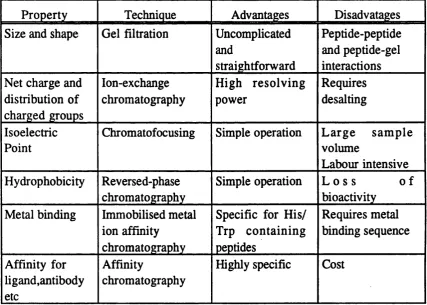
For the purification of short synthetic peptides, up to about 40 residues in length, the application o f conventional chromatographic techniques have proved to be extremely successful. Standard laboratory methods used to obtain the pure product are based on separations by chromatography. Many different stationary phases are available which exploit different physico-chemical properties o f the peptides. Table 5 below lists some of the important chromatographic techniques, the charateristies upon which separation is achieved and some o f their limitations.
Property Technique Advantages
Uncomplicated and
straightforward
Disadvatages
Size and shape Gel filtration Peptide-peptide
and peptide-gel interactions Net charge and
distribution of charged groups
Ion-exchange chromatography
High resolvin g power
Requires desalting
Isoelectric Point
Chromatofocusing Simple operation L arge sam p le volume
Labour intensive Hydrophobicity Reversed-phase
chromatography
Simple operation L o s s o f bioactivity
Metal binding Immobilised metal ion affinity
chromatography
Specific for H is/ Trp containing peptides
Requires metal binding sequence
Affinity for ligand,antibody etc
Affinity
chromatography
Highly specific Cost
Table 5. Comparison of some chromatographic methods for the purification of proteins
[Chapter One] 32
purification o f non-hydrophilic peptides, especially protected peptide fragments, that could not normally be purified in large quantities due to the poor solubility in most solvents [Nyfeler et al, 1991].
Where repetition of one technique may not yield the homogeneous product, a successive procedure or series of procedures which utilise different separation criterias could be employed. However this approach is time consuming and requires the operator to have a good practical knowledge o f different purification methods in order to optimise the series of steps. Running the same material through different procedures will also reduce the final yield o f product.
[Chapter One] 33
Recently Engstrom et al [1989] purified peptides between 25 and 40 residues in length on an immobilised metal-ion column. General applicability o f this method is also lacking due to its reliance on the presence o f His and/or Trp residues in the N-terminal region of the peptide.
Affinity chromatography has been extended to the purification of synthetic proteins. Lobl et al [1988] constructed the 153 residue IL-1 synthetic protein and went on to attach biotin to the N-terminus residue through a covaient linkage, thus enabling separation of biotinylated chains on an avidin-agarose column. Although this purification was successful biotin could not be removed from the purified protein due to its covalent linkage.
The strong affinity biotin has for avidin was also exploited by Bannow et al
[Chapter One] 34
FR A G M EN T CO NDENSATION
Towards Fischers original b elief that proteins could be chem ically synthesised work has focused on two different approaches. While one group of researchers have concentrated on optimising the chemistry involved in stepwise solid phase synthesis, others have taken the approach that smaller fully protected peptide fragments can be linked together to form the desired protein sequence. Convergent fragment condensation [Finn and Hofmann, 1976] involves synthesising short segments of the desired sequence which retain their side chain protecting groups. Since the peptide fragments are small it was envisaged that conventional chromatographic techniques could be applied to purify them to homogeneity. In the majority of cases, previous research towards the chemical synthesis of polypeptides has been performed in the solution phase [Denkewalter
[Chapter One] 35
The alternative technique o f solid phase fragment condensation helps to overcome some of the problems encountered with solution phase methods by combining the advantages of stepwise SPPS with the ability to purify short fully protected peptide fragments. Polypeptides synthesised by fragment condensation as opposed to stepwise SPPS have also been found to have greater biological activity [Yajima et al, 1974]. However to be successful the technique is dependent on a rapid and efficient method o f preparing and purifying the protected peptide intermediates. The 'linker' group on which the protected peptides are synthesised must offer (i) ease of derivatisation to the resin support, (ii) allow efficient stepwise synthesis of fragments, (iii) stability to the normal coupling conditions and (iv) the cleavage protocol should leave side chain and N-terminus protecting groups unaffected and be quantitative.
[Chapter One] 36
technique that does not involve the same chemical process as that used to cleave the side chain protecting groups.
In an attempt to address these problems several linker groups have been proposed for use with Boc chemistry that are cleaved by organic bases or by photolysis. Additionally, two allylic anchoring groups namely 4-bromocrotonic acid [Kunz and Dombo, 1988] and 4-trityloxy-2-but-2-enyloxyacetic acid [Guibe
et al, 1989] employ an hydrogenation procedure (at atmospheric pressure) to cleave the peptide from the resin. Since the cleavage conditions leave all side chain and N-terminal protecting groups intact, these allylic resin linkers are compatible with both Boc and Fmoc chemistries [Kunz et al, 1991]. The resin-linker molecules have been used to synthesise a variety o f protected peptides [Lloyd-Williams etal, 1991a].
One of the techniques used to develop an orthogonal approach to the removal o f protected peptide chains from the solid support was photolysis [Rich and Gurwara, 1973; Rich and Gurwara, 1975; Wang, 1976; Tjoeng et al, 1978; Tam
[Chapter One] 37
Several laboratories have explored resin-handles that are sensitive to mild base catalysed cleavage reagents. The Fmoc based 9-(hydroxymethyl)fluorene-4-carboxylic acid (4-COOH-Fmoc) was described by Mutter and B ellof [1984] as a novel anchor group for the synthesis of protected peptides which used acid-labile N-terminal amino protecting groups. The 4-COOH-Fmoc molecule was stable to the normal treatments o f Boc chemistry. The application o f the base-labile handle was demonstrated by the synthesis o f a model tetrapeptide. It was reported that the loading o f the first amino acid onto the 9-hydroxymethyl functionality proceeded in high yield without racémisation. The synthesis o f a similar Fmoc based molecule was reported by Liu et al [1990]. In this case attachment of the handle to the resin support was through a carboxyl group at position 2 on the fluorene ring. Unlike the fluorene handle developed by Mutter and Bellof, an extra methylene group separated the ring from the carboxyl group, which Liu et al [1990] argued, rendered the linker less susceptible to premature ^-elimination, due to the slight basicity o f the free amino group of the growing peptide chain. Addition of mildly acidic HOBt to the coupling mixture was found to counteract this undesired effect and thereby maximise the yield of peptide. To investigate the application of both these linker molecules to solid phase synthesis of protected peptides, five residue [Mutter and Bellof, 1984] and a seven residue [Liu et aU 1990] peptides were constructed using Boc chemistry.
[Chapter One] 38
tetramethylguanidine (TMG) and l,8-diazabicyclo-[5.4.0]-undec-7-ene (DBU) provided the necessary conditions for cleavage. Importantly, the success of cleavage was not dependent on the length of peptide chain. Both Whitney et al
[1984] and Liu et al [1990] advise caution when subjecting peptides containing aspartic or glutamic acids to organic bases (eg. piperidine) due to the possibility of cyclisation to pyroglutamic and aspartimide products. The side reaction can be avoided by using cyclohexyl as opposed to the benzyl ester protecting groups
[Schon et aU 1983].
Other methods have been developed to generate protected peptide fragments. Tam et al [1977] found that when potassium cyanide was complexed with 18-Crown-6, its nucleophilicity could be enhanced to an extent that it became a suitable reagent to cleave Boc-aminoacyloxyacyl-polystyrene resins.
The principle difficulty of the fragment condensation approach has been the purification o f the protected peptide intermediates on a larger scale. Since protected peptides are extremely hydrophobic in nature their solubility in many solvents is limited. Consequently, highly solubilising solvents (eg. DMF) have been used in order to maintain the material in solution and allow purification [Lloyd-Williams et al, 1991b]. It has also been shown that protecting the side chains of glutamine and asparagine can improve dramatically the solubility of protected fragments by disrupting the electrostatic forces that encourage aggregation [Atherton et al, 1990; Kamber and Riniker, 1991]. For this reason, Fmoc chemistry offers distinct advantages over the Boc method, since the trityl protecting group is maintained on the side chains throughout the synthetic and cleavage procedures. Unfortunately, the xanthanyl group used to protect the Boc derivatives o f asparagine and glutamine residues is sensitive to the acidolytic conditions used to remove the N-terminal protecting group and therefore can only be maintained during coupling step.
[Chapter One] 39
hydrophobicity [Nyfeler et al, 1991] or a combination o f different techniques [Pedroso et al, 1982]. Precipitation whilst quick and easy to perform generally tends to yield all peptidic material and hence peptidic impurities. Chromatographic separation on the basis of polarity using silica gel, especially on open-column apparatus, is generally slow and suffers from poor resolution o f closely related compounds. Gel filtration on Sephadex LH20 [Nystrom and Sjovall, 1963; Meienhofer et al, 1971], LH-60 [Zeiger and Anfinsen, 1973] and G-50 [Galpin et al, 1975] have been described using chloroform, DMF and alcohols. The low efficiency of these techniques however required the use of large columns and long elution times (1-4 days). Probably the most important m ethod o f purification is based on hydrophobicity. R eversed-phase chromatographic media has been developed for MPLC systems [Lloyd-Williams
et al, 1991b] but require large quantities o f DMF, both in terms o f volume and proportion in the eluting solvent to maintain the peptide in solution. However, the advantage of MPLC is that the column can handle a high loading o f crude material.
[Chapter One] 40
important implications with regards to the optical purity o f the C-terminal residue. Consequently, whenever possible this amino acid should be a glycine or proline to avoid problems of racémisation.
The practical difficulties encountered when using protected peptides can be partially overcome by purifying the short peptide fragments in an unprotected form and then chemically ligating them with minimal protection. This approach was illustrated by the synthesis of a 92 amino acid protein [Blake et al, 1986]. A highly inventive method of protein synthesis was suggested by Schnolzer and Kent [1992]. They coupled two unprotected synthetic peptide segments corresponding to the two halves of the HIV-1 protease sequence, through a thioester linkage. Consequently, the resulting protein was not com pletely natural. An alternative technique involves enzyme-catalysed peptide bond formation and has been explored by Nakatsuka et al [1987] and Wallace and Campbell [1989]. The advantage arising from the use of peptidases like trypsin are that the coupling is absolutely specific, without side reactions and requires no side chain protection of the fragments to be coupled. The success o f the method has been variable and possibly more could be achieved by using these specific proteases as stoichiometric reagents rather than as catalysts [Kent,
1988].
41
[Chapter Two] 42
PURIFICATION OF SYNTHETIC PEPTIDES USING
CHROMATOGRAPHIC PROBES BASED ON THE
FMOC MOLECULE
IN T R O D U C T IO N
[Chapter Two] 43
the biotinylation was irreversible. A reversible approach was suggested by Bannow et al., [1991], where the synthetic protein itself (the 99 residue SIV protease) cleaved the N-terminal Ala-Pro bond. As a result o f the requirement for specific amino acid residues the method did not offer a general applicability. The procedure that has been developed was based on the addition o f a molecular label to the N-terminus of the last amino acid of the peptidyl-resin. To avoid the unwanted derivatisation of shorter deletion sequences, a capping procedure following the coupling of each amino acid would be required. The key molecule (9-hydroxymethyl)fluorene-4-carboxylic acid (4-COOH-Fmoc, 1) was synthesised from fluorene-4-carboxylic acid and possessed the chemical properties o f the fluorenylmethoxycarbonyl (Fmoc, 2) group.
COOH
CH2OH
[Chapter Two] 44
[Chapter Two] 45
SPPS B o c o r F m o c
s tr a t e g i e s w i t h c a p p i n g
. (g)—Peptide-NH-Probe - Z _
Peptide-NH-Probe I +
Capped peptides +
Truncated peptides
Probes:
C O R
where R is a lipophilic or charged group
C H ^ O C O N H - P e p U d e
R E V E R S E D -P H A S E H PL C IO N -E X C H A N G E C H R O M A T O G R A P H Y
O r g a n i c b a s e
pure, cleaved peptide
probe
[Chapter Two] 46
R ESU LTS AND DISCUSSIO N
SYNTHESIS AND COUPLING OF TH E CHROM ATOGRAPHIC PROBES
The method described in the literature [Mutter and Bellof, 1984] for the synthesis of 9-(hydroxymethyl)fluorene-4-carboxylic acid (4-COOH-Fmoc, 1), involved an initial protection of the 4-carboxyl function with a t-butyl group (3:R1). Since the reaction required about 7 days to go to completion, alternative protecting groups were investigated as shown in figure 1.
COift
H H
CHg
I
R i = - C " C H 3 R 2 =
CH3
R 2 = - C H 3 R i =
C H3
I
- C H
I
C H3
C H3
I
-S1-CH3
I
C H3
Figure 1. Protecting groups used for fluorene-4-carboxylic acid.
[Chapter Two] 47
significant hydrolysis to the free acid. An alternative protecting group which was easier to prepare than the tert.butyl ester was the isopropyl ester group (3:R2). Unfortunately, while the reaction with sodium hydride proceeded to the 9-formylated intermediate, the similar reactivity o f the isopropyl ester C-H group an additional formylation had occuntd. The presence o f the di-formylated compound was supported by NMR and FAB-MS data which gave a mass of 28 units higher than expected. It was therefore concluded that due to the instability of the isopropyl protecting group to the reaction conditions, it should be abandoned and attention focused on different groups. The final derivative synthesised was the trimethylsilane group (3:R D which was found to be too labile for the intended applications. D espite the various attempts no improvements in time and yields were obtained, over the original method, which was therefore used for the synthesis of (3:RJD.
S y n th esis 9-(h y d ro x y m eth y l)flu o ren e-4 -ca rb o x y lic acid (1)
[Chapter Two] 48
chromatography technique (yields 75.9%). The overall yield for the four step procedure to synthesise 9-(hydroxymethyl)fluorene-4-carboxylate was 45%.
COOH COOtBu
4
CH2=CH(CH3)2
COOtBu
CH2OH
TFA
COOH
NaBH*
NaH/ HCOOEt
COOtBu
CHO
[Chapter Two] 49
Effect of increased lipophilicity on chromatographic properties
Once the central molecule 1, which would provide the reversible link to the peptide chain, had been synthesised it was necessary to design suitable groups that would dictate the chromatographic charateristics o f the probe. One such candidate available in the laboratory was the lipophilic molecule, a-am in o-decanoic acid (8) [Albertson and Archer, 1945; Albertson and Tuller,1945].
CHg I (CH2>7
I
NH2-CH-COOH
8
[Chuter Two] 50
T-10 T
5 15 min
Figure 2. C ig RP-HPLC of FMDV Vpl 141-160 (1) derivatised with one (2), two (3) and three (4) a-aminodecanoic acid residues (System 1).
Synthesis of lipophilic 4-C O R -Fm oc probes
[Chapter Two] 51
COOH
CH2OH R-H EDC/HOBT
CH2OH Disuccinimidyl Carbonate
COR
CHoOCOONSu
ROUTE 1
NH2-Peptide-Resin
COR
R = i N H C H (C H 2)7C H 3C 00C (C H 3> 3
6 NHCH(CH2)7CH3C0NHCH(CH2)7CH3C00CH3
2 { NHCH(CH2)4NHC1Z-C0}2NHCH(CH)4NHZC00CH3
fi { NHCH(CH2)2COOcHx-CO}2NHCH(CH2)2COOEtCOOEt
ROUTE 2
(i) NH2-Gly-0tBu
(Ü)TFA COR
NH2-Peptide-Resin EDC/HOBT
11
CH2OCONHCH2COOH
CH2 0 CONH-Peptide-Resin
(i) HF (ii) R P/IELC (iii) 5% aq. TEA
COR
NH2“Peptide
[Chapter Two] 52
CH3
I
(CR^h
I
NH2-CH-COOH
8 CH2=CH(CH3)2 CH. I (CH2)7 I NH^-CH-COOCCCHg)^ 1 4 B CH. I (CH2)7 I Boc-NH-CH-COOH 15 CH. I (CH2)7 I
NH2-CH-COOH
DCC/HOBt/DIEA
CH. I
(CH2)7
I
HClJSIH2-CH-C0 0 Me
1 6
(CH2>7 (CH2>7
I I
B0C-NH-CH-CONH-CH-COOCH3 1 7
CH.
50% TFA/DCM
CH. (CH2)7 (CH2>7
I I
TfaJ^-CH-CONH-CH-COOCHg 1 8
[Ch£Ç)ter Two] 53
To synthesise the simpliest o f the two derivatives 4-COR-Fmoc (9:R&), it was first necessary to protect the C-terminal group of 8 as a t-butyl ester, using the reaction conditions described for the estérification of fluorene-4-carboxylic acid (Scheme 4 A ) . The coupling of the monomeric (D,L) a-aminodecanoic acid t-butyl ester (14) to 4-COOH-Fmoc (1) was performed using o f 1.1 equivs. of l-ethyl-3-(3-dimethylaminopropyl)carbodiimide (EDC) and HOBt. Purification was achieved by flash chromatography on silica gel with a yield of 61.5%.
Solution phase peptide synthesis methodologies were used to couple two (D,L) a-aminodecanoic acid molecules together, which could then be linked to 4-COOH-Fmoc (1) to form the second hydrophobic probe molecule. However, unlike the mono-fatty acid derivative, the C-terminal group and appropriate N-terminal protection was achieved using the methyl ester and Hoc groups, respectively, as shown in Scheme 4b. The dipeptide (D,L) a-aminodecanoic acid methyl ester was then coupled to 4-COOH-Fmoc (1), using 1.1 equivs. each of HOBt and EDC, 1 equiv. of DIEA (Scheme 3) and the product (9:R4) purified by flash chromatography to give a solid 'glassy' material (yield; 68.3%).
Synthesis o f charged 4-C O R -Fm oc probes
[Chapter Two] 54
The ion-exchange probes developed for the extension of the purification system to alternative chromatographic media were based on the addition o f the charged amino acids Lys and Glu to the 4-COOH-Fmoc moiety (1). As representative molecules of this class, tripeptides o f lysine (19) and glutamic acid (20), each made up o f three residues, were synthesised.
NH(2C1Z) NH(2C1Z) NHZ
I I I
(CH2)4 (CHj)^ (CH2)4
I I I
TfaJ^H2-CH-CONH-CH-CONH-CH-COOCH3
1 9
COOcHx COOcHx COOEt
I I I
(CH2)2
(CH2)2
(CH2)2
I I I
TfaMl2-CH-C0NH-CH-C0NH-CH-C00Et 20
The tripeptides were synthesised by solution phase peptide synthetic methods. The first derivative was the tri-lysine analogue which was protected at the C-terminus as the methyl ester. The side chain protecting groups were carbobenzoxy (CBZ) and 2-chloro CBZ. The first two amino acids were coupled together using 1.1 equivs. each of HOBt and DCC and 1 equiv. of DIEA. Further elongation to the tripeptide was performed in the same fashion and follow ing purification by flash chromatography on silica gel, gave an overall yield o f 67.7%.
[Chapter Two] 55
linkage, the result was that in this example two less negative charges would be present on the 4-COR-Fmoc molecule (9:Rg).
Coupling the trilysine peptide to the 4-carboxyl group of 4-COOH-Fmoc was mediated using 1.1 equivs. HOBt and EDC and 1 equiv. DIEA. Purification of the desired product, 4-COR-Fmoc (9:R%) was by recrystallisation from hot acetonitrile with a recovery o f 70%. The same conditions as previously described yielded the triglutamic acid chromatographic probe 4-COR-Fmoc (9:R8.). To purify the latter m olecule flash chromatography was used successfully to obtain 81% of the required product.
Synthesis of 4-COR-Fmoc succinimidyl carbonates
![Table 1. Comparison of solution and solid phase peptide synthesis [Taken from Kent and Clark-Lewis, 1985]](https://thumb-us.123doks.com/thumbv2/123dok_us/9157650.1453608/18.595.102.505.285.531/table-comparison-solution-peptide-synthesis-taken-clark-lewis.webp)

![Table 3. Side reactions of individual amino acids. [Compiled from Bodanszky 1984 and the references cited therein]](https://thumb-us.123doks.com/thumbv2/123dok_us/9157650.1453608/26.595.96.520.106.732/table-reactions-individual-amino-acids-compiled-bodanszky-references.webp)
![Table 4. Optimised protocol for stepwise SPPS using Boc chemistry. [Taken from Kent and Clark-Lewis 1985]](https://thumb-us.123doks.com/thumbv2/123dok_us/9157650.1453608/30.595.99.503.323.622/table-optimised-protocol-stepwise-chemistry-taken-clark-lewis.webp)