4344
Usage Of Modified Pheromone Function In Eaco
For Task Scheduling In Cloud Computing
Anwar R Shaheen, Dr A R Nadira Banu Kamal
Abstract: One of the fast growing trend which distributes the required resources and delivers them to a particular user depending upon the demand of the user is cloud computing. The resources must be scheduled in a proper manner which enables the users to make most out of the resources, at a very comfortable cost as well. Nowadays, a wide range of industries and organizations are making use of the cloud computing. But a very major problem involved in the cloud computing is the management of the necessary resources provided by the cloud computing depending upon the concept of virtualization. This problem can be solved by utilizing Ant Colony Optimization (ACO) algorithm and the task scheduling is also done in an efficient manner with the purpose of reducing the cost and runtime of the virtual machines. To improve the performance measures further by reducing the cost and runtime, an Enhanced Ant Colony Optimization (EACO) algorithm is proposed in this research paper. This algorithm makes use of the pheromone function for the scheduling of tasks.It is a chemical substance that is secreted by ants during the time of travelling towards their food from the nest. The usage of this function prevents the wrong choice and helps in obtaining an optimal solution. The results are obtained in terms of SD cost, VM cost and total runtime for the various task scheduling algorithms and these results are compared with the same performance measures for the proposed EACO algorithm. The results indicate that the proposed algorithm provides with the lower values of SD cost, VM cost and total runtime on comparing with other task scheduling algorithms.
Index Terms: Cloud computing,Task scheduling,Pheromone,Enhanced Ant Colony Optimization (EACO) algorithm.
——————————◆——————————
1
INTRODUCTION
Advancement of the virtual techniques leads cloud computing (CC) to emerge as a computing archetype which provides vibrant provision for computation on the basis of pay/use[1]. In IT industry, these services are provided in any one of the following forms, which are infrastructure as a service (IaaS), software as a service (SaaS) and platform as a service (PaaS).The CC possess huge popularity in the field of scientific and business communities mainly due to its reliability, scalability, fault tolerance and minimized cost. Apart from the prescribed factors the users may not require any kind of security attaining of any innovative framework. The could achieve their requested services from any parts of the world without the intervention of IT infrastructure complexity. In general CC have few limitations related to the scheduling of task which is regarded as one of the important resource management. [2]The task scheduling in CC denotes the allocation of the user tasks available for improving the task execution and increasing the resource usage. Since the cloud resource allocation is predicted on the basis of SLA, the cost of task execution is regarded as the significant analyzing factor of task scheduling. Further the framing of TS algorithm is a critical process since more number of tasks should be scheduled into the accessible sources. Since this TS was great NP Complete issue, various optimization methods with the consideration of appropriate parameters may be utilized for solving the issue. [3]The paper focused on the optimization of the task scheduling in the CC on the basis of ant colony algorithm.
This enables the easy allocation and execution of the all the independent tasks for reducing the cost of execution, increasing the task completion time and also to vast utilization of the resources.
2
RELATED
WORK
Task scheduling can be performed by employing various types of algorithms. Some of the algorithms that were utilized in previously conducted research works for the scheduling of tasks are discussed in this section. Then a comparison table is mentioned which provides the comparison of different techniques utilized in the previous research works in terms of advantages and disadvantages of the techniques. [4]investigated about the dynamic scheduling of the workflow with a bag of task which schedules the stochastic task execution times in clouds. The algorithm that is proposed in the work is responsible for the dynamic cloud resource provisioning and mainly takes care of the scheduling process. The main objective of the work is to meet with the deadline of the workflow by summing up the task execution time, expectation and standard deviation. And by this the real task execution time is calculated. The renting cost of the resource is reduced by making use of a special strategy proposed for scheduling the delay is bag based delay scheduling strategyalong with an interval renting approach based on single type virtual machine. From the results of the simulations, it can be inferred that the proposed algorithm reduces the renting cost of the resources and ensures the deadline of the workflow by comparing the proposed algorithm with the previous existing algorithms. [5] proposed a technique for scheduling the tasks in cloud computing environment with the employment of Ant colony Optimization (ACO) algorithm. The makespan of the tasks which are submitted to the cloud systems are minimized by the proposed algorithm. The ACO algorithm functions based on the behavior of the ants which determines the very shortest distance present between the location of the food source and the colony. It comes under the category of heuristic algorithm.It is demonstrated that the ACO is one of the very useful heuristic algorithm by which the NP-hard problems are solved by utilizing the mechanism of positive feedback and distributed cooperation. The effectiveness of this algorithm is obtained with the help of the experimental results.
_____________________________________
• Anwar R Shaheen Research Scholar, Department of Computer Science, Alagappa University, Karaikudi, Tamilnadu, India, PH-7010324647. E-mail:[email protected]
• Dr A R Nadira Banu Kamal, Research Supervisor and Principal, Mohamed Sathak Hamid College of Arts and Science for Women,
Ramanathapuram, Tamilnadu, India, PH-9894431631.
[6] experimented a novel hybrid technique of SRDQ which combines the two methods of SJF – Shortest Job First schedulers with the RR – Round Robin for the scheduling of tasks. It functions by considering the dynamic variable task quantum. First the waiting time present between the short and long tasks was balanced by the dynamic task quantum and then the ready queue is divided into two sub queues in the following step. The dominance or advantages of the algorithm proposed in the research work over the existing works were provided by the results obtained after performing various experiments. The obtained outcomes represents a reduction in the response and waiting time and then a partial reduction of long tasks. [7]To obtain enhanced scheduling solutions for the systems in cloud computing, an innovative and novel algorithm for the scheduling is presented in the work with the name of HHSA – Hyper-Heuristic Scheduling Algorithm. The type of low level heuristic that is utilized for estimating the better candidate solutions are determined dynamically by employing the operators like improvement detection operators and diversity detection operators. The performance of the proposed algorithm is estimated by comparing the algorithm proposed in the work with various algorithms that were discussed in the existing works. All of these algorithms were employed in a simulator with the name of CloudSim and a real system with the name of Hadoop. Successive outcomes which were obtained indicate that the proposed HHSA reduces the makespan of the task scheduling significantly when comparing it with other scheduling algorithms which were employed in the CloudSim and Hadoop. [8]performed the scheduling of tasks on heterogeneous cloud systems by constructing an architecture for the management of cloud resources and cloud task is split up into two execution parts with the aid of the stochastic task model. Followed by this the makespan (i.e.) the schedule length for the bag of tasks applications’ was deduced. Based on the online feedback information of heterogeneous clouds, the first part execution was carried out for the tasks. Then this stochastic nature of the scheduling problem were formulated into the problem of linear programming. Then at last, a multi objective stochastic genetic algorithm for the scheduling of task was proposed for both the objectives of cost and time. This estimates the Pareto optimal schedules for the stochastic cloud type of task which satisfies the constraints present in the budget. Simulation experiments were performed on 400 virtual machines present in the heterogeneous cloud platform. Then the respective tasks were derived from the archives of parallel workloads and the data analysis of real-world cloud systems. Results obtained at the end of the experimentations exhibit that shorter schedule length and low cost are attained by the proposed genetic algorithm for the stochastic scheduling of tasks with certain budget restrictions.
TABLE I COMPARISON OF DIFFERENT PREVIOUSLY EXISTING
SCHEDULING ALGORITHMS
3
PROPOSED
WORK
3.1 Ant Colony Optimization
4346 problem that is to be solved. This algorithm is represented as
one of the conventional technique for the heuristic construction. The process of adapting the trails of pheromone substance is considered as the key difference as it is adapted at the time of executing the algorithm for the consideration of cumulated search experience.
3.2 Proposed Flow
The flow of the proposed work is represented in the Fig. 1.
FIG 1.FLOW OF THE PROPOSED METHODOLOGY
The above figure provides the overall flow involved in the proposed methodology. First the input buffer is given as input to the proposed work. Then the Virtual Machines (VM) and tasks are initialized in the next step. The artificial ants are randomly initialized in the VMs. Then the chemical substance of pheromone is initialized for identifying shortest distance between the location of food and the nest of ants. A question of “whether all ants have visited the pheromone?” is asked for the purpose of computing optimal path and updating the pheromone. If all the above conditions are satisfied, the desired outputs are generated at the end of the experimentations.
3.3 Pheromone
Ants communicate and cooperate with each other indirectly by utilizing a type of chemical substance known as pheromone which are left over by the ants along their path. [10]This substance helps in determining optimum solution for a task in terms of both by information and also in determining a new and short path. Hence probability of lower premature convergence is attained by using pheromone in the ACO algorithm.
The expression for pheromone is given as
𝜏𝑖,𝑗 = (1- ρ)𝜏𝑖,𝑗+ ∑𝑛𝑘=1∆𝜏(𝑖,𝑗)𝑘 (1)
whereρ is the rate of evaporation, 0<ρ<1, n is the no of ants
3.4 Pseudocode
Pseudo-code for EACO
Step 1: Initial solution generation Step 2: Initialize pheromone τ𝑖,𝑗 ,𝑘∗ Step 3:for each k (ant in the colony) do
Step 4: initialize candidate
Step 5: while candidate is not empty select and assign job j to l
Step 6: Update candidate Step 7: end while
Step 8: estimate solution Step 9:if (k<k*) then Step 10: k* k
Step 11: end if Step 12:end for
Step 13: if exploration is not terminated then Step 14:update pheromone
Step 15: do random move with probability p Step 16: return 1
Step 17: end if Step 18: return 𝑘∗k*
The above mentioned algorithm provides the pseudo-code of the work proposed in the research paper. For an instance, all the tasks are assigned or scheduledto a particular component, but with a condition of completing all the task assigned. The initial solution is generated in the step 1.Then the pheromone is initialized in the next step for determining the most optimal and shortest possible distance. After the initialization of pheromones, the ants (k) are introduced in the step 3. From the next step onwards the particular job or task is assigned if the initialized candidate is not empty. This operations are repeated till all the tasks are properly scheduled or allotted. Then the appropriate solution is estimated in the consecutive step. Designing a suitable local heuristics is essential for the effective decision making process.If the explorations for finding the optimal solution is not terminated even after attaining the desirable solutions, then the values of pheromones are updated and the optimization of optimal solution is enhanced further by employing local heuristic search approach. A random move is performed with the probability p. The position of the jobs are changed within the results of the ants trace for scheduling with various priority values. The best values of the optimum solutions that were obtained in the previous steps are returned in the last step.
4
RESULTS
AND
DISCUSSIONS
The SD cost, VM cost and total runtime are calculated separately for the existing task scheduling approaches of Round-Robin (RR), First Come First Serve (FCFS) and Inverted Ant Colony Optimization (IACO). The obtained values for these approaches are tabulated separately in the following Tables II, III and IV.
TABLE II.PERFORMANCE MEASURES FOR RR(ROUND-ROBIN)
TABLE II.PERFORMANCE MEASURES FOR RR(ROUND-ROBIN)
TABLE III.PERFORMANCE MEASURES FOR FCFS(FIRST COME
FIRST SERVE)
SD Cost of Virtual
Machine VM Cost Total Runtime Tasks VM Host
13.62454995 14.48 1,251,635.30 250 50 50
13.66865991 16.38 1,501,962.34 300 50 50
14.33782788 18.825 1,752,289.38 350 50 50
SD Cost of Virtual
Machine VM Cost
Total
Runtime Tasks VM Host
13.62454995 14.48 1,251,635.30 250 50 50
13.66865991 16.38 1,501,962.34 300 50 50
14.33782788 18.825 1,752,289.38 350 50 50
15.3808735 21.23333333 2,002,616.42 400 50 50
TABLE IV.PERFORMANCE MEASURES FOR IACO(INVERTED ANT
COLONY OPTIMIZATION)
SD Cost of Virtual Machine
VM Cost Total Runtime Tasks VM Host
13.52371013 14.33 1,251,635.30 250 50 50
13.55395549 16.29428571 1,501,962.34 300 50 50
14.11828921 18.585 1,752,289.38 350 50 50
15.25661856 21.11333333 2,002,616.42 400 50 50
TABLE V.PERFORMANCE MEASURES FOR THE PROPOSED
ALGORITHM
SD Cost of Virtual
Machine VM Cost
Total
Runtime Tasks VM Host
165.1111 14.13 1,251,734.30 250 50 50
13 15.79420571 1,501,962.77 300 50 50
13.8921454
6 18.258
1,752,290.3
7 350 50 50
15.1232465 20.1896 2,002,716.11 400 50 50
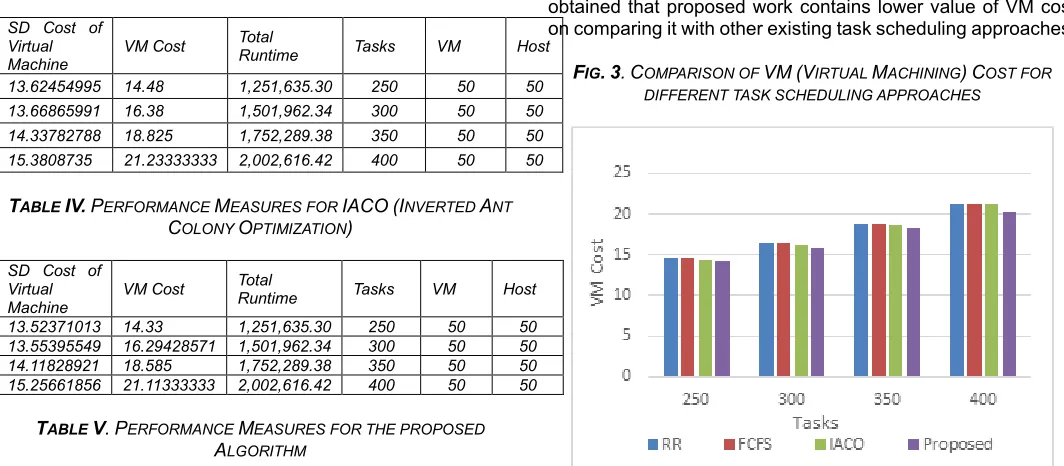
Then the same performance measures are determined for the proposed algorithm in the above Table V. Then the performance measures are compared separately for the various task scheduling approaches in the following figures.
FIG. 2.COMPARISON OF SD(STANDARD DEVIATION)COST FOR
DIFFERENT TASK SCHEDULING.
Fig. 2. provides the comparison of SD (Standrad Deviation) cost for the various task scheduling approaches. And it is clearly obtained that proposed work provides with the lower SD cost when comparing to the other existing approaches.
Fig. 3. indicates the comparison of VM (Virtual Machining) cost for the various task scheduling approaches. And it is clearly
obtained that proposed work contains lower value of VM cost on comparing it with other existing task scheduling approaches.
FIG. 3.COMPARISON OF VM(VIRTUAL MACHINING)COST FOR DIFFERENT TASK SCHEDULING APPROACHES
TABLE VI.COMPARISON OF TOTAL RUNTIME FOR DIFFERENT TASK
SCHEDULING APPROACHES
Tasks RR FCFS IACO Proposed
250 1,251,635.30 1,251,635.30 1,251,635.30 1,251,734.30 300 1,501,962.34 1,501,962.34 1,501,962.34 1,501,962.77 350 1,752,289.38 1,752,289.38 1,752,289.38 1,752,290.37 400 2,002,616.42 2,002,616.42 2,002,616.42 2,002,716.11
Table VI. exhibits the comparison of total runtime for the various task scheduling approaches. And it is clearly obtained that proposed EACO contains lower value of total runtimewhen comparing it with other previously existing task scheduling approaches.
5
CONCLUSION
The artificial ants present in ACO are a statistical solution with the exploitation of pheromone (artificial) data. The concept function on the basis of searching experience of ants and the availability of the heuristic data. This paper on the basis of this concept contributed to the enhancement of SD and VM cost and consequently the total run time. When comparing the above parameters with the existing RR, FCFS and IACO the proposed system depicts minimized runtime, SD and VM cost that proves the effectiveness and efficiency of the system.
6
REFERENCES
[1] Panda, S.K. and P.K. Jana, Efficient task scheduling algorithms for heterogeneous multi-cloud environment. The Journal of Supercomputing, 2015. 71(4): p. 1505-1533. [2] Hamad, S.A. and F.A. Omara, Genetic-based task
scheduling algorithm in cloud computing environment. International Journal of Advanced computer Science and Applications, 2016. 7(4): p. 550-556.
[3] Dorigo, M. and T. Stützle, Ant colony optimization: overview and recent advances, in Handbook of metaheuristics. 2019, Springer. p. 311-351.
4348 times in clouds. Future Generation Computer Systems,
2017. 71: p. 57-72.
[5] 5. Wang, L. and L. Ai, Task scheduling policy based on ant colony optimization in cloud computing environment, in LISS 2012. 2013, Springer. p. 953-957.
[6] Elmougy, S., S. Sarhan, and M. Joundy, A novel hybrid of Shortest job first and round Robin with dynamic variable quantum time task scheduling technique. Journal of Cloud Computing, 2017. 6(1): p. 12.
[7] Tsai, C.-W., et al., A hyper-heuristic scheduling algorithm for cloud. IEEE Transactions on Cloud Computing, 2014. 2(2): p. 236-250.
[8] Tang, X., X. Li, and Z. Fu, Budget‐constraint stochastic task scheduling on heterogeneous cloud systems. Concurrency and Computation: Practice and Experience, 2017. 29(19): p. e4210.
[9] Mirjalili, S., J.S. Dong, and A. Lewis, Ant Colony optimizer: theory, literature review, and application in AUV path planning, in Nature-Inspired Optimizers. 2020, Springer. p. 7-21.