S T U D Y P R O T O C O L
Open Access
Developing the Autism Model of Implementation
for Autism spectrum disorder community
providers: study protocol
Amy Drahota
1,2*, Gregory A Aarons
2,3and Aubyn C Stahmer
2,3Abstract
Background:Currently, 1 out of 88 children are diagnosed with an autism spectrum disorder (ASD), and the estimated cost for treatment services is $126 billion annually. Typically, ASD community providers (ASD-CPs) provide services to children with any severity of ASD symptoms using a combination of various treatment paradigms, some with an evidence-base and some without. When evidence-based practices (EBPs) are successfully implemented by ASD-CPs, they can result in positive outcomes. Despite this promise, EBPs are often implemented unsuccessfully and other treatments used by ASD-CPs lack supportive evidence, especially for school-age children with ASD. While it is not well understood why ASD-CPs are not implementing EBPs, organizational and individual characteristics likely play a role. As a response to this need and to improve the lives of children with ASD and their families, this study aims to develop and test the feasibility and acceptability of the Autism Model of Implementation (AMI) to support the implementation of EBPs by ASD-CPs.
Methods/design:An academic-community collaboration developed to partner with ASD-CPs will facilitate the development of the AMI, a process specifically for use by ASD community-based agencies. Using a mixed methods approach, the project will assess agency and individual factors likely to facilitate or hinder implementing EBPs in this context; develop the AMI to address identified barriers and facilitators; and pilot test the AMI to examine its feasibility and acceptability using a specific EBP to treat anxiety disorders in school-age children with ASD.
Discussion:The AMI will represent a data-informed approach to facilitate implementation of EBPs by ASD-CPs by providing an implementation model specifically developed for this context. This study is designed to address the real-world implications of EBP implementation in ASD community-based agencies. In doing so, the AMI will help to provide children with ASD the best and most effective services in their own community. Moreover, the proposed study will positively impact the field of implementation science by providing an empirically supported and tested model of implementation to facilitate the identification, adoption, and use of EBPs.
Keywords:Autism spectrum disorder, Evidence-based practice, Implementation, Organization, Community provider, Model development
Background
Autism spectrum disorders (ASD) are a set of pervasive, clinically complex disorders that require multiple inter-vention types to alleviate common clinical targets, such as impaired social skills and communication, executive functioning, empathy and perspective taking, sensory
perception, and motor skills, along with restricted and circumscribed interests and co-occurring psychiatric dis-orders [1]. Currently 1 out of 88 children are diagnosed with an ASD [2], and treatments for ASD symptoms are estimated to cost $125 billion annually [3]. Typically, ASD community providers (ASD-CPs) provide services to children with any severity of ASD symptoms using a combination of various treatment paradigms, with some treatments considered efficacious or probably efficacious and some with no base [4-7]. When evidence-based practices (EBPs) are successfully implemented by
* Correspondence:[email protected]
1Department of Psychology, San Diego State University, San Diego, CA, USA 2
Child and Adolescent Services Research Center, Rady Children’s Hospital, San Diego, CA, USA
Full list of author information is available at the end of the article
ASD-CPs, outcomes include increased IQ, communica-tion, social and daily living skills, and provide an improved developmental trajectory for children with ASD [8]. Despite this promise, EBPs are often imple-mented unsuccessfully, and other treatments used by ASD-CPs lack supportive evidence; both may be incon-sequential at best and harmful, even deadly, to children with ASD, at worst [9,10]. Given that 25.3% of California Department of Developmental Services’ total budget pays for services for individuals with ASD [11], it is crit-ical that EBPs be successfully implemented by ASD-CPs to improve the lives of children with ASD and their fam-ilies, and as a measure of fiscal responsibility.
Recently, research emphasis has been placed on devel-oping and testing EBPs for children with ASD and their families, resulting in an increase in the number of EBPs targeting many common clinical targets of the disorder [2,12]. However, ASD-CPs are not implementing these EBPs at the same rate that they are being developed and tested [5]. Instead, ASD-CPs are either delivering a single type of intervention for all clinical targets (e.g., Discrete Trial Teaching (DTT)), combining prac-tices in a non-systematic manner, or using pracprac-tices that lack supportive evidence. For example, DTT is a highly structured EBP that targets ASD symptoms, such as communication, and has robust evidence supporting its use. However, it does not fit all children with ASD, in particular, higher functioning school-age children with ASD, nor treat many common clinical disorders experi-enced by children with ASD [6]. Thus, many children with ASD in the community are left with unmet clinical needs [7].
It is not well understood why ASD-CPs are not imple-menting EBPs for common clinical issues related to ASD. It is likely that both organizational and individual ASD-CP characteristics play a role in hindering imple-mentation. Further, preliminary individual interviews with a convenience sample of five ASD community agency leaders (herein referred to as‘ASD leaders’) indi-cated a need for a contextually specific model designed for use by ASD-CPs to facilitate implementing EBPs for children with ASD. That is, while EBPs may be available, ASD-CPs do not have an efficient and effective process to facilitate EBP adoption, implementation, and sustain-ment. As a response to this need, and to improve the lives of children with ASD and their families, this study aims to develop the Autism Model of Implementation (AMI) that will facilitate implementation of EBPs within ASD community-based agencies.
A contextually specific implementation model for ASD-CPs is necessary
Current empirically derived implementation models [13-15] provide useful guidance for the development of
the AMI given that they consider a comprehensive set of organizational and individual provider factors likely to contribute to the adoption and implementation of EBPs. However, it is not known whether these models can be generalized to ASD-CPs. Attempting to generalize em-pirically derived implementation models for other settings may fail to recognize the unique context and characteris-tics of ASD-CPs. For example, compared with other community-based contexts (e.g., community mental health providers), ASD-CPs differ in training, attitudes towards EBPs, and funding [5,16,17]. Preliminary data gathered for this study indicate that ASD Leaders are willing to adopt EBPs (after evaluating the EBP-agency fit) but identified implementation barriers ranging from the educational level of their staff (predominantly undergraduate college students), funding (e.g., need for ongoing intervention to treat pervasive symptoms, insurance limits treatment ses-sions and types of treatments, so many families must pay out-of-pocket for many services), societal constraints (e.g., parents may demand specific services that are not typically provided for specific symptoms of ASD), and difficulty identifying EBPs for use with children with ASD. ASD-CPs may be expected to adapt interventions to meet the needs of the heterogeneous set of symptoms and behaviors displayed by children with ASD without appropriate training or knowledge of the intervention. Further, parents and consumer advocacy groups have a strong influence on legislation and funding for ser-vices, thus affecting the organizational context of ASD agencies [18].
Collaboration with community partners
vision and impact benchmarks, building interdepend-ence between collaborative partners, consensus and shared decision making, and formalized collaborative structure (e.g., roles, responsibilities of collaborators). ACC is an ideal approach to overcome previous imple-mentation challenges because it involves community sta-keholders as partners in most aspects of research endeavors [19,25] and will allow researchers to better address issues of external validity, feasibility, and accept-ability of the AMI.
The autism model of implementation (AMI)
While numerous empirically-derived models exist that are comprised of variables affecting adoption and mentation of EBPs [13-15], no models focus on imple-mentation of EBPs by ASD-CPs, specifically. Further, few studies have conducted applied research to assess the outcomes of these models of implementation in practice. In the few studies investigating the application of implementation models [26,27], key elements leading to success have emerged, including: using distinct phases to guide implementation; involving direct service provi-ders and community members as collaborative partners providing input on the uptake of EBPs; and providing comprehensive training with ongoing support prior to and during early EBP uptake.
The purpose of this study is to develop the AMI that will involve factors relevant to implementation on mul-tiple levels, including assessing both agency factors and provider characteristics related to facilitating or inhibit-ing implementation of EBPs (e.g., structured needs as-sessment; standardized process for evaluating the EBP, evaluating organizational adoption readiness factors). In collaboration with ACC partners, a review of the lit-erature and agency implementation assessment data will guide the development of the AMI. Preliminary discussions with ASD-CPs indicate that some factors included in general health service organizations’ mod-els of implementation may be of particular importance to the implementation of EBPs by ASD-CPs (e.g., on-going support, flexibility of EBP) and require greater emphasis in the AMI. Furthermore, additional factors may need to be added to the AMI (e.g., assess need fac-tors). Although the exact factors included in the AMI will require completion of aim one research activities, Figure 1 presents a preliminary model that has been adapted in collaboration with ACC partners. In particu-lar, questions remain about a feasible model and process of implementation, such as: within an ASD community-based agency, who assesses client and agency need and how; who identifies the appropriate EBP and how; and what structures and processes can be embedded within the AMI regarding evaluating the validity, feasibility, or adaptability of the EBP? What
agency-level training process will facilitate EBP implemen-tation? What structured evaluation of implementation is needed to sustain the use of the EBP by ASD-CPs over time? Results from aim one will be discussed with ACC partners in order to refine the preliminary AMI model.
The work in the proposed project will proceed in three phases corresponding to three specific aims:
Aim one: Assess agency antecedents and readiness factors, individual ASD-CP characteristics, and methods of implementing EBPs by ASD Leaders to identify factors that facilitate or hinder adoption and use of EBPs by ASD-CPs.
Aim two: Develop the autism model of implementation (AMI) with the focus on identification, adoption, and use of EBPs within community-based agencies serving children with ASD.
Aim three: Examine the feasibility and acceptability of the AMI through a small-scale pilot study. It is hypothesized that ASD-CPs will successfully complete each activity within each phase of the AMI to implement new EBPs within their ASD community-based agencies.
Methods/Design
Aim one: Assess agency antecedents and readiness fac-tors, individual ASD-CP characteristics, and methods of implementing EBPs by ASD Leaders to identify factors that facilitate or hinder adoption and use of EBPs by ASD-CPs.
Participants
At least two focus groups involving approximately five to eight ASD-CPs will be conducted to assess perspec-tives related to EBP implementation factors. ASD-CPs will include ASD agency Leaders as well as direct service providers, and are expected to be mostly female and range in educational level from college students to Ph.D. level staff. Age is not known, but typically varies between 24 and 69 years [5]. It is expected that ethnical/racial composition will reflect that of mental health service providers in San Diego, Imperial, and Orange Counties, which is diverse.
Procedure
groups of ASD-CPs. Findings will be used to expand or narrow the focus of each theoretically derived imple-mentation factor. Specifically, focus group participants will be asked to complete and return the quantitative measures prior to the focus group in order to allow focus group discussions to elaborate on the responses. Focus groups will be convened at times convenient to a majority of participants to elicit perceptions of identified implementation factors as well as previously unidentified factors particular to ASD-CP services. Further, focus groups will evaluate what methods are being used, if any, to assess need, evaluate EBPs, make decisions regarding adoption, and facilitating implementation of EBPs.
Measures
Demographic survey
The demographic survey will provide information about the ASD-CPs individual characteristics including gender, race/ethnicity, educational level, years as an ASD-CP at and outside of their current ASD agency, training received at the ASD agency, training received outside of the ASD agency, and professional or net-working organization membership.
Evidence-based practice attitude scale (EBPAS)
Focus group participants will complete the EBPAS [28,29], a structured questionnaire designed to assess empirically-derived constructs related to adoption and implementation of EBPs: appeal, requirements, open-ness, divergence, and a total EBPAS score representing the ASD-CPs global attitude toward EBPs [30,31].
Children’s services survey (CSS)
The CSS [32], adapted for use by ASD-CPs, will assess organizational culture and climate in order to provide information about factors related to implementing EBPs.
ASD community provider strategies survey (PSS)
The PSS, adapted for this study, will assess ASD-CPs’use of EBPs, knowledge of the evidence supporting the use of the practice, and whether they use the EBP or not, and whether the have received formal training in the EBP [33].
Focus group data
Semi-structured focus group guides will be used with ASD-CPs to elicit data on their perspectives on the follow-ing topics: needs of both clients and ASD-CPs in regard to children with anxiety disorders; EBPs in general; agency and ASD-CP factors that might facilitate or inhibit EBP implementation; and their current process used to imple-ment EBPs (if any). Focus groups will be conducted until the data collected reaches saturation (i.e., the same infor-mation is obtained from more than one group). The PI will introduce the initial issues to be addressed and mod-erate the dynamics of the group discussion to assure that all views are represented. This structure is dictated by the objective of collecting comparable data from both focus groups. Focus group discussions will follow a‘funnel inter-view structure’ [34], starting with broader researcher-driven issues and narrowing to more participant-researcher-driven specific illustrations of these issues.
Analysis plan: Integration of qualitative and quantitative analyses
Integrating qualitative and quantitative methods involves both deductive and inductive approaches to the research
Phase 1: Assessing
Need
Phase 2: EBP Factors
Phase 3: Adoption Factors
Phase 4: Implementation
Factors
Identifying client need Identifying agency need Locating EBP for specific ASD clinical targets
Goals Content Structure
Adaptability of EBP Training requirement Validity of EBP
Agency Antecedents
Organizational structure
Capacity for new knowledge
Receptivity for change Agency Readiness
Tension for change
Agency-EBP fit
Implications for adoption (e.g., funding) Dedicated time/ resources
Monitoring and feedback
ASD-CP Characteristics
ASD-CP motivations ASD-CP skills and capacity
ASD-CP attitudes toward EBP
ASD-CP/EBP fit
Mandatory versus voluntary use Involvement of leaders
Training Ongoing support
Dedicated resources External
collaboration
Flexibility of EBP Feedback on progress/fidelity monitoring
Figure 1Preliminary conceptual model of the Autism Model of Implementation (Adapted from Aaronset al., 2011 [13]; Damschroeder
design and interpretation of data within the same study [35], and is most appropriate for addressing the com-plexities of modern social phenomena by utilizing mul-tiple approaches to understand a given phenomenon or process [36]. This study will employ a mixed method ap-proach in order to acquire understanding of the factors involved in implementation by ASD-CPs, and to evalu-ate the process of implementation that ASD-CPs are currently using in order to identify facilitating and inhi-biting factors related to implementing EBPs by ASD-CPs. Implementation factors are not easily quantified, requiring the use of qualitative methods and data to in-form the development of structured assessment and evaluation tools (quantitative measures) for future use. Three different strategies will be employed when inte-grating quantitative and qualitative data, as suggested by Creswell and Plano Clark [37]: triangulation, expansion, and complementarity.
First, merging qualitative and quantitative data will occur through triangulation in which results of quantita-tive and qualitaquantita-tive analyses are placed side by side to de-termine whether each provides the same answer to the same question (convergence;e.g., do ASD-CP focus group data concur with quantitative data regarding attitudes regarding EBPs, organizational culture and climate, and EBP use and knowledge). Second, results from qualitative and quantitative analyses will be linked when the former is used to provide explanations for unanticipated findings produced by the latter (expansion;e.g., questionnaire data will be used to assess the prevalence of emergent barriers to implementing EBPs observed in qualitative interviews). Finally, results of qualitative analysis can be embedded within the analysis of quantitative data by helping to contextualize results obtained in statistical analyses fo-cused on the questionnaires (complementarity).
Aim two: Develop the autism model of implementa-tion (AMI) with focus on identificaimplementa-tion, adopimplementa-tion, and use of EBPs within agencies serving children with ASD.
Participants
Development of the AMI will involve approximately seven ACC partners. The ACC will be comprised of three to five ASD-CPs who are responsible for directing, supervising, or training direct service providers within their agencies, one to two funding agency representa-tives (e.g., regional centers, insurance companies, school districts) who are knowledgeable about how funding deci-sions are made for children with ASD, and an implementa-tion researcher with expertise in studying implementaimplementa-tion factors related to community agencies. A systematic re-cruitment strategy will be used in order to maximize the diversity of ACC partners, which is expected to increase the generalizability of the AMI to a variety of organiza-tions, geographic locaorganiza-tions, and providers.
Procedure
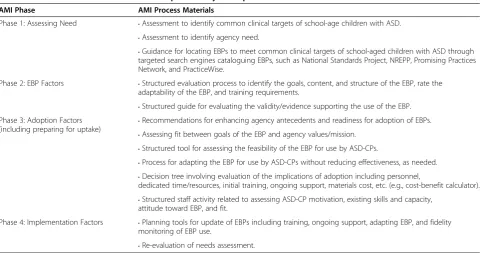
In collaboration with ACC partners, the review of the literature and aim one data will guide the development of the AMI. Specifically, results will be presented to ACC partners to obtain feedback and additional inter-pretation. Results and ACC partner feedback will be used to guide the development of the AMI and AMI materials (e.g., needs assessment materials, et al.). Al-though the exact factors included in the AMI will re-quire completion of aim one research activities, the AMI will likely include four phases: assessing needs of children with ASD and the agency, examining EBP factors to ad-dress those needs, adad-dressing organizational factors and ASD-CP characteristics related to adoption, and identify-ing implementation factors, such as trainidentify-ing, EBP flexibil-ity, and ongoing support that will facilitate EBP use at the agency (Figure 1). For each phase, the AMI will have spe-cific products, developed by the PI in collaboration with ACC partners, to be used by ASD Leaders in order to ac-complish the goals of that phase. For example, ACC part-ners who collaborated in the development of this proposal reported that assessing need was an important step for an implementation model and that there was not a general-ized, systematic assessment tool available for use by ASD-CPs. Therefore, an organizational assessment tool to identify common clinical targets of school-age children with ASD will be developed to support the implementa-tion of the AMI. Table 1 outlines likely materials sup-porting AMI implementation.
Process of developing the AMI
The development of the AMI will involve an iterative approach (Figure 2) involving the ACC partners. Specif-ically, the PI will revise the preliminary conceptual model of the AMI based on the literature review and aim one results. The ACC partners will provide feedback to enhance the interpretation of aim one results and for revisions to the AMI and AMI process materials. It is expected that this iterative approach will increase the ex-ternal validity, feasibility, and acceptability of the AMI.
Aim three: Examine the feasibility and acceptability of the AMI through a small-scale pilot study.
The AMI model will be designed for use by ASD community-based agencies to implement any EBP. How-ever, for this pilot study, an EBP has been chosen a priori. This will allow for examination of each phase of the AMI and preliminary comparison between use of the AMI among agencies who participate in the pilot study. Specifically, an EBP to treat co-occurring anxiety disor-ders in children with ASD has been targeted due to the prevalence of anxiety disorders among school-age chil-dren with ASD and interest expressed by ACC partners.
impairment above and beyond that caused by the ASD, and is the second most highly prevalent problem reported by parents [38-43]. Cognitive behavioral therapy (CBT) to treat anxiety disorders in children with ASD is considered evidence-based because multiple laboratories using rigorous research designs and methods (e.g., randomized controlled trials) have found evidence supporting its use to alleviate or reduce anxiety symptoms or interference with large treatment effect sizes at post-treatment compared to control conditions [44-46].
Moreover, evidence suggests that intervening on chil-dren’s anxiety disorders has distal outcomes such as in-creasing social and daily living skills, and family functioning [44,47,48]. Preliminary data gathered from ASD Leaders indicate that anxiety is a significant prob-lem for some of the school-age children being provided services at ASD community-based agencies. Interviews with ASD Leaders regarding current use of CBT by ASD-CPs found only two of the five agencies using CBT strategies to treat anxiety among school-age children Table 1 AMI Process Materials for the AMI preliminary conceptual model
AMI Phase AMI Process Materials
Phase 1: Assessing Need •Assessment to identify common clinical targets of school-age children with ASD. •Assessment to identify agency need.
•Guidance for locating EBPs to meet common clinical targets of school-aged children with ASD through targeted search engines cataloguing EBPs, such as National Standards Project, NREPP, Promising Practices Network, and PracticeWise.
Phase 2: EBP Factors •Structured evaluation process to identify the goals, content, and structure of the EBP, rate the adaptability of the EBP, and training requirements.
•Structured guide for evaluating the validity/evidence supporting the use of the EBP. Phase 3: Adoption Factors
(including preparing for uptake)
•Recommendations for enhancing agency antecedents and readiness for adoption of EBPs. •Assessing fit between goals of the EBP and agency values/mission.
•Structured tool for assessing the feasibility of the EBP for use by ASD-CPs.
•Process for adapting the EBP for use by ASD-CPs without reducing effectiveness, as needed. •Decision tree involving evaluation of the implications of adoption including personnel,
dedicated time/resources, initial training, ongoing support, materials cost, etc. (e.g., cost-benefit calculator). •Structured staff activity related to assessing ASD-CP motivation, existing skills and capacity,
attitude toward EBP, and fit.
Phase 4: Implementation Factors •Planning tools for update of EBPs including training, ongoing support, adapting EBP, and fidelity monitoring of EBP use.
•Re-evaluation of needs assessment.
Change in EBPAS, CSS, PSS from pre-to
post-implementation (Quant) Use and fidelity measures (Quant)
SIC (Quant)
Perceived acceptability of the AMI (Qual)
PI Activities: Synthesis of literature Collect data
Data analyses and data interpretation Develop AMI Co-author manuscripts
ACC Partners:
Feedback/guidance on literature synthesis
Interpret data analyses Feedback on AMI Co-author manuscripts
Autism Model of Implementation and AMI Process Materials
Implementation of the AMI using a specific EBP (“Building Confidence”) to treat anxiety disorders in school age children with ASD.
Participants include ASD Leaders
with ASD. Of these, one agency reported using a man-ualized anxiety CBT developed for typically developing children with anxiety disorders rather than developed for children with ASD, and the other used exposure therapy (a component of CBT) but indicated that ASD-CPs were not certain about how to effectively use this practice with children with ASD. Using the AMI to implement a specific EBP to treat anxiety disorders in school-age children with ASD, aim three will evaluate the: feasibility of using the AMI within ASD community-based agencies; perceived fit, relevance, utility and compatibility of the AMI within ASD community-based agencies; training and support in the use of the AMI and AMI process materials; and observed fidelity of using the AMI to implement at EBP within ASD community-based agencies.
Participants
Approximately 10 ASD Leaders (e.g., clinical directors, executive directors), not participating in the ACC, will be recruited to participate in the AMI pilot study to test the feasibility and acceptability of the AMI. An agency will be eligible if it provides behavioral interventions, speech and language therapy, or social skills training to children with ASD and co-occurring anxiety disorders between the ages of 7–11 years. Agencies will be excluded if they do not provide services to children aged 7–11 years or do not serve any children with co-occurring anxiety disorders.
Procedure
The AMI will be used to implement ‘Building Confi-dence,’a manualized CBT for children with ASD and co-occurring anxiety disorders [49]. The PI is a co-author of the manualized intervention and will consult with the primary author throughout the pilot study to address EBP factors (e.g., time available for training, billing pro-cedures, et al.), organizational adoption-related factors, and factors facilitating implementation. The pilot test will involve a pre-post design. ASD Leaders will be asked to complete questionnaires and participate in interviews prior to and after implementation of the AMI. Measures of AMI implementation will involve process and fidelity measures within each agency.
Data/measures
Data from the demographic survey, EBPAS, CSS, and PSS used during aim one will be administered at pre-and post-implementation of the AMI (see aim one for more information about these measures).
Stages of implementation completion (SIC)
The SIC [50] is a time-to-event based observational measure of implementation progress that consists of eight stages relating to specific implementation milestones.
These milestones include: engagement, consideration of feasibility, readiness planning, staff hired/trained, adher-ence monitoring processes in place, services and consult-ation begin, ongoing services, consultconsult-ation fidelity monitoring and feedback, and competency. The mile-stones span the timeframe from the engagement stage where initial contact between interested parties occurs through the attainment of program competency stage. Stages extend from ASD Leaders through ASD-CPs in order to capture the multiple levels involved in imple-mentation. The SIC is intended to be tailored to fit spe-cific EBPs and implementation models, and can be modified to assess quality and fidelity of the stages of implementing the AMI. The measure authors have agreed to work with the PI to adapt the SIC to best re-flect the phases and steps within the AMI. Analysis of the SIC involves a time-to-event modeling method.
Individual interviews
Leaders will be interviewed prior to the AMI implemen-tation to assess their perceptions of the AMI, including perceived fit, relevance, utility, and compatibility with their ASD agency. At post-implementation, interviews will assess perspectives about the AMI, including feasibil-ity and acceptabilfeasibil-ity, changes in agency process for implementing EBPs, and changes in ASD-CP practices. Individual interviews will take approximately 30 minutes.
Analysis plan: Integration of qualitative and quantitative analyses
Repeated measures ANOVA for pre- and post-implementation questionnaires will be used to examine the changes that occurred during AMI. Due to the lack of a control group and the small sample sizes, interpretation of effect sizes will be examined.
treated as being censored (e.g., standard time-to-event analysis).
Pre- and post-implementation interviews will be ana-lyzed using a coding, consensus, and comparison meth-odology [52], which follow an iterative approach rooted in grounded theory [53]. Transcriptions will be inde-pendently coded by the PI and a trained research assist-ant at a general level in order to condense data into analyzable units. The coding will be reviewed by grant mentors and consultants. Transcriptions will be assigned codes based on a priori or emergent themes. Transcrip-tions may be assigned more than one code. Disagree-ments will be resolved through subsequent discussion between research team members. The final list of codes will be developed through consensus with ACC partners. Based on the codes, the process of axial coding will be used to generate a series of categories arranged in a tree-like structure connecting segments into separate cat-egories or nodes. Nodes and trees will be used to create a taxonomy of themes, including a prioriand emergent categories and new, unrecognized categories. Results will be presented to ACC partners for interpretation.
Finally, methods for integrating qualitative and quanti-tative data for analyses will be the same as those used in aim one (see aim one for details).
Discussion
The AMI will represent a data-informed approach to fa-cilitate implementation of EBPs by ASD-CPs by providing an implementation model specifically developed for this context. This study is designed to address the implications of EBP implementation in ASD community-based agen-cies. In doing so, the exploratory and developmental work proposed in this study aims have a positive public health impact on the lives of children with ASD and their fam-ilies by increasing the implementation of EBPs by ASD-CPs, especially for children with ASD with co-occurring anxiety disorders. Moreover, the proposed study will posi-tively impact the field of implementation science by pro-viding an empirically-supported and tested model of implementation to facilitate the identification, adoption, and use of EBPs by ASD-CPs, specifically.
In this project, the AMI will be developed and pilot tested. The AIM is designed to assist ASD community-based agencies assess and find EBPs to their meet agency needs, systematically evaluate the EBP for acceptability and feasibility within the agency, consider salient adop-tion factors, and guide the effective implementaadop-tion of the EBP. Through the use of the AMI phases and AMI process materials (e.g., structured materials guiding the phases of implementation), it is hypothesized that imple-menting EBPs will be more likely for ASD community agencies.
Once developed and pilot tested, further refinement of the AMI, including specific aspects of the AMI process materials, will be done to allow for larger-scale imple-mentation studies focusing on testing the implementa-tion effectiveness, generalizability, and sustainability of the AMI. By continuing to involve ACC partners, the ex-ternal validity of refinements made to the AMI will in-crease. Additionally, larger-scale studies will allow for involving more varied organizations or systems providing services to children with ASD (e.g., school districts) as well as diverse providers, and multilevel data (e.g., ASD-CPs nested within managers nested within agencies nested within service systems). Future tests of the ef-fectiveness of the AMI will not have an EBP selected a priori.
Abbreviations
ASD-CP: Autism spectrum disorders community provider; ASD: Autism spectrum disorder; AMI: Autism Model of Implementation; CBT: Cognitive-behavioral therapy; CSS: Children’s Services Survey; DTT: Discrete trial teaching; EBP: Evidence-based practice; EBPAS: Evidence-based Practice Attitude Scale; PI: Principal investigator; PSS: ASD Community Provider Strategies Survey; SIC: Stages of Implementation Completion.
Competing interests
GAA is an Associate Editor of Implementation Science; all decisions on this paper were made by another editor. The authors declare that they have no other competing interests.
Authors’contributions
AD is the principal investigator for the described study. AD conceptualized and designed the study, drafted the manuscript, and approved the final version. GAA and AS are co-mentors for AD’s NIMH K01 award, which funds the study activities. GAA and AS contributed to the conceptualization and design of the study, reviewed and provided feedback on the manuscript. All authors read and approved the final manuscript.
Acknowledgements
This study is supported by the National Institute of Mental Health grant K01MH093477 (Principal investigator: Amy Drahota).
Author details
1Department of Psychology, San Diego State University, San Diego, CA, USA. 2
Child and Adolescent Services Research Center, Rady Children’s Hospital, San Diego, CA, USA.3Department of Psychiatry, University of California, San Diego, La Jolla, CA, USA.
Received: 9 July 2012 Accepted: 30 August 2012 Published: 10 September 2012
References
1. Volkmar FR, Klin A:Issues in the classification of autism and related conditions. InHandbook of Autism and Pervasive Developmental Disorders. Edited by Volkmar FR, Rhea P, Klin A, Cohen D. Hoboken, New Jersey: John Wiley & Sons; 2005:5–41.
2. Autism and Developmental Disabilities Monitoring Network Surveillance: Prevalence of autism spectrum disorders–Autism and developmental disabilities monitoring network, United States, 2008.MMWR2012, 61:1–19.
3. Knapp M, Mandell D, Buescher A, Cidav A:Autism: Economic impact and implications. InAutism Summit, Investing in our Future. Hong Kong: The Economic Costs of Autism; 2012.
4. Rogers SJ, Vismara LA:Evidence-based comprehensive treatments for early autism.JCCAP2008,37:8–38.
5. Stahmer AC, Collings NM, Palinkas LA:Early intervention practices for children with autism: Descriptions from community providers.Focus on
6. Matson JL, Smith KRM:Current status of intensive behavioral
interventions for young children with autism and PDD-NOS.JADD2008, 2:60–74.
7. Brookman-Frazee LI, Taylor R, Garland AF:Characterizing community-based mental health services for children with autism spectrum disorders and disruptive behavior problems.JADD2010,40:1188–1201.
8. Humphrey N, Parkinson G:Research on interventions for children and young people on the autism spectrum: A critical perspective.J Res in
Special Ed Needs2006,6:76–86.
9. Chorpita B:The frontier of evidence-based practice. InEvidence-based
psychotherapies for children and adolescents. Edited by Kazdin AE, Weisz JR.
New York, NY: Guilford Press; 2003:42–59.
10. Associated Press: Boy with autism dies after chelation therapy:5-year-old
was receiving controversial treatment in doctor’s office. http://www.msnbc.
msn.com/id/9074208/ns/health-mental_health/.
11. California Health and Human Services Agency:Autistic Spectrum Disorders.
Changes in the California Caseload. An Update: June 1987-June 2007.
Sacramento, CA; 2008.
12. National Institutes of Mental Health:Strategic Plan. Bethesda: Maryland; 2008.
13. Aarons GA, Hurlburt M, Horwitz SM:Advancing a conceptual model of evidence-based practice implementation in public service sectors.Admin
Policy in Mental Health & Mental Health Svs Res2011,38:4–23.
14. Damschroeder LJ, Aron DC, Keith RE, Kirsh SR, Alexander JA, Lowery JC: Fostering implementation of health services research findings into practice: A consolidated framework for advancing implementation science.Implementation Sci2009,4:50.
15. Greenhalgh T, Robert G, Macfarlane F, Bate P, Kyriakidou O:Diffusion of innovations in service organizations: Systematic review and recommendations.Milbank Q2004,82:581–629.
16. Stahmer AC, Aarons G:Attitudes toward adoption of evidence-based practices: A comparison of autism early intervention providers and children’s mental health providers.Psych Svs2009,6:223–234. 17. Brookman-Frazee L, Baker-Ericzen M, Stahmer A, Mandell D, Haine RA,
Hough RL:Involvement of youths with autism spectrum disorders or intellectual disabilities in multiple public service systems.J Mental Health
Res in Intellectual Dis2009,2:201–219.
18. Mandlawitz MR:The impact of the legal system on educational programming for young children with autism spectrum disorder.JADD 2002,32:495–508.
19. Merzel C, Burrus G, Davis J, Moses N, Rumley S, Walters D:Developing and sustaining community-academic partnerships: Lessons from downstate New York Healthy Start.Health Promot Pract2007,8:375–383.
20. Altman DG:Sustaining interventions in community systems.Health Psych 1995,14:526–536.
21. Israel BA, Schultz AJ, Parker EA, Becker AB:Review of community-based research: Assessing partnership approaches to improve public health.
Ann Review of Public Health1998,19:173–202.
22. Lasker RD, Weiss ES, Miller R:Partnership synergy: A practical framework for studying and strengthening the collaborative advantage.Milbank Q 2001,79:179–205.
23. Jones L, Wells K:Strategies for academic and clinician engagement in community-participatory partnered research.JAMA2007,297:407–410. 24. Mendel P, Meredith LS, Schoenbaum M, Sherbourne CD, Wells KB:
Interventions in organizational and community context: A framework for building evidence on dissemination and implementation in health services research.Admin & Policy in Mental Health & Mental Health Svs Res 2008,35:21–37.
25. Baker E, Homan S, Schonhoff R, Kreuter M:Principles of practice for academic/practice community research partnerships.Am J Prev Med1999, 16:86–93.
26. Glisson C, Schoenwald SK:The ARC organizational and community intervention strategy for implementing evidence-based children’s mental health treatments.Mental Health Svs Res2005,7:243–259. 27. Wandersman A, Duffy J, Flaspohler P, Noonan R, Lubell K, Stillman L,et al:
Bridging the gap between prevention research and practice: The interactive systems framework for dissemination and implementation.
Am J Community Psych2008,41:171–181.
28. Aarons GA:Mental health provider attitudes toward adoption of evidence-based practice: The Evidence-Based Practice Attitudes Scale (EBPAS).Mental Health Svs Res2004,6:61–74.
29. Aarons GA, McDonald EJ, Sheehan AK, Walrath-Greene CM:Confirmatory factor analysis of the Evidence-Based Practice Attitude Scale (EBPAS) in a geographically diverse sample of community mental health providers.Admin & Policy in Mental Health & Mental Health Svs Res2007, 34:465–469.
30. Aarons GA, Sommerfeld DH, Hecht DB, Silovsky JF, Chaffin MJ:The impact of evidence-based practice implementation and fidelity monitoring on staff turnover: Evidence for a protective effect.JCCP2009, 77:270–280.
31. Aarons GA, Sawitzky A:Organizational climate mediates the effect of culture on work attitudes and turnover in mental health services.
Admin & Policy in Mental Health & Mental Health Svs Res2006,
33:289–301.
32. Glisson C, James LR:The cross-level effects of culture and climate in human service teams.J Organizational Beh2002,23:767–794. 33. Brookman-Frazee L, Garland AF, Taylor R, Zoffness R:Therapists’
attitudes towards psychotherapeutic strategies in community-based psychotherapy with children with disruptive behavior problems.Admin & Policy in Mental Health & Mental Health Svs Res 2009,36:1–12.
34. Morgan DL:Designing focus group research. InTools for primary care
research. Research methods for primary care. Edited by Stewart MA, Tudiver F,
Bass MJ, Dunn EV, Norton PG. Thousand Oaks, CA: Sage Publications; 1992:177–193.
35. Tashakkoi A, Teddlie C:Handbook of Mixed Methods in Social and Behavioral
Research. Thousand Oaks, CA: Sage Publications; 2003.
36. Morgan DL:Practical strategies for combining qualitative and quantitative methods: Applications to health research.Qual Health Res 1998,8:362–376.
37. Creswell JW:Plano Clark VL: Designing and Conducting Mixed Methods
Research. Thousand Oaks, CA: Sage Publications; 2006.
38. Mills R, Wing L:Researching interventions in ASD and priorities for research:
Surveying the membership of the NAS. London: National Autistic Society;
2005.
39. Bellini S:Social skill deficits and anxiety in high-functioning adolescents with autism spectrum disorder.Focus on Autism & Other Developmental Dis 2004,19:78–86.
40. Matson JL, Nebel-Schwalm MS:Comorbid psychopathology with autism spectrum disorder in children: An overview.Res Developmental Dis2007, 28:341–352.
41. de Bruin EI, Ferdinand RF, Meesters S, de Nijs PFA, Verheij F:High rates of psychiatric co-morbidity in PDD-NOS.JADD2007,37:877–886. 42. Klin A, Pauls R, Schultz R, Volkmar F:Three diagnostic approaches to
Asperger syndrome: Implications for research.JADD2005, 35:221–234.
43. Muris P, Steerneman P, Merckelbach H, Holdrinet I, Meesters C:Comorbid anxiety symptoms in children with pervasive developmental disorders.
J Anxiety Dis1998,12:387–393.
44. Wood JJ, Drahota A, Sze K, Har K, Chiu A, Langer DA:Cognitive behavioral therapy for anxiety in children with autism spectrum disorders: A randomized, controlled trial.JCPP2009,50:224–234.
45. Chalfant AM, Rapee R, Carroll L:Treating anxiety disorders in children with high functioning autism spectrum disorders: A controlled trial.JADD 2007,37:1842–1857.
46. Sofronoff K, Attwood T, Hinton S:A randomised controlled trial of a CBT intervention for anxiety in children with Asperger syndrome.JCPP2005, 46:1152–1160.
47. Drahota A, Wood JJ, Sze KM, Van Dyke M:Effects of cognitive behavioral therapy on daily living skills in children with high-functioning autism and concurrent anxiety disorders.JADD2011, 41:257–265.
48. Wood JJ, McLeod BD, Sigman M, Hwang W-C, Chu BC:Parenting and childhood anxiety: Theory, empirical findings, and future directions. JCPP2003,44:134–151.
49. Wood JJ, Drahota A, Sze KM:Cognitive behavioral therapy for anxiety and
social problems in children with autism: Intervention manual. Los Angeles:
Unpublished intervention manual developed at the University of California; 2007.
50. Chamberlain P, Brown HC:Observational measure of implementation progress: The Stages of Implementation Completion (SIC).
51. Fox J, Weisberg S:An R Companion to Applied Regression. 2nd edition. Thousand Oaks: Sage Publications; 2011.
52. Willms DG, Best JA, Taylor DW,et al:A systematic approach for using qualitative methods in primary prevention research.Medical Anthro Q 1990,4:391–409.
53. Glaser BG, Strauss AL:The Discovery of Grounded Theory: Strategies for
Qualitative Research. Chicago, IL: Aldine Publishing Company; 1967.
doi:10.1186/1748-5908-7-85
Cite this article as:Drahotaet al.:Developing the Autism Model of
Implementation for Autism spectrum disorder community providers: study protocol.Implementation Science20127:85.
Submit your next manuscript to BioMed Central and take full advantage of:
• Convenient online submission
• Thorough peer review
• No space constraints or color figure charges
• Immediate publication on acceptance
• Inclusion in PubMed, CAS, Scopus and Google Scholar
• Research which is freely available for redistribution
![Figure 1 Preliminary conceptual model of the Autism Model of Implementation (Adapted from Aarons et al., 2011 [13]; Damschroederet al., 2009 [14]; and Greenhalgh et al., 2004 [15])](https://thumb-us.123doks.com/thumbv2/123dok_us/690238.1565260/4.595.59.540.89.271/figure-preliminary-conceptual-implementation-adapted-aarons-damschroederet-greenhalgh.webp)