R E S E A R C H
Open Access
Normative data and clinically significant effect
sizes for single-item numerical linear analogue
self-assessment (LASA) scales
Jasvinder A Singh
1,2,3, Daniel Satele
4,5, Suneetha Pattabasavaiah
5, Jan C Buckner
6and Jeff A Sloan
5*Abstract
Background:Single-item assessments have been the most often-used measures in National Cancer Institute (NCI) cancer control clinical trials, but normative data are not available. Our objective was to examine the normative data and clinically significant effect sizes for single-item numerical linear analogue self-assessment (LASA) scale for overall quality of life (QOL).
Methods:We analyzed baseline data from 36 clinical trials and 6 observational studies with various populations, including healthy volunteers, cancer trial patients (patients with advanced incurable cancer or patients receiving treatment with curative intent) and hospice patients as well as their caregivers. The overall QOL LASA was rated 0 (as bad as it can be) to 10 (as good as it can be). We calculated the summary statistics and the proportion of patients reporting a clinically meaningful deficit (CMD) of a score equal to 5 or less on the 0–10 scale.
Results:In total, for the collective sample of 9,295 individuals, the average overall QOL reported was 7.39 (SD = 2.11) with a markedly skewed distribution with roughly 17% reporting a score of 5 or below indicating a clinically significant deficit in overall QOL. Hospice patients report a much worse average score of 5.7 upon entry to hospice; hospice caregivers average 7.4. Cancer patients vary within these two extremes with most patients averaging in the 7’s on the 0–10 scale (range, 0 to 10 p-value < 0.0001). Men and women’s QOL distributions were virtually identical (with average of 7.6 vs. 7.5, p-value = 0.046). Overall QOL was weakly related to performance status with a Spearman correlation coefficient of−0.29 (p-value < 0.0001). Overall QOL was related to tumor response (p-value = 0.0094), i.e. patients with a full or partial response reported a CMD in 11.4% of cases compared to 14.4% among those with stable disease and 18.5% among those with disease progression. Data missingness was high for performance status and tumor response associations. Conclusions:This study provides the normative data for cancer patients and healthy volunteers for overall QOL using the LASA. These can serve as benchmarks for future studies and inform clinical practice decision-making.
Keywords:Quality of life, Measurement, LASA, Validation, Single item, Linear analog scale, Patient-reported outcomes, PROs, QOL
Background
Patient-reported outcomes (PROs) are increasingly be-coming the focus of research and clinical practice [1,2]. A major challenge in the use of PROs is the practical consid-eration of the number of items that can be asked [3]. Con-siderable evidence has been generated to demonstrate the value of simple single-item PRO assessments for describing
the effects of disease and treatment in cancer and other diseases [4-6]. Single-item assessments in fact have been the most often-used measures in National Cancer Institute (NCI) cancer control clinical trials [7,8]. The purpose of this manuscript was to present normative data for a spe-cific set of single item PRO measures that have been used in numerous clinical trials and clinical practice settings so as to serve as a reference resource.
Linear Analogue Self Assessment (LASA) items have been validated as general measures of global QOL dimen-sional constructs in numerous settings [9-13]. The acronym * Correspondence:[email protected]
5
Department of Health Sciences Research, 200 First Street SW, Rochester, MN 55905, USA
Full list of author information is available at the end of the article
LASA actually only refers to the type of response scale, but has come to be associated with simple single-item PRO measures in clinical research. This is partially due to the wide application of these simple measures and the ready acceptance by clinical researchers and clinicians. These single-item assessments have become the most-used as-sessment in all NCI-sponsored cancer control studies [8]. Single-item tools are in widespread use, for example JCAHO has mandated that single-item pain assessments be completed at the time of every clinical intake for insti-tutions to maintain accreditation [14]. The incorporation of these requirements into clinical practice presumes patient care has improved although the evidence is in-consistent [15]. Recently, a PRO Outcome Measurement System (PROMIS) paper compared a single-item pain measure to a longer assessment and indicated that the two were psychometrically similar but complimentary [16]. This would seem to indicate that there is a place for both in the clinical trials armamentarium.
The advantages of the LASA include brevity and mini-mized burden for both the patient and the clinical or research system. Sloan and colleagues explored the ad-vantages and disadad-vantages of single versus multiple item approaches extensively [1] and have further demonstrated that where an indication of clinically significant deficits is the goal of assessment, the LASAs are superior to longer multi-item scales. This is in part due to the LASA allow-ing a patient to make the gestalt combination for sub-constructs rather than a predetermined metric formula derived empirically from a factor analysis for example [3]. Trusting that the patient has this capability is a key assumption to success. Whatever a patient says their QOL is, that is what it is. Some psychometric analyses assume that the patient has to be fooled into providing an accurate score or that they may give an
“inaccurate score”. This is condescending and paternalistic in the extreme. As a triage screening or trigger, an indi-vidual LASA has the most obvious application. Also, the brevity allows for routine application in clinical settings where a longer tool would be economically and temporally prohibitive.
The disadvantages of the LASA include a lack of detail about the deficit indicated by the single item. Others have pointed to a lack of capability to obtain a measure of reli-ability for a single item. However, as demonstrated by Cleeland, if the construct being measured is valid and understandable to the subject, then unidimensional reli-ability is automatically present [17,18]. Furthermore, re-cent research has indicated that reliability for single-items can indeed be measured by using correction for attenu-ation or factor analysis [19].
The LASA have become the focus of a specific line of research into prognostic factors for survival. Specifically, single item measures of overall QOL and fatigue have
been seen to be prognostic for survival in multiple disease groups [1,20-22].
Typically, LASAs are scored on a 0 to 10 scale. Ini-tially a true linear analogue (i.e. a line) was presented to patients who were asked to then place an X on the line to represent their score. This had the benefit of producing a“continuous”variable, but was arduous in terms of scor-ing, as staff would have to use a ruler to measure the score on each item. Research indicated that patients tended to clump around the middle and quartiles of the line so that the true measurement accuracy that was being provided was realistically a five-point scale with errors around each point. Subsequent LASAs hence used a 0–4 or 0–10 nu-merical response scale (NRS). In some papers one will see NRS instead of LASA for a label to be psychometrically precise. The use of the 0–10 scale was demonstrated by Norman et al. to have advantages over other alternatives, although 0–4, 1–7, 1–5 and other response scales have all been employed [23]. A linear transformation of any such scaling can be used to translate all scores onto a 0–100 point scale.
A score 50 or below on the transformed 0–100 scale is indicative of a need for immediate exploration and inter-vention for the QOL deficit [4,24]. Due to these findings, the NCCTG and subsequently the Alliance for Clinical Trials in Oncology (Alliance) decided to include LASA measures for overall QOL and fatigue in all future phase II and phase III clinical trials as an independent prog-nostic factor independent of performance status. Our study objective was to analyze and present normative data for LASA measures from various patient and con-trol populations.
Methods
This paper presents a series of normative data for over-all QOL LASA scale (Additional file 1) drawn from dif-ferent populations ranging from healthy volunteers to hospice patients. In total, baseline QOL LASA data from 36 clinical trials and 6 observational studies are included (Table 1). The reference indicated for each study was either a published manuscript, a protocol, an abstract or unpublished dataset as indicated. Healthy NCCTG volunteers (54) provided LASA data via a sur-vey at a semi-annual meeting. Mayo physician and residents data is drawn from a survey. Please refer to Additional file 2 for the details about where each sample was obtained.
Results
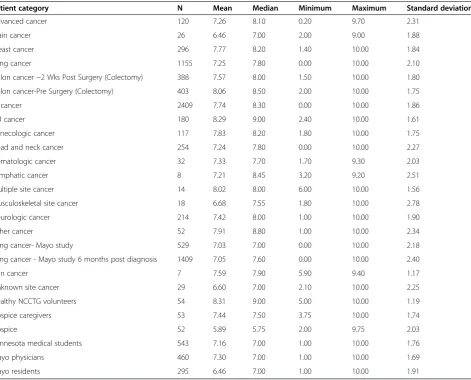
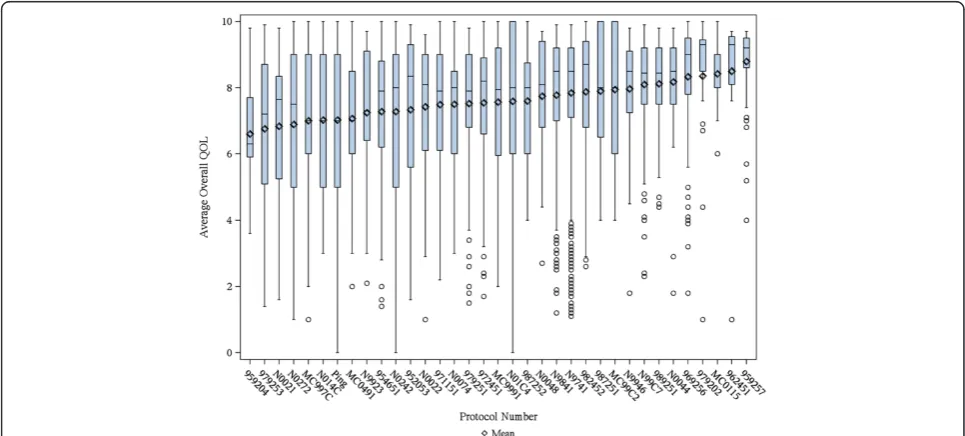
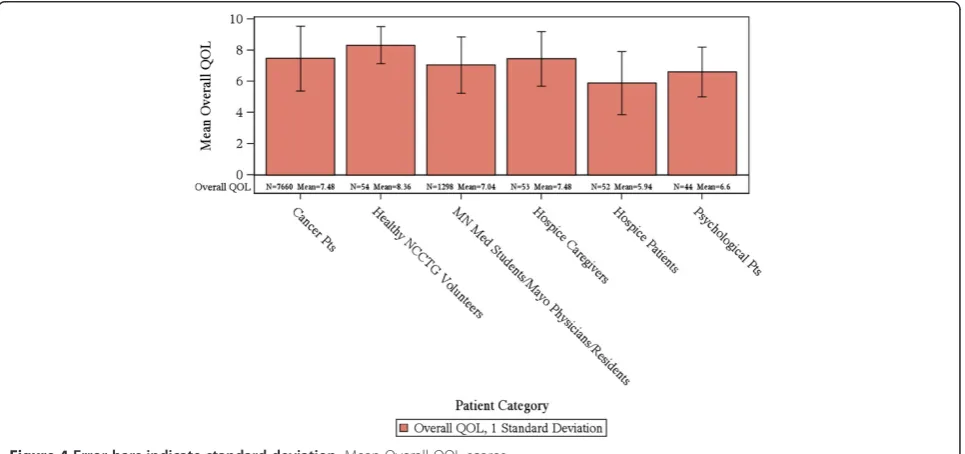
In total, for the collective sample of 9,295 individuals, the average overall QOL reported was 7.39 (SD = 2.11) with an overall distribution displayed in Figure 1. The distribu-tion is markedly skewed with roughly 17% reporting a score of 5 or below indicating a clinically significant deficit in overall QOL. Distributions for the various cohorts of Table 1 are displayed in Figures 2 and 3. Comparison of overall QOL scores for select groups is shown in Figure 4.
Healthy individuals average above 8.3 (SD = 1.2) on the 0–10 scale and rarely report a score of 5 or below indi-cating a clinical deficit (Tables 1 and 2). Hospice patients report a much worse average score of 5.7 upon entry to hospice, although it has been seen that their QOL will im-prove after hospice care has been initiated [25]. Hospice caregivers average 7.4. Cancer patients vary within these two extremes with most patients averaging in the 7’s on the 0–10 scale. Health care professionals score on average al-most as bad as their patients. In particular, Mayo Physicians
and Minnesota Medical students average 7.3 while resi-dents averaged 6.5. The full range of the scale was reported by almost all cohorts except for healthy individuals, hospice caregivers and skin cancer patients.
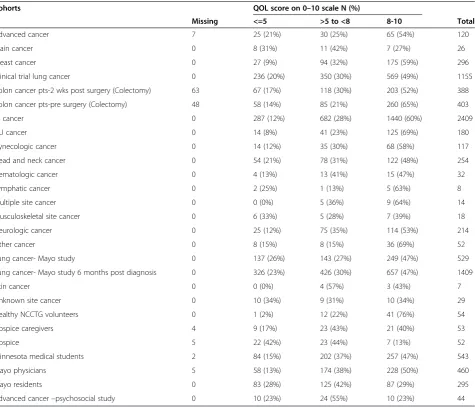
Table 2 differentiates patient cohorts by the propor-tion of patients reporting a clinically meaningful deficit (CMD) of a score equal to 5 or less. This CMD is related to a relative doubling for the risk of death [1]. Healthy volunteers rarely (2%) reported a clinically significant deficit. Hospice patients upon entry had the highest prevalence (42%) of clinically significant deficits in over-all QOL.
In terms of cancer site, lung, brain, musculoskeletal, metastatic cancer, head and neck and lymphatic cancers had between 20-33% with CMD in overall QOL. All other cancer cohorts reported lower incidence rates of CMD in overall QOL. It was notable that 28% of Mayo residents, 13% of Mayo physicians and 15% of MN med-ical students reported CMDs in QOL.
Table 1 Data sources, population type, summary statistics for overall QOL
Patient category N Mean Median Minimum Maximum Standard deviation
Advanced cancer 120 7.26 8.10 0.20 9.70 2.31
Brain cancer 26 6.46 7.00 2.00 9.00 1.88
Breast cancer 296 7.77 8.20 1.40 10.00 1.84
Lung cancer 1155 7.25 7.80 0.00 10.00 2.10
Colon cancer−2 Wks Post Surgery (Colectomy) 388 7.57 8.00 1.50 10.00 1.80
Colon cancer-Pre Surgery (Colectomy) 403 8.06 8.50 2.00 10.00 1.75
GI cancer 2409 7.74 8.30 0.00 10.00 1.86
GU cancer 180 8.29 9.00 2.40 10.00 1.61
Gynecologic cancer 117 7.83 8.20 1.80 10.00 1.75
Head and neck cancer 254 7.24 7.80 0.00 10.00 2.27
Hematologic cancer 32 7.33 7.70 1.70 9.30 2.03
Lymphatic cancer 8 7.21 8.45 3.20 9.20 2.51
Multiple site cancer 14 8.02 8.00 6.00 10.00 1.56
Musculoskeletal site cancer 18 6.68 7.55 1.80 10.00 2.78
Neurologic cancer 214 7.42 8.00 1.00 10.00 1.90
Other cancer 52 7.91 8.80 1.00 10.00 2.34
Lung cancer- Mayo study 529 7.03 7.00 0.00 10.00 2.18
Lung cancer - Mayo study 6 months post diagnosis 1409 7.05 7.60 0.00 10.00 2.40
Skin cancer 7 7.59 7.90 5.90 9.40 1.17
Unknown site cancer 29 6.60 7.00 2.10 10.00 2.25
Healthy NCCTG volunteers 54 8.31 9.00 5.00 10.00 1.19
Hospice caregivers 53 7.44 7.50 3.75 10.00 1.74
Hospice 52 5.89 5.75 2.00 9.75 2.03
Minnesota medical students 543 7.16 7.00 1.00 10.00 1.76
Mayo physicians 460 7.30 7.00 1.00 10.00 1.69
Mayo residents 295 6.46 7.00 1.00 10.00 1.91
Overall QOL scores were subsequently analyzed by selected demographics. Overall QOL on average de-clined slightly with increased age, but only one seventh of a standard deviation or a 7% increase in the per-centage reporting a CMD in overall QOL (Table 3). Men and women’s overall QOL distributions were vir-tually identical (Table 4). When examining data separ-ately from cancer treatment trials vs. observational studies, differences were noted by age in treatment tri-als, but not observational studies (Additional file 3). Most data for gender came from cancer treatment
trials, which showed identical scores in men and women (Additional file 3); few data from observational studies were available that showed some gender differences (Additional file 4).
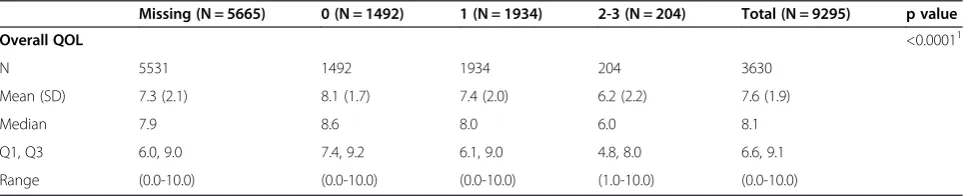
Overall QOL was weakly related to performance status with a Spearman correlation coefficient of−0.29 indicating that people with lower performance status tended to have worse overall QOL (Table 5). Roughly 14% of patients with performance status 0 or 1 reported a CMD compared to 58% reporting a CMD among patients with a performance status 2 or worse.
Figure 2Error bars indicate standard deviation; medians are indicated by the horizontal lines with in each graphic.Boxplots of Overall QOL for individual studies.
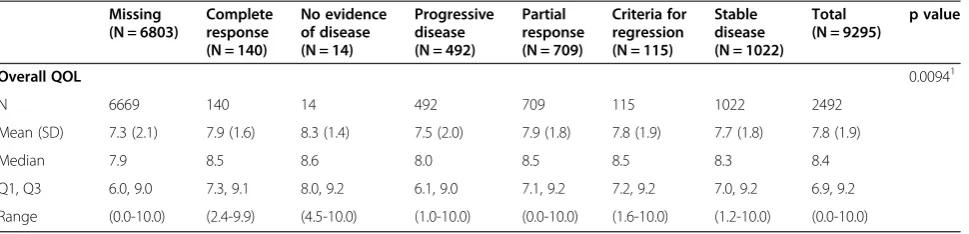
Overall baseline QOL was somewhat related to subse-quent tumor response (Table 6; p = 0.0094). Patients with a full or partial response reported a CMD at baseline in 11.4% of cases compared to 14.4% among those with stable disease and 18.5% among those with tumor progression.
Discussion
This paper provides a series of normative data drawn from multiple sources for the simple single-item measure of overall QOL that has been used in numerous clinical trials, observational research and clinical practice settings.
The overall QOL item differentiates across healthy popu-lations and various patient popupopu-lations in terms of average values and the incidence of CSDs reported.
A key finding is that overall QOL is different from per-formance status. This result has been demonstrated previ-ously in individual studies [3,4,26], but was demonstrated here to be consistent across study populations. Similarly, the relationship between tumor response in cancer pa-tients and QOL is weak, as reported previously in a study of 989 metastatic colorectal cancer [27]. For example, neither baseline QOL nor changes in QOL indicated a
Figure 3Error bars indicate standard deviation; medians are indicated by the horizontal lines with in each graphic.Boxplots of Overall QOL for Patient Categories.
relationship of any strength with tumor response [27]. A limitation of our analyses of associations of QOL with performance status and tumor response there was that large amount of data were missing. The impact of data missingness on our results is unclear and this must be taken into account while interpreting these results. Gender
differences in reporting QOL are also nonexistent. Overall QOL also does not automatically decline with age although a general trend is present. Collectively these findings indi-cate that a patient’s self-reported QOL is more than merely a function of performance status, age, gender or any other demographic/clinical variable.
Table 2 Incidence of clinically significant deficits in QOL for each cohort
Cohorts QOL score on 0–10 scale N (%)
Missing <=5 >5 to <8 8-10 Total
Advanced cancer 7 25 (21%) 30 (25%) 65 (54%) 120
Brain cancer 0 8 (31%) 11 (42%) 7 (27%) 26
Breast cancer 0 27 (9%) 94 (32%) 175 (59%) 296
Clinical trial lung cancer 0 236 (20%) 350 (30%) 569 (49%) 1155
Colon cancer pts-2 wks post surgery (Colectomy) 63 67 (17%) 118 (30%) 203 (52%) 388
Colon cancer pts-pre surgery (Colectomy) 48 58 (14%) 85 (21%) 260 (65%) 403
GI cancer 0 287 (12%) 682 (28%) 1440 (60%) 2409
GU cancer 0 14 (8%) 41 (23%) 125 (69%) 180
Gynecologic cancer 0 14 (12%) 35 (30%) 68 (58%) 117
Head and neck cancer 0 54 (21%) 78 (31%) 122 (48%) 254
Hematologic cancer 0 4 (13%) 13 (41%) 15 (47%) 32
Lymphatic cancer 0 2 (25%) 1 (13%) 5 (63%) 8
Multiple site cancer 0 0 (0%) 5 (36%) 9 (64%) 14
Musculoskeletal site cancer 0 6 (33%) 5 (28%) 7 (39%) 18
Neurologic cancer 0 25 (12%) 75 (35%) 114 (53%) 214
Other cancer 0 8 (15%) 8 (15%) 36 (69%) 52
Lung cancer- Mayo study 0 137 (26%) 143 (27%) 249 (47%) 529
Lung cancer- Mayo study 6 months post diagnosis 0 326 (23%) 426 (30%) 657 (47%) 1409
Skin cancer 0 0 (0%) 4 (57%) 3 (43%) 7
Unknown site cancer 0 10 (34%) 9 (31%) 10 (34%) 29
Healthy NCCTG volunteers 0 1 (2%) 12 (22%) 41 (76%) 54
Hospice caregivers 4 9 (17%) 23 (43%) 21 (40%) 53
Hospice 5 22 (42%) 23 (44%) 7 (13%) 52
Minnesota medical students 2 84 (15%) 202 (37%) 257 (47%) 543
Mayo physicians 5 58 (13%) 174 (38%) 228 (50%) 460
Mayo residents 0 83 (28%) 125 (42%) 87 (29%) 295
Advanced cancer–psychosocial study 0 10 (23%) 24 (55%) 10 (23%) 44
NCCTG, North central chapter treatment group.
Table 3 Overall QOL by age
Missing (N = 2898) <50 (N = 910) 50-64 (N = 2378) 65-71 (N = 1444) 72+ (N = 1665) Total (N = 9295) p value
Overall QOL 0.00131
N 2884 901 2350 1410 1616 6277
Mean (SD) 7.1 (2.1) 7.5 (1.9) 7.6 (1.9) 7.6 (2.0) 7.4 (2.1) 7.5 (2.0)
Median 7.2 8.0 8.0 8.0 8.0 8.0
Q1, Q3 6.0, 9.0 6.6, 9.0 6.8, 9.1 6.4, 9.1 6.0, 9.0 6.3, 9.0
Range (0.0-10.0) (1.1-10.0) (0.0-10.0) (0.0-10.0) (0.0-10.0) (0.0-10.0)
1
There are numerous existing well validated and reliable, but much longer, measures of quality of life in cancer patients, there is an overriding need for simple single item assessment measures, such as the LASA used for re-cording overall QOL in this study [28]. This brief QOL measure is advantageous because it reduces patient bur-den, both in clinical situations and in clinical trials, and has greater clinical utility for the busy practitioner [29]. Nearly 10 years ago, editors of health quality and life out-comes indicated that there may be too many QOL assess-ment tools, making the goal of finding an optimal tool difficult [30], as suggested from our work published in 1998 [31]. In the text book by Fayers and Machin, section 2.5 states“the simplest and most overtly sensible approach to measure QOL is to use global rating scales” “A global single item measure may be a more valid measure of the concept of interest than a score from a multi-item scale” [32]. In a series of studies, Zimmerman et al. had almost 2,000 psychiatric outpatients complete single-item assess-ments of psychosocial functioning and QOL, as well as more complex measures [33]. The single item measures of symptom severity, psychosocial functioning and QOL were strongly correlated with the multi-item measures and were able to discriminate among various clinical pop-ulations, e.g., depressed and non-depressed patients. They concluded that single-item measures could be easily incor-porated into a busy clinical practice and were reliable and valid in order to collect data on patient condition and treatment effective. Similar results were found by Yohannes et al. in patients with cystic fibrosis [34]. Krause et al. dis-cussed the practical utility of single-item assessments [35].
In fact, this measure is presently being used routinely in our clinical practice for every patient visit.
Results of a survey of usage of the overall QOL item indicate that it allows for clinicians to identify otherwise patient concerns and to facilitate conversations regarding the precise nature of the issues underlying the concerns [36]. A single item can play a central role in triaging and routine screening for issues that patients want addressed but that have either not been raised by the clinician or volunteered by the patient for various reasons including lack of time in the clinical visit or discomfort surrounding sensitive issues like sexuality [37].
The clinical importance of the single item overall QOL is inherent in its ability to tap into the simple construct of overall well being within a patient using his/her own internal weighting scheme for the innumerable compo-nent constructs [3]. While some multiple item measures may look at many aspects of QOL, it is impossible to cover all facets of QOL or give them appropriate weight-ing. Indeed, it has been previously demonstrated that a patient may report a deficit in overall QOL due to a deficit in a single sub-domain that they consider of primary im-portance that overrides positive indications on all other domains [1,4]. It is this gestalt capability of a single item that is likely the reason that it has been seem to be em-pirically linked to overall survival. In its simplest form, the item is asking “Do you think you are doing well?” This even in the presence of overwhelmingly positive objective laboratory and clinical data may be the overriding deter-minant of the individual’s well being. In one way, this gen-eral item can capture unknown important aspects of well Table 4 Overall QOL by gender
Missing (N = 2931) F (N = 2835) M (N = 3529) Total (N = 9295) p value
Overall QOL 0.251
N 2906 2772 3483 6255
Mean (SD) 7.1 (2.1) 7.6 (1.9) 7.5 (2.0) 7.5 (2.0)
Median 7.1 8.0 8.0 8.0
Q1, Q3 6.0, 9.0 6.6, 9.0 6.0, 9.0 6.3, 9.0
Range (0.0-10.0) (0.0-10.0) (0.0-10.0) (0.0-10.0)
1
Kruskal Wallis test.
Table 5 Overall QOL by performance score
Missing (N = 5665) 0 (N = 1492) 1 (N = 1934) 2-3 (N = 204) Total (N = 9295) p value
Overall QOL <0.00011
N 5531 1492 1934 204 3630
Mean (SD) 7.3 (2.1) 8.1 (1.7) 7.4 (2.0) 6.2 (2.2) 7.6 (1.9)
Median 7.9 8.6 8.0 6.0 8.1
Q1, Q3 6.0, 9.0 7.4, 9.2 6.1, 9.0 4.8, 8.0 6.6, 9.1
Range (0.0-10.0) (0.0-10.0) (0.0-10.0) (1.0-10.0) (0.0-10.0)
1
being that are being the capability of presently available clinical measures.
A major drawback and concern with the use of a simple single-item measure of QOL is the lack of detail and pre-cise determination of what is being measured or meant by
“overall QOL”[38]. Clearly it is not possible for any single item to capture sufficient detail so as to delineate the appropriate clinical pathway that should be pursued. Its utility lies instead in the ability to differentiate between those patients who have CSDs in the well being that can further be explored and subsequently treated.
Another issue with the use of an overall QOL measure is that it may involve issues that are beyond the purview of the clinician, such as financial or legal issues. In the age of comprehensive, multi-disciplinary, patient-centered care, however, identifying such issues can improve the effi-cacy of clinical care [39]. Indeed, much has been written about how issues beyond clinical care can impede or block positive clinical outcomes [40,41].
The overall LASA is routinely supplemented in clinical trials and practice by a series of other items relating to physical mental, emotional and spiritual well-being. These data are described elsewhere in the context of individual studies. The purpose of presenting only the overall item for this analysis is based on its universality and its demon-strated linkage to survival in a wide variety of patient populations.
Conclusions
The present study indicates that the single-item measure of overall QOL has acceptable content and construct validity to be used as a clinical indicator of patient well-being. The relative capability for single items versus multiple item PRO measures to help us understand patient well-being is the focus of an R01-funded investi-gation presently ongoing. This project will compare psy-chometric properties, including the prognostic capability for survival, among the simple LASA measures, the PRO version of the Common Toxicity Criteria (PRO-CTCAE), and the PROMIS. This and other studies will further
enhance our understanding of how we may“Cross-walk” results from alternative measures of the patient experi-ence. Ultimately, this work will lead to a day when PROs are routinely incorporated into clinical care as a supple-mentary vital sign.
Additional files
Additional file 1:LASA QOL Assessment scale used in studies.
Additional file 2:Study Details.
Additional file 3:Separate analyses of association of age category to LASA scores in observational (A) vs. cancer treatment trials (B).
Additional file 4:Separate analyses of association of age category to LASA scores in observational (A) vs. cancer treatment trials (B).
Abbreviations
LASA:Linear analogue self assessment; CMD: Clinically meaningful difference; QOL: Quality of life; PROs: Patient-reported outcomes; PROMIS: Patient-reported outcome measurement information system; NCI: National Cancer Institute; PRO-CTCAE: PRO version of the common toxicity criteria.
Competing interests
The authors have no conflict of interest or financial involvement with this manuscript. JAS (Dr. Singh) has received research grants from Takeda and Savient and consultant fees from Savient, Takeda, Regeneron and Allergan. JAS is a member of the executive of OMERACT, an organization that develops outcome measures in rheumatology and receives arms-length funding from 36 companies; a member of the American College of Rheumatology's Guidelines Subcommittee of the Quality of Care Committee; and a member of the Veterans Affairs Rheumatology Field Advisory Committee. Other coauthors declare no financial conflict.
No funding support was obtained for this study. JAS (Dr. Singh) is supported by grants from the Agency for Health Quality and Research Center for Education and Research on Therapeutics (AHRQ CERTs), National Institute of Arthritis, Musculoskeletal and Skin Diseases (NIAMS) P50, National Institute of Aging (NIA) U01, National Cancer Institute (NCI), the resources and the use of facilities at the VA Medical Center at Birmingham, Alabama and research contract CE-1304-6631 from the Patient Centered Outcomes Research Institute (PCORI).
Authors’contributions
JAS, JCB, JAS: Study concept and protocol. SP, DS: Data programming and data analyses. All authors: Review of data analyses; data interpretation. First draft of the manuscript: JAS, JAS. All authors: Critical revision of the manuscript and permission to submit. All authors read and approved the final manuscript.
Table 6 Overall QOL by best response
Missing (N = 6803)
Complete response (N = 140)
No evidence of disease (N = 14)
Progressive disease (N = 492)
Partial response (N = 709)
Criteria for regression (N = 115)
Stable disease (N = 1022)
Total (N = 9295)
p value
Overall QOL 0.00941
N 6669 140 14 492 709 115 1022 2492
Mean (SD) 7.3 (2.1) 7.9 (1.6) 8.3 (1.4) 7.5 (2.0) 7.9 (1.8) 7.8 (1.9) 7.7 (1.8) 7.8 (1.9)
Median 7.9 8.5 8.6 8.0 8.5 8.5 8.3 8.4
Q1, Q3 6.0, 9.0 7.3, 9.1 8.0, 9.2 6.1, 9.0 7.1, 9.2 7.2, 9.2 7.0, 9.2 6.9, 9.2
Range (0.0-10.0) (2.4-9.9) (4.5-10.0) (1.0-10.0) (0.0-10.0) (1.6-10.0) (1.2-10.0) (0.0-10.0)
1
Acknowledgements
This study was conducted as a collaborative trial of the North Central Cancer Treatment Group and Mayo Clinic and was supported in part by Public Health Service grants CA 25224, CA 37404, CA 15083, CA 35415, CA 149950 and the Linse Bock Foundation.
Author details
1
Department of Medicine, University of Alabama at Birmingham, Birmingham, AL, USA.2Medicine Service, Veterans Affairs Medical Center, Birmingham, AL, USA.3Department of Orthopaedic Surgery, Mayo Clinic, Rochester, MN, USA.4Department of Psychiatry, Moffitt Cancer Center, Tampa, FL, USA.5Department of Health Sciences Research, 200 First Street SW, Rochester, MN 55905, USA.6Department of Medical Oncology, Mayo Clinic, Rochester, MN, USA.
Received: 9 October 2014 Accepted: 8 December 2014
References
1. Sloan JA, Zhao X, Novotny PJ, Wampfler J, Garces Y, Clark MM, Yang P: Relationship between deficits in overall quality of life and non-small-cell lung cancer survival.J Clin Oncol2012,30:1498–1504.
2. Brundage M, Blazeby J, Revicki D, Bass B, de Vet H, Duffy H, Efficace F, King M, Lam CL, Moher D, Scott J, Sloan J, Snyder C, Yount S, Calvert M: Patient-reported outcomes in randomized clinical trials: development of ISOQOL reporting standards.Qual Life Res2013,22(6):1161–75. 3. Sloan JA, Aaronson N, Cappelleri JC, Fairclough DL, Varricchio C:Assessing
the clinical significance of single items relative to summated scores. Mayo Clin Proc2002,77:479–487.
4. Huschka MM, Mandrekar SJ, Schaefer PL, Jett JR, Sloan JA:A pooled analysis of quality of life measures and adverse events data in north central cancer treatment group lung cancer clinical trials.Cancer2007, 109:787–795.
5. Bernard AL, Prince A, Edsall P:Quality of life issues for fibromyalgia patients.Arthritis Care Res2000,13:42–50.
6. Stauder MC, Romero Y, Kabat B, Atherton PJ, Geno D, Deschamps C, Jatoi A, Sloan JA, Botros M, Jung KW, Arora AS, Miller RC:Overall survival and self-reported fatigue in patients with esophageal cancer.Support Care Cancer 2013,21(2):511–519.
7. Basch E, Abernethy AP, Mullins CD, Reeve BB, Smith ML, Coons SJ, Sloan J, Wenzel K, Chauhan C, Eppard W, Frank ES, Lipscomb J, Raymond SA, Spencer M, Tunis S:Recommendations for incorporating patient-reported outcomes into clinical comparative effectiveness research in adult oncology.J Clin Oncol2012,30(34):4249–4255.
8. Buchanan DR, O'Mara AM, Kelaghan JW, Minasian LM:Quality-of-life assessment in the symptom management trials of the National Cancer Institute-supported Community Clinical Oncology Program.J Clin Oncol 2005,23:591–598.
9. Grunberg SM, Groshen S, Steingass S, Zaretsky S, Meyerowitz B:Comparison of conditional quality of life terminology and visual analogue scale measurements.Qual Life Res1996,5:65–72.
10. Gudex C, Dolan P, Kind P, Williams A:Health state valuations from the general public using the visual analogue scale.Qual Life Res1996, 5:521–531.
11. Hyland ME, Sodergren SC:Development of a new type of global quality of life scale, and comparison of performance and preference for 12 global scales.Qual Life Res1996,5:469–480.
12. Sriwatanakul K, Kelvie W, Lasagna L, Calimlim JF, Weis OF, Mehta G:Studies with different types of visual analog scales for measurement of pain. Clin Pharmacol Ther1983,34:234–239.
13. Wewers ME, Lowe NK:A critical review of visual analogue scales in the measurement of clinical phenomena.Res Nurs Health1990,13:227–236. 14. Berry PH, Dahl JL:The new JCAHO pain standards: implications for pain
management nurses.Pain Manag Nurs2000,1:3–12.
15. Koller A, Miaskowski C, De Geest S, Opitz O, Spichiger E:Results of a randomized controlled pilot study of a self-management intervention for cancer pain.Eur J Oncol Nurs2013,17(3):284–91.
16. Amtmann D, Cook KF, Jensen MP, Chen WH, Choi S, Revicki D, Cella D, Rothrock N, Keefe F, Callahan L, Lai JS:Development of a PROMIS item bank to measure pain interference.Pain2010,150:173–182.
17. Cleeland CS, Sloan JA, Cella D, Chen C, Dueck AC, Janjan NA, Liepa AM, Mallick R, O'Mara A, Pearson JD, Torigoe Y, Wang XS, Williams LA, Woodruff JF, CPRO (Assessing the Symptoms of Cancer Using Patient-Reported Outcomes) Multisymptom Task Force:Recommendations for including multiple symptoms as endpoints in cancer clinical trials: a report from the ASCPRO (Assessing the Symptoms of Cancer Using Patient-Reported Outcomes) Multisymptom Task Force.Cancer2013,119:411–420. 18. Cleeland CS, Mendoza TR, Wang XS, Chou C, Harle MT, Morrissey M,
Engstrom MC:Assessing symptom distress in cancer patients: the M.D. Anderson Symptom Inventory.Cancer2000,89:1634–1646.
19. Wanous JP:Single-item reliability: a replication and extension.Organ Res Meth2001,4:361–375.
20. Ganz PA, Lee JJ, Siau J:Quality of life assessment. An independent prognostic variable for survival in lung cancer.Cancer1991, 67:3131–3135.
21. Gotay CC, Kawamoto CT, Bottomley A, Efficace F:The prognostic significance of patient-reported outcomes in cancer clinical trials. J Clin Oncol2008,26:1355–1363.
22. Efficace F, Bottomley A, Smit EF, Lianes P, Legrand C, Debruyne C, Schramel F, Smit HJ, Gaafar R, Biesma B, Manegold C, Coens C, Giaccone G, Van Meerbeeck J, EORTC Lung Cancer Group and Quality of Life Unit:Is a patient's self-reported health-related quality of life a prognostic factor for survival in non-small-cell lung cancer patients? A multivariate analysis of prognostic factors of EORTC study 08975.Ann Oncol2006, 17:1698–1704.
23. Norman GR, Sloan JA, Wyrwich KW:The truly remarkable universality of half a standard deviation: confirmation through another look.Expet Rev Pharmacoecon Outcomes Res2004,4:581–585.
24. Butt Z, Wagner LI, Beaumont JL, Paice JA, Peterman AH, Shevrin D, Von Roenn JH, Carro G, Straus JL, Muir JC, Cella D:Use of a single-item screening tool to detect clinically significant fatigue, pain, distress, and anorexia in ambulatory cancer practice.J Pain Symptom Manage2008, 35:20–30.
25. Bretscher M, Rummans T, Sloan J, Kaur J, Bartlett A, Borkenhagen L, Loprinzi C: Quality of life in hospice patients. A pilot study.Psychosomatics1999, 40:309–313.
26. Velanovich V, Wollner I:Quality of life and performance status in patients with pancreatic and periampullary tumors.Int J Clin Oncol2011, 16:401–407.
27. Sloan JA, Grothery A, Green E, Zhao X, Campbell ME, Szydio DW, Sargent DJ, Goldeberg RM:Tumor response is not related to quality of life in patients with metastatic colorectal cancer (abstract).J Clin Oncol2008,26:4017. 28. Snyder CF, Watson ME, Jackson JD, Cella D, Halyard MY:Patient-reported
outcome instrument selection: designing a measurement strategy. Value Health2007,10(Suppl 2):S76–S85.
29. Velikova G, Awad N, Coles-Gale R, Wright EP, Brown JM, Selby PJ:The clinical value of quality of life assessment in oncology practice-a qualitative study of patient and physician views.Psychooncology2008, 17:690–698.
30. Asadi-Lari M, Tamburini M, Gray D:Patients' needs, satisfaction, and health related quality of life: towards a comprehensive model.Health Qual Life Outcomes2004,2:32.
31. Sloan JA, Loprinzi CL, Kuross SA, Miser AW, O'Fallon JR, Mahoney MR, Heid IM, Bretscher ME, Vaught NL:Randomized comparison of four tools measuring overall quality of life in patients with advanced cancer.J Clin Oncol1998,16:3662–3673.
32. Fayers P, Machin D:Single gobal questions versus multi-item scales. InQuality of life: The assessment, analysis and interpretation of patient-reported outcomes.2nd edition. Somerset, NJ: John Wiley & Sons; 2013. Section 2.5. 33. Zimmerman M, Ruggero CJ, Chelminski I, Young D, Posternak MA, Friedman
M, Boerescu D, Attiullah N:Developing brief scales for use in clinical practice: the reliability and validity of single-item self-report measures of depression symptom severity, psychosocial impairment due to depression, and quality of life.J Clin Psychiatry2006,67:1536–1541. 34. Yohannes AM, Dodd M, Morris J, Webb K:Reliability and validity of a
single item measure of quality of life scale for adult patients with cystic fibrosis.Health Qual Life Outcomes2011,9:105.
35. Krause NM, Jay GM:What do global self-rated health items measure? Med Care1994,32:930–942.
fatigue, and pain assessment into clinical practice.J Oncol Pract2014, 10:248–253.
37. Bowling A:Just one question: If one question works, why ask several? J Epidemiol Community Health2005,59:342–345.
38. Somerfield MR:Wherefore global quality-of-life assessment?J Clin Oncol 1999,17:738–740.
39. Laine C, Davidoff F:Patient-centered medicine. A professional evolution. JAMA1996,275:152–156.
40. Zwarenstein M, Goldman J, Reeves S:Interprofessional collaboration: effects of practice-based interventions on professional practice and healthcare outcomes.Cochrane Database Syst Rev 2009(3):CD000072. doi:10.1002/14651858.CD000072.pub2. 41. Blazeby JM, Wilson L, Metcalfe C, Nicklin J, English R, Donovan JL:
Analysis of clinical decision-making in multi-disciplinary cancer teams. Ann Oncol2006,17:457–460.
Submit your next manuscript to BioMed Central and take full advantage of:
• Convenient online submission
• Thorough peer review
• No space constraints or color figure charges
• Immediate publication on acceptance
• Inclusion in PubMed, CAS, Scopus and Google Scholar
• Research which is freely available for redistribution