1
Supplementary material
Elucidating the Importance of Numeracy Skills for Undergraduate Students in Life Sciences Using the Oxygen Requirement in Yeast as an Example
1
Contents
1. Motivation ... 2
2. Suggested learning outcomes for the questions listed in the main article .... Error! Bookmark not defined. 3. Step by step calculations for determining the oxygen requirement in yeasts ... 3
3.1 O2 concentration in air ... 3
3.2 O2 solubility in water ... 3
3.3 Amount of O2 entering the reactor with the N2 gas ... 4
3.4 O2 diffusion through the tubing ... 4
3.5 O2 transfer from gas to liquid phase ... 6
3.6 O2 and yeast metabolism ... 6
3.7 O2 requirement for anaerobic yeast growth ... 7
3.8 O2 demand during exponential growth ... 7
4. References ... 8
2 1. Motivation
Undergraduate students possess some research experience in the laboratory and this provides a rich
opportunity to engage in quantitative reasoning. However, teachers require richer examples in microbial
physiology to make the dream of teaching quantitative biology come to fruition. In this regard, a context
based mathematical learning is motivating and vital; in asking how many glucose molecules enter a yeast
cell, calculations involving nutrient uptake rates presents itself naturally and students might be able to inquire
on the various factors that affect nutrient uptake. This ‘tips and tools’ article is an attempt to provide an
example from yeast physiology to bring a quantitative understanding to the anaerobic fermentation process.
Examples such as this one could be used in the classroom to foster a stronger and a motivating mathematical
basis for students taking undergraduate studies in life sciences.
On the one hand, many laboratory anaerobic setups are not truly anaerobic and some O2 diffuses into the cultivation system. In this situation, fermentation is not the sole free-energy conserving mechanism used by
the cells for maintaining their viability and growth. On the other hand, even when no respiration takes place
and fermentation is the sole free-energy conserving mechanism active in the cells, the syntheses of ergosterol
and oleic acid – both compounds necessary for Saccharomyces cerevisiae to build its cell membrane and to
grow – require and consume a certain amount of O2. For this reason, such compounds are frequently added
to the cultivation medium under anaerobic conditions. Misinterpretations about yeast metabolism might have
important consequences for medium design and for scaling up bioprocesses. Figure 1 shows the mechanism
of transfer of O2 from gaseous to liquid phase. The array of questions is depicted as a decision flowchart in Figure 2; students might also ask questions such as ‘where do I start, what can I do, and what can I gain by
doing so?’ (Polya 1956).
Based on these questions, we envisage a set of learning outcomes (and list some thought problems to
consolidate the students’ learning, see section Error! Reference source not found.) that can aid the student
and the educator to answer if yeast can indeed grow without the exogenous supply of the two growth factors
– ergosterol and oleic acid. To facilitate the exercise for students in Life Sciences (Fawcett and Higginson
2012), equations are relegated to the supplementary material and only the key numbers are shown in the main
article. The educator and the learner could ask one question at a time, engage in a group discussion, consult
the supplementary material from time to time, before arriving at the final solution. The questions can be
3
teacher should put himself in the student’s place, he should see the student’s case, he should try to understand
what is going on in the student’s mind, and ask a question or indicate a step that could have occurred to the
student himself.” We hope that the questions that are posed invite curiosity among the learners. As the
concepts used to perform the calculations mostly uses high school physics and chemistry with some basics
of microbial physiology, prior exposure to a microbial metabolism course might be beneficial.
2.
Step by step calculations for determining the oxygen requirement in yeasts
2.1 O2 concentration in air
Oxygen is the second most abundant element in earth’s atmosphere and accounts for nearly half of the
mass of earth’s crust in the form of compounds. The O2 pool in the atmosphere and the superficial waters
in the Earth is constantly renewed by the photosynthetic action of bacteria, plants, and algae. At sea level,
the relative molar abundance of O2 in the atmosphere is 20.95 mole percent, and from Dalton’s law, the
partial pressure of O2, pO2 is 20.67 kPa (thus, the partial pressure will be lower at high altitudes as the
ambient pressure would be lower). Concentration (c) relates to the number of molecules and the volume
and for a gas, it can be obtained from the ideal gas equation. Strictly speaking, the similarity between O2 and an ideal gas is only valid at low pressures and high temperatures, but for the purposes of our
calculation, we would assume that the gaseous O2 obeys the ideal gas law under the conditions employed. So:
= = ∗ 1
where n is the number of moles, V is the volume, p is the partial pressure, R is the universal gas constant
and T is the absolute temperature (in Kelvin). Using the universal gas constant (8.314 J·mol-1·K-1)and
the following conversion factors 1 Pa = 1 N·m-2, 1 J = 1 N m, 1 L = 0.001 m3, we obtain the concentration of O2 in air at 25oC:
. = .
. ∗ ∗ = 8,343 2
2.2 O2 solubility in water
Henry's law relates the partial pressure of a gas in the gaseous phase to its solubility in the liquid phase
through the proportionality constant KH, which changes with temperature and composition of the liquid:
4
Considering that KH [4] for O2 in water = 756.7 atm·L·mol-1:
. = .
. ∗ = 276. 8 4
Thus, the concentration of O2 in water is 276.8 μM at 25oC. It is worth noting that the concentration of O2
in water is nearly 30 times lower than that in the gaseous phase. The solubility of O2 in water increases with decreasing temperature, reaching as high as 400 μM at 0oC and decreases with increased concentration
of other dissolved solutes.
2.3 Amount of O2 entering the reactor with the N2 gas
It is very common in laboratory microbial cultivations, to continuously sparge the culture medium with N2
foranaerobic processes. The N2 used always has traces of O2 (in our case ~5 ppm, as provided by the supplier). Inflow rate of N2 is given in L per L of liquid volume per min. For a reactor volume of 1 L, 0.5
L of N2 couldenter the reactor per min. The ideal gas law relates the volume to the number of molecules for a given pressure and temperature. This way:
∗ = ∗ ∗ 5
Doing re-arrangements, introducing time (t) at both sides of the equation and introducing the fraction (f =
5/106) of O
2 in the compressed gas:
= ∗ ∗( )∗ 6
Using the gas constant in convenient units (R = 0.08206 atm·L·mol-1·K-1; in equation 2, the value for R is different because it is expressed in a different unit), we can calculate the O2 entering the reactor by
substituting the values for f = 5/106, P =1 atm, V/t,= 0.5 L·min-1, R = 0.08206 atm·L·mol-1·K-1 and T = 298 Kin equation 6
∗ ∗ ∗ . ∗
. ∗ ∗ ∗ = 6.13 7
2.4 O2 diffusion through the tubing
In addition to the O2 coming along with the N2 sparged into the reactor, one must also calculate the diffusion through the ports and the tubing material used. As the ports are made of stainless steel, we will
5
commonly employed during anaerobic cultivations as it has 40 times lower permeability to O2 than silicone tubing, which is most commonly used - in microbial cultivations that do not require O2 to be excluded.
Fick’s law relates the flux of O2 (net movement of molecules per unit time per unit area perpendicular to the direction of flow) to the gradient in concentration through a constant of proportionality (D) that changes
with the composition of the solute/solvent and temperature:
= − ∗ 8
JO2has units of mol·m-2·s-1, concentration (c) has units of mol·m-3 and length (x) has units of m, hence
diffusion coefficient D has units of m2·s-1 (we encourage the students to verify the dimensional
consistency of this equation). As the gaseous O2 is diffusing through a semi-permeable tubing, the constant of proportionality is called permeability coefficient (Denny 1993; Saint-Gobain, n.d.).
As shown above, the concentration of the gases is directly proportional to the partial pressure. Hence,
knowing the partial pressure difference of O2 between the inside of the tube (nearly zero) and the outside
air (calculated previously as 20.67 kPa or 15.50 cmHg), and using the information of the characteristics
of the tubing material used, we are now able to calculate the flux of O2 entering the system via the tubing.
The smaller the thickness and longer the tubing, the higher is the diffusion of O2 into it.
For a tubing with a diameter d and length l, the area available for diffusion for a tube of cylindrical shape
would be 2 * π * 0.5 * d * l. The molecules of O2 must diffuse through a tube thickness of x cm. Hence,
the rate of diffusion (flux of O2 multiplied by cross-sectional area) given a tube of d = 0.31 cm, l = 30 cm and x = 0.1 cm and a D = 20 barrer*, can be calculated as follows:
∗ · 3· · ∗ ∗ ∗ . ∗ . ∗ ∗ .
. = 9.11 ∗ 10
−6 3 9
Converting the volumetric rate to molar rate using molar volume, we obtain the O2 entering the tubing as:
= 9.11 ∗ 10 ∗ , ∗ = 1.47 10
* Permeability has units of barrer. 1 barrer = 10 ·
6
O2 diffusing into the system through the norprene tubing used is ~ four times less than the amount entering the reactor via the N2 gas.
2.5 O2 transfer from gas to liquid phase
The moles of O2 transferred into the liquid per unit time (Oxygen Transfer Rate) is given by the expression:
= ∗ ( ∗− ) ∗ 11
Where C* is the saturation concentration of O
2 in water (mol O2·h-1) determined using Henry’s law, Cbulk
is concentration in the bulk liquid, kla is the gas-liquid mass transfer coefficient, (s-1), Vlis the liquid volume
in the reactor (in our case 1 L). kla is determined by the reactor and impeller geometry, agitation speed,
flow rate of gas and the bubble size.
5 ppm of O2 in the gaseous phase is equivalent to a dissolved O2 concentration of 6.60 nM†. Typical kla
value‡ for laboratory bioreactors is 0.1 s-1 (Finn 1954). By substituting these two values and if the bulk concentration is close to zero:
∗ ∗∗ = 0.1 ∗ ∗ 3600 6.6 ∗ 10 ∗ 1 = 2.37 12
we get an OTR value of 2.37 μmol O2·h-1, representing only a third of the gaseous phase O2, the rest of
which leaves the bioreactor with the off-gas stream (because there is not enough time for all O2 molecules to be transferred from the gaseous to the liquid phase).
2.6 O2 and yeast metabolism
O2 plays a major role in aerobic respiration as a terminal electron acceptor. In this process, some reduced coenzymes generated both in catabolic and anabolic reactions are re-oxidised, sustaining further growth.
The re-oxidation of these coenzymes is usually coupled to processes where a fraction of the chemical
potential is conserved through the synthesis of molecules of ATP from ADP and inorganic phosphate via
a complex chemo-osmotic process. However, under anaerobiosis, yeast cells mostly conserve a fraction of
the free energy coming from the substrate oxidation via a mechanism called substrate-level
phosphorylation and re-oxidise the coenzyme NADH via ethanol and glycerol formation.
† 209,500 ppm equals 276. 8 (concentration of O
2) Thus 5 ppm O2 on gaseous phase amounts to 276. 8 ∗ , = 6.6
‡ For calculating
7
Undergraduate students are more like to rely on textbooks and search engines to obtain information. To
find out the number of reactions involving O2 in S. cerevisiae, students could be introduced to databases
such as Pubmed, to search for the latest genome-scale model of S. cerevisiae and get a spreadsheet with a
list of metabolic reactions. In the latest genome-scale model of yeast (Österlund et al. 2013), the list with
O2 as reactant has 48 reactions accounting for 3% of total reactions (around 1000) and six reactions are involved in oleate and ergosterol synthesis.
2.7 O2 requirement for anaerobic yeast growth
Facultative anaerobes such as S. cerevisiae require the exogenous supply of ergosterol and oleic acid for
growth in synthetic defined media, under fully anaerobic conditions. Molecular oxygen is required for the
conversion of squalene (linear hydrocarbon) into ergosterol (cyclic sterol), 12 molecules of O2 are required for the synthesis of one molecule of ergosterol. One O2 molecule is required for the formation of each
double bond from one acyl coenzyme-A in the biosynthesis of oleate (Ishtar Snoek and Yde Steensma
2007). Oleate makes up to 3.5% of dry cell mass (DCM) and ergosterol constitutes 0.2% of DCM (Verduyn
et al. 1990).
Therefore, to calculate the requirement of O2, it is first necessary to know the amount of cell biomass
present in the bioreactor. For a glucose concentration of 10 g·L-1 in the culture medium, a biomass yield on glucose Yxs of 0.1 gDCM·gglucose-1 is expected under anaerobic conditions (Verduyn et al. 1990). Hence,
1 g biomass would have 2 mg of ergosterol and 35 mg of oleate (Verduyn et al. 1990). Knowing the
stoichiometric O2 required, one can calculate the O2 required for the biosynthesis of these two cofactors.
=
. ∗ = 60.50 13
=
. ∗ = 123.91 14
Hence, YO2x under the anaerobic condition is 184.41 µmol O2·gDCM-1.
2.8 O2 demand during exponential growth
8
oleate in the medium. O2 entering the reactor was already calculated as 7.60§ µmol·h-1 but only a third of
this dissolves in the medium ~ 2.5 µmol·h-1. The metabolic demand of O
2 could be calculated knowing the YO2x (O2 required per unit biomass), and the specific growth rate (μ, how fast the yeast grows) and the
amount of biomass present in the vessel (X). Under anaerobic batch conditions in defined medium, a µ of
0.25 – 0.35 h-1 could be expected (Verduyn et al. 1990). The metabolic demand for a µ = 0.30 h-1 can be calculated as follows:
= ∗ ∗ 15
= 184.41 ∗ 0.30 ∗ 1 = 55.3
16
The metabolic O2 demand (55 μmol O2·h-1) is not met by its supply (2.5 μmol O2·h-1). The importance
of O2 during anaerobic cultivation of S. cerevisiae in a defined medium in the absence of supplementation with ergosterol and oleic acid was illustrated using basic principles of physical chemistry and some basic
biochemistry. The topic allows students to seek out and explore more about the O2 requirements in other situations (life in deep oceans, in ice crystals for example).
3
References
Denny, Mark M. 1993. Air and Water: The Biology and Physics of Life’s Media. Princeton University Press.
Fawcett, Tim W, and Andrew D Higginson. 2012. “Heavy Use of Equations Impedes Communication among Biologists.” Proceedings of the National Academy of Sciences of the United States of America 109 (29). National Academy of Sciences: 11735–39. doi:10.1073/pnas.1205259109.
Finn, R K. 1954. “Agitation and Aeration in the Laboratory.” Bacteriology Reviews I8 (4): 254–74.
Ishtar Snoek, I S, and H Yde Steensma. 2007. “Factors Involved in Anaerobic Growth of
Saccharomyces Cerevisiae.” Yeast (Chichester, England) 24 (1): 1–10. doi:10.1002/yea.1430.
Österlund, Tobias, Intawat Nookaew, Sergio Bordel, and Jens Nielsen. 2013. “Mapping Condition-Dependent Regulation of Metabolism in Yeast through Genome-Scale Modeling.” BMC Systems Biology 7 (1): 36. doi:10.1186/1752-0509-7-36.
Polya, George. 1956. “How to Solve It? A New Aspect of Mathematical Method.” In , Second edi, 33–36. Princeton University Press.
Saint-Gobain. n.d. “Saint-Gobain Performance Plastics Permeability Coefficients For Peristaltic Pump
§ O
9
Tubings.” http://www.processsystems.saint-gobain.com/uploadedFiles/SGPPL-PS/Documents/Peri_Pump/PS-PeriPumps-Permeability(1).pdf.
10
4
Box
Dalton’s law: The total pressure of a gas is equal to the sum of the individual partial pressures of
the component gases.
Fick’s law: The net flux of solute per unit area (the area perpendicular to the flux direction) is
proportional to the gradient in the concentration of solute. The constant of proportionality is called
diffusion coefficient denoted D, and it is unique for each pair solute - solvent. D varies with
temperature.
Henry’s law: The solubility of a gas in a liquid is determined by Henry’s law. It states that the
concentration of a gas molecule in a liquid phase (in equilibrium with the gas) is proportional to the
partial pressure of the gas in the gaseous phase. The constant of proportionality is called Henry’s
constant (KH) and is unique for each gas and a given liquid phase. KH varies with the temperature. ppm: Parts Per Million. Air has ~21% O2 which is 21 parts per 100 parts; hence the concentration
of O2 molecules would be 210000 ppm. (in one million parts)
Specific rate (qi rate): It is calculated from the production or consumption rates. It is defined as the
number of species i formed or consumed per hour per unit amount of cell biomass present in the
cultivation vessel. For a given biomass (x), qx(denoted µ) is defined as the specific growth rate
( . ) and has the unit [time-1]. µ is directly related to the doubling time t
d, thought he relation, μ =
( )
.
vvm: Volume per volume per minute. vvm is the common unit used to indicate the gas flow rate
into a bioreactor. It refers to the volume of gas sparged per volume of liquid in the reactor per
minute.
11
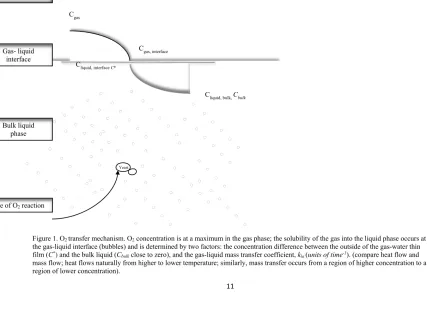
Figure 1.O2transfer mechanism. O2 concentration is at a maximum in the gas phase; the solubility of the gas into the liquid phase occurs at the gas-liquid interface (bubbles) and is determined by two factors: the concentration difference between the outside of the gas-water thin film (C*) and the bulk liquid (Cbulk close to zero), and the gas-liquid mass transfer coefficient, kla (units of time-1). (compare heat flow and
mass flow; heat flows naturally from higher to lower temperature; similarly, mass transfer occurs from a region of higher concentration to a region of lower concentration).
Gas- liquid interface Bulk gas phase
Cgas, interface Cgas
Cliquid, interface C*
Cliquid, bulk, Cbulk
Site of O2 reaction Bulk liquid
phase
12