for mobile devices
Anna Kocurova
A thesis submitted in partial fulfilment of the
requirements of the University of West London
for the degree of Doctor of Philosophy
From my point of view, the past four years have been a pilgrimage and I would like to thank the following people for all their support during this journey.
First, I would like to express my deep gratitude to my research supervi-sors, Dr Samia Oussena, Prof Peter Komisarczuk, and Prof Tony Clark. My special thanks to Samia, for the opportunity, for her valuable and pa-tient guidance and for useful critiques of this research work. Many thanks to Peter, for his suggestions, advices and positive attitude. Many thanks to Tony, for being my external supervisor and his insightful comments and feedbacks.
I would like to thank to my fellow PhD mates, Dean Kramer, Malte Ressin, Alison Wiles and Sujan Shresta, for great office co-habitation and all those unforgettable moments. Special thanks to Dean and Malte, for sharing so many ups and downs of the PhD life with me, for being so encouraging and friendly. I am particularly grateful to Dean for his hard work on our Context Engine. I would also like to thank Tina South, for her regular visits to our office and for being so supportive and caring. I wish to express my thanks to all members of the School of Computing and Technology at University of West London, for their help and support in completing this work. I would like to thank Maria Pennells for her inde-spensable support and help during the last four years, and arranging the viva. I would also like to thank Prof Thomas Roth-Berghofer for agreeing to be an internal examiner at my viva.
I would like to thank Urmi Chana and Mahendra Mahey for their continual support and their tips for improving my English.
Ubiquitous mobile devices have become a necessity in today’s society, opening new opportunities for interaction and collaboration between geo-graphically distributed people. With the increased use of mobile phones, people can collaborate while on the move. Collaborators expect tech-nologies that would enhance their teamwork and respond to their indi-vidual needs.
Workflow is a widely used technology that supports collaboration and can be adapted for a variety of collaborative scenarios. Although the originally computer-based workflow technology has expanded also on mobile devices, there are still research challenges in the development of user-focused device-oriented collaborative workflows.
As opposed to desktop computers, mobile devices provide a different, more personalised user experience and are carried by their owners ev-erywhere. Mobile devices can capture user context and behave as dig-italised user complements. By integrating context awareness into the workflow technology, workflow decisions can be based on local, context information and therefore, be more adapted to individual collaborators’ circumstances and expectations. Knowing the current context of collab-orators and their mobile devices is useful, especially in mobile peer-to-peer collaboration where the workflow process execution can be driven by devices according to the situation.
In mobile collaboration, team workers share pictures, videos, or other content. Monitoring and exchanging the information on the current state of the content processed on devices can enhance the overall workflow execution. As mobile devices in peer-to-peer collaboration are not aware of a global workflow state, the content state information can be used to communicate progress among collaborators. However, there is still a lack of integrating content lifecycles in process-oriented workflows.
The collaborative workflow technology has been adapted for mobile peer-to-peer collaboration by integrating context and content awareness. In the first place, a workflow-specific context management approach has been developed that allows defining workflow-specific context models and supports the integration of context models with collaborative work-flows. Workflow process has been adapted to make decisions based on context information. Secondly, extra content management support has been added to the workflow technology. A representation for content life-cycles has been designed, and content lifelife-cycles have been integrated with the workflow process.
Contents v
List of Figures ix
List of Algorithms xi
I
Foundations
1
1 Introduction 2
1.1 Motivation . . . 2
1.1.1 The Vision of Mobile Collaboration . . . 2
1.1.2 Challenges of Mobile Collaborative Workflows . . . 4
1.2 Research Aim and Objectives . . . 7
1.3 Research Questions and Focus . . . 8
1.4 Contributions . . . 9
1.5 Approach . . . 11
1.5.1 Research Methodology . . . 11
1.5.2 Development Methodology . . . 12
1.5.3 Validation Approach . . . 14
1.6 Scope and Structure of Thesis . . . 15
2 Background and Concepts 18 2.1 Introduction . . . 18
2.2 Mobile Peer-to-Peer Collaboration Scenario . . . 19
2.3 Workflow Management . . . 22
2.3.1 Basic Terminology and Concepts . . . 22
2.3.2 Workflow Management . . . 24
2.4 Mobile Peer-to-Peer Workflow Management . . . 25
2.4.1 Workflow Standards . . . 27
2.4.2 BPEL . . . 29
2.5 Content/Object Awareness . . . 31
2.6.1 Context Classification . . . 33
2.6.2 Context Management for Mobile Systems . . . 34
2.7 Summary . . . 36
3 Related Work 37 3.1 Introduction . . . 37
3.2 Techniques for Workflow Adaptation . . . 37
3.3 Context Management . . . 42
3.3.1 Workflow Contextualisation . . . 42
3.3.2 Context Modelling and Management . . . 45
3.4 Object Behaviour Modelling and Management . . . 47
3.4.1 Artifact-Centric and Object-Aware Workflows . . . 47
3.4.2 Support for Content Lifecycle Management . . . 52
3.5 Mobile Peer-To-Peer Workflow Execution . . . 53
3.6 Summary . . . 55
II
Contribution
57
4 MobWEL Definition and Syntax 58 4.1 Introduction . . . 584.2 MobWEL Workflow Approach . . . 59
4.2.1 Adapted Collaborative Workflow . . . 59
4.2.2 MobWEL Workflow Process Anatomy . . . 61
4.2.3 Overview of MobWEL Metamodel . . . 62
4.3 MobWEL Workflow Process Definition . . . 63
4.3.1 MobWEL Process Control Flow Representation . . . 63
4.3.2 MobWEL Global Declarations . . . 66
4.3.3 Peer-To-Peer Interaction Model . . . 68
4.3.4 Content Management Support . . . 72
4.3.5 Support for Context and Content Awareness . . . 75
4.4 Representation of Collaborators Group . . . 80
4.4.1 MobWEL Group Identification Metamodel . . . 80
4.4.2 Group Identification XML Schema . . . 81
4.5 Representation of Workflow-Specific Context Definition . . . 82
4.5.1 MobWEL Context Definition Metamodel . . . 83
4.5.2 Context Definition XML Schema . . . 88
4.6 Representation of Context-Aware Content Lifecycles . . . 89
4.6.1 MobWEL Context-Aware Content Lifecycle Definition . . . 89
4.6.2 Context-Aware Content Lifecycle XML Schema . . . 95
5 MobWEL Semantics 98
5.1 Introduction . . . 98
5.2 Context Situation . . . 99
5.3 Control Flow Semantics . . . 99
5.4 Extended Semantics with Data Flow . . . 104
5.5 Content Behaviour . . . 105
5.6 Consistency of Process Flow and Content Lifecycle . . . 106
5.7 Summary . . . 107
6 MobWEL Workflow Management and Execution 108 6.1 Introduction . . . 108
6.2 Architecture of MobWEL Workflow Management System . . . 109
6.3 Context Provider . . . 112
6.3.1 Context Data Processing Layer . . . 113
6.3.2 Interaction and Context Management Layer . . . 118
6.3.3 Context Provider Interface . . . 119
6.3.4 Context Provider Usage . . . 119
6.4 Context Manager . . . 120
6.4.1 Context Manager Interface . . . 124
6.5 Content Manager . . . 125
6.5.1 Content Provider . . . 126
6.5.2 Content Lifecycle Parser . . . 127
6.5.3 Content State Transition System . . . 131
6.5.4 Content Manager Interface . . . 132
6.6 MobWEL Engine . . . 134
6.7 Peer-To-Peer Interaction Manager . . . 135
6.7.1 Interaction and Message Handling . . . 135
6.7.2 MobWEL Communication Protocol . . . 137
6.7.3 Message Structure . . . 138
6.7.4 Message Processing . . . 139
6.8 Internal Cooperations . . . 139
6.9 Summary . . . 142
III
Validation
143
7 From Design To Implementation 144 7.1 Introduction . . . 1447.2 ContextEngine . . . 145
7.2.1 Context Data Processing Layer . . . 145
7.3 CAWEFA . . . 151
7.3.1 CAWEFA Service . . . 151
7.3.2 MobWEL Process Parsing . . . 152
7.3.3 Interaction with ContextEngine . . . 156
7.3.4 Peer-to-Peer Message Exchange . . . 158
7.4 Summary . . . 160
8 Evaluation 161 8.1 Introduction . . . 161
8.2 Experimental Design . . . 162
8.3 Scenario-Based Evaluation . . . 163
8.3.1 Construction of a MobWEL workflow process . . . 163
8.3.2 Quantitative Data . . . 167
8.4 Workflow Instantiation . . . 168
8.4.1 Sequential Workflow Instantiation . . . 168
8.4.2 Parallel Workflow Instantiation . . . 173
8.5 Discussing Findings . . . 175
8.6 Summary . . . 176
IV
Conclusion
177
9 Conclusion and Future Work 178 9.1 Summary of This Thesis . . . 1789.2 Contributions of This Thesis . . . 179
9.3 Future Work . . . 181
Appendix A - Design Methodology for MobWEL workflows 184
Appendix B - XML schemas 186
Appendix C - MobWEL Workflow Models 193
Bibliography 199
1.1 Research Methodology . . . 11
1.2 Relation between key contributions of this thesis . . . 17
2.1 Collaborative Workflow Scenario . . . 22
2.2 Workflow-Related Concepts (Hollingsworth, 1995) . . . 24
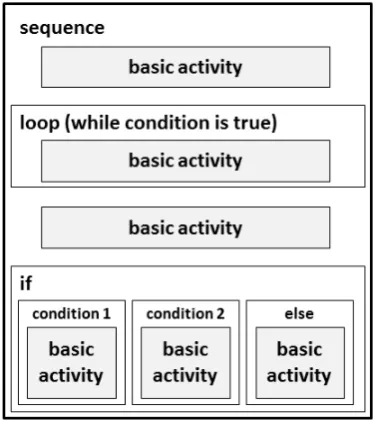
2.3 BPEL Process Structure (Informatica, 2007) . . . 29
2.4 BPEL Control Flow . . . 30
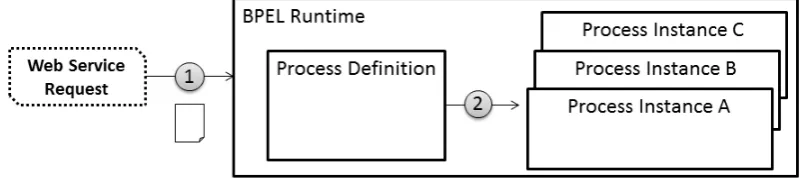
2.5 BPEL Process Lifecycle . . . 31
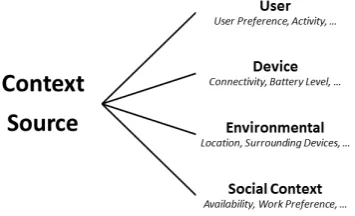
2.6 Context Types based on the context source . . . 33
3.1 Taxonomy for Dynamic Processes (Weber et al., 2009) . . . 38
3.2 Flexibility Classification (Nurcan, 2008) . . . 41
3.3 The architecture of the Sliver execution engine (Hackmann et al., 2006b) 55 4.1 Collaborative Workflow Scenario . . . 59
4.2 Anatomy of the MobWEL Workflow Definition . . . 61
4.3 Overview of MobWEL Metamodelling . . . 63
4.4 MobWEL Metamodel of Adapted Process Control Flow . . . 65
4.5 The Structure of the MobWEL Workflow Process . . . 65
4.6 Group Identification . . . 80
4.7 Group Identification XML Schema . . . 81
4.8 Context Definition Metamodel . . . 83
4.9 Examples of Context Aggregation . . . 85
4.10 Context Use . . . 87
4.11 Context Definition XML Schema . . . 88
4.12 Metamodel for Content Lifecycle Definition . . . 90
4.13 Example of Context-Driven Transitions . . . 93
4.14 Example of Context-Aware Transition . . . 94
4.15 XML Schema for Content Lifecycle . . . 95
5.1 MobWEL Process Flow as a Graph . . . 100
5.2 Example of MobWEL Control Flow Execution . . . 103
5.4 Example of Execution of an Interaction Activity - Individual Actors . . . 104
5.5 Examples of Executions Paths Depicted on Model . . . 104
5.6 Notation for Data Flow . . . 105
5.7 Notation for Decisions . . . 106
6.1 High-Level Architecture of the MobWEL Workflow Management System109 6.2 Deployment of MobWEL Workflow . . . 111
6.3 Context Provider Infrastructure . . . 112
6.4 Context Component . . . 114
6.5 A Composite Component . . . 116
6.6 Composite Component Lifecycle . . . 117
6.7 Usage Scenarios . . . 119
6.8 Context Manager . . . 121
6.9 Content Manager . . . 125
6.10 Data Model of Content Provider . . . 126
6.11 Internal Structures of Content Lifecycles . . . 128
6.12 Lifecycle Example in Different Representations . . . 129
6.13 Incoming Message from Another Mobile Device . . . 137
6.14 Context-Related Interactions . . . 141
6.15 Content-Related Interactions . . . 141
7.1 Component Types . . . 146
8.1 Experimentation Strategy . . . 162
8.2 The Basic Work Flow in the Usage Scenario . . . 164
8.3 Picture Lifecycle . . . 166
8.4 Anatomy of the Workflow Process . . . 167
8.5 Workflow Instance . . . 169
8.6 Testing . . . 172
1 Model for Battery Context . . . 193
2 Models for Bluetooth Context and Wifi Context . . . 193
3 Model for DataSync . . . 194
4 Model for Connectivity . . . 194
5 Models for User Preferences . . . 194
6 Model for Collaborator’s Availability . . . 195
7 Model for Location . . . 195
8 Picture Information Object Model . . . 195
9 Picture Lifecycle Object Model . . . 196
10 Process Control Flow for Designer . . . 197
6.1 Registering of Context Definition . . . 122
6.2 Registering of Context Definition - STEP 1 and STEP 2 . . . 123
6.3 Obtaining context notification from Context Provider . . . 124
6.4 Adding of Context-Aware Content Lifecycle . . . 130
6.5 Transition of content object O:si c 7→sj . . . 133
6.6 The internal execution ofcontentActivity . . . 134
Introduction
Contents
1.1 Motivation . . . 2
1.2 Research Aim and Objectives . . . 7
1.3 Research Questions and Focus . . . 8
1.4 Contributions . . . 9
1.5 Approach . . . 11
1.6 Scope and Structure of Thesis . . . 15
1.1
Motivation
1.1.1
The Vision of Mobile Collaboration
collaboration in manufacturing, health care and education. Improved and instant communication enables interactions between suppliers and customers, nurses and patients, or tutors and students. A broad range of mobile collaborative applications such as Dropbox, or ShowDocument have been developed to support collaboration, file management, social networking, work organisation or scheduling.
Advances in mobile collaborative solutions have enriched user experience, but also have resulted in a new set of user demands. The raising user expectations for mobile collaboration, apart from just putting workload onto smartphones, include the demand for an intelligent mobile collaborative environment which responds to people0s needs. A smartphone is a device physically mobile and carried by its owner constantly. Therefore, the device and the user have a similar perception of the environment which makes possible for the mobile device to be a user’s digital complement. The fact has motivated users to raise the demand for intelligent mobile systems being centred on an individual user.
Bringing intelligence into everyday life and environments is addressed by the ambient intelligence paradigm. The ambient intelligence vision is characterised by technologies which are embedded, context-aware, personalised, adaptive and an-ticipatory (Denning, 2001). In other words, the ambient intelligence paradigm refers to a) devices and technologies integrated into the environment which is sensitive to humans’ presence;b) people0 interaction with devices is personalised, easy and natural; andc) devices can recognise the situational context and are tailored to user needs. The goal of ambient intelligence is to seamlessly weave intelligent tech-nologies into everyday lives and its ongoing challenges include awareness of user preferences and needs in the systems (Cook et al., 2009).
There is no doubt that the technologies will not come from a single research field. Building a fully intelligent environment requires the development of well integrable, improvable and evolutive individual technologies that address certain aspects and requirements of it. The individual technologies need to envisage today’s raising user expectations, add value to real world and contribute to the existing base of knowledge.
1.1.2
Challenges of Mobile Collaborative Workflows
Collaboration originated in the past when work was divided into separate tasks as-signed to single workers. Workers, each specialising only on a particular aspect of service or goods production, had to collaborate together to reach common goals. During the workdays, people followed certain work processes and patterns to ac-complish their goals. The last decades of the 20th century, a period of an infor-mation technology boom, opened new ways of collaboration. The work processes, previously managed only by people, have been handled by information technologies which could partially support, control or automate the work. New concepts such as workflow, an abstraction of phenomena of work in the real world, and workflow management systems (WfMS), generic software packages designed for workflow management and execution, have been introduced.
The impact made by the introduction of the workflow management technology is present in many areas such as transportation management, enterprise resource planning or customer relationship management. Better efficiency, process control, worker productivity and process improvement can be achieved by the deployment of workflow systems (Yan et al., 2006). By using the technology, the logistic facilities for processes automation have been provided by workflow management systems and the complexity of work processes has been reduced as the tasks have been allocated to right people at right time and in right order.
Workflow management systems belong to a class of generic software and can be used for a number of different purposes. However, in the workflow management systems the processing logic is separated from the application logic. This means that actual tasks are not performed by the systems and other software applications are needed. Therefore, the technology has been often customised, modified and adapted for various collaboration needs. As a result, a variety of workflow models, languages, modelling concepts and software packages has been developed.
Some workflow solutions for smart devices have been developed, however, the approaches relied on workflow management systems deployed on servers and pro-vide only light-weight workflow process support on mobile devices (Battista et al., 2008; Pryss et al., 2011). Using the approaches that are based on the server-client model is almost impractical for small-scaled workflows in various situations in which people could collaborate only by using mobile devices. Typical situations where purely mobile collaboration might add value are meetings between business part-ners who share private information, or teamwork in small companies without own server. Moreover, in the centralised architectural style, control and management of workflows is driven by a central unit with mobile devices behaving only as thin clients. The central management unit makes all important decisions and drives the whole workflow execution without considering the current situation of users and context the devices reside in. The need for a mobile device-centric workflow process, and sys-tems that manage such workflow processes in a completely distributed manner has been recognised (Pajunen & Chande, 2007). Mobile collaboration in a distributed manner, also labeled as mobile peer-to-peer collaboration, involves a set of mobile devices connected through wireless links. Moreover, in peer-to-peer workflow man-agement, data and content can be distributed by direct exchange and all decisions are made by mobile devices. Therefore, the decisions can be adapted to the current user and device circumstances and based on local, context information.
is usually used in content management systems such as Alfresco1. In contrast, in
the activity-centric or process-centric approach, the workflow process is described as a sequence of activities and the control-flow facet of workflow is emphasised. BPEL, BPMN and YAWL are examples that represent this approach. This approach is useful for representing the functional view of workflows. Although the flow of data and objects is indicated, data and objects are handled only as second-class citizens in the centric approaches. The duality of information-centric and activity-centric workflow models, and the strengths and weaknesses of the two modelling approaches have been illustrated in the work of Kumaran et al. (2008).
There are several benefits to increasing content awareness in process-oriented workflows and integrating advanced content management capabilities in peer-to-peer mobile workflow management. Firstly, knowing the content state can enable content synchronisation over a number of devices, especially in peer-to-peer collab-oration. There are basically two ways to share the information about content object that is processed on a particular device. In the first way, a set of all content-related data would be send to all interested devices at any time when content has been updated or modified. In this case, all devices would need to process the whole set of information and if required, undertake any consequential actions. This approach is inefficient as all devices would need to process and evaluate the incoming set of data. Moreover, the broadcasting would be irregular and chaotic, requiring an ex-cessive amount of processing on all involved devices. On the other hand, the more organised and simpler way to share the information among the devices is by more controlled and organised content management on each device. Adding extra con-tent management functionalities on each device enables the set of concon-tent-related information to be processed directly on the device, using content states as mile-stones in content behaviour. Sending the information only about certain content states can keep the workflow execution more consistent and synchronised. The number of messages would be significantly reduced, the interaction points could be better indicated and the shared messages would be more expressive. Secondly, there can be relationships and dependencies between various content items. For example, the proposal can have more sections edited by co-workers on their de-vices. Receiving the regular information about the sections would enable to process the proposal accordingly.
So far, however, too little attention has been paid to content processed in process-centric workflows. Many workflow approaches are organised around process-process-centric and activity-centric workflow models which have relatively limited focus on artifacts processed in workflows. Entities such as content or business artifacts are integrated
in workflows as an input or output of an activity and the effects of how performed ac-tivities influence an entity’s behaviour are not visible (Bhattacharya et al., 2009). The field of artifact-centric workflows is still in infancy (Hull, 2008) and object-awareness in process-centric workflows is still very limited (K ¨unzle & Reichert, 2011). More-over, there has been lack of consideration how the approaches could operate in a peer-to-peer mobile setting and the research to date has tended to focus on the lifecycle of the artifact without considering its adaptation to context changes.
The work presented in this thesis explores how the collaborative workflow ma-management technology can be adapted to mobile platforms in order to meet inter-action needs of collaborators, and how content behaviour and context awareness can be integrated in the adapted workflow management. Workflows need to be well defined because the success of the workflow management system is based on the quality of the workflow models put into it (Aalst & Hee, 2004). This thesis tackles the problem associated with the representation of context information available on a single mobile device, and using context information to shape peer-to-peer work-flow execution. Context describes the current situation of a user, a device or an environment regarding a specific purpose. By expressing context explicitly for each workflow, each mobile device can monitor, acquire and process only the required context information. By adapting workflow management to consume the context in-formation and make decision based on it, the workflow execution can become more dynamic and responsive to individual collaborator’s needs and current situation.
1.2
Research Aim and Objectives
The research aim is to adapt the collaborative workflow technology for peer-to-peer mobile collaboration by targeting the challenges described in the previous section. The intention includes making workflows context-aware so the execution of work-flows can be based on local, context information and therefore adapted to collab-orator’s needs and circumstances. Adding extra support for content lifecycle and management will increase content awareness in workflows and make content a first-class citizen in the activity-based workflows.
The main objectives addressed in this work are:
1. To design a workflow model that defines a certain class of mobile distributed context-aware content-centric workflow processes at an abstract level and in a machine-interpretable form. The characteristics of the certain class of work-flows are as follows:
performed by a number of roles and actors.
• Workflow tasks are accomplished by using mobile devices such as smart-phones or tablets, and workflows are executed solely on mobile devices.
• Current situation and needs of stakeholders can be captured on mobile devices and used to trigger workflow tasks or influence workflow deci-sions.
• There is one or more artifacts such as pictures or documents processed in the workflow. Different artifact evolution states are monitored and used to communicate workflow progress among collaborators.
2. To design a generic workflow management software architecture that is ca-pable of managing and executing such workflow processes and operates in a peer-to-peer manner on mobile devices.
3. To implement a prototype of the generic workflow management system on a mobile platform.
4. To analyse two usage scenarios and construct a concrete mobile distributed context-aware content-centric workflow process for a usage scenario.
5. To demonstrate that the workflow instances of the constructed workflow pro-cess are manageable and executable.
1.3
Research Questions and Focus
Based on the research aim outlined in the previous section, the investigation leads to the following research question and subquestions:
Research Question
• How can distributed mobile context-aware content-centric workflows be represented, managed and executed?
Research Subquestions
1. How can context-awareness be integrated and supported within the work-flow process?
A workflow-specific context management approach has been developed as a part of the MobWEL workflow approach. A metamodel that defines context models is introduced in Section 4.5. Processing of context models is elabo-rated in Sections 6.3 and 6.4.
2. How can content behaviour be supported in the workflow process? Content lifecycles are expressed in the same way as the workflow process is described. A metamodel for the definition of content lifecycles is presented in Section 4.6. Content management support is described in Sections 6.5.
1.4
Contributions
The thesis contributes to the mobile collaborative workflow domain in the following ways:
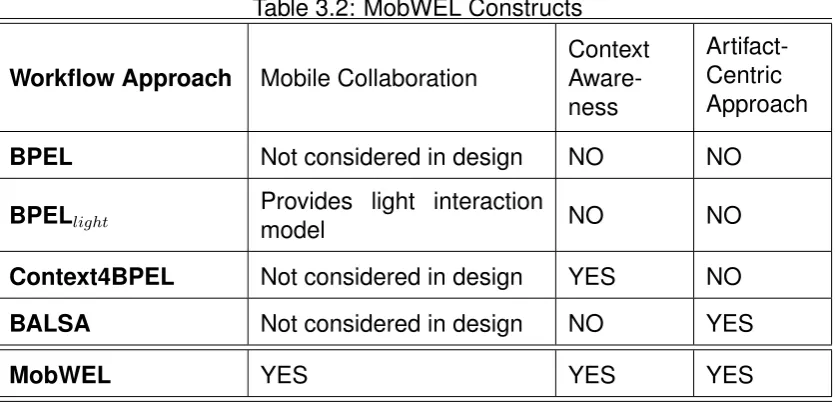
• Mobile Workflow Execution Language (MobWEL) Metamodel: A mobile workflow execution language called MobWEL has been designed and its meta-model is introduced in the thesis. The MobWEL metameta-model comprises four parts (Workflow-specific context definition, Context-aware content lifecycle, Group identification, and Process Control Flow). MobWEL extends BP EL, integrates BP ELlight’s interaction model, uses the Context4BP EL’s
context-aware approach and adapts dimensions defined in BALSA, an artifact-centric workflow model.
• MobWEL Syntax and Semantics: MobWEL syntax and formalised seman-tics are described in this thesis. Its syntax is expressed in XML because of
BP EL, BP ELlight and Context4BP EL are XML-based workflow languages. Concrete workflow definitions are described in XML and their behaviour can be described in a formal way by using MobWEL semantics.
Context Provider monitors, acquired, processes and disseminates context in-formation. Context Manager manages and routes relevant context information to right internal components. Content Manager provides advanced content management functionalities. The MobWEL engine manages and instantiates MobWEL workflows, and executes its instances. Peer-to-peer Interaction Man-ager handles interaction among collaborators.
• Workflow-Specific Context Management Approach: A workflow-specific context management approach has been designed. The approach is intro-duced in the thesis and covers context modelling, context acquisition, context providing, context management and context consumption on a mobile device. Separation of the context acquisition logic from context adaptation logic is sup-ported in this approach, meaning that the Context Provider component can be used either internally as a part of the MobWEL workflow management sys-tem, or externally as a context providing service. As an external component, the service can be used by multiple context aware applications running on the same mobile device.
• Context-Aware Content Management Approach: Mobile content objects processed in MobWEL workflows are considered as significant workflow ar-tifacts, and their lifecycles are explicitly expressed. Content states are moni-tored and used to communicate progress to fellow collaborators.
• Software Prototypes: Two software prototypes have been built on the An-droid platform1and are described in this work. ContextEngine, a prototype of
the context provider, monitors, acquires, processes and distributes workflow-specific context information. ContextEngine provides context provisioning ser-vices to context-aware mobile applications running on the same mobile device. This engine has been developed in collaboration with Dean Kramer, who has used it for a different research project. CAWEFA is a prototype of a mobile workflow management system. CAWEFA extends the Sliver BPEL engine, and has been developed to carry out MobWEL workflows. Both software pro-totypes will be available to research community as open source software. Generally, the designed technology intends to enhance mobile peer-to-peer col-laboration. This thesis presents the MobWEL workflow approach that contains all necessary information to define a certain class of workflows. The MobWEL workflow approach adds a value in the real world as follows. Firstly, it can be used by work-flow designers who will be able to model and define the concrete workwork-flow cases
for mobile applications. Secondly, the workflow management software is designed in a generic way and can provide workflow management support to multiple mobile applications running on the same mobile device. Finally, the abstracted description of the MobWEL workflow management system can be used for the implementation of the software on any mobile platform.
1.5
Approach
1.5.1
Research Methodology
Design Science Research by definition changes the state-of-the-world through the introduction of novel artefacts (Vaishnavi & Kuechler, 2004) and is particularly rel-evant for investigation and understanding innovation in mobile computing (Love, 2009).
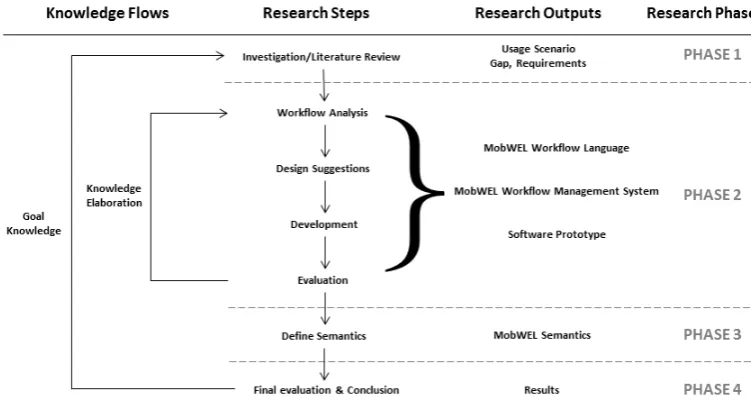
By considering Hevner’s Design-Science research guidelines (Hevner et al., 2004) and the design cycle of Vaishnavi & Kuechler (2004), this research has engaged the design science research approach which comprises four phases as follows (Fig-ure 1.1):
Figure 1.1: Research Methodology
Research Phase 2: Epistemologically, the ’knowing through making’ belief is im-plied. Knowledge and artifacts are elaborated through an iterative constructive process which stops when the research results are acceptable and satisfac-tory. The process is based on the following steps:
1. Qualitative workflow analysis: By performing workflow process analysis, opportunities for workflow adaptation are identified.
2. Design suggestions: As a result of the qualitative workflow process anal-ysis, new workflow constructs are formed, new data structures are exam-ined, and a set of requirements and expectations is suggested.
3. Development phase: Development of research artifacts is based on ex-periments.
4. Evaluation iterations: Micro-evaluation accompanies each design deci-sion.
Research Phase 3: Formalisation of the knowledge obtained in Phase 2 and de-veloping the MobWEL semantics.
Research Phase 4: Final Evaluation, Validation and Verification of the research ar-tifacts.
1.5.2
Development Methodology
Design Research produces general outputs in a form of constructs, models, meth-ods, or instantiations (March & Smith, 1995). Development of the research artifacts requires various techniques that extend and enhance the design research paradigm. The following techniques have been implied.
A usage scenario presented in Chapter 2 has been created and used to navigate this research. Scenario-based design is a family of techniques in which the narra-tive descriptions of the system use are described early in the development process (Rosson & Carroll, 2002). The scenario-based design approach has been employed in various ways to guide the development of the research artifacts :
• Requirements analysis: The scenario has provided a rich picture on par-ticipating stakeholders, and their work pattern, and outlined the need for a technology that would enhance their collaboration and teamwork. Scenario analysis has been used to gather requirements.
• Envisioning: The scenario has been used to visualise and simulate the use of a system.
• Software design: The identification of key domain objects and the decisions about the design direction have been based on the scenario analysis.
• Implementation: The prototype implementation has been driven by the usage scenario in order to keep certain boundaries of the phase.
• Evaluation and testing: The scenario has been used as a skeleton for vali-dation of the MobWEL approach.
These steps have been relevant to the development of the workflow language and the software.
MobWEL Language Definition
Metamodelling is the way to design and integrate semantically rich languages in a unified way (Clark et al., 2008). A metamodelling approach is used to define all con-structs of the MobWEL workflow processes, the relationships between concon-structs and rules that state how the constructs can be combined to create models.
The constructed metamodel is then mapped into an XML Schema and MobWEL becomes an XML-based language. MobWEL workflows are described in XML docu-ments which conform to the XML schema.
Software Development
MobWEL workflows are carried out by appropriate software.Prototyping, a software engineering developmental technique based on iterative and incremental building of software prototypes, has used to develop the software and explore design alterna-tives, test theories and suggestions. By using the software prototyping technique, the suggestions are implemented. Working software is a proof of concept that the theory is functional and workflows are executable. The construction of prototypes is driven by the usage scenario.
1.5.3
Validation Approach
Validation and verification are important phases of the research process to deter-mine whether the designed research artifacts fit the intended purpose. In design research, the evaluation of the artifacts requires formulation of criteria for success (Blessing & Chakrabarti, 2009). Criteria are used to plan the appropriate evaluation, assess the evaluation results and judge the outcome of the research against the research goals and objectives.
This design science research produces an artifact in the form of the MobWEL workflow language. The hypothesis is that the MobWEL workflow language is a suit-able technology for the definition and representation of mobile distributed context-aware content-centric workflows. To validate this hypothesis, the following criteria for success have been defined:
• A certain class of mobile distributed context-aware content-centric workflows can be defined by using the MobWEL workflow language.
• The instances of MobWEL workflows are manageable and executable. To achieve the validation goal, the following steps have been undertaken: 1. Design and development of the MobWEL workflow management system:
• A logical and run-time architecture of the system have been designed.
• A prototype of the system has been developed on the Android platform. 2. Once the MobWEL workflow language and management system were
con-structed, the artifacts are evaluated according to the defined criteria. The final evaluation based on experimentation, one of the most fundamental methods for validation in the software engineering area (Wohlin et al., 2012), was con-ducted:
• A MobWEL workflow definition for the usage scenario has been con-structed.
• The MobWEL semantics has been used to describe the expected be-haviour of individual workflow instances.
• The MobWEL workflow definition has been deployed to the MobWEL workflow management system.
• Comparison of the expected with the actual behaviour of workflow in-stances. Quantitative data was collected and analysed appropriately to produce relevant answers.
This concludes the description of the methodologies used in this research. The next section outlines the structure of this thesis.
1.6
Scope and Structure of Thesis
The goal of this thesis is to present a first milestone in the definition, management and execution of MobWEL workflows designed for peer-to-peer mobile collabora-tion. The focus is put on the description and integration of two main aspects: the workflow-specific context management process and context-aware content manage-ment support. Special interest is placed on specifying the anatomy, syntax and semantics of the MobWEL workflow language.
However, to complete this work within three-and-a-half year time frame, this work does not include workflow partitioning, run-time optimisation of the workflow pro-cesses and fault handling. It is not extended to deal with tasks allocation and op-timised content sharing in peer-to-peer interactions. Also this work does not cover the recent concepts of the adaptation or composition of the workflow definition at run-time. In addition, an overall logical architecture of the workflow management software package is highlighted, however, the system is complex and thereby only its major components are fully described.
Generally, there are five categories of workflow management activities: workflow design, workflow modelling, workflow execution, workflow monitoring, and workflow optimisation. It is necessary to emphasise that only first three categories are ad-dressed in this work.
The reader should be familiar with the following concepts and technologies: BPEL, UML, Java, XML schema and XML.
This thesis comprises four parts:Foundations, Contribution, Validation and Con-clusion.
Part I: Foundations
re-search approach were described.
Chapter 2: Background and Concepts- In this chapter a scenario of mobile peer-to-peer collaboration is presented. The scenario describes a particular workflow case which is used to illustrate the technology produced in this work. After that, a background to the topic is given and the basic terminology needed to understand the work in this thesis is defined.
Chapter 3: Related Work- This chapter provides the literature review. The review covers the various aspects of context modelling and management, content manage-ment and workflow adaptation. The support for the managemanage-ment and execution of context-aware content-centric workflows is also discussed.
Part II: Contribution
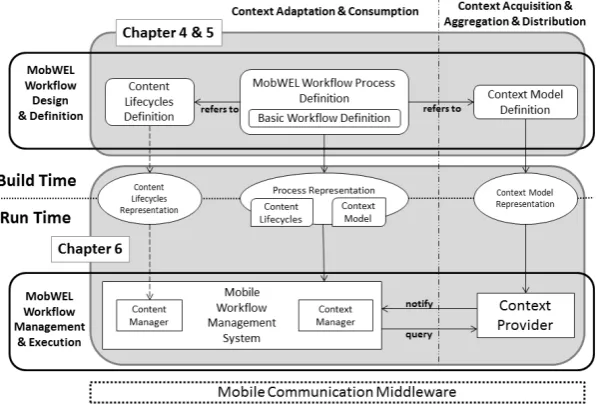
This main part presents the contribution of the thesis. This thesis is concerned with designing a workflow model that contains information to define, manage and exe-cute MobWEL workflows. Figure 1.2 shows the components of the workflow model and outlines the structure of Part II. The model is based on the workflow reference model defined by Workflow Management Coalition (Hollingsworth, 1995). At the highest level, two functional areas are characterised: build-time functions and run-time functions. At build-run-time, workflows are defined. MobWEL workflow specification comprises three parts: Context Definition Model, Content Lifecycles and Adapted Workflow Process Definition which is an extended version of an existing basic work-flow definition. The defined workwork-flows are represented in a machine-interpretable form and are deployed to a workflow management software package. At run-time, the software package interprets the defined workflows, instantiate them and ma-nages the execution of running workflow instances. The software package is built from two systems: Context Provider and Mobile Workflow Management System.
The contribution of the thesis is decomposed into three chapters as follows:
Chapter 4: MobWEL Definition and Syntax - The MobWEL workflow anatomy, metamodel and syntax are described here.
Chapter 5: MobWEL Semantics- This chapter defines the semantics of the Mob-WEL workflow language.
Figure 1.2: Relation between key contributions of this thesis
architecture of the MobWEL workflow management system is presented and the functioning of all system components is elaborated.
Part III: Validation
The following two chapters are dedicated to the validation of the MobWEL workflow management approach:
Chapter 7: From Design to Implementation - This chapter presents the imple-mentation details of software prototypes implemented for the Android platform.
Chapter 8: Evaluation- Experiments have been conducted to validate the designed research artefact. The validation technique and results are described in this chapter.
Part IV: Conclusion
Chapter 8: Conclusion and Future Work - This chapter summarises the thesis and outlines interesting areas of future work.
Background and Concepts
Contents
2.1 Introduction . . . 18 2.2 Mobile Peer-to-Peer Collaboration Scenario . . . 19 2.3 Workflow Management . . . 22 2.4 Mobile Peer-to-Peer Workflow Management . . . 25 2.5 Content/Object Awareness . . . 31 2.6 Context Awareness . . . 32 2.7 Summary . . . 36
2.1
Introduction
This chapter presents background information for the remainder of the thesis. The objective of this chapter is to provide an introduction to the domain and define the terminology used in this work.
2.2
Mobile Peer-to-Peer Collaboration Scenario
The MobWEL approach is tailored specifically to a certain class of workflows and this section describes the type of workflows which are targeted. Two usage scenar-ios are described to illustrate the use of the MobWEL workflow model.
The characteristics of the targeted workflow type are as follows:
• Workflows are activity-oriented and collaborative. Workflow activities are per-formed by a number of roles and actors.
• Workflow tasks are accomplished by using mobile devices such as smart-phones or tablets, and workflows are executed solely on mobile devices.
• Current situation and needs of stakeholders can be captured on mobile de-vices and used to trigger workflow tasks or influence workflow decisions.
• There is one or more artifacts such as pictures or documents processed in the workflow. Different artifact evolution states are monitored and used to commu-nicate workflow progress among collaborators.
In the first usage scenario, consider a small business focusing on residential and commercial interior design of houses, offices and shops. In this company, design projects are carried out by a team of ten interior designers. Business success de-pends on close cooperation within the team and between the team and customers. Designers usually work out in the field and communicate with each other by using their smartphones. With mobile devices, designers can make important decisions right away and share images of design patterns with as little delay as possible.
Designers work on a number of concurrent projects. Although each project is as-signed to a particular designer, design decisions are never done by a single person. Jane, as a specialist on private houses, has been assigned to a project to redesign a living room for a private client. The client wishes to optically enlarge the room by repositioning the furniture. Undertaking of the project requires following this work pattern:
1. Designer Jane takes a picture of a new room design by using her smart phone. 2. A simple rating system is used to quickly assess design ideas. Jane adds her
own rating to the picture.
3. The picture is sent to her fellow workers. They work out in the field so each of them can review the picture by using their own mobile phone.
5. Reviews and comments are sent back to Jane. She finally reassesses her idea according to opinions of other designers.
6. If the idea is good, the picture is sent for final approval to customer. 7. The approved picture is added to Jane’s completed work.
Designers do not want to perform all tasks, such as launching camera to take picture, or sending the picture to team workers by looking up their contact details in the contact list, manually. The team follows this work pattern on a regular daily basis, therefore, performing the tasks manually several times a day would be time consuming and inefficient. Therefore, the company expect to have a technology that automates this work pattern and minimalises the number of human input.
In addition, there are other requirements for the technology:
• The company does not have an own server, therefore, the technology has to be supported on smartphones.
• The technology needs to be adapted to individual collaborator’s needs. For example, one designer might need to obtain two reviews at a certain point of time, while another designer requires at least 4 reviews to be able to assess whether the proposed design is really good.
• Not all designers are always available to review the picture. For instance, some of them might have a day off, or are busy in a meeting with clients. Thereby, sending the picture to all of them would be inefficient and the picture should be sent only to those team workers who are available to review it.
• Finally, the picture is processed on several devices. Consider a situation that the picture has been sent to all fellow collaborators to be reviewed but the interior designer who sent the picture needs to obtain only two reviews to be able to assess the picture. Therefore, when the picture is assessed, the other collaborators, who have been also asked to review it but have not done so yet, are informed that the picture has been already assessed and there is no more need for their reviews.
In the first workflow for monitoring attendance, smartphones can be used to cap-ture time when student comes to the placement venue and a message of the arrival is sent to tutor and mentor. When student enters the placement venue, the location data provided by the GPS of the mobile device can be used as a trigger for capturing the time on a daily basis. On the other hand, if student does not enter the placement venue in a certain time range, and student arrival has not been recorded in any other way, tutor and mentor are informed about student absence by their mobile devices.
In the second workflow, mentor creates a day plan of actions and tasks for stu-dent. Each task has its start time, duration, goals, learning outcomes and location. Mentor shares the plan with student and tutor. Student can indicate completion of each task, add own notes and task rating by using own smartphone or tablet. In addition, if allowed, student can take pictures by using own smarthphone and enrich task related notes by them. Once the plan achieves a certain state of completeness, the plan outcome is sent to mentor and tutor who assess it and take further actions. Using smartphones in this scenario would enable capturing of important informa-tion more accurately, for example, timestamps can be added to tasks or task-related pictures can be taken.
The second scenario highlights a need for a technology that supports collabora-tion on mobile devices such as smartphones and tablets, is adaptable and reactive to the current situation of stakeholders such as location, and supports monitoring of the state of shared artifacts such as student plan of actions.
The main commonalities between the two usage scenarios are that there are different roles involved in collaboration, a work pattern is followed and each role has certain activities that need to be completed. The activities can be accomplished by using smartphones. In both scenarios, current user situations are obtained by mobile devices in order to make workflow decisions. While in the first usage sce-nario, designer’s preferences are used to decide which execution path is taken, in the second scenario, location data enables to make decision for monitoring student attendance. Moreover, artifacts are handled in both scenarios, pictures are captured and reviewed in the first scenario, action plans are created and followed in the sec-ond scenario. In both cases, states of artifacts are monitored and shared among collaborators to communicate workflow progress.
2.3
Workflow Management
Collaborative workflow is a technology that supports multi-party collaboration and can be adapted for various needs. This section presents the basic concepts related to workflow and workflow management.
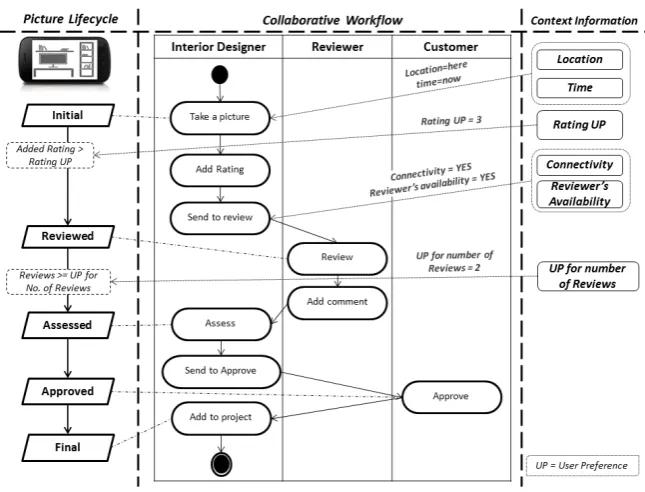
Basically, the work pattern described in the collaborative scenario can be ab-stracted into a collaborative workflow, as outlined in Figure 2.1. The simplified work-flow process is illustrated from a user’s point of view. It shows three roles that par-ticipate in this collaboration: Interior Designer, Reviewer and Customer. The roles can be assigned to one or more collaborators. Each role has allocated a number of tasks. The logical order of task execution is outlined, too.
Figure 2.1: Collaborative Workflow Scenario
The work pattern can be described by a workflow language. Then the workflow description is interpreted by a workflow management system which manages and executes multiple instances of the particular workflow.
2.3.1
Basic Terminology and Concepts
Generally, workflow is an abstracted form of a real work pattern. Although there have been some efforts from various vendors to standardise the definition of workflow, workflow language and workflow management system architecture, there is no fully standardised workflow technology that would be used by all and the meaning of concepts can vary depending on the purpose of their application. The terminology used throughout this thesis follows and extends that given in (Hollingsworth, 1995) and in (Aalst & Hee, 2004):
whole or part, during which documents, information or tasks are passed from one participant to another for action, according to a set of procedural rules. Workflow Management System (WfMS): A system that completely defines,
ma-nages and executes workflows through the execution of software whose or-der of execution is driven by a computer representation of the workflow logic. WfMS provide support in three functional areas:
• Build-time functions are concerned with defining, and possibly modelling, the workflow process and its constituent activities;
• Run-time control functions concerned with managing the workflow pro-cesses in an operational environment and sequencing the various activi-ties to be handled as part of each process;
• Run-time interactions with human users and applications for processing the various activity steps.
Workflow Schema/Metamodel: The meta structure of a workflow process defined in terms of a data model.
Workflow Process Definition: The computerised representation of a process de-scribed by using a workflow language. The definition contains all necessary information about the workflow process to enable its execution by software. This includes:
• starting and completion conditions;
• constituent activities;
• rules to navigate between activities;
• user tasks to be undertaken;
• references to applications which may to be invoked;
• definition of any workflow relevant data.
Workflow Case Type: A workflow process description for a particular usage sce-nario. It is a collection of related, structured activities or tasks that produce a specific output for a particular user or application.
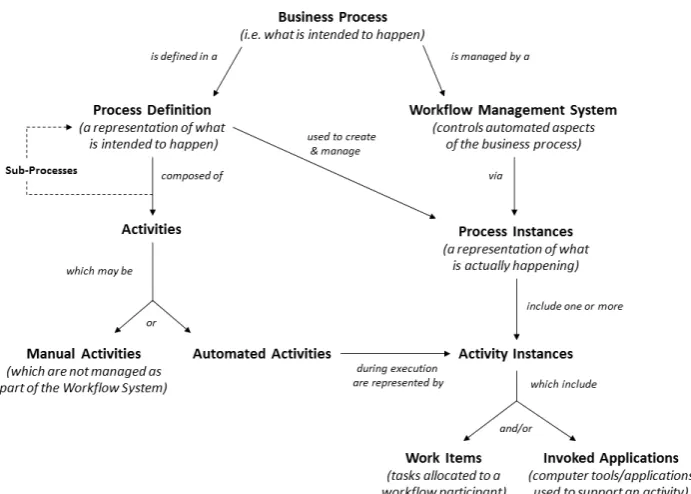
Figure 2.2: Workflow-Related Concepts (Hollingsworth, 1995)
Automated Activity: A step in a process that is performed directly by the workflow execution engine.
Task: Task is a special type of activity representing a unit of work performed by one or more human workflow participants or carried out by another application. The relationships between the basic concepts are illustrated in Figure 2.2. To clarify, workflow is often named as a business process, however, in this work the term ’workflow’ is used rather than ’business process’.
The following terms related to workflow scheduling are extracted from the ta-xonomy described by (Yu & Buyya, 2006). Local scheduling means task handling of a single resource whereasglobal scheduling involves deciding where to handle the task. Managing the task execution depends on the architecture of workflow system. Secondly, local decision is based on on the information of current task and global decisionis based on the information of entire workflow.
2.3.2
Workflow Management
• The functional aspect defines a functional decomposition of activities in the workflow and describes what should be done.
• Thebehavioural aspect defines the execution order and dependencies (control flow) of activities in the workflow and describes when the activities should be done.
• The informational aspect describes internal and external data used in the workflow, their dependencies and data-flow.
• The organisational aspect defines allocation of work to resources in the or-ganisation: describes who should do the work including the hierarchy and the policies.
• Theoperational aspect describes interaction between the workflow manage-ment system and environmanage-ment.
Mobile workflow management can be centralised with a workflow management system running on a server, or distributed with the workflow management system running solely on mobile devices. As described in the usage scenario, the company does not possess an own server, therefore, mobile peer-to-peer collaboration is required. The peer-to-peer workflow management approach on mobile devices is described next.
2.4
Mobile Peer-to-Peer Workflow Management
As mobile phones are becoming more capable and wireless networks improve, the mobile phone users are expecting the same or better services as traditionally avail-able in the fixed networks. Classical distributed systems designed for desktop com-puting are usually stable, consisting of multiple autonomous computers. In contrast, systems targeting mobile devices face a number of constraints in terms of location variability, context changes, network data connectivity and resource sharing (Mah-moud, 2004). The development of distributed mobile applications introduces chal-lenging problems as devices have also more scarce resources especially in terms of battery consumption. Thus the distributed mobile applications are often adapted for the constraints, for example, certain operations are performed only when the battery level is sufficient enough.
var-ious environments. Moreover, the wireless communication supports forming peer-to-peer systems which allow data and content distribution between devices by direct exchange without using centralized servers. The administration, maintenance, re-sponsibility for the operation, and even the notion of ’ownership’ of peer-to-peer sys-tems are distributed among the users or devices (Androutsellis-Theotokis & Spinel-lis, 2004). By using the peer-to-peer technology, there is the potential that com-munication processes are accelerated and collaboration costs through the ad hoc administration of working groups are reduced (Schoder & Fischbach, 2003).
Coulouris et al. (2005) has described the characteristics of peer-to-peer systems as follows:
• Each peer contributes information resources located on the device to the sys-tem through a network.
• Each peer has the same functional capabilities and responsibilities.
• No centrally administered system.
• Each node has a certain level of anonymity to other peers.
• Efficient functioning depends on a choice of an algorithm for the placement of data across many peers.
In the pure peer-to-peer architecture, all peers are equal and each peer becomes a supplier and consumer of resources and information services. Application of the decentralized algorithm implies that no device has complete information about the system state and devices make decisions based only on local information. If the peer-to-peer model is used in mobile collaboration, data management and deci-sion making techniques that support tasks, processes or workflows need to be ade-quately developed.
Workflow management systems purely designed for mobile devices has a de-centralised, peer-to-peer infrastructure. The application of the peer-to-peer charac-teristics into workflow management means that:
• A workflow definition is decomposed into small partitions and the workflow par-titions are deployed on participating mobile devices, also labeled as a workflow peer or participant.
• Each device acts autonomously and executes an allocated workflow partition in order to achieve the common goal.
Distributed workflow execution is performed when each device executes an al-located partition of the workflow. Each participating device needs to be aware of the workflow process definition and also all multiple process instances the device is involved in.
It is important to outline that there exist two different views on distributed workflow management: orchestration view and choreography view (Peltz, 2003). From the or-chestration point of view, the workflow logic and behaviour of a single participant is described. An orchestrated workflow does not describe coordination between two or more parties. As opposed to the orchestration view, the choreography view focuses on interactions and message exchanges between two or more workflow participants. Choreography refers to an overall process without specifying how it is implemented and describes coordination between two or more parties. The choreography may consist of several orchestrations. In this work, the focus is put more on the orches-tration view and on what is happening on a single device rather than optimisation of the interaction among participating devices.
In the following section, existing workflow standards, which have been consi-dered to be used as a base for the workflow described in the usage scenario, are presented.
2.4.1
Workflow Standards
The workflow management field has been shaped from the nineties onward. Various workflow standard models and specifications have been developed. This section presents the most known and adopted workflow approaches.
Workflow Management Reference Model: An almost two-decade-old Workflow Management Reference Model developed by the Workflow Management Coalition1
represents a rich source of specifications for the design and development of work-flow management systems. The reference model, described by Hollingsworth (1995), identifies the basic characteristics, terminology, general structure and components of a workflow management system. The major component within the workflow ar-chitecture is a workflow enactment service which provides the run-time environment and utilises one or more workflow engine(s). A number of core interfaces and inter-change workflow definition formats are constructed around the workflow enactment service to regulate the interactions between the workflow control component and external resources such as process definition tools, workflow client applications, invoked applications, other workflow enactment services and administration tools.
Other standards proposed by the WfMC include XML Process Definition Language (XPDL) and Workflow API (WAPI). XPDL is used to describe workflow processes which are deployed to the enactment service. WAPI is a set of API calls and inter-change functions around the workflow enactment service used to interact with other resources and applications.
BPMN:Business Process Modeling Notation (BPMN) is a graphical representation of a business process developed by the Object Management Group (OMG) (OMG, 2011). The notation facilitates businesses by giving them the ability to communicate their business procedures in a standard manner. The goal of BPMN is to provide a standardised notation that is easily understandable by various business users. Al-though BPMN is a useful notation tool to visualise business processes, it has been developed for graphical design and its deployment to the process engine is con-ditional on transformation to another process format. Because of wide-spread of BPEL in process engines, BPMN processes have often been mapped to the execu-tion format such as Business Process Execuexecu-tion Language (BPEL)
BPEL:BPEL, a shortened name for Web Service Business Process Execution Lan-guage, is a standard executable XML-based language developed by the Organi-sation for the Advancement and Structured Information Standards (OASIS). The full specification of BPEL process can be found online (OASIS, 2007). BPEL has been designed for specifying business process behaviour based on Web Services. Web services are self-contained and self-describing software application compo-nents designed to achieve interoperability between applications over the network by using Web standards. Applications integration and interoperability requires a formally defined interaction model that supports peer-to-peer message exchanges, both request-response and one-way formats, between two or more parties. An ab-stract process is used to describe the interaction model without revealing the internal implementation of the parties involved. Separating the public aspects of business process behaviour from internal business aspects enables to hide internal data ma-nagement and decision making from other parties and provides the ability to change the private aspects without affecting the public process behaviour. BPEL is an orchestration language, not a choreography language. BPEL defines how multi-ple service interactions are coordinated to achieve a business goal and provides a mechanism for dealing with exceptions and faults. BPEL utilises XML specifications such as WSDL 1.1, XML Schema 1.0, XPath 1.0 and XSLT 1.0.
many scenarios, however, its standard constructs did not support the various re-quirements. Therefore, more functionality had to be added and the language has been frequently extended. BPEL4Chor extends BPEL for modelling choreographies (Decker et al., 2007), BPEL4People to cover also human user interactions (Klopp-mann et al., 2005) or BPEL4SWS is BPEL for semantic web services (Nitzsche et al., 2007a) are only some examples of BPEL extensions.
BPEL isa) platform-agnostic;b) expressed entirely in XML,c) extensible and adapt-able, d) accepted as standard and widely adopted, e) provides robust interaction model that enables peer-to-peer conversation. Because of the BPEL characteris-tics, BPEL is used for describing the scenario work pattern and forms a base for MobWEL. Thereby, its basic constructs are described next.
2.4.2
BPEL
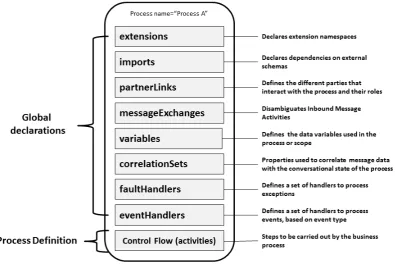
The structure of a BPEL process is outlined in Figure 2.3. At the top, the<process>
element with attributes such as name, query language, expression language, target namespace, etc. is defined. Global declarations define items that used within the process, including extensions, imports, partnerLinks, etc. For this work, the most important concepts arevariablesandeventHandlers.
Figure 2.3: BPEL Process Structure (Informatica, 2007)
Figure 2.4: BPEL Control Flow
shared variables. Data in variables are accessed and modified by activities. Va-riables can be inputs or outputs of activities such as receive, pick or invoke. Data can be copied from one variable to another variable by using the assign activity. To obtain the value of a variable, a built-in function: ’bpws:getVariableData’ can be used. An XPath expression is used to extract data from an XML document.
BPEL processes can be organised into logical units of work called scopes. To react to certain events or to the expiration of timers during the scope execution, event handler can be used. The most obvious reasons for using event handlers are events, for example, a cancellation event to terminate the scope or process escalation when a timer set on the scope expires.
After the global declarations, the process control flow is defined. The flow con-sists of several individual activities. In BPEL, each activity represents an action that is actually performed. There are two types of activities: basic and structured. Basic activities such as invoke, receive, assign, or exit are atomic. Structured activities such as flow, if, pick or sequence are containers which can contain other activities. To describe each activity is out of scope of this thesis, however, activities that have been altered or adopted in MobWEL will be described in other chapters.
BPEL Process Lifecycle
Once a BPEL process is designed, it is deployed to a BPEL-compliant engine. After that, the BPEL process can be instantiated. The process is typically initiated when an incoming message is received (Figure 2.5, step 1). At first, the engine would try to find and match the message to a currently running instance (Figure 2.5, step 2).
Figure 2.5: BPEL Process Lifecycle
If not successful, a new process instance is created. Each process instance represents a separated thread of execution of the single BPEL process, using its own associated data, and is controlled independently. Process instances have their own internal states which represent their progress towards completion. While the BPEL process instance is executed, corresponding activity instances are created and managed for each invocation of the process activities in accordance to the pro-cess definition.
This section has introduced the concepts related to workflow management and standards, particularly BPEL. Next section explores content and object awareness with respect to workflow management.
2.5
Content/Object Awareness
Several representations for modelling object lifecycles have been developed, of-ten based on finite state machines or statecharts. In state machines, a set of states and directed transitions between the states form a representation (Sipser, 2006). Many of the state-machine representations use the event-condition-action paradigm and associate transitions with events that triggers transitions. On the other hand, al-though statecharts can be seen an extended version of state-machines, statecharts have been designed more to represent concurrency. For example, the statechart approach has been used in the UML State Machines (OMG, 2007). In this thesis, the state machine approach is used to describe lifecycles of the objects processed in workflows and the object lifecycles are integrated to the process flow. If the view on the object lifecycle is integrated in an activity-based workflow, the workflow be-comes object-aware, also referred as content-centric in this thesis. In other words, the object-aware activity-based workflow captures the order of the workflow tasks complemented with the view on lifecycles of objects processed in the workflow.
The following terminology related to content awareness is used throughout this thesis:
Content/ Content Piece: An object type such as image or document processed in a workflow, and declared as variable in a workflow definition.
Content Lifecycle: Content can have a longer lifespan than workflow that creates it. Description of a period involving all stages of the content life from its creation to its disposal.
Content Item/ Content Object: A concrete workflow object processed in a parti-cular workflow instance.
Content Metadata/ Content Attribute: Data providing information about a content object.
It has been outlined in the usage scenario that the technology needs consider needs of individual collaborators. In the next section, context awareness as a con-cept that can be used to adapt the technology for the requirement is presented.
2.6
Context Awareness
’...as an active process dealing with the way humans weave their experience within their whole environment, to give it meaning.’ (Bolchini et al., 2009) or
’Context awareness is of an entity to be aware of the surrounding situations and use the information to perform some tasks.’ (Dawson et al., 2008) In this thesis, the following definition of context is used:
’Context is any information that can be used to characterize the situation of an entity. An entity is a person, place, or object that is considered relevant to the interaction between a user and an application, including the user and applications themselves. Context is typically the location, identity, and state of people, groups, and computational and physical objects.’ (Dey et al., 2001)
2.6.1
Context Classification
Context information can originate from various sources. Hence, the heterogeneous context raw data need to be processed into more compact and meaningful context information that is delivered to various context-aware systems. Concerning that context diversity, context classes relevant for the MobWEL are clarified.
Based on the source, the following classes of context have been identified as rel-evant for the MobWEL workflow model: user context, device context, environmental context and social context, see Figure 2.6.
Figure 2.6: Context Types based on the context source
usually accomplished by considering additional information about a user, for exam-ple, by including more detailed information based on personal preferences (Bierig, 2008). Using user preferences in the workflow concept can lead to more flexible and dynamic workflow structures that can respond to collaborators’ needs.
Secondly, smart mobile phones are capable of capturing various types of contex-tual information. Sensors that can be found in the phones include GPS, accelero-meters, digital compass, or proximity sensors. These sensors with other equipment found in mobile phones can be used for acquisition of a wide range of contextual information. Context information can be related to the context of device or environ-ment. Connectivity and battery level are examples of device’s context. Environmen-tal context groups all those aspects in which the device is embedded such as time, location or information about surrounding devices.
Finally, significant context to establish cooperative effort is social context. Social context awareness relies on knowing the work context of fellow collaborators, such as their availability, current activity and location (Bardram & Hansen, 2004). A core challenge, especially in the mobile environment, is to provide collaborators with a social context information of each another.
2.6.2
Context Management for Mobile Systems
Contextual information is consumed by context-aware mobile applications. Context aware applications have been described as:
’...intelligent applications that can monitor the user’s context and, in case of changes in this context, consequently adapt their behaviour in order to sa