Determinism through modulation diversity: can
combining multiple IEEE 802.15.4-2015 SUN
modulations improve communication reliability?
Pere Tuset-Peir´o, Ferran Adelantado, Xavier Vilajosana
Wireless Networks Research LabInternet Interdisciplinary Institute (IN3) Universitat Oberta de Catalunya (UOC)
Barcelona, Spain
{peretuset, ferranadelantado, xvilajosana}@uoc.edu
Ruan Delgado Gomes
Research Group on Communications Systems and Information Processing
Federal Institute of Para´ıba (IFPB) Campina Grande, Brazil {ruan.gomes}@ifpb.edu.br
Abstract—The IEEE 802.15.4-2015 standard includes the SUN (Smart Utility Networks) modulations, i.e., FSK, SUN-OQPSK and SUN-OFDM, which provide long range communi-cations and allow to trade data rate, occupied bandwidth and re-liability. However, given the constraints of low-power devices and the challenges of the wireless channel, communication reliability cannot still meet the PDR (Packet Delivery Ratio) requirements of industrial applications, i.e., PDR>99%. Hence, in this paper we evaluate the benefits of improving communication reliability by combining packet transmissions with modulation diversity using multiple IEEE 802.15.4g SUN modulations. The results derived from a real-world deployment show that going from 1 to 3 packet transmissions with the same SUN modulation can increase PDR from 85.0/84.6/71.3% to 94.2/94.1/86.0% using SUN-FSK, SUN-OQPSK and SUN-OFDM, respectively. Combining the same number of packet transmissions with modulation diversity allows to further increase the average PDR to 97.1%, indicating its potential as a tool to help meeting the reliability requirements of industrial applications.
Index Terms—IEEE 802.15.4g, Smart Utility Networks, Low-Power, Wireless, Modulation Diversity, Reliability, Availability.
I. INTRODUCTION
The IEEE 802.15.4 standard [1] defines the physical and data-link layers for a low-power wireless technology aimed at home and industrial automation applications requiring low data rate communications (i.e., up to 250 kbps) in an ad-hoc self-organizing network [2]. At the physical layer the standard operates in unlicensed bands (i.e., Sub-GHz and 2.4 GHz) and uses OQPSK-DSSS (Offset Quadrature Phase-Shift Keying with Direct Sequence Spread Spectrum) to meet low power requirements while maintaining an acceptable level of robustness against propagation and interference effects. At the data-link layer the standard defined the use of slotted and unslotted CSMA-CA (Carrier Sense Multiple Access with Collision Avoidance) for star and mesh network topologies. However, given the challenges of wireless communications, it is widely accepted that reliability has been one of the main challenges for adopting IEEE 802.15.4-based networks in industrial scenarios given their stringent requirements [3].
A rising alternative to IEEE 802.15.4 are LPWAN (Low Power Wide-Area Network) technologies [4], includ-ing SigFox, LoRa and Ingenu, among others. Similarly to IEEE 802.15.4, LPWAN technologies operate in unlicensed bands, but they exploit robust modulations to enable long-range networks with star topologies, but at the cost of lower data rates (i.e., from 0.1 to 50 kbps). But despite the success of this approach thanks to its simplicity, LPWANs are intrinsi-cally limited in terms of scalability given the trade-off between the potential large number of devices, the low transmission rates, the stringent radio regulations, and the simplistic MAC protocols [5] used to manage access to the shared medium, i.e., ALOHA or Slotted ALOHA.
Simultaneously to the rise of LPWANs, the IEEE 802.15.4-2015 standard revision [6] incorporated new modulation schemes with pre-defined operational parameters to allow trading communication range, bandwidth occupation, data rate and communication reliability, depending on the application requirements. Among others, the standard included the SUN (Smart Utility Network) modulations, defined in the IEEE 802.15.4g amendment [7], which incorporate FSK (Frequency Shift Keying), OQPSK (Offset Quadrature Phase-Shift Key-ing) and OFDM (Orthogonal Frequency Division Multiplex-ing) modulations. However, the use of IEEE 802.15.4g mod-ulations has been somewhat limited due to the availability of radio transceivers supporting all modes. To the best of our knowledge, at the time of writing IEEE 802.15.4g has only been evaluated for smart networks [8], smart buildings [9] and environmental observations [10]. Also, in [11] the authors study the interference robustness of OPQSK-DSSS and SUN-OFDM in a controlled environment to determine its suitability for low-power wireless communications in industrial settings. Given the raising interest in reliable and available com-munications [12], in this paper we experimentally explore the concept of modulation diversity, i.e., the combination of the SUN modulations defined in 802.15.4-2015 standard, and investigate if it can improve communication reliability, which is key to ensure dependability in the context of low-power
wireless communications. To that end, we use the dataset presented in [13], which provides traces from a real-world deployment using the IEEE 802.15.4g SUN modulations. To the best of our knowledge, this is the first paper to explore the notion of modulation diversity for low-power wireless communications and show that it can indeed improve the network reliability.
The remainder of the paper is organized as follows. Sec-tion II presents the work related to IEEE 802.15.4 relia-bility and an overview of the physical layers introduced in IEEE 802.15.4g. Section III describes the deployment that has allowed to study the performance of IEEE 801.15.4g modulations in a real-world environment. Section IV presents and discusses the results of the evaluation, which confirms the potential of using modulation diversity to increase the determinism of these networks. Finally, Section V presents the conclusions and the future work.
II. BACKGROUND
This section presents the work related to IEEE 802.15.4 reliability, and provides a brief introduction to the new IEEE 802.15.4g SUN modulations.
A. Related work
Over the years there have been different studies focused on understanding the reliability issues of IEEE 802.15.4-based networks [14]. For example, at the physical layer the authors of [15] study the impact of interference on IEEE 802.15.4-based networks, showing the effects of different wireless technolo-gies operating in the same location and time. In contrast, the authors of [16] focus on the data-link layer and propose an adaptive algorithm based on MAC (Medium Access Control) parameters (i.e., macMinBE, macMax-CSMABackoffs, and macMaxFrameRetries) for minimizing power consumption while guaranteeing reliability and delay constraints in the packet transmission.
Conversely, other authors have focused on making proposals to improve the reliability issues at the different layers of the stack. For example, the authors of [17] and [18] proposed using time synchronization and channel hopping (i.e., sending subsequent packets over different frequency channels) at the physical layer as a means to combat both multi-path propaga-tion and external interference. Alternatively, the authors of [19] have proposed using packet replication over disjoint paths at the data-link layer, which provides a 90% reduction in packet loss and a 40% reduction in end-to-end latency when one extra copy of a packet is sent, but requires an 86% increase in overall energy consumption.
B. IEEE 802.15.4g overview
As introduced earlier, the IEEE 802.15.4g ammendment in-troduced three new modulations targeted to SUN applications: SUN-FSK, SUN-OQPSK, SUN-OFDM.
First, SUN-FSK was included mainly due to its power efficiency and to ensure compatibility with legacy systems. Three different operation modes are defined for each frequency
band supported in the standard. They define modulation and channel parameters, such as the modulation type (2-FSK or 4-FSK), the channel spacing, and the modulation index, providing data rates between 50 kbps and 200 kbps.
Second, SUN-OQPSK extends the original OQPSK-DSSS, which was introduced back in 2003 in the first version of the IEEE 802.15.4 standard. Originally, it supported 20/40 kbps and 250 kbps in the Sub-GHz (868/915 MHz) and the 2.4 GHz ISM (Industrial, Scientific and Medical) bands. The current revision adds additional frequency bands and supports differ-ent spreading factors, providing effective data rates between 6.25 kbps to 500 kbps.
Finally, SUN-OFDM provides higher data rates and longer communication range, while dealing with interference and multi-path propagation effects. Different MCS (Modulation and Coding Schemes) are defined to use alternative mod-ulations (i.e., BPSK, QPSK and 16-QAM) and frequency repetition schemes (i.e., 0x, 2x, 4x), providing effective data rates between 50 kbps and 800 kbps with channel bandwidth ranging from 200 kHz to 1.2 MHz.
III. METHODOLOGY
To evaluate the suitability of packet replication and mod-ulation diversity to improve the communication reliability of low-power wireless networks we use the dataset presented in [13], which is available at GitHub1.
The deployment to collect the dataset was conducted in a clothing warehouse located in Madrid (Spain), between July 31 and November 10, 2019, and contains 99 days of measurements for a total of 10.710.868 received packets. The warehouse measures 451 m x 244 m (110.044 m2) and
presents a very challenging environment for radio-frequency propagation, with metal structures and moving objects that create multi-path propagation. In addition, other wireless sys-tems operating in the same Sub-GHz band (i.e., 868 MHz) are known to be deployed, creating interference that affects network reliability.
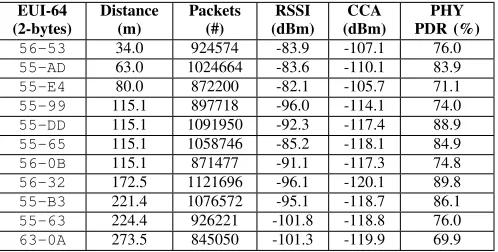
The network uses a star topology with one gateway, which contains three independent IEEE 802.15.4g SUN radio transceivers to be able to receive packets simultaneously. A total of 11 OpenMote-B nodes [20] are deployed at distances to the gateway ranging from 34.0 meters to 273.5 meters. Table I shows the node identifiers (last two bytes of EUI-64) and the distance to the gateway, as well as the basic per-node statistics (i.e., RSSI, CCA and PDR).
To transmit packets to the gateway, nodes operate on a 60 seconds period, with an active sub-period of 1750 ms. In each active sub-period nodes perform three transmit cycles, and in each transmit cycle nodes transmit three consecutive packets, one with each IEEE 802.15.4g SUN modulation, i.e., SUN-FSK, SUN-OQPSK and SUN-OFDM. All modulations are configured to provide an effective data rate of 50 kbps and each transmitted packet has a payload of 21 bytes, but packets are encrypted with AES-128, leading to a 32 byte
EUI-64 (2-bytes)
Distance (m)
Packets (#)
RSSI (dBm)
CCA (dBm)
PHY PDR (%) 56-53 34.0 924574 -83.9 -107.1 76.0 55-AD 63.0 1024664 -83.6 -110.1 83.9 55-E4 80.0 872200 -82.1 -105.7 71.1 55-99 115.1 897718 -96.0 -114.1 74.0 55-DD 115.1 1091950 -92.3 -117.4 88.9 55-65 115.1 1058746 -85.2 -118.1 84.9 56-0B 115.1 871477 -91.1 -117.3 74.8 56-32 172.5 1121696 -96.1 -120.1 89.8 55-B3 221.4 1076572 -95.1 -118.7 86.1 55-63 224.4 926221 -101.8 -118.8 76.0 63-0A 273.5 845050 -101.3 -119.9 69.9
TABLE I: Node identifier (EUI-64), gateway distance, re-ceived packets, RSSI, CCA and PDR values.
PSDU (Physical-layer Service Data Unit). To minimize colli-sion probability with other nodes in the network, as well as nodes from other networks, nodes use CCA (Clear Channel Assessment) before each packet transmission. Finally, packets are transmitted using the maximum transmit power supported by the Atmel AT86RF215 radio transceiver for each SUN modulation (i.e., 15 dBm for SUN-FSK and SUN-OQPSK, and 9 dBm for SUN-OFDM).
Table II shows the per-node and per-modulation average reception probability for each transmission attempt (i.e., P1,
P2, P3). As expected, the data shows that there is a relationship
between distance from the gateway and the reception prob-ability depending on the selected modulation. For example, for nodes closer to the gateway (i.e., 56-53 or 55-AD) we observe that SUN-OFDM provides better reception probability. In contrast, for nodes farther from the gateway (i.e., 55-63
or 63-0A) we observe that SUN-FSK and SUN-OQPSK provide better reception probability. This is resulting from the fact that nodes closer to the gateway are limited by external interference, whereas nodes farther from the gateway are limited by the transmit power (as presented earlier) and the receive sensitivity (i.e., -114 dBm for SUN-FSK, -116 dBm for SUN-OQPSK and -111 dBm for SUN-OFDM) of each modulation. Finally, it is important to remark that, for a given node and modulation, the reception probability can be assumed to be independent because nodes are not time-synchronized and use CCA before each transmission.
EUI-64 SUN-FSK SUN-OQPSK SUN-OFDM
P1 P2 P3 P1 P2 P3 P1 P2 P3
56-53 71.9 81.3 73.6 74.4 84.1 80.8 73.8 75.8 68.2 55-AD 87.6 85.3 78.7 85.7 84.3 77.5 92.4 87.7 75.9 55-E4 78.9 74.2 56.7 81.6 78.7 60.4 72.9 69.5 67.4 55-99 85.1 76.0 85.3 84.4 75.3 84.9 72.3 62.7 40.4 55-DD 93.2 92.4 92.8 91.3 91.9 92.8 81.9 81.2 82.3 55-65 70.3 90.9 90.4 82.3 95.1 94.4 64.9 87.6 88.2 56-0B 75.3 88.3 82.3 76.6 87.6 82.7 71.1 69.9 39.6 56-32 97.2 94.5 97.6 92.7 89.7 92.9 82.4 79.4 81.6 55-B3 96.8 96.4 78.7 97.2 96.6 79.9 80.0 86.8 62.2 55-63 86.7 93.4 93.8 75.4 79.4 81.1 58.7 58.8 56.5 63-0A 91.9 88.6 89.4 89.4 85.4 86.9 33.7 29.8 33.9
Mean 85.0 87.4 83.6 84.6 86.2 83.1 71.3 71.7 63.3
Std. Dev. 9.2 7.1 11.0 7.1 6.5 9.0 14.7 16.3 17.9
TABLE II: Average PDR (physical layer) values separated by modulation type and packet transmission attempt.
IV. RESULTS
In this section we use the dataset presented in the previous section to evaluate the impact of packet retransmissions and modulation diversity to increase the PDR at the application layer and meet the requirements of industrial applications.
For that purpose, we start by defining three groups of nodes according to their distance (d) with respect to the gateway. In particular, we define the close, medium and far groups, as described next. First, the nodes in the close are those that are at a distance smaller than 80 meters, i.e.,56-53,55-AD,
55-E4. Second, the nodes in themediumgroup are those that are at a distance equal to 115 m, i.e.,55-99,55-DD,55-65,
56-0B. Finally, the nodes in thefargroup are those that are at a distance greater than 170 m, i.e.,56-32,55-B3,55-63,
63-0A. We do so as the average PDR for nodes closer to the gateway is mostly determined by interference, whereas for nodes farther from the gateway the average PDR is mostly limited by attenuation. Hence, grouping nodes together allows to observe the benefits of modulation diversity according to the link properties.
A. Packet retransmissions
As explained earlier, in the deployment site, packets are transmitted 3 times with each of the IEEE 802.15.4g SUN modulations. As expected, the dataset corroborates that packet transmissions are independent. Hence, we can exploit packet retransmissions using the same modulation to increase PDR at the application layer.
For that purpose, Table III shows the accumulated success probability with 1, 2 and 3 transmissions (i.e., P1, P12 and
P123, respectively) using the same IEEE 802.15.4g SUN
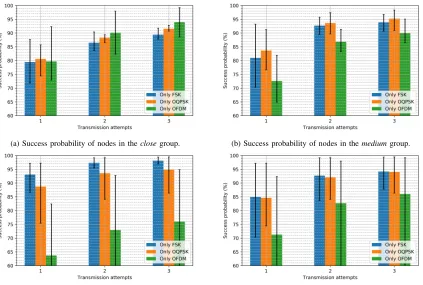
mod-ulation. As it can be observed, using three transmissions per packet it is possible to increase the average PDR significantly, as well as reduce its standard deviation. For example, the average PDR increases from 85.0% to 94.2% with SUN-FSK, from 84.6% to 94.1% with SUN-OQPSK, and from 71.3% to 86.0% with SUN-OFDM.
EUI-64 SUN-FSK SUN-OQPSK SUN-OFDM
P1 P12 P123 P1 P12 P123 P1 P12 P123
56-53 71.9 85.4 88.8 74.4 89.4 92.8 73.8 90.1 94.0 55-AD 87.6 90.4 91.7 85.7 89.2 91.1 92.4 98.0 99.2 55-E4 78.9 83.7 87.8 81.6 86.5 90.7 72.9 82.3 88.6 55-99 85.1 92.5 94.0 84.4 91.5 94.8 72.3 83.2 86.5 55-DD 93.2 95.7 96.8 91.3 95.7 96.8 81.9 88.8 92.0 55-65 70.3 93.0 94.0 82.3 97.4 98.4 64.9 91.4 95.1 56-0B 75.3 89.5 90.7 76.6 89.7 91.0 71.1 83.9 86.7 56-32 97.2 99.2 99.5 92.7 95.9 96.8 82.4 88.3 90.8 55-B3 96.8 98.4 98.7 97.2 99.2 99.5 80.0 92.8 94.8 55-63 86.7 95.5 96.9 75.4 84.1 86.3 58.7 66.4 68.2 63-0A 91.9 96.4 97.6 89.4 95.0 96.6 33.7 44.1 50.3
Mean 85.0 92.7 94.2 84.6 92.1 94.1 71.3 82.7 86.0
Std. Dev. 9.2 4.8 3.8 7.1 4.6 3.8 14.7 14.4 13.7
TABLE III: Accumulated PDR (application layer) values with 1, 2 and 3 transmissions attempts for each SUN modulation.
(a) Success probability of nodes in theclosegroup. (b) Success probability of nodes in themediumgroup.
(c) Success probability of nodes in thefargroup. (d) Success probability of all nodes.
Fig. 1: Transmission success probability using 1, 2 and 3 packet transmissions. The bars represent the average of all nodes in the group and the error lines represent the maximum and minimum values of the nodes in that group.
to 94.2/94.1/86.0% for FSK, OQPSK and SUN-OFDM, respectively. For nodes in theclosegroup (Figure 1a), we observe that SUN-OQPSK provides the best PDR for 1 transmission attempt (81.5%), whereas SUN-OFDM provides the best PDR for 3 transmission attempts (94.0%). For nodes in the mediumgroup (Figure 1b), we observe that SUN-OQPSK provides the best PDR for both 1 transmission attempt (83.7%) and 3 transmission attempts (95.3%). Finally, for nodes in the far group (Figure 1c), we observe that SUN-FSK provides the best PDR for both 1 transmission attempt (93.2%) and 3 transmission attempts (98.2%).
The presented results show that introducing packet repli-cation can indeed increase PDR at the applirepli-cation layer, but at the expense of increasing node energy consumption and creating network congestion. However, contrarily to the results presented in [19], the results show that in a real industrial environment transmitting 3 packet replicas does not ensure a PDR>99% at the application layer due to propagation and interference effects. In contrast, it is widely acknowledged that different modulations have different properties at the physical layer. For example, wide-band modulations are robust against multi-path propagation, whereas narrow-band modulations are robust against interference. Hence, the obtained results and the complementary properties of modulations justify the study of modulation diversity as a means to further increase the relia-bility of low-power wireless communications, with the aim to
meet the operational requirements of industrial applications, while limiting the impact on nodes’ energy consumption and being compliant with radio-frequency regulations.
B. Modulation diversity
We now focus on combining packet replication with mod-ulation diversity to determine to which extent it can increase the network reliability by exploiting the inner properties of each modulation against propagation and interference effects. We start by defining the policy that we have used to select the modulation to transmit each individual packet. Since packet transmissions are blind, i.e., no acknowledgement from the gateway, we use a simple strategy where we select the transmission attempt (i.e., P1, P2 or P3) that has the higher
and smaller average PDR according to the values presented in Table IV. For example, for node 56-53 we use P2 for
SUN-FSK, P2 for SUN-OQPSK and P2 for SUN-OFDM, as
the columns with the higher PDR values. For the columns with the lower PDR values, we pick P1 for SUN-FSK, P1
for SUN-OQPSK and P3 for SUN-OFDM. We name these
strategies asBEST andWORST, and iterate over all the packet transmissions of each node to calculate the probability that at least one packet has been successfully received.
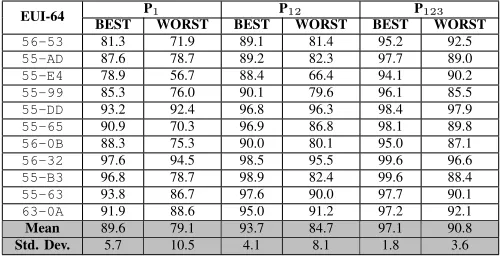
Using this approach, Table IV shows the accumulated suc-cess probability with 1, 2 and 3 transmissions (i.e., P1, P12and
selection strategies. As it can be observed, using the BEST strategy it is possible to increase the average PDR above with respect to the results presented in Table III. For example, using 1 transmission we can increase average PDR to 89.6% from 85.0/84.6/71.3% using FSK, OQPSK and SUN-OFDM, respectively. Similarly, using 3 transmissions we can increase average PDR to 97.1% from 94.2/94.1/86.0% using SUN-FSK, SUN-OQPSK and SUN-OFDM, respectively. Re-garding theWORSTstrategy, it is interesting to mention that it represents a lower bound and that it can improve average PDR only in scenarios where one modulation performs poorly due to propagation and interference effects. For instance, for nodes in theclosegroup theWORSTstrategy can outperform SUN-FSK on average thanks to the additional reliability provided by SUN-OFDM. In contrast, for nodes in the far group the WORST strategy can outperform SUN-OFDM thanks to the additional link budget provided by SUN-FSK.
EUI-64 P1 P12 P123 BEST WORST BEST WORST BEST WORST
56-53 81.3 71.9 89.1 81.4 95.2 92.5
55-AD 87.6 78.7 89.2 82.3 97.7 89.0
55-E4 78.9 56.7 88.4 66.4 94.1 90.2
55-99 85.3 76.0 90.1 79.6 96.1 85.5
55-DD 93.2 92.4 96.8 96.3 98.4 97.9
55-65 90.9 70.3 96.9 86.8 98.1 89.8
56-0B 88.3 75.3 90.0 80.1 95.0 87.1
56-32 97.6 94.5 98.5 95.5 99.6 96.6
55-B3 96.8 78.7 98.9 82.4 99.6 88.4
55-63 93.8 86.7 97.6 90.0 97.7 90.1
63-0A 91.9 88.6 95.0 91.2 97.2 92.1
Mean 89.6 79.1 93.7 84.7 97.1 90.8 Std. Dev. 5.7 10.5 4.1 8.1 1.8 3.6
TABLE IV: Accumulated PDR (application layer) with 1, 2 and 3 transmissions attempts using modulation diversity.
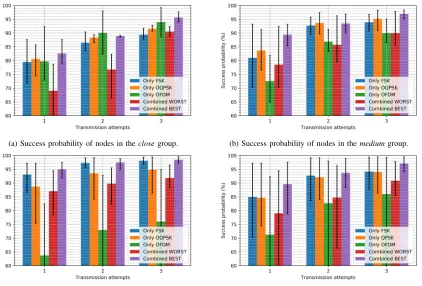
Figure 2 shows the success probability for nodes in the different groups using 1, 2 and 3 packet transmissions com-bined with modulation diversity. In general, we observe that the average PDR of all nodes for 1, 2 and 3 packet transmis-sions (Figure 2d) increases with respect to using each SUN modulation independently (i.e., without modulation diversity). For instance, for 1 transmission attempt the average PDR goes from 85.0% (i.e., using P1with SUN-FSK) to 89.6%, whereas
for 3 transmission attempts the average PDR increases from 94.2% (i.e., using P123 with SUN-FSK) to 97.1%.
For nodes in the close group (Figure 2a) we observe that for 1 transmission attempt the average PDR increases from 80.6% (i.e., using SUN-OQPSK) to 82.6%, whereas for 3 transmission attempts the average PDR increases from 94.0% (i.e., using SUN-OFDM) to 95.7%. For nodes in the medium group (Figure 2b) we observe that for 1 transmission attempt the average PDR increases from 83.7% (i.e., using SUN-OQPSK) to 89.4%, whereas for 3 transmission attempts the average PDR increases from 95.3% (i.e., using SUN-OQPSK) to 96.9%. Finally, for nodes in the far group (Figure 2c) we observe that for 1 transmission attempt the average PDR in-creases from 93.2% (i.e., using SUN-FSK) to 95.0%, whereas for 3 transmission attempts the average PDR increases from 98.2% (i.e., using SUN-FSK) to 98.5%.
Given these results, we conclude that combining packet replication with modulation diversity can increase PDR re-gardless of the best modulation for each node group.
V. CONCLUSIONS
In this paper we have proposed combining packet repli-cation with modulation diversity to increase network relia-bility and meet the requirements of industrial applications, i.e., PDR>99%. To validate the concept we have used a dataset obtained from a real-world deployment using the SUN modulations (i.e., FSK, OQPSK and OFDM) defined in the IEEE 802.15.4-2015 standard. Compared to using packet replication alone, the results obtained show that using modu-lation diversity can indeed increase the network reliability. In summary, with 3 packet transmissions the average PDR for all nodes increases from 94.2% to 97.1%, while maintaining the same energy consumption. Hence, we believe that modulation diversity can be a useful tool to increase reliability of low-power wireless networks, specifically for industrial applica-tions with stringent reliability requirements.
However, the analysis to evaluate the gains of modulation diversity conducted throughout the paper is based on the global average PDR values, and does not take into account the instantaneous variations that may occur due to physical layer effects. Therefore, as future work, it would be interesting to explore different policies to select the modulation combination that provides the best reliability.
REFERENCES
[1] “IEEE Standard for Local and Metropolitan Area Networks–Part 15.4: Low-Rate Wireless Personal Area Networks (LR-WPANs) Amendment 1: MAC sublayer,”IEEE Std 802.15.4e-2012 (Amendment to IEEE Std 802.15.4-2011), pp. 1–225, April 2012.
[2] E. Callaway, P. Gorday, L. Hester, J. A. Gutierrez, M. Naeve, B. Heile, and V. Bahl, “Home Networking with IEEE 802.15.4: A Developing Standard for Low-Rate Wireless Personal Area Networks,”IEEE Com-munications Magazine, vol. 40, no. 8, pp. 70–77, Aug 2002.
[3] P. Bartolomeu, M. Alam, J. Ferreira, and J. A. Fonseca, “Supporting Deterministic Wireless Communications in Industrial IoT,”IEEE Trans-actions on Industrial Informatics, vol. 14, no. 9, pp. 4045–4054, Sep. 2018.
[4] U. Raza, P. Kulkarni, and M. Sooriyabandara, “Low Power Wide Area Networks: An Overview,” IEEE Communications Surveys Tutorials, vol. 19, no. 2, pp. 855–873, Secondquarter 2017.
[5] F. Adelantado, X. Vilajosana, P. Tuset-Peiro, B. Martinez, J. Melia-Segui, and T. Watteyne, “Understanding the Limits of LoRaWAN,”IEEE Communications Magazine, vol. 55, no. 9, pp. 34–40, Sep. 2017. [6] “IEEE Standard for Low-Rate Wireless Networks,”IEEE Std
802.15.4-2015 (Revision of IEEE Std 802.15.4-2011), pp. 1–709, April 2016. [7] “IEEE Standard for Local and Metropolitan Area Networks–Part 15.4:
Low-Rate Wireless Personal Area Networks (LR-WPANs) Amendment 3: Physical Layer (PHY) Specifications for Low-Data-Rate, Wireless, Smart Metering Utility Networks,”IEEE Std 802.15.4g-2012 (Amend-ment to IEEE Std 802.15.4-2011), pp. 1–252, April 2012.
[8] C.-S. Sum, M.-T. Zhou, F. Kojima, and H. Harada, “Experimental Performance Evaluation of Multihop IEEE 802.15.4/4g/4e Smart Utility Networks in Outdoor Environment,” Wireless Communications and Mobile Computing, vol. 2017, pp. 1–13, 2017.
(a) Success probability of nodes in theclosegroup. (b) Success probability of nodes in themediumgroup.
(c) Success probability of nodes in thefargroup. (d) Success probability of all nodes.
Fig. 2: Transmission success probability with 1, 2 and 3 packet transmissions with modulation diversity. The bars represent the average of all nodes in the group and the error lines represent the maximum and minimum values of the nodes in that group.
[10] J. Mu˜noz, T. Chang, X. Vilajosana, and T. Watteyne, “Evaluation of IEEE802.15.4g for Environmental Observations,”Sensors, vol. 18, no. 10, 2018. [Online]. Available: https://www.mdpi.com/1424-8220/ 18/10/3468
[11] P. Tuset-Peir´o, F. V´azquez-Gallego, J. Mu˜noz, T. Watteyne, J. Alonso-Zarate, and X. Vilajosana, “Experimental interference robustness evaluation of ieee 802.15.4-2015 oqpsk-dsss and sun-ofdm physical layers for industrial communications,” Electronics, vol. 8, no. 9, p. 1045, Sep 2019. [Online]. Available: http://dx.doi.org/10.3390/ electronics8091045
[12] P. Thubert, D. Cavalcanti, X. Vilajosana, and C. Schmitt, “Reliable and Available Wireless Technologies,” Work-ing Draft, IETF Secretariat, Internet-Draft draft-thubert-raw-technologies-04, January 2020, http://www.ietf.org/internet-drafts/ draft-thubert-raw-technologies-04.txt. [Online]. Available: http: //www.ietf.org/internet-drafts/draft-thubert-raw-technologies-04.txt [13] P. Tuset-Peir´o, R. D. Gomes, P. Thubert, and X. Vilajosana, “Evaluating
IEEE 802.15.4g SUN for Dependable Low-Power Wireless Communi-cations In Industrial Scenarios,”Sensors, vol. XX, no. XX, 2020. [14] N. Baccour, A. Koubundefineda, L. Mottola, M. A. Z´u˜niga, H. Youssef,
C. A. Boano, and M. Alves, “Radio Link Quality Estimation in Wireless Sensor Networks: A Survey,”ACM Trans. Sen. Netw., vol. 8, no. 4, Sep. 2012. [Online]. Available: https://doi.org/10.1145/2240116.2240123 [15] W. Guo, W. M. Healy, and M. Zhou, “Impacts of 2.4-GHz ISM Band
Interference on IEEE 802.15.4 Wireless Sensor Network Reliability in Buildings,”IEEE Transactions on Instrumentation and Measurement, vol. 61, no. 9, pp. 2533–2544, Sep. 2012.
[16] P. Park, C. Fischione, and K. H. Johansson, “Adaptive IEEE 802.15.4 Protocol for Energy Efficient, Reliable and Timely Communications,”
in Proceedings of the 9th ACM/IEEE International Conference on
Information Processing in Sensor Networks, ser. IPSN ’10. New York, NY, USA: Association for Computing Machinery, 2010, p. 327–338. [17] T. Watteyne, A. Mehta, and K. Pister, “Reliability through frequency diversity: Why channel hopping makes sense,” inProceedings of the
[Online]. Available: https://doi.org/10.1145/1791212.1791251 6th ACM Symposium on Performance Evaluation of Wireless Ad Hoc,
Sensor, and Ubiquitous Networks, ser. PE-WASUN ’09. New York,
NY, USA: Association for Computing Machinery, 2009, p. 116–123. [Online]. Available: https://doi.org/10.1145/1641876.1641898 [18] T. Watteyne, S. Lanzisera, A. Mehta, and K. S. J. Pister, “Mitigating
Multipath Fading through Channel Hopping in Wireless Sensor Net-works,” in 2010 IEEE International Conference on Communications, May 2010, pp. 1–5.
[19] J. d. Armas, P. Tuset, T. Chang, F. Adelantado, T. Watteyne, and X. Vilajosana, “Determinism through path diversity: Why packet repli-cation makes sense,” in 2016 International Conference on Intelligent Networking and Collaborative Systems (INCoS).
[20] P. Tuset-Peir´o, X. Vilajosana, and T. Watteyne, “OpenMote+: A range-agile multi-radio mote,” in Proceedings of the 2016 International Conference on Embedded Wireless Systems and Networks, ser. EWSN ’16. USA: Junction Publishing, 2016, pp. 333–334.
ACKNOWLEDGMENTS