A Prospective, Randomized, Blinded, Placebo-Controlled Pilot Study
on the E
ff
ect of
Enterococcus faecium
on Clinical Activity and
Intestinal Gene Expression in Canine Food-Responsive Chronic
Enteropathy
S. Schmitz, B. Glanemann, O.A. Garden, H. Brooks, Y.M. Chang, D. Werling, and K. Allenspach
Background: Canine chronic enteropathies (CE) are believed to be caused by an aberrant immune response towards the intestinal microbiome. Administration of probiotics can alleviate colitis in people. In vitro effects of the probiotic Enterococ-cus faeciumNCIMB 10415 E1707 (EF) previously have been evaluated using canine cells (e.g., whole blood, intestinal biop-sies), but data on in vivo efficacy are lacking.
Hypothesis/Objectives:Administration of EF to dogs with food-responsive CE will improve clinical outcome and decrease the intestinal inflammatory profile.
Animals: Dogs diagnosed with CE were prospectively recruited to receive a hydrolyzed elimination diet plus either a syn-biotic product containing EF or placebo for 6 weeks. Both veterinary staffand owners were blinded to the treatment.
Methods:Clinical severity index (CCECAI), clinicopathological data and gene expression using intestinal biopsies (TLR2/ 4/5/9, IL-17A, IL-22, IL-23p19, RORC, IL-2, IL-12p35, TNFa, IL-4, IFNy, IL-10, TGFb, IL-1b, IL-18, NLRP3, casp-1, TFF1, TFF3 and PPARy) before and after 6 weeks of treatment were analyzed using linear mixed modeling.
Results: Of the 45 cases recruited, 12 finished the clinical trial. Seven received the synbiotic and 5 the placebo product. There was no difference between groups or treatments regarding clinical efficacy, histology scores or expression of any of the investigated genes.
Conclusions and clinical importance: Standard dietary treatment induced rapid clinical response in all cases. Because the study was underpowered, it was not possible to determine whether or not EF had an additional effect within the time period of 6 weeks.
Key words: diarrhea; dog; inflammatory bowel disease; probiotics.
C
anine chronic enteropathies (CE) are a group of
inflammatory
intestinal
diseases
of
unknown
cause.
1,2They usually are defined by response to
treat-ment as food-responsive disease (FRD),
antibiotic-responsive disease (ARD) and (idiopathic) inflammatory
bowel disease (IBD), with the latter also being termed
steroid-responsive disease (SRD).
2,3All of these
syn-dromes manifest in variable degrees and combinations
of gastrointestinal signs (e.g., diarrhea, vomiting, weight
loss, changes in appetite).
Because microbiome changes are consistently found
in dogs with CE,
4–6modification of the intestinal
From the Department of Clinical Sciences and Services, (Schmitz, Glanemann, Garden, Allenspach); Department of Pathology and Pathogen Biology, (Brooks, Werling); and the Research Support Office, Royal Veterinary College, University of London, North Mymms, Hertfordshire, UK (Chang).
The work presented in this manuscript was performed at the Royal Veterinary College, London, UK.
This paper was presented as an oral abstract at the ECVIM Con-gress 2013 in Liverpool, UK.
Corresponding author: Silke Schmitz, Small Animal Hospital, Department Internal Medicine, Justus-Liebig University, Frankfurter Str. 126, 35392, Giessen, Germany; e-mail: Silke.Schmitz@vetmed. uni-giessen.de
Submitted September 18, 2014; Revised January 7, 2015; Accepted January 28, 2015.
©2015 The Authors. Journal of Veterinary Internal Medicine pub-lished by Wiley Periodicals, Inc. on behalf of the American College of Veterinary Internal Medicine.
This is an open access article under the terms of the Creative Commons Attribution-NonCommercial License, which permits use, distribution and reproduction in any medium, provided the original work is properly cited and is not used for commercial purposes.
DOI: 10.1111/jvim.12563
Abbreviations:
ACTH adrenocorticotropic hormone ARD antibiotic-responsive disease
ASPA animal scientific procedure act of the United Kingdom casp-1 caspase 1
CCECAI canine chronic enteropathy clinical activity index CE chronic enteropathy
cPL canine pancreatic lipase EF enterococcus faecium FOS fructo-oligosaccharides FoxP3 forkhead-box protein 3 FRD food-responsive disease GIT gastrointestinal tract IFNc interferon gamma IL interleukin
MAPK mitogen-activated pyruvate kinase NFjB nuclear factor kappa B
NLRP3 nod-like receptor with pyrin domain 3 PI3K phosphatidyl-Inositol 3 kinase
PPARc peroxisome proliferator-activated receptor gamma PRR pathogen-recognition receptor
qPCR quantitative reverse-transcription real-time polymerase chain reaction
RIN RNA integrity number
RORC retinoic acid receptor-related orphan receptor C RVC Royal Veterinary College, London, United Kingdom SRD steroid-responsive disease
TFF trefoil factor
TGFb transforming-growth factor beta Th cells T helper lymphocyte cells TLI trypsin-like immunoreactivity TLR toll-like receptor
TNFa tumor-necrosis factor alpha Tregs regulatory T-lymphocytes
microbiome in the form of pre- and pro-biotics seems
to be an interesting treatment option. Several studies
have shown that probiotics can influence key
biologi-cal signaling pathways in immune cells such as NF
j
B,
MAPK,
Akt/PI3K
and
PPAR
c
.
7–11In
humans
with IBD and mice with experimental colitis,
respec-tively, administration of probiotics has been shown to
alleviate intestinal inflammation, prevent relapse or
both by induction of a more tolerant
microenviron-ment.
12–14Knowledge about the usefulness of probiotics in CE
in dogs is limited. Only two studies have evaluated the
in vivo
e
ff
ect of probiotics in dogs with chronic
gastrointestinal diseases.
15,16One used a combination of
di
ff
erent lactobacilli in dogs with FRD compared to
placebo (diet only),
15the other a commercially available
product for humans, which contains eight di
ff
erent
strains of bacteria (lactobacilli, bifidobacteria,
strepto-cocci) in comparison to a combination treatment
consisting of metronidazole and prednisolone.
16In the
FRD study, all dogs improved clinically after treatment,
but intestinal mucosal cytokine patterns were not
corre-lated with clinical outcome or probiotic
supplementa-tion. In the second study, all dogs also improved
clinically, but only in the group treated with probiotics
was an increase in FoxP3 positive regulatory
T-lympho-cytes (Tregs) as well as an increase in the supposedly
protective
Faecalibacterium prausnitzii
in fecal samples
observed.
5,17Enterococcus faecium
NCIMB 10415 E1707 (EF) is
commercially available as a probiotic or synbiotic for
small animals both in Europe and in the USA (the US
strain is SF68). The strain has shown good properties
regarding survival in the upper gastrointestinal tract
(GIT),
18adhesion to canine intestinal mucus and
persis-tence in fecal samples,
19but has not been tested
exten-sively
for
its
immunomodulatory
functions.
No
information regarding the e
ffi
cacy of this specific
probi-otic in dogs with CE is available.
The aim of the present work was to assess the clinical
benefit (as measured by the canine chronic enteropathy
clinical activity index CCECAI
1) of treatment with a
synbiotic product (containing EF)
ain dogs with FRD.
In addition, selected clinicopathological data, intestinal
endoscopic and histology scores and mucosal gene
expression for a variety of genes associated with
microbial recognition and modulation of the immune
system in the intestine were investigated before and
after treatment to assess if EF can induce a more
anti-inflammatory environment.
Materials and Methods
Conduct of a Prospective, Blinded, Placebo-Controlled
Clinical Trial
Ethical Approvals and Products Used. The clinical trial was approved by the RVC’s Ethics and Welfare Committee (ASPA number 70/7393) and conducted between June 2010 and May 2013. The synbiotic used contained 19109cfu EF NCIMB 10415
E1707, FOS and gum Arabica. The placebo consisted of an
identi-cal capsule containing maltodextran.
Inclusion and Exclusion Criteria. Dogs with a history typical for chronic enteropathy (≥3 weeks of vomiting, diarrhea or both, with or without weight loss) were included. The diagnosis of chronic enteropathy was confirmed based on established criteria (no clini-cally relevant abnormalities on routine hematology, serum bio-chemistry; trypsin-like immunoreactivity [TLI], canine pancreatic lipase [cPL] and adrenocorticotropic hormone [ACTH]-stimulation test results within the reference range; no abnormalities on abdominal imaging [radiographs, abdominal ultrasound examina-tion or both]). Histopathologic findings of intestinal mucosal biopsies had to show lymphoplasmacytic, eosinophilic or mixed inflammation with or without architectural changes.20,21Exclusion
criteria were the presence of concurrent diseases or treatment with antimicrobials, anti-inflammatory drugs or both 7 days before presentation.
Study Design. Dogs were seen at three separate visits: visit 1 (recruitment), visit 2 (14!3 days after starting the trial medica-tion) and visit 3 (42!3 days after starting the trial medication; see Fig 1). The procedures performed at each visit are listed in Table 1. Patients were randomized (using random permutated blocks of n=12 that had been designed before the start of the studyb) to receive either the synbiotic EF product or placebo in conjunction with a hydrolyzed protein dietc. All members of staff
involved in the trial (apart from the study monitor, a head nurse) were blinded to the dogs’ medications.
Assessment of Clinical Severity. Clinical severity was assessed using the CCECAI at all three visits.1
Endoscopy and Endoscopic Scoring of Lesions
Gastroduodenoscopy and colonoscopy were performed in all dogs according to standard procedures. Macroscopic endoscopic scoring was performed using the World Small Animal Veterinary Association (WSAVA) approved endoscopic examination report.20
Multiple biopsies (15–20) from the duodenum and colon were taken with a single-use endoscopic biopsy forceps, and 10–15 from each site were transferred immediately into 2% neutral-buffered formalin. The remaining biopsies (minimum of 2) were transferred
Table 1.
Outline and procedures for each dog at each visit of the clinical trial.
Visit History PE CCECAI CBC/BC UA TLI/cPLI Folate/ cobalamin ACTH stim Faecal Endoscopy and biopsy
1 X X X X X X X X X X
2 X X X Only albumin
3 X X X X X
to RNAlaterd , stored at 4°C for 24 h and then at
"80°C until further processing.
Histopathology
Initial histopathological assessment was performed at the pathology department of the RVC as part of the routine diagnos-tic procedure. After finalizing the study, all slides were reviewed by 1 of the authors (HB), and WSAVA standardized classification was applied to all slides.20,21As described previously,229 histologic
variables, five representing morphological changes and four repre-senting inflammatory changes were scored as absent=0, mild=1, moderate=2, or severe=3 according to the WSAVA guide-lines.20,21The total histology score was recorded. At this stage of
histologic analysis, HB was blinded to original diagnosis, visit number and treatment group.
Gene Expression from Intestinal Tissues
RNA Extraction and cDNA Synthesis. A single biopsy stored in RNAlater was thawed and homogenized in lysis buffere using 5 mm stainless steel beadseand a tissue grinderf. Total RNA was
extracted using a commercial kitgincluding an on-column DNAse
treatment, and eluted in 30lL nuclease-free water. RNA quantity and quality was assessed using an automated analyzerh. Reverse
transcription of 1lg of RNA was performed with a cDNA syn-thesis kiti, which uses a mixture of oligo-dT and random nonamer
primers.
Generation of Positive Controls and Selection of Reference Gen-es. Canine sequences for the genes of interest and reference genes were cloned as described before.23 Primers were designed
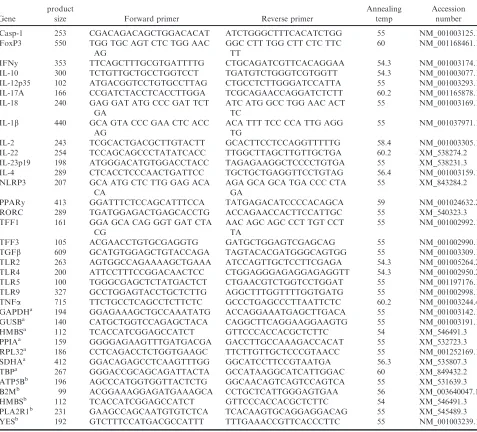
based on publically available gene sequences (Genbank, ENSEMBL) using the Primer3 software (see Table 2).24 A total
of 16 genes were assessed for stability using suitable softwarej with a commercially available canine reference gene arrayk. Based on these data, four reference genes were selected for canine duodenum and five for the colon, respectively (Table 2). Primers were optimized using standard PCRl. Amplicons were
visualized on a 1.5% agarose gel, purifiedm and cloned into a
holding vectorn for subsequent sequencingo and for qPCR
stan-dards (see below).
Quantitative Polymerase Chain Reaction. qPCR reactions were carried out in triplicate at a total reaction volume of 20lL, using a commercially available reagent mixpand a primer concentration
of 200 nM. Cycling steps were: 95°C for 5 min, then 40 cycles of 94°C for 15 s, 55°C for 10 s, 72°C for 10 s and 80°C for 5 s. Reaction efficiency was determined using 10-fold dilutions (107
moleculeslL"1to 101moleculeslL"1) of plasmids containing the
cloned amplicon. Melting curves were generated to ensure a single amplicon had been produced. Averaged gene expression data for each sample were normalized against the geometric mean of the reference genes.25
Genes of Interest. Several genes of the innate immune system interacting with bacteria (Toll-like receptors26,27[TLRs] 2,4,5, and 9
as well as components of the inflammasome,28 NLRP3, casp-1,
interleukin [IL]-1band IL-18) and the adaptive immune response in the intestine were investigated. For the latter, several signature cyto-kines and transcription factors of different T helper lymphocyte (Th) cell lines were assessed. These included Th17 cells (IL-17A, IL-22, IL-23p40, RORC),29,30Th1 cells (IL-12p35, IL-2, TNFa), Th2 cells
(IFNcand IL-4,31and Tregs (IL-10 and TGFb).32
Expression of the so-called trefoil factors (TFF), genes associ-ated with epithelial barrier function and repair,33 also was assessed. The nuclear receptor PPARc, usually responsible for blocking the transcription of inflammatory cytokines34 and
sup-posedly especially up-regulated in intestinal epithelial cells by enterococci,35was investigated additionally.
Dendrograms and Heatmaps from Gene Expression
Data
To facilitate visualization of gene expression data and changes in gene expression among visits of the clinical trial, heatmaps were created using a statistical packageq.
Statistical Analyses
Power Calculation. Clinical severity (as assessed by CCECAI) was selected as the primary outcome measure. Calculations were based on a type I error of 0.05 and a type II error of 0.1, which corresponds to a power of 90%. When assuming a difference (delta,D) of 1.5 times the sd (r) to be medically relevant, the nec-essary number of animals in each group (treatment versus placebo) was determined to be n=11.
Analysis of Clincopathological, Histological and Gene Expression Data. Statistical analysis was performed using 2 commercially available software packagesr,s. Normal distribution was assessed
by inspection of histograms or D’Agostino and Pearson omnibus normality test. Subsequently, either parametric or non-parametric tests were performed: A repeated measures model was used to assess the effect of the treatment interval (before versus after 6 weeks of treatment) and treatment type (EF versus placebo). Kruskal-Wallis ort-tests were performed to compare clinical and clinicopathological data, endoscopy and histology scores on visit 1 between treatment groups. Significance was set atP<0.05.
Results
Patients.
A total of 51 possible cases were identified,
45 cases were recruited, and 28 completed visit 1. The
remaining 17 dogs dropped out for several reasons:
Owners changing their mind about participation in the
study without giving specific reasons (n
=
5), owners
not wanting endoscopy performed (n
=
3), additional
medical problems were discovered before endoscopy
was performed (n
=
3), with 1 dog developing
pro-nounced neurological symptoms that were deemed more
important than the chronic GIT signs, 1 dog collapsing
after sedation for abdominal ultrasound examination
and 1 dog being diagnosed with concurrent
hypothy-roidism, identification of other diseases causing the GIT
signs (n
=
2, with 1 dog having metastatic gastric
carci-noma and the other a pyloric sarcoma), owners not
wanting to complete a 6-weeks food trial (n
=
2),
own-ers wanting to perform a food trial before endoscopy
(n
=
1) and 1 dog that had an aggressive temperament.
Of the remaining 28 dogs, 16 were withdrawn after visit
1 and did not complete the study. Reasons were: failure
to respond to dietary treatment (n
=
6), owner not
wishing to continue with the study without giving
spe-cific reasons (n
=
4), owner objecting to a second
endos-copy procedure (n
=
2), diagnosis of another condition
responsible for the clinical signs (n
=
2; 1 dog with
colonic mucinous adenocarcinoma and 1 dog with
pan-creatitis), dog not eating the hydrolyzed protein diet
(n
=
1), and 1 dog being too di
ffi
cult to handle for a
second period of hospitalization. Thus, a total of 12
dogs finished the clinical trial, including Labrador
Retrievers (n
=
6), Golden Retrievers (n
=
2) and 1 dog
each of the following breeds: Bracco Italiano, English
Setter, Miniature Schnauzer and Standard Poodle. Six
dogs were intact males, two dogs castrated males, and
four dogs were spayed females. Their median age was
40 months (range, 12
–
84 months). Seven dogs had been
Table 2.
List of genes investigated by quantitative reverse-transcriptase real-time PCR with the respective primers
used.
Gene
product
size Forward primer Reverse primer
Annealing temp
Accession number Casp-1 253 CGACAGACAGCTGGACACAT ATCTGGGCTTTCACATCTGG 55 NM_001003125.1 FoxP3 550 TGG TGC AGT CTC TGG AAC
AG
GGC CTT TGG CTT CTC TTC TT
60 NM_001168461.1
IFNy 353 TTCAGCTTTGCGTGATTTTG CTGCAGATCGTTCACAGGAA 54.3 NM_001003174.1 IL-10 300 TCTGTTGCTGCCTGGTCCT TGATGTCTGGGTCGTGGTT 54.3 NM_001003077.1 IL-12p35 102 ATGACGGTCCTGTGCCTTAG CTGCCTCTTGGGATCCATTA 55 NM_001003293.1 IL-17A 166 CCGATCTACCTCACCTTGGA TCGCAGAACCAGGATCTCTT 60.2 NM_001165878.1 IL-18 240 GAG GAT ATG CCC GAT TCT
GA
ATC ATG GCC TGG AAC ACT TC
55 NM_001003169.1
IL-1b 440 GCA GTA CCC GAA CTC ACC AG
ACA TTT TCC CCA TTG AGG TG
55 NM_001037971.1
IL-2 243 TCGCACTGACGCTTGTACTT GCACTTCCTCCAGGTTTTTG 58.4 NM_001003305.1 IL-22 254 TCCAGCAGCCCTATATCACC TTGGCTTAGCTTGTTGCTGA 60.2 XM_538274.2 IL-23p19 198 ATGGGACATGTGGACCTACC TAGAGAAGGCTCCCCTGTGA 55 XM_538231.3 IL-4 289 CTCACCTCCCAACTGATTCC TGCTGCTGAGGTTCCTGTAG 56.4 NM_001003159.1 NLRP3 207 GCA ATG CTC TTG GAG ACA
CA
AGA GCA GCA TGA CCC CTA GA
55 XM_843284.2
PPARy 413 GGATTTCTCCAGCATTTCCA TATGAGACATCCCCACAGCA 59 NM_001024632.2 RORC 289 TGATGGAGACTGAGCACCTG ACCAGAACCACTTCCATTGC 55 XM_540323.3 TFF1 161 GGA GCA CAG GGT GAT CTA
CG
AAC AGC AGC CCT TGT CCT TA
55 NM_001002992.1
TFF3 105 ACGAACCTGTGCGAGGTG GATGCTGGAGTCGAGCAG 55 NM_001002990.1 TGFb 609 GCATGTGGAGCTGTACCAGA TAGTACACGATGGGCAGTGG 55 NM_001003309.1 TLR2 263 AGTGGCCAGAAAAGCTGAAA ATCCAGTTGCTCCTTCGAGA 54.3 NM_001005264.2 TLR4 200 ATTCCTTTCCGGACAACTCC CTGGAGGGAGAGGAGAGGTT 54.3 NM_001002950.2 TLR5 100 TGGGCGAGCTCTATGACTCT CTGAACGTCTGGTCCTGGAT 55 NM_001197176.1 TLR9 327 GCCTGGAGTACCTGCTCTTG AGGCTTTGGTTTTGGTGATG 55 NM_001002998.1 TNFa 715 TTCTGCCTCAGCCTCTTCTC GCCCTGAGCCCTTAATTCTC 60.2 NM_001003244.4 GAPDHa 194 GGAGAAAGCTGCCAAATATG ACCAGGAAATGAGCTTGACA 55 NM_001003142.1
GUSBa 140 CATGCTGGTCCAGAGCTACA CAGGCTTCAGGAAGGAAGTG 55 NM_001003191.1 HMBSa 112 TCACCATCGGAGCCATCT GTTCCCACCACGCTCTTC 54 XM_546491.3 PPIAa 159 GGGGAGAAGTTTGATGACGA GACCTTGCCAAAGACCACAT 55 XM_532723.3 RPL32a 186 CCTCAGACCTCTGGTGAAGC TTCTTGTTGCTCCCGTAACC 55 NM_001252169.1 SDHAa 412 GGACAGAGCCTCAAGTTTGG GGCATCCTTCCGTAATGA 56.3 XM_535807.3
TBPa 267 GGGACCGCAGCAGATTACTA GCCATAAGGCATCATTGGAC 60 XM_849432.2
ATP5Bb 196 AGCCCATGGTGGTTACTCTG GGCAACAGTCAGTCCAGTCA 55 XM_531639.3
B2Mb 99 ACGGAAAGGAGATGAAAGCA CCTGCTCATTGGGAGTGAA 56 XM_003640047.1
HMBSb 112 TCACCATCGGAGCCATCT GTTCCCACCACGCTCTTC 54 XM_546491.3
PLA2R1b 231 GAAGCCAGCAATGTGTCTCA TCACAAGTGCAGGAGGACAG 55 XM_545489.3
YESb 192 GTCTTTCCATGACGCCATTT TTTGAAACCGTTCACCCTTC 55 NM_001003239.1
a
Reference genes for the duodenum.
b
randomly assigned to receive the synbiotic product and
5 to receive placebo.
Clinical and Clinicopathological Data.
The majority
of dogs su
ff
ered from mixed small and large intestinal
clinical signs (n
=
6), 3 had solely small intestinal
clini-cal signs, 2 only chronic vomiting and 1 only large
intestinal diarrhea. Clinical signs at visit 1 were scored
mild to moderate with a median CCECAI of 4 (range,
1
–
6) in the synbiotic group and 5 (range, 2
–
7) in the
placebo group, without a significant di
ff
erence between
groups. In addition, there was no e
ff
ect of probiotic
treatment on CCECAI at visit 2 or 3 compared to visit
1 (
P
=
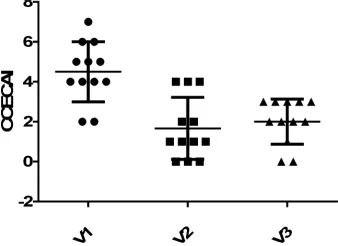
0.72). For both groups combined, CCECAI was
significantly decreased at visits 2 and 3 compared to
visit 1 (
P
<
0.001), but not between visits 2 and 3
(Fig 2).
There were no significant di
ff
erences in hematological
and biochemical variables (including TLI, cPL, folate
and cobalamin) between treatment groups at visit 1.
Serum
folate
concentrations
showed
a
significant
increase with treatment at visit 3 compared to visit 1
(
P
=
0.012). In addition, there was a significant di
ff
er-ence in serum folate concentrations between the 2
treat-ment groups at visit 3 (
P
=
0.012): dogs treated with
placebo had higher serum concentrations of folate
(mean, 21.42
l
g L
"1; SD, 2.56
l
g L
"1) than dogs
trea-ted with the synbiotic (mean, 17.02
l
g L
"1; SD,
1.68
l
g L
"1).
Endoscopic
Findings.
Endoscopic
WSAVA
scores
were low in all areas examined at the initial visit:
esoph-agus median 0 (range, 0
–
6), stomach median 0 (range,
0
–
16), duodenum median 1.5 (range, 0
–
14) and colon
median 0 (range, 0
–
6). Endoscopy scores were even
lower (but not significantly) at visit 3: esophagus
med-ian 0 (range, 0
–
1), stomach median 0 (range, 0
–
3),
duo-denum median 0 (range, 0
–
6) and colon median 0
(range, 0
–
1).
Histopathology.
Median total WSAVA scoring of
his-topathological findings was 3 for the duodenum (range,
1
–
5) and 2 (range, 1
–
5) for the colon at visit 1. At visit
3, the median was 1 (range, 0
–
8) and 3 (range, 0
–
4) for
the duodenum and colon, respectively. There was no
significant di
ff
erence in total scores among visits or
between treatment groups for both sites. In the
duodenum at visit 1, 7 dogs showed a mild increase in
intra-epithelial
lymphocytes,
6
dogs
showed
mild
generalized lymphoplasmacytic infiltration, and 2 dogs
mild eosinophilic inflammation. Duodenal architectural
changes were present in 8 dogs, and included villous
stunting (n
=
5), mucosal fibrosis (n
=
3), lacteal
disten-sion (n
=
2), crypt distension (n
=
2) and epithelial
injury (n
=
2). Mild lacteal dilatation was identified in 2
cases.
In the colon (visit 1), mild lymphoplasmacytic
infiltra-tion was present in six dogs, mild eosinophilic in two
dogs, marked eosinophilic in one dog, and mild
neutro-philic inflammation in two dogs. Architectural changes in
the colon included crypt hyperplasia (n
=
6), crypt
dis-tention and distortion (n
=
4), fibrosis and atrophy
(n
=
3) and mild surface epithelium injury (n
=
1). In 1
dog, the histology of the colon was reported as normal.
Gene Expression.
In both duodenum and colon,
TLR2 and TLR4 were more abundantly expressed than
TLR5, and TLR9 was expressed at the lowest level (see
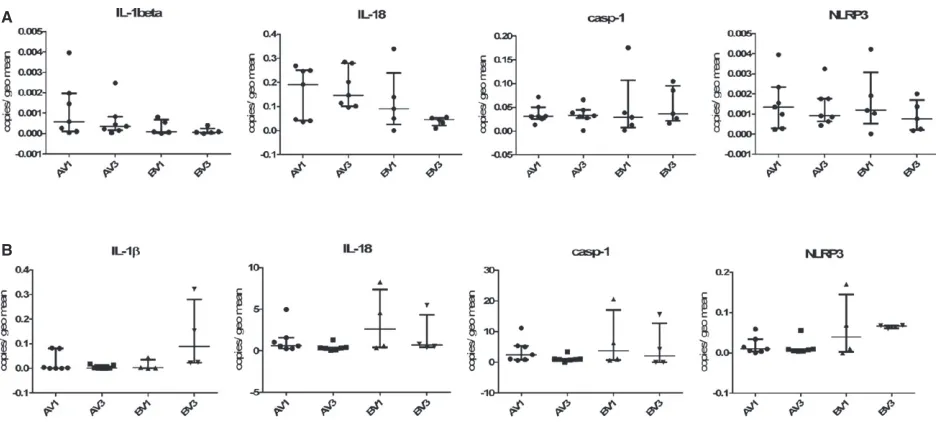
Fig 3). Genes associated with the inflammasome
gener-ally were expressed at a much higher level in the colon
than in the duodenum, especially casp-1 (Fig 4).
There was no expression of IL-17A in any duodenal
sample, although RORC was expressed at a moderate
level (Fig 5). In the colon, IL-17A gene expression was
detectable, but still negligible. Moderate levels of IL-22
and IL-23p19 and high levels of RORC mRNA
expres-sion were present in the colon (see Fig 6).
As observed for other genes, expression levels of Th1
and Th2 cell-related cytokines generally were higher in
the colon than in the duodenum. The IL-12p35 subunit
was most abundantly expressed across all samples,
fol-lowed by IFNy and TNF
a
. IL-2 was expressed at low
levels and IL-4 showed the lowest expression (see
Figs 5, 6).
Of the genes associated with Tregs, TGF
b
showed
the highest expression levels, followed by IL-10,
whereas FoxP3 was undetectable (Figs 5, 6).
TFF1 expression was very low in duodenal samples,
whereas TFF3 was highly expressed. The nuclear
recep-tor PPAR
c
showed decreased gene expression at visit 3
compared to visit 1 in the duodenum (possibly more
pronounced in the placebo-treated group than the
syn-biotic-treated dogs), but these di
ff
erences were not
sta-tistically significant.
For all of the examined genes, there was no
signifi-cant di
ff
erence in expression with regard to time (before
versus after treatment) or treatment (synbiotic versus
placebo).
Heatmaps of Gene Expression.
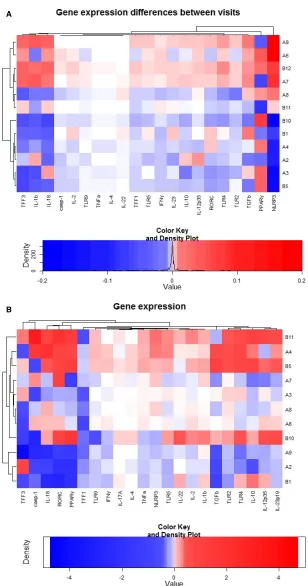
When assessing all
duodenal or colonic samples, there was no clear e
ff
ect
of visit or treatment on di
ff
erences in gene expression,
both by repeat linear mixed modeling including all gene
expression data or by subjective analysis of the
cluster-ing created by the heatmaps and dendrograms (see
Fig 7). Similarly, there was no e
ff
ect of visit or
treat-ment on di
ff
erences in gene expression in the colon by
linear mixed modeling, and the heatmap also showed
no clustering (see Fig 7). Gene expression responses in
both tissue types were very variable among individual
dogs.
Discussion
The objective of the current study was to test the
in vivo
e
ff
ects (clinical outcome and changes in gene
expression in intestinal tissues) of the PO administration
of a synbiotic containing the probiotic EF in dogs with
FRD. Although the number of initially recruited dogs
would have likely been su
ffi
cient to show a di
ff
erence
based on the power calculation, unfortunately, the
drop-out rate was considerable. Hence, no additional
clinical benefit of the administration of the synbiotic
could be demonstrated or excluded. Also, no significant
di
ff
erences in expression of the examined genes were
observed between visit 1 and 3 or between treatment
groups in the duodenum or colon.
A
B
Fig 3. TLR expression in the duodenum (panels A) and colon (panels B) of 12 dogs participating in the clinical trial. V1=pre-treatment visit, V3=after 6 weeks of dietary treatment and either synbiotic (labelled A on the x-axis) or placebo (labelled B on the x-axis) adminis-tration.
A
B
The study population was consistent with the literature
regarding breed distributaion and age of dogs with
CE.
5,36,37Especially, dogs with FRD seem to be
substan-tially younger than dogs su
ff
ering from other forms of
CE.
1,38,39There was no significant correlation between
CCECAI and histopathological scores, a finding that has
been demonstrated before.
36,38However, it is possible
that the dietary trial was not conducted for a su
ffi
cient
period of time for morphological changes to resolve.
Interestingly, in all dogs, serum folate concentrations
increased above the reference range with dietary
treat-ment alone. This was more pronounced in the
placebo-treated group than in the synbiotic group. Because
exocrine pancreatic insu
ffi
ciency had been eliminated in
these dogs, this finding could be indicative of a change
in bacterial composition induced by the dietary
inter-vention, which could have been ameliorated by
probiot-ic treatment. Complementary investigations into the
composition of the intestinal microbiome before
treat-ment unfortunately was not performed. Macroscopic
endoscopy scores and WSAVA histology scores did not
change significantly with treatment, which is consistent
with the literature.
1,36,40,41The gene expression study showed that certain
recep-tors of the innate immune system are di
ff
erentially
expressed in the canine intestine (TLR2 and 4 are more
abundant than TLR5 and 9). This, as well as the fact
that TFF1 is expressed at low levels, whereas TFF3 is
abundantly present, has been reported before.
39,42–44The general notion that there is no Th cell
lineage-asso-ciated cytokine bias in biopsies from dogs with FRD
also could be confirmed
45and was shown to be true for
both the duodenum and the colon.
Most genes investigated were expressed at a higher
level in the colonic mucosa compared to the duodenum.
This is unlikely due to a better preservation or quality
of colonic samples, because RNA quality and quantity
were assessed for all biopsies and quantification of gene
expression was performed relative to several reference
genes that were assessed for their stability across
sam-ples. The increased gene expression levels in the large
intestine could be associated with the larger number of
bacteria present in the lumen compared to numbers in
the small intestine. However, this also did not change
with treatment for FRD or probiotic supplementation.
Limitations of the study included the fact that
(despite all e
ff
orts) it remained underpowered.
There-fore, results regarding the clinical benefit of EF in
canine CE, as well as possible e
ff
ects on gene
expres-sion, must be interpreted with caution. The clinical trial
was designed to only include dogs with FRD and not
other forms of CE. Including more severely a
ff
ected
dogs (with ARD or SRD) needing a variety of
treat-ments would have required even larger numbers of dogs
in each treatment group and might have made it more
di
ffi
cult to assess clinical improvement. Even if the
desired 11 dogs had been recruited per treatment group,
the study might have been underpowered. The choice of
the appropriate data set from the literature to use for a
power calculation is challenging, because usually a
decrease of clinical indices of approximately 75% is
considered consistent with remission.
46However, this
has been demonstrated mostly in dogs with idiopathic
IBD (i.e., SRD), which seem to have much higher
dis-ease activity compared to FRD dogs.
1Because the
expected probiotic e
ff
ect was unknown, power
calcula-tion was di
ffi
cult to conduct.
Also, the dose of EF chosen to be administered to
the dogs of this clinical trial was recommended by the
manufacturer (1
9
10
9CFU once daily). However,
lim-ited data are available to suggest the appropriate
amount of that particular EF strain needed to induce
clinical,
immunological
or
microbiome
alterations.
Administration of 2
–
3
9
10
9CFU/day of a di
ff
erent
EF strain resulted in its persistence in feces for
3 months after cessation of the treatment.
19In addition,
culture of feces before and after treatment with EF was
not performed in this study, which potentially could
have been used to ensure owner compliance of capsule
administration. However, because EF can be part of the
normal fecal flora and the probiotic strain cannot be
di
ff
erentiated from the naturally-occurring EF strains,
the additional benefit of fecal culture is questionable.
In conclusion, this study did not have enough power
to enable a statement regarding a potential additional
e
ff
ect of EF (given as a synbiotic) on clinical signs or
gene expression in intestinal biopsies in dogs with FRD
within a time period of 6 weeks. More studies using a
larger number of dogs or dogs with di
ff
erent forms of
CE are needed to assess the benefit of probiotics in CE
of dogs. Testing of di
ff
erent probiotic strains for their
clinical or anti-inflammatory properties in comparison
with EF also should be considered.
Footnotes
a
Synbiotic D-C; Probiotics International/ Protexin, Somerset, UK
b
Microsoft Office, Excel, Microsoft Cooperation, Redmond, USA
A
B
cPurina Veterinary Diet canine HA Hypo Allergenic, Purina,
Nes-tle, York, UK
dRNAlater (Ambion, UK) e
Qiagen (Manchester, UK)
f
Mixer Mill MM300 tissue grinder (Retch, Leeds, UK)
g
RNeasy micro kit (Qiagen)
h
Eukaryote Total RNA Nano chip, Agilent Bioanalyzer, Agilent Technologies, Wokingham, UK)
iiScript cDNA synthesis kit (Bio-Rad, Hemel Hampstead, UK) jqBase/GeNorm software (Biogazelle, Gent, Belgium)
kPrimerDesign Ltd., Southampton, UK) lImmolase polymerase, Bioline, London, UK) mWizard SV Gel and PCR clean-up system (Promega) npGemT-Easy vector (Promega)
oSource Bioscience, Cambridge, UK
pSsoFast Evagreen Supermix (Bio-Rad, Hemel Hampstead, UK) qThe R project for statistical computing; www.r-project.org;
“gplots” package; function heatmap.2
r
SPSS (IBM SPSS statistics, version 19.0)
s
Graph Pad Prism Version 5 (Graph Pad Software Inc., La Jolla, California, USA)
Acknowledgments
The authors thank the owners of the dogs
participat-ing in this study for takparticipat-ing part, as well as the help of
the sta
ff
of the Queen Mother Hospital for Animals
and the Clinical Investigation Centre of the RVC for
their support in recruiting cases and acquiring all
neces-sary samples and data. Additional thanks go to Dr.
Victoria O
ff
ord (Bioinformatics Unit of the RVC) for
her help with using the statistical programme “R” and
creating the heat maps. The study was supported by the
BBSRC with a studentship with Probiotics International
Ltd., Somerset, UK. The RVC manuscript approval
number is CSS_00823.
Conflict of Interest Declaration
: Authors disclose no
conflict of interest.
O
ff
-label Antimicrobial Declaration
: Authors declare
no o
ff
-label use of antimicrobials.
References
1. Allenspach K, Wieland B, Grone A, Gaschen F. Chronic€
enteropathies in dogs: evaluation of risk factors for negative out-come. J Vet Intern Med 2007;21:700–708.
2. Jergens AE, Moore FM, Haynes JS, Miles KG. Idiopathic inflammatory bowel disease in dogs and cats: 84 cases (1987–
1990). J Am Vet Med Assoc 1992;201:1603–1608.
3. German AJ, Hall EJ, Day MJ. Chronic intestinal inflamma-tion and intestinal disease in dogs. J Vet Intern Med 2003;17:8–
20.
4. Suchodolski JS, Xenoulis PG, Paddock CG, et al. Molecular analysis of the bacterial microbiota in duodenal biopsies from dogs with idiopathic inflammatory bowel disease. Vet Microbiol 2010;142:394–400.
5. Suchodolski JS, Markel ME, Garcia-Mazcorro JF, et al. The fecal microbiome in dogs with acute diarrhea and idiopathic inflammatory bowel disease. PLoS ONE 2012;7:e51907.
6. Xenoulis PG, Palculict B, Allenspach K, et al. Molecular-phylogenetic characterization of microbial communities imbalances in the small intestine of dogs with inflammatory bowel disease. FEMS Microbiol Ecol 2008;66:579–589.
7. van Baarlen P, Troost FJ, van Hemert S, et al. Differential NF-kappaB pathways induction by Lactobacillus plantarum in the duodenum of healthy humans correlating with immune tolerance. Proc Natl Acad Sci USA 2009;106:2371–2376.
8. Di Caro S, Tao H, Grillo A, et al. Effects of Lactobacillus GG on genes expression pattern in small bowel mucosa. Dig Liver Dis 2005;37:320–329.
9. Foligne B, Zoumpopoulou G, Dewulf J, et al. A key role of dendritic cells in probiotic functionality. PLoS ONE 2007;2:e313.
10. Thomas CM, Versalovic J. Probiotics-host communication: modulation of signaling pathways in the intestine. Gut Microbes 2010;1:148–163.
11. Shida K, Nanno M, Nagata S. Flexible cytokine production by macrophages and T cells in response to probiotic bacteria: a possible mechanism by which probiotics exert multifunctional immune regulatory activities. Gut Microbes 2011;2:109–114.
12. Bellavia M, Rappa F, Lo Bello M, et al. Lactobacillus casei and bifidobacterium lactis supplementation reduces tissue damage of intestinal mucosa and liver after 2,4,6-trinitrobenzenesulfonic acid treatment in mice. J Biol Regul Homeost Agents 2014;28:251–261.
13. Jeon SG, Kayama H, Ueda Y, et al. Probiotic Bifidobacte-rium breve induces IL-10-producing Tr1 cells in the colon. PLoS Pathog 2012;8:e1002714.
14. Linskens RK, Huijsdens XW, Savelkoul PH, et al. The bac-terial flora in inflammatory bowel disease: current insights in path-ogenesis and the influence of antibiotics and probiotics. Scand J Gastroenterol Suppl 2001;234:29–40.
15. Sauter SN, Benyacoub J, Allenspach K, et al. Effects of probiotic bacteria in dogs with food responsive diarrhoea treated with an elimination diet. J Anim Physiol Anim Nutr (Berl) 2006;90:269–277.
16. Rossi G, Pengo G, Caldin M, et al. Comparison of micro-biological, histological, and immunomodulatory parameters in response to treatment with either combination therapy with pred-nisone and metronidazole or probiotic VSL#3 strains in dogs with idiopathic inflammatory bowel disease. PLoS ONE 2014;9: e94699.
17. Sokol H, Pigneur B, Watterlot L, et al. Faecalibacterium prausnitzii is an anti-inflammatory commensal bacterium identified by gut microbiota analysis of Crohn disease patients. Proc Natl Acad Sci USA 2008;105:16731–16736.
18. Marcin"akov"a M, Klingberg TD, Laukov"a A, Budde BB. The effect of pH, bile and calcium on the adhesion ability of pro-biotic enterococci of animal origin to the porcine jejunal epithelial cell line IPEC-J2. Anaerobe 2010;16:120–124.
19. Marcin"akov"a M, Simonov"a M, Strompfov"a V, Laukov"a A. Oral application of Enterococcus faecium strain EE3 in healthy dogs. Folia Microbiol. (Praha) 2006;51:239–242.
20. Washabau RJ, Day MJ, Willard MD, et al. Endoscopic, biopsy, and histopathologic guidelines for the evaluation of gastro-intestinal inflammation in companion animals. J Vet Intern Med 2010;24:10–26.
21. Day MJ, Bilzer T, Mansell J, et al. Histopathological stan-dards for the diagnosis of gastrointestinal inflammation in endo-scopic biopsy samples from the dog and cat: a report from the World Small Animal Veterinary Association Gastrointestinal Stan-dardization Group. J Comp Pathol 2008;138(Suppl 1):S1–S43.
22. Procoli F, M~otskula PF, Keyte SV, et al. Comparison of€
histopathologic findings in duodenal and ileal endoscopic biopsies in dogs with chronic small intestinal enteropathies. J Vet Intern Med 2013;27:268–274.
24. Rozen S, Skaletsky H. Primer3 on the WWW for general users and for biologist programmers. Methods Mol Biol 2000;132:365–386.
25. Vandesompele J, de Preter K, Pattyn F, et al. Accurate nor-malization of real-time quantitative RT-PCR data by geometric averaging of multiple internal control genes. Genome Biol 2002;3: RESEARCH0034.
26. Abreu MT. Toll-like receptor signalling in the intestinal epi-thelium: how bacterial recognition shapes intestinal function. Nat Rev Immunol 2010;10:133–141.
27. Tyrer P, Foxwell AR, Cripps AW, et al. Microbial pattern recognition receptors mediate M-cell uptake of a gram negative bacterium. Infect Immun 2006;74:625–631.
28. Cario E. Heads up! How the intestinel epithelium safe-guards mucosal barrier immunity through the inflammasome and beyond. Curr Opin Gastroenterol 2010;26:583–590.
29. Hirota K, Martin B, Veldhoen M. Development, regulation and functional capacities of Th17 cells. Semin Immunopathol 2010;32:3–16.
30. Kanai T, Mikanmi Y, Sujuno T, et al. RORyt-dependent IL-17A-producing cells in the pathogenesis of intestinal inflamma-tion. Mucosal Immunol 2012;5:240–247.
31. Mosmann TR, Coffman RL. Th1 and Th2 cells: different patterns of lymphokine secretion lead to different functional prop-erties. Annu Rev Immunol 1989;7:145–173.
32. Fontenot JD, Gavin MA, Rudensky AY. FoxP3 programs the development and function of CD4+CD25+ regulatory T-cells. Nat Immunol 2003;4:330–336.
33. Thim L. Trefoil peptides: from structure to function. Cell Mol Life Sci 1997;53:888–903.
34. Wahli W, Michalik L. PPARs at the crossroads of lipid signal-ling and inflammation. Trends Endocrinol Metab 2012;23:351–363.
35. Are A, Aronsson L, Wang S, et al. Enterococcus faecalis from newborn babies regulates endogenous PPARgamma activity and IL-10 levels in colonic epithelial cells. Proc Natl Acad Sci USA 2008;106:1943–1948.
36. Schreiner NMS, Gaschen F, Grone A, et al. Clinical signs,€
histology, and CD3-positive cells before and after treatment of dogs with chronic enteropathies. J Vet Intern Med 2008;22:1079–1083.
37. Mandigers PJJ, Biourge V, van den Ingh TSGAM, et al. A randomized, open-label, positively-controlled field trial of a hydro-lyzed protein diet in dogs with chronic small bowel enteropathy. J Vet Intern Med 2010;24:1350–1357.
38. Walker D, Knuchel-Takano A, McCutchan A, et al. A comprehensive pathological survey of duodenal biopsies from dogs with diet-responsive chronic enteropathy. J Vet Intern Med 2013;27:862–874.
39. Allenspach K, House A, Smith K, et al. Evaluation of mucosal bacteria and histopathology, clinical disease activity and expression of Toll-like receptors in German shepherd dogs with chronic enteropathies. Vet Microbiol 2010;146:326–335.
40. Luckschander N, Allenspach K, Hall J, et al. Perinuclear antineutrophilic cytoplasmic antibody and response to treatment in diarrheic dogs with food responsive disease or inflammatory bowel disease. J Vet Intern Med 2006;20:221–227.
41. Gaschen L, Kircher P, Stussi A, et al. Comparison of ultr-€
asonographic findings with clinical activity index (CIBDAI) and diagnosis in dogs with chronic enteropathies. Vet Radiol Ultra-sound 2008;49:656–664.
42. McMahon LA, House AK, Catchpole B, et al. Expression of Toll-like receptor 2 in duodenal biopsies from dogs with inflam-matory bowel disease is associated with severity of disease. Vet Immunol Immunopathol 2010;135:158–163.
43. Burgener IA, K€onig A, Allenspach K, et al. Upregulation of toll-like receptors in chronic enteropathies in dogs. J Vet Intern Med 2008;22:553–560.
44. Schmitz S, Hill S, Werling D, Allenspach K. Expression of trefoil factor genes in the duodenum and colon of dogs with inflammatory bowel disease and healthy dogs. Vet Immunol Im-munopathol 2013;151:168–172.
45. Jergens AE, Sonea IM, O’Connor AM, et al. Intestinal cytokine mRNA expression in canine inflammatory bowel disease: a meta-analysis with critical appraisal. Comp Med 2009;59:153–
162.