Effects of spinal manipulation versus therapeutic
exercise on adults with chronic low back pain: a
literature review
Alban Merepeza, BA, DC*
* Port Hope Health Centre 181 Toronto Rd. Unit 6 Port Hope ON, L1A 3V5
[email protected] Tel: 905-885-5111
©JCCA 2014
Background Context: Chronic low back pain (CLBP) is a prevalent disorder that has a significant burden to society in terms of loss of work time and increased economic cost. Two common treatment choices of intervention for CLBP are spinal manipulation and prescribed exercise.
Purpose: The purpose of this systematic review was to examine the effectiveness of spinal manipulation vs prescribed exercise for patients diagnosed with CLBP. Studies that compared head-to-head spinal manipulation to an exercise group were included in this review. Methods: A search of the current literature was conducted using a keyword process in CINAHL, Cochrane Register of Controlled Trials Database, Medline, and Embase. The search was conducted on, and included studies available up to August 29th 2014. Studies were included based on PICOS criteria 1) individuals with CLBP defined as lasting 12 weeks or longer; 2) spinal manipulation performed by a health care practitioner; 3) prescribed exercise for the treatment of CLBP and monitored by a health
Historique : La lombalgie chronique est un trouble fréquent qui devient un lourd fardeau pour la société, en perte de temps au travail et en augmentation du coût économique. La manipulation vertébrale et la prescription d’exercices représentent deux choix de traitement courants pour la lombalgie chronique. Objectif : Le but de cette analyse systématique était d’examiner l’efficacité des manipulations vertébrales par rapport aux exercices pour les patients atteints de lombalgie chronique. Les études qui ont comparé directement la manipulation vertébrale à un groupe suivant des exercices ont été intégrées dans cette analyse.
Introduction
Chronic low back pain (CLBP), defined as pain lasting 3 months or more, is a major cause of disability in indus-trialized societies and more than 80% of the health care resources for back pain are utilized on these patients.1,2,3
CLBP can arise from a variety of anatomical structures or can be part of an array of pathologies of the spine and therefore require different treatments depending on its cause.4 It is estimated that 80-90% of patients are
diag-nosed with low back pain arising from non-specific mech-anical reasons.4,5 Most patients suffering with CLBP are
treated non-operatively with a variety of conservative treatments.4
The rehabilitation health care professionals treating CLBP patients often employ a variety of modalities
in-cluding therapeutic exercise and spinal manipulation.4,6,7
Some studies have found that the treatment of CLBP with spinal manipulative therapy may significantly decrease pain and improve function.4,6,7 Therapeutic exercise has
also been shown to provide improvement on pain and functioning.4,6 There have been many studies assessing
the benefits of either treatment on patients with CLBP, however the majority of these studies have focused on investigating each treatment on their own. There are sig-nificantly fewer studies that have investigated and com-pared both treatments head-to-head in the treatment of CLBP.
To the author’s knowledge, there has been only one previous systematic review that has examined studies comparing head-to-head the effectiveness of spinal ma-care practitioner; 4) measurable clinical outcomes
for reducing pain, disability or improving function; 5) randomized controlled trials. The quality of included articles was determined by the author using the criteria developed and used by the Physiotherapy Evidence Database (PEDro).
Results: Three randomized controlled trials met the inclusion criteria of this systematic review and were included in this review. The outcomes used in these studies included Disability Indexes, Pain Scales and function improvement scales. The results included a mix of effects with one study finding spinal manipulation as more effective and another finding the exercises more so. The third study found both interventions offering equal effects in the long term.
Conclusion: Based on the findings of this systematic review there is no conclusive evidence that clearly favours spinal manipulation or exercise as more effective in treatment of CLBP. More studies are needed to further explore which intervention is more effective.
(JCCA 2014; 58(4):456-466)
k e y w o r d s: back pain, chronic, spinal manipulation,
exercise, chiropractic
la douleur, l’invalidité ou améliorer la fonction; 5) essais cliniques randomisés. La qualité des articles retenus a été arrêtée par l’auteur à partir des critères développés et utilisés par la base de données factuelles de physiothérapie (Physiotherapy Evidence Database – PEDro).
Résultats : Trois essais cliniques randomisés
répondaient aux critères d’admissibilité à cette analyse systématique et donc ont été inclus dans cette analyse. Les résultats utilisés dans ces études comprenaient des indices d’invalidité, des échelles de la douleur et des échelles d’amélioration de la fonction. Les résultats comprenaient un mélange d’effets, une étude montrant l’efficacité supérieure de la manipulation vertébrale alors qu’une autre concluait que les exercices étaient plus efficaces. La troisième étude a conclu que les deux interventions offraient les mêmes effets à long terme. Conclusion : En fonction des résultats de cette analyse systématique, on ne peut pas déduire de façon concluante et claire si la manipulation vertébrale ou les exercices sont plus efficaces dans le traitement de la lombalgie chronique. Il faut mener d’autres études pour explorer davantage laquelle des interventions est plus efficace.
(JCCA 2014; 58(4):456-466)
m o t s c l é s : lombalgie, chronique, manipulation
nipulation and exercise in treating CLBP.8 However, that
systematic review defined CLBP as 6 weeks or more in duration where as in the current review it is defined as 12 weeks or more in duration.
Spinal manipulation and exercise are important modal-ities that play a central role in the treatment of CLBP.9
This paper aims to summarize the available research evidence comparing the effects of spinal manipulation and therapeutic exercise [on disability or pain] related to chronic low back pain in adults.
Methods Study Design
The author used Preferred Reporting Items for
System-atic Reviews and Meta-analysis (PRISMA).10 PRISMA
can be used to report systematic reviews of various forms of research but is most appropriate for randomized con-trolled trials.10
Eligibility Criteria
Decisions for inclusion of published studies were based on the following Population, Intervention, Control, Out-comes, and Study design (PICOS) criteria11 defined for
this systematic review as: Inclusion criteria:
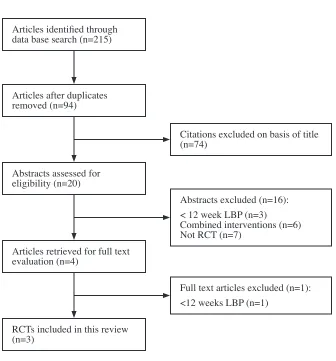
Patients: human adult participants (18 years of age or older) with low back pain persisting 12 weeks or longer. Intervention: spinal manipulative therapy, defined as high velocity and low amplitude thrust and/or manual Articles identified through
data base search (n=215)
Articles after duplicates removed (n=94)
Abstracts assessed for eligibility (n=20)
Articles retrieved for full text evaluation (n=4)
RCTs included in this review (n=3)
Citations excluded on basis of title (n=74)
Abstracts excluded (n=16): < 12 week LBP (n=3)
Combined interventions (n=6) Not RCT (n=7)
Full text articles excluded (n=1): <12 weeks LBP (n=1)
mobilization of vertebral joints, must be performed by a health care practitioner (chiropractor, physiotherapist or other manual health care practitioner).
Comparison: exercise must be prescribed specifically for the treatment of CLBP and monitored by a health care professional.
Outcome: pain, disability or quality of life scores, not limited to one specific measure. No restriction on length of follow up.
Study Design: published randomized controlled trials Additional inclusion criteria: Studies must be published and in the English Language (due to limited resources to translate from other languages). The search was not re-stricted by publication date to avoid exclusion of relevant studies.
Exclusion criteria:
• Studies that used CLBP subjects diagnosed with spinal stenosis, spondylolisthesis (2nd degree or more), lum-bar scoliosis (>20’ or more), previous vertebral frac-tures, systemic causes of CLBP (rheumatoid arthritis), psychiatric or cognitive co-morbidities.
• Studies that used CLBP patients diagnosed with specif-ic spinal pathologies including malignancies, inflam-matory joint disease and bone disease and/or disc prolapsed or herniations with or without neurological compromise.
Search Strategy
A keyword search in CINAHL, Cochrane Register of Controlled Trials Database, Medline, and Embase was conducted on August 29th 2014. The keywords used were
manipulation, exercise, and chronic low back pain. The search was completed by combining the keywords with AND. Limits applied were human and English language. In addition to the above primary database search, the reference lists of included studies and systematic reviews of similar topics were screened for relevant studies that were not produced by the database search.8,12 This was
done to ensure that no relevant study was missed in the search.
Study Selection
The review process was completed systematically as fol-lows 1) title search, 2) abstract search, and 3) full text search for relevance. The reason for excluding articles at step 2 and 3 are described.
Risk of Bias
Each of the included articles was reviewed by the auth-or and scauth-ored with the Physiotherapy Evidence Database (PEDro) quality assessment tool.13 This retrospective
quality assessment tool was designed to evaluate the internal validity and statistical reporting of randomized controlled trials. The PEDro scale consists of 11 items that pertain to the quality of RCTs. The highest score of 11/11 represents the highest possible quality and the low-est risk of bias whereas 0/11 is the lowlow-est possible quality. Results
Risk of Bias Within Studies
Risk of bias within the individual studies was assessed using the PEDro scale and results are as follows. One study scored 9/1114, the second study scored 8/119, and
the third study scored 9/1115. None of the three studies
met criteria five and six (blinding of all the subjects and of all therapists administering therapy respectively).
One study15 carried a participant selection bias risk.
All of the participants were recruited through public hos-pitals, were unemployed and from low socioeconomic status. Studies show that CLBP patients from low soci-oeconomic status may be harder to treat.16 This may put
the external validity of the study to the general population into question.
Another study9 may have a participant selection bias.
All the participants were recruited at a public national health service at their physiotherapy department. These participants were all referred to this department and had not sought other choices such as private care or other health care practitioners that provide spinal manipulation such as chiropractors, osteopaths, or other practitioners trained in spinal manipulation. Thus, the external validity of the results might be questionable.
Risk of Bias for all Studies
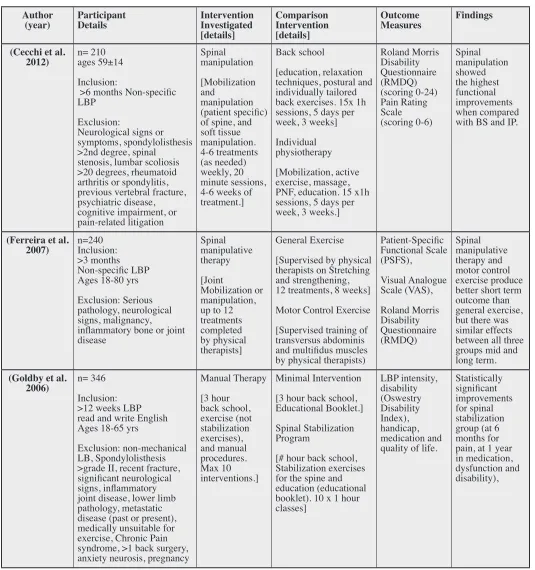
cat-Table 1.
Characteristics of Individual Studies
Author
(year) Participant Details Intervention Investigated [details] Comparison Intervention [details] Outcome Measures Findings
(Cecchi et al.
2012) n= 210 ages 59±14 Inclusion:
>6 months Non-specific LBP
Exclusion:
Neurological signs or symptoms, spondylolisthesis >2nd degree, spinal
stenosis, lumbar scoliosis >20 degrees, rheumatoid arthritis or spondylitis, previous vertebral fracture, psychiatric disease, cognitive impairment, or pain-related litigation Spinal manipulation [Mobilization and manipulation (patient specific) of spine, and soft tissue manipulation. 4-6 treatments (as needed) weekly, 20 minute sessions, 4-6 weeks of treatment.]
Back school
[education, relaxation techniques, postural and individually tailored back exercises. 15x 1h sessions, 5 days per week, 3 weeks] Individual physiotherapy [Mobilization, active exercise, massage, PNF, education. 15 x1h sessions, 5 days per week, 3 weeks.]
Roland Morris Disability Questionnaire (RMDQ) (scoring 0-24) Pain Rating Scale (scoring 0-6) Spinal manipulation showed the highest functional improvements when compared with BS and IP.
(Ferreira et al.
2007) n=240 Inclusion: >3 months Non-specific LBP Ages 18-80 yrs Exclusion: Serious pathology, neurological signs, malignancy, inflammatory bone or joint disease Spinal manipulative therapy [Joint Mobilization or manipulation, up to 12 treatments completed by physical therapists]
General Exercise [Supervised by physical therapists on Stretching and strengthening, 12 treatments, 8 weeks] Motor Control Exercise [Supervised training of transversus abdominis and multifidus muscles by physical therapists)
Patient-Specific Functional Scale (PSFS), Visual Analogue Scale (VAS), Roland Morris Disability Questionnaire (RMDQ) Spinal manipulative therapy and motor control exercise produce better short term outcome than general exercise, but there was similar effects between all three groups mid and long term.
(Goldby et al.
2006) n= 346
Inclusion: >12 weeks LBP read and write English Ages 18-65 yrs
Exclusion: non-mechanical LB, Spondylolisthesis >grade II, recent fracture, significant neurological signs, inflammatory joint disease, lower limb pathology, metastatic disease (past or present), medically unsuitable for exercise, Chronic Pain syndrome, >1 back surgery, anxiety neurosis, pregnancy
Manual Therapy [3 hour back school, exercise (not stabilization exercises), and manual procedures. Max 10 interventions.] Minimal Intervention [3 hour back school, Educational Booklet.] Spinal Stabilization Program
[# hour back school, Stabilization exercises for the spine and education (educational booklet). 10 x 1 hour classes] LBP intensity, disability (Oswestry Disability Index), handicap, medication and quality of life.
egorised as shown in Table 1 based on Levels of Evidence (Centre for Evidence Based Medicine, 2011).17 These
studies met all the PICOS criteria. The other studies that did not meet all the PICOS criteria were excluded. There were no additional relevant studies identified by search-ing the reference list of the three chosen studies.
One study14 reported that spinal manipulation is more
ef-fective than individual physiotherapy or back school in reducing disability as measured by RMDQ at discharge time. More importantly, this improvement held con-sistently on all the follow-ups. Pain relief was also re-duced at discharge time and maintained over the 3, 6, and 12 months follow ups. Furthermore, the spinal manipu-lation group also experienced a lower use of pain related medication during the period of follow-ups. Interestingly, in the follow ups it was found that after discharge, the spinal manipulation group sought care more frequently than the individual physiotherapy group or back school. This occurred despite their pain reduction at discharge, 3, 6, and 12 months follow ups.
The back school and individual physiotherapy pro-vided similar results in the short term when compared to baseline however the individual physiotherapy subjects experienced more recurrences of frequent constant low back pain in the follow-ups and this difference became significant at 3 and 6 months from the baseline. Thus, back school appears to have provided better results than individual physiotherapy when it comes to promoting ac-tive treatment as the subjects experienced significantly less recurrences on all the follow-ups.
The second study15 reported the motor control
exer-cise group and the spinal manipulative therapy group had slightly better outcomes than the general exercise group at 8 weeks but all three groups had similar outcomes at 6 and 12 months follow-ups. The results show that in the short term the motor control exercise and spinal manipu-lative therapy groups have better function and perception of effect than the general exercise group but this does not hold on the long term.
The third study9 reported that a spinal stabilization
pro-gram is significantly more effective than manual therapy in all of the outcomes. It reduced pain intensity, disability, dysfunction, medication intake and improved the quality of life in patients with CLBP. Manual therapy was signifi-cantly more effective than a spinal stabilization program or minimal intervention in one outcome, pain. However
this was only significant with patients with the highest intensity.
Discussion
Three randomized controlled trials were reviewed in or-der to determine the effectiveness of spinal manipulation and therapeutic exercise on disability or pain related to CLBP in adults.
Cechi et al (2012) found that spinal manipulation showed the best improvement when compared with in-dividual physiotherapy. Spinal manipulation appears to have produced the best results in both outcomes, pain re-duction and improved function, however this has not been able to promote active self-treatment. This implies that spinal manipulation therapy depends on the availability of a specialist in spinal manipulation.
Ferreira et al (2007) found that spinal manipulation therapy and motor control exercise are better at reducing pain and disability than general exercise in the short term but not in the long term. All three interventions produce similar results in the long term. These results suggest that spinal manipulation therapy is an appropriate treatment modality for CLBP patients with high intensity pain. However, it should be utilized in conjunction with other modalities in order to have the best results in reducing disability, handicap and improving the quality of life. Goldby et al (2006) found that spinal stabilization exercises were more effective than manual therapy in reducing pain intensity and disability and dysfunction. Interestingly, manual therapy was more effective in re-ducing pain in patients with the highest intensity.
These studies offer a glimpse of the literature available in general and suggest that there does not appear to be clear answers or conclusive evidence as to which treat-ment, spinal manipulation or exercise, is more effective in treating CLBP.
Perhaps the difficulties in finding conclusive evidence may lay in the entity of CLBP itself. It is by nature a heterogeneous entity that comprises a myriad of clinical signs and symptoms to offer different clinical scenarios in which a practitioner chooses an algorithm to diagnose CLBP. Then, the treatment choices are also a multitude of components that comprise exercise, manual therapy and spinal manipulation or any permutation of these.12,18
the literature on what it exactly entails. In many cases it may include high-velocity thrust techniques or manu-al mobilization of the involved anatomicmanu-al structures. In other cases, such as in one of the studies included in this review9 it did not provide sufficient detail on what manual
therapy procedures are.
Another difficulty when dealing with spinal manipu-lation or spinal manipumanipu-lation therapy, is that it is not an exact science and it cannot be measured directly, and as such it offers variability on its delivery and therefore the potential for error in measurement of effects. This is made more so by the fact that it is delivered by a variety of health care practitioners that have different training and different modes of delivery. This may make the study of the effects of spinal manipulation on CLBP more challenging espe-cially when comparing studies in a systematic review. This is in fact a major limitation of this review that the variables of spinal manipulation and exercise differ and vary significantly from each of the studies. This non-uni-formity of variables makes it difficult to compare the studies or generalize on the results.
More comprehensive studies are required with more rigorous design, better defined sub-groups of CLBP pa-tients, clearly defined interventions including cost-effect-iveness in order for us to provide better evidence to guide practice.
Uncovering the evidence is crucially important for the chiropractic profession as spinal manipulation therapy and LBP have been the corner stone of our existence and will likely play as crucial a role in our future.
Conclusion
It is evident from the literature review that there is no conclusive evidence favouring either exercise (of vari-ous forms) or spinal manipulation as treatment of choice to provide effective improvements on patients with CLBP.9,12,14,15,18 For patients diagnosed with CLBP, joint
mobilization and/or manipulation does not appear to provide better results than lumbar stabilization exercise programs. In this review, three studies offered different evidence as to which treatment is more effective.9,14,15 In
one study9 prescribed therapeutic exercise provided
sig-nificant improvements to CLBP patients when compared with spinal manipulation therapy where as in another study14 spinal manipulation offered the most
improve-ments.
It is also evident from the literature review that the na-ture of CLBP is heterogeneous in terms of the cause, and as such, it is no surprise that the treatment choices are not definitive in their effectiveness in improving all CLBP. Further research that compares both treatments is re-quired to definitively identify the most effective choice of treatment for individuals suffering from CLBP.
References
1. Dagenais S, Caro J, Haldeman S. A systematic review of low back pain cost of illness studies in the United States and internationally. Spine J. 2008; 88:8–20.
2. Waddell G. The back pain revolution. (1998) London: Churchill Living-Stone.
3. Waddell G. Low back pain: a twentieth century health care enigma. Spine. 1996; 21:2820-5.
4. Christopher J, Friedly J, Erwin M, Lee M, Rechtine G, Henrikson N, Norvell D. Comparative effectiveness of exercise, acupuncture and spinal manipulation for low back pain. Spine. 2011; 36: 120-130.
5. Dagenais S, Tricco AC, Haldeman S. Synthesis of recommendations for the assessment and management of low back pain from recent clinical practice guidelines. Spine J. 2010;10(6):514–29.
6. Assendelft WJJ, Morton SC, Yu EI et al. Spinal
manipulative therapy for low back pain: a meta- analysis of effectiveness relative to other therapies. Ann Intern Med. 2004;138:871-81.
7. Flynn T, Fritz J, Whitman J. A clinical prediction rule for classifying patients with low back pain who demonstrate short-term improvement with spinal manipulation. Spine. 2002;27:2835-2843.
8. Dvorak, H, Kujat C, Brumitt J. Effect of therapeutic exercise versus manual therapy on athletes with chronic low back pain. J Sport Rehab. 2011; 20:494-504. 9. Goldby JL, Moore A, Doust J, Trew M. A randomized
controlled trial investigating the efficiency of musculoskeletal physiotherapy on chronic low back disorder. Spine. 2006; 31(10):1083-1093.
10. Moher D, Liberati A, Tetzlaff J, Altman DG, The PRISMA Group (2009). Preferred Reporting Items for Systematic Reviews and Meta-Analyses: The PRISMA Statement. Open Med 2009; 3(3); 123-130
11. Stone PW. Popping the (PICO) question in research and evidence-based practice. Appl Nurs Res. 2002; 15:197-8. 12. Rasmussen-Barr E, Nilsson-Wikmar L, Arvidsson I.
Stabilizing training compared with manual treatment in sub-acute and chronic low-back pain. Manual Therapy. 2003; 8(4): 233-241.
Chiti M, Zaina F, Macchi C, Molino-Lova R. Predictors of functional outcome in patients with chronic low back pain undergoing back school, individual physiotherapy or spinal manipulation. Eur J Phys Rehab Med. 2012;48: 371-378.
15. Ferreira M, Ferreira P, Latimer J, Herbert R, Maher C. Does spinal manipulative therapy help people with chronic low back pain? Austr J Physio. 2002; 48:277-284.
16. Croft PR, Rigby AS. Socioeconomic influences on back problems in the community in Britain. J Epidemiology Community Health. 1994; 48(2): 166–170.
17. Howick J, Chalmers I, Glasziou P, Greenhalgh T, Heneghan C, Liberati A, Moscheti I, Phillis B, Thornton H, Goddard O, Hodgkinson M. The Oxford 2011 levels of evidence. Retrieved from Oxford Centre for Evidence-Based Medicine (2011) website: http://www.cebm.net/ index.aspx?o=5653
Appendix A
Search Strategy and Search Results
Database: Embase, 1974 to 2014 August 28, 2014
1 manipulation.mp. (77551) 2 exercise.mp. (329457)
3 chronic low back pain.mp. (5254) 4 1 and 2 and 3 (51)
5 limit 4 to (human and english language) (45)
Database: Ovid MEDLINE(R), 1996 to August 28, 2014
1 manipulation.mp. (44646) 2 exercise.mp. (151252)
3 chronic low back pain.mp. (2880) 4 1 and 2 and 3 (48)
5 limit 4 to (english language and humans) (45)
Database: CINAHL, 1982 to August 29, 2014
Search ID# Search Terms Search Options Results
S5 S1 AND S2 AND S3 Limiters – English Language Search modes – Boolean/Phrase 43 S4 S1 AND S2 AND S3 Search modes – Boolean/Phrase 44 S3 “chronic low back pain” Search modes – Boolean/Phrase 1,875 S2 “exercise” Search modes – Boolean/Phrase 78,372 S1 “manipulation” Search modes – Boolean/Phrase 8,814
Cochrane Central Register of Controlled Trials searched August 29, 2014
There are 47 results from 800283 records for the search on ‘manipulation in Title, Abstract, Keywords and exercise in Title, Abstract, Keywords and chronic low back pain in Title, Abstract, Keywords in Trials’
PUBMED, searched August 29 2014
Appendix B Final Articles Eliminated
1. Aure OF, Nilsen JH, Vasseljen O. Manual therapy and exercise therapy in patients with chronic low back pain: a randomized, controlled trial with 1-year follow-up... including commentary by Lindström I. Spine. 2003; 28(6): 525-532.
2. Balthazard P, et al. Manual therapy followed by specific active exercises versus a placebo followed by specific active exercises on the improvement of functional disability in patients with chronic non specific low back pain: a randomized controlled trial. BMC Musculoskeletal Disorders. 2012; 13:162 DOI: 10.1186/1471-2474-13-162. 3. Bronfort G, et al. Evidence-informed management of chronic low back pain with spinal manipulation and
mobilization. Spine J. 2008; 8(1): 213-225.
4. Bronfort G, et al. Supervised exercise, spinal manipulation, and home exercise for chronic low back pain: a randomized clinical trial. Spine J. 2011; 11:585-98 DOI: 10.1016/j.spinee.2011.01.036.
5. Brox JI, et al. Is exercise therapy and manipulation effective in low back pain? Tidsskrift for den Norske lægeforening: tidsskrift for praktisk medicin, ny række. 1999; 119: 2042-50.
6. Cecchi F, et al. Spinal manipulation provides better short and long-term reduction in pain and disability for patients with non-specific chronic low back pain. Focus on Alternative and Complementary Therapies. 2010; 15(2): 137-138.
7. Cecchi, F, et al. Spinal manipulation compared with back school and with individually delivered physiotherapy for the treatment of chronic low back pain: a randomized trial with one-year follow-up. Clinical Rehabilitation. 2010; 24:26-36 DOI: 10.1177/0269215509342328.
8. Cecchi F, et al. Predictors of functional outcome in patients with chronic low back pain undergoing back school, individual physiotherapy or spinal manipulation. Eur J Phys Rehab Med. 2012; 48: 371-8.
9. Cuesta-Vargas AI, et al. Exercise, manual therapy, and education with or without high-intensity deep-water running for nonspecific chronic low back pain: a pragmatic randomized controlled trial. Am J Phys Med Rehab. 2011; 90:526-34; quiz 535-8 DOI: 10.1097/PHM.0b013e31821a71d0.
10. Dvorak H, Kujat C, Brumitt J. Effect of therapeutic exercise versus manual therapy on athletes with chronic low back pain. J Sport Rehab. 2011; 20(4):494-504.
11. Ferreira ML, et al. Comparison of general exercise, motor control exercise and spinal manipulative therapy for chronic low back pain: A randomized trial. Pain. 2007; 131:31-7 DOI: 10.1016/j.pain.2006.12.008.
12. Geisser ME, et al., A randomized controlled trial of manual therapy and specific adjuvant exercise for chronic low back pain. Clinical J Pain. 2005; 21(6): 463-470.
13. Goldby LJ, et al. A randomized controlled trial investigating the efficiency of musculoskeletal physiotherapy on chronic low back disorder. Spine. 2006;31(10):1083-93.
14. Koes BW, et al. A randomized clinical trial of manual therapy and physiotherapy for persistent back and neck complaints: subgroup analysis and relationship between outcome measures. J Manip Physiol Thera. 1993; 16:211-9.
16. Mooney V. Manual therapy and exercise therapy in patients with chronic low back pain: a randomized, controlled trial with 1-year follow-up. Spine. 2004; 29(1):107-8.
17. Niemistö L, et al. A randomized trial of combined manipulation, stabilizing exercises, and physician consultation compared to physician consultation alone for chronic low back pain. Spine. 2003; 28:2185-91 DOI: 10.1097/01. BRS.0000085096.62603.61.
18. Rasmussen-Barr E, Nilsson-Wikmar L, Arvidsson I. Stabilizing training compared with manual treatment in sub-acute and chronic low-back pain. Manual Therapy. 2003; 8(4):233-241.
19. Standaert CJ, et al. Comparative effectiveness of exercise, acupuncture, and spinal manipulation for low back pain. Spine. 2011; 36(21 SUPPL):S120-S130.