A Deep Learning Model of Perception in Color-Letter
Synesthesia
Joel R. Bock1
[1]1 San Diego, CA, 92120, USA; [email protected]
1
2
3
4
5
6
7
8
9
10
11
12
13
Abstract: Synesthesiaisapsychologicalphenomenonwheresensorysignalsbecomemixed.Inputto onesensorymodalityproducesanexperienceinasecond,unstimulatedmodality.In“grapheme-color synesthesia", viewed letters and numbers evoke mental imagery of colors. The study of this condition hasimplications for increasing ourunderstandingofbrain architectureand function, language,memoryandsemantics,andthenatureofconsciousness.Inthiswork,weproposeanovel applicationdeeplearningtomodelperceptioningrapheme-colorsynesthesia. Achromaticletter images,takenfromdatabaseofhandwrittencharacters,areusedtoinducesynesthesia. Results showthemodellearnstoaccuratelycreateacoloredversionoftheinducingstimulus,accordingto astatisticaldistributionfromexperimentsonasamplepopulationofgrapheme-colorsynesthetes. Thespontaneous,creativementalimagerycharacteristicofthesynestheticperceptualexperience isreproducedbythemodel. Amodelofsynesthesiathatgeneratestestablepredictionsonbrain activityandbehaviorisneededtocomplementlargescaledatacollectioneffortsinneuroscience, especially when articulating simple descriptions of cause (stimulus)and effect (behavior). The researchandmodelingapproachreportedherebeginstoaddressthisneed.
14
Keywords: synesthesia; deep learning network; color perception; generative adversarial network; 15
cognitive modeling; character recognition; GPU computing 16
1. Introduction 17
1.1. Background 18
Synesthesia is a psychological phenomenon where sensory signals become mixed; input to one 19
sensory modality produces an experience in a second, unstimulated modality [1]. For example, the 20
experience of colors may be induced by seeing or hearing digits, letters or words. In “grapheme-color 21
synesthesia", viewed letters and numbers evoke mental imagery of colors. These color associations 22
are involuntary, idiosynchratic and highly consistent over time [2]. The study of synesthesia has 23
implications for furthering our understanding of brain architecture and function, as well as creative 24
processes, language acquisition, and learning and memory performance [3]. The study of consciousness 25
itself may benefit from investigation of synesthesia [4]. 26
Due to the significance of synesthesia across disciplines, the scientific literature is rich with studies 27
aiming to account for the physiological origins and behavioral manifestations. Investigations into 28
cognitive and behavioral aspects and neurological substrates are reviewed in [1] and [5]. 29
Cognitive models have been proposed to identify partitions of cognition and perception in 30
synesthesia. In [6], multiple interconnected pathways of form and color analysis under visual or 31
auditory stimuli are modeled. Symbol and color representation domains interact with semantic 32
identification at higher stages of processing. An important contribution of the model in [6] is 33
explicit description of the levels of inducer processing, from preconscious feature analysis to ultimate 34
production of synesthetic assignment of color to the input. 35
Descriptions of the neurological basis of synesthesia center on two main theories: the synesthetic 36
brain is (1)cross-activationbetween color processing area V4 and proximal visual word form area in 37
the fusiform gyrus ([7]); or (2)disinhibited feedbackbetween circuits of bottom-up sensory input and 38
higher-level visual areas [8]. Functional neuroimaging studies dynamically localize activated cortical 39
regions in synesthetic perception versus controls [9], and provide valuable insight to validate and 40
continue to develop such theories [10]. 41
Such neuroscientific investigations are now collecting huge amounts of data, even down to the 42
granularity of single neuronal firings. How do cognition and behavior arise from the interactions 43
between activated neurons and assemblies under external sensory input? An ongoing challenge is to 44
uncover causal relationships between “big neural" and “big behavioral" data [11]. 45
1.2. Deep learning models 46
Deep learning facilitates machine learning from large scale data. Complicated, abstract 47
representations of structure in computer vision, language processing, and many other domains can be 48
explored [12], [13]. 49
Hinton demonstrated that multilayer generative models could learn the joint distribution 50
of handwritten digit images and their labels [14]. These deep belief networks learned latent 51
representations of the input in densely-connected hidden layers. Generative models were shown 52
capable of (1) learning low-level features in an unsupervised manner, and (2) learning very large 53
number of parameters without overfitting [14]. 54
Recently, Goodfellow [15] introduced generative adversarial networks (GANs), a general 55
framework for training deep learning networks. GANs eliminate the need for difficult probabilistic 56
computations when learning hidden layer parameters. 57
The central idea of GANs is to establish competition between two deep network models– the 58
discriminator(D) and thegenerator(G).Gis tasked with generating samplesG(z)(drawn frompz(z))
59
that appear toDas having been drawn from the actual distributionpdata(x).Dmust learn to discern 60
between real and artificial data. In this numerical game, model parameters are optimized alternatively 61
to solve the minimax objective function 62
min
G maxD V(D,G) = Ex∼pdata(x)[log(D(x))] + Ez∼pz(z)[log(1−D(G(z))] (1)
This formulation has an unique global optimum representing the real data distributionpdata(x) 63
[15]. This is true even when the prior distributionpz(z)is random noise. Extensions of the GAN
64
framework conditionDandGon additional information such as class label [16], [17]. 65
BothDandGare implemented as multilayer convolutional neural networks, as described in 66
Section2.3. 67
1.3. Contribution of present study 68
In this work, the generator networkGis a model for grapheme-color synesthesia. Achromatic 69
letter images, taken from database of handwritten characters [18], are used to induce synesthesia. 70
Glearns to create a colored version of the inducing stimulus, according to a statistical distribution 71
from experiments on grapheme-color synesthetes [19]. The identity of each symbol determines its 72
concurrent color [8]. 73
The spontaneous, creative mental imagery characteristic of the synesthetic perceptual experience 74
is reproduced by the model. 75
Thr present study contributes an approach to extract essential mechanisms relating sensory input 76
and processing to behavioral effects in neuro- and cognitive science. 77
2. Methods 78
2.1. Handwritten letters database 79
Handwritten letter images were extracted from the EMNIST dataset [18]. The raw images are 80
letters was constructed using theBy_Classsubset and annotations. We excluded lowercase letters and 82
numeric digits resulting in 220,304 examples. Counts of individual letters in this sample varied from 83
2,850 (’K’) to >29,000 (’O’); qualitatively, moderate variance in handwritten morphological structure for 84
given letters was observed. No balancing of the 26 letter-classes was carried out; the aim here was not 85
to develop a discriminative model for classification.1 86
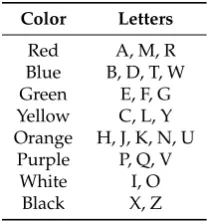
2.2. Synesthesia color-letter pairs 87
Each grayscale letter image was converted to a 3-channel (R,G,B) image using experimental 88
statistics of perceived colors in grapheme-color synesthesia as reported by Witthoftet al. [19]. The most 89
frequently reported letter-color pairings from a large sample of synesthetes (n=6,588) were used to 90
represent the sample population (c.f. Fig.1 in [19]), recognizing that signficant idiosynchratic differences 91
in color experienced for a given letter exists between individuals. These aggregrate “modal" colors for 92
each letter were used to develop the basic examples for generative colorization model learning in the 93
current study. These pairings are listed in Table1. 94
Table 1. Grapheme-color associations of 6,588 synesthetes. The most common color assignment
reported for each letter is shown. After [19].
Color Letters
Red A, M, R
Blue B, D, T, W Green E, F, G Yellow C, L, Y Orange H, J, K, N, U
Purple P, Q, V
White I, O
Black X, Z
2.3. Numerical implementation 95
The conditional GAN model of grapheme-color synesthesia perception was adapted from a 96
deep convolutional neural network (CNN) implementation described in [20]. The generator network 97
encodes the input image by six successive hidden layers, each ouputting a reduced dimensional 98
image relative to the input. Six decoding layers follow; these layers invert the compression operations 99
by deconvolution. The final output of the generator is an image with synthetic colorization. Each 100
compression layer reduces noise while increasing the level of abstraction in representation of the input 101
[21]. The discriminator has similar multilayer convolutions, ulimately outputting a reduced image and 102
probabilities of the input image being real or synthetic. Additional details of the GAN architecture 103
appear in [20].2 104
We developed code to download, extract and preprocess EMNIST handwritten letters [18]; colorize 105
examples based on synesthesia statistics [19]; train, test, analyze and visualize results of the generative 106
learning process. Deep learning experiments were carried out using the TensorFlow software library 107
controlled by the Python language API [22]3. Models were developed on a CPU/GPU-based system 108
(i5-3470 16 GB RAM; NVIDIA GeForce GTX 1050 Ti 4 GB on-board). 109
Transformations and processing for each training image followed the protocol of [20]: (1) convert 110
example (R,G,B) image (described in Sections 2.1and2.2) to CIE Lab color space; (2) present the 111
L(grayscale) channel to the input of the generative modelG; (3) output synthetica,bchannel data 112
1 The EMNIST data can be obtained at:https://www.nist.gov/itl/iad/image-group/emnist-dataset.
2 See [20] Appendix 1. Original image colorization GAN adapted here is based on code from the repository:https://github. com/sawhney-kartik/gan-colorization.
fromG, and reconstruct a full 3-channel (L,a,b) color image; (4) present real and artificial images to 113
discriminatorD; (5) evaluate objective function (Equation1); (6) backpropagate errors through both 114
networks, updating weights using stochastic gradient descent. 115
Generative model training was performed for three epochs on a random sample of 125,000 images 116
(total 375,000 iterations) from the EMNIST dataset. Periodically, generated images were converted 117
back to (R,G,B) color space and stored to disk for human observation and post-analysis. 118
3. Results 119
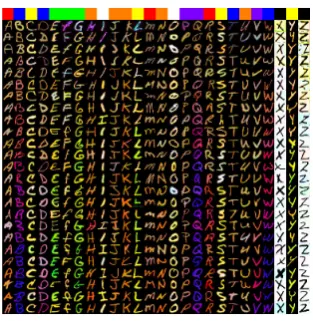
Results of synesthetic letter colorization by the generative network are presented in Figure1. 120
The figure panels display (a) typical inputs and (b) corresponding outputs in the very early phases 121
of model training (<3, 000 iterations). Each panel contains samples for one handwritten letter per 122
column. Iteration count progresses from top to bottom. The top-most row on the right-hand side 123
shows the true modal color-letter pairings from the experimental distribution reported in [19] (Table1). 124
Letters are presented in random order and are unbalanced; the example count seen for each letter is 125
therefore not uniform. 126
At this stage of learning, the generative network is not producing realistic colored images matching 127
the true distribution. Several letters begin to appear to align with their synesthetic concurrents, but 128
most others miss the mark. The letters often perceived as either black or white in color-grapheme 129
synesthesia (I,O,X,Z) are already reproduced fairly well. 130
(a)Early generator input. (b)Early generator color induction.
Figure 1. Synesthetic letter colorization by the evolving generative network. Early training: 1st
epoch;<3, 000 iterations. (a) generator input; (b) generator output. One letter per column. Iteration count progresses from top to bottom.
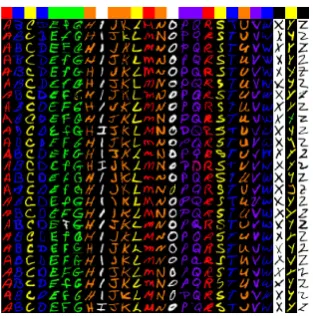
Following additional optimization of the GAN, more realistic results are observed. Consider 131
the images shown in Figure2. After three epochs of training, the synesthesia model generates 132
colored letters with high accuracy. The colors produced are nearly indistinguishable from the actual 133
distribution. Accuracy of color reproduction in the 26X26 grid is over 99%; very few instances (G: row 134
The results exhibited in Figure2are typical of those observed in out-of-sample tests on∼95, 000 136
additional handwritten letter examples. Once the generator learns the true distribution of color-letter 137
associations, the concurrent response remains consistent under additional stimuli. 138
(a)Trained generator input. (b)Trained generator color induction.
Figure 2. Synesthetic letter colorization by the trained generative network.Late training: 3rd epoch,
∼375, 000 iterations. (a) generator input; (b) generator output. One letter per column. Iteration count progresses from top to bottom.
4. Discussion 139
We applied a generative deep neural network to model perception in grapheme-color synesthesia. 140
Grayscale letters are used to stimulate the model, which colorizes each letter. Training data were taken 141
from experiments on a large sample of synesthetes [19], combined with a database of handwritten 142
letters [18]. 143
Automatic and consistent response to characters or digits are fundamental to synesthesia, even 144
when the stimulus is non-physical (i.e., conceived in the mind’s eye) [23]. Recognition of the identity of 145
a symbol determines its concurrent color [8], [2]. In the present model, the generative network hidden 146
layer weights encode information on pixel intensities describing the structure of each letter (and its 147
identity) when perceived in two dimensions. We suggest that a similar mechanism may regulate the 148
process of letter identification and association with color in a synesthete’s perceptual experience. 149
A model of synesthesia that generates testable predictions on brain activity and behavior is needed 150
[2]. With the collection of “big data" in neuroscience, comes an increased complexity of analysis and 151
the distillation of conclusions, especially when articulating simple descriptions of cause (stimulus) and 152
effect (behavior) [11]. The research and modeling approach reported here begins to address this need. 153
Three particulary ambitious areas in which to apply and extend this research are summarized 154
below. 155
1. Functional brain imaging. Studies aimed to identify and localize structure and function within 156
the synesthesia experience [5]. Experimental data from functional magnetic resonance imaging 157
(fMRI) or other modalities could be used to build a complementary deep learning model with 158
more explicit mapping of layers to physiologic modular components than used in the current 159
study. Such a model could provide additional insights to refine the competing hypotheses of 160
cross-activation (increased linkage between proximal regions) [7] or disinhibited feedback from 161
2. Language learning and memory. Studying synesthesia may advance our understanding of human 163
perception and information arrangement [6]. One theory proposed in [3] advances the idea 164
that graphemecolor synesthesia develops in part by children to learn category structures; a 165
fundamental task in literacy development is to recognize and discriminate between letters. 166
Therefore synesthesia might arise as an aid to memory. More generally, the ability to discern 167
statistical regularities of printed letters or learn complex rules for letter combinations would assist 168
learning at subsequent stages of literacy development [3]. In [24], small sample experiments 169
suggested that additional sensory dimensions in synesthesia aid in memory tasks when compared 170
to controls. We submit that the generative modeling approach of the current work may be useful 171
to develop and test hypotheses in studies of language acquisition, memory and semantics. 172
3. Consciousness studies. Synesthesia can give insight into the neural correlates of consciousness, 173
through interaction between sensory inputs and their mediation by semantics in the induction 174
of phenomenal subjective experience [4]. Connecting neural activations with subjective 175
aspects of consciousness (perception of shape, color movement of an object) is potentially 176
achievable following a systematic experimental approach [25]. In deep learning, understanding 177
representations within deep layers is easy at the layer level; at the level of individual neurons, 178
such understanding is much more difficult [26]. Extensions of the deep learning model reported 179
here may help to advance toward these formidable objectives. 180
Acknowledgments:The author thanks Tom Zingale, who provided the GPU-based computer used to conduct
181
this research. 182
Conflicts of Interest:The author declares no conflict of interest. 183
Abbreviations 184
The following abbreviations are used in this manuscript: 185
186
GAN Generative adversarial network GPU Graphics processing unit CPU Central processing unit CNN Convolutional neural network
fMRI Functional magnetic resonance imaging 187
References 188
1. Hubbard, E.M.; Ramachandran, V. Neurocognitive Mechanisms of Synesthesia. Neuron2005,48, 509–520. 189
2. Mattingley, J. Attention, Automaticity, and Awareness in Synesthesia. Annals of the New York Academy of 190
Sciences2009,1156, 141–67. 191
3. Watson, M.; Akins, K.; Spiker, C.; Crawford, L.; Enns, J. Synesthesia and learning: a critical review and 192
novel theory. Frontiers in Human Neuroscience2014,8, 98. 193
4. van Leeuwen, T.M.; Singer, W.; Nikoli´c, D. The Merit of Synesthesia for Consciousness Research. Frontiers 194
in Psychology2015,6, 1850. 195
5. Rouw, R.; Scholte, H.; Colizoli, O. Brain Areas Involved in Synaesthesia: A Review. Journal of 196
Neuropsychology2011,5, 214–42. 197
6. Rich, A.; Mattingley, J. Anomalous perception in synaesthesia: A cognitive neuroscience perspective. 198
Nature Reviews Neuroscience2002,3, 43–52. 199
7. Ramachandran, V.; Hubbard, E. Psychophysical investigations into the neural basis of synaesthesia. 200
Proceedings of the Royal Society of London B: Biological Sciences2001,268, 979–983. 201
8. Grossenbacher, P.; Lovelace, C. Mechanisms of synesthesia: cognitive and physiological constraints. 202
TRENDS in Cognitive Sciences2001,5, 36–41. 203
9. Jäncke, L.; Beeli, G.; Eulig, C.; Hänggi, J. The neuroanatomy of grapheme-color synesthesia. European 204
10. Brang, D.; Hubbard, E.; Coulson, S.; Huang, M.; Ramachandran, V. Magnetoencephalography reveals early 206
activation of V4 in grapheme-color synesthesia.NeuroImage2010,53, 268–274. 207
11. Sejnowski, T.; Churchland, P.; Anthony Movshon, J. Putting big data to good use in neuroscience. Nature 208
Neuroscience2014,17, 1440–1. 209
12. Bengio, Y. Learning deep architectures for AI.Foundations and Trends in Machine Learning2009,2, 1–127. 210
13. LeCun, Y.; Bengio, Y.; Hinton, G. Deep Learning. Nature2015,521, 436–44. 211
14. Hinton, G.E.; Osindero, S.; Teh, Y.W. A Fast Learning Algorithm for Deep Belief Nets. Neural Computation 212
2006,18, 1527–1554. 213
15. Goodfellow, I.; Pouget-Abadie, J.; Mirza, M.; Xu, B.; Warde-Farley, D.; Ozair, S.; Courville, A.; Bengio, 214
Y. Generative Adversarial Nets. InAdvances in Neural Information Processing Systems 27; Ghahramani, 215
Z.; Welling, M.; Cortes, C.; Lawrence, N.D.; Weinberger, K.Q., Eds.; Curran Associates, Inc., 2014; pp. 216
2672–2680. 217
16. Mirza, M.; Osindero, S. Conditional Generative Adversarial Nets.CoRR2014,abs/1411.1784. 218
17. Gauthier, J. Conditional generative adversarial networks for convolutional face generation. Technical 219
report, Stanford University, 2015. 220
18. Cohen, G.; Afshar, S.; Tapson, J.; van Schaik, A. EMNIST: an extension of MNIST to handwritten letters. 221
CoRR2017,abs/1702.05373,[1702.05373]. 222
19. Witthoft, N.; Winawer, J.; Eagleman, D.M. Prevalence of Learned Grapheme-Color Pairings in a Large 223
Online Sample of Synesthetes.PLoS ONE2015,10. 224
20. Agrawal, M.; Sawhney, K. Exploring Convolutional Neural Networks for Automatic Image Colorization. 225
Technical report, Stanford University, 2017. 226
21. Shwartz-Ziv, R.; Tishby, N. Opening the Black Box of Deep Neural Networks via Information. CoRR2017, 227
abs/1703.00810,[1703.00810]. 228
22. Abadi, M.; Barham, P.; Chen, J.; Chen, Z.; Davis, A.; Dean, J.; Devin, M.; Ghemawat, S.; Irving, G.; Isard, 229
M.; Kudlur, M.; Levenberg, J.; Monga, R.; Moore, S.; Murray, D.G.; Steiner, B.; Tucker, P.A.; Vasudevan, V.; 230
Warden, P.; Wicke, M.; Yu, Y.; Zhang, X. TensorFlow: A system for large-scale machine learning. CoRR 231
2016,abs/1605.08695,[1605.08695]. 232
23. Dixon, M.J.; Smilek, D.; Cudahy, C.; Merikle, P.M. Five plus two equals yellow.Nature2000,406, 365. 233
24. Mills, C.; Innis, J.; Westendorf, T.; Owsianiecki, L.; McDonald, A. Effect of a Synesthete’s Photisms on 234
Name Recall. Cortex2006,42, 155–63. 235
25. Crick, F.; Koch, C. A Framework for Consciousness. Nature Neuroscience2003,6, 119–26. 236