* Homewood Professor, Canadian Memorial Chiropractic College. Vice President, National Institute of Chiropractic Research. 6135 N. Central Avenue, Phoenix AZ 85012 USA. 602-264-3182; [email protected]
An Invited Presentation at the Canadian Chiropractic Association’s “Practice Makes Perfect 2001” Seminar 9 November 2001, Toronto, Ontario
The Meanings of Innate
Joseph C. Keating, Jr.,
PhD*
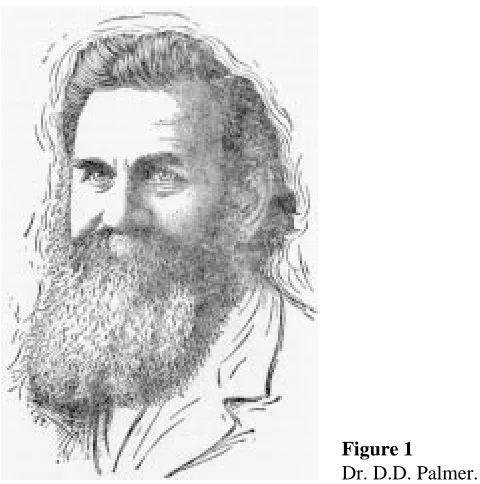
Since the notion was first introduced by D.D. Palmer circa 1904, “Innate Intelligence” (II) has been a source of inspi-ration, confusion and derision for chiropractors. Please note that no editorial privilege is taken by capitalizing “II,” since Old Dad Chiro meant to indicate a unique Person who, in B.J. Palmer’s phraseology, “guides, explains and directs all the function of the body from above down and inside out.”
principles are not inherently inappropriate in science, and indeed, all science is based on several untestable, a priori assumptions, for example, the belief that there are poten-tially discoverable causes and effects. Indeed, we might even go so far as to refer to a “dogma of science,” without which scientists could not operate. However, II is not one of the essential elements of this dogma.
D.D. Palmer first used the terms “innate” and “edu-cated” (uncapitalized) as adjectives to describe the differ-ent compondiffer-ents of the nervous system. His discussion of “innate nerves” was roughly synonymous with our idea of the autonomic (unconscious, involuntary) nervous system, while “educated nerves” refer to that portion of the nerv-ous system under voluntary control. However, by not later than 1906 the father of chiropractic had converted these adjectives into nouns, more precisely, proper names. In subsequent elaborations, II was proposed as a fraction of Universal Intelligence (God) who controlled the indi-vidual’s biological functions through the medium of the nervous system.3,4 However, Palmer’s is not the only inter-pretation of II.5
What are we to think of II? Is this a legitimate meta-physical proprosition, a worthy basis for the science and art of chiropractic? Is there a justifiable place for concepts like II in a discipline which seeks legitimacy and advance-ments in knowledge by means of critical thinking and empirical evidence? The answer, I suggest, depends upon what is meant by II, and at least four major meanings (and several derivatives) are available to us. These include II as a synonym for homeostasis, II as a label for our ignorance, II as a vitalistic explanation of life, and II as a metaphysical assumption.
1. Innate as synonym for homeostasis
Many chiropractors consider II an alternate designation for homeostasis. In this sense, II is a descriptive term which refers to an ontological characteristic of living things, all the way from lowly life forms like amoebas,
viruses to the more complex organisms
we call humans. An ontological characteristic is a funda-mental or irreducible property of a thing. For instance, one of the ontological properties of magnets is demonstrated by sprinkling them with iron filings and watching for the resulting patterns formed around the magnets’ tips. We don’t seem to be able to explain magnetism, but we can point to it, and if we find that a supposed magnet fails to arrange iron filings in the expected pattern, we may decide that the object is not a magnet after all. We might even wax poetic and suggest that the “spark of magnetism” has departed the supposed magnet, but in so doing, we haven’t explained anything.
Homeostasis is an ontological characteristic of life. Homeostasis doesn’t explain life, rather, it is an essential property of biological organisms. The interlocking and reverberating circuits of our physiology collectively com-prise life. And in the same poetic vein as before, when we come upon an organism that no longer displays homeo-stasis, we might opine that the “spark of life” has departed the body. But this is not explanation, merely a more colorful, quaint and poetic mode of description. We cannot explain death by saying the life spirit has departed; we cannot explain life by attributing it to mysterious forces.
To the extent that a doctor’s mention of II is synony-mous with homeostasis, and to the extent that the DC invokes the II construct as description (but not as explana-tion), then the expression “II” is not at all inappropriate within scientific discourse. However, there is a problem, in that II is so overburdened with meaning that it’s possible for a doctor to mean one thing by II in one sentence (e.g., description), and something quite different in the next breath (e.g., explanation). Indeed, the crossover in mean-ings may go undetected by the speaker as well as her/his audience. Therefore, it is recommended that when some-one uses that term, II, you must ask for a definition in order to understand what is communicated. Please keep in mind that, as the late Stanley Martin, D.C. used to joke: “for every chiropractor there is an equal and opposite chiropractor.” Unless a doctor clarifies her/his meaning, there’s often no way to be sure what is meant by II.
2. Innate as a label for our ignorance
Another meaning of II is implicit in some of the synonyms doctors use when we reach the limits of our knowledge and understanding. For instance, in the case of a patient who
recovers despite expectations of imminent death, the sur-geon may invoke “Mother Nature” or “viz medicatrix naturae” (Latin for the healing power of nature) as a pseudo-explanation. Of course, in such instances nothing has really been explained. In fact, referring to “nature” or “God’s will” as an explanation is just another way of saying “we don’t know.” Attributing what we don’t know to a “cause” like II is no explanation at all; to accept such would be to take false pride based on word magic. We cannot explain one mystery (life) by offering another mys-tery (life force) as its cause.
Innate Intelligence can be a fancy name for our igno-rance. Perhaps the label is acceptable, if it serves to remind us of just how much doctors and scientists have to be humble about. If the mention of II, mother nature or the “doctor within” spurs us to further explore the mysteries and complexities of life, then it may be useful. If the mention of II causes us to think more carefully about the details and intricacies of the problems presented by each individual patient, or prompts us to reassess our diagnostic and intervention hypotheses, then it holds strategic clinical value. When recognition of our limited appreciation of the intricacies of patients’ problems leads us to adopt a more conservative approach to clinical practice, to try gentler remedies before more invasive methods are employed, then the concept of II has played a useful role. If, on the other hand, the mention of II leads us to adopt a cavalier attitude toward patient care, as manifest in the “pop and pray” tradition or what Oliver Wendell Holmes referred to as the “nature-trusting heresy,”6 then it fosters an arro-gance which is incongruent with the clinical situation.
The physician of whatever school (allopathic,
practic, homeopathic, osteopathic) who respects the pa-tient’s self-healing capacity is more likely to seek con-servative remedies before attempting more heroic means of intervention. In this sense, II may be seen as a meta-phorical reminder and elaboration on the Hippocratic tra-dition to do no harm, and to first try the least invasive and hazardous remedies. In this scenario, I say “Vive L’Innate!”
3. Innate as vitalistic “explanation”
When physiologist Walter Cannon introduced the concept of homeostasis in his book, The Wisdom of the Body,7 most readers recognized that the biologist was waxing poetic in his title. However, many folks in chiropractic take the metaphor of wisdom literally, and in so doing engage in a form of bio-theology known as vitalism.
Vitalism is that rejected tradition in biology which proposes that life is sustained and explained by an un-measurable, intelligent force or energy. The supposed effects of vitalism are the manifestations of life itself, which in turn are the basis for inferring the concept in the first place. This circular reasoning offers pseudo-explana-tion, and may deceive us into believing we have explained some aspect of biology when in fact we have only labeled our ignorance. “Explaining an unknown (life) with an unknowable (Innate),” suggests philosopher Joseph Donahue, D.C., “is absurd.”
When chiropractors employ II as part of their clinical theory, as indicated by the sequence:
Adjusting®ÿ ¯subluxations ®ÿ II communication ®ÿ
¯disease, ¯symptoms, health
they commit the error of adding an unnecessary and untestable step in causal explanation. Some go so far as to imbue this additional hypothetical construct (II commu-nication) with all sorts of magical possibilities. And so we may encounter the doctor who practices as though adjust-ments were a panacea, good for whatever ails the patient. In B.J.’s time as well as our own, there are DCs who disparage diagnosis on the grounds that “II knows more than any diagnosing fool.” The clinical task for the chiropractor in this scenario is very clear and very simple: find a subluxation, adjust it, and II takes care of the rest. But for the scientist, II as hypothetical construct is
super-fluous; we can do just as well (or better) without it:
Adjusting®ÿ ¯subluxations ®ÿ ¯disease,
¯symptoms, health
Vitalism has many faces and has sprung up in many areas of scientific inquiry. Psychologist B.F. Skinner, for example, pointed out the irrationality of attributing behavior to mental states and traits.8 Such “mental way stations,” he argued, amount to excess theoretical baggage which fails to advance cause-and-effect explanations by substituting an unfathomable psychology of “mind.” The concept of the homunculus similarly provides a useless
explanation of biology by proposing a little man inside the man who pulls the levers of biological function. Once the little man inside has been accepted, one must propose a little man inside the little man who further determines the behavior of the homunculus. There is no logical endpoint to this line of thinking, and it serves no useful purpose.
Vitalism in chiropractic, that is, II, has several variants. For instance, D.D. Palmer believed that the unseen Innate spirit (again, a fraction of Universal Intelligence or God), existed throughout the body and was able to exert its beneficial control of human function through any nerve ganglion.9 The founder prided himself on developing a science that united the “material and the immaterial,” and held that his theosophy was not religion, because it was
non-denominational. B.J. Palmer, on the other hand, lo-cated the II in the brain, but like his father, conceived of it as a fraction of the Almighty. T.F. Ratledge, D.C., founder of what became the Cleveland Chiropractic College of Los Angeles, also thought of II as synonymous with “brain-power”,10 but avoided spiritual or theological connections. B.J. Palmer applauded the expositions on II offered by his faculty member, Ralph W. Stephenson, D.C. Stephenson’s Chiropractic Textbook11 gave rise to a com-plex of theories regarding this Vital Being, and to deriva-tive discussions that leave this writer amazed and incredu-lous. For example, Joseph B. Strauss, D.C., former president of the Pennsylvania College of Straight Chiro-practic, refuses to personify or spiritualize the vital entity (he offers an aspiritual spirit).13, p. 38 On the other hand, Dr. Strauss takes up the question of whether the human fetus is guided by its own “innate intelligence” or that of the mother.13, pp. 18–20 Elsewhere, Dr. Strauss considers the “intelligence” of the universe, the “innate intelligence” of chickens, and the “organ intelligence” of chicken hearts that have been removed from the bird.14 One is tempted to ponder how many Innates might dance on the head of a pin.
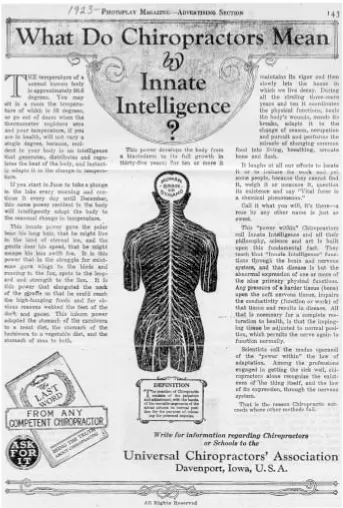
Others have made II the center of their advertising and marketing efforts (see Figure 5).
4. Innate as metaphysical premise
Some chiropractors seek to preserve the II construct by offering the vitalism of Innate as an a priori, metaphysical assumption, rather than as a hypothetical construct. For example, Palmer Chiropractic University offers as its first and most basic tenet that “life is intelligent.” In this sense, II might mean something akin to holism. As a reminder to think multi-factorially, to construe patients’ problems in terms of multiple interacting systems within the person and her/his surrounding environment, and as an exhorta-tion to take the patient’s point of view and motivaexhorta-tions into account, this meaning of Innate deserves applause. How-ever, I can see no advantage to proposing an Intelligent Spirit, when a bio-psychosocial model of the patient will serve the same purpose. We may well acknowledge that the “whole is greater than the sum of its parts,” but this does not mean that the whole is an intelligent, purposive, benevolent being that dwells within us. Palmer Universi-ty’s first tenet opens the door to all sorts of magical possibilities. Do you remember that old TV commercial
Figure 4 “The most valuable drawing in the world – for it solves all the problems of man” (B.J. Palmer, quoted in 12); the diagram originally appeared in
for peanut butter which claimed: “If you like peanuts, you’ll love Skippy”? In a similar vein, I suggest that “If you like miracles, you’ll love Innate!” But as a metaphysi-cal premise for a science of chiropractic, II offers no incremental utility, no added value.
Implications of chiropractic vitalism
founder of Concept-Therapy,16 developed what might be described as a form of psychotherapy based upon the Innate concept, while retaining something of D.D. Palmer’s notions of “spirit” and “soul.” Jimmy Parker, D.C., a student of Dr. Fleet in the 1950s, founder of the Parker Seminars in the 1950s and founder of Parker College in the late 1970s, elaborated upon Fleet’s “stickman” diagram of human personality to create his notion of “Infinite Oneness.” With Innate, I suppose, all things are possible.
Non-verbal communication between the II of the doctor and the II of the patient has also been suggested. The late Richard Van Rumpt, D.C., founder of the “Directional Non-Force Technique” (DNFT), devised a method of as-sessment in which the chiropractor mentally asks the pa-tient’s II to indicate the location of subluxations while the patient lies prone. The doctor then observes for leg-length changes, which is II’s means of communication.17 Others have opined that II is “quite mechanical and more or less synonymous with Subconscious Mind” (Harrison, quoted in 5). My friend, Fred Barge, D.C., former president of the
International Chiropractors’ Association and the author of
One Cause, One Cure, attributes the “Cause” of all disease
to “The body’s inability to comprehend itself and/or its environment”.18 Such “weaker” forms of vitalism none-theless offer a purposive, immaterial being, an anthro-pomorphization if not a deification of biological “cause.” And, as suggested earlier, many DCs confuse Innate-the-explanation with the descriptive concept of homeostasis. This amounts to leaving health care in the hands of the angels.
Figure 6 Concept-Therapy “stickman” diagram of the structure of personality.
Figure 8 A vision of Innate Intelligence?
Chiropractors are not unique in recognizing a tendency and capacity for self-repair and auto-regulation of human physiology. But we surely stick out like a sore thumb among professions which claim to be scientifically based by our unrelenting commitment to vitalism. So long as we propound the “One cause, one cure” rhetoric of Innate, we should expect to be met by ridicule from the wider health science community. Chiropractors can’t have it both ways. Our theories cannot be both dogmatically held vitalistic constructs and be scientific at the same time. The pur-posiveness, consciousness19 and rigidity of the Palmers’ Innate should be rejected.
Now, I can’t tell you with any certainty that there’s no such thing, or no such Person, or no such Persons as II, any more than I can state with certainty that there is or is not a God (or if you prefer, Universal Intelligence). Belief in “immaterial” intelligences is a matter of faith, not of sci-ence. What I can say with some certainty is that such concepts have no constructive role to play within the realm of natural philosophy. Innate Intelligence fails as a hypo-thetical construct because it is not testable, and fails as a metaphysical assumption in that it has not been productive in any unique way in the generation of testable hypotheses. Nevertheless, II may be true, on some spiritual level. On the other hand, I’m reminded of a comment from a well-known chiro-basher, H.L. Mencken, who suggested that:
For every complex problem there is a solution which is simple, direct, and wrong.
So, I’ll end here, and leave you with this query: what do you mean by Innate?
Acknowledgments
My thanks to the National Institute of Chiropractic Re-search for financial support in the preparation of this paper. The author is solely responsible for its content.
References
1Keating JC. Toward a philosophy of the science of chiropractic: a primer for clinicians. Stockton CA: Stockton Foundation for Chiropractic Research, 1992. 2 Keating JC. Philosophy and science in chiropractic:
essential, inseparable and misunderstood. European J Chiropractic 2001; 46(3): 51–60.
3 Donahue, Joseph H. D.D. Palmer and Innate Intelligence: development, division, and derision. Chiropractic History 1986; 6:30–6.
4 Donahue, Joseph H. D.D. Palmer and the metaphysical movement in the 19th century. Chiropractic History 1987; 7(1):22–7.
5 Donahue, Joseph H. Disease in our principles: the case against Innate Intelligence. Am J Chiropractic Medicine 1988 (Jun); 1(2):86–8.
6 Starr, Paul. The social transformation of American medicine. New York: Basic Books, Inc., 1982. 7 Cannon, Walter B. The wisdom of the body. Second
Edition. New York: Norton, 1939.
8 Skinner, B.F. About behaviorism. New York: Vintage Books, 1976.
9 Palmer, D.D. The Chiropractor. Los Angeles: Beacon Light Printing, 1914, p. 11.
10 Smallie, Paul. The guiding light of Ratledge. Stockton CA: World-Wide Books, 1963.
11 Stephenson, Ralph W. Chiropractic textbook. Davenport IA: the author, 1927.
12 Frigard, Ted L. How the elite one percent use the innate factor to achieve noble goals. Digest of Chiropractic Economics 1994; Sept/Oct: 36–7.
13 Strauss, Joseph B. The Pivot Review, 1984–1991. Levittown PA: Foundation for the Advancement of Chiropractic Education, 1992.
14 Strauss, Joseph B. Chiropractic philosophy. Levittown PA: Foundation for the Advancement of Chiropractic
Education, 1991, pp. 47–8.
15 Martin, Steven C. “The only truly scientific method of healing.” Chiropractic and American science, 1895–1990. Isis 1994; 85: 207–27.
16 Keating JC, Fleet GT. Thurman Fleet, D.C. and the early years of the Concept-Therapy Institute. Chiropractic History 1997 (June); 17(1): 57–65.
17 Fuhr AW, Green JR, Colloca CJ, Keller TS. Activator Methods chiropractic technique. St. Louis: Mosby, 1997, p. 6.
18 Barge, Fred H. One cause, one cure: the health and life philosophy of chiropractic. La Crosse WI: the author, 1990.
19 Donahue, Joseph H. Philosophy of chiropractic: lessons from the past-guidance for the future. J Can Chiropr Assoc 1990b (Dec); 34(4):194–205.
Help Support Chiropractic Research
Become a member of the