REGENERATIVE BIKE
Ankur Lath1, Aakash Sharma2, Aditya Choudhary3, Anil kr. Yadav4, Sneha Basak5, Atul kr. Kushwaha 6
12345
Student (Electrical & Electronics Deptt.), IMS Engineering College, Ghaziabad, INDIA 6
Asst Prof (Electrical& Electronics Deptt), IMS Engineering College, Ghaziabad, INDIA [email protected], [email protected], [email protected], [email protected], [email protected], [email protected]
Abstract—The project attempts to counter the prevailing problem of Pollution and high fuel prices by using not 1 or 2 but a total of 5 non-conventional sources of energy. All the various forms of energy which were being wasted before is now being channelized and converted into electrical energy and saved into the battery. The Regenerative Bike is an electricity based bike which is designed to go for an extra distance by charging its battery as we move towards the destination. All the sources of energy in the bike are environment friendly and will not cause any type of pollution but rather it will use noise pollution as its source, wind energy, solar energy and power generation via dynamo being other. The vehicle comes into motion by taking up energy from the solar panel, wind turbine, microphone, dynamo on the suspension and a dynamo mechanically connected to rear wheel. It is designed to replace the present electric as well as fossil fuel engines as it tops them both by being long lasting and environment friendly. Key points - Regenerative bike, Dynamo, Solar and Wind Energy.
1. INTRODUCTION
REGENERATIVE BIKE is the state of the art Electric Bike which is designed to be operated for a very long duration by constantly recharging the battery it is being operated on. It is a life size Electric bike which is harnessing electricity as it moves towards its destination, this not only enables the bike to cover longer distances than the conventional Electric Bikes but also refueling itself free of cost when on the run.
A hybrid vehicle is a vehicle that stores energy on board in two or more forms. In a typical hybrid electric vehicle one form is gasoline with an engine as a fuel converter. The other is a bidirectional electrical storage device. By use of an energy storage, there are several different ways that hybrid electric vehicles reduce fuel consumption; recover energy during braking, downsizing of the engine, operating engine more efficiency, and shutting the engine off when it is not moving.
In this paper, an overview of HEVs is presented. In fact, we aim to introduce the HEVs and present their history, advantages, disadvantages, classification, vehicle types, energy management strategies and some other related information. The methodology used in this paper is descriptive, library and analytical. The descriptive aspect of this paper is based on identification of its required materials and information have been complied using related scientific papers.
2. NEED OF REGENERATIVE BIKE
Transportation systems are very important to the entire world today. Most of them use of vehicles that have internal combustion engine (ICE). Using the ICE have caused and continuously cause serious problems, such as air pollution, global warming, and the rapid depletion of the Earth’s petroleum resources. Electric vehicles (EV), hybrid electric vehicles (HEV), and fuel cell vehicles (FCV) are the three typical vehicles that are proposed to replace conventional vehicles with ICE. The performance of EV and fuel cell vehicle is far behind the requirement. Thus advanced vehicle technology research has been turned to focus on HEVs.
The studies for hybrid electrical vehicle (HEV) have attracted considerable attention because of the necessity of developing alternative methods to generate energy for vehicles due to limited fuel based energy, global warming and exhaust emission limits in the last century. HEV incorporates internal composition engine, electric machines and power electronic equipment.
Here are few of the top advantages of having a regenerative bike-
Environmentally friendly.
Financial benefits.
No more dependence on fossil fuels.
Regenerative braking system.
Built from light materials.
3. REGENERATIVE BIKE
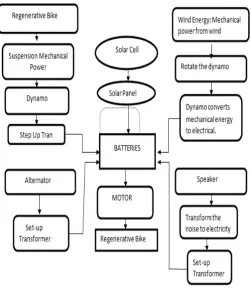
The block diagram representation of the regenerative bike is shown below. This figure describes how the different renewable source of energy are producing electricity which are further stored in the battery. Now the motor used in the bike uses the power from this battery and make the bike in motion with the help of gear box attached to the given motor.
Fig. 1. Block Diagram
The bike will use various energy sources which were disguised and wasted with the conventional sources of energy, it will charges its battery even when on the run. This is the modern day Hybrid electric vehicleit is not like the conventional electric bikes. It not only is powered by electricity, but it is designed such that it need not to be stopped for charging.
It uses different disguised sources of energy which were neglected by its predecessors. 4. RENEWABLE SOURCES USED
REGENERATIVE BIKE is extracting electricity via every possible way known to science. It recharges it's battery via five different ways and they are as following:
Solar energy: It comes with a solar panel which feeds nearly 35 V to the battery. A solar panel of rating 45V/8A is mounted at the back of the regenerative bike as shown in the figure below. Solar panels arranged to generate electricity are becoming more and more frequent these days. Electricity generated from solar panels are free, nearly infinitely abundant, and non-polluting.
The main source of solar panel is Sunlight. Sunlight is composed of photons, or particles of solar energy. These photons contain various amounts of energy corresponding to the different wavelengths of the solar spectrum. When photons strike a photovoltaic cell, they may be reflected, pass right through, or be absorbed. Only the absorbed photons provide energy to generate electricity. As long as the sun is present the battery will never run out empty and even if the sun is not present at that time there are other sources.
ISSN (Print) : 2278–9510
Fig. 2. Solar Panel
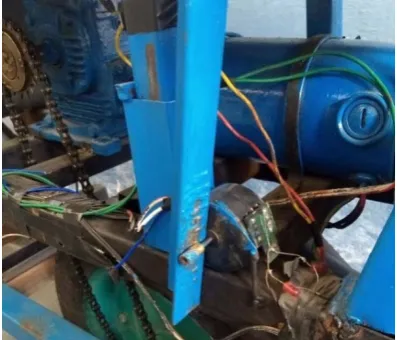
Alternator: In this method an Alternator is used and which is mechanically coupled to the rear wheel as shown in figure below. As the rear wheel will be in motion the shaft of the generator will also get moved and thus electricity is produced and is continuously feeding into the battery. An electric generator is a device that converts mechanical energy to electrical energy. A generator forces electric charge (usually carried by electrons) to flow through an external electrical circuit. A DC generator can operate at any speed within mechanical limits, but always output direct current.
Fig. 3. Alternator coupled to the rear wheel
Regenerative suspension system: With every bump the rider experiences on the road there is simultaneous feed to the battery which recharges it to some extent. Rack–pinion used in the bikes at the lower side of the seat as shown in figure below, converts the oscillatory vibration into unidirectional rotation of the generator and produce electricity with the principle as described above. This method of producing electricity is very advanced and till now rarely used in the market.
Wind Energy: As the bike moves forward, the wind it resists will also be utilized to help charge our battery. The wind will rotate the fan mounted at the front part of the bike and that fan will rotate the shaft of the dynamo. Hence the electricity is produced which is further stored in the battery. This method of producing electricity is very helpful in spring season.
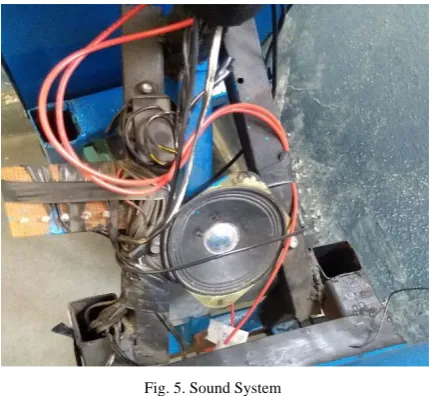
Sound Energy to Electricity: The apparatus for this is strategically placed near the horn and is designed to embrace maximum sound from the bike itself and its surroundings. A speaker is used as shown in the figure below. The sound nearby it will move the diaphragm of the speaker up and down. The movement of this diaphragm between the magnets present inside the speaker will led to the production of the electricity. And further this electricity is stored inside the battery.
This method of producing electricity shows that this bike is totally eco-friendly.
Fig. 5. Sound System
Hence REGENERATIVE BIKE is designed to go longer distances with its energy harnessing mechanisms which will successfully replace the current automobile system. It is light weighted low power environment friendly vehicle designed to cut the fuel cost and use the renewable energy resources. It offers an excellent opportunity to develop further technologies that can be applied to practical application.
5. SPECIFICATIONS
The specifications of the different components used in the regenerative bike is given below-
Table 1: Specifications of different components used
S.no Component Used Rating
1 D.C Brushless Motor 180V, 4600 RPM, 1.25 HP.
2 Solar Panel 45 V/8 A, 300W
3 Dynamo 150 rpm, 12 V
4 Battery(Li-ion) 3*12 V, 7.2Ah
5 Gear Box 1:15(teeth ratio)
Specific attention was paid to the specification and rating of motor ensuring high reliability, ease of manufacture and light weight construction without compromising efficiency of bike. The motor used is BLDC (Brush Less DC Motor) and the portability of the batteries is a high value concerned and shall be met with proper result to the bike. The battery will be reused for further purposes and can be charged bysolar energy, regenerative suspension system, wind energy, sound energy to electricity andalternator coupled to the rear wheel.
ISSN (Print) : 2278–9510
6. CONNECTION AND WIRING DIAGRAM
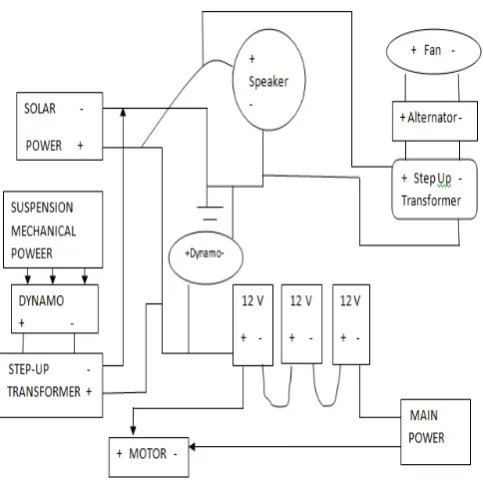
Fig. 6. Connection and wiring diagram
The power is mainly withdraw from solar, wind, suspension and alternator coupled to rear wheel which reaches to the step up transformer through dynamo. All these connections are interconnected as shown in the above connection and then chargesthe batteries of 36V (3*12) through different sources. The charged battery is used to drive the motor attached to it and further the bike come into the motion.
7. CONCLUSION AND FUTURE PROSPECTS
Regenerative Bike is the modification of existing bike and driven by five different renewable sources. It is mainly suitable for metro cities in order to reduce the pollution level.Among several technologies, regenerative bike is a hot subject today that has the advantages of lower operating cost, simpler in construction & can be widely used for short distance travelling especially by school children, college students, office goers,etc. It can be operated throughout the year free of cost. The most important feature of this bike is that it does not consume valuable fossil fuels thereby saving crores offoreign currencies. It is eco-friendly& pollution free, as it does not have any emissions. Moreover it is noiseless and can be recharged automatically by using different sources. The operating speed isaround 10km/hrs. It has fewer components, can be easily mounted or dismounted, thus needs less maintenance.
The major challenge remaining is to add a set of controller to control the speed of the bike smoothly.
8. REFERENCES
[1] The Pandit G. Patil, Energy Systems Division, Argonne National Laboratory “Advanced Battery Technology for Electric Two-Wheelers” Journal of Energy Systems Division, Argonne National Laboratory June 2009.
[2] Jean-Marc Timmermans1, Julien Matheys, Philippe Lataire, Joeri Van Mierlo, Jan Cappelle2 “A Comparative Study of 12 Electrically Assisted Bicycles” World Electric Vehicle Journal Vol. 3 - ISSN 2032-6653 - © 2009 AVERE.
[3] Ahmad A. Pesaran and Tony Markel, Harshad S. Tataria, David Howell “Battery Requirements for Plug-In Hybrid Electric Vehicles – Analysis and Rationale” Conference Paper of National Renewable Energy Laboratory, USA NREL/CP-540-42240 July 2009. [4] Tony Markel, Michael Kuss, and Paul Denholm “Communication and Control of Electric Drive Vehicles Supporting Renewables”
Conference Paper of Center for Transportation Technologies and Systems National Renewable Energy Laboratory, NREL/CP-540-46224 August 2009.
[5] T. Markel, K. Bennion and W. Kramer, National Renewable Energy Laboratory & J. Bryan and J. Giedd Xcel Energy “Field Testing Plug-in Hybrid Electric Vehicles with Charge Control Technology in the Xcel Energy Territory.” Technical Report of National Renewable Energy Laboratory, NREL/TP-550-46345, August 2009.
[6] T. Markel, K. Bennion and W. Kramer, National Renewable Energy Laboratory & J. Bryan and J. Giedd Xcel Energy “Field Testing Plug-in Hybrid Electric Vehicles with Charge Control Technology in the Xcel Energy Territory” Journal of International Conference on Renewable Energies and Power Quality (ICREPQ’11) Las Palmas de Gran Canaria (Spain),13th to 15th April, 2011.
[7] C. E. (Sandy) Thomas” Fuel Cell and Battery Electric VehiclesCompared” Journal ofH2Gen Innovations, Inc., Alexandria, Virginia, 22304, USA.
[8] Todd Litman, “Efficient V ehicles Versus Efficient Transportation “comparing transportation energy conservation strategies. Journal paper of Victoria Transport Policy Institute 26 August 2009.
[9] An MIT Energy Initiative Symposium, “Electrification of the Transportation System”. Journal paper of An MIT Energy Initiative Symposium April 8, 2010.
[10] Chetan Kumaar Maini, Deputy Chairman and Chief Technology officer, Reva Electric Car Company, India “Development of a next generation Electric Car for World Markets” Journal of EVS 24 Stavanger, Norway, May13-16,2009.
[11] V.B. Bhandari, Design of machine elements, The McGraw. Hill Companies, Second Edition. [12] S.S. Ratan, Theory of Machine the McGraw, Hill Companies, Second Edition.
[13] Atul kr. Kushwaha, Debojyoti Sen et al, “Design and Implementation of Hybrid Bike” International journal of scientific research and development, Vol. 5 Issue 01, 2017.
ISSN (Print) : 2278–9510