Received: May 13, 2019. In Revised Form: September 09, 2019. Accepted: September 20, 2019. Available online: September 23, 2019. http://dx.doi.org/10.1590/1679-78255624
Free Vibration of flexible soft-core sandwiches according to layerwise
theories differently accounting for the transverse normal
deformability
Ugo Icardia*
Andrea Urracia
a Dipartimento di Ingegneria Meccanica e Aerospaziale - Politecnico di Torino - Corso Duca degli Abruzzi 24, 10129 Torino, Italy. E-mail:
[email protected], [email protected] * Corresponding author
https://doi.org/10.1590/1679-78255624
Abstract
This study aims to generalize a previously developed accurate and inexpensive 3-D zig-zag theory up to an arbitrary representation form and to determine which simplifications are yet accurate in determining transverse shear and normal stress/deformation effects on vibrations of soft-core sandwiches with not moving middle/neutral plane (pumping). Natural frequencies are calculated using displacements assumed differently across the thickness, having fixed d.o.f., not yet explored forms of representation and zig-zag functions differently accounting for the transverse normal deformability and that partially or fully fulfill physical constraints. Applications are presented for sandwich plates and beams with length-to-thickness ratios and material properties of faces and core varying within an industrial range, for which layerwise effects are very important and so suited to the evaluation of theories. Analytical solutions are found using the same trial functions and expansion order for all theories, so to evaluate their accuracy under the same conditions. The choice of the representation form and of zig-zag functions is shown immaterial if displacement field coefficients are recomputed across the thickness by enforcing the fulfillment of all physical constraints (using symbolic calculus). Furthermore, it is shown that assigning a specific role to each coefficient is immaterial, as well as exchanging the order of representation of in-plane and transverse displacement components and even that zig-zag functions could be omitted. This no longer occurs for lower-order theories with only a partial fulfillment of constraints. Pumping motions are highlighted as the first modes, which require the theories much accurately accounting for transverse normal deformability.
Keywords
Composite and sandwich plates and beams, interlaminar transverse shear and normal stress continuity, Navier’s and 3D finite element analysis (FEA) solutions, free vibration behavior, different zig-zag functions, various form of representation of variables
1 INTRODUCTION
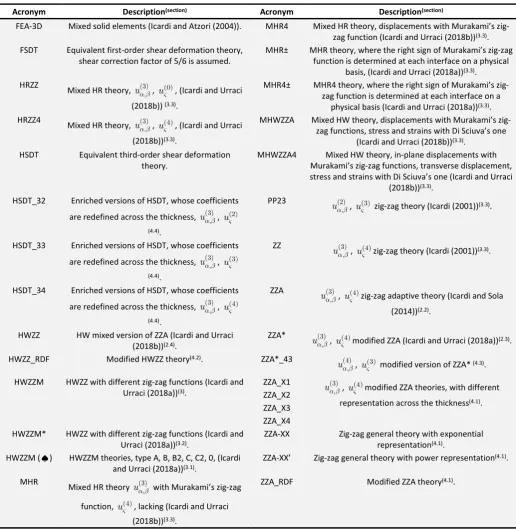
Table 1 Acronyms.; in bold the new teories; (n) degree of displacements.
Acronym Description(section) Acronym Description(section)
FEA-3D Mixed solid elements (Icardi and Atzori (2004)). MHR4 Mixed HR theory, displacements with Murakami’s zig-zag function (Icardi and Urraci (2018b))(3.3).
FSDT Equivalent first-order shear deformation theory,
shear correction factor of 5/6 is assumed. MHR± MHR theory, where the right sign of Murakami’s zig-zag function is determined at each interface on a physical basis, (Icardi and Urraci (2018a))(3.3).
HRZZ Mixed HR theory, (3) ,
u , u(0)
, (Icardi and Urraci (2018b)) (3.3).
MHR4± MHR4 theory, where the right sign of Murakami’s zig-zag function is determined at each interface on a
physical basis (Icardi and Urraci (2018a))(3.3).
HRZZ4 Mixed HR theory, (3) ,
u , u(4)
, (Icardi and Urraci (2018b))(3.3).
MHWZZA Mixed HW theory, displacements with Murakami’s zig-zag functions, stress and strains with Di Sciuva’s one
(Icardi and Urraci (2018b))(3.3).
HSDT Equivalent third-order shear deformation
theory. MHWZZA4 Murakami’s zig-zag functions, transverse displacement, Mixed HW theory, in-plane displacements with stress and strains with Di Sciuva’s one (Icardi and Urraci
(2018b))(3.3).
HSDT_32 Enriched versions of HSDT, whose coefficients are redefined across the thickness, (3)
,
u , u(2)
(4.4).
PP23 (2)
,
u , u(3)
zig-zag theory (Icardi (2001))(3.3).
HSDT_33 Enriched versions of HSDT, whose coefficients are redefined across the thickness, u (3), , u(3)
(4.4).
ZZ (3)
,
u , u(4)
zig-zag theory (Icardi (2001))(3.3).
HSDT_34 Enriched versions of HSDT, whose coefficients are redefined across the thickness, u (3), , u(4)
(4.4).
ZZA (3)
,
u , u(4)
zig-zag adaptive theory (Icardi and Sola (2014))(2.2).
HWZZ HW mixed version of ZZA (Icardi and Urraci
(2018b))(2.4). ZZA* u(3) , , u(4) modified ZZA (Icardi and Urraci (2018a))(2.3). HWZZ_RDF Modified HWZZ theory(4.2). ZZA*_43 (4)
,
u , u(3)
modified version of ZZA* (4.3). HWZZM HWZZ with different zig-zag functions (Icardi and
Urraci (2018a))(3). ZZA_X1 u(3) , , u(4) modified ZZA theories, with different representation across the thickness(4.1).
ZZA_X2 ZZA_X3 ZZA_X4 HWZZM* HWZZ with different zig-zag functions (Icardi and
Urraci (2018a))(3.2). ZZA-XX Zig-zag general theory with exponential representation(4.1).
HWZZM (♠) HWZZM theories, type A, B, B2, C, C2, 0, (Icardi
and Urraci (2018a))(3.1). ZZA-XX’ Zig-zag general theory with power representation (4.1).
MHR Mixed HR theory (3) ,
u with Murakami’s zig-zag function, u(4)
, lacking (Icardi and Urraci (2018b))(3.3).
ZZA_RDF Modified ZZA theory(4.1).
However, their displacement field is no longer C1-continuous as in homogeneous non-layered materials, but instead it is C°-continuous (zig-zag effect) because only appropriate slope discontinuities at interfaces allow the fulfilment of local equilibrium equations, namely the continuity of transverse shear and normal stresses and of the transverse normal stress gradient at layer interfaces.
A multitude of theories have been proposed so far for multilayered structures, to which sandwiches are ascribed whenever it is not necessary to describe cell scale effect of honeycomb core, which can be summarily categorized into equivalent single-layer (ESL), discrete-layer (DL) and zig-zag (ZZ) theories (acronyms used throughout the paper are defined in Table 1).
Reddy and Robbins (1994), Lur’e, and Shumova (1996), Noor et al. (1996), Altenbach (1998), Khandan et al. (2012) and Kapuria and Nath (2013) and the book by Reddy (2003) are cited among many others, wherein a broad discussion of this matter can be found. However a brief description must be given to justify accuracy and computational costs that differ greatly.
ESL, completely disregard layerwise effects and are cheap but also unable to accurately predict through-thickness displacement and stress fields and even overall response quantities for certain loading, material properties and stack-up and for sandwiches, as shown e.g. by Zhen and Wanji (2006), Kapuria et al. (2004), Burlayenko et al. (2015) and by Jun et al. (2016), by analyses carried out by Carrera’s unified formulation (CUF) (see Carrera (2001)) and by advanced ZZ (see Icardi and Sola (2014), Icardi and Urraci (2018a, 2018b)). Also DL, which assume quantities at layer level as the functional d.o.f., are of limited validity since their use must be restricted to limited regions of structures of industrial interest, otherwise the computational capacity could be overwhelmed due to too many unknowns growing with the number of physical and computational layers considered. It must however be recognized that DL have the merit of accurately predicting displacement and stress fields irrespective for lay-up, layer properties, loading or boundary conditions considered. ZZ theories, having intermediate features between ESL and DL, strikes the right balance between accuracy and cost saving, allowing designers’ demand of theories in a simple already accurate form to be met. Often higher-order sandwich theories are considered wherein in-plane and transverse displacements vary nonlinearly across the thickness and takes different forms between the faces and the core.
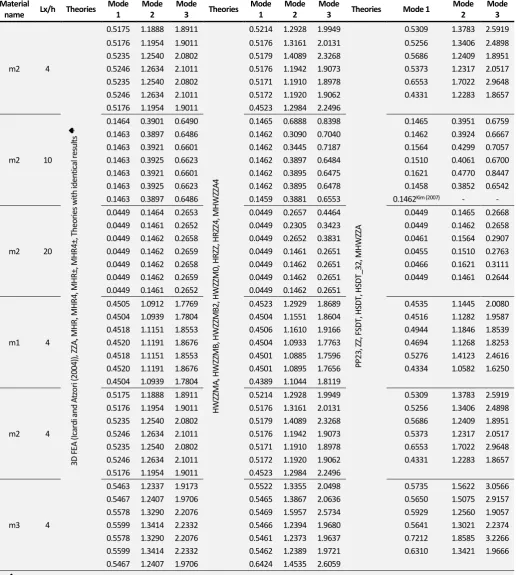
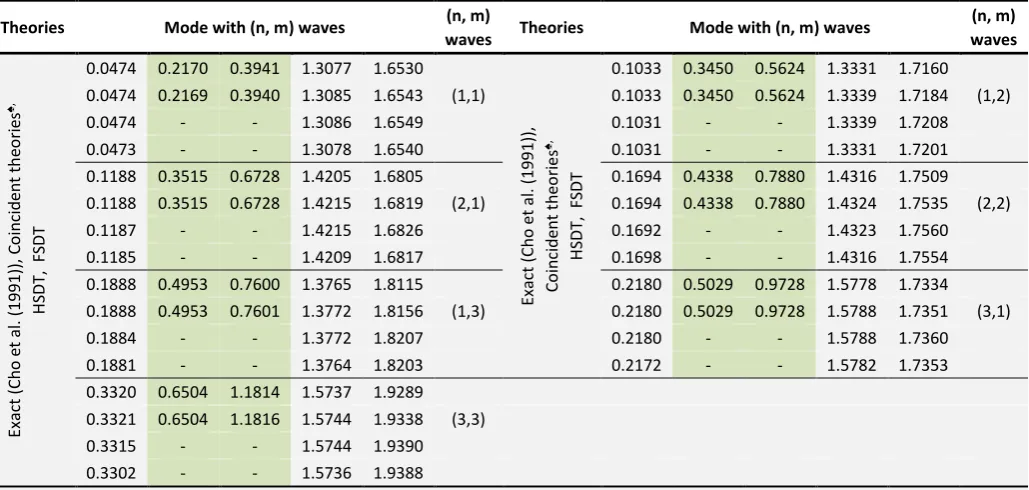
One of the first examples of higher-order sandwich theory for dynamic studies is the paper by Cho et al. (1991) wherein similarly to DL a separate representation is used for each constituent layer. The results of this paper show that natural frequencies are overestimated by ESL for laminates with arbitrary layouts and soft-core sandwiches. Besides it is shown that sandwiches can vibrate even at lower frequencies in modes where the middle plane does not move (pumping), which so cannot be captured by any lower order theory not properly accounting for transverse normal deformability effects.
Higher-order theories are of interest for industrial applications, such as structural health monitoring techniques for revealing and locating damage that are based on guided-wave propagation across the thickness (Barouni and Saravanos (2016)). The structural models used for studying through-thickness vibrations often consider the face sheets as ordinary plates with flexural and in-plane rigidities, irrespective they are made by different plies, although studies carried out by accounting for the laminated construction, including the present one, show that low frequency pumping occurs more easily when the faces consist of a superposition of rigid and less rigid materials. The core is often assumed to be shear resistant in the transverse direction, free of in-plane normal and shear stresses and deformable in the thickness direction.
One of the first studies in this field is published by Frostig and Thomsen (2004), where free vibration through-thickness modes of simply-supported sandwiches with equal faces are investigated using two different structural models. The first assumes the core transverse shear stress and the displacements of the faces as unknowns, while the other assumes a polynomial displacement field across the core based on the former one, whose unknowns are in additions the coefficients of polynomials. The latter model is suited for capturing nonlinear distributions of vertical and in-plane deformations, which are important when the core is soft and flexible. Another example where the same vibration problem is studied is the paper by Rao and Desai (2004), wherein analytical solutions are obtained using equivalent single layer and mixed layerwise theories. The latter ones account for warping of transverse cross-section. In a subsequent article, Malekzadeh et al (2005) investigate the dynamic behavior of sandwiches with a soft viscoelastic flexible core using non-linear displacements across the thickness, so to account for the distortions of the cross-sectional plane and for the transverse normal deformation, while the face sheets are described by FSDT.
Schwarts-Givli et al. (2007) study the free vibration of delaminated unidirectional sandwich panels using a structural model accounting for the flexibility of the core in the thickness direction and assuming nonlinear displacement, acceleration, and velocity fields across it. More recently, Frostig and Thomsen (2009a, 2009b) carried out with a flexible and compliant core in the vertical direction and with temperature-dependent mechanical properties. In another recent paper, Lopatin and Morozov (2010) investigate pumping vibrations of sandwiches with equal faces considering compressive and shear stiffnesses and a nonlinear distribution of the transverse normal displacement across the core thickness. Rahmani et al. (2010) study the free vibration behavior of a composite sandwich cylindrical shell with a flexible core using the classical shell theory for the face sheets and an elasticity approach for the core, so to account for high-order effects caused by the nonlinearity of in-plane and transverse displacements.
layerwise theories which allow to represent each face ply as a single physical layer and the core is splitted into one or more mathematical layers. Last in order of time, the paper by Yang et al. (2017) constitutes an example where a closed-form free vibration analysis of simply supported composite laminated beams has been carried out employing Carrera Unified Formulation (CUF) (Carrera (2001)) which can solve cases including general loading and boundary conditions where other theories cease to be accurate (that is why it is today extensively applied). CUF allows displacements to take arbitrary forms that can be chosen by the user as an input of the analysis and also gets existing ESL and Murakami’s zig-zag theories (MZZ, discussed below) as particularizations. But also refined ZZ theories (Icardi and Sola (2014), Icardi and Urraci (2018a, 2018b)) allow to overcome certain limitations of the theories of sandwiches, such as the assumption of faces of equal thickness, with the same elastic properties and described as a single equivalent layer. Moreover it must be stressed that refined ZZ allow obtaining an accuracy comparable to that of CUF with fewer variables. Papers by Icardi and Urraci (2018a, 2018b) represent successful attempts to extend the physically-based ZZ formulation to assume a degree of generalization comparable to that of CUF. This research continues in this paper through the evolution of ZZ towards a physically-based general theory that considers arbitrary displacement fields and that does not require to embed zig-zag functions explicitly, the displacement coefficients being redefined for each physical or computational lamina, which requires a computational burden still comparable to that of ESL. As a necessary premise to better frame the new contributions brought in this paper, a brief discussion of the characteristics of available ZZ follows.
ZZ can be subdivided into physically-based (DZZ) and kinematic-based (MZZ) theories because layerwise contributions are expressed differently. In DZZ they are embodied as the product of linear (Di Sciuva (1984)) or nonlinear (Icardi (2001)) zig-zag functions and unknown zig-zag amplitudes, while they are a priori assumed as functions featuring a periodic change of the slope of displacements at interfaces in MZZ, then stress fields are assumed apart from displacements within the framework of Hellinger-Reissner mixed variational theorem. The reason why MZZ theories sometimes provide an inappropriate representation of the displacement field (Icardi and Urraci (2018b)) is that the slope of displacements does not necessarily invert at interfaces as instead it is forcibly assumed. In addition there is also the possibility that while stresses are accurately reproduced, displacements are not because of the simplified kinematic assumptions used very often.
Improved DZZ based on a global-local superposition of displacement fields, have been proposed by Li and Liu (1997) and refined over the years by Zhen and Wanji (see e.g. Zhen and Wanji (2007)). ZZA theory by Icardi and Sola (2014) and those by Icardi and Urraci (2018a, 2018b) as its generalizations have five fixed d.o.f. and through-thickness variable kinematic representation that satisfies physical and elasticity theory constraints. They proved capable of the same accuracy of CUF and DL with a lower number of variables, as proven in Icardi and Urraci (2018b). The representation can be arbitrarily chosen by the user to obtain a redefinition of the coefficients of the displacement field similar to what would get by DL. Although preliminary, the study by Icardi and Urraci (2018b) shows that physically-based zig-zag theories with feature similar to those of CUF and HT (discussed below) can be developed starting from different assumptions and by considering forms of representation different for each displacements, that also vary across the thickness. Not yet explored zig-zag functions have also been considered, as will as theories wherein they are even omitted (and therefore with an additional cost benefit), provided that a number of coefficients equal to the number of stress compatibility conditions (or, in general, of constraints enforced) is recomputed at interfaces.
Theories based on a hierarchical set of locally defined polynomials (HT) have been developed (see, Catapano et al. (2011) and de Miguel et al. (2018)), which neither incorporate zig-zag contributions, nor post-processing steps, but which require a large number of degrees of freedom and a large expansion order. As an expamle of the studies where a variable-kinematics is used, see e.g. Vescovini and Dozio (2016). Although dynamic studies are still overwhelmingly carried out using ESL, excluding those previously mentioned concerning sandwiches, those carried out using DL and ZZ and CUF have highlight the superior performance of refined theories (see, e.g., Vescovini and Dozio (2016), Boscolo and Banerjee (2014), Khdeir and Aldraihem (2016), Sayyad and Ghugal (2015), Kazancı (2016), Lin and Zhang (2018)). In particular, those accounting for the transverse normal deformability have shown such deformation important even to predict first free-vibration modes of sandwiches with flexible soft-core, as highlighted in the previously cited articles (Cho et al. (1991), Barouni and Saravanos (2016), Frostig and Thomsen (2004, 2009a, 2009b), Rao and Desai (2004), Malekzadeh et al (2005), Schwarts-Givli et al. (2007), Lopatin and Morozov (2010), Rahmani et al. (2010), Yang et al. (2017)).
the minimum order and type of representation that allows to capture these effects. In this context it is necessary to test more extensively than in Icardi and Urraci (2018b) if theories derived from ZZA without the explicit incorporation of the zig-zag functions, or with arbitrary choices of these functions, as well as with arbitrary displacements are actually always as accurate as the parent theory.
It must be extensively tested even if theories derived from ZZA with a partial a priori assumption of zig-zag functions, which of consequence doesn’t satisfy certain physical constraints, may still be sufficiently accurate. To contribute to clarify this matter, in this paper various theories derived by the authors as variants of ZZA Icardi and Sola (2014) that are obtained assuming differently the representation of displacement components one from the other and in different sections across the thickness, as well as differently assuming zig-zag functions or even omitting them are developed and compared each other, to reference results retaken from literature and to 3-D FEA (Icardi and Atzori (2004)). The purpose of numerical illustrations is to confirm the findings of previous articles (Icardi and Sola (2014), Icardi and Urraci (2018a, 2018b)), namely that the choice of zig-zag functions is immaterial, that these functions can even be omitted when a sufficient number of coefficients is incorporated that are re-determined at interfaces, that displacements can be arbitrarily chosen for the dynamic cases considered, provided that the full set of physical constraints (Khandan et al. (2012), Reddy (2003), Zhen and Wanji (2006), Kapuria et al. (2004)) is satisfied, as discussed below.
The intended aim of numerical applications is also to show how a partial fulfillment of these constraints reflects on accuracy of results, as well as that the redefinition of coefficients which is consequent to the imposition of constraints allows theories to significantly increase their accuracy. The aim is also to show that there is no variation in the accuracy of results exchanging the order of representation of in-plane and transverse displacement components. Furthermore it is proven that for lower-order theories with only a partial fulfillment of constraints the choice of zig-zag and representation functions can no longer be arbitrary and which is the lowest degree and order of expansion that is sufficient to capture the pumping modes. Furthermore it is proven that assigning a specific role a priori to the displacement field coefficients is unnecessary as their role can be freely exchanged without changing the results. To prove all these claims, the theories of this paper are applied to the study of free vibrations of flexible soft-core sandwich plates, for which the transverse deformation is as important as transverse shear one.
2 THEORETICAL FRAMEWORK
The feature of theories retaken from recent papers by the authors and others new proposed in this paper that are used in the numerical applications are presented and discussed below, so to provide the necessary theoretical support as well as to better understand meaning, distinctive features and limitations of the assumptions made and justify how they are reflected on accuracy of results. Those developed in this paper intend to demonstrate that the choice of zig-zag functions is immaterial once physical constraints specified below are enforced, as well as also to show that their explicit incorporation is inessential. Indeed, interlayer stress compatibility conditions can be satisfied by the normal coefficients that describe the displacement field, once they are redefined across the thickness by imposing the appropriate physical constraints, as outlined in the following.
First the notations used and the basic assumptions (common for all the theories) are defined. Constituent layers are assumed to have linear elastic properties, a uniform arbitrary thickness hk and to be perfectly bonded to each
other (bonding resin interlayer disregarded). Global-scale response being examined, cell-scale effects are also disregarded, so sandwiches are described in homogenized form as multi-layered structures with a thick soft intermediate layer as the core.
As reference frame, a rectangular, right-handed Cartesian coordinate reference system (x y z, , ) is assumed, (x y, )
being on the middle reference plane of the multilayered plate (origin in the lower left edge) and z as the thickness
coordinate ( , 2 2
h h z
, h being the overall thickness and Lx and Ly being the plate side-lengths).
( )k
z
and ( )kz
represents the upper and lower position of interfaces, respectively, subscripts k and superscripts k are used to indicate the belonging of quantities to the layer k, while u and l mark upper and lower faces of the laminate. Symbols
x y z
, ,
are replaced by greek letters, i.e. 1,2x y, ; 3 z, to make formulas compact.Elastic in-plane and transverse displacement components are indicated as uand u, respectively, a comma is used to indicate spatial derivatives (e.g.,(.),x x,(.),z z) and strains are assumed to be infinitesimal.
0
u , v0, w0 and the rotations of the normal 0 0 0 0
, ,
( , ) ( , ) , ( , ) ( , )
x x x y w x y x y y x y w x y y
, as the only functional
degrees of freedom. Governing dynamic equations will not be reported as they can be obtained in a straightforward way for each theory using standard variational techniques, so just displacement, strain and stress fields which are ones that affect accuracy will be discussed.
2.1 Analytical solutions
Dynamic governing equation are solved as customary expressing functional degrees of freedom (d.o.f.) as the product of an harmonic function of time ei t and a truncated series expansion of unknown amplitudes Ai
and trial
functions i( , )x y , which individually satisfy prescribed boundary conditions:
1
( , )
m i i i
A x y
(1)the symbol being used to represent in turns the d.o.f. u0, v0, w0, x, y, while mechanical boundary conditions are satisfied using Lagrange multipliers method. So, a number of unknown amplitudes Ai
is determined in proportion
to the number of boundary conditions enforced, while those remaining are determined deriving governing functionals with respect to still unknown amplitudes and equating to zero, the work of inertial forces
[ i i] [ i i]
V V
b u dv u u dv
(2)being considered. An algebraic system is obtained, whose solution provides the numerical value of each amplitude. The trial functions adopted in each individual application and the expansion order used for each case are specified in Table 2. They are chosen in order to satisfy the following boundary conditions, representative of simply-supported edges (other boundary conditions have been considered in Icardi and Urraci (2018a) and Icardi and Urraci (2018b), so they are not replicated also in the present study):
0 0 0 0
, ,
0 0 0 0
, ,
(0, ) 0; ( , ) 0; (0, ) 0; ( , ) 0
( , 0) 0; ( , ) 0; ( , 0) 0; ( , ) 0
x xx x xx
y yy y yy
w y w L y w y w L y
w x w x L w x w x L
(3)
at x 0, x Lx and y 0, y Ly for z 0, i.e. on the reference mid-plane.
2.2 ZZA displacement-based theory
The through-thickness displacement field of this theory (from which all other theories of this paper are particularized) is postulated as (Icardi and Sola (2014), Icardi and Urraci (2018a, 2018b)):
0 0 0
, 0
1 1
0 2
0
1 1
( , , ) [ ( , ) ( ( , ) ( , ) )] [ ( )] [ ( , )( ) ( ) ( , ) ( )]
( , , ) [ ( , )] [ ( )] [ ( , )( ) ( ) ( , )( ) ( ) ( , ) ( )]
i
i
n n
u k k
i k k u k c
k k
n n
k k k
i k k k k k c
k k k
u x y z u x y z x y w x y F z x y z z H z C x y H z
u x y z w x y F z x y z z H z x y z z H z C x y H z
1
i
n
(4)Linear-
[...]
0, higher-[...]
i and layerwise[...]
c contributions are incorporated, whose meaning and purpose are as follows.[...]
0 contains the only five functional degrees of freedom, while[...]
i can contain any combination of independent functions [ u( )]i
2 3 4 4 3
2 3 4 5 5
4
[ ( )] [ ( , ) ( , ) ( ...)] [ (.) ] [( ...)]
[ ( )] [ ( , ) ( , ) ( , ) ( , ) ( ...)] [ (.) ] [( ...)]
u i i
i i i i
i i i i
i i i i
F z C x y z D x y z Oz Oz
F z b x y z c x y z d x y z e x y z Oz Oz
(5)
and of which Icardi (2001) is a particularization with a through-thickness fixed representation, namely higher-order contributions [( 4...)]
i
Oz , [( 5...)] i Oz
are characteristic of ZZA, while terms [ (.) ]3 i, [ (.) ]4 i are the same as in the
previous theory.
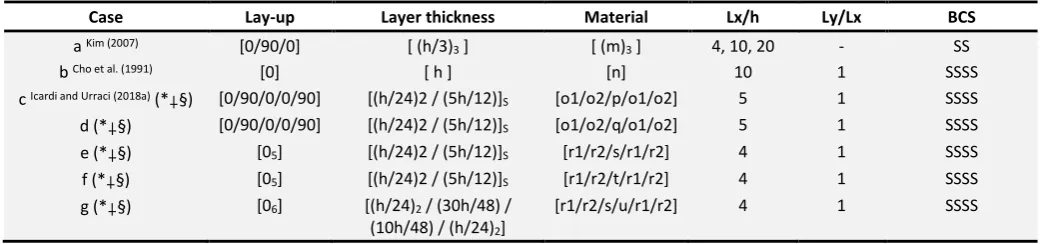
Table 2a Reference pattern of all cases ; *⸸§: Murakami’s slope assumption not respected by u(*), u(⸸) and u(§).
Case Lay-up Layer thickness Material Lx/h Ly/Lx BCS
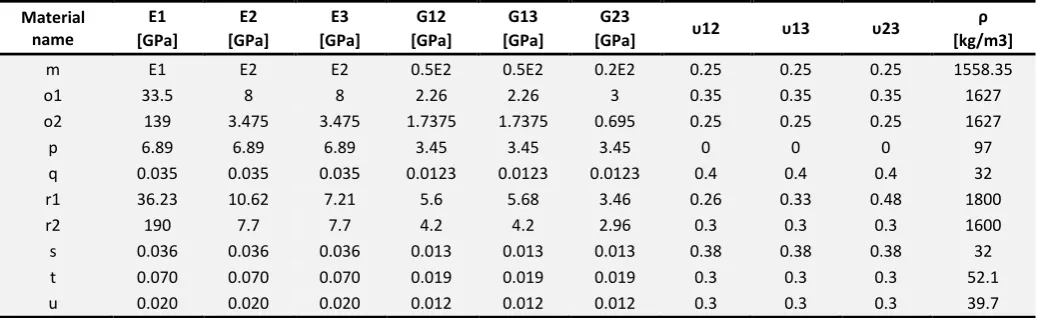
a Kim (2007) [0/90/0] [ (h/3)3 ] [ (m)3 ] 4, 10, 20 - SS
b Cho et al. (1991) [0] [ h ] [n] 10 1 SSSS
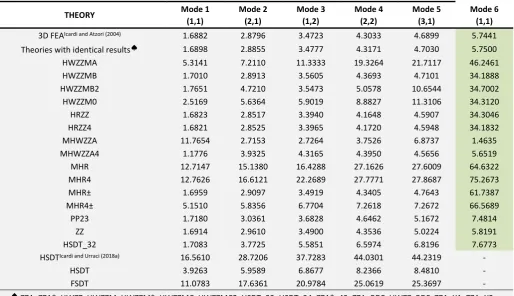
c Icardi and Urraci (2018a) (*⸸§) [0/90/0/0/90] [(h/24)2 / (5h/12)]S [o1/o2/p/o1/o2] 5 1 SSSS
d (*⸸§) [0/90/0/0/90] [(h/24)2 / (5h/12)]S [o1/o2/q/o1/o2] 5 1 SSSS
e (*⸸§) [05] [(h/24)2 / (5h/12)]S [r1/r2/s/r1/r2] 4 1 SSSS
f (*⸸§) [05] [(h/24)2 / (5h/12)]S [r1/r2/t/r1/r2] 4 1 SSSS
g (*⸸§) [06] [(h/24)2 / (30h/48) /
(10h/48) / (h/24)2]
[r1/r2/s/u/r1/r2] 4 1 SSSS
Table 2b Normalization, trial functions and expansion order for each case.
Case Normalization Trial functions Expansion order
a _
12_ MATp MATp h G 0 1 0 1 0 1
( , ) cos ;
( , ) sin ;
( , ) cos
M m m x M m m x M x m m x m x
u x y A
L m x
w x y C
L m x
x y D
L
5b _
11 MATn h Q 0 1 1 0 1 1 0 1 1 0
( , ) cos sin ;
( , ) sin cos ;
( , ) sin sin ;
( , )
M N
mn
m n x y
M N
mn
m n x y
M N
mn
m n x y
x
m n
u x y A x y
L L
m n
v x y B x y
L L
m n
w x y C x y
L L x y
1 1 0 1 1cos sin ;
( , ) sin cos ;
M N
mn
m n x y
M N
y mn
m n x y
m n
D x y
L L
m n
x y E x y
L L
10c 2 _ 2
2_ 2 max max
MATo ij
x i
i ij
MATo i ij
L u
u
h E u
10
d
2
_ 2
2_ 2 max max
MATo ij
x i
i ij
MATo i ij
L u
u
h E u
10
e 2 _ 2
2_ 2 max max
MATr ij
x i
i ij
MATr i ij
L u
u
h E u
15
f 2 _ 2
2_ 2 max max
MATr ij
x i
i ij
MATr i ij
L u
u
h E u
15
g 2 _ 2
2_ 2 max max
MATr ij
x i
i ij
MATr i ij
L u
u
h E u
15
Note that [ u( )]
i
F z and [F z( )]i aren’t just depending on z because symbols u
, represent the functional
dependence on the d.o.f. which are function of in-plane coordinates. Expressions of coefficients Ci
, 0
; 0
( ) p
(6)
having assumed only a transverse distributed loading to act at upper (+) and lower (-) faces (non-homogeneous conditions ; 0 could be enforced without difficulty). It should be noticed that for this paper, p0( ) 0,
being free vibration analyses. Contributions
[...]
i by (5) can be rearranged as:2 3 4
2 3 4
2 3 4 5
1 2 3 4 5
( , , ) [ ] ...
( , , ) [ ] ...
i n
n
i n
n
U x y z A z A z A z A z
U x y z A z A z A z A z A z A z
(7)
to highlight which those under square brackets are determined by enforcing the fulfilment of boundary conditions (6) and local equilibrium equations:
, , b
; , , b (8)
at selected points across the thickness, while higher-order contributions 4
4 ... n n
A z A z , 5 5
A z ... n n A z
,
which enable a variable-kinematics representation across the thickness, are computed by imposing just the fulfilment of (8). Note that the in-plane position of equilibrium points can be chosen appropriately for each case and that coefficients that qualify displacements are re-computed specifically for each computational/physical layer, so that the representation can properly manage strong variations of layer properties without any increase of the d.o.f. In the numerical applications a third/fourth order representation that embraces the whole laminate is used being generally sufficient to obtain accurate results (Icardi and Sola (2014), Icardi and Urraci (2018a, 2018b)).
[...]
c represent layerwise contributions where the expressions of zig-zag amplitudes k
, k and k are determined so that the continuity of
out-of-plane stresses and of the transverse normal stress gradient , at layer interfaces
( ) ( )
(kz ) (kz )
; (( )kz ) (( )kz )
;
( ) ( )
,(kz ) , (kz )
(9)
is satisfied, as prescribed by the elasticity theory. The other layerwise contributions k u
C and Ck
restore the continuity of displacements
( ) ( )
(k ) (k )
u z u z ; u (( )kz ) u (( )kz )
(10)
at mathematical layer interfaces, i.e. when it is chosen to split physical layers. The symbols ni and n in the
summations of (4) are used to distinguish the number of physical layer interfaces from that of mathematical layer interfaces, respectively. The enforcement of equilibrium and stress compatibility conditions yields to a system of algebraic equations at each interface that is solved using a symbolic calculus tool. Notice that if just the material properties and/or the orientation of layers change, but not their number, symbolic expressions representing the solution will remain the same. The computation of zig-zag amplitudes takes only an small fraction of the overall calculation time, so costs remains compatible with that of ESL (see, Table 3). Note that SEUPT technique (Icardi and Sola (2014)) can be used to obtain a C° formulation of the ZZA theory, as well as of all the other theories of this paper.
2.3 ZZA* displacement-based theory
A modified version of ZZA indicated as ZZA* (Icardi and Urraci (2018a)) is considered to show that zig-zag functions (zz Hk) k and ( )2
k k
translates into the fact that contributions [...]c can be completely omitted if other coefficients can be redefined across
the thickness, even if they are not multiplied by zig-zag functions. As this latter choice speeds-up the computations of coefficients, it turns into a computational advantage that grows with the number of computational layers. To construct ZZA*, the displacement field (4) is rewritten as:
0 0 0 2 3 3
, 0
1 1
0 2 2
0
1 1
( , , ) [ ( , ) ( ( , ) ( , ) )] { ( , ) [ ( , ) ] [ ( , ) ( , ) ] ( , )}
( , , ) [ ( , )] {[ ( , ) ( , ) ] [ ( , ) ( , ) ]
i i
n n
i i i i i
k j k i c
k k
n n
i i i i
k k
k k
u x y z u x y z x y w x y B x y z C x y z D x y z D x y z C x y
u x y z w x y b x y z b x y z c x y z c x y z
3 4
1
[ ( , ) ] ( , ) i ( , )}
n
i i i
k i c
k
d x y z e x y z d x y
(11)
wherein
[...]
0 still contains the only five functional d.o.f., the same of ZZA. Terms kBi , Ci, kCi serve the same purpose as k , Ci
and Cuk inside ZZA, while kbi and kci have the function of k and k and kdithat of Ck once they are redefined across the thickness in order to satisfy physical constraints.
Table 3 Processing time [s] on a computer with quad-core [email protected], 64-bit OS and 8.00 GB RAM; errors: ♥> 3%; ♣> 10%.
Theory a b c Case d e f g
Reference FSDT ♥3.0397♣ ♥3.5504♣ ♥21.6851♣ ♥23.4756♣ ♥21.9426♣ ♥23.1613♣ ♥27.5775♣ theories HSDT ♥3.2507♣ ♥3.8809♣ ♥24.4111♣ ♥25.6612♣ ♥23.9855♣ ♥25.3175♣ ♥30.1449♣
Ne
w
Th
eo
rie
s
ZZA_RDF 4.9187 6.6559 48.3134 44.0099 41.1360 43.4205 51.6997 ZZA*_43 3.8743 5.2426 38.0547 34.6650 32.4013 34.2008 40.7219 (mixed HW) HWZZ_RDF 4.5332 6.1343 44.5274 40.5611 37.9124 40.0179 47.6483
HSDT_32 ♥3.1870♣ 4.3126 ♥31.3042♣ ♥28.5158♣ ♥26.6537♣ ♥28.1339♣ ♥33.4983♣ (no zig-zag
functions) HSDT_33 3.4203 4.6283 33.5957 30.6032
♥28.6047 30.1933 ♥35.9504
HSDT_34 3.8645 5.2293 37.9586 34.5775 32.3195 34.1144 40.6191
ZZA_X1 3.9015 5.2795 38.3226 34.9090 32.6294 34.4415 41.0086 (arbitrary
representation) ZZA_X2 4.0033 5.4172 39.3223 35.8197 33.4806 35.3400 42.0784 ZZA_X3 4.0537 5.4854 39.8173 36.2706 33.9020 35.7848 42.6081 ZZA_X4 4.0517 5.4827 39.7974 36.2525 33.8851 35.7670 42.5868
(general) ZZA-XX 9.8060 13.2694 96.3194 87.7398 82.0102 86.5648 103.0703 ZZA-XX’ 9.5369 12.9052 93.6760 85.3319 79.7595 84.1891 100.2417
M
ixe
d H
R
(uniform w) HRZZ 4.6117 6.2076 ♥44.8213♣ 41.0461 ♥38.3657♣ ♥40.4964♣ ♥48.2179♣ (polynomial w4) HRZZ4 5.0138 6.7541 ♥48.8044♣ 44.6591 ♥41.7428♣ ♥44.0610♣ ♥52.4623♣
(Murakami’s
zig-zag MHR
♥2.8107♣ 4.1177 ♥32.1710♣ ♥27.2271♣ ♥25.4491♣ ♥26.8625♣ ♥31.9844♣
u3,v3) MHR± ♥3.0388♣ 4.2840 ♥32.3442♣ 28.3264 ♥26.4767♣ 27.9471♣ ♥33.2758♣
(Murakami’s
zig-zag MHR4
♥2.9093 4.2454 ♥33.0563♣ ♥28.0714♣ ♥26.2383♣ ♥27.6955♣ ♥32.9763♣
Theory Case
a b c d e f g
M
ixe
d H
W
HWZZ 4.9640 6.4877 45.4263 42.8977 40.0964 42.3232 50.3931
(no zig-zag
functions) HWZZM* 3.9374 5.1532 36.1369 34.0740 31.8489 33.6177 40.0277
MHWZZA ♥3.7606♣ 5.1634 ♥38.0218♣ ♥34.1415♣ ♥31.9120♣ ♥33.6843♣ ♥40.1070♣ MHWZZA4 ♥3.7602♣ 5.1663 ♥38.0678♣ ♥34.1607♣ ♥31.9299♣ ♥33.7032♣ ♥40.1295♣ HWZZM 4.1887 5.6511 40.8973 37.3664 34.9263 36.8660 43.8954 (Murakami’s
zig-zag HWZZMA
♥4.1595♣ 5.5746 ♥40.0733♣ ♥36.8605♣ ♥34.4534♣ ♥36.3669♣ ♥43.3010♣
u3,v3,w4) HWZZMB ♥4.1817♣ 5.6134 ♥40.4178♣ 37.1167 ♥34.6929♣ 36.6197 ♥43.6020♣ HWZZMB2 ♥4.1869♣ 5.6175 ♥40.4263♣ ♥37.1439♣ ♥34.7183♣ ♥36.6464 ♥43.6339♣ HWZZMC 4.1659 5.6065 40.4737 37.0715 34.6507 36.5750 43.5489 HWZZMC2 4.1849 5.6148 40.4071 37.1262 34.7018 36.6290 43.6131 HWZZM0 4.1554 5.5491 ♥39.7426♣ ♥36.6915♣ ♥34.2955♣ ♥36.2002♣ ♥43.1026♣ (adaptive
u3,v3,w4) ZZA 5.3866 7.0182 48.9768 46.4055 43.3751 45.7840 54.5138
(u3,v3,w4) ZZ ♥3.7072♣ 5.0165 ♥36.4137 33.1702 ♥31.0041♣ ♥32.7259♣ ♥38.9659♣
(no zig-zag functions) u3,v3,w4)
ZZA* 3.8722 5.2398 38.0345 34.6466 32.3841 34.1826 40.7003
(no zig-zag functions) u2,v2,w3)
PP23 ♥2.8765♣ 3.8924 ♥28.2542♣ ♥25.7375 ♥24.0568♣ ♥25.3928♣ ♥30.2345♣
Again Ci
, Di , bi, ci, di and ei allow local equilibrium equations (8) and stress boundary conditions (6) and be met. At the bounding lower face bi and ci enable the fulfillment of stress boundary conditions regarding that
transverse normal stress and gradient , then they are canceled in subsequent layers where Ci , Di , di and
i
e allow to satisfy the three equilibria (8) at two points per layer (excluding the upper layer), while these coefficients enable stress-free boundary conditions on and three equilibrium equations at a single point to be satisfied.
The remaining still free variables allow to meet three equilibrium equations at a single point across the upper layer and the boundary conditions at the upper bounding surface. It could be noticed that the first, the intermediate and the last layers can be subdivided each into two or more computational layers if more equilibrium points are required for improving accuracy. However, this decomposition into computational layers does not prove necessary for the benchmarks considered, just a third/fourth order overall piecewise representation of displacements being usually appropriate.
However for this to happen, the displacement field (11) must contain a sufficient number of contributions for ensuring the imposition of a sufficient number of equilibrium conditions at selected positions zj across the thickness.
This doesn’t necessarily mean that an increased order of expansion is required, because coefficients can be evaluated at different positions using the same power of the thickness coordinate.
2.4 HWZZ mixed theory
HWZZ theory (Icardi and Urraci (2018b)) is a mixed version of ZZA developed within the framework of Hu-Washizu variational theorem which is obtained keeping only contributions to displacement, strain and stress fields deemed essential, for the purpose of reducing the computational effort but preserving accuracy.
Displacements derive from those of ZZA neglecting the contributions of kwhich provide much less important
slope variations than k
,
k. Higher-order and adaptive contributions, 44 ...
A z n
n A z
, 5
5 ... n n
A z A z ,
which as k are important for an accurate description of the stress field in ZZA, but here because stresses are
assumed separately from displacements, are also neglected.
As a direct consequence, no decomposition into mathematical layers is allowed For consistency, consequently, contributions k
u
C , k v
C , k w
C are omitted. As a result, the displacement field of HWZZ is:
0 0 0 2 3
, 0
1
0 2 3 4
0 1 ( , , ) [ ( , ) ( ( , ) ( , ) )] [ ( , ) ( , ) ] [ ( , )( ) ( )] ( , , ) [ ( , )] [ ( , ) ( , ) ( , ) ( , ) ] [ ( , )( ) ( )] i i n
i i k
x i k k c
k n
i i i i k
i k k c
k
u x y z u x y z x y w x y C x y z D x y z x y z z H z
u x y z w x y b x y z c x y z d x y z e x y z x y z z H z
(12)The decomposition into mathematical layers is restored in out-of-plane strains zz,
xz, yz, as their expressionsare derived from
0 0 0 2 3
, 0
1 1
0 2 3 4
0 1 ( , , ) [ ( , ) ( ( , ) ( , ) )] [ ( , ) ( , ) ] [ ( , )( ) ( ) ( , ) ] ( , , ) [ ( , )] [ ( , ) ( , ) ( , ) ( , ) ] [ ( , )( ) ( ) i n
i i k k
x i k k u k c
k k
i i i i k
i k k
k
u x y z u x y z x y w x y C x y z D x y z x y z z H z C x y H
w x y z w x y b x y z c x y z d x y z e x y z x y z z H z
1 ( , ) ] i n kw k c
k
C x y H
(13)The symbol
(.)
states that displacements refer to the computational layer . Instead, no decomposition into mathematical layers is allowed for the in-plane strains, they being derived from (12).The expressions of membrane stresses xx, yy, xy are obtained in a straightforward way from stress-strain relations, while for improving accuracy and recovering mistakes consequent the restrictive assumptions made, such as the small stress jumps resulting from omission of contributions by k,
xz
, yz, zz are obtained from membrane stresses by integrating local equilibrium equations (8).
3 HWZZM MIXED THEORY
It is constructed following a similar pattern to HWZZ in order to show that the choice of zig-zag functions is immaterial, as the same results can be achieved irrespective of the choice made whenever the full set of physical constraints discussed so far in this paper are enforced. HWZZM is developed assuming the following displacement field (Icardi and Urraci (2018a)):
1
0 0 0
, 0 1 1 2 1 0 0
1 1 1
2
( , , ) [ ( , ) ( ( , ) ( , ) )] [ ( )] [ ( )[ ] ( , )]
(2 ) 2
( , , ) [ ( , )] [ ( )] [ ( )[ ] ( )[ ] ( , )]
u k k
u k
i k c
k k k k
u k k u k
i k k c
k k k k k k
z z
z
u x y z u x y z x y w x y F z A z C x y
z z z z
z z z
z
u x y z w x y F z A z B z C x y
z z z z z z
(14)
Layerwise functions within the third square bracket constitute variations of Murakami’s zig-zag contributions
( ) ( 1)
k k k
M z in canonical form, where k a zk bk,
1 2 , k k k a
z z
1 1 k k k k k z z b z z
in the literature, are multiplied by amplitudes u k
A and u
k
B whose expressions are defined by enforcing the fulfillment of interfacial stress compatibility conditions.
Note that this is operation is the one making the choice of zag functions immaterial, since the product of zig-zag amplitudes and functions becomes an invariant, as shown by the numerical results, once the full set of physical stress compatibility constraints (9) is enforced. Again, Ck
and Ckrestore the continuity of displacements at interfaces of mathematical layers. HWZZM is developed starting from the previous displacement field and similar to HWZZ inhibiting the decomposition into fictitious computational layers. Moreover, contributions to in-plane displacements over the third-order and to the transverse displacement over the fourth-order are neglected. As for HWZZ, membrane strains are derived from (14) with the decomposition into computational layers prevented, while it is allowed for deriving the expressions of out-of-plane strains. Membrane stresses
xx , yy, xy are obtained from stress-strainrelations, while out-of-plane master stresses come from integration of local equilibrium equations.
3.1 Theories HWZZM(A-B-B2-C-C2-0)
In this section, several theories are particularized from HWZZM by assuming a priori the expressions of some zig-zag amplitudes, as specified below. Since contrary to what was done previously they are not determined through the imposition of physical and elasticity constraints, the theories of the present section resemble Murakami's like ones nowadays widely used, at least from the standpoint of the basic idea on which they are founded. Their purpose is that of highlighting that as physical constraints are only partially satisfied, in the present case due to the omission of certain interfacial stress compatibility conditions, it is no longer possible to obtain the same accuracy of ZZA, ZZA*, HWZZ and HWZZM with the same order of representation. On the contrary, it will be shown that displacement representation form and zig-zag functions can be assumed arbitrarily and the latter even omitted with no loss of accuracy, if instead the full set of constraints is enforced (see, section 4).
Amplitudes of HWZZMA are assumed coincident with those of HWZZM at the first interface from below, while
( ) u k
A z and u ( )
k
B z of HWZZMB are assumed the same of HWZZMA at the first interface from below, but u ( )
k A z is
calculated like in HWZZM. In HWZZMC Bku( )z is assumed uniform across the thickness (it is that by HWZZM at the first interface from below), while the remaining amplitudes are computed at each interface. In HWZZM0 Bku( )z are neglected, while Aku( )z and u ( )
k
A z are assumed the same of HWZZMB. HWZZMB2 and HWZZMC2 theories are similar to HWZZMB and HWZZMC, except amplitudes are those of HWZZM at the first interface from above.
Because out-of-plane stresses by these theories result discontinuous, integration of local equilibrium equations is required, with a corresponding increase in costs by 0.9%. But at the same time, a savings of 10% is obtained, as zig-zag amplitudes are not computed at each interface, so in the end a positive is achieved which, however, is thwarted by the lack of accuracy.
3.2 HWZZM* theory
This theory is derived as a particularization of ZZA*, in order to assess the effect of omission of layerwise functions. It is developed in a similar way of HWZZ, omitting terms i
kc , kCi , kdi into displacement field (no
decomposition into mathematical layers is allowed for displacement field):
0 0 0 2 3
, 0 1
0 2 3 4
0
1
( , , ) [ ( , ) ( ( , ) ( , ) )] { ( , ) } {[ ( , ) ] [ ( , ) ]}
( , , ) [ ( , )] {[ ( , ) ] [ ( , ) ] [ ( , ) ] ( , ) } { ( , ) } n
i i i
k c i
k
n
i i i i i
i k c
k
u x y z u x y z x y w x y B x y z C x y z D x y z
u x y z w x y b x y z c x y z d x y z e x y z b x y z
(15)
In this case, terms [...]i only serve to satisfy stress-boundary conditions and local equilibrium equations, while
[...]c serve to satisfy stress compatibility conditions (9). Accordingly, the representation (15) is nothing but an equivalent form of (11). Regarding master strain field, contributions i
kC and kdi are restored, because
obtained from master strain field using stress-strain relations, while out-of-plane ones are obtained by integrating local equilibrium equations.
From a practical viewpoint, (15) imply a reduction of about 10% of the processing time per each layer with respect to ZZA and about of 6% with respect to HWZZ, but the goal is not so much this reduction, even if it becomes more important with the increase of the constituent layers, but instead that of proving how arbitrary layerwise functions give the same result once the full set of physical constrains (6, 8-10) is enforced.
3.3 Lower order theories for comparisons
Lower-order theories with some features reminiscent to ones of theories in the literature are particularized for sake of comparison. MHR considers piecewise cubic in-plane displacements incorporating Murakami’s zig-zag function as the layerwise function, and a fourth-order polynomial transverse displacement:
0 0 0 2 3
, 0
0 2 3 4
0
( , , ) [ ( , ) ( ( , ) ( , ) )] [ ( , ) ( , ) ] ( , ) ( )
( , , ) [ ( , )] [ ( , ) ( , ) ( , ) ( , ) ]
k
x i z
i
u x y z u x y z x y w x y C x y z D x y z u x y M z
u x y z w x y a x y z b x y z c x y z d x y z
(16)
where M zk( ) is defined in section 3. Coefficients C
, D,
a
, b,c
,d are calculated by enforcing the fulfilment of stress boundaries conditions (6), while uz is calculated by enforcing the fulfilment of first and second equilibriumequations (8) at the middle-plane of the laminate. The expressions of out-of-plane stresses are derived integrating local equilibrium equations, within the framework of HR variational theorem.
MHR±, is a variant where the right sign of Murakami’s zig-zag function is determined at each interface on a physical basis (that which produces the least error in equilibrium equations), instead of being forced to reverse by the coefficient ( 1) k.
A refined variant MHR4 is obtained assuming the in-plane displacement of MHR and a fourth-order piecewise variation of the transverse displacement
0 2 3 4
0
( , , ) [ ( , )] [ ( , ) ( , ) ( , ) ( , ) ] ( , ) k( )
i z
u x y z w x y a x y z b x y z c x y z d x y z w x y M z (17)
Coefficients a to d are determined by enforcing the fulfiment of stress boundary conditions (6), while wz is
calculated by enforcing the fulfilment of the third local equilibrium equation at the middle-plane. Another theory, MHR4±, is obtained by MHR4, assuming the right sign of Murakami’s zig-zag functions at each interface on a physical basis, similarly to MHR±.
Theory MHWZZA has the same displacement-field of MHR (16), but its master stress field is that of HWZZ and, in addition, displacement, strain and stress fields are recovered using ZZA as post-processor.
Theory MHWZZA4 is derived assuming the in-plane displacement field by MHR, the transverse displacement by ZZA and as master strain and stress fields ones by HWZZ. So, the only substantial difference of MHWZZA4 with respect to HWZZ and ZZA is a different zig-zag function and a simplified kinematics, while MHR4, MHR4±, MHR± and MHR are approximations obtained with increasing restrictions from MHWZZA4, in order to identify the effects played by single contributions omitted.
Theory HRZZ is developed within the framework of HR variational theorem postulating a uniform transverse displacement and a third-order zig-zag representation of in-plane displacements:
0 0 0 2 3
, 0
1 1
0
( , , ) [ ( , ) ( ( , ) ( , ) )] [ ( , ) ( , ) ] [ ( , )( ) ( ) ( , ) ]
( , , ) ( , )
i
n
i i k k
x i k k u k c
k k
u x y z u x y z x y w x y C x y z D x y z x y z z H z C x y H
u x y z w x y
(18)Theory HRZZ4 assumes the same in-plane representation of HRZZ, the following fourth-order polynomial approximation of the transverse displacement:
0 2 3 4
0
( , , ) [ ( , )] [ ( , ) ( , ) ( , ) ( , ) ]i
u x y z w x y b x y z c x y z d x y z e x y z (19)
and the same stress fields of HRZZ. In this case u
being no longer null it is not necessary to use transformed, reduced stiffness properties. Coefficients b to e are determined by enforcing the stress boundary conditions (6).
Regarding PP23 theory, in-plane displacements are parabolic, while the transverse one is cubic:
2
0 0 0
, 0 _
1 3
0 0
1
1 1 1
_
( , , ) [ ( , ) ( ( , ) ( , ) )] [ ( , ) ( ) ]
( , , ) [ ( , )] [ ( , ) ( ) ]
0; 0; 0; ( ) ( ) ( )
i i
k k i c
k
i i
k k i c
k
i i i k
k k k
u x y z u x y z x y w x y C x y F z C
u x y z w x y D x y G z C
C C C F z G z z
(19’)Coefficients are calculated similarly to ZZA, by imposing the fulfilment of boundary conditions (6) and of continuity of out-of-plane stresses, of , and of displacements (9)-(10) and the fulfilment of local equilibrium equations (8) at different points across the thickness. Results of out-of-plane stresses are post-processed by integrating local equilibrium equations.
Regarding ZZ theory, the displacement field is:
0 0 0 2 3
, 0
1
0 2 3 4 2
0
1 1
( , , ) [ ( , ) ( ( , ) ( , ) )] ( , ) ( , ) ( , )( ) ( )
( , , ) [ ( , )] [ ( , ) ( , ) ( , ) ( , ) ] ( , )( ) ( ) ( , )( ) ( )
i
i i
n k
k k k
n n
k k
i k k k k
k k
u x y z u x y z x y w x y C x y z D x y z x y z z H z
u x y z w x y b x y z c x y z d x y z e x y z x y z z H z x y z z H z
(19”)Coefficients C D b c d e, , , , , are not redefined across the thickness and are obtained by imposing the boundary conditions (6) of out-of-plane stresses and of , , while k, k and k are calculated by imposing the continuity of transverse shear stresses and of its gradient (9) across the thickness. similarly to PP23 and other lower-order theories, out-of-plane stresses have to be post-processed and obtained by integrating local equilibrium equations.
4 NEW THEORIES OF THIS PAPER
New theories with a growing order of generalization are introduced below, which are aimed at demonstrating that the representation form of the displacement field and can be assumed arbitrarily and zig-zag functions can be omitted, whenever the full set of constraints (6, 8-10) is enforced and the coefficients of the representation are redefined across the thickness. The comparison with theories partially fulfilling constraints will show that instead the accuracy depends on the choices made, as known in literature for non-physically-based theories (see for example Catapano et al. (2011) and de Miguel et al. (2018)), which cannot fully satisfy (6, 8-10). Although zig-zag functions are not incorporated, the theories of this sections can still be considered as physically-based zig-zag theories, because constraints are enforced in order to determine the expressions of coefficients.
In spite displacements can be assumed arbitrarily, including a different representation for each component and from point to point across the thickness, unlike DL the d.o.f. remain fixed because coefficients, which are redefined through the use of symbolic calculations, aren’t assumed as d.o.f. but instead they are fixed once for all, as outlined forward.
![Table 3 Processing time [s] on a computer with quad-core CPU@2.60GHz, 64-bit OS and 8.00 GB RAM; errors: ♥> 3%; ♣> 10%](https://thumb-us.123doks.com/thumbv2/123dok_us/8382414.1679130/9.595.45.557.302.764/table-processing-time-computer-quad-core-cpu-errors.webp)