Adeyemo et al. World Journal of Engineering Research and Technology
PERFORMANCE EVALUATION OF APPEARANCE AND
GEOMETRY BASED ALGORITHMS FOR FACIAL FEATURE
EXTRACTIONS
Ganiyu Rafiu Adesina, Adeyemo Isiaka Akinkunmi, Olabiyisi Stephen Olatunde, Akande Noah Oluwatobi
Onuiyi Road, Nsukka, Enugu State, Nigeria.
Article Received on 24/05/2018 Article Revised on 14/06/2018 Article Accepted on 05/07/2018
ABSTRACT
Facial feature extraction is an important step towards the development
of any facial recognition system. Many algorithms have been used to
improve feature extraction but little research work has been done to
evaluate their performances in order to determine the most efficient.
This paper focuses on the performance evaluation of appearance and geometry based facial
features extraction techniques using Gabor Wavelet (GW) and Local Binary Patterns (LBP)
algorithms, respectively. The GW and LBP algorithms were implemented using MATLAB
8.1 (R2013a) with Euclidean distance as similarity metric between each testing and training.
Each of the implemented algorithms was used to extract facial features. The GW algorithm
was used to extract facial features such as projection axes, edge, valley and ridge contours
while features such as histograms, pixel values, lines, edges and corners were extracted using
the LBP algorithm. The results of evaluation showed that GW feature extraction technique
assumed an average Computational Time of 3.92seconds while LBP yielded an average
Computational Time of 6.0seconds. Also, GW yielded 56.2% False Acceptance Rate while
82.5% False Acceptance Rate was recorded for LBP. Similarly, the False Rejection Rate of
GW was 88.7% while that of LBP was 48.5%. The results obtained in this study implied that
GW facial features extraction technique is more efficient than LBP in terms of Computational
Time, False Acceptance Rate and False Rejection Rate. Also, it could serve as a guide for
researchers to choose appropriate algorithm for facial features extraction.
World Journal of Engineering Research and Technology
WJERT
www.wjert.org
SJIF Impact Factor: 5.218*Corresponding Author Adeyemo Isiaka
Akinkunmi
Onuiyi Road, Nsukka,
KEYWORDS: Facial Images, Features Extraction, Geometry features, LBP, Gabor Wavelet.
I. INTRODUCTION
The ideal of features extraction is to find a specific representation of the data that can
highlight relevant information.[1] The reliability of face recognition schemes is a great
challenge to the scientific community. Falsification of identity cards or intrusions of physical
and virtual areas by cracking alphanumerical passwords appear frequently in the media.
These problems of modern society have triggered a real necessity for reliable, user-friendly
and widely acceptable control mechanisms for the identification and verification of the
individual. Biometrics, which is based on authentication on the intrinsic aspects of a specific
human being, appears as a viable alternative to more traditional approaches such as PIN
codes or passwords.[2]
Some facial recognition algorithms identify facial features by extracting landmarks, or
features, from an image of the subject's face. For example, an algorithm may analyse the
relative position, size, and or shape of the eyes, nose, cheekbones, and jaw. These features are
then used to search for other images with matching features. Other algorithms normalize a
gallery of face images and then compress the face data, only saving the data in the image that
is useful for face recognition. A probe image is then compared with the face data. One of the
earliest successful systems is based on template matching techniques applied to a set of
salient facial features, providing a sort of compressed face representation. Recognition
algorithms can be divided into two main approaches, Geometric, which looks at
distinguishing features, or Photometric, which is a statistical approach that distils an image
into values and compares the values with templates to eliminate variances. Popular
recognition algorithms include Principal Component Analysis using Eigen faces, Linear
Discriminate Analysis, Elastic Bunch Graph Matching using the Fisher face algorithm, the
Hidden Markov model, the Multi-linear Subspace Learning using tensor representation, and
the neuronal motivated dynamic link matching.[8]
II. RELATED WORKS
Several works have been done in the area of features extractions and different approaches
have been considered for the evaluation, in,[3] Gabor feature for face recognition from the
new angle of its robustness to misalignment using a novel quantificational evaluation method
combining both the alignment precision and the recognition accuracy. Their experiments
caused by the imprecision of facial feature localization, which further support the feasibility
of Gabor representation. Also, it was suggested in[4] that the performance of face recognition
system is determined by how to extract feature vector exactly and to classify them into a class
correctly. Therefore, it is necessary to pay close attention to feature extractor and classifier.
They proposed a methodological improvement to raise face recognition rate by fusing the
phase and magnitude of Gabor's representations of the face as a new representation, in the
place of the raster image, although the Gabor representations were largely used, particularly
in the algorithms based on global approaches, the Gabor phase was never exploited, followed
by a face recognition algorithm, based on the principal component Analysis approach and
Support Vector Machine (SVM) is used as a new classifier for pattern recognition. Local
binary pattern (LBP) is a nonparametric descriptor, which efficiently summarizes the local
structures of images.[5] It has aroused increasing interest in many areas of image processing
and computer vision and has shown its effectiveness in a number of applications, in particular
for facial image analysis, including tasks as diverse as face detection, face recognition, facial
expression analysis, and demographic classification.
The classified problems of LBP feature selection techniques were categorised into two. The
first one is to reduce the feature length based on some rules (like uniform patterns), while the
other one exploits feature-selection techniques to choose the discriminative patterns. Both
streams have their own merits and drawbacks: the first one is simple, but has limited features
election ability; on the contrary, the second one has a better feature-selection capacity, but
usually requires offline training that could be computationally expensive.[3]
Also in,[6] the use of Gabor wavelets for efficient face representation was established. Face
recognition is influenced by several factors such as shape, reflectance, pose, occlusion and
illumination which make it even more difficult. Today there exist many well-known
techniques to try to recognize a face. The introduction of the Gabor wavelets for an efficient
face recognition system by simulating human perception of objects and faces. The
demonstrated technique was technically feasible to scan pictures of human faces and
compared them with ID photos hosted in a centralized database using Gabor wavelets.
Similarly, the approach appears to be quite perspective, insensitive to small changes in head
poise and homogenous illumination changes, robust against facial hair, glasses and also
generally very robust compared to other methods. However it was found to be sensitive to
consistent for efficient recognition. It is worth mentioning that Gabor wavelets technique has
recently been used not only for face recognition, but also for face tracking and face position
estimation.[6] Face recognition using both shape and texture information empirically
evaluated to represent face images based on Local Binary Patterns for person independent
face recognition. The face area is first divided into small regions from which Local Binary
Patterns (LBP), histograms are extracted and concatenated into a single feature vector. This
feature vector forms an efficient representation of the face used to measure similarities
between images.[7] A comparison was explored in[8] between geometry-based and
Gabor-wavelets-based facial expression recognition system without dealing with facial expression
information extraction in an automatic way. They use 34 facial points for which a set of
Gabor wavelet coefficients is extracted. Wavelets of three spatial frequencies and six
orientations have been utilized. Furthermore,[8] deal only with pixels frontal view images of
nine female Japanese subjects, manually normalized so that the distance between the eyes is
60 pixels.
III.RESEARCH METHODOLOGY
The research approach to carry out the performance evaluation of Feature extractions consists
of Face Acquisition, Face Pre-processing, Feature Extraction, Training and Feature matching/
Recognition.
i. Face acquisition: Facial images of 175 students of Computer Science and Engineering, Department of Ladoke Akintola University of Technology, ogbomoso was used as a case
study with a SAMSUNG 201 digital camera and normalized to a uniform size of 300 x
300 pixels Images and converted into values suitable for processing by the computer.
ii. The pre-processing of the face images used to create the training database was performed, pre-processing automatically reduces every face image size in order to
enhance the data. The pre-processing steps considered are:
(a) Cropping: face images were cropped out from the original captured images of 450 x 450 pixels to 300 x 300 pixels in order to extract major features like axes, edge, valley and
ridge contours, histograms, pixel values, lines, edges.
(b) Grayscale conversion: The captured coloured images were converted into grayscale of two dimensional to suitable for the face processing.
iii. The feature vector: The feature vector of the faces were extracted from each face image. GW and LBP algorithms were employed in obtaining the Eigen faces that represent
significant features which enhanced the extractions stages.
iv. Training: 100 images were used for training while the remaining 75 images were used for testing purposes. The GW algorithm was used to extract facial features such as
projection axes, edge, valley and ridge contours while features such as histograms, pixel
values, lines, edges and corners were extracted using the LBP algorithm. The collected
black facial images were used to train the Images employed into the Gabor Wavelet
(Geometry based features extraction method) and the Local Binary Pattern (Appearance
based features extraction method) techniques which were later implemented on a
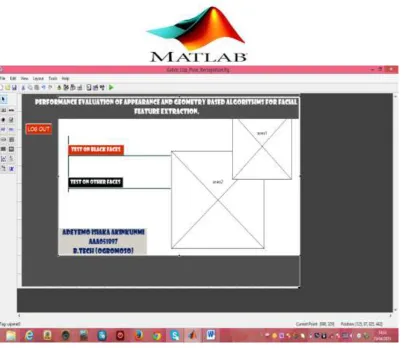
MATLAB 8.1.604 (R2013a) programming environment. Figure 1 shows MATLAB
interface of the process, Figures 2 and 3 also showed how the processes are be implement
during the experiments.
v. Feature matching: This is the actual recognition process. The feature vector obtained from the feature extraction was matched into classes (persons) of facial images already
enrolled in a database.
Fig. 2: Implementation Process of GW and LBP.
A. Similarity Measures of GW and LBP Eigen Vector
Eigenvector were calculated using LBP, GW algorithm and experiment were performed by
varying the number of eigenvectors used to calculate the feature of the images. Facial images
in the training stage were projected onto the eigenvectors to obtain a set of weight (feature
vectors). The face was recognized by finding the different between the projected training and
testing images using Euclidean distance as similarity measuring technique.
Algorithm 1: GW
The implementation of Gabor Wavelet was carried as enumerated:
1) The images were fed into the developed features extraction platform; this involved
specifying the images filename
2) An interface that showed selected images was displayed
3) The initial points that was employed to extract the wavelet features on the facial images
was determined
4) The dimensions of the inner region of the face depending upon the ratios of the distances
between the wavelet points were calculated. A selection of 3X 3 points gives the ideal
trade-off between image representations
5) The set of frequencies are chosen from to
6) The number of orientations is chosen to be 6
7) Total number of iterations is 16 * 6 * 10 (P*Q*R). Successive images of the reconstruction process
8) This images were written and named appropriately by the program; specifying the
number of wavelet points, number of frequencies used and number of different
orientations chosen
9) As the reconstruction process took place, the projections (weights) are calculated. These
weights are stored in an array and the array was bubble sorted and the highest 50
projections (in terms of magnitude) and corresponding frequencies and orientations were
chosen. These 150 parameters form the feature vector which is fed to the black database.
Algorithm 2: LBP
Input: Training Images
Output: Feature extracted from face image and compared with centre pixel and recognition
with unknown face image
2. FOR each image I in the training image set
3. Initialize the pattern histogram, H = 0
4. FOR each centre pixel tc Є I
5. Compute the pattern label of tc, LBP (1)
6. Increase the corresponding bin by 1
7. END FOR
8. Find the highest LBP feature for each face image and combined into single vector
9. Compare with test face image
10.If it matches it most similar face in database then successfully recognized.
IV.RESULTS AND DISCUSSION
The results of this research work were evaluated based on the following parameters:
Computational Time, False Acceptance Rate and False Rejection Rate. Experiments were
conducted on the images using GW and LBP techniques. Three selected eigenvectors: 240,
120 and 60 were considered for each of the algorithms. This was taking into consideration the
effects of the selected size of eigenvectors on the parameters.
In Tables 4.1, 4.2 and 4.3, the result showed that GW, LBP had the Computational time of
3.92seconds, 6.0seconds. False acceptance Rate of 56.2%, 82.5% and False Rejection Rate of
88.7%, 48.5%. When 100 of eigenvectors were selected, we had 70.49, 60.0%, 70, 55.0% and
65%, when 50 eigenvectors were selected, we had 60.0, 71.0%, 73.0, 59.0% and when 25 of
eigenvector were selected, we had 53.0, 60.0%, 61.0, 59.0%
The system also had the recognition time 10.3 seconds, 14.5 seconds and 52.4seconds when
100 eigenvectors were selected for the training while 8.3seconds, 9.2seconds and
50.2seconds were acquired for 75 eigenvectors.
Table 4.1:Simulation Results for 300 x 300 pixels for 275 selected eigenvectors. TNI TTI RR (%) EV TR(secs) CT FRR(%) FAR(%)
GW 275 100 138.7 275 3.92 3.92 56.2 88.7 LBP 275 100 137.2 275 6.0 6.0 82.5 48.5
Table 4.2: Simulation Results for 300 x 300 pixels for 100 selected eigenvectors. TNI TTI RR (%) EV TR (secs) CT FRR (%) FAR (%)
Table 4.3:Simulation Results for 300 x 300 pixels for 50 selected eigenvectors. TNI TTI RR (%) EV TR(secs) CT FRR (%) FAR (%)
GW 275 100 65.3 50 3.92 10.3 60.0 71.0 LBP 275 100 55.2 50 6.0 14.5 73.0 59.0
V. CONCLUSION AND FUTURE WORK
This paper has successfully evaluated the appearance and geometry based algorithms for
facial feature extraction based on the following parameters: Computational Time, False
Acceptance Rate and False Rejection Rate. Experiments were conducted on the images using
GW and LBP techniques. Three selected eigenvectors: 240, 120 and 60 were considered for
each of the algorithms. This was taking into consideration the effects of the selected size of
eigenvectors on the parameters. Also, experiment showed that GW and LBP have comparable
performance with the similarity measures considered in facial features training and testing
with significant speed improvement because they did not have learning phase where they can
be repeatedly learn. Conclusively, this work evaluated the efficiencies of Appearance and
Geometry based features extraction techniques.
The results obtained imply that GW facial features extraction technique is more efficient than
its LBP counterpart. However, it is recommended that use of more morphological technique
for feature extraction could be considered for the improvement on the recognition accuracy of
different extraction and LBP and GW can also be used for the Hybridization of two
algorithms in facial features implementation.
REFERENCES
1. Arun Ross., “Face Recognition: the Path Forward”. A publication of the IEEE Computer
society, 2010; 10: 30-35.
2. Ahonen, T., Hadid, A., Pietikainen, M, “Face Recognition with Local Binary Patterns”,
In: Pajdla, T., Matas, J(G.) (eds.), 2007; 3021: 469-481.
3. Shiguang, Wen, Yizheng, Bo, and Pang: “Strength of Gabor Feature Extraction for Face Recognition‟‟, International Journal of Innovative Technology and Exploring Engineering
(IJITEE), 2004; 2: 76-78.
4. Bermani, Ghalwash and Youssif: “an Automatic System for Facial ExpressionRecognition‟‟, International Journal of Electronic Imaging, 2012; 8: 1-15.
5. Huang, J. “Detection strategies for Face Recognition using Learning and Evolution”,
6. Kumar and Murthy “Gabor Wavelets for Efficient Face Representation by Several Factors”, International Journal of Engineering and Technology (IJET), 2006; 5: 27-36.
7. Rahim, Azam, Hossain and Islam: “Empirical Evaluation of Face Recognition”, 2013.
8. Lee. T, “Image Representation using 2D Gabor Wavelets.”, IEEE Transactions of Pattern
Analysis and Machine Intelligence, 1996; 18: 156-158. for both Shape and Texture Information „‟, Symposium on Bio-inspired learning and intelligent systems for security,
IEEE computer society, 4: 188-201.
9. Zhang & Gao: Critical Survey of Researches on Image-based Face Recognition across Pose‟‟, International Journal of Innovative Technology and Engineering (IJITE), 2009;
10: 108-201.
BIOGRAPHY
Adeyemo I. A is Assistant Lecturer in University of Nigeria, Nsukka, Enugu State, Nigeria. He graduated with B. Tech and M. Tech, from Computer Science and Engineering
Department, Ladoke Akintola University of Technology, Ogbomoso, Nigerian the year 2010
and 2015 respectively. He is presently pursuing his Ph.D in the same institution. His research
interests are Biometrics information, Pattern Recognition, Data and Information Security. He
can be reached through this email: [email protected].
Ganiyu R. A. is a Senior Lecturer in the Department of Computer Science and Engineering, Ladoke Akintola University of Technology, Ogbomoso, Nigeria. He graduated with a
B.Tech. degree in Computer Engineering from Ladoke Akintola University of
Technology,Ogbomoso, Nigeria in 2002. Also, he obtained M. Tech and Ph. D degrees in
computer science from Ladoke Akintola University of Technology, ogbomoso, Nigeria, in
2008 and 2012 respectively. He has published in reputable (local and international) journals.
His research interests include: Modelling and Simulation of physical Systems Using Petri
Nets, Biometrics-based algorithm and its applications, Dynamic programming as well as
Microprocessor system design. He belongs to the following professional bodies: Full
member, Computer Professionals (Registration) Council of Nigeria (MCPN); Registered
Engineer, Council for the Regulation of Engineering in Nigeria (COREN). He can be reached
through this email: [email protected].
Olabiyisi, S. O. received his B. Tech., M. Tech and Ph.D degrees in Mathematics from Ladoke Akintola University of Technology, Ogbomoso, Nigeria, in 1999, 2002 and 2006
Ibadan, Nigeria in 2003. He is currently a Professor in the Department of Computer Science
and Engineering, Ladoke Akintola University of Technology, Ogbomoso, Nigeria. He has
published in reputable journals and learned conferences. Prof. Olabiyisi is a full member of
Computer Professional (Registration) Council of Nigeria (CPN). His research interests are in
computational mathematics, theoretical computer science, information systems and
performance modelling and simulation. He can be reached through this mail:
Akande N. O is Assistant Lecturer in Landmark University, Omu-aran Kwara State. He graduated with B. Tech and M. Tech, from Computer Science and Engineering Department,
Ladoke Akintola University of Technology, Ogbomoso, Nigerian the year 2010 and 2015
respectively. He is presently pursuing his Ph.D in University of Ilorin. His research interests
are Biometrics information, Pattern Recognition, Data and Information Security. He can be