Applying the Heterogeneity Level Metric in a Distributed Platform
PAULOS. L. SOUZA
FABIOHISTOSHI
MARCOSJ. SANTANA
REGINAH. C. SANTANA
SARITAM. BRUSCHI
KALINKAR. L. J. C. BRANCO
USP - University of São Paulo
ICMC - Institute of Mathematics and Computer Sciences SSC - Computer Systems Department
P.O. Box: 668 - 13560-970 - São Carlos (SP) - Brazil {pssouza, hitoshi, mjs, rcs, sarita, kalinka}@icmc.usp.br
Abstract. Heterogeneity Level (HL) metric has been developed by our research-group to help scheduling algorithms to adapt themselves to the existent heterogeneity in the platforms. This paper presents our results considering the HL’s behaviour in a real adaptive scheduling. HL metric quantifies qualitative aspects from heterogeneity in order to provide efficient performances and lower cost to the execution in both heterogeneous and homogeneous platforms. HL use is investigated under different perspectives: CPU, memory, network and considering benchmarks results. A simple but effective adaptive scheduling using HL is proposed and its results point out to performance-gains around 53% when a non-adaptive scheduling algorithm is used. Our case studies show that the HL was efficient, flexible and easily used for scheduling policies.
Keywords: heterogeneity, load balancing, cluster.
(Received February 22nd, 2011 / Accepted May 2nd, 2011)
1 Introduction
Heterogeneous distributed platforms allow exploring different and specific resources according to differ-ent demands. They extend the platform performance through both gradual improvements and reuse of the resources already available in the organization. How-ever, associating different resources with diversified de-mands implies to compute a more complex strategy for this distribution. Heterogeneity must be used carefully in order to improve the computing cost vs. benefit rela-tion.
Processes scheduling is directly affected by hetero-geneity. It is necessary to consider relevant aspects from both platform and applications demand when the re-sources present different features, architecture or
per-formance. On the other hand, when the platform is homogeneous, the scheduling may encapsulate details from devices and basic software (such as operating sys-tems and compilers), because they present a uniform behavior, performance and architecture. This allows simpler and cheaper scheduling with efficiency. Other important point is that heterogeneity can be temporal as well, due to workload dynamical variation and node-changes in the platform [3].
schedul-ing for distributed platforms. Our aim in this paper is compare the HL metric behavior when applied in an adaptive scheduling policy on a platform with different heterogeneity levels.
The HL behavior is investigated using two differ-ent perspectives: changes in the hardware-resources and with distinct benchmarks. These hardware re-sources and benchmarks allow analyzing the HL behav-ior according to different and real perspectives, such as: floating-point, integer operations, memory use and net-work consumption [6, 7, 10, 11, 12, 14, 15].
A novel adaptive scheduling algorithm has been proposed to investigate HL impact in this context. This algorithm is used by AMIGO (DynAMical FlexIble SchedulinG EnvirOnment) [13] and PVM (Parallel Vir-tual Machine) [5]. The choice by PVM is due to both its source code structure and its tightly coupling to AMIGO. However, the PVM choice does not imply in generality loss, because the studies presented here are focused on the HL impact mainly, independently if this scheduling is done by MPI, PVM or by a distributed op-erating system. Indeed, the novel scheduling policy and the investigations about the use of the HL are orthogo-nal to the message passing interface used.
The best results in our case studies show that the adaptive scheduling using HL metric allow a real per-formance gain around 53% for the application runtime. The HL is simple to be used in scheduling algorithms and presents a stable behaviour.
This paper is organized as follows. Section 2 presents some basic definitions about heterogeneity. Section 3 presents HL metric and its behavior consider-ing benchmarks demand. Section 4 presents the adap-tive scheduling algorithm proposed, describing how to use the HL metric. Section 5 describes the main results obtained using the HL metric and Section 6 presents the concluding remarks.
2 Heterogeneity and Homogeneity
There are different kinds of heterogeneity [3]. Initially, it can occur considering the configuration and architec-ture. There is configuration heterogeneity when differ-ences of performance are observed on devices with the same platform (hardware and basic software). Architec-tural heterogeneity implies different devices when con-sidering hardware and/or basic systems.
Heterogeneity can be considered as positive or neg-ative, depending on heterogeneity contribution for the system performance. We have a positive heterogene-ity when devices with better performance in relation to previous ones are added in the platform. A negative heterogeneity (or a performance lack) can occur when
devices with worse performance are added in a platform [3].
Time is other important feature related to hetero-geneity. There is temporal or dynamical heterogene-ity if the platform presents a homogeneous behavior in determined situations and heterogeneous in other. Fac-tors that contribute for a temporal heterogeneity are: workload, multi-users and the resources being consid-ered to report the heterogeneity level. Considering the last one (resources), for example, when two nodes have both distinct processors and the same memory quan-tity/type, they can be heterogeneous under CPU point-of-view and homogeneous when considering memory. Depending on application demand, the platform can be considered heterogeneous or homogeneous [3].
Different research works quantify the platforms het-erogeneity degree [1, 3] [6, 14, 16]. Some models and metrics for heterogeneous systems were proposed by Zhang and Yang [16], in which heterogeneous com-puting systems can be represented by a graph(M, C), whereM = M1, M2, M3, M4, M5, ...., Mn is
consid-ered a set of heterogeneous workstations andC is the communication network linking the workstations (with a homogeneous bandwidth). Aiming to quantify the heterogeneity of a system machines without using com-plex measurements, Zhang and Yang [16] proposed two metrics to evaluate the relative computing power of a set of workstations (the capacity of each workstation is evaluated in comparison to the fastest one):
Wi(A) =
Si(A)
maxn
i=1{Si(A)} (1)
Wherei = 1, ..., nandSi(A)represents the speed
ofMito execute applicationAdedicatedly. Speed can
be defined by the number of basic operations per time unit, for instance, and the computing power of each workstation is represented by a relative speed. A sec-ond metrics proposed is:
Wi(A) =
minn
i=1{T (A, Mi)}
T (A, Mi) (2)
Where i = 1, ..., n andT (A, Mi) is the time
re-quired to execute application A at workstation Mi.
Grosu [6] extends these metrics so that the computing power is given by the relative speed of the workstation in relation to the slowest one:
Wi(A) =
minn
i=1{Si(A)}
Si(A) (3)
Wherei = 1, ..., nandSi(A)is the speed of
computing power is given by relative speeds. Further-more, Grosu [6] defines:
Wi(A) =
T (A, Mi)
maxn
i=1{T (A, Mi)} (4)
Wherei = 1, ..., nandT (A, Mi)is the time it takes
to execute applicationAat workstationMi.
Thus, equations 1 and 2 now act as the basis to de-fine the computing power, considering the fastest ma-chine as a reference point, which is renamedWif(f−
f ast). On the other hand, equations 3 and 4 identify the computing power based on the slowest machine, which is represented byWs
i(s− slow). Four ways to quantify
the heterogeneity level in a system based on the value ofWare proposed in [16] and [6]. The first and second use the standard deviationH1, which can be calculated
based on the computing powers compared to either the fastest or the slowest workstation:
H1=
� �n
i=1(Wmed− Wi)2
n (5)
The mean absolute deviation, calledH2, also
calcu-lated based on the fastest or the slowest workstation:
H2=
�n
i=1|Wmed− Wi|
n (6)
where:
Wmed=
�n i=1Wi
n (7)
The values in bothH1andH2are observed and
an-alyzed uniformly, using the average to find the standard deviation and the mean absolute deviation. However, this uniformity invalidates the analysis when there are reasonable differences among the workstations comput-ing powers, since the standard deviation cannot reflect computer systems.
Based on this weakness of theH1andH2metrics,
Zhang and Yang [16] proposed a third metric,H3,
eval-uated from the fastest workstation in the computing sys-tem:
H3=
�n
i=1(1− W f i (A))
n (8)
Similarly, Grosu [6] definesH4based on the
com-puting power of the slowest workstation in the comput-ing system:
H4=
�n
i=1(1− Wis(A))
n (9)
InH3, the computing power of the fastest
worksta-tion is equal to 1 while, inH4, the slowest machine has
a computing power value of 1. Thus,H4represents the
difference of computing power between each machine and the fastest machine andH3calculates the same
dif-ference between each machine and the slowest one. Based on his experiments, Grosu [6] states that the metric H4 is more suitable than H3. However, the
case studies presented in [3] demonstrate the fallacy of that statement in some situations, because the met-rics present contradictory behaviour when evaluating the same platform, in different cases.
Branco et al. [3] propose the HL (Heterogeneity Level) metric to eliminate these discrepancies. HL con-siders a hypothetic (not real) standard node, represent-ing the nodes average performance [3]. This metric will be detailed in next section due to its importance for this work.
3 The HL Metric
Platform heterogeneity can be quantified considering different perspectives, such as: architectural aspects, operating systems or resources performance [15]. In this sense, Branco et al. proposed the HL metric [3] to quantify the heterogeneity, using a virtual node (called standard node), which represents the average perfor-mance in the platform. The dispersion around this stan-dard node allows quantifying the platform heterogene-ity level, in a similar way to the works presented in [6] and [16] that use respectively the worst and the best node as standard node. The main difference be-tween HL metric and those two is that HL has a uni-form behaviour when quantifying distinct heterogene-ity levels and also both the positive and the negative heterogeneities. HL quantifies the platform heterogene-ity level through equation 10, wheren represents the amount of nodes in the platform,Xiis thenodei
perfor-mance andXis the virtual standard node performance.
HL = �n
i=1
� �Xi− X
� �
n∗ X (10)
The preliminaries results using the HL [3] consid-ered a general parameter called "speed", in order to qualify application demands. Indeed, Branco et al. con-sidered "speed" as a generic value, which should be eas-ily instantiated later at real parameters, such as: MIPS, MFLOPS, runtime, RAM amount or other.
Different experiments were conducted by Branco et al. [3] to simulate the HL behaviour when including new nodes in a heterogeneous platform with just three nodes with "speeds" 10, 100 and 1000.
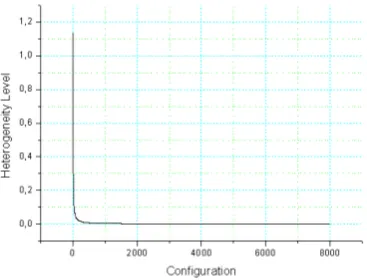
nodes are being added, the system heterogeneity level drops and stabilizes close to zero. Few nodes with high-speeds change the platform status quickly for homoge-neous. This situation could be represented by the met-rics proposed by Zhang (Zhang & Yang) as well; how-ever, it is not properly represented by Grosu’s metrics [6], due to standard node, based on the slowest work-station.
Figure 1: Behavior of the heterogeneity degree when nodes identical to the system’s fastest node are added (initial speeds of 10, 100 and 1000)
Figure 2 shows the HL behaviour when nodes iden-tical to the slowest one are added. The heterogeneity level rises at a first moment, because more nodes with "speed" 10 are required to reach the speed of the fastest node. When they reach this threshold, the heterogene-ity level falls near to zero, where it must stabilize. The HL metric evaluations done by Branco et al. [3] were not concerned about static or dynamic behaviour of the environment being used for the experiments, since the "speed" parameter encapsulated this question.
However, metrics based on static data, such as hard-ware features, offer just a partial view of both perfor-mance and heterogeneity. They are not able to repre-sent usual dynamic changes in the platforms that make them temporarily heterogeneous. In this sense, dynamic metrics, such as runtime, can point out the heterogene-ity level on-the-fly and according to user point-of-view [12]. Runtime encapsulates basic details from hardware and software, grouping them in a common point: to of-fer better performance (considering time) to end-user applications. Indeed, if used properly, time allows a performance comparison while encapsulating architec-ture details.
We develop initially two new experiments with HL metric to show these perspectives. For the first one
Figure 2: Behavior of the heterogeneity degree when nodes identical to the system’s slowest node are added (initial speeds of 10, 100 and 1000)
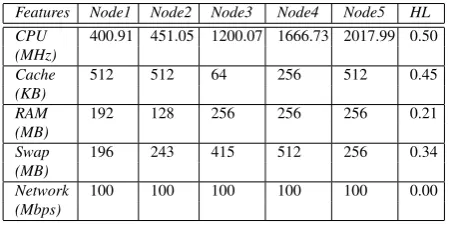
we use real and static hardware features to evalu-ate the HL metric. For the second one we use dy-namic benchmarks results to determine the heterogene-ity. Both experiments consider the same platform. The hardware features considered for the first analysis are: CPU frequency, cache amount, RAM amount, swap-memory amount and network peak throughput (see Ta-ble 1). The second analysis considers six different open-source benchmarks: (Whetstone, Dhrystone and Linpack), memory (Stream and Cachebench) and net-work (Netperf). Table 2 points out the main features evaluated in each benchmark and their respective met-rics [4, 7, 9, 10, 11, 14]. These benchmarks were cho-sen because they are: (1) meet the specific-demands planned for our experiments, (2) open-source and (3) free.
Table 1: HL results when evaluated on a five nodes cluster and ac-cording to hardware features such as: CPU frequency, cache amount, RAM amount, swap amount and network peak throughput.
Features Node1 Node2 Node3 Node4 Node5 HL CPU 400.91 451.05 1200.07 1666.73 2017.99 0.50 (MHz)
Cache 512 512 64 256 512 0.45 (KB)
RAM 192 128 256 256 256 0.21 (MB)
Swap 196 243 415 512 256 0.34 (MB)
Network 100 100 100 100 100 0.00 (Mbps)
It can be observed through Table 3 that HL metric is also efficient to represent the platform heterogeneity and it presents a stable behaviour according to bench-marks results. The values showed in the Table 3 repre-sent the average of 30 executions.
The HL values in Tables 2 and 3 point out some pos-sible discrepancies that occur when considering hetero-geneity in a distributed platform. An example is the HL value obtained from CPU feature (0.50) and the Whet-stone result (0.74), because both consider CPU perfor-mance. In these cases, the results obtained from the benchmark were considered more efficient to represent the platform heterogeneity, since they intend to indicate the real performance for the user.
This difference can also be observed with mem-ory and network. Network is a critical case, since the platform is homogeneous (HL=0.00) when consider-ing peak performance (100Mbps). However, Netperf benchmark shows that when different nodes send mes-sages to (or receive from) node 5, the platform pre-sented the second major HL result (0.67) and thus, can be considered heterogeneous. Again, in these cases, the benchmark results should be used because they repre-sent the performance expected by final user. In these cases, a simple view considering just one hardware fea-ture is not a better choice to estimate the heterogeneity level.
4 An Adaptive SchedulingAs/Hl
An adaptive scheduling based on the heterogeneity level (or As/Hl) was developed in this work to investigate the HL metric impact in a real scenario, considering the end-user perspective. The As/Hl is adaptive because it changes dynamically the scheduling algorithm accord-ing to the HL metric.
AMIGO (DynAMical FlexIble SchedulinG
Envi-Table 2: Benchmarks used to evaluate the HL metric behaviour.
Category Benchmark Demand Metric Whetstone Floating-Point Execution Time
simple execution time arithmetic, and dhrystones; Dhrystone strings, performance in logical and relation to Vax CPU access to the 11/780 for one memory benchmark iter linear eq FLOPS and Linpack systems execution time
float/double in arrays
memory throughput and Stream throughput avg execution
Memory time
accesses to throughput Cachebench memory and
to cache
latency, throughput and Network Netperf TCP/UDP avg execution
throughput time
rOnment) [13] and PVM (Parallel Virtual Machine) [5] were used to insert the HL metric in the As/Hl. AMIGO allows grouping specific scheduling policies according to different demands. The choice by PVM is due to its source code structure and because it is tightly cou-pled to AMIGO. However, it is important to note that the choice by AMIGO/PVM does not cause general-ity loss, because this policy could be applied in other contexts, such as: MPI environment, operating system or directly inside parallel application code. The As/Hl determines which scheduling algorithm must be used considering the platform heterogeneity. The aim is min-imizing scheduling costs and at the same time maximiz-ing its benefits.
Table 3: HL results when evaluated on a five nodes cluster and ac-cording to six distinct benchmarks.
Benchmark Node1 Node2 Node3 Node4 Node5 HL Whetstone 1119.0 995.4 265.0 190.4 1265.0 0.74
(s)
Dhrystone 3.2 2.8 1.0 0.7 0.8 0.49 (s)
Linpack 0.020 0.018 0.006 0.004 0.005 0.52 (s)
Stream 0.31 0.30 0.07 0.06 0.04 0.58 (s)
Cachebench 984.2 1105.0 3509.6 5054.5 5400.3 0.53 (Mb/s)
Netperf 64.9 5753.3 5559.5 15988.2 x 0.67 (Mb/s)
lower layer. Upper layer is responsible by the config-uration, while lower layer is responsible by schedul-ing policies, AMIGOD (AMIGO Daemon), message-passing environment (in this work instantiated by PVM) and parallel applications [13].
AMIGO has scheduling policies for memory-bound, network-bound and CPU bound applications. DPWP (Dynamical Policy Without Preemption) is one of them, which presents features such as: dynamic (de-cides the scheduling at runtime), specific to CPU-bound applications and does not consider preemption [2]. The scheduling done by DPWP aims to balance new work-loads considering the existent nodes load. It tries to normalize this workload using a relative-performance in relation to the whole platform. DPWP normalizes the ready-processes in the ready-queue to determine the target node.
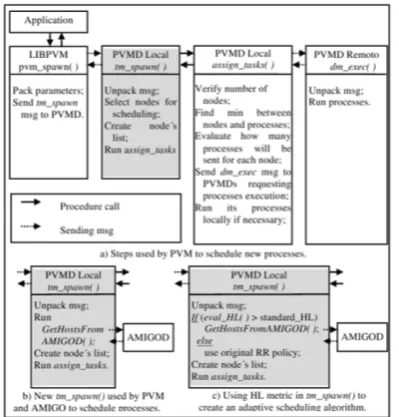
AMIGO acts just when the message-passing en-vironment needs to schedule new processes on the platform. Figure 3(a) shows the steps followed by the original PVM in this case. An application re-quests the scheduling frompvm_spawn(), which for-wards the request to local PVMD. The local PVMD, running tm_spawn(), create a list contending nodes that will receive the new processes using by default a round-robin policy. The functionsassign_tasksand dm_execare called later to create and to start these pro-cesses, respectively.
To interact with AMIGO, tm_spawn() routine was modified (Figure 3(b)), where processes selec-tion is always requested to AMIGOD through the GetHostsF romAM IGOD(). This request will be attended by an AMIGO’s scheduling policy, indepen-dently if round-robin policy existing in PVM could present better results or not, according to used plat-form. The HL metric was inserted in this scenario try-ing to solve this problem by analyztry-ing the platform het-erogeneity and creating a simple but efficient adaptive scheduling algorithm in this point.
AMIGO is requested to give a nodes-relation ac-cording to DPWP policy when the platform is hetero-geneous; when it is homogeneous, the request is not sent to AMIGO and the original round-robin policy is used to determine the nodes target to the scheduling. Figure 3(c) shows the algorithm basic steps, highlight-ing just thetm_spawn() routine. This adaptive algo-rithm is based on a conditional structure comparing the HL value returned fromeval_HL() with a threshold, calledstandard_HL. The correct choice of this value is a complex question and needs to be investigated in a more detailed sense. Unfortunately, this study does not belong to the scope of this paper. Thestandard_HL
Figure 3: Steps followed by (a) original PVM, (b) PVM/AMIGO and (c) As/Hl algorithm in order to schedule new processes.
must be defined by the system manager considering the expected demand, used platform and objectives. The standard_HLwas empirically fixed as 0.01 in this pa-per, as explained in the next section.
The HL is evaluated by the eval_HL() consider-ing the nodes performance. The activities conducted by eval_HL()are: gets the computing performance from each node, evaluates the HL through equation 10 and returns the HL value.
The node performance can be determined from dif-ferent ways. In this paper, they were instantiated through benchmarks previously executed.
5 Experiments and Results withAs/Hl
not the execution.
Experiments were done in a Beowulf cluster with ten nodes, all of them with: Intel Pentium4 Processor (64bits and 3.4GHz), RAM with 4GBytes, a Gigabit Ethernet network and GNU/Linux operating system.
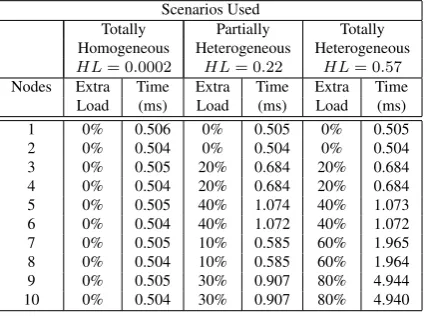
This cluster is a homogeneous platform. Fixed-and-extra workloads were inserted into some nodes, turn-ing this platform a temporally-heterogeneous one with three different levels: totally homogeneous, partially heterogeneous and totally heterogeneous. The syn-thetic extra workloads were generated using the Lin-pack, Dhrystone and Whetstone benchmarks. The ho-mogeneous scenario is composed by ten nodes without any extra workload. In the partially heterogeneous sce-nario the nodes are grouped into five distinct pairs with workload ranging from 0% to 40% in relation to CPU utilization. For the totally heterogeneous scenario the nodes are also grouped in pairs, being generated for them extra workloads ranging from 0% to 80% in re-lation to the CPU utilization. Benchmarks used to cre-ate the two heterogeneous-scenarios affected the plat-form perplat-formance in a fixed and constant way, during the whole experiment.
The Linpack benchmark was used to evaluate the node performance in these three platforms. It was cho-sen because it has features close to the parallel appli-cation used: operations with floating-point vectors to solve linear systems. The results obtained from the Lin-pack were applied to equation 10 in order to evaluate the HL metric. Using Linpack to establish the hetero-geneity in platform allows focusing on CPU features, majorly those related to FPU. Table 4 presents the re-sults when using Linpack and HL for the three scenarios discussed.
Table 4: Results for Linpack benchmark and HL metric.
Scenarios Used
Totally Partially Totally Homogeneous Heterogeneous Heterogeneous
HL = 0.0002 HL = 0.22 HL = 0.57
Nodes Extra Time Extra Time Extra Time Load (ms) Load (ms) Load (ms) 1 0% 0.506 0% 0.505 0% 0.505 2 0% 0.504 0% 0.504 0% 0.504 3 0% 0.505 20% 0.684 20% 0.684 4 0% 0.504 20% 0.684 20% 0.684 5 0% 0.505 40% 1.074 40% 1.073 6 0% 0.504 40% 1.072 40% 1.072 7 0% 0.505 10% 0.585 60% 1.965 8 0% 0.504 10% 0.585 60% 1.964 9 0% 0.505 30% 0.907 80% 4.944 10 0% 0.504 30% 0.907 80% 4.940
The threshold used by HL to determine if the
platform is either homogeneous or heterogeneous (standard_HL) was arbitrarily fixed in 0.1, due to HL results obtained from the three platforms. This HL value allows separating the totally homogeneous plat-form (HL=0.0002) from other two possibilities: par-tially and totally heterogeneous with HL 0.22 and 0.57, respectively.
In a first execution, the Gauss-Jacobi application was scheduled using the As/Hl algorithm on the three platforms and according standard_HL value. This means that the policy used was the round-robin when executing the homogeneous scenario and the DPWP when executing on the partially and totally heteroge-neous platforms.
In order to compare the scheduling done for each platform, we repeated the executions, changing the policies used. In these complementary executions the policy DPWP was chosen when executing the homoge-neous scenario and the round-robin policy was the op-tion when executing both the partially and totally het-erogeneous platforms.
Table 5 presents the runtime average in sec-onds for thirty Gauss-Jacobi parallel application executions, using the round-robin/PVM and the DPWP/AMIGO/PVM scheduling policies, and consid-ering platforms: homogeneous, partially heterogeneous and totally heterogeneous. The values between paren-theses indicate the complementary execution.
Table 5: Gauss-Jacobi parallel application runtime using round-robin and DPWP policies on three different platforms. Values between parentheses indicate the complementary executions to compare the correct scheduling done in each platform by As/Hl.
Schedule Totally Partially Totally Policy Homogeneous Heterogeneous Heterogeneous Round- 5,1s (17,6s) (28,6s)
Robin
DPWP (7,8s) 11,6s 23,7s
the use of a higher computing cost scheduling policy (such as the DPWP).
The DPWP policy is more efficient than the round-robin policy when considering the partially heteroge-neous platform. In this case the performance gain was around 51.7%. This is due to the heterogeneity pre-sented in the platform, fact considered only by the DPWP. Again, the HL metric can choose properly the schedule policy.
The DPWP obtains a better performance when com-pared to the round-robin in the heterogeneous scenario, as expected. However, the difference between both exe-cutions was lower, with a DPWP performance gain just around 20.7%. This smaller difference, when compar-ing to partially heterogeneous platform, is due to the overload of 60% and 80% in four nodes available for the experiments. These four nodes are near to satura-tion and this causes a higher impact in the DPWP per-formance, due to its costs. In this scenario DPWP spent more time to find the correct nodes to use and how many processes each node should receive, when comparing to the round-robin policy.
6 Concluding Remarks
This work investigates the HL metric behaviour in real scenarios. The HL metric [3] was investigated consider-ing static and dynamic perspectives and it was also used in the As/Hl algorithm. The HL metric presented excel-lent behaviors in our case studies, pointing out the plat-form heterogeneity for both static features (e.g.: CPU frequency, memory quantity or network) and dynami-cal features, these obtained from benchmarks.
The results obtained from the experiments con-ducted with As/Hl algorithm, show performance loss to 53% when using the wrong scheduling policy in re-lation to the platform heterogeneity level. They show also performance gains to 51.7% when using the correct scheduling policy. The investigations performed in this work confirm that the correct use of the heterogeneity level is essential to improve the platform performance, therefore, producing better benefits with lower costs for the end-user. They also show that the HL is efficient to represent the heterogeneity degree, flexible when con-sidering different heterogeneity perspectives and easy to be used in the processes scheduling context.
Future works include studying the HL metric thresh-olds to indicate if a platform must be handled either as homogeneous or heterogeneous, also under differ-ent perspectives such as: CPU, memory, network and a mixing of them.
7 Acknowledgments
The authors would like to thank CAPES, CNPq and FAPESP, Brazilian funding agencies, for the financial support.
References
[1] Al-Jaroodi, J., Mohamed, N., Hong, J., and Swan-son, D. Modeling parallel applications perfor-mance on heterogeneous systems. In Int. Paral-lel and Distributed Processing Symposium, pages 160.2–, Washington, DC, USA, 2003. IEEE Com-puter Society.
[2] Araujo, A. P. F., Santana, M., Santana, R. H. C., and Souza, P. S. L. Dpwp - a new load balanc-ing algorithm. In 5th Int. Conference on Infor-mation Systems Analysis and Synthesis - ISAS’99, Orlando, U.S.A., 1999.
[3] Branco, K., Santana, M., and Santana, R. H. C. A novel metric for checking levels of heterogeneity in distributed computer systems. In Advances in Intelligent System and Robotic. IOS Press, 2003.
[4] Curnow, H. J. and Wichmann, B. A. A syn-thetic benchmark. Computer Journal, 19(1):43– 49, 1976.
[5] Geist, G. A., Beguelin, A., Dongarra, J. J., Jiang, W., Manchek, R., and Sunderam, R. Pvm 3 users guide and reference manual. Oak National Lab., 1994.
[6] Grosu, D. Some performance metrics for hetero-geneous distributed systems. In Proceedings of PDPTA’96. Las Vegas, 1996.
[7] Linpack. www.math.utah.edu/software/ linpack.html#documentation, Last access: 02/02/2011.
[8] Massie, Matthew, L., Chun, Brent, N., and Culler. The ganglia distributed monitoring system: de-sign, implementation, and experience. Parallel Computing, 30(7):817–840, 2004.
[9] McCalpin, J. D. Memory bandwidth and machine balance in current high performance computers. IEEE Computer Society Technical Committee on Computer Architecture (TCCA) Newsletter, 1995.
[11] Netperf. www.netperf.org/netperf/NetperfPage.html Last access: 02/02/2011.
[12] Petterson, D. A. Computer organization and design: the hardware/software interface. Else-vier/Morgan Kaufmann, third edition, 2005.
[13] Souza, P. S. L., Santana, M., and Santana, R. H. C. Amigo - a dynamical flexible scheduling environ-ment. In 5th International Conference on Infor-mation Systems Analysis and Synthesis - ISAS’99, 1999.
[14] Weicker, R. P. Dhrystone: a synthetic systems programming benchmark. ACM Computing Sur-veys, 27:1013 – 1030, 1984.
[15] Zhang, Z. and Seidel, S. Benchmark measure-ments of current upc platforms. In 19th IEEE In-ternational on Parallel and Distributed Process-ing Symposium, 2005.