~ 111 ~ WWJMRD 2017; 3(12): 111-115
www.wwjmrd.com International Journal Peer Reviewed Journal Refereed Journal Indexed Journal UGC Approved Journal Impact Factor MJIF: 4.25 e-ISSN: 2454-6615
Kapil Mittal
Research Scholar, Mechanical Engineering, National Institute of Technology, Kurukshetra, Haryana, India
Dinesh Khanduja Professor, Mechanical Engineering, National Institute of Technology, Kurukshetra, Haryana, India
Puran Chandra Tewari Professor, Mechanical Engineering, National Institute of Technology, Kurukshetra, Haryana, India
Correspondence: Kapil Mittal
Research Scholar, Mechanical Engineering, National Institute of Technology, Kurukshetra, Haryana, India
An Insight into “Decision Tree Analysis”
Kapil Mittal, Dinesh Khanduja, Puran Chandra Tewari
Abstract
Decision making is a regular exercise in our daily life. One has to make decisions in their personal as well as professional life on number of occasions but professional decisions affects whole organization, both in terms of future of organization and achieving the goals that have been embarked. One bad decision can ruin whole planning and preparation that have been made in realizing the targets. That’s why decision making is termed as a tedious task. Thanks to our great researchers who have explored some techniques as an aid to this challenging yet essential task. One of those technique is “Decision Tree Analysis”. A decision tree is a graphical representation of decisions and their corresponding effects both qualitatively and quantitatively. The structure of the methodology is in the form of a tree and hence named as decision tree analysis. In this paper authors describes the theory and history behind evolution of decision tree analysis along with its application, advantages and disadvantages. Some examples have also been listed that shows the positive effects of using decision tree analysis on productivity improvement under industrial environment.
Keywords: Decision Tree Analysis, Operation Research, Project Selection, Pre-planning, Project optimization
Introduction
Decision tree is a type of statistical method performed via graphical representation of decision making process under several specified conditions. It is generally used to determine whether the decision made under given data is optimal or not? It is also used to scale the decision after it has been made, as viewing its consequences under imagined conditions can give one a learning of what to expect in similar conditions in near future.
History of decision analysis cannot be predicted accurately due to its nature and application area. Humankind has been making decision since its evolution but in this paper only industrial environment will be than into consideration. In industrial environment some data is always available. It can be the historical data, survey data or any other type of data. Decision making requires an analysis of the situation with the help of available data before giving a final result. Frank P. Ramsey in 1931 was the first to develop a methodology of decision analysis based on probability and utility. Major work in formalizing the decision theory was done by John von Neumann and Oscar Morgenstern in 1954. They formulated a way to define the utility by anassigned value and decision maker can easily chose the option with a higher one. This is known as “expected utility hypotheses”. Another mathematician Abraham Wald used game theory methods in statistical decision making successfully in 1950. Many other mathematicians of that era backed the suggestions of Wald framework. After that David Blackwell, M. A. Girshick and L. J. Savage contributed on a major scale by combining the theories developed by Neumann and Wald. Once the theory was developed its application began. In late 60s the theory was started to be known as decision theory, a more application oriented name. Over the past 50 years revolutionary work has been done by mathematicians around the world. Names include Frederick Mosteller, Philip Nogee, Milton Friedman, Leonard Jimmie Savage, Ward Edwards, Donald Davidson, Kenneth R. Hammond, Robin Miles Hogarth and many more. Case studies have been reported which shows productivity improvement by focusing on a particular project (Kaushik & Mittal Talking about industrial environment, various 2015b; Kaushik, Prikshit, et al. 2016; Mittal et al. 2017b; Kaushik, Mittal, et al. 2016; Mittal, Tewari, Khanduja, et al. 2016;Mittal &
Prajapati 2014; Mittal et al. 2012; Kaushik et al. 2012; Mittal et al. 2011; Kaushik et al. 2017; Mittal, Tewari & Khanduja 2016; Kaushik & Mittal 2015a; Sharma & Kadyan 2016a; Sharma & Kadyan 2015a). All the above examples are detailed case studies that discuss the pathway following different quality management technique which ultimately led to customer satisfaction. Customer satisfaction can be of many shapes i.e. quality improvement, on schedule delivery, lower cost, good service, improved maintainability and reliability etc
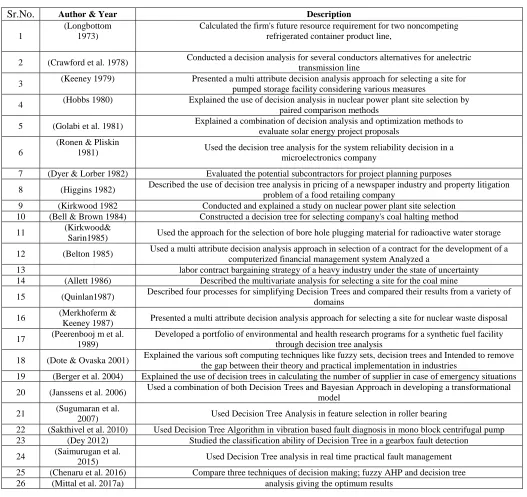
(Sharma 2017b) (Sharma 2017a). These case study must have involved a project selection step which though not discussed but must have been followed because there are various projects available in an organization that can be commenced. Project selection is also a decision making process and so decision tree analysis can also help in selecting a project for increased benefits. Here are some more examples (table 1) that explains the use of decision tree analysis in different circumstance that results in improved organizational efficiency.
Table 1: Literature Review of Decision Tree Analysis
Sr.No. Author & Year Description
1
(Longbottom 1973)
Calculated the firm's future resource requirement for two noncompeting refrigerated container product line,
2 (Crawford et al. 1978) Conducted a decision analysis for several conductors alternatives for anelectric transmission line
3 (Keeney 1979) Presented a multi attribute decision analysis approach for selecting a site for pumped storage facility considering various measures
4 (Hobbs 1980) Explained the use of decision analysis in nuclear power plant site selection by paired comparison methods
5 (Golabi et al. 1981) Explained a combination of decision analysis and optimization methods to evaluate solar energy project proposals
6
(Ronen & Pliskin
1981) Used the decision tree analysis for the system reliability decision in a microelectronics company
7 (Dyer & Lorber 1982) Evaluated the potential subcontractors for project planning purposes
8 (Higgins 1982) Described the use of decision tree analysis in pricing of a newspaper industry and property litigation problem of a food retailing company
9 (Kirkwood 1982 Conducted and explained a study on nuclear power plant site selection
10 (Bell & Brown 1984) Constructed a decision tree for selecting company's coal halting method
11 (Kirkwood&
Sarin1985) Used the approach for the selection of bore hole plugging material for radioactive water storage
12 (Belton 1985) Used a multi attribute decision analysis approach in selection of a contract for the development of a computerized financial management system Analyzed a
13 labor contract bargaining strategy of a heavy industry under the state of uncertainty
14 (Allett 1986) Described the multivariate analysis for selecting a site for the coal mine
15 (Quinlan1987) Described four processes for simplifying Decision Trees and compared their results from a variety of domains
16 (Merkhoferm &
Keeney 1987) Presented a multi attribute decision analysis approach for selecting a site for nuclear waste disposal
17 (Peerenbooj m et al. 1989)
Developed a portfolio of environmental and health research programs for a synthetic fuel facility through decision tree analysis
18 (Dote & Ovaska 2001) Explained the various soft computing techniques like fuzzy sets, decision trees and Intended to remove the gap between their theory and practical implementation in industries
19 (Berger et al. 2004) Explained the use of decision trees in calculating the number of supplier in case of emergency situations
20 (Janssens et al. 2006) Used a combination of both Decision Trees and Bayesian Approach in developing a transformational model
21 (Sugumaran et al.
2007) Used Decision Tree Analysis in feature selection in roller bearing
22 (Sakthivel et al. 2010) Used Decision Tree Algorithm in vibration based fault diagnosis in mono block centrifugal pump 23 (Dey 2012) Studied the classification ability of Decision Tree in a gearbox fault detection
24 (Saimurugan et al.
2015) Used Decision Tree analysis in real time practical fault management
25 (Chenaru et al. 2016) Compare three techniques of decision making; fuzzy AHP and decision tree
26 (Mittal et al. 2017a) analysis giving the optimum results
Above examples shows the utility of decision tree analysis in industrial environment. The examples shows how proper decision making aid in the success of project. Above examples can also be explained in terms of their area of application. Here is the explanation:
1. Site Selection: Keeney in 1979 published an article that discussed the selection of site for a pumping storage facility using multi-attribute decision analysis approach considering a number of alternatives and
~ 113 ~
in site selection decisions as all projects later on were successful.
2. Vendor Selection: In industries often a decision has to be made about vendor selection for offloading some parts for the purpose of cost reduction or unavailable process. This is a very important decision as it affects the overall quality and cost of the assembled part. Dyer and Lorber in 1982, Belton in 1985 and Berger in 2004 have explained the successful use of decision tree analysis in vendor/subcontractor selection that ultimately increased the productivity.
3. Method/Process/Material Selection: It has also been observed in the literature that method/process selection is also done using decision tree analysis. Golabi in 1981 used the approach for choosing method to evaluate solar energy project proposal. Bell & Brown in 1984 selected a coal halting method and Kirkwood & Sarin in 1985 selected a bore hole plugging material for radioactive water storage. Sugumaran in 2007 has discussed the use of decision analysis in feature selection of a roller bearing.
4. Miscellaneous: Other uses of decision tree includes the system reliability analysis by Ronen & Pliskin in 1981, pricing of newspaper industry by Higgins in 1982, selection and modelling for options of risk response development by Dey in 2012, gearbox fault detection by Saimurugan in 2015 and many more.
Above discussed examples shows the range of application of the approach and its usefulness in industrial environment.
Structure
Decision tree analysis, as name suggests, has a tree like structure. Basically, it displays an algorithm under given conditions. Many sequential problems and there effects are considered before making a decision. In other words, it is a type of flowchart in which at each point denotes a test & it's corresponding result. The structure looks like a natural tree where itsroot is decision making methodology, branches as conditions & tests and leafs as the result. The basic methodology of decision tree analysis is similar to Bayes’ theorem where conditional probability is calculated and decision is made on the calculated values. Therefore, decision tree can be termed as descriptive means for calculating conditional probability. In decision tree we calculate different valueset at different nodes for considering whether the path gives optimal decision or not. Decision is deterministic or probabilistic in nature.It is generally read from left to right.
Type of Nodes & their Functions
Various types of nodes are used in decision tree analysis, these are described as follows.
Decision node-This nodehas a square shape. It indicates the places where we have to select one out of various options. Branches coming out represent available set of alternatives. Chance node-This nodehas a circular shape.It symbolizes that the event occurring is outside the thinking of decision maker.
Terminal Node- This node has a triangular shape. It shows final outcomes.
The branch coming out from decision node is called decision branch which represents course of action and
branch coming out from chance node is called chance branch which represents state of nature.
Applications
Decision tree analysis has many application almost in each area where a choice has to be made from several available alternatives. Apart from manufacturing industry the application include social problems, business setups, and service industry like banking, library and hospitals, pharmaceutical industry all in all each small and big enterprises (Sharma 2013b; Sharma 2012; Sharma 2013a). Actually the success of any project/product depends upon various decisions made during the production process. There are various situations starting from the choice of raw materials, vendors for sub-parts, machines, manpower, sales and marking methods etc. where a decision is to be made out of several available choices. Decision tree analysis can help the decision maker by providing some quantifiable terms. Some examples of the situations are as follows:
1. Several simultaneous objectives: Sometimes a situation may arise that one has to take in account the several objectives from a single decision. This is a complex situation for a decision maker as the outcome may have an adverse effect on one aspect than other. In these cases decision tree analysis along with other tools such as fuzzy MADM can prove to be very worthwhile.
2. Indirect benefits: It is matter of fact that human intelligence increases with experience (Sharma & Kadyan 2015b; Sharma & Kadyan 2016b). One can visualize the direct benefits of the decisions but indirect benefits are hard to predetermine. Use of decision tree analysis helps decision maker choosing right alternative that eventually helps with achieving indirect benefits along with the direct ones.
3. Long terms goals: Decision making is generally thought of a situational activity but a right decision can also help in achieving long term goals of any organization.
Advantages & Disadvantages
Apart from its simple to understand nature, decision tree analysis can help any individual in achieving his goals by aiding him in each aspect of personal and professional life. It certainly help by providing a numerical value of the various choices by taking into account all available parameters. The data generated is justifiable and presentable. Optimum decisions definitely results in higher sales, increased profit, energy saving, optimum resource utilization, decreased accidental losses and many more intangible benefits.
Apart from many benefits, there are some risk involved too. For example, inexperience of decision maker and unseen situations like weather, recession, inflation etc. can deter the optimum decision making process and can results in false decisions. But looking at the many advantages over the negligible and irrepressible circumstances authors strongly suggest the use of approach in any industrial situation.
Conclusion
Which shows the wide operational area of the approach. Decision tree represent decision making under uncertainty. Optimal decisions can boost any process by minimize the time and defects inherited in a process. Many approaches are available for decision making purpose but decision tree analysis is a virtuous approach due to its nature, easy to applied methodology and strong justifiable results. Therefore authors strongly suggests the use of this methodology in case of decision making starting right from the business selection. Use of these type of approaches gives the user a confidence to move forward by helping them in coming out of tough situations. As an employee, it helps them to acquire the management confidence and as an entrepreneur it motivates them by enhancing the revenues.
References
1. Allett, E.J., 1986. Environmental impact assessment and decision analysis. Journal of Operational Research Society, 37(9), pp.901–910.
2. Bell, D.E. & Brown, E., 1984. Bidding for the S. S. Kuniang. Interfaces, 14(2), pp.17–23.
3. Belton, V., 1985. The use of a simple multiple-criteria model to assist in selection from a shortlist. Journal of Operational Research Society, 36(4), pp.265–274. 4. Berger, P.D., Gerstenfeld, A. & Zeng, A.Z., 2004.
How many suppliers are best? A decision-analysis approach. Omega, 32(1), pp.9–15.
5. Chenaru, O., Popescu, D. & Enache, D., 2016. Practical fault management using real-time decision tree analysis. In 24th Mediterranean Conference on Control and Automation. pp. 384–389.
6. Crawford, D., Huntzinger, B. & Kirkwood, C., 1978. Multiobjective decision analysis for transmission conductor selection. Management science, 24, pp.1700–1709.
7. Dey, P.K., 2012. Project risk management using multiple criteria decision-making technique and decision tree analysis: a case study of Indian oil refinery. Production Planning & Control,
8. 23(12), pp.903–921.
9. Dote, Y. & Ovaska, S.J., 2001. Industrial applications of soft computing: A review. In Proceedings of the IEEE. pp. 1243–1264.
10. Dyer, J. & Lorber, H., 1982. The Multiattribute Evaluation of Program-Planning Contractors.
11. Omega, 10, pp.673–678.
12. Golabi, K., Kirkwood, C. & Sicherma, A., 1981. Selecting a Portfolio of Solar Energy Projects Using Multiattribute Preference Theory. Management science, 27, pp.174–189.
13. Higgins, J.C., 1982. Decision-Making at Board Level Using Decision Analysis : Two Case Studies. Journal of Operational Research Society, 33(4), pp.319–326. 14. Hobbs, B., 1980. A Comparison of Weighting Methods
in Power Plant Siting. Decision Sciences, 11, pp.725– 737.
15. Janssens, D. et al., 2006. Integrating Bayesian networks and decision trees in a sequential rule-based transportation model. European Journal of Operational Research, 175(1), pp.16–34.
16. Kaushik, P. et al., 2012. A case study: Application of Six Sigma methodology in a small and medium-sized manufacturing enterprise. The TQM Journal, 24(1), pp.4–16.
17. Kaushik, P., Dahiya, V.K. & Mittal, K., 2017. Statistics for industries: A sophisticated approach. 18. Management Science Letters, 7(8), pp.397–406. 19. Kaushik, P. & Mittal, K., 2015a. A General Model for
Problem Solving in Manufacturing or Service Organizations. Journal of Engineering and
Technology, 0(0), p.0. Available at:
http://www.onlinejet.net/preprintarticle.asp?id=158566 20. Kaushik, P. & Mittal, K., 2015b. Significance of Six Sigma Basics in a Manufacturing Unit: A Case Study. Progress in Management Sciences, 3(1). Available at: http://pscipub.com/Journals/Data/JList/Progress in Management Sciences/2015/Volume 3/Issue 1/4.pdf. 21. Kaushik, P., Mittal, K. & Rana, P., 2016. Energy
paybacks of six-sigma: A case study of manufacturing industry in India. Management Science Letters, 6, pp.691–700.
22. Kaushik, P., Prikshit & Mittal, K., 2016. Gratitude of Six-Sigma: A Case Study of Manufacturing Environment Prabhakar. Journal of Mechanical Engineering, 126, pp.223– 231.
23. Keeney, R., 1979. Evaluation of Proposed Storage Sites. Operation Research, 27, pp.48–64.
24. Kirkwood, C., 1982. A Case History of Nuclear Power Plant Site Selection. Journal of Operational Research Society, 33(4), pp.353–363.
25. Kirkwood, C. & Sarin, R., 1985. Ranking With Partial Information: A Method and an Application. Operation Research, 33, pp.38–48.
26. Longbottom, D., 1973. The Application of Decision Analysis to a New Product Planning
27. Decision. Operational research Quarterly, 24, pp.09– 17.
28. Merkhoferm, W. & Keeney, R., 1987. A Multiattribute Utility Analysis of Alternative Sites for the Disposal of Nuclear Wast. Risk Analysis, 7, pp.173–194.
29. Mittal, K., Tewari, P.C., Khanduja, D., et al., 2016. Application of Fuzzy TOPSIS MADM approach in ranking & underlining the problems of plywood industry in India. Cogent Engineering, 3, pp.1–11. 30. Mittal, K., Kaushik, P. & Khanduja, D., 2012.
Evidence of APQP in quality improvement : An SME case study. International Journal of Management Science and Engineering Management, 7(1), pp.20–27. 31. Mittal, K., Khanduja, D. & Kaushik, P., 2011. Leveraging APQP methodology to drive improvement in SME : A case study. International Journal of Contemporary Practices, 1(1), pp.38–51.
32. Mittal, K. & Prajapati, R.K., 2014. Quality Councils: An Overview. International Journal of Management, IT and Engineering, 4(12), pp.200–211.
33. Mittal, K., Tewari, P.C. & Khanduja, D., 2017a. On the Right Approach to Selecting a Quality Improvement Project in Manufacturing Industries. Operation Research and Decisions, 27(1), pp.105–124. 34. Mittal, K., Tewari, P.C. & Khanduja, D., 2017b.
Productivity improvement under manufacturing environment using Shainin system and fuzzy analytical hierarchy process: a case study. The International Journal of Advanced Manufacturing Technology. 35. Mittal, K., Tewari, P.C. & Khanduja, D., 2016.
Refurbishing Business Processes : An Insight.
~ 115 ~
37. Peerenboojm, P., Buehring, W. & Joseph, T., 1989. Selecting a Portfolio of Environmental Programs for a Synthetic Fuels Facility. Operation Research, 37, pp.689–699.
38. Quinlan, J.R., 1987. Simplifying decision trees. International Journal of Man-Machine Studies, 27(3), pp.221–234.
39. Ronen, B. & Pliskin, J., 1981. Decision Analysis in Microelectronic Reliability: Optimal Design and Packaging of a Diode Arra. Operation Research, 29, pp.229–242.
40. Saimurugan, M. et al., 2015. A Study on the Classification Ability of Decision Tree and Support Vector Machine in Gearbox Fault Detection. Applied Mechanics and Materials, 813-814, pp.1058–1062. 41. Sakthivel, N.R., Sugumaran, V. & Babudevasenapati,
S., 2010. Vibration based fault diagnosis of monoblock centrifugal pump using decision tree. Expert Systems with Applications, 37(6), pp.4040–4049.
42. Sharma, C., 2013a. Begining of diverse quality management methodologies in libraries:An outline. International Journal of Management, IT and Engineering, 3(8), pp.322–346.
43. Sharma, C., 2017a. Initiating and Linking Total Quality Management in Libraries. World Wide Journal of Multidisciplinary Research and Development, 3(10), pp.119–122.
44. Sharma, C., 2013b. Quality Management in Libraries: An Outline. International Journal of Enhanced Research in Management & Computer Application, 2(8), pp.01–04.
45. Sharma, C., 2017b. Quality Management in Relation with Library Services. International Journal of Research in Engineering, IT and Social Sciences, 7(10), pp.11–14.
46. Sharma, C., 2012. Six Sigma Reflections in the Direction of Librarie: An Organization Outlook. 47. International Journal of Management, IT and
Engineering, 2(12), pp.521–528.
48. Sharma, C. & Kadyan, S., 2015a. Analyzing quality management move towards quality service in libraries. Research Journal of Library Sciences, 3(4), pp.08–11. 49. Sharma, C. & Kadyan, S., 2016a. Examine Total
Quality Management in Engineering College Libraries : An Evaluative Study. Pearl-I Journal of Library and Information Science, 10(4), pp.215–223. 50. Sharma, C. & Kadyan, S., 2015b. Performance
Evaluation through Quality Index Model: A Case Study of an Institute Library. International Research: Journal of Library & Information Science, 5(4), pp.625–641.
51. Sharma, C. & Kadyan, S., 2016b. Road Plan to Enterprise TQM from Manufacturing to Library Services. International Journal of Information Dissemination and Technology, 6(3), pp.165–169. 52. Sugumaran, V., Muralidharan, V. & Ramachandran,
K.I., 2007. Feature selection using Decision Tree and classification through Proximal Support Vector Machine for fault diagnostics of roller bearing. Mechanical Systems and Signal Processing, 21(2), pp.930–942.
53. Winter, F., 1985. An Application of Computerized
Decision Tree Models in Management-Union