Author for correspondence:
1ME Thermal scholar, Department of Mechanical Engineering, Jayam College of Engineering and Technology,
Dharmapuri, Tamil nadu, India 636 813.
2Asst. Professor, Department of Mechanical Engineering, Jayam College of Engineering and Technology,
Volume-5 Issue-2
International Journal of Intellectual Advancements
and Research in Engineering Computations
To improve the efficiency of solar panel by using solar tracker in air
cooler
S.Nirmal Kumar, G.Arul Gandhi
ABSTRACT
Solar energy is very important means of expanding renewable energy resources. In this paper is described the design and construction of a micro controller based “solar panel tracking system for Air cooler”. Air Cooler is the widely used device in all the places like offices, Houses, Shopping Malls etc. The power consumption for the AC has higher, so it is used for the application of this project to alternate the electric power by sol ar power. Solar is a non conventional source of energy, considering this we have developed solar panels. So it will fulfill our electricity need. But due to revolution of the earth, solar source from sun. It face the panel continuously hence less electricity is produced. The energy panel should face the sun till it is present in a day. Usually, the heat from the sun has been utilized 5 hours per day for 11:00 am to 4:00 pm. By placing our tracking system to the panel will increase the electricity production nearly for 5 hours. The tracking system can tracks the heat from the sun when sun rise starts about 7:00 am in morning till 5 or 6:00 pm in evening sun sets. By this process the energy utilization of solar is increasing to 5 hours
INTRODUCTION
Energy is the primary and most universal measure of all kinds of work by human beings and nature. Energy is a crucial input in the process of economic, social and industrial development. Day by day the energy consumption is increasing very rapidly. The rate of energy consumption is increasing. Supply is depleting resulting in inflation and energy shortage. This is called the energy crisis. According to law of conservation of energy ''energy can neither be created nor be destroyed but can be transformed from one form to another form. Energy can be transported from one place to another place [1-3].''
Alternative or non-conventional or renewable energy resources are very essential to develop for future energy requirements. The energy demand increases day by day because of population increasing industrialization increases and transportation increases etc [4-6].
Sun is the source of all energy on the earth. It is most abundant, inexhaustible and universal source of energy. AH other sources of energy draw their strength from the sun. India is blessed with plenty of solar energy because most parts of the country receive bright sunshine throughout the year except a brief monsoon period. India has developed technology to use solar energy for cooking, water heating, water dissimilation, space heating, crop drying etc. [7-11].
In this project, the solar tracking with weather monitoring system to be implemented for gaining high accuracy to operate the air Cooler. The LDR sensor was used to monitor the sun rising and its alternative movement. The microcontroller was used to initialize the sequence of step by step process of the DC stepper motor.
LITERATURE REVIEW
DESIGN OF A SOLAR TRACKER SYSTEM FOR PV POWER PLANTS, Tiberiu Tudorache1 ,Liviu Kreindler1, 2 1 Electrical Engineering Faculty, University Politehnica Of Bucharest, 313 Splaiul Independentei, Sect. 6, Bucharest, Romania, E-Mail: [email protected]. This paper deals with the design and execution of a solar tracker system dedicated to the PV conversion panels. The proposed single axis solar tracker device ensures the optimization of the conversion of solar energy into electricity by properly orienting the PV panel in accordance with the real position of the sun. The operation of the experimental model of the device is based on a DC motor intelligently controlled by a dedicated drive unit that moves a mini PV panel according to the signals received from two simple but efficient light sensors. The performance and characteristics of the solar tracker are experimentally analyzed.
INTERNATIONAL JOURNAL OF CORE ENGINEERING & MANAGEMENT (IJCEM) VOLUME 1, ISSUE 7, OCTOBER 2014, AUTOMATIC SOLAR TRACKING SYSTEM. Solar energy is very important means of expanding renewable energy resources. In this paper is described the design and construction of a microcontroller based solar panel tracking system. Solar is a nonconventional source of energy, considering this we have developed solar panels so that we can fulfill our electricity need. But due to revolution of the earth, solar source i.e. sun does not face the panel continuously hence less electricity is produced. The energy panel should face the SUN till it is present in a day.
A NOVEL GUI MODELED FUZZY LOGIC CONTROLLER FOR A SOLAR POWERED ENERGY UTILIZATION SCHEME, Salameh And Dagher. They have proposed a switching system that changes the cell array topology and connections or the configurations of the cells to get the required voltage during different periods of a day.
A JOURNAL FOR SOLAR AND SOLAR-STELLAR RESEARCH AND THE STUDY OF SOLAR TERRESTRIAL PHYSICS, Kenj
Kobayashi .They found that a PV array alone had relatively low output power density and had greatly drooping I-V characteristics. Therefore MPPT was used. This control concept was done by simulation study using PSM and Lab view software. Jensak Eakburanawat studied a TE battery that uses waste heat and describes a battery charger which was powered by TE power modules.
USE OF SOLAR TRACKING SYSTEM FOR EXTRACTING SOLAR ENERGY, Gagari Deb And Arijit Bardhan Roy The increasing demand for energy, the continuous reduction in existing sources of fossil fuels and the growing concern regarding environment pollution, have pushed mankind to explore new technologies for the production of electrical energy using clean, renewable sources, such as solar energy, wind energy, etc. Among the non-conventional, renewable energy sources, solar energy affords great potential for conversion into electric power, able to ensure an important part of the electrical energy needs of the planet.
SOLAR POWER SOURCE
Solar power source components
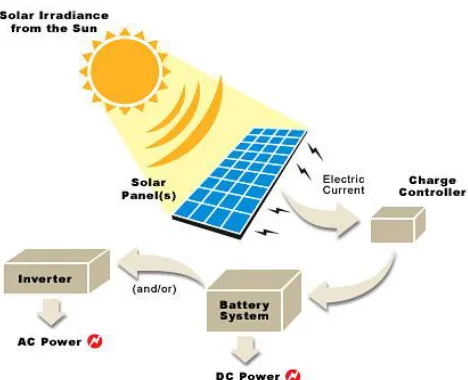
Figure 3.1 Solar system components
Solar cells (really called “photovoltaic” or “photoelectric” cells) that convert light directly into electricity, bypassing thermodynamic cycles and mechanical generators. PV stands for photo (light) and voltaic (electricity), whereby sunlight photons free electrons from common silicon. A photovoltaic module is composed of individual PV cells.
This crystalline-silicon module has an aluminum frame and glass on the front. In the field of photovoltaic, a photovoltaic module is a packaged interconnected assembly of photovoltaic cells, also known as solar cells. An installation of photovoltaic modules or panels is known as a photovoltaic array or a solar panel. A photovoltaic installation typically includes an array of photovoltaic modules or panels, an inverter, batteries (for off grid) and interconnection wiring. Solar energy is the utilization of the radiation energy from the sun.
Solar power is used interchangeably with solar energy but refers more specifically to the conversion of sunlight into electricity by photovoltaic and concentrating solar thermal devices, or by one of several experimental technologies such as thermoelectric converters, solar chimneys and solar ponds.
Sunlight is composed of photons, or particles of solar energy. These photons contain various amounts of energy corresponding to the different wavelengths of the solar spectrum.
When photons strike a photovoltaic cell, they may be reflected, pass right through, or be absorbed. Only the absorbed photons provide energy to generate electricity. When enough sunlight (energy) is absorbed by the material (a semiconductor), electrons are dislodged from the material's atoms.
Special treatment of the material surface during manufacturing makes the front surface of the cell more receptive to free electrons, so the electrons naturally migrate to the surface.
When the electrons leave their position, holes are formed. When many electrons, each carrying a negative charge, travel toward the front surface of the cell, the resulting imbalance of charge between the cell's front and back surfaces creates voltage potential positive terminals of a battery. When the two surfaces are connected through an external load, electricity flows.
RESULT AND DISCUSSION
proposed technology within larger power PV systems. The experimental model, along with the light intensity measurement device and the two LEDs, are presented. The start-up of the designed system and the setting of the specific parameters of the motor and of the IBL2403 drive unit were executed using Easy Motion Studio. In is presented the dialog window for the DC motor parameter settings and in the dialog window for the IBL2403 drive unit parameter settings. In are presented the variations of the received signals from the two LDRs, when a light source moves in front of the PV panel and the difference signal that can be used for the decision taking module to move the panel to the right or to the left.
The results for the project were gotten from LDRs for the solar tracking system and the panel that has a fixed position. The results were recorded for four days, recorded and tabulated. The outputs of the LDRs were dependent on the light intensity falling on their surfaces. Arduino has a serial that communicates on digital pins 0 (RX) and 1 (TX) as well as with the computer through a USB. If these functions are thus used, pins 0 and 1 can be used for digital input or output.
Arduino environment’s built in serial monitor can be used to communicate with the arduino
board. To collect the results, a code was written that made it possible to collect data from the LDRs after every one hour. The values from the two LDRs are to be read and recorded at the given intervals. The LDRs measure the intensity of light and therefore they are a valid indication of the power that gets to the surface of the solar panel. As a result, by measuring the light intensity at a given time, it will be possible to get the difference in efficiency between the tracking panel and the fixed one. The light intensity is directly proportional to the power output of the solar panel.
A code was written that made it possible to obtain readings from the two LDRs at intervals of one hour. The EEPROM came in handy in this. It is the memory whose values are kept when the board is turned off. The ATmega 328P has 1024 bytes of EEPROM. To get the values at the end of the day, the Arduino board was used to connect the microcontroller to the computer. The RX and TX pins are used for the connection. The code for reading the values that were recorded is loaded into the microcontroller. The various values are obtained and converted into volts. The Vcc to the microcontroller and the LDRs is 5volts.
LDR Output=
023
5 1
Equivalent Digital output volts
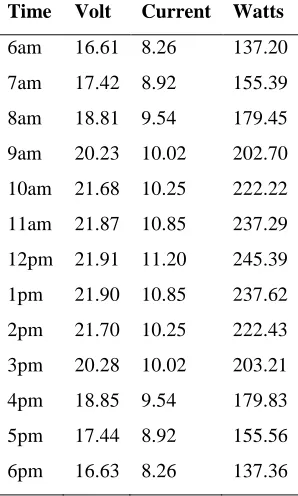
Table 4.1 Solar panel produced power without tracking
Time Volt Current Watts
6am 16.61 8.26 137.20
7am 17.42 8.92 155.39
8am 18.81 9.54 179.45
9am 20.23 10.02 202.70
10am 21.68 10.25 222.22
11am 21.87 10.85 237.29
12pm 21.91 11.20 245.39
1pm 21.90 10.85 237.62
2pm 21.70 10.25 222.43
3pm 20.28 10.02 203.21
4pm 18.85 9.54 179.83
5pm 17.44 8.92 155.56
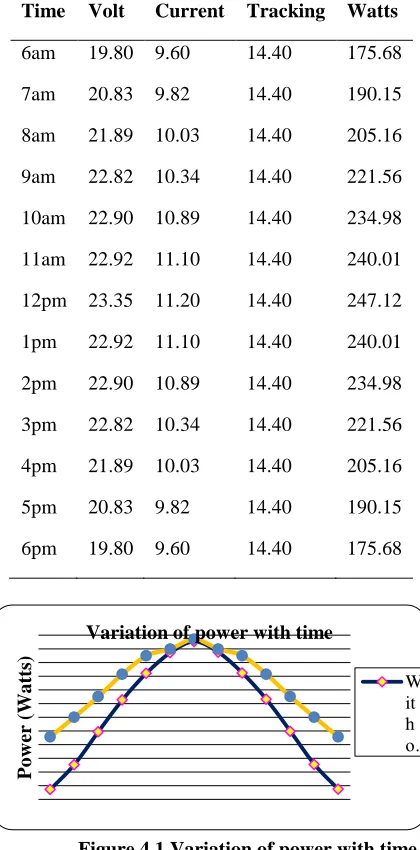
Table 4.2 Solar panel produced power with tracking
Time Volt Current Tracking Watts
6am 19.80 9.60 14.40 175.68
7am 20.83 9.82 14.40 190.15
8am 21.89 10.03 14.40 205.16
9am 22.82 10.34 14.40 221.56
10am 22.90 10.89 14.40 234.98
11am 22.92 11.10 14.40 240.01
12pm 23.35 11.20 14.40 247.12
1pm 22.92 11.10 14.40 240.01
2pm 22.90 10.89 14.40 234.98
3pm 22.82 10.34 14.40 221.56
4pm 21.89 10.03 14.40 205.16
5pm 20.83 9.82 14.40 190.15
6pm 19.80 9.60 14.40 175.68
Figure 4.1 Variation of power with time
ADVANTAGES& DISADVANTAGES
Advantages
This automatic solar tracker is easy to implement since its construction is simple.
With the implementation the proposed system the additional energy generated is around 25% to 30% with very less consumption by the system itself.
The solar panel with the sun in order to extract maximum energy falling on it renewable energy is rapidly gaining importance as an energy resource as fossil fuel prices fluctuate.
Disadvantages
This system cannot be used in rainy season.
Initial cost is high.
Websites
www.eere.energy.gov
www.plantservices.com
http://www.solartechnology.co.uk/support-centre/calculating-your-solar-requirments
www.wikipedia.com
P
o
w
er
(
Wa
tt
s)
Variation of power with time
REFERENCES
[1]. American Society Heating Refrigeration and Air Conditioning. ASHRAE Hand Book. 2001
[2]. Arora, C.P. Refrigeration and Air Conditioning. Second edition. Tata McGraw-Hill Publishing Company Ltd. 2000.
[3]. Bureau of Energy Efficiency, Ministry of Power, India. HVAC and Refrigeration Systems. In: Energy Efficiency in Electrical Utilities, 4. 2004
[4]. Munters Pre-Cooling of Gas Turbines–Evaporative Cooling. 2001.
www.munters.com/home.nsf/FS1?ReadForm&content=/products.nsf/ByKey/OHAA-55GSWH [5]. National Productivity Council, Ministry of Industries, India. Technology Menu on Energy Efficiency. [6]. Plant Services Magazine. US Department of Energy, Energy Efficiency and Renewable Energy.
[7]. A.K. Saxena and V. Dutta, “A versatile microprocessor based controller for solar tracking,” in Proc. IEEE, 1990, 1105 – 1109.
[8]. Muhammad Faheem Khan and Rana Liaqat Ali “Automatic Sun Tracking System (ASTS)”, Faculty of Electronics Engineering, Air University.
[9]. T, Esram and P.L. Chapman, “Comparison of Photovoltaic Array Maximum Power Point Tracking Techniques,” IEEE Transactions
[10].Chong, K.K.; Wong, C.W. General formula for one-axis sun tracking system and its application in improving tracking accuracy of solar collector “Solar Energy. 2009, 83, pp.298-305.