Amusan et al. World Journal of Engineering Research and Technology
DESIGN OF A MOBILE MULTI AGENT-BASED RESOURCE
ALLOCATION AND COORDINATION SYSTEM IN A GRID
ENVIRONMENT
1
Emuoyibofarhe O. J., *2Amusan E. A. and 3Salahu A. S.
1,2
Computer Science and Engineering Department, Ladoke Akintola University of
Technology, Ogbomoso, Oyo State, Nigeria.
3
Kwara State College of Education, Ilorin, Nigeria..
Article Received on 10/04/2018 Article Revised on 01/05/2018 Article Accepted on 21/05/2018
ABSTRACT
Availability, discovery and proper sharing of resources on a grid need
proper attention to optimize the expected goal. The existing static
resources allocation mechanisms are not able to handle the
dynamically changing characteristics and capabilities of the resources
in grid environment. Mobile agent technology is used as an alternative
approach for the design of distributed systems to the traditional
centralized architecture for effective allocation and coordination of resources. However,
bandwidth utilization, resource discovery time and rejection of agents are some of the
drawbacks limiting the efficiency of existing agent-based systems. Hence, this work
developed a mobile agent-based resource allocation and coordination model that focused on
searching, allocating and coordinating resources that change dynamically which is also
characterized with high percentage bandwidth utilization, low resource discovery time and a
decrease in rejection of agents. The system was implemented using C# programming language run in the .NET framework and the designed model simulated. Simulation results
showed that an increase in number of clusters produced a corresponding increase in the
percentage bandwidth utilization (PBU) especially in Tree transfer topology more than single
step and random topologies. Also, Rejection of agent (ROA) decreased by 20% when number
of clusters was increased.
World Journal of Engineering Research and Technology
WJERT
www.wjert.org
SJIF Impact Factor: 5.218*Corresponding Author Amusan E. A.
Computer Science and
Engineering Department,
Ladoke Akintola University
of Technology, Ogbomoso,
KEYWORDS: Computational grid, mobile agents, resource allocation, resource coordination.
1. INTRODUCTION
Grid computing is primarily concerned with sharing and allocation of resources such as
computing power, networks and database, rather than mainly file exchange (Chevaleyre et al,
2006). Grid technology has been applied to computationally intensive scientific,
mathematical, and academic problems through volunteer computing, and it is used in
commercial enterprises for such diverse applications as drug discovery, economic
forecasting, seismic analysis, and back office data processing in support for e-commerce and
Web services (Wolski et al, 2001).
Allocation and coordination of resources involve searching for appropriate resources and
allocating them to solve specific jobs. When allocating these resources, they may change
dynamically, which makes resource coordination very critical. Resources allocation could be
either centralized or distributed. In the centralized case, a single entity decides on the final
allocation of resources amongst agent, possibly after having elicited the preferences of the
other agents in the system. Typical examples of the centralized approach are combinatorial
auctions, in which the central entity is the auctioneer and the reporting of preferences takes
the form of bidding. On the other hand, allocations emerge as a result of sequence of local
negotiation steps in distributed approach. Such local negotiation is often restricted to bilateral
trading as in the classical Contract-Net approach, but systems allowing form bilateral
exchanges of resources between more than two agents are also possible (Chevaleyre et al,
2006).
Current grid systems are somewhat rigid and inflexible in terms of their interoperability and
interactions, while agent based systems can be used as serious distributed systems which are
robust, secure, requires scaling, and with bandwidth constraint (Foster, Jennings, and
Kesselman, 2004). A major limitation of the agent-based approach discussed above is that
whilst multi-agent systems are used to trade for grid resources, the trading tends to happen at
the higher “service” level and not at the base “resource” level. In this study, a multi-agent
architecture based on the hierarchical organization is proposed in other to overcome this
2. LITERATURE REVIEW
Mobile agents are considered one of the most powerful forms of code mobility. They can
exploit the high processing power available in the server machines by shifting the
computations into the server side. A mobile agent is a software module able to migrate to
among the hosts of a network and carry on a specific task. The state of the program that runs
is saved, transported to the new host, and restored, allowing the program to resume where it
left off. Mobile agent technology seems to be very adequate to cope with systems’
heterogeneity (Valliyammai et al, 2010). Mobile agents are autonomous and intelligent
programs that move through a network, searching for and interacting with services on the
user's behalf and possess inherent navigational autonomy. Valliyammai et al, (2010)
explained that mobile agents’ role is vital in grid because to support the local monitoring,
local correlation on management devices, deploying agents dynamically, good scalability,
continuing execution on device when link-down or unreliable and return results when
available. Mobile Agents provide an effective way of migrating code and data together and
return the results to the original user. (Valliyammai et al 2010).
Distributed information processing is a primary application of agent technology. Consider a
mobile computing scenario with low bandwidth connection links. Agents suit them in a better
way because the code to be executed migrates into the network leaving the portable device
and performs necessary actions in the remote execution site. Only the result is returned back
to the mobile device The techniques devised for protecting the agent platform are
software-based fault isolation, safe code interpretation, signed code, authorization and attribute
certificates, state appraisal, path histories and proof carrying code. While those for protecting
an agent are partial result encapsulation, mutual itinerary recording, itinerary recording with
replication and voting, execution tracing, environmental key generation computing with
encrypted functions and unclear code (Valliyammai et al, 2010).
2.1 Related Works
The Network Weather Service (NWS) is a distributed system used by several grid systems for
producing short term performance predictions of computational and network resources. It
involves monitoring and prediction but does not include (re)scheduling of tasks. NWS works
on small time scales; hence, it is not suitable for applications which take hours to run.
Besides, uncertainties on applications demands are not accounted in predictions. Errors in
graphics for bandwidth availability predictions in which the differentiation between predicted
and measured values are not easy to evaluate (Daniel and Nelson, 2008).
The Grid Architecture for Computational Economy (GRACE) allocates resource on the basis
of supply and demand dynamics. Resource broker deals with resource discovery and
adaptation of resource allocation given changes in availability. It presents the grid to the users
as a single computational system. However, the major drawback of this proposal is the lack
of flexibility to adjust the resource allocation given changes of resource availability. The
major contribution of this research is to maximize incentives to the provider of resources
(Boutilier, Bacchus and Brafman, 2004).
The Cactus Worm system employs code migration and monitoring to allow applications to
adapt its resource allocation, when required performance level is not achieved. However,
intermediate nodes can become a bottleneck. Cactus Worm does not deal with uncertainties.
It was evaluated on the GrADS testbed, a grid composed of American universities.
Experimental results show the advantage of Cactus Worm adaptive mechanism. However,
there is no concluding data on the performance of the whole system (Daniel and Nelson
2008).
The Framework for Dynamic Grid Environments was targeted to promote changes when fault
occurs as well as when resource availability increases. It was evaluated on TRGP testbed and
a decrease of execution time of the order of 30% was observed. Experiments were conducted
involving only CPU intensive applications and, therefore, there is a need to consider data
intensive applications to derive broader conclusions on its performance (Daniel and Nelson
2008).
Cao et al, (2002) developed an agent based resource management system (ARMS) on grids.
Its design methodology focused on solving the problems associated with scalability and
dynamism in large multi-agent systems. It is not clear whether agents in the ARMS system
bundle CPU resources together to form a service or indeed what the differences in granularity
are between the PACE scheduler and the agent based resource negotiation however, it seems
that the use of agents is primarily targeted toward service discovery whilst the PACE
3. METHODOLOGY
The research method employed in this work is design and simulation. The first step was to
design a mobile agent-based resources allocation and coordination system in a grid
environment. Next was to simulate the designed grid environment model, and lastly, evaluate
the performance of the developed system.
3.1 System Design
The grid model was designed based on three agent types, which are Job Request Agents
(JRAs), Broker Service Agents (BSAs) and Resource Producer Agents (RPAs).
The JRAs were developed to represent the users for completing the job requests and
submitting the jobs to the Broker Service Agents (BSAs), while BSAs served as resource
schedulers as well as the brokers in the system. The system was developed using Random,
Single Step and Tree topologies where percentage bandwidth utilization (PBU), Average
Resource Discovery time (ARD) and Rejection of the agents (ROA) were used as
specifications. Resource Producer Agents (RPAs) reside in the nodes of the local clusters, set
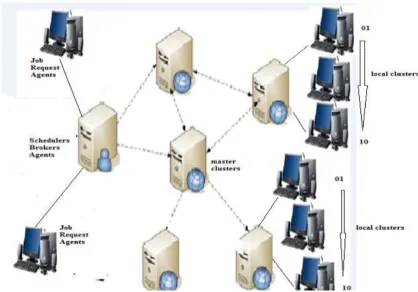
the price of resource to maximum, average and minimum price. The system’s physical layout
is as shown in Figure 1.
The system is a collection of user nodes, resource owner nodes and local and global servers,
all connected to networks, mobile agents representing users, resource owners and taking care
of its job execution. The middleware consist of wrappers, each wrapping a user program, and
user programs written in C# programing language run in window .NET. The system assumes
the availability of an agent platform at all the nodes of the network. The system
communicates through the internet platform only. It is assumed that each grid node consists
of a finite number of resources such as buffers, processing power, bandwidth, and storage
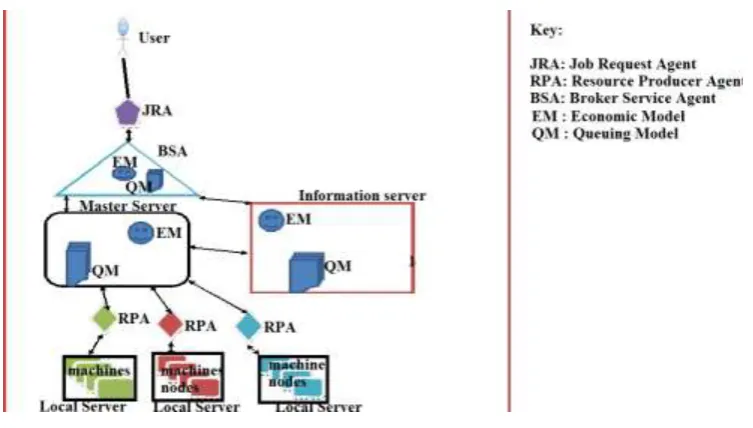
devices.. Figure 1 shows the physical layout of the system while Figure 2 depicts the grid
model that consists of master cluster servers, local cluster servers, routers, adapters and
nodes, grid information servers, grid resource brokers, and users.
3.2System Architecture
Multi-agent system architecture is proposed for grid resources allocation in this research. The
architecture of model is as shown in Figure 2. The agents in the architecture are organized in
hierarchies and comprise the Job Request Agents (JRAs), Broker Service Agents (BSAs) and
the Resource Producer Agents (RPAs). The system model consists of master cluster servers,
local cluster servers and nodes, grid information servers, grid resource brokers, and users.
Local cluster has a set of machines, cluster server and was implemented as a local area
networks (LAN), which incorporate local scheduler. Several local clusters are grouped and
controlled by a master cluster server implemented as a wide area network (WAN) which
incorporates global scheduling. The master cluster server collects information about the
resources in its local clusters and then stores the information in its own database and also
supplies the information to the grid information servers. The resource brokering agents
discover the resources through the grid information servers.
The scheduling system used the scheduler that match available jobs to available resources
Figure 2: System Model Architecture.
3.2.1 Job Request Agents (JRAs)
Job Request Agents (JRAs) are mobile agent that represents a user and it accepts the job
requests of the user, searches and sends the job to BSA. This system performs brokerage with
the agents in the resource brokering nodes by negotiating within the given price limits. JRA
reserves the resources by paying a higher price to BSAs.
3.2.2 Brokering Service Agents (BSAs)
The BSAs act as the resource schedulers as well as brokers for the users to submit the jobs
(through the JRAs). The BSAs incorporate some economic and queuing models to address
the dynamic behavior of the grid systems. The BSAs that present in different nodes
communicate with each other in order to coordinate the pricing of the resources.
The job is submitted and queuing model of an RBA groups the JRA’s. The grouping is based
on the First-in First-Out (FIFO) manner. In this grid, BSAs are arranged in several different
topologies. The BSAs make decision about the migration of the unallocated JRAs, according
to the nature of the topology. Thus, three different kinds of topologies considered in this
model are single step transfer or circular topology, random transfer topology, and tree shape
topology.
3.2.3 Resource Producer Agents (RPAs)
RPA monitors the resources either periodically or continuously and informs the status related
to resource utilization, resource availability, and price of the resource, to its information
3.3 SIMULATION ALGORITHM
The simulation algorithm is as follows:
(a) Generate the grid with Gngrid nodes using a random, single step, and tree topologies. The
number of users, number of master cluster, number of local cluster, number of job
Agents, size of jobs, number of machines, amount of job Agent requirements that need to
be processing, and the rate at which jobs are sent from the user, are all variables.
(b) Generate the resources producer agents at each of the local clusters. Each local cluster has
a RPA with mean inter-arrival time of the jobs with Poisson distribution in msec
(milliseconds). It also has its own local scheduler and JRA requirements for the resources
are distributed uniformly between the range [w, z]. Each resource requirement is
generated uniformly between the range [Qa, Qb], which is normalized. The basic prices of
the resources at a grid are uniformly distributed between <p1, p2> units.
(c) Generate the BSA with minimum and maximum number of JRAs that are generated by
the users. Where Minimum and Maximum utilization threshold values for the resources
are MUT and XUT respectively
(d) Resource brokering nodes are generated for a set of grid nodes. The timeout for a JRA is
considered as β seconds. The quantity of a resource available at each of the local clusters
is distributed between the range [0, 1], which is normalized. The number of resources
available is between the range [Rx, Ry].
(e) Apply mobile agent for resources allocation and coordination model. That size of each
JRA is α KB (kilobytes). The agent migration time on a single hop is uniformly
distributed between <t1, t2>.
(f) Compute the performance parameters.
3.4 PERFORMANCE METRICS
In the simulation of this system, three metrics were utilized to measure system performance.
They are:
(a) The total grid bandwidth utilization (total used computation time/total available
computation time).
(b) The amount of time a mobile agent spends to perform assigned duty
3.5Simulation Parameters
The number of users, number of resources, number of jobs, size of jobs, amount of machines,
amount of processors a machine had and their processing power, the budget for brokers in
auctions, and the rate at which jobs are sent from the user were used as variables.
3.6Experimental Configuration
Varying the number of users shows the sensitivity of the scheduler relative to the user load on
the grid system, while varying resources shows the sensitivity of the scheduler relative to
resource availability and repeated for the three topologies.
4. RESULT AND DISCUSSION
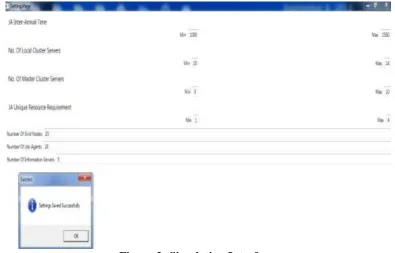
The simulation interface is as presented in Figure 3 in which the number of local servers,
master servers, inters arrival time and resource requirement can be given minimum and
maximum values to avoid grid lock and overcrowding of the resources. With all parameters
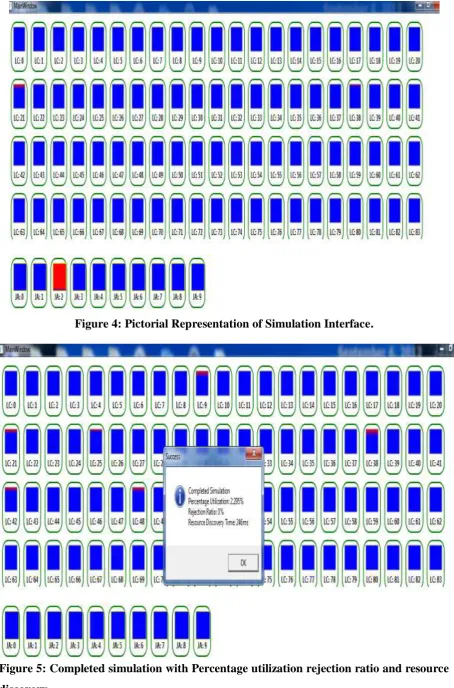
ascribed, simulation start button can be pressed and the agents start the bidding process as
shown in Figure 4. The agent painted red symbolizes the agent biding at a particular time. If
the job resources to be used is found, the job is run on a local cluster, however if the job is
too large the master cluster divides the job to various local clusters, the various bits are
compiled afterward and sent to the agent which sends the job the owner. When the simulation
is completed, a summary of all resources discovered are shown, rejection ratio and time used
for the simulation is displayed as shown in Figure 5.
Figure 4: Pictorial Representation of Simulation Interface.
As shown in Table 1, when the number of job increase, the bandwidth utilization increases.
The table also reveals that, as number of clusters and resources in clusters increased the
bandwidth utilization is reduced. This is because, the allocated bandwidth is increasing
suddenly and not in a uniform manner. The allocation of resources to execute certain job in
an environment is not relevant with the requirements of potential requests for the bandwidth.
It was observed that the bandwidth utilization value decreases as the number of JRAs
increases. The tree topology gives better resource utilization when compared with the other
two topologies, since the grid nodes are arranged in a tree-like hierarchical fashion. Mobile
agent moved to the nearest resource broker agent in the tree structure and allocates the
resources if available. If the resources are not available then the mobile agent moves to the
parent of the previous resource broker agents and so on, until it gets the required resources to
execute its job. It is noted from the figures that with an increase in the number of mobile
agent requesting for resources, the mobile agent that arrive late have to move to more number
of hops. This is because the nearest resources are already occupied by the mobile agents that
started early. There is an increase in the overheads due to this problem.
For a tree topology, the resource utilization value decreases as the number of grid nodes
increases and the number of JRAs decreases.
Table 1: percentage bandwidth utilization.
Clusters Single step (%) Random (%) Tree (%)
200 54.9 48.5 68.8
163 44.0 48.7 68.5
150 40.6 65.7 68.3
137 36.5 65.9 66.1
124 41.9 80.7 62.5
111 40.6 57.2 57.8
98 48.4 33.7 75.0
85 36.5 68.9 81.2
72 56.2 45.5 81.5
59 60.3 73.0 81.7
46 60.3 41.4 83.9
33 56.2 42.8 87.5
20 14.0 71.6 92.2
The resource discovery process takes less time in the environments with more number of
Table 2: Resource Discovery Time (gridsim sec).
Clusters Single Step (ms) Random (ms) Tree (ms)
20 318 228 288
72 320 443 311
147 320 480 141
59 330 432 315
111 380 477 278
124 390 478 250
98 432 479 290
33 450 358 451
85 465 462 306
146 473 402 323
150 478 480 315
163 478 480 324
176 476 420 342
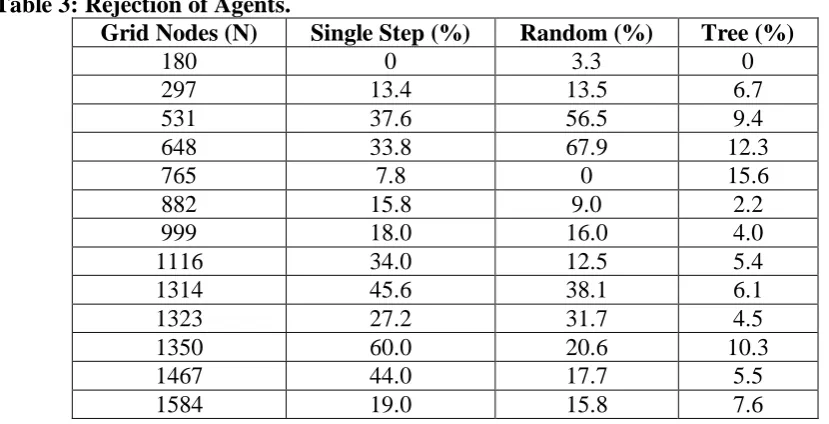
Table 3 illustrates the rejection of agents. The experiment behaves well with fewer numbers
of resources, usually an increase in the number of jobs increases the number of job rejections.
If the number of jobs exceeds the grid accommodating capacity, the rejection of the agents
increases.
Table 3: Rejection of Agents.
Grid Nodes (N) Single Step (%) Random (%) Tree (%)
180 0 3.3 0
297 13.4 13.5 6.7
531 37.6 56.5 9.4
648 33.8 67.9 12.3
765 7.8 0 15.6
882 15.8 9.0 2.2
999 18.0 16.0 4.0
1116 34.0 12.5 5.4
1314 45.6 38.1 6.1
1323 27.2 31.7 4.5
1350 60.0 20.6 10.3
1467 44.0 17.7 5.5
1584 19.0 15.8 7.6
5. CONCLUSION
The agent-based resource allocation model used a cluster based agent frame work, in which
the nodes are clustered providing the same type of resource. It localized the searches to
reduce the JRA travel thereby making it easy to avoid clue or priority for finding its requested
resources. This type of arrangement has reduced discovery time, less bandwidth
consumption, as the requests would be fulfilled in more number of hops and higher risk of
discovery time and number of agent rejected are the main factors used as parameters to
evaluate the performance of the system. On the other hand rejection of the agent had a direct
relation with resource discovery.
Simulation results showed number of cluster increased from 20 to 200, PBU increased to
75% in Tree transfer topology more than single step and random topologies 48.4% and 57.2%
respectively at 0 to 480 simulation time. The ROA decreased by 20% when number of
clusters was increased. The results showed an improvement when compared with existing
ones due to the reduction of the rejection of the agents (ROA). Also the system was able to
serve large number of job request agents (JRAs) and percentage of bandwidth utilization
(PBU) that is increased allow the resource owners to vary the price for cost benefit.
REFERENCES
1. Boutilier, C, Bacchus, F. and Brafman. R. “UCP networks: A directed graphical
Representation of conditional utilities”. In Proc. 17th Annual Conference on certainty in
Artificial Intelligence, Morgan Kaufmann, 2004; 56-64.
2. Cao,J., S.A. Jarvis, S. Saini, D.J. Kerbyson and G.R. Nudd, “ARMS: An agent-based
resource management system for grid computing”. Sci. Program., 2002; 10: 135-148.
http://www.dcs.warwick.ac.uk/~saj/papers/arms.pdf.
3. Chevaleyre, Y., Paul E, UlleE.,Lang, U., Estivie S., and Maudet. N. “Issues in
Multi-agent Resource Allocation”. In Engineering Societies in the Agents World, 2006;
123-124.
4. Daniel, M. Batista and Nelson L. S. da Fonseca. “A Brief Survey on Resource Allocation
in Service Oriented Grids”. Institute of Computing State University of ampinas Avenida
Albert Einstein, 2008; 1251–13084-971.
5. Foster, I., Jennings, N. R., and Kesselman, C. "Brain Meets Brawn: Why Grid and Agents
Need Each Other". Proceedings of 3rd Int. Conf. on Autonomous Agent and Multi-Agent
Systems (AAMAS), New York, USA.
6. Valliyammai, C. ThamaraiSelvi S., Satheesh Kumar R., Pradeep E, and Naveen.K: “an
alternate approach to Resource Allocation Strategy UsingNetworkMetricsinGrid”, a paper
presentation submitted to International Journal of Grid Computing and applications,
2010; 1: 1-8.
7. Wolski, R. Plank J. S., Brevik J., and Bryan T. “Analyzing Market-Based Resource
Allocation Strategies for the Computational Grid”. International Journal of