Original Research Article
Assessment of awareness and perception regarding eye donation among
selected patients attending field practise area of a tertiary care hospital
in Mangalore: a cross-sectional study
G. Rakesh Maiya
1*, K. G. Kiran
2, Sanjeev Badiger
3INTRODUCTION
India has a large number of blind population of which major proportion of blindness can be corrected. Significant cause of visual impairment and blindness in developing world is because of corneal diseases like keratitis or trauma resulting in corneal scarring and in
turn unilateral or bilateral blindness and visual impairment.1,2 Trachoma, corneal ulceration, xerophthalmia due to vitamin-A deficiency, leprosy, onchocerciasis, ophthalmia neonatorum, ocular trauma and use of harmful traditional eye medicines are few major causes of corneal blindness globally.3 The Andhra Pradesh Eye Disease Study (APEDS) reported the
ABSTRACT
Background: India has a large number of blind population of which major proportion of blindness can be corrected. One of the major cause in developing countries is corneal ulceration. Vision restoration for a sizeable proportion of corneal blind is possible through corneal transplant. Data from Eye Bank Association, India suggests that the annual corneal procurement for donation is 1/10th of annual requirement. Raising the level of public awareness on eye donation is one of the important step in increasing corneal procurement. The objectives of the study were to evaluate persons who know about eye donation and to assess the awareness and perception regarding eye donation among those who know about eye donation.
Methods: A cross-sectional study on 400 patients aged more than 18 years visiting the health centers affiliated to department of Community Medicine, KSHEMA, Deralakatte using convenient sampling during June-July 2017 using pre-validated questionnaire.
Results: Out of 400, only 44% (176) knew about eye donation. Awareness and perception regarding eye donation was studied in those 44% (176). 28.4% (50, N=176) thought that blood group is a barrier for eye donation. Only 56.8% (100, N=176) knew the contact place for eye donation. Only 24.4% (43, N=176) had pledged to donate eyes. age, education and information from TV, family members, health professionals and pamphlets had significant association with willingness to donate (p<0.05).
Conclusions: Though many strategies are in place, awareness regarding eye donation is less. Hence, there is a need for development of newer strategies to increase eye donation.
Keywords: Eye donation,Willingness, Information, Barriers
1
Post-Graduate, 3Professor and Head of the Department, Department of Community Medicine, K. S. Hegde Medical Academy, Nitte University, Mangalore, Karnataka, India
2
Professor and Head of the Department, Department of Community Medicine, Kanachur Institute of Medical Science, Deralakatte, Mangalore, Karnataka, India
Received: 02 April 2018
Revised: 10 May 2018
Accepted: 15 May 2018
*Correspondence:
Dr. G. Rakesh Maiya,
E-mail: [email protected]
Copyright: © the author(s), publisher and licensee Medip Academy. This is an open-access article distributed under the terms of the Creative Commons Attribution Non-Commercial License, which permits unrestricted non-commercial use, distribution, and reproduction in any medium, provided the original work is properly cited.
prevalence of corneal blindness at 0.13%(95% CI: 0.06-0.24) which constitutes 9% of all blindness.4 Approximately 18.7 million people are blind in India.5 20,000 is added to the list every year. Organ donation is considered as giving one or more organs, without compensation, for transplantation to another person.6 Corneal transplant stays to be important resort in restoration of vision among people having corneal blindness already, even though primary and secondary prevention are more cost-effective. According to National Programme for Control of Blindness and Awareness report only 18,000 of donor eyes are procured annually.7 Recently the factors affecting cornea procurement and attitude of public regarding eye donation in developed world has received attention but not much in developing world.8-11 Level of public education regarding eye donation has to be raised as an important first step to increase cornea procurement. Many studies have assessed the awareness and perception in different parts of country. The study regarding awareness regarding eye donation is relatively less in this region. With this in mind the present study was done to assess the awareness and perception regarding eye donation.
Objectives
To evaluate persons who know about eye donation. To assess the awareness and perception regarding
eye donation among those who know about eye donation.
METHODS
A cross-sectional study was done on patients attending the health centres affiliated to Department of Community Medicine, K. S. Hegde Medical Academy, Mangalore. Based on a previous study where the prevalence of eye donation was 51% and assuming 5% allowable error the sample size calculated was 400 using 4pq/d2 formula.12 During the time period of June-July 2017 the patients attending health centres were selected using convenient sampling. Patient aged 18 years and above was included. Pre-validated questionnaire was used to collect data using interview method. The questionnaire contained Socio-demographic factors, awareness regarding eye-donation, awareness regarding optimal time for eye-donation, source of information on eye-donation, willingness to donate eyes, perceived reasons for donating eyes and perceived reasons for not donating eyes. Socio-demographic factors were asked to everyone. Next, participants were asked the question “Have you ever heard about Eye-donation?” Participants answering “YES” were considered to have awareness and were included for further study. Participant consent was taken before administering the questions.
Data was entered into excel sheet and analysed using SPSS software version 16. Proportions and percentages were used for descriptive statistics. Chi-square test was used for inferential statistics. P value less than 0.05 was considered significant.
RESULTS
Out of 400, 7% (28) were between 18-20years, 25.3% (101) were between 21-30 years, 19% (76) were between 31-40 years, 21.3% (85) were between 41-50 years and 27.5% (110) were above 50 years. 56.5% (226) were males whereas 43.5% (174) were females. 11.3% (45) were illiterates, 29% (116) had primary schooling, 17.3% (69) had secondary schooling education, 23.3% (93) studied till PUC, 16.5% (66) were graduates and 2.8% (11) were post-graduates.
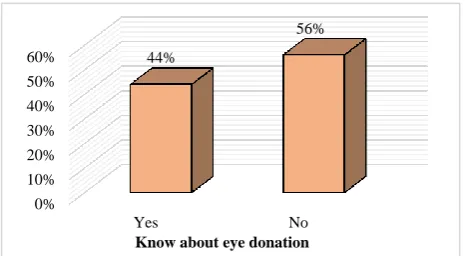
64.3% (257) were Hindu, 28.5% (114) were Muslims and 7.2% (29) belonged to Christian religion. 23.5% (94) were unmarried whereas 76.5% (306) were married. 22.4% (90) were unskilled workers, 47.4% (188) were semiskilled workers, 25.9% (104) were skilled workers whereas 4.3% (18) were not working. 23.8% (95) stay in urban area and 76.2% (305) belonged to rural area. Out of 400, 44% (176) answered “YES” for the question “Have you ever heard about Eye-donation?” (Figure 1).
Figure 1: Know about eye donation (N=400).
Further study regarding awareness and perception was done among these 176 people who answered “YES” for the question.
Out of 176, for the question meaning of eye-donation 30.7% (54) answered as removal of cornea of eye, 60.8% (107) answered as removal of entire eye, 8.5% (15) answered as removal of lens. 20.5% (36) knows a person who has received eye, 79.5% (140) does not know any person who has donated eyes. 19.9% (35) said that eyes can be removed from a living donor, 59.1% (104) said that eyes cannot be removed from a living donor whereas 21% (37) had no idea. 88.1% (155) said consent is necessary for eye donation, 1.7% (3) said consent is not necessary and 10.2% (18) had no idea. 36.9% (65) said that there is an age limit for eye donation, 19.9% (35) said there is no age limit for eye donation and 43.2% (76) had no idea. 15.9% (28) said that a person with communicable disease can donate eyes, 36.9% (65) said that a person with communicable disease cannot donate eyes and 47.2% (83) had no idea. 28.4% (50) said blood group can be a barrier, 14.8% (26) said blood group cannot be a barrier and 56.8% (100) had no idea. 24.4% (43) already had pledged to donate eyes. 56.8% (100)
0% 10% 20% 30% 40% 50% 60%
Yes No
44%
56%
knew contact place for eye donation whereas 43.2% (76) did not know the contact place for eye donation. 20.5% (36) told eye donation causes face disfigurement, 39.2% (69) told it will not cause face disfigurement where as 40.3% (71) had no idea.
When asked about optimal time for eye donation 5.1% (9) answered before death, 15.9% (28) said during death, 35.8% (63) said within 6 hours after death, 22.7% (40) answered any time after death and 20.5% (36) did not have any idea (Figure 2).
Figure 2: Optimal time for eye donation felt by participants (N=176).
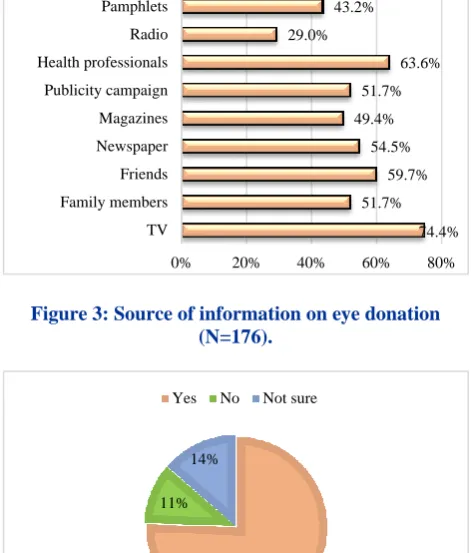
For source of information multiple answers were accepted. 51.7% (91) got information regarding eye donation through family members, 59.7% (105) through friends/neighbours, 74.4% (131) through TV, 54.5% (96) through Newspaper, 49.4% (87) through magazines, 29% (51) through Radio, 43.2% (76) through pamphlets, 51.7% (91) through publicity campaign and 63.6% (112) through Doctors/Health workers (Figure 3).
Out of 176, 75.6% (133) were willing to donate eyes, 10.8% (19) were not willing to donate eyes and 13.6% (24) needed more information (Figure 4).
Figure 3: Source of information on eye donation (N=176).
Figure 4: Willingness to donate eyes (N=176).
Table 1: Association between age, education and place of residence and participants who know about eye donation (N=400).
Know about eye donation
Total Chi-square value P value
Yes (176) No (224) Age
<20 years 25 3 28
71.474 0.000
21-30 years 64 37 101
31-40 years 39 37 76
41-50 years 25 60 85
>50 years 23 87 110
Education
Illiterate 10 35 45
124.202 0.000
Primary school 21 95 116
High school 26 43 69
Pre-university college 47 46 93
Graduate 65 1 66
Post-graduate 7 4 11
Place of residence
Urban 70 25 95
44.555 0.000
Rural 106 199 305
0% 5% 10% 15% 20% 25% 30% 35% 40%
Before death
During death
Within 6 hours after
death
Anytime after death
Don’t know 5.1%
15.9%
35.8%
22.7% 20.5% 74.4%
51.7% 59.7% 54.5% 49.4%
51.7% 63.6% 29.0%
43.2%
0% 20% 40% 60% 80%
TV Family members Friends Newspaper Magazines Publicity campaign Health professionals Radio Pamphlets
75% 11%
14%
Table 2: Association between few socio-demographic factors and willingness to donate eyes (N=176).
Willingness to donate
Total Chi-square value P value
Yes (133) No (19) Need more information (24) Age
<20 years 16 0 9 25
39.189 0.000
21-30 years 58 6 0 64
31-40 years 27 5 7 39
41-50 years 13 8 4 25
>50 years 19 0 4 23
Religion
Hindu 82 14 8 104
15.619 0.004
Muslim 40 3 8 51
Christian 11 2 8 21
Education
Illiterate 9 0 1 10
19.795 0.031
Primary school 13 3 5 21
High school 15 3 8 26
Pre-university college 33 6 8 47
Graduate 56 7 2 65
Post-graduate 7 0 0 7
Place of residence
Urban 63 6 1 70
16.438 0.000
Rural 70 13 23 106
Table 3: Association between few sources of information and willingness to donate (N=176).
Willingness to donate eyes
Total Chi-square value P value
Yes (133) No (19) Need more information (24) Television
Yes 101 7 23 131
20.042 0.000
No 32 12 1 45
Family members
Yes 79 5 7 91
12.940 0.002
No 54 14 17 85
Friends/neighbours
Yes 88 5 12 105
12.047 0.002
No 45 14 12 71
Pamphlets
Yes 68 5 3 76
14.834 0.001
No 65 14 21 100
Doctors/health workers
Yes 91 8 13 112
6.052 0.049
No 42 11 11 64
Out of 133 those who were willing to donate eyes 82.7% (110) said that they are willing to donate eyes as it a noble work, 69.2% (92) said that they are willing to donate to give vision to others, 72.2% (96) said its pleasure to help, 50.4% (67) said that they are willing to donate eyes influenced by articles, 40.6% (54) told they were influenced by lectures, 15% (20) were willing to donate because their friend/relative donated eyes and 9%
(12) were willing to donate because their friend/relative has received eyes.
Age (p=0.000), education (p=0.000) and place of residence (p=0.000) were significantly associated with participants who know about eye donation (Table 1). Willingness to donate eye was significantly associated with age (p=0.00), education (p=0.031), religion (p=0.004), marital status (p=0.001), place of residence i.e. urban or rural (p=0.000), knows a person who has donated eyes (p=0.002) (Table 2).
Source of information from television (p=0.00), family members (p=0.002), friends/neighbours (p=0.002), pamphlets (p=0.001) and doctors/health workers (p=0.049) had significant association with willingness to donate (Table 3).
Few things like knowing there is shortage of doctors (p=0.48), knowing a person who has received eye (p=0.476) and occupation (p=0.058) did not have any significant association with willingness to donate.
DISCUSSION
In our study 44% participants knew about eye donation which is dissimilar to studies conducted by Vijayalakshmi et al in Bangalore where 93.8% knew, Singh et al in urban slum in New Delhi where 65.72% knew and Krishnaiah et al in rural Andhra Pradesh where 28% knew.13-15 This difference is may be due to more of rural population.
In our study 20.5% said eye donation causes disfigurement of face which is similar to study done by Vijayalakshmiet al (16.6%).13 35.8% said eyes should be donated within 6 hours of death which is similar to studies done by Gupta et al (38.2%) and Bharti et al (28.75%).16,17 60.8% answered eye donation as removal of entire eye which is similar to study done by Bharti et al.17 In our study 56.8% knew contact place for eye donation which is similar to studies done by Bharti et al (66%) and Patil et al in rural Pondicherry (55.7%).17,18 In our study 75.6% were willing to donate eyes which is similar to studies conducted by Vijayalakshmi et al and Anita Gupta et al and dissimilar to studies conducted by Krishnaiah et al, Bharti et al and Boptom et al.13,15-17,19 Out of those who are willing to donate, 82.7% gave nobility as a reason which is similar to study conducted by Gupta et al (85.6%).16 Television was the common source of information which is similar to studies done by Singh et al, Gupta et al and Patil et al.14,16,18 Age was significantly associated with willingness to donate which is similar to studies done by Vijayalakshmi et al and Krishnaiah et al.13,15
CONCLUSION
In the study majority of the participants did not know regarding eye donation comparatively. Among those who know Television was the main source of information. Though the percentage of people who have already
pledged to donate eyes is less, majority of them were willing to donate eyes as most of them consider it as a noble work. Age, education and place of residence had significant association with awareness regarding eye donation whereas age, education, religion, marital status, place of residence, source of information from Television, family members, friends/neighbours, pamphlets and doctors/health workers had significant association with willingness to donate eyes.
Recommendations
Information regarding eye donation was found to be less. IEC activities should be conducted to increase the level of information. There is a need for development of newer strategies to increase the awareness and to change the wrong perceptions. Ophthalmologists, general physicians, medical students, non-governmental organizations and religious leaders should be motivated to work together to increase the eye donation rates.
Limitations
As it is a convenient sampling done in a single college generalizability will be difficult. Majority of the participants are from rural areas thus affecting the awareness and perception
ACKNOWLEDGEMENTS
We like to thank the study participants for their participation in the study.
Funding: No funding sources Conflict of interest: None declared
Ethical approval: The study was approved by the Institutional Ethics Committee
REFERENCES
1. Thylefors B, Negrel AD, Pararajasegaram R, Dadzie KY. Global data on blindness. Bulletin World Health Organization. 1995;73:115-21.
2. Rao GN. What is Eye Banking? Indian J Ophthalmol. 1996;44:1-2.
3. Dandona R, Dandona L. Corneal blindness in a southern Indian population: Need for health promotion strategies. Br J Ophthalmol. 2003;87:133-41.
4. Dandona L, Dandona R, Srinivas M, Giridhar P, Vilas K, Prasad MN, et al. Blindness in the Indian state of Andhra Pradesh. Invest Ophthalmol Vis Sci. 2001;42:908-16.
5. Dandona L, Dandona R, John RK. Estimation of blindness in India from 2000 through 2020: Implications for the blindness control policy. Natl Med J India. 2001;14:327-34.
7. Ministry of Health and Family Welfare, Government of India. Donors? A literature review and survey. Eye care services – eye banking,2002. Available at: http:/mohfw.nic.in.b/index.html# vision. Accessed on 3 March 2018.
8. Diamond GA, Michael C, Mussoline JF, Robert AD. Obtaining consent for eye donation. Am J Ophthalmology. 1987;103:198-203.
9. Mack RJ, Mason P, Mathers WD. Obstacles to donor eye procurement and their solutions at the University of Iowa. Cornea. 1995;14:249–52. 10. Doering JJ. Families experiences in consenting to
eye donation of a recently deceased relative. Heart Lung. 1996;25:72–8.
11. Saini JS. Realistic Targets and Strategies in Eye Banking. Indian J Ophthalmol. 1997;45:141-42. 12. Priyadarshan B, Srinivasan M, Padmavathi A,
Selvam R, Saradha R, Nirmalan PK. Awareness of eye donation in an adult population of southern India. A pilot study. Indian J Ophthalmol. 2003;51:101-4.
13. Vijayalakshmi P, Thiyagarajan S, Gandhi S, Thimmaiah R, Math SB. Knowledge, Attitude and Behaviour of The General Population Towards Organ Donation: An Indian Perspective. National Medical J India. 2016;29(5):257-61.
14. Singh A, Gupta N, Ganger A, Vashist P, Tandon R. Awareness Regarding Eye Donation in an Urban
Slum Population: A Community-Based Survey. Experimental Clin Transplantation. 2017.
15. Krishnaiah S, Kovai V, Nutheti R, Shamanna BR, Thomas R, Rao GN. Awareness of eye donation in the rural population of India. Indian J Ophthalmol. 2004;52(1):73-78.
16. Gupta A, Jain S, Jain T, Gupta K. Awareness and perception regarding eye donation in students of a nursing college in Bangalore. Indian J Community Med. 2009;34(2):122-125.
17. Bharti MK, Reddy SC, Tajunisiah I, Ali NA. Awareness and knowledge on eye donation among university students. Med J Malaysia. 2009;64(1):41-5.
18. Patil R, Prasath ER, Borante A, Gupta SK, Datta SS. Status of eye donation awareness and its associated factors among adults in rural pondicherry. J Clin Diagn Res. 2015;9(2):1-4.
19. Dandona R, Dandona L, Naduvilath TJ, McCarty CA, Rao GN. Awareness of eye donation in an urban population in India. Aust NZ J Ophthalmol. 1999;27:166-9.