Original Research Article
A community based study on e-waste disposal in Srinagar,
Uttarakhand: assessment of awareness and practices
Bhola Nath
1, Ranjeeta Kumari
2*, Valendu Gupta
3, N. D. Vaswani
4, Seema Lekhwani
5INTRODUCTION
The current explosion in technology development has lead to an exponential rise in the use of electronic equipments (EE). Equipments, ranging from the smallest pen drives to the large sized air conditioners are now a prized possession for almost every individual. Increasing rates of obsolescence due to rapid upgradation, coupled with increasing affordability of these EE due to reduced prices and increasing purchasing power has led to a rapid turnover of these consumer goods. This has consequently lead to the production of enormous amounts of electronic
waste (e-waste). E-waste management and handling rules 2011, defines „E-waste‟ as „waste electrical and electronic equipments like batteries, mobile phone, computers, laptops etc., whole or in part or rejects from their manufacturing and repair process, which are intended to be discarded‟.1
Globally, about 20-50 million tones (MT) of e-wastes is disposed off each year, which accounts for 5% of all municipal solid waste.2 If unchecked, the global volume of discarded e-waste will weigh almost equivalent to 200 Empire State buildings.3 India ranked third in the world in
ABSTRACT
Background: „E-waste‟ is waste electrical and electronic equipment (EE) which are intended to be discarded. Improper disposal leads to hazardous effects on health and environment. Awareness about e-waste is important for all those using EE.
Methods: It was a community based cross sectional study among consumers of EE and scrap dealers in Srinagar city, of Pauri district in Garhwal division of Uttarakhand. Information was collected on knowledge about e-waste, its types and disposal practices.
Results: Only 6.7% respondents heard the term E-waste. 77% of the respondents didn‟t know about the ways of disposing the e-waste and 45.7% were totally unaware of hazardous effects of improper disposal. Knowledge among scrap dealers was altogether absent.
Conclusions: Awareness on various aspects of E-waste was found to be poor among respondents and totally absent among scrap dealers.
Keywords: Electronic equipment, E-waste, Awareness, E-waste disposal
1
Department ofCommunity Medicine, VCSGGMS & RI, Srinagar, Uttarakhand, India
2
Department ofCommunity and Family Medicine, AIIMS, Rishikesh, Uttarakhand, India
3
VCSGGMS & RI, Srinagar, Uttarakhand, India
4
Department of Pediatrics, Shaheed Hassan Khan Mewati Government Medical College, Nalhar, Mewat, Haryana, India
5
Department of Biochemistry, BPS Khanpur Government Medical College, Sonipat, Haryana, India
Received: 03 May 2018
Revised: 02 July 2018
Accepted: 04 July 2018
*Correspondence:
Dr. Ranjeeta Kumari,
E-mail: [email protected]
Copyright: © the author(s), publisher and licensee Medip Academy. This is an open-access article distributed under the terms of the Creative Commons Attribution Non-Commercial License, which permits unrestricted non-commercial use, distribution, and reproduction in any medium, provided the original work is properly cited.
e-waste generation per annum with a whopping 1.7 MT of e-waste in 2014. Illegal shipping of e waste from industrialized countries with strict laws, India, by „toxic traders‟, adds to the already high burden of e-waste in India.4
Of the 64.5 MT of e-waste generated annually world over, only around 40% is processed properly.3 The situation is even gloomier in India which is primarily due to poor awareness in consumers and scrap dealers and weak enforcement of environmental regulations. Improper E-waste disposal by means of land filling, incineration or dumping leads to various hazardous effects on the health of people by invading the ecological and human systems.5,6 This effect would be even more deleterious in states with rich ecosystem such as Uttarakhand. On the other hand proper disposal by recycling can reap rich benefits in terms of prevention of health hazards and reclamation of recycled materials like precious metals such as gold, copper, nickel etc.
Individual households contribute to 22% of all the e-waste generated.7 Though individual households are not large contributors to waste generated by computers, they consume large quantities of consumer durables and are, therefore, potential creators of waste.8 Proper management of e-waste, similar to solid waste, requires active participation of the consumers, which emanates from their awareness regarding various aspects of e-waste. This would lead to proper segregation of e-waste at the point of use and proper disposal. When consumer awareness is supported by adequate disposal mechanisms instituted by district authorities, managing e-waste in a formal, systematic and eco-friendly manner becomes a reality. Therefore, the present research was planned in Srinagar, Uttarakhand with the objectives of assessment of the awareness and practices of consumers and junk/scrap dealers about various aspects of e-waste and its disposal in reference to E waste Management & Handling Rules 2011 and to find out the various factors including socio-demographic factors associated with knowledge regarding E waste disposal.
METHODS
Uttarakhand is a hilly state in northern part of the India, often referred to as the "Land of the Gods". It is divided in to two divisions- Garhwal and Kumaon, each division having seven and six districts respectively. The present study was a community based cross sectional study conducted among the consumers of EE of Srinagar city, of Pauri district in Garhwal division of Uttarakhand from September 2016 to September 2017. Data was collected for a period of six months. All consumers and scrap dealers more than 18 years of age were eligible for participation in the study. Non-willingness to participate served as exclusion criteria.
Sample size
Sample size was calculated by the following formula:9
n =
Z(0.05) = 1.96
n = required sample size
p (prevalence rate of proper e-waste disposal) = 10% The prevalence of proper e-waste disposal by recycling in India has been reported to be 10%.10
q = 100-p = 90
L = least permissible error (absolute precision) = 5% Desired confidence level= 95%
Hence sample size = =138.2 ≈ 138
The complete information could be collected from 105 participants.
Sampling procedure
Srinagar city has a Nagar Palika Parishad and is divided into 9 wards with a total population of 20,115. As per the census 2011 data, Srinagar Palika Parishad has total 4,669 houses. Equal number of participants were selected from each ward. The first household was selected randomly by reaching the centre of the ward by rotating a pencil and following the direction of the tip. 3-4 houses were selected consecutively in each of the four directions to complete the required sample size. In each household, one person (youngest of all available adults) was interviewed using oral questionnaire method. The rationale for selecting the youngest adult is that EE are most commonly used by the younger generations than the older ones and their knowledge would affect the e-waste disposal scenario in near future as well. A sample of scrap dealers, approximately 10 in number, were selected by consecutive sampling for the purpose of obtaining information on their knowledge and practices regarding e-waste disposal/ management.
Study tool
A pre-designed, pre tested questionnaire was used to collect data regarding the sociodemographic variables, and knowledge about e-waste, its types, disposal and practices. Knowledge score was calculated by giving one point for each of the correct responses to 10 questions in knowledge questionnaire
Statistical analysis
Ethical considerations and quality control
Ethical clearance from Institutional ethical committee was obtained and informed written consent was obtained by the participants on patient information document and consent form. Participants were told about the purpose of the study, the steps taken to ensure confidentiality and informed that they could refuse to answer any questions or withdraw at any time if they were uneasy with the questions put to them. The data was collected by the same investigator to overcome interviewer bias.
RESULTS
Mean age of the participants was 43.4 years, with a standard deviation of 12.5. Most of the respondents were Hindu (97.1%), married (87.6%) and belonged to general caste (69.5). About half of the respondents were professional by occupation and belong higher socio economic class. None of these background characteristics were found to be significant with knowledge scores to "E-waste” (Table 1).
Table 1: Background characteristics.
Background
characteristics Number
Percentage (%)
Caste
General 73 69.5
Others 32 30.5
Type of family
Nuclear 48 45.7
Joint 57 54.3
Marital status
Single (Unmarried/
Widow/er/ Divorced) 13 12.4
Married 92 87.6
Educational status
High school or less 8 7.6 Intermediate 10 9.5 Graduation/Diploma 31 29.5 Professional degree/
Honours and above 56 53.3 Student/ Unemployed/
Skilled/ Clerk 37 35.2 Semiprofessional 9 8.6 Professional 58 53.3
Socioeconomic status (As per Kuppuswami classification)
1 57 54.3
2 44 41.9
3 4 3.80
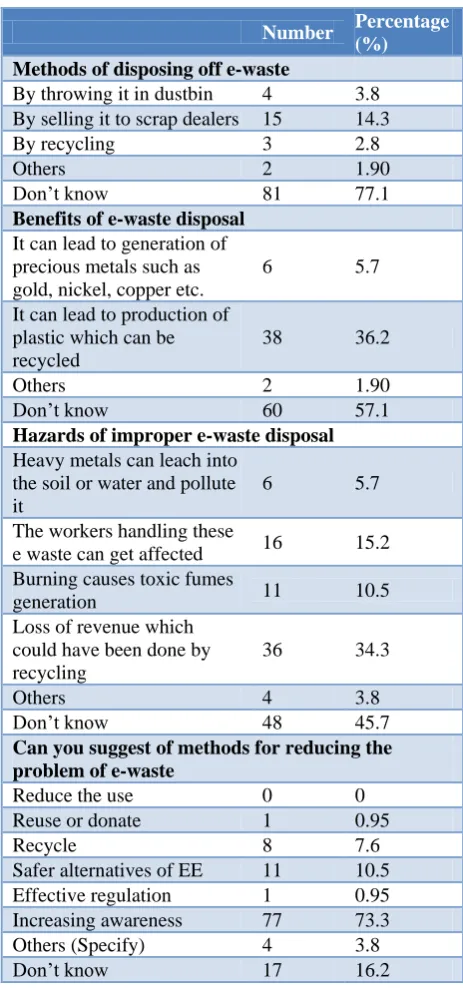
Only 6.7% respondents had heard the term "E-waste" and only 5% of the respondents were aware of different types of e-waste like mobile phones, printer laptops etc. It was observed that 77% of the respondents didn‟t know about the ways of disposing the e-waste, while 14% said that it can be discarded by selling it to scrap dealers. 57% of the respondents didn‟t know about the benefits of proper
e-waste disposal, while 36% of the respondents were of the view that e waste can generate the recyclable plastic. Only 5.7% knew that e-waste can generate precious metals such as Gold, Nickle and Copper etc. About 30% of the respondents were aware of hazardous effects of e– waste. While about half of the respondents (45.7%) were totally unaware of the hazardous effects. 34.3% were aware of the loss of revenue which could have been generated through the recycling of the e-waste.
Table 2: Awareness in community on various aspects of e-waste.
Number Percentage (%)
Methods of disposing off e-waste
By throwing it in dustbin 4 3.8 By selling it to scrap dealers 15 14.3
By recycling 3 2.8
Others 2 1.90
Don‟t know 81 77.1
Benefits of e-waste disposal
It can lead to generation of precious metals such as gold, nickel, copper etc.
6 5.7 It can lead to production of
plastic which can be recycled
38 36.2
Others 2 1.90
Don‟t know 60 57.1
Hazards of improper e-waste disposal
Heavy metals can leach into the soil or water and pollute it
6 5.7 The workers handling these
e waste can get affected 16 15.2 Burning causes toxic fumes
generation 11 10.5
Loss of revenue which could have been done by recycling
36 34.3
Others 4 3.8
Don‟t know 48 45.7
Can you suggest of methods for reducing the problem of e-waste
Reduce the use 0 0 Reuse or donate 1 0.95
Recycle 8 7.6
Safer alternatives of EE 11 10.5 Effective regulation 1 0.95 Increasing awareness 77 73.3 Others (Specify) 4 3.8
Don‟t know 17 16.2
of e-waste (10.5%) and recycling (7.6%). However, most of respondents were of the view that problem can be reduced by creating awareness regarding e-waste in the population. (73.3%) (Table 2). None of the respondents
were aware about the collection centres of EE in their locality, the nearest recycling unit in Uttarakhand or about the concept of extended producer responsibility.
Table 3: E-waste disposal practices in community.
Number Percentage (%)
According to you what is the best way to discard your old mobile phone batteries
Return it to the retailer 4 3.8
Give to scrap dealer 25 23.8
Throw it to the dustbin 69 65.7
Any other (Please specify) 7 6.7
What is the best way to discard broken CFL and tube lights?
Return it to the retailer 5 4.8
Give to scrap dealer 3 2.8
Throw it to the dustbin 96 91.4
Any other (please specify) 1 0.95
How frequently do you change your mobile
Each year 4 3.8
After every two years 10 9.5
After every 3 years 17 16.2
Until it stops working 74 70.5
What was the main reason of changing your mobile
Technological Problem 65 61.9
For fashion/ latest trend 9 8.6
Physical damage 31 29.5
Method of disposal of your mobile
Pass it on to relative/friend 6 5.7
Sell in second hand/exchange 41 39.0
Directly in dustbin 11 10.5
Disposed off with other solid waste to the scrap dealers 1 0.95 Segregated and then deposit it at collection centers at Mobile stores 1 0.95
Other (please specify) 45 42.8
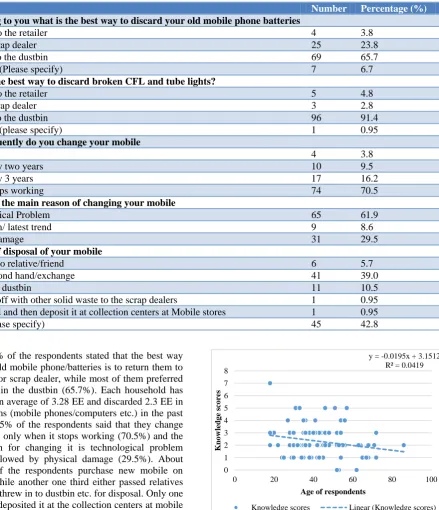
Only 27.6 % of the respondents stated that the best way to discard old mobile phone/batteries is to return them to the retailer or scrap dealer, while most of them preferred throwing it in the dustbin (65.7%). Each household has purchased an average of 3.28 EE and discarded 2.3 EE in various forms (mobile phones/computers etc.) in the past 5 years. 70.5% of the respondents said that they change their mobile only when it stops working (70.5%) and the main reason for changing it is technological problem (61.9%) followed by physical damage (29.5%). About one third of the respondents purchase new mobile on exchange while another one third either passed relatives or friend or threw in to dustbin etc. for disposal. Only one respondent deposited it at the collection centers at mobile stores (Table 3).
Examining association of age with knowledge scores showed a weak negative association with increasing age. However, the coefficient of determination was only 0.041, indicating that age could only explain 4% of the variation in knowledge scores (Figure 1).
Figure 1: Association of age and knowledge scores.
On enquiring about the knowledge regarding e-waste and its disposal among scrap dealers, it was found that all of them were totally unaware about e-waste, its segregation and its disposal. They treated the e-waste as any other solid waste.
y = -0.0195x + 3.1512 R² = 0.0419
0 1 2 3 4 5 6 7 8
0 20 40 60 80 100
K
no
w
ledg
e
sco
res
Age of respondents
DISCUSSION
Such as that in the present study, the hilly areas suffer from problems of solid waste disposal much more in comparison to plain areas because of paucity of land and hazards of incineration/burning which produces greater risk to the ecological system. Therefore, the best way to treat wastes is by reducing its production, its use and by proper disposal. This can only be possible by increasing awareness of people regarding these issues.
The background characteristics such as gender, marital status and religion in our study were almost similar to that of studies carried in other parts of country such as Vishakpattnam, Pune and Delhi, however participants in our study were primarily middle aged in contrast to respondents from Vishakpattnam and Pune where respondents were younger and elder respectively.11-13 Awareness regarding e-wastes was found to be lacking in present study in comparison to other metropolitan cities of India while it was comparable to the study carried out in Nigeria.11,13,14 Knowledge about hazardous effects of e-waste was vey less (30%) in comparison to a study from Pune where it was reported to be 80%. The results of our study were comparable to a study from Nigeria where people from most of the households were not aware of the harmful content of electronics.14 This could be due to differences in level of education and awareness among the people in big cities like Pune. This could also be due to the fact that people in big cities are more sensitive on keeping their cities clean.13
Respondents of our study were also found to be lagging far behind on awareness about the uses of E-waste in comparison to study by Bhatt et al where more than three fourth of the respondents were aware of the presence of precious metals such as Gold, Nickle and Copper etc. in e-waste.13
About one third of respondents from our study were aware of the loss of revenue through improper recycling of the e-waste which was not reported by any other study. This result can be considered important as the awareness about the benefit of recycling the e-waste could help people to be more sensitive about proper disposal of the e-waste.
Respondents in our study, were also found to be totally unaware of collection centers of E-waste and awareness about the places where e-waste could be send for recycling whereas in Delhi and Pune 37% and 3% of respondents respectively, knew about the formal collection centres of e-waste.11,13 In Pune, 61% of respondents denied of the presence of e-waste facilities/services in their area despite its presence.13 In a study from Delhi, respondents purchased, on an average, 4.3 mobile phones every year however in our study rate of purchase of mobile was far less among the respondents who reported changing it usually after two or
three years. The reason for changing the mobiles in study from Delhi was mostly because of desire of getting the latest technology in mobile while in our study two thirds of the respondents change their mobile only when it stops working which could help in solving the problem of E-waste.11 This is a good and environment friendly practice, which will reduce the quantum of e waste significantly. With regard to disposal of mobile, less than half of respondents purchased new mobile in exchange of their old mobile in our study, while study from Delhi found that people tend to sell or give unused electronic items to personal contacts (35%), or keep these electronics in the home (26%).13 Exchange of mobiles is a good practice and helps reduce e-waste. In view of the fact that most of the respondents disposed their mobiles along with scrap by selling it to scrap dealers, it becomes imperative that scrap dealers are made aware about segregation of e waste, which was nil in the present study. Also mechanisms for further collection of e-waste from scrap dealers needs to be developed in each city.
CONCLUSION
Awareness on various aspects of e-waste was found to be poor among respondents and among scrap dealers.
Recommendations
Awareness on various aspects of e-waste should be raised among people through media such as radio, TV etc. This should be complemented by establishing collection points of e-wastes, where people may go and dispose them. Principle of segregation, reduce, reuse and recycle is equally pertinent to e-waste as it is for other solid wastes, to ensure efficient disposal. Research on e-waste recycling/disposal should be promoted among higher educational institutes.
Funding: No funding sources Conflict of interest: None declared
Ethical approval: The study was approved by the Institutional Ethics Committee
REFERENCES
1. Ministry of Environment and Forests. (2010) E-Waste (Management and Handling) Rules 2010. Available at: http://moef.nic.in/downloads/rules-and-regulations/1035e_eng.pdf. New Delhi, India: Ministry of Environment and Forests. Accessed on 12 January 2012.
2. UNEP Press Release, 'Basel Conference addresses Electronic Wastes Challenge'. Available at: http://www.unep.org/. Accessed on 27 November 2006.
3. E waste can produce more gold than mining. Times of India, Dehradun, 2016.
with recent advances. New Delhi: Jaypee Publisher; 2017.
5. Wath SB, Vaidya AN, Dutt PS, Chakrabarti T. E-waste scenario in India, its management and implications. Environ Monitoring Assessment. 2010;172;249–62.
6. Electronic waste from homes turning city into toxic dump of India, Mumbai, 8th January 2015.
7. Scrapping the hi-tech myth: Computer waste in India. Published in Toxics Link, 2003. Available at: http://www.toxicslink.org/pubview.php?pubnum=3. Accessed on 3 August 2017.
8. Sinha S. „Downside of the Digital Revolution', Toxics Link, 2007. Available at: http://www. toxicslink.org. Accessed on 3 August 2017.
9. Lwanga SK, Lemeshaw S. Sample size determination in health studies: A practical manual. Geneva, WHO; 1991.
10. E-waste in India. Research unit (Larrdis) Rajya Sabha secretariat New Delhi June, 2011. Available at: rajyasabha.nic.in/rsnew/publication_electronic/ E-Waste_in_india.pdf. Accessed on 13 November 2017.
11. Bischoff J. A report on “e-Waste assessment in India: Specific Focus on Delhi” A Quantitative Understanding of Disposal Recycling of Electronic Waste. 2007: 1-66
12. Saritha V, Kumar S, Srikanth V.N. Consumer attitudes and perceptions on electronic waste: An assessment. Pollution. 2015,1(1):31-43,
13. Bhat V, Patil Y. E-waste consciousness and disposal practices among residents of Pune city. Procedia – Social Behavioral Sci. 2014;133:491-8.
14. Okoye A, Odoh C. Assessment of the Level of Awareness of E-Waste Management and Concern for the Environmen amongst the Populace in Onitsha, Southeastern Nigeria. J Environ Protection. 2014;5:120-34.