INTRODUCTION
The modern sense of beauty has increased tremendously over the recent decade leading to high expectations of patients and the public belief that most of all facial deficiencies can be corrected. Therefore, rhinoplasty has become one of the common facial aesthetic surgeries worldwide and in Iran1, 2. Rhinoplasty performed with the aesthetic purposes outweighs that of the
Evaluating the Effect of Intravenous Tranexamic Acid on
Intraoperative Bleeding During Elective Rhinoplasty Surgery
MEHDI BEIKAEI
1*,
ALI GHAZIPOUR
2,
VITA DERAKHSHANDE
3,
NADER SAKI
2and SOHEILA NIKAKHLAGH
21Resident of otolaryngology, Hearing and Speech Research Center, Ahvaz Jundishapur University of Medical Sciences, Ahvaz, Iran. 2Associated Professor of Otolaryngology, Head and Neck Surgery, Hearing and Speech Research Center, Ahvaz Jundishapur University of Medical Sciences, Ahvaz, Iran.
3Assistant Professor of Otolaryngology, Head and Neck Surgery, Hearing and Speech Research Center, Ahvaz Jundishapur University of Medical Sciences, Ahvaz, Iran.
*Corresponding author Email: [email protected] DOI: http://dx.doi.org/10.13005/bpj/779
(Received: August 15, 2015; accepted: September 20, 2015) ABSTRACT
Rhinoplasty is associated with intraoperative bleeding which affects the quality of operation and may increase surgery duration. This study is designed with the aim assessing the role of intravenous tranexamic acid (TA) on reduction of intraoperative bleeding during elective open rhinoplasty. This was a single center double blind randomized controlled trial (phase 2) conducted in Imam Khomeini Hospital affiliated to Ahvaz Jundishapur University of Medical Sciences, one hundred candidates of elective rhinoplasty were randomly allocated to one treatment arm receiving a bolus 10mg/kg dose of intravenous TA (n=50) and one control group being administered with normal saline as the placebo (n=50). All subjects underwent open rhinoplasty under general anesthesia with the same surgical team using standard technique. The primary outcome measure was the estimated volume of intraoperative bleeding (measured in mL).Ninety six patients successfully completed the study (n=48 in each group). Unadjusted for covariates, the total volume of blood loss was 43.3±11.0 mL in the TA group while it was 60.3±9.5 mL in the control group (mean difference=16.9 mL, 95% CI [12.7-21.0], p<0.001). After controlling for the confounding effect of age, gender, weight and surgery duration on intraoperative blood loss, TA was associated with a 15.6 mL decrease (95% CI [11.8-19.4], p<0.001) in intraoperative bleeding.Considering the efficacy and safe therapeutic profile of tranexamic acid, we recommend a single bolus dose of intravenous TA (10mg/kg) upon anesthesia induction in order to achieve satisfactory hemostasis in healthy candidates of open rhinoplasty.
Key words: Open Rhinoplasty, Tranexamic Acid, Intraoperative Bleeding
which include head elevation, cold compressions, administration of vasoconstrictive agents, intraoperative controlled hypotension and administration of pharmacologic hemostatic agents. Among the hemostatic agents, tranexamic acid (TA) is a synthetic derivative of the amino acid lysine, which serves as an antifibrinolytic agent preventing dissolution of the fibrin clot5. This agent is well known to reduce gynecologic bleeding such as heavy menstrual bleeding and postpartum hemorrhage. In addition, intravenous TA reduces preoperative blood loss in a variety of surgical procedures including cardiac surger y, total hip/knee replacement and prostatectomy6-8. However, in the case of facial surgery and specifically elective rhinoplasty, few studies have evaluated beneficial effects of TA on reducing perioperative bleeding. For instance, intravenous administration of TA (5-15 mg/Kg) significantly decreased hemorrhage during endoscopic nasal sinus surgeries9,10. Regarding rhinoplasty, there is only one published trail showing that patients receiving either oral or intravenous TA, have lower intraoperative bleeding comparing to controls11. There appears to be enough evidence at present to justify a randomized trail assessing the role of intravenous TA on reduction of intraoperative bleeding during rhinoplasty surgery.
Patients and Methods Study Design
This prospective randomized double blinded placebo controlled trail aims to understand whether intravenous administration of tranexamic acid (10 mg/kg) exceeds placebo in reducing intra operative amount of bleeding in patients undergoing elective open rhinoplasty. This parallel designed trial was conducted in Imam Khomeini Hospital (Ahvaz, Iran) from March 2014 to March 2015. All participants were asked to fill and sign the written consent after being informed about the study design and purpose. Thereafter, subjects were randomly allocated to one treatment arm receiving intravenous TA at a dose of 10 mg/kg immediately after anesthesia induction, and one control arm being administered with normal saline (10 mL) as the placebo. Open Rhinoplasty was performed using standard technique and estimated volume of intraoperative hemorrhage, was the primary outcome measure.
Participants
Individuals with the following criteria were considered eligible for inclusion: Normotensive patients scheduled for elective open rhinoplasty aged 16-42 years with ASA (American Society of Anesthesiologists) class of either I or II without a history bleeding diathesis. Subjects with the following characteristics were excluded: presence of a history of allergy or hypersensitivity to tranexamic acid, brain vascular diseases, coronary artery diseases, cardiac dysrhythmia, liver/kidney or metabolic disorders, ASA class of either III or IV. In the context of an interview upon the initial visit in outpatient ENT (Ear Nose and Throat) clinic affiliated to Ahvaz Jundishsapur University of Medical Sciences, baseline characteristics (age, gender, weight, previous medical history) were recorded during patient recruitment. Surgery duration, total amount of irrigation and number of blood soaked 4*4 gauzes were recorded by the anesthesiologist and reported after rhinoplasty was finished.
Interventions
Study subjects in the treatment arm were administered with a bolus intravenous dose of tranexamic acid (10 mg/kg Caspian – Tamin Pharmaceutical Company, Rasht, Iran) which was transfused slowly after anesthesia induction. Patients in the control group received normal saline as the placebo. Anesthesia was attempted similarly for all patients. Briefly, protocol 2 mg/kg and fentanyl 1 mcg/kg were transfused with the aim of induction. Atracurium (0.5 mg/kg IV) was administered to facilitate orotracheal intubation and anesthesia was maintained using isoflurane inspired at a flow rate of 5 L/min in combination with air 30% in oxygen. Intravenous neostigmine 0.04 mg/kg and atropine 0.01 mg/kg were used to reverse neuromuscular blockage at the end of operation. Extubation was attempted after recovery of adequate spontaneous ventilation and patients were transferred to post anesthesia care unit where additional recovery was monitored.
Outcomes
surgery is calculated by subtracting the amount of irrigation fluid used during a surgery from the total amount of fluid gathered in suction canister at the end of surgery. The volume of blood absorbed by 4*4 inch gauzes during an operation is calculated by multiplying the number of gauzes completely soaked with blood by 10 milliliters (an estimated average of blood absorbed per gauze)12. These two values were then added to estimate the total intraoperative volume of blood loss. No secondary outcome measures were defined.
Sample Size and Randomization
Sample size was determined based on a priori analysis conducted on 20 patients which revealed the total amount of bleeding to be 42±12 mL for patients receiving TA, and 59±12 mL in the control group. Assuming a type I error of 0.05 (α) and a power of 0.95 (1-β), 20 patients were required in each group to detect a 25% difference in total volume of blood loss.
A statistician not otherwise involved in the study provided the randomization sequence using the Microsoft Excel program. One hundred random numbers were generated and printed. Allocation letters were sent to pharmacy unit where one investigator prepared TA or normal saline solutions so that they appeared indistinguishable to the case anesthesiologist and operating surgeon. The solution bags were sent to the operating room consecutively upon patients’ arrival. This investigator was not involved in data gathering or analysis. The randomization scheme was not revealed until data was collected from all patients.
Statistical Analysis
Data management and analysis was conducted using the Statistical Package for Social Sciences (SPSS, version 18, Chicago, Illinois). Normality was checked using the Shapiro-Wilk test and normally distributed continuous variables were summarized using mean and standard deviation (Mean±SD). Categorical variables were summarized by frequencies and proportions [n (%)]. Upon initiation of inferential statistical testing, a two sided p-value of less than 0.05 was considered statistically significant. Comparison between TA and control groups was conducted using the independent t-test regarding baseline continuous variables and Pearson Chi-square test for baseline categorical variables. The total amount of bleeding was considered as a continuous variable (outcome) and independent t-test is used to compare average blood loss between the study groups. A multiple linear regression was used to control for possible confounding effect of age, gender, weight, surgery duration on the total amount of intraoperative bleeding.
RESULTS
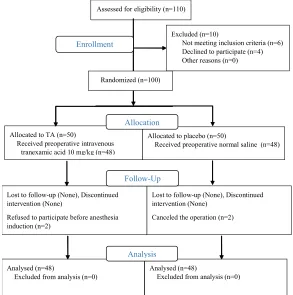
A total number of 100 elective rhinoplasty candidates were randomly assigned to preoperative intravenous TA (n=50) or placebo (n=50). Figure 1 represents flow of patients throughout the study. In the TA group, two participants refused to take part in the trial after enrollment and another two canceled the surgery in the placebo group leaving 98 patients to undergo statistical analysis. The trail was commenced from March 2014 to March 2015.
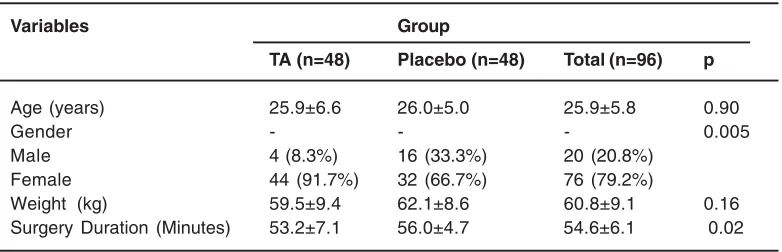
Table 1: Baseline Characteristics of the Participants in either TA or Placebo Groups
Variables Group
TA (n=48) Placebo (n=48) Total (n=96) p
Age (years) 25.9±6.6 26.0±5.0 25.9±5.8 0.90
Gender - - - 0.005
Male 4 (8.3%) 16 (33.3%) 20 (20.8%)
Female 44 (91.7%) 32 (66.7%) 76 (79.2%)
Weight (kg) 59.5±9.4 62.1±8.6 60.8±9.1 0.16
Surgery Duration (Minutes) 53.2±7.1 56.0±4.7 54.6±6.1 0.02
Table 2: Multiple Linear Regression Analysis for Controlling the Effect of Confounders on Intraoperative Bleeding
Predictors Unstandardized Regression Beta (Standardized t p
Coefficients (95% CI) Coefficients)
(Constant) -59.8 (-93.2,-26.4) -3.5 0.001
Age -0.08 (-0.42,0.24) -0.04 -0.52 0.600
Gender 9.1 (1.90,16.33) 0.28 2.50 0.014
Weight 0.50 (0.133,0.763) 0.31 2.82 0.006
Surgery Duration 0.86 (0.561,1.156) 0.40 5.73 <0.001
Study Group 15.60 (11.80,19.42) 0.59 8.15 <0.001
Assessed for eligibility (n=110)
Excluded (n=10)
Not meeting inclusion criteria (n=6) Declined to participate (n=4) Other reasons (n=0)
Analysed (n=48)
Excluded from analysis (n=0) Lost to follow-up (None), Discontinued intervention (None)
Refused to participate before anesthesia induction (n=2)
Allocated to TA (n=50)
Received preoperative intravenous tranexamic acid 10 mg/kg (n=48)
Lost to follow-up (None), Discontinued intervention (None)
Canceled the operation (n=2) Allocated to placebo (n=50)
Received preoperative normal saline (n=48)
Analysed (n=48)
Excluded from analysis (n=0) Allocation
Analysis Follow-Up Randomized (n=100) Enrollment
Fig. 1. CONSORT flow chart of elective rhinoplasty patients receiving tranexamic acid or placebo Baseline demographic and clinical
characteristics of the studied patients are reflected in Table 1. No significant difference was noted between the study groups regarding age, and weight. Surgery was significantly longer in the control group comparing to the TA group (mean difference =2.8 minutes, 95% CI [0.4-5.2], p=0.02). On bivariate analysis, intraoperative volume of bleeding was not correlated with
Unadjusted for covariates, the total volume of blood loss was 43.3±11.0 mL in the TA group while it was 60.3±9.5 mL in the control group (mean difference=16.9 mL, 95% CI [12.7-21.0], p<0.001). A Multiple linear regression analysis was conducted to control for possible confounding effects of age, gender, weight and surger y duration on intraoperative blood loss. The model adequately fitted the data (F [5, 90] =26.8, p<0.001, R2=0.60). In this model, tranexamic acid was associated with a 15.6 mL decrease (95% CI [11.8-19.4], p<0.001) in intraoperative bleeding after adjusting for confounders (Table-2).
DISCUSSION
During the recent years, there has been a consistent increasing demand for cosmetic facial surgeries, specifically rhinoplasty. Surgeons may be encountered with cases of considerable bleeding which may hinder surgical field eventually leading to misidentifications of anatomic structures and undesired surgical outcome. Various methods have been proposed with aim of controlling intraoperative bleeding which include preparing the nose with local vasoconstrictors, use of hypotensive anesthesia, and elevating the head of the bed during surgery. Meanwhile, tranexamic acid has a proven effect in various surgeries13 and this study was developed to determine if tranexamic acid had any impact on intraoperative bleeding during open rhinoplasty.
In this trial, 98 candidates of open rhinoplasty were randomized to receive preoperative intravenous tranexamic acid or placebo. To reduce the effect of confounding factors, all operations were performed by the same surgical team using the same technique. In addition, patients with uncontrolled hypertension were excluded in order to achieve a homogenous population which helped to maintain a standardized anesthetic protocol to remove intraoperative blood pressure as a confounding variable. Since therapeutic concentration of TA is maintained for approximately three hours14, a single intravenous bolus dose of 10 mg\kg was assumed to satisfyingly fulfil our therapeutic intention. Considering the average duration of rhinoplasty which was less than 1 hour (54.6±6.0 minutes) in this study, we assume that an
acceptable TA blood level is achieved without directly measuring its serum levels. Meanwhile, other researchers has shown that administration of 15 mg/Kg TA intravenously is more effective than 5 mg or 10 mg in achieving hemostasis and improving the quality of surgical field during endoscopic sinus surgery without considerable adverse effects (9).
Our findings indicated that on average, tranexamic acid decreased intraoperative bleeding by 15.6 mL. This hemostatic effect was also evident after controlling for patients’ demographics and duration of operation. Our results could be regarded as another piece of evidence confirming a preventive role of tranexamic acid in reducing intraoperative bleeding. It should be mentioned that the hemostatic property of tranexamic acid was affected by patients’ gender, weight and surgery duration. This implies that female patients with higher weight and longer rhinoplasty duration may benefit this treatment the least. To the best of our knowledge and specifically in case of rhinoplasty, there is only one published study by Sakallioðlu, which showed that administration of oral tranexamic acid (one gram, 2 hrs before surgery) is associated with significantly less intraoperative bleeding compared with placebo11. Apart from rhinoplasty surgery, various authors have documented the hemostatic effect of TA during endoscopic sinus surgeries. In a study conducted by Alimian et al. on patients undergoing functional endoscopic sinus surgery, intravenous tranexamic acid (10 mg/kg) effectively reduced bleeding and improved the surgical field quality15. In a similar group of patients, a single (15 mg/kg) perioperative dose of TA significantly decreased hemorrhage without increasing side effects such as alteration in coagulation parameters, hemodynamic changes or emesis16. In addition, TA administered via others routs (topical/oral) has been shown to effectively reduce intraoperative bleeding during endoscopic nasal sinus surgeries17-19. Apart from the hemostatic properties, edema and ecchymosis following rhinoplasty is decreased using tranexamic acid11.
of 1 mg/kg/hr, TA did not appear to result in a clinically meaningful reduction in blood loss or improve visualization of the surgical field. This may have originated from the fact that different methods of estimating intraoperative bleeding are used and relatively lower number of subjects were studied in the referenced article (n=23). Finally, in a recent review of the role of tranexamic acid in endoscopic sinus surgeries, intra-operative use of local and systemic tranexamic acid resulted in significantly reduced estimated blood loss and improved surgical field quality. Moreover, operative time and incidence of side effects were not increased10. According to findings of the present work along with those existing in literature, it is concluded that well-conducted larger RCTs focusing on patients undergoing rhinoplasty are required to confirm the effect of TA on bleeding during surgery.
One major limitation of this study is that we did not address the quality of surgical field during rhinoplasty. Considering the fact that the average blood loss is less than 400 mL in the majority of nasal surgeries (50 ml in the present study), the bleeding itself may not be a considerable
challenge, and rather it is the surgical field visualization that is of greater importance for a surgeon. We did not systematically monitored the studied subjects for possible adverse effects of intravenous TA or incidence of postoperative bleeding, though we did not encounter any major side effects.
CONCLUSION
Considering the efficacy and safe therapeutic profile of tranexamic acid, we recommend a single prophylactic dose of (10 mg/ kg) in healthy candidates of open rhinoplasty in order to reduce intraoperative bleeding.
ACKNOWLEDGMENTS
The authors would like to appreciate the contribution of deputy dean of School of Medicine and financial sponsorship of deputy chancellor of Ahvaz Jundishapur University of Medical Sciences. This article is extracted from a thesis project required for partial fulfillment of the specialty degree in ENT surgery (U-93110).
REFERENCES
1. Lenehan S. Nose aesthetics: Rhinoplasty and identity in Tehran. Anthropology of the Middle East. 6(1):47-62 (2011).
2. Shadfar S, Deal AM, Jarchow AM, Yang H, Shockley WW. Practice patterns in the perioperative treatment of patients undergoing septorhinoplasty: a survey of facial plastic surgeons. JAMA Facial Plast Surg. 16(2):113-9 (2014).
3. Koc S, Gurbuzler L, Yaman H, Eyibilen A, Suren M, Kaya Z, et al. The effectiveness of steroids for edema, ecchymosis, and intraoperative bleeding in rhinoplasty. Am J Rhinol Allergy. 25(2):e95-8 (2011).
4. Hwang SH, Lee JH, Kim BG, Kim SW, Kang JM. The efficacy of steroids for edema and ecchymosis after rhinoplasty: a meta-analysis. Laryngoscope. 125(1):92-8 (2015). 5. Dunn CJ, Goa KL. Tranexamic acid: a review of its use in surgery and other indications. Drugs. 57(6):1005-32 (1999).
6. McCormack PL. Tranexamic acid: a review
of its use in the treatment of hyperfibrinolysis. Drugs. 72(5):585-617 (2012).
7. Song G, Yang P, Hu J, Zhu S, Li Y, Wang Q. The effect of tranexamic acid on blood loss in orthognathic surgery: a meta-analysis of randomized controlled trials. Oral Surg Oral Med Oral Pathol Oral Radiol. 115(5): 595-600 (2013).
8. Ker K, Beecher D, Rober ts I. Topical application of tranexamic acid for the reduction of bleeding. Cochrane Database Syst Rev. 7: Cd010562 (2013).
9. Abbasi H, Behdad S, Ayatollahi V, Nazemian N, Mirshamsi P. Comparison of two doses of tranexamic acid on bleeding and surgery site quality during sinus endoscopy surgery. Adv Clin Exp Med. 21(6):773-80 (2012). 10. Pundir V, Pundir J, Georgalas C, Fokkens
Orhan I, Akyigit A. The efficacy of tranexamic acid and corticosteroid on edema and ecchymosis in septorhinoplasty. Ann Plast Surg. 74(4):392-6 (2015).
12. Hughes K, Chang YC, Sedrak J, Torres A. A clinically practical way to estimate surgical blood loss. Dermatol Online J. 13(4):17 (2007).
13. Ker K, Edwards P, Perel P, Shakur H, Roberts I. Effect of tranexamic acid on surgical bleeding: systematic review and cumulative meta-analysis. BMJ. 344:e3054 (2012). 14. Hynes MC, Calder P, Rosenfeld P, Scott G.
The use of tranexamic acid to reduce blood loss during total hip arthroplasty: an observational study. Ann R Coll Surg Engl. 87(2):99-101 (2005).
15. Alimian M, Mohseni M. The effect of intravenous tranexamic acid on blood loss and surgical field quality during endoscopic sinus surgery: a placebo-controlled clinical trial. J Clin Anesth. 23(8):611-5 (2011). 16. Nuhi S, Zarkhah L. Impact of Intravenous
Tranexamic Acid on Hemorrhage During Endoscopic Sinus Surgery. Iranian Journal of Otorhinolaryngology. 27(82):349-54
(2015).
17. Jabalameli M, Zakeri K. Evaluation of topical tranexamic acid on intraoperative bleeding in endoscopic sinus surger y. IJMS. 31(4):221-3 (2006).
18. Athanasiadis T, Beule AG, Wormald PJ. Effects of topical antifibrinolytics in endoscopic sinus surgery: a pilot randomized controlled trial. Am J Rhinol. 21(6):737-42 (2007).
19. Jahanshahi J, Hashemian F, Pazira S, Bakhshaei MH, Farahani F, Abasi R, et al. Effect of topical tranexamic acid on bleeding and quality of surgical field during functional endoscopic sinus surgery in patients with chronic rhinosinusitis: a triple blind randomized clinical trial. PLoS One. 9(8): e104477 (2014).