Original Research Article
Longitudinal study to assess socio-demographic profile and treatment
outcome of new sputum smear positive cases at designated
microscopy centre of tertiary care hospital
G. R. Vishwanath
1, Sandeep Dattatray Babar
2*, J. D. Naik
2, Girish Kamble
2INTRODUCTION
Tuberculosis (TB) is one of the oldest diseases known to mankind and history showed that prevailed among human since antiquity, the Bones which have been recovered from different parts of the world showed evidence of TB among Neolithic man and mummified bodies recovered from the engravings of ancient Egypt showed definite
evidence of TB in spine, these indicate that human race suffered from TB as early as in 5000 BC.1 This record was found in the library of King Assurbanipal of Assyria the following is an extract: “The patient coughs frequently his sputum is thick and sometimes contains blood, his breathing is like a flute, his skin is cold but his feet are hot, he sweats greatly and his heart is much disturbed, when the disease is extremely grave he suffers
ABSTRACT
Background: Tuberculosis (TB) remains one of the world‟s deadliest communicable diseases. In 2013, an estimated 9.0 million people developed TB and 1.5 million died from the disease, 360 000 of whom were HIV-positive. Of the estimated 9 million people who developed TB in 2013, more than half (56%) were in the South-East Asia and Western Pacific Regions and India and China alone accounted for 24% and 11% of total cases, respectively. India‟s TB Control Program is on track as far as reduction in disease burden is concerned there was 50% reduction in TB mortality rate by 2013 as compared to 1990 level. Tuberculosis prevalence per lakh population reduced from 465 in year 1990 to 211 in 2013. But still, in India there is high burden of Tuberculosis cases and high mortality in the current situation.
Methods: Descriptive Longitudinal study was conducted from 1st January 2015 to 31st December 2016 at designated microscopy centre (DMC) in tertiary care hospital of Government Medical Miraj.
Results: Maximum of TB cases 47 (30.71%) were from >30-45 age group and 72 (47.05%) cases belongs nuclear family. 126 (82.35%) cases had completed their treatment schedule for 6/7 months were labelled „cured‟ at the end of study, while among 27 (17.65%) cases 17 (11.11%) „Died‟ during treatment schedule, 9 (5.88%) cases became „defaulters‟ and 1 (0.65%) case was „failure‟.
Conclusions: In the present study, Maximum cases were from >30-45 yrs age group and proportions of males were more as compare to females. Hindus was predominantly more in number among all religions and number of cases coming from rural area was more. The association between gender and treatment outcome of study cases was found statistically significant.
Keywords: Tuberculosis, Treatment outcome, Longitudinal study, Designated microscopy centre
1
ESIS Dispensary, Sangli, Maharashtra, India
2
Department ofCommunity Medicine, Government Medical College, Miraj, Maharashtra, India
Received: 19 October 2018 Revised: 29 November 2018 Accepted: 30 November 2018
*Correspondence:
Dr. Sandeep Dattatray Babar,
E-mail: [email protected]
Copyright: © the author(s), publisher and licensee Medip Academy. This is an open-access article distributed under the terms of the Creative Commons Attribution Non-Commercial License, which permits unrestricted non-commercial use, distribution, and reproduction in any medium, provided the original work is properly cited.
from diarrhea”.2
„Mycobacterium tuberculosis‟ was one of the first bacterial pathogens to be identified by Robert Koch, who in 1882 discovered a staining technique that enabled to see Mycobacterium tuberculosis.3 Almost all the cases and practically all deaths due to TB take place in developing countries like India, China, Indonesia, South Africa and Nigeria rank first to fifth respectively in terms of absolute numbers of cases India accounts for a fifth of the world‟s new TB cases and 2/3rd of the cases in South - East Asia and prevalence of disease is thought to be 4 per 1000 and the incidence of disease 1.5 per 1000.4 As per WHO global TB report 2015, out of the estimated global annual incidence of 9.6 million TB cases, 2.2 million TB cases were estimated to have occurred in India, SEAR has 39% of global TB cases India has 24% world TB cases.5 In Maharashtra total numbers of smear positive patients diagnosed in 2013 were 80068, annual new sputum smear positive TB case notification rate was 46 in 2013, total numbers of smear positive patients diagnosed in 2014 were 76789, total numbers of sputum smear positive patients diagnosed in 2015 were 74463 as per the Annual status report 2016 – TBC INDIA.6 In 1993, because of emergence of HIV pandemic and increased incidence of MDR–TB cases, WHO declared „Global Emergency‟ So, in 1993, Govt. of India intensified and revised the NTCP Programme and renamed and launched as „Revised National Tuberculosis Control Programme (RNTCP)‟ Programme.7 Detection Rate in TB infection is less than 80% and more TB patients of category-I goes into default, treatment failure, relapse phase, monitoring and evaluation of outcome of this newly diagnosed sputum smear positive cases are very important.8 So, this study was planned to study the socio- demographic profile and treatment outcome of new sputum smear positive pulmonary TB cases attended Designated Microscopy Centre (DMC) in Tertiary care Hospital.
METHODS
Descriptive Longitudinal study was conducted from 1st January 2015 to 31st December 2016 at Designated Microscopy Centre (DMC) in tertiary care hospital of Government medical Miraj. As per available previous records of DMC average total adult OPD≥15 year‟s age for previous three years was 18877 and average adult OPD suspects were 1463 and prevalence of new smear positive pulmonary TB case is 10% of the Suspects, so sample seize was about 146 cases. Also, the sample size was calculated by the formula for Qualitative data as, n = 4pq / L2, (With 5% absolute error) Calculated sample size was „144‟. Data was collected to assess socio- demographic, treatment profile and treatment outcome of sputum smear positive pulmonary tuberculosis cases from 1st January 2015 till the sample size was achieved i.e. January 2016 and further followed for 6/7 months i.e. up to July 2016. Modified B.G. Prasad‟s Socio-economic classification was used.9 Newly diagnosed smear positive pulmonary tuberculosis cases of ≥15 yrs age are included in study. Smear negative cases, extra pulmonary cases,
years, Multi Drug Resistant (MDR) -Tuberculosis patients are excluded from study. The data was tabulated after entering in Microsoft Excel 2010 and analysed by using SPSS version 16.
RESULTS
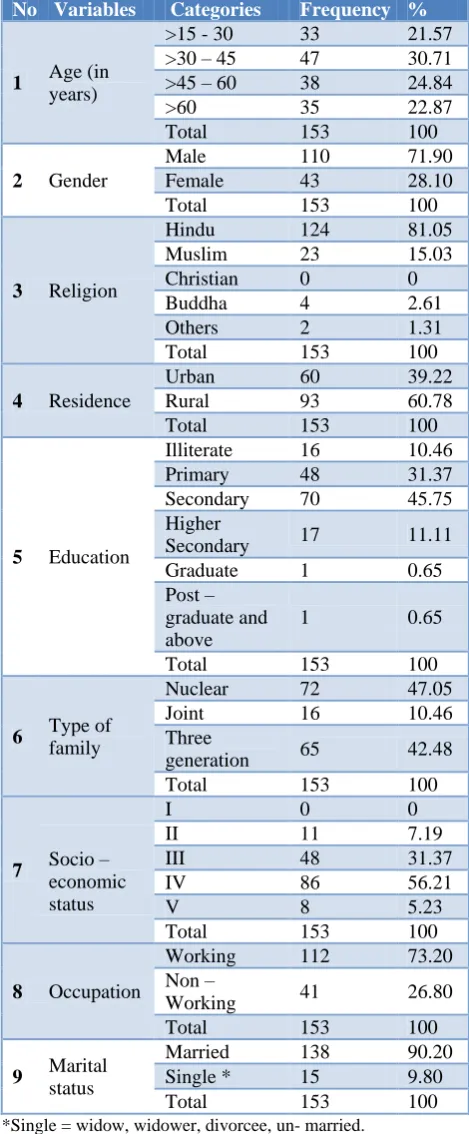
Table 1: Socio-demographic profile of the study group.
No Variables Categories Frequency %
1 Age (in years)
>15 - 30 33 21.57 >30 – 45 47 30.71 >45 – 60 38 24.84
>60 35 22.87
Total 153 100
2 Gender
Male 110 71.90
Female 43 28.10
Total 153 100
3 Religion
Hindu 124 81.05
Muslim 23 15.03
Christian 0 0
Buddha 4 2.61
Others 2 1.31
Total 153 100
4 Residence
Urban 60 39.22
Rural 93 60.78
Total 153 100
5 Education
Illiterate 16 10.46
Primary 48 31.37
Secondary 70 45.75 Higher
Secondary 17 11.11
Graduate 1 0.65
Post – graduate and above
1 0.65
Total 153 100
6 Type of family
Nuclear 72 47.05
Joint 16 10.46
Three
generation 65 42.48
Total 153 100
7 Socio – economic status
I 0 0
II 11 7.19
III 48 31.37
IV 86 56.21
V 8 5.23
Total 153 100
8 Occupation
Working 112 73.20
Non –
Working 41 26.80
Total 153 100
9 Marital status
Married 138 90.20
Single * 15 9.80
It was observed that out of 153 cases, maximum no cases i.e. 47 (30.71%) were from >30-45 age group, proportions of males were more as compare to females. In present study, there was predominance of Hindus followed by Muslims as compare to other religion. 60 (39.22%) cases were from urban area whereas, 93 (60.78%) cases were from rural area. Majority of cases 70 (45.75%) cases having education up to secondary level, next to that 48 (31.37%) cases were having primary education. Cases with higher secondary level of education were 17 (11.11%), while graduation was completed by only 1 (0.65%) case, post graduate and above was also only 1 (0.65%) case and 16 (10.46%) study subjects were illiterate while 137 (89.54%) cases were literate. Maximum numbers of TB cases were from nuclear family 72 (47.05%), whereas 65 (42.48%) cases were from three generation family and 16 (10.46%) cases were from joint family. In the present study, 11 (7.19%) cases were from class II, 48 (31.37%) cases were from class III, 86 (56.21%) cases were from class IV, while remaining i.e. 8 (5.23%) cases were from class V. Among study cases 112 (73.20%) were working and 41 (26.80%) cases were non–working. Maximum numbers of new sputum smear positive TB cases were married 138 (90.20%) and remaining were single 15 (9.80%).
Table 2: Treatment profile of study group.
No Type of treatment taken Frequency %
1 Only anti – TB drugs
taken 36 23.53
2
Anti TB drugs + other
drugs --- ---
A) symptomatic drugs --- --- i. During intensive
phase 55 35.95
ii. During
continuation phase 0 0 B) Treatment for
co-morbidity 62 40.52
Total 153 100
Out 153 study cases, 36 (23.53%) cases received only anti-TB drugs while 55 (35.95%) cases received anti-TB drug along with symptomatic drugs during Intensive phase of treatment. No one received any type of drug other than anti-TB drug during continuation phase. 62 (40.52%) were taking drugs for their co-morbidities (HIV, DM, HT and asthma) along with anti-TB drugs.
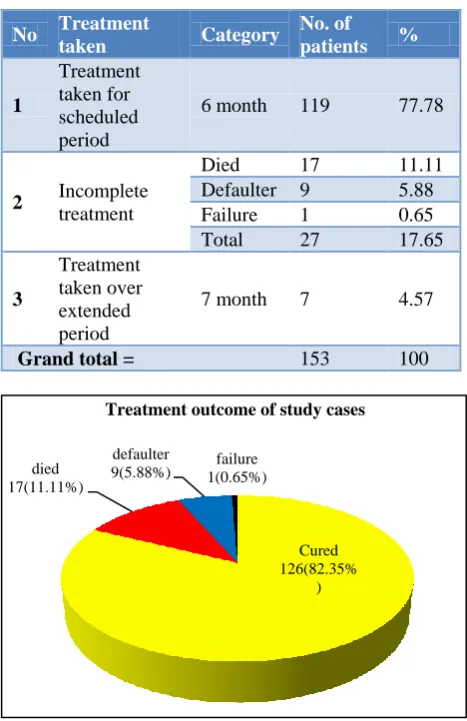
In present study revealed that 119 (77.78%) cases has taken anti-TB treatment for scheduled period i.e. for 6 month, while 27 (17.65%) cases received incomplete treatment due to death in 17 (11.11%) cases, default in 9 (5.88%) cases and failure in 1 (0.65%) case. While, 7 (4.57%) cases received treatment over extended period i.e. for 7 month due to extension of intensive phase.
Table 3: Treatment duration of the study cases.
No Treatment
taken Category
No. of
patients %
1
Treatment taken for scheduled period
6 month 119 77.78
2 Incomplete treatment
Died 17 11.11
Defaulter 9 5.88
Failure 1 0.65
Total 27 17.65
3
Treatment taken over extended period
7 month 7 4.57
Grand total = 153 100
Figure 1: Pie chart showing treatment outcome of the study cases.
Above Figure shows that out of total 153 cases, as per the guidelines given under RNTCP, 126 (82.35%) cases had completed their treatment schedule for 6/7 months were labelled „cured‟ at the end of study, while among 27 (17.65%) cases 17 (11.11%) „Died‟ during treatment schedule, 9 (5.88%) cases became „defaulters‟ and 1 (0.65%) case was „failure‟.
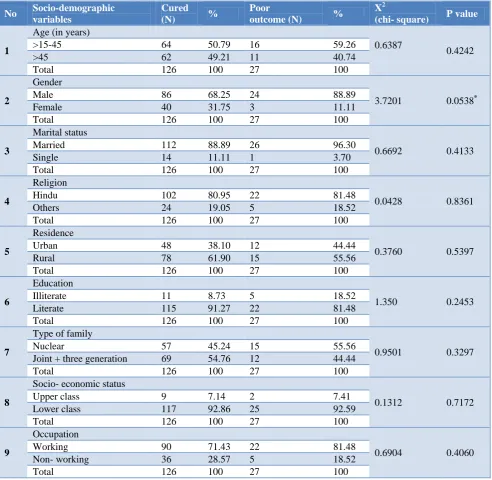
Our study found that among socio- demographic variables there was statistically significant association between the gender and treatment outcome. Gender has got influence over treatment outcome. Other variables such as age, marital status, religion, residence, education, type of family, socio- economic status, occupation were not associated with treatment outcome. In contrast to present study findings, Various studies shows that socio- demographic variables such as age, marital status, religion, residence, education, type of family, socio- economic status, occupation were associated with treatment outcome.
Cured 126(82.35%
) died
17(11.11%)
defaulter
9(5.88%) 1(0.65%) failure
Table 4: Association of Socio-demographic variables and treatment outcome.
No Socio-demographic variables
Cured (N) %
Poor
outcome (N) %
X2
(chi- square) P value
1
Age (in years)
0.6387
0.4242
>15-45 64 50.79 16 59.26
>45 62 49.21 11 40.74
Total 126 100 27 100
2
Gender
3.7201 0.0538*
Male 86 68.25 24 88.89
Female 40 31.75 3 11.11
Total 126 100 27 100
3
Marital status
0.6692 0.4133
Married 112 88.89 26 96.30
Single 14 11.11 1 3.70
Total 126 100 27 100
4
Religion
0.0428 0.8361
Hindu 102 80.95 22 81.48
Others 24 19.05 5 18.52
Total 126 100 27 100
5
Residence
0.3760 0.5397
Urban 48 38.10 12 44.44
Rural 78 61.90 15 55.56
Total 126 100 27 100
6
Education
1.350 0.2453
Illiterate 11 8.73 5 18.52
Literate 115 91.27 22 81.48
Total 126 100 27 100
7
Type of family
0.9501 0.3297
Nuclear 57 45.24 15 55.56
Joint + three generation 69 54.76 12 44.44
Total 126 100 27 100
8
Socio- economic status
0.1312 0.7172
Upper class 9 7.14 2 7.41
Lower class 117 92.86 25 92.59
Total 126 100 27 100
9
Occupation
0.6904 0.4060
Working 90 71.43 22 81.48
Non- working 36 28.57 5 18.52
Total 126 100 27 100
*Significant as p<0.05 by using Fisher‟s exact test i.e. 0.0339, df=1 for all variables.
DISCUSSION
Maximum cases i.e. 47 (30.71%) were from >30-45 yrs of age group followed by 38 i.e. (24.84%) cases from >45-60 yrs age group. Rekha et al study found that age >45 years was main variable which was associated with lack of sputum smear or culture conversion, higher the age higher was the lack of sputum smear conversion.10 In the study group, proportions of males were more as compare to females. Vijay et al in their study also observed that the study group predominantly comprised males, difference in proportions of males and females were significant.11 In present study, there was
al study showed that illiteracy and working status of the cases were the risk factors observed to be associated with treatment outcome.13 Similarly Gopi et al in their study also observed that Illiterate patients were 39% who were not adhered to DOTS Treatment.14 While, except gender present study did not show any association of treatment outcome with all these variables.
Limitation of study
All sectors of the community could not be reached as study was conducted at tertiary care hospital and owing to low educational status of study group there is possibility of recall bias in study subjects.
CONCLUSION
In the present study, maximum no of cases was from >30-45 yrs age group and proportions of males were more as compare to females. Number of cases coming from rural area was more and association between gender and treatment outcome of study cases was found statistically significant. Among treatment outcome, cases who had completed their treatment schedule had good treatment outcome.
Recommendations
100% literacy is one of the important measures to achieve the health for all, so all effort should be diverted to improve the literacy status of the population by the policy makers. “Type 2 Diabetics” group is becoming important high risk group should be categorically screened for TB. Key focus during campaigning should be on generating demand through IEC, Interpersonal communication (IPC) and behaviour change communication (BCC).
Funding: No funding sources Conflict of interest: None declared
Ethical approval: The study was approved by the Institutional Ethics Committee
REFERENCES
1. History of TB and Significance of World TB day. JIMA. 2003;101(3):138.
2. Harms, Jerome. 1997. Tuberculosis: Captain Death. http://www.bact.wisc.edu/Bact330/lectureTB. Accessed on 3 June 2018.
3. Bhalwar R. Textbook of Public Health and community Medicine, AFMC Pune; 2005: 1104– 1113.
4. Lal S. Textbook of Community Medicine, 4thedition.CBS publishers and Distributors Pvt Ltd; 2014: 435–452.
5. World Health Organization, Global Tuberculosis Report, 2015.
6. Annual Tuberculosis status report, TBC india.pdf. 2016.
7. Suryakantha AH. Community Medicine with recent advances. 3rd edition. Jaypee brothers medical publishers; 2014: 351–376.
8. Annual Tuberculosis status Report, TBC India, 2015.
9. Mangal A, Kumar V, Panesar S, Talwar R, Raut D, Singh S. Updated BG Prasad socioeconomic classification, 2014: A commentary. Indian J Public Health. 2015;59:42-4.
10. Banu Rekha VV, Balasubramanian R, Swaminathan S, Ramachandran R, Rahman F, Sundaram V, et al, Sputum conversion at the end of intensive phase of Category-1 regimen in the treatment of pulmonary tuberculosis patients with diabetes mellitus or HIV infection:an analysis of risk factors. Ind. J. Med. Res. 2007;126:452–8.
11. Sophia V, Balasangameswara VH, Jagannatha PS, Saroja VN, Kumar P. Treatment outcome and two and half years follow-up status of new smear positive patients treated under RNTCP. Indian J Tuberc. 2004;51:199-208.
12. Jethani S, Kakkar R, Semwal J, Rawat J. Socio- demographic profile of tuberculosis patient:a hospital based study at dehradun. National J Community. 2014;5(1):6-9
13. Chandrasekaran V, Santha T, Garg R, Frieden TR, Subramani R, Gopi. Default during the intensive phase of treatment under dots programme.Int. J. Tuberc. Lung Dis. 2005;52:197-202.
14. Gopi PG, Vasantha M, Muniyandi M, Chandrassekaran V, Balasubramanian R and Narayanan R. Risk factors for non-adherence to directly observed treatment (DOT) in a rural tuberculosis unit, South India. Indian J Tuberculosis. 2007;54(2):66–70.
Cite this article as: Vishwanath GR, Babar SD, Naik JD, Kamble G. Longitudinal study to assess socio-demographic profile and treatment outcome of new sputum smear positive cases at designated