Original Research Article
A cross sectional study to assess the knowledge, attitude and practice
towards road traffic safety among adolescent students of a selected
Pre-University college in Raichur city
Din Prakash Ranjan,
M. A. Fahim*, Rahul C. Kirte
INTRODUCTION
Accident is as an unfortunate incident that happens unexpectedly and unintentionally, resulting in damage or injury. Increased number of vehicles, drink driving, inadequacies of the road, over confidence, distracted driving, ignorance, increased speed of the vehicles and child restraints are the commonest causes for increased road accidents.1 We have had great success in fighting disease that kill children. We can’t now sit and watch people die or disabled due to injuries that can be easily prevented. Each year more than 20 million people are
injured and 1.25 million are killed due to road traffic accident.2
Globally, road traffic injuries are estimated to be the leading cause of death among young people aged 15–29 years, and second leading cause of death in 10–14 years and 20–24 years age groups. Every hour, forty youngsters die due to road traffic crashes.3 As a result, accident takes a heavy toll on the people entering their most productive years. According to WHO global burden of disease project for 2004 updates, road traffic accidents stands as 6th rank of leading causes of death in children and
ABSTRACT
Background: Globally, road traffic injuries are estimated to be the leading cause of death among young people aged 15–29 years, and second leading cause of death in 10–14 years and 20–24 years age groups. The objective of the study is to assess the knowledge, attitude and practice towards road traffic safety among adolescent students of a selected Pre-University college in Raichur city.
Methods: Cross-sectional study conducted among (372) adolescent students of a selected Pre-University college in Raichur city by using pre-tested, semi-structured questionnaire and analyzed using Epi-Info software. Chi-Square test was applied and level of significance was kept at P value of <0.05.
Results: Mean age of the participants was 16.68±0.75. 196 participants (52.8%) had adequate knowledge on the road safety rules and regulations. Only 25 participants (7.7%) were driving with a valid driving license. The most common reason for motor vehicle accidents was high speed. Knowledge adequacy about road safety rules and regulations had statistically significant association with age and gender.
Conclusions: Mere knowledge does not necessarily translate into improved traffic behavior as was seen in this study. School/college is the basic institution where we can formulate interventions. Continuous reinforcement and education reminding them of traffic rules can bring about a positive change and motivate them to strictly adhere to the traffic norms and help reduce the morbidity and mortality regarding road traffic accidents.
Keywords: Road traffic safety, Adolescents, KAP, PU College, Raichur
Department ofCommunity Medicine, Raichur Institute of Medical Sciences, Raichur, Karnataka, India
Received: 18 March 2018
Accepted: 03 May 2018
*Correspondence:
Dr. M. A. Fahim,
E-mail: [email protected]
Copyright: © the author(s), publisher and licensee Medip Academy. This is an open-access article distributed under the terms of the Creative Commons Attribution Non-Commercial License, which permits unrestricted non-commercial use, distribution, and reproduction in any medium, provided the original work is properly cited.
adolescent.4 Economically disadvantaged families are hardest hit by the losses arise from cost of treatment and reduced/lost productivity for the killed or disabled, and for their family members who need to take time off to care for the injured. Road traffic injuries are increasing, notably in low- and middle-income countries, rates being twice than those in high-income countries. Over a third of road traffic deaths in low and middle-income countries like India occur among pedestrians and cyclists. Current trends suggest that road traffic injuries will become the fifth leading cause of death by 2030.1
Urgent action is needed to achieve the determined target for road safety reflected in the newly adopted 2030 agenda for sustainable development (goal 3 and 11) and halving the global number of deaths and injuries from road traffic crashes by 2020.2 India a middle income country with a population of more than a billion witnessed 31.3% of the road traffic deaths among 15 to 29 years individuals in the year 2011 as reported by national crime records bureau (NCRB).5
Simple measures like awareness and practice of road safety measures can effectively reduce the impact of RTAs on the lives of people. Road safety deals exclusively with road traffic crashes – how to reduce their number and their consequences. Road safety aims to reduce the harm resulting from crashes of road vehicles and to convey information to road users to enhance their knowledge about road safety issues, influence their behavior on the road and prepare them for new safety measures.6 Road safety-educated students will grow to be leaders of communities forming opinions. The chances of road traffic accidents can be averted to a large extent, if these adolescents who are going to be adults of tomorrow are made aware of road safety measures. Adolescence is like a bridge between childhood and adult hood, during which the individual is gaining further physical maturity. This study was carried out with an aim to assess the knowledge, attitude and practices by adolescents while driving a vehicle.
METHODS
Study design: Cross-sectional study.
Study period: December 2017 to January 2018.
Study setting: Selected Pre-University college of Raichur city.
Sample size and sampling method
A college was selected randomly from Raichur city and all the students from that college were taken as sample size.
Inclusion criteria
PUC1 & 2 students of selected pre-university college of
Exclusion criteria
Students who didn’t give consent and students who were absent at the time of data collection.
Method of collection of data
Ethical clearance for the study was taken from Institutional Ethical Committee of Raichur Institute of Medical Sciences, Raichur, Karnataka. Permission was taken from principal of college to conduct the study. Data was collected using pre-tested, semi-structured questionnaire after taking verbal consent from students. 10 questions were asked to assess the knowledge of the students on road safety rules and regulations. It included questions on traffic signals, road safety laws and road signs. The knowledge level was scored into two categories, inadequate knowledge (0-5) and adequate knowledge (6-10). Other questions were asked to assess the attitude and practice of the participants.
Statistical analysis
Data was entered using Microsoft Excel 2007 and analyzed using Epi-Info 7 software and appropriate statistical tests were applied. Level of significance was kept at P value of <0.05.
RESULTS
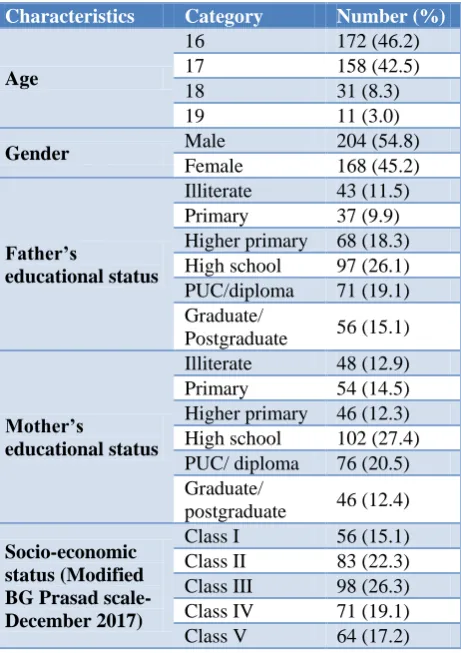
The study included 372 participants (204 males and 168 females). Among them, 193 (51.9%) participants belonged to 11th standard and 179 (48.1%) participants belonged to 12th standard. The age of the participants ranged from 16 to 19 years. The mean age was 16.68±0.75 (Table 1).
Knowledge: Among the 372 participants, 196 participants (52.8%) had adequate knowledge and 176 participants (47.2%) had inadequate knowledge on the road safety rules and regulations. According to the motor vehicle act (MVA) the age to get a valid driving license was 18 years.6 This was known by 99.1% of the participants. Maximum penalty for driving without a valid driver’s license was known by only 57.8%. 97.8% and 99.4% participants knew that it is compulsory to put on the seat belt while in a moving car and wear helmet while travelling in two wheelers respectively. 55.4% participants knew that 40 kmph is the normal driving speed limit in the city and only 25.3% participants knew that the permissible blood alcohol limit for driving in India is <40 mg/dl. Only 8 participants knew all the 8 road signs. 162 participants (43.6%) were not able to identify even one of the 8 road signs. Only 33.8% participants had correct knowledge of traffic lights (Table 2).
Table 1: Socio demographic details of the participants.
Characteristics Category Number (%)
Age
16 172 (46.2) 17 158 (42.5) 18 31 (8.3) 19 11 (3.0)
Gender Male 204 (54.8)
Female 168 (45.2)
Father’s
educational status
Illiterate 43 (11.5) Primary 37 (9.9) Higher primary 68 (18.3) High school 97 (26.1) PUC/diploma 71 (19.1) Graduate/
Postgraduate 56 (15.1)
Mother’s
educational status
Illiterate 48 (12.9) Primary 54 (14.5) Higher primary 46 (12.3) High school 102 (27.4) PUC/ diploma 76 (20.5) Graduate/
postgraduate 46 (12.4)
Socio-economic status (Modified BG Prasad scale-December 2017)
Class I 56 (15.1) Class II 83 (22.3) Class III 98 (26.3) Class IV 71 (19.1) Class V 64 (17.2)
Table 2: Knowledge regarding road safety rules and regulations.
Knowledge regarding road safety rules and regulations
Number with correct response (N=372) (%) Age to get major driving license 369 (99.1)
Is it compulsory to put on the seatbelt while you are in a moving car
364 (97.8)
Normal speed limit for driving in city 206 (55.4)
Permissible blood alcohol limit for
driving in India 94 (25.3)
Is it compulsory to wear a helmet
while riding a two wheeler 370 (99.4) Road signs ( ≥6 signs correct out of 8) 46 (12.4)
Indication of amber (yellow) light 126 (33.8)
From where do you overtake a
vehicle 122 (32.8)
On which side of the road you must
walk to reduce accidents 201 (54.2) Maximum penalty for driving
without driver’s license 215 (57.8)
Table 3: Attitude regarding road safety rules and regulations.
Attitude regarding road safety rules and regulations
Number of respondents who agreed (N=372) Pedestrians must be given
prime importance regarding their security
319 (85.8)
Following traffic rules and regulations will reduce accidents
231 (62.1)
Owning a driving license for
driving a vehicle is necessary 265 (71.2) Road signs and symbols help to
reduce road accidents 221 (59.4)
Practice: Among the 372 participants, only 34.6% used zebra crossing for crossing roads, 62.3% followed the road signs and symbols and only 58 participants had the habit of wearing seat belt while in a moving car. 322 participants were driving vehicles. Among them, 22 drove four wheelers, remaining drove two wheelers. Among 88 participants who had been exposed to road traffic accidents, pedestrian accidents accounted for only 7 (7.9%), the remaining 81 (92.1%) were motor vehicle accidents. The most common reason for motor vehicle accidents was high speed in 61 participants, followed by overtaking in 12 participants and bad roads in 8 participants (Table 4).
Table 4: Practice regarding road safety rules and regulations among all the participants.
Practice regarding road safety rules and regulations
Number of respondents who practice (N=372) Use zebra crossing to cross roads 129 (34.6)
Obey the road signs and symbols 232 (62.3)
Drive vehicles 322 (86.6)
Exposed to a road traffic
accident 88 (23.7)
Wear seat belt when travelling in
a four-wheeler 58 (15.6)
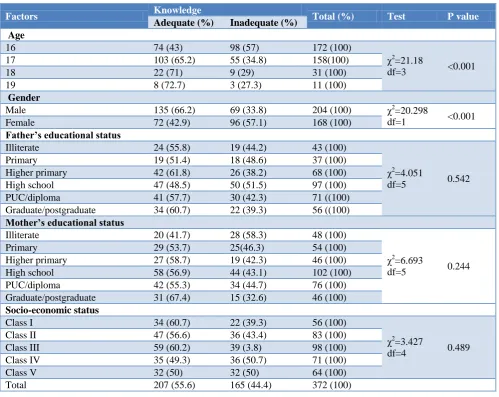
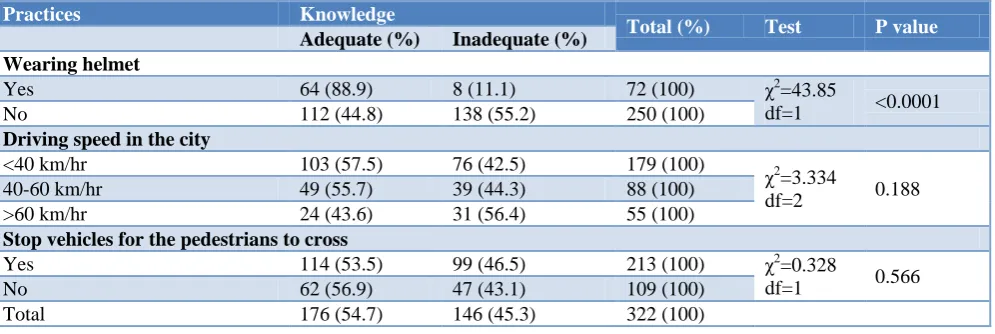
Among the socio demographic details, age and sex of the participants had statistically significant association with adequate knowledge regarding road safety rules and regulations (Table 6). The road safety practices were better in participants with adequate knowledge compared
to those with less knowledge. The differences in knowledge and practice of wearing seat belt while travelling in a car and wearing helmet while travelling in a two wheeler were found to be statistically significant (Table 7 and 8).
Table 5: Practice regarding road safety rules and regulations among those who drive vehicles.
Practice regarding road safety rules and regulations Number of respondents who practice (N=322)
Borrow vehicles from friends 138 (42.9)
Ever been held by traffic police 85 (26.4)
Drive vehicles without license 297 (92.2)
Driving speed of <40 km/hr in the city 179 (55.6)
Drive vehicle without parent’s knowledge 82 (25.5)
Stop vehicle for pedestrians to cross even with no traffic signals
or traffic police around 213 (66.1)
Wear helmet while driving 72 (22.4)
Use mobile phone while driving 149 (46.3)
Table 6: Relationship between knowledge adequacy and socio demographic details of all the participants.
Factors Knowledge Total (%) Test P value
Adequate (%) Inadequate (%) Age
16 74 (43) 98 (57) 172 (100)
χ2 =21.18
df=3 <0.001
17 103 (65.2) 55 (34.8) 158(100)
18 22 (71) 9 (29) 31 (100)
19 8 (72.7) 3 (27.3) 11 (100)
Gender
Male 135 (66.2) 69 (33.8) 204 (100) χ2=20.298
df=1 <0.001
Female 72 (42.9) 96 (57.1) 168 (100)
Father’s educational status
Illiterate 24 (55.8) 19 (44.2) 43 (100)
χ2 =4.051
df=5 0.542
Primary 19 (51.4) 18 (48.6) 37 (100)
Higher primary 42 (61.8) 26 (38.2) 68 (100) High school 47 (48.5) 50 (51.5) 97 (100) PUC/diploma 41 (57.7) 30 (42.3) 71 ((100) Graduate/postgraduate 34 (60.7) 22 (39.3) 56 ((100)
Mother’s educational status
Illiterate 20 (41.7) 28 (58.3) 48 (100)
χ2 =6.693
df=5 0.244
Primary 29 (53.7) 25(46.3) 54 (100)
Higher primary 27 (58.7) 19 (42.3) 46 (100) High school 58 (56.9) 44 (43.1) 102 (100) PUC/diploma 42 (55.3) 34 (44.7) 76 (100) Graduate/postgraduate 31 (67.4) 15 (32.6) 46 (100)
Socio-economic status
Class I 34 (60.7) 22 (39.3) 56 (100)
χ2 =3.427
df=4 0.489 Class II 47 (56.6) 36 (43.4) 83 (100)
Class III 59 (60.2) 39 (3.8) 98 (100) Class IV 35 (49.3) 36 (50.7) 71 (100)
Class V 32 (50) 32 (50) 64 (100)
Table 7: Relationship between knowledge adequacy and practices among all the participants.
Practices Knowledge Total (%) Test P value
Adequate (%) Inadequate (%) Cross the roads at the zebra crossing
Yes 78 (58.9) 51 (41.1) 129 (100) χ2=1.859
df=1 0.17
No 129 (52.3) 114 (47.7) 243 (100)
Obey the road signs and symbols
Yes 127 (53.9) 105 (46.1) 232 (100) χ2=0.204
df=1 0.65
No 80 (55.7) 60 (44.3) 140 (100)
Wearing seat belt while travelling in 4 wheeler
Yes 44 (72.4) 14 (27.6) 58 (100) χ2
=11.38
df=1 0.0007
No 163 (51.3) 151 (48.7) 314 (100)
Total 207 (55.6) 165 (44.4) 372 (100)
Table 8: Relationship between knowledge adequacy and practices among the participants who drive vehicles.
Practices Knowledge
Total (%) Test P value Adequate (%) Inadequate (%)
Wearing helmet
Yes 64 (88.9) 8 (11.1) 72 (100) χ2
=43.85
df=1 <0.0001
No 112 (44.8) 138 (55.2) 250 (100)
Driving speed in the city
<40 km/hr 103 (57.5) 76 (42.5) 179 (100)
χ2 =3.334
df=2 0.188 40-60 km/hr 49 (55.7) 39 (44.3) 88 (100)
>60 km/hr 24 (43.6) 31 (56.4) 55 (100)
Stop vehicles for the pedestrians to cross
Yes 114 (53.5) 99 (46.5) 213 (100) χ2=0.328
df=1 0.566
No 62 (56.9) 47 (43.1) 109 (100)
Total 176 (54.7) 146 (45.3) 322 (100)
DISCUSSION
Road traffic awareness among school going adolescents is one of the most important aspect towards safety concerning traffic rules. The students in adolescence may derive a thrill out of taking risks on road not realizing the consequences such risks may have. This age group is rapidly emerging as a major population of vehicle owners and also constitutes major number of accidents, making it very important to sensitize this population about road traffic rules, as they are future of the nation. In the present study, only half of the students had adequate knowledge on road safety rules. This finding is similar to the study done by Mahawar et al in Indore among school going teenagers and Kulkarni et al in south Indian states.7,8 In a study in Chandigarh, 60% students had correct knowledge on the road safety rules.6 In the current study, males had significantly better knowledge than females, similar to the study carried out by Raj et al among high school students in rural community in Tamil Nadu and Reang and Tripura in medical college students in Agartala.9,10 Probably because boys have a habit of going out more frequently and have more exposure to media, traffic signals in the cities and people around them, than girls who are confined to homes most of the time.
99.1% participants knew the legal age for driving geared vehicles and 55.4% respondents had correct knowledge on the correct speed limit for driving in the city, much higher than the studies by Swamy et al, Raj et al and Mahawar et al.6,7,9 Only 33.8% participants had correct knowledge of traffic lights. This finding was similar to the study done by Mahawar et al among school going teenagers in Indore.7 The inability to correctly identify the traffic lights need to be addressed immediately as road traffic accidents can be reduced drastically if the knowledge towards traffic lights improves. More than 50% participants were not able to identify any of the road signs correctly. Similar findings were found in a study among high school students in rural area of Tamil Nadu.9 Knowledge of traffic sign and speed limit was poor even among commercial bus drivers whereas good knowledge on road signs was observed among medical students.8,10,11 The poor knowledge of traffic signs among participants might be due to the reduced exposure to IEC activities and road safety education is not a part of their school curriculum.
had correct knowledge.7 Almost half of the participants believed that pedestrians should walk on the left side of the road. This could be a major contributor towards high rate of road traffic accidents among pedestrians. According to the WHO report, 27% of all road traffic deaths occur among pedestrians and cyclists.1 Knowledge regarding use of seat belts and helmets was high among the participants, which was similar to study by Reang, Tripura among medical students.10 57.8% of the respondents knew the maximum penalty for driving without a valid license and about one third felt driving license was not necessary to drive vehicles. This is because the punishment for driving without license is not implemented effectively in India. Among those who drove vehicles, 92.2% did not have a valid driving license and 26.4% were held by the traffic police for driving without a valid license.
Regarding practice, only 22.4% of the students who ride motorized two-wheelers wear helmets. Use of helmet prevents the risk of fatalities among motorcycle riders. Similarly only 15.6% of the participants wear seat belts regularly. Above data indicates that despite good awareness students do not practice them. This shows the alarmingly wide knowledge practice gap, which needs immediate attention to ensure road safety.
44.4% of the participants agreed to have exceeded their speed limits while driving and there is a significant knowledge practice gap regarding the driving speed in the city in the present study. Study among medical students in Agartala reported that one third of them exceeded their speed limits while driving.10 Among those who had been exposed to road traffic accidents, 7.9% were pedestrian accidents and remaining were motor vehicle accidents. There was no statistically significant association between adequacy of road safety knowledge and participants' road crossing behaviors which is in contrast to a study by Ibrahim et al, Chang, Jha and Mehta who reported statistically significant association between adequacy of road safety knowledge and participants' road crossing behaviors.12-15
In our study we found 46.3% participants use mobile phone while driving. This is similar to study conducted by Salve et al, Yilmaz et al, Singh et al, Trivedi and Rawal who reported that almost half of the young drivers use mobile phone while driving.16-19
The study reveals moderate knowledge and attitude regarding traffic rules and road signs among the PUC students, whereas knowledge regarding risk factors associated with road accidents was found to be adequate. A limitation of the present study is that the findings and their interpretations are restricted to only college going adolescents only. Further studies are needed to cover the adolescents that are out of college, as the prevalence of health-risk behaviors is likely to be higher among such adolescents. Mere knowledge does not necessarily
this study. Continuous reinforcement and education reminding them of traffic rules can bring about a positive change and motivate them to strictly adhere to the traffic norms and help reduce the morbidity and mortality regarding road traffic accidents.
School/college is the basic institution where we can formulate interventions towards health promotion and prevention of accidents.
To improve road safety among school-going adolescents, a multi dimensional program requiring efforts and coordination from students, parents, teachers, law enforcement agencies and policy makers on prevention of traffic injuries should be organized.
Comprehensive measures to improve conditions of roads and road environments to provide safer environments for pedestrians and drivers and the use of seat belts and helmets should be promoted.
The attitudes and practices, which negatively affect traffic safety, should be changed. Information and education campaigns and the role of media should be effectively utilized to disseminate information to community and topics on traffic safety should be included in the compulsory training program of secondary schools.
ACKNOWLEDGEMENTS
We are thankful to all the students who participated in the study without them this study was not possible.
Funding: No funding sources Conflict of interest: None declared
Ethical approval: The study was approved by the
Institutional Ethics Committee of Raichur Institute of
Medical Sciences, Raichur
REFERENCES
1. WHO Road traffic injuries. Available at: http://www.who.int/roadsafety/about/resolutions/do wnload/en/. Accessed on 21 January 2018.
2. WHO Global Status Report on Road Safety, 2015. Available at: http://www.who.int/violence_injury_ prevention/road_safety_status/2015/en/. Accessed on 21 January 2018.
3. Toroyan T, Peden M (eds), Youth and Road Safety, Geneva, World Health Organization, 2007.
4. WHO Global Burden of Disease Project for 2004 updates. Available at: http://www.who.int/ healthinfo/global_burden_disease/GBD_report_200 4update_full.pdf. Accessed on 21 January 2018. 5. New Delhi: National Crime Records Bureau,
6. Swami HM, Puri S, Bhatia V. Road safety awareness and practices among schoolchildren of Chandigarh: Indian Community Med. 2006;31:199. 7. Mahawar P, Dixit S, Khatri AK, Rokade R, Bhurre
R, Kirar S, et al. An Educational invention to improve awareness on road safety: A study among school going teenager in Indoor. Nat J Comm Med. 2013:4(3):529:32.
8. Kulkarni V, Palanivel C, Kumar N. Awareness and practice of road safety measures among undergraduate medical students in a South Indian state. J Forensic and Legal Med. 2012;30:1-4. 9. Raj C, Datta S, V J, Singh Z, V S. Study of
knowledge and behavioural patterns with regard to road safety among high school children in a rural community in Tamil Nadu, India. Indian J Med Spec. 2011;2(2).
10. Reang T, Tripura A. Road Safety: knowledge, practice and determinants among undergraduate medical students of Agartala Government Medical College & Govinda Ballabh Pant Hospital. Int J Med Sci Public Health. 2014;3:911-5.
11. Ifeoma P, Kofoworola A, Duro C. Knowledge of commercial bus drivers about road safety measures in Lagos, Nigeria. Ann Afr Med. 2013;12(1):34. 12. Ibrahim J, Day H, Hirshon J, El-Setouhy M. Road
risk-perception and pedestrian injuries among students at Ain Shams University, Cairo, Egypt. J Inj Violence Res. 2012;4(2):71-8.
13. Chang H, Yeh T. Motorcyclist accident involvement by age, gender, and risky behaviors in Taipei, Taiwan. Transportation Research Part F: Traffic Psychol Behaviour. 2007;10(2):109-22.
14. Jha N. Road traffic accident cases at BPKIHS, Dharan, Nepal. One year in retrospect. J Nepal Med Asso. 1997;35:241-4.
15. Mehta SP. An Epidemiological study of Road Traffic Accidents cases admitted in Safdar Jang Hospital. New Delhi. Indian J Med Res. 1968,56(4):456-66.
16. Salve SB, Dase RK, Jadav VS, Mahajan SM. A Study on Awareness and Behaviour of Adolescents towards Road Traffic Accidents. Inte J Curr Med App Scie. 2014;4(1):33-40.
17. Yilmaz V, Eray H. Risky Driving Attitudes and Self-Reported Traffic Violations Among Turkish Drivers: The Case of Eskişehir = Türk Sürücülerinin Kendi Bildirimlerine Dayanan Trafik İhlalleri ve Riskli Sürüş Tutumlari: Eskişehir Örneği. Doğuş Üniversitesi Dergisi. 2006;7:127-38.
18. Singh A, Bhardwaj A. An Epidemiological study of road traffic accident cases at a tertiary care hospital in rural Haryana. Ind J Comm Health. 2011;23(2):7-11.
19. Trivedi A, Rawal D. Prevalence of Road traffic accidents and driving practices among young drivers in Tumkur. 2011;2(2):72-5.