Original Research Article
Study to assess knowledge, attitude on organ donation among medical
students in a medical college, Telangana, India
S. Priyanka
1, Sunil Pal Singh C.
2*, P. Narsimha Reddy
2INTRODUCTION
Organ donation is defined as transferring of organs from a human body, either by consent while the donor is alive or after death for the purpose of treatment.1The organs from one donor can save or help as many as 50 people. Organs which can be donated include internal organs such as Kidneys, heart, liver, pancreas, intestines, lungs, bone and bone marrow, external organs like cornea and skin. Organ transplantation is only cure for the patients suffering from end stage organ failure. There are only few donors for transplantations when compared to more requirements. This is because of lack of awareness and misconception regarding organ donation.
In year 2018 more than 36,528 transplants brought renewed life to patients and their families. In 2018, 62% of organ recipients were males and other 38% were females.2One person is added up the transplant waiting list for every 10 minutes.80, 000 people die each year because of unavailability of required organ or tissues in time. Each year surgical need for tissue transplant is steadily rising, there were approximately 30,000 tissue donors and more than 1.75 million tissue transplants. 48,000 patients have restored their sight through corneal transplant each year. The total donors in March 2017 are 2,5532.3
In India organ donation after brain death has been slow take off. In 1994 government enacted a law the
ABSTRACT
Background: Organ donation rate in India is only 0.26 per million. This is mainly due to lack of knowledge about the need of organ donation. Health care professionals play a vital role in imparting positive knowledge regarding organ donation.
Methods: Institutional based cross sectional study was conducted among 1st year MBBS students (n=135). Data was collected and pre and post analysis was done using a pre-validated self-administered questionnaire. Data was entered in Ms Excel and analysed using SPSS 17 software.
Results: Media was found to be most common source of information regarding organ donation. 91.1% support organ donation. 78.5% have not heard about donor card. Only 34.6% have heard about jeevandan scheme. 77.8% participants has knowledge that brain death is irreversible and 65.9% students believe that there is age limit for organ donation. 87.4% has adequate knowledge that single donor can donate to multiple recipients and 95.6% students believe that organs should not be donated from persons who has cancers or HIV.
Conclusions: From the data analysed it is evident that there was a significant increase in knowledge following Awareness session on organ donation. Many have a positive attitude towards organ donation.
Keywords: Undergraduate, Organ donation, Jeevandan, Organ recipient
Department of Community Medicine, 1Kamineni institute of Medical Sciences, Narketpally, 2Kamineni Academy of Medical Sciences and Research centre, L. B. Nagar, Hyderabad, Telangana, India
Received: 01 May 2019
Accepted: 11 June 2019
*Correspondence:
Dr. Sunil Pal Singh C.,
E-mail: [email protected]
Copyright: © the author(s), publisher and licensee Medip Academy. This is an open-access article distributed under the terms of the Creative Commons Attribution Non-Commercial License, which permits unrestricted non-commercial use, distribution, and reproduction in any medium, provided the original work is properly cited.
transplantation of human organ act which brought significant change in organ donation. This act was amended further in 2011 in order to control organ trade and trafficking. In the year 2000 NGO called Mohan foundation was started in Tamilnadu as organ sharing network between various hospitals. Later this foundation extended their services to few other states. State
government of Telangana introduced cadaver
transplantation programme called “Jeevandan” for organ donation, allocation and transplantation across the state.4
The shortage of organs can be improved by increasing the awareness about organ donation. Doctors can play key role in solving this problem. Education of medical students in their early career may enhance knowledge and hence awareness can be created among patients for organ donation.5 Thus educating health care professionals and people on organ donation remains essential to increase the organ donation rate. Since medical students are future doctors of the country, their positive attitude and high level of knowledge can create positive environment and promote organ donation. Hence this study was carried out to determine the present level of knowledge of medical students on organ donation and to identify the lacking aspects and to suggest the measures to increase knowledge in those areas.
METHODS
Study design
Institution based interventional cross-sectional study, conducted during January to march 2019.
Study population
The study participants were first year undergraduate medical students of kamineni Academy of medical sciences and research centre, L.B.Nagar.
Study sample
In a total class of 150, only 135 students who were consented orally and were willing to participate by filling the questionnaire were enrolled into the study.
Study tool
A questionnaire adapted to the study requirements was designed to capture the knowledge, attitudes and beliefs towards organ donation. The questionnaires were predesigned and pre tested on a sample of fifteen undergraduate students and finalized. The questionnaire consists of structured questions with two sections:
Section A: This section included demographic
information such as age, gender, education, religion etc. Section B: This section assessed the level of knowledge,
assess knowledge and 7 questions to assess the attitude and beliefs of the respondents.
The questionnaires were administered to students as a pre-test and collected back after completion. Then a session on organ donation was conducted. The session focused on the state of persistent organ shortage worldwide and in India, types of organ donation, organs that can be donated while alive and deceased, criteria for deceased donation, organ procurement and allocation procedures, legislations regulating organ donation, NGOs, ethical aspects of organ donation and transplantation such as consent, accepting benefits and confidentiality. The intervention was delivered to participants in a lecture hall. Post-tests using same questionnaires with 10 questions out of 12 were filled from the knowledge aspect. Scoring was done by giving 1 point for each correct answer for all the ten questions in both pre and post-tests. Person attaining more than 5 points were termed as having good knowledge and less than 5 as poor knowledge.
Statistical analysis
Statistical analysis was carried out using Microsoft Excel and SPSS version 17. Pre-test and Post-test was done on 10 questions on knowledge aspect of organ donation and p values less than 0.05 were considered statistically significant.
Ethical clearance
Ethical clearance wasobtainedfromInstitutional Ethical Committee of KAMSRC, L.B. Nagar.
RESULTS
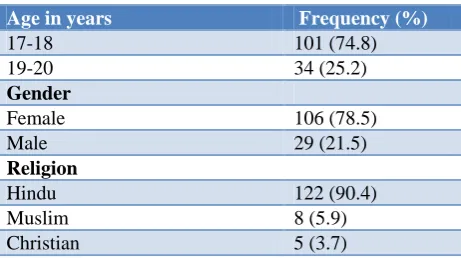
The study population consists of 135 respondents of whom 74.8% belongs to age group 17 to 18 years. There were more number of female participants (78.5%). Majority belong to Hindu religion (90.4%) followed by Muslims (5.9%) and Christians (Table 1). The most common source of information about organ donation was found to be television (45.9%) followed by internet (23.7%) and newspaper (11.9%) respectively (Table 2).
Table 1: Distribution of study subjects according to their age, gender and religion (n=135).
Age in years Frequency (%)
17-18 101 (74.8)
19-20 34 (25.2)
Gender
Female 106 (78.5)
Male 29 (21.5)
Religion
Table 2: Distribution according to source of awareness of organ donation (n=135).
Source Percentage(%)
Newspaper 16 (11.9)
Television 62 (45.9)
Internet 32 (23.7)
Family members 14 (10.4)
Discussed at medical college 5 (3.7)
Books 3 (2.2)
No awareness 3 (2.2)
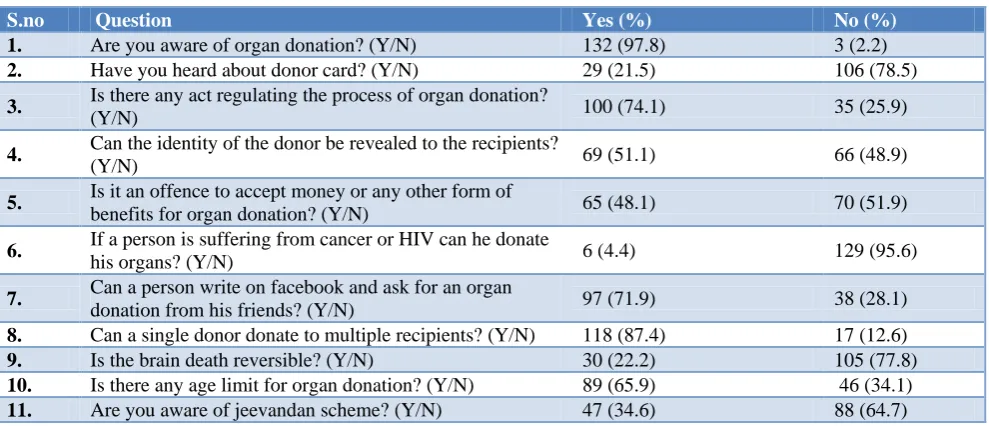
Majority of students (97.8%) were aware about organ donation. 78.5% of have not heard about donor card. About 48.1% believe that it is offence to accept money or
any other benefit for organ donation and 71.9% believe that a person can write on Facebook and ask for organ donation from their friends. We found that 77.8% participants has knowledge that brain death is irreversible and 65.9% students believe that there is age limit for organ donation. In present study 87.4% has adequate knowledge that single donor can donate to multiple recipients and 95.6% students believe that organs should not be donated from persons who has cancers or HIV. Majority (51.1%) believe identity of donor cannot be revealed. About 35% of study population have heard about jeevandan scheme (Table 3). 60.7% respondents has adequate knowledge regarding the possible donors for organ donation (Table 4).
Table 3: Knowledge of medical students regarding organ donation (n =135).
S.no Question Yes (%) No (%)
1. Are you aware of organ donation? (Y/N) 132 (97.8) 3 (2.2)
2. Have you heard about donor card? (Y/N) 29 (21.5) 106 (78.5)
3. Is there any act regulating the process of organ donation?
(Y/N) 100 (74.1) 35 (25.9)
4. Can the identity of the donor be revealed to the recipients?
(Y/N) 69 (51.1) 66 (48.9)
5. Is it an offence to accept money or any other form of
benefits for organ donation? (Y/N) 65 (48.1) 70 (51.9)
6. If a person is suffering from cancer or HIV can he donate
his organs? (Y/N) 6 (4.4) 129 (95.6)
7. Can a person write on facebook and ask for an organ
donation from his friends? (Y/N) 97 (71.9) 38 (28.1)
8. Can a single donor donate to multiple recipients? (Y/N) 118 (87.4) 17 (12.6)
9. Is the brain death reversible? (Y/N) 30 (22.2) 105 (77.8)
10. Is there any age limit for organ donation? (Y/N) 89 (65.9) 46 (34.1)
11. Are you aware of jeevandan scheme? (Y/N) 47 (34.6) 88 (64.7)
Table 4: Knowledge of medical students regarding possible donors for organ donation (n=135).
S.no Total (%)
1 Living person 14 (10.4)
2 Brain dead person 19 (14.1)
3 Naturally dead person 20 (14.8)
4 All 82 (60.7)
About 91.1% support organ donation and 86.7% were ready to motivate their family members and others to
donate organs. Few respondents (30%) has
misconception that organ donation cause harmful effects or complication to the donors and some of them fear about disfigurement of body after organ donation. Around 16.2% participants felt organ donation should be made mandatory by law (Table 5).
Table 5: Attitude of medical students regarding organ donation (n=135).
S.no Question Yes (%) No (%)
1 Would you like to be organ donor? (Y/N) 123 (91.1) 12 (8.9)
2 Do you motivate your family and others to donate organs? (Y/N) 117 (86.7) 18 (13.3)
3 Do you think donating organ can cause any harmful effects/complication to
you? (Y/N) 41 (30.3) 94 (69.6)
4 Do you fear of disfigurement of body after organ donation? (Y/N) 40 (29.6) 95 (70.4)
Table 6: Willingness of cadaveric donation (n=135).
S.no Total (%)
1 Willing 23 (17)
2 Not willing 51 (37.8)
3 Undecided 61 (45.2)
Table 7: Various methods to promote organ donation (n=135).
S.no Total (%)
1 Health education in institutions 2 (1.5)
2 Conducting campaign and
rallies 3 (2.2)
3 Social media 3 (2.2)
4 All 127 (94.1)
Table 8: knowledge of medical students regarding organ donation (n=135).
Mean Co-relationship p value
Pre- test 6.64
0.360 0.00
Post- test 8.80
In our study only 17% were willing for cadaveric donation (Table 6).
Majority (94.1%) believe that awareness about organ donation can be done through health education in institutions, by conducting campaigns and rallies and by social media (Table 7).
Table 8 shows that there is increase in the levels of knowledge about organ donation in the study population in the post test analysis which is statistically significant (p<0.001).
DISCUSSION
In practical life, the actual number of organ donors is considerably lower than the number of patients needing an organ transplant. This discrepancy creates a challenge for the health professionals and organ procurement agencies concerned for patients care to need organ transplants.6,7
In the present study it was found that majority of the study subjects (74.8%) belonged to the 17-18 years age group and there was more number of female participants (78.5%) than the males and majority belong to Hindu religion (90.4%). Whereas in a study done by Shah et al among commerce college students, 73.5% were males and in another study among dental students by Chakradhar et al 79.9% of the respondents were females.8,9
(Table 2). In a study carried out by Bapat et al television, newspaper, radio and magazines were responsible for 61%, 60%, 31% and 51% respectively of knowledge promotion regarding the organ donation.10
This study revealed fair knowledge regarding the organ donation which increased to notably higher levels post intervention. Students lack awareness regarding donor card only 21.5% were aware of donor card and only 37% of the respondents know which organs to be donated. Similarly in a study by Annadurai et al who studied the knowledge of college non-medical students regarding organs that can be donated and found that above 80% were aware of eye and kidney donations, and below 15% had knowledge regarding any other organ or tissue donations.11 In other study by Karini et al it was only 26%.only 34.1% of respondents know there is no age limit for organ donation.12 Similarly in the studies of Agarwal and karini et al it was about 43% and 47.2% respectively has knowledge about the age limit for organ donation.12,13 Only 34.6% of the respondents heard about jeevandan scheme in contrast to study done in Kerala by Adityan.G.S et al about 87.7% has knowledge regarding Mritasanjeevani.14 In this study 60.7% has knowledge that dead person, alive and brain dead can donate organs and in other study by Sucharitha et al only 11.3% has knowledge regarding this.15
Many students liked to be organ donor and were willing to motivate their family members and others to donate organs.in a study done by Arunachalam et al revealed same findings around 80.6% subjects has intention to donate their organs.16 16% of the subjects were in favour of organ donation should be mandatory by law and the findings were similar to the study done in Kerala by Ali et al (15.2%).17
In this study as to the willingness for the cadaveric donation only 17% participants responded positively and in the study by Aditya et al about 44.3% responded positively. 14
CONCLUSION
Our study reveals poor knowledge regarding the organ donor card, jeevandan scheme, about the act of organ donation and age limit for organ donation. There was misconception regarding the complications to the donor. There was significant increase in the levels of knowledge about organ donation after the awareness session. This implies that knowledge should be enhanced through awareness programmes about organ donation and transplantation needs and organized lectures should be included in the undergraduate medical curriculum.
Funding: No funding sources Conflict of interest: None declared
Ethical approval: The study was approved by the Institutional Ethics Committee
REFERENCES
1. World Health Organisation (WHO). Global glossary
of terms and definitions on donation and transplantation, Geneva; 2009.
2. Organ donation statistics. (online) Available:
https://www.organdonor.gov/statistics-stories/statistics.html#glance, Accessed January 16, 2019.
3. Organ donation statistics (online).
Available:http://organdonation.com/organ-donation-statistics-2018/. Accessed February 13, 2018.
4. Jeevandan (cadaver transplantation programme).
Govt of telangana.awareness material. Available at: http://www.jeevandan.gov.in/PDF's/englishPamplet. pdf.
5. Bardell T, Hunter DJW, Kent WDT, Jain MK. Do medical students have the knowledge needed to maximize organ donation rates. Can J Surg. 2003;46(6):453-7.
6. Bener A, El-Shoubaki H, Al-MaslamaniY. Do we need to maximize the knowledge and attitude level of physicians and nurses toward organ donation and transplant? Exp Clin Transplant. 2008;6:249-53. 7. Figueroa CA, Museum ET, Acton NT, Kunst AE.
Medical students' knowledge and attitudes toward organ donation: results of a Dutchsurvey. Transplant Proc. 2013;45:2093-7.
8. Shah R, Patel A, Ramanuj V, Solanki N. Knowledge
and Attitudes about organ donation among commerce college students. Ntl J of Community Med. 2015;6(4):533-5.
9. Chakradhar K, Doshi D, Reddy BS, Kulkarni S, Reddy MP, Reddy SS. Knowledge, attitude and practice regarding organ donation among indian dental students. Int J Org Transplant Med. 2016;7(1):28-35.
10. Bapat U, Kedlaya PG, Gokulnath. Organ donation, awareness, attitudes and beliefs among post graduate medical students. Saudi J Kidney Dis Transpl. 2009;20(1):174-80.
11. Annadurai K, Mani K, Ramasamy J. A study of knowledge, attitude and practices about organ donation among college students in Chennai, Tamil Nadu-2012. Prog Health Sci. 2013;3(2):59-65. 12. Karini D, Sunitha S, Devi Madhavi B. Perceptions
of medical students in a Government Medical College towards organ donation. J Evidence based Med Healthcare. 2015;2(44):7998-8005
13. Agarwal S. Are medical students having enough knowledge about organ donation. IOSR J Dental Med Sci. 2015;14(7):29-34.
14. Adithyan GS, Mariappan M, Nayana KB. A study on knowledge and attitude about organ donation among medical students in Kerala. Indian J Transplant. 2017;11:133-7.
15. Sucharitha ST, Siriki R, Dugyala RR, Mullai P, Roshini K. Organ donation: awareness, attitudes and beliefs among undergraduate medical students in South India. Natl J Res Community Med. 2013;2(2):79-148.
16. Arunachalam D, Chandrabose GS. Barriers and
facilitators of intention to organ donation among general people in state of Puducherry: a cross sectional study. Int J Community Med Public Health. 2018;5:134-9.
17. Ali NF, Qureshi A, Jilani BN, Zehra N. Knowledge
and ethical perception regarding organ donation among medical students. BMC Med Ethics. 2013;14:38.