* To whom all correspondence should be addressed. E-mail: [email protected]
Data Transfer Implementation in the
Wireless Capsule Endoscopy
Artem Anpilogov, Ivan Bulychev, Anastasia Tolstaya and Polina Tolstaya
National Research Nuclear University MEPhI (Moscow Engineering Physics Institute), Kashirskoe Highway 31, 115409, Moscow, Russian Federation.
http://dx.doi.org/10.13005/bbra/2282
(Received: 19 May 2016; accepted: 21 July 2016)
The wireless capsule endoscopy is a modern mean for an invasive examination of the digestive tract. This paper deals with the features of the information transfer implementation between the wireless capsule and the receiver, which are the part of the “Landish” capsule endoscopic complex. The benefits and the shortcomings of usinguni-and bidirectional communication in the capsule are discussed, a reasonable choice in favor of the unidirectional communication is made. The various options of the integrity control and the recovery are analyzed and experimentally verified. For reasoning the choice between the noiseless coding and the use of the checksum we carried out an experiment on influence of their implementation on the energy consumption of the endoscopic capsule. It was found that the noiseless coding considerably reduced the time of an autonomous work of the capsule that is why the checksum was selected.
Keywords:data transmission between the capsule and the receiver,
communication, radiofrequency protocol, communication implementation algorithms.
The wireless capsule endoscopy is a modern method of the gastrointestinal tract diagnosis with the help of a small ingestible capsule with aninbuiltcamera1-5. The capsule
swallowed by the patient passes through the digestive tract taking the images of the inner walls and transmits them to the receiver.Then the dataare processed on a computer using special software recognizing morphological changes and pathologies6-8.
This diagnostic area is promising, the research and development to improve the technical performance of the capsule endoscopic complexes are maintained in different directions: improving
the recognizing software2, 6, 8-9, the capsule control 10-12, the lighting system10,13, the transmitter/receiver
elements14-15, etc.
The issue of the image exchange between the capsule and the receiver is particularly relevant, since their completeness influence among other the diagnosisaccuracy. This is discussed in many scientific articles, for example, Ding et al. present a wireless power transfer and bidirectional data communication system for capsule endoscopy16.
Carta and Puers propose a wireless power and data transmission for a robotic capsule endoscope17.
In18 authors describe a Wi-Fi based transmission
technology for wireless capsule endoscopy that potentially allow to use the common Android mobile phone or iPad as the endoscopic receiver.
commands, etc. However, they are often energy-consuming, which reduces the capsule operation time and has a negative impact on the examination results. There is also a likelihood of the substantial data loss.
This article describes the implementation of the data packets transfer for the developed “Landish” capsule endoscopic complex. This approach will take into account the existing shortcomings in the imagetransfer methods and will help to select the optimal solution for the endoscopic complex.
The idea was previously discussed at the Annual International Conference on Biologically Inspired Cognitive Architectures 2016.
Communication realization algorithms
There are two possible algorithm of communication implementation between the capsule and the receiver:
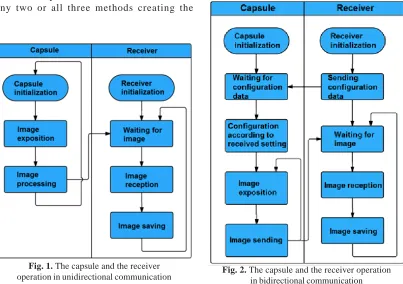
• on the basis of the unidirectional communication, when the endoscopic capsule has a radiotransmitter, and a device that receives images of the digestive tract obtained by the capsule – radio receiver (Figure 1);
• on the basis of the bidirectional communication, when the receiver may also send the configuration data on the capsule (set light-emitting diodes‘(LED) brightness, change resolution, etc.). At that the channel may be either symmetrical (having the same capacity in both directions) or asymmetric (when the capacity in the capsule ’! receiver direction is higher than the capacity in the receiver ’! capsule direction, since the volume of the data sent during the configuration of the capsule is significantly less than the volume of the images coming in the opposite direction). See Figure 2.
Note, that this is not the only option –the waiting configuration information by thecapsule can take place parallel to the main work cycle consisting of exposition and image sending or between the sending oftwo images.
The example of a commercial product, which uses the bidirectional data exchange is an endoscopic capsule Jinshan OMOM. In the capsule Jinshan OMOM the receiver sends one of two commands– adjust the LEDs‘brightness and the image resolution (the first is caused by the lack of the automatic matrix adjustment and/or the brightness of the LEDs based on the obtained
images, and the second – by the presence of the opportunities to increase the image resolution, however, significantly reducing the data transfer rate to 0.5 fps)19-20
Table 1 shows the benefits and the shortcomings of these methods in relation to the developed wireless endoscopic capsule.
Making a decision about the necessary settings before the procedure is trivial, but the ability to use an asymmetric antenna system (focused on the transfer, rather than on the reception) is a significant advantage. At the same time the advantages of the bidirectional communication are leveled by the functional requirements for providing the higher resolution and the data rate at the higher power consumption. Thus, at this stage it would be appropriate to use a unidirectional communication.
Features of radio frequency protocol
Let us consider the features of the radio frequency protocol implementation in terms of reliability of packets delivery and monitoring of their correctness (integrity).
Each radio channel can be characterized by the so-called Bit Error Rate (BER). This quantity is the probability of the error in a randomly selected bit. In fact, the bit error probability is uneven for different bits, however, through the statistical experiment the average value is calculated21
BER is the most important characteristic of the reliability of the data transmission over the air. In general, BER is determined by the signal level at the receiver, the transmitter and the receiver quality. Thus, for fixed transmitter and receiver it is possible to plot a dependency graph of BER on the signal strength at the receiver.
There are non-radiotechnicalmethods for improving BER characteristics: using of noiseless coding (e.g., Reed-Solomon22), which adds
Fig. 1. The capsule and the receiver
operation in unidirectional communication Fig. 2. The capsule and the receiver operationin bidirectional communication
Table 1. Advantages and disadvantages of uni- and bidirectional communication.
Communication Advantages Disadvantages method
Unidirectional Does not require a doctor’s decision on capsule No possibility to adjust the capsule settings before the procedure.Simplification operation for the target research area of the antenna system. before the procedure.
Bidirectional Allows to adjust the capsule to the target Requires a doctor to make a decision research area (to increase the resolution of the before the capsule swallowedMore intestine or the speed for the esophagus complex algorithm of workMore and the stomach) complex antenna system
Thus, the data recovery will not be possible but the set of the received bits can be verified and discarded or put into operation (with a certain probability the checksum of the correct and the incorrect control set may coincide, however, the order of this probability can be estimated as BERN
that, for example, for the CRC16 algorithm and BER that equals 10-4 is equal to 10-64).
The last tool to providethe reliability of the communication is the use of the protocol with confirmation when the transmitter ensures retransmission of the next set of bits when the receiver has not confirmed it for some time.
It is possible to use the combinations of any two or all three methods creating the
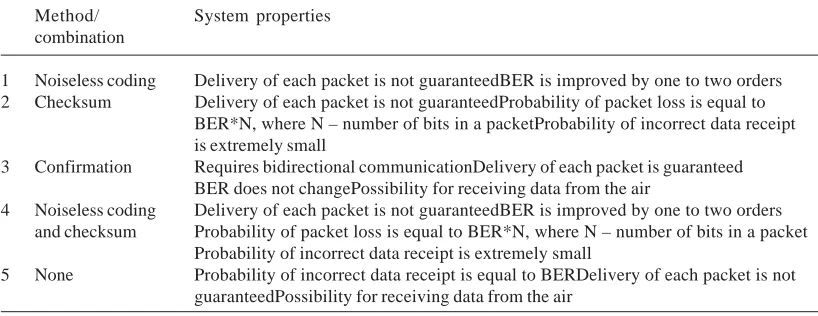
communication system with different properties for different applications. Table 2 showsthe properties of the communication systems that implement the methods listed above and combinations thereof to determine their applicability in the capsule endoscopy.
As can be seen from Table 2, the selection between the items 1-2 and 4-5 can be made only by an experiment.
Table 2. Features of the communication systems that implement various methods of BER improving.
Method/ System properties combination
1 Noiseless coding Delivery of each packet is not guaranteedBER is improved by one to two orders 2 Checksum Delivery of each packet is not guaranteedProbability of packet loss is equal to
BER*N, where N – number of bits in a packetProbability of incorrect data receipt is extremely small
3 Confirmation Requires bidirectional communicationDelivery of each packet is guaranteed BER does not changePossibility for receiving data from the air
4 Noiseless coding Delivery of each packet is not guaranteedBER is improved by one to two orders and checksum Probability of packet loss is equal to BER*N, where N – number of bits in a packet
Probability of incorrect data receipt is extremely small
5 None Probability of incorrect data receipt is equal to BERDelivery of each packet is not guaranteedPossibility for receiving data from the air
Fig. 3. Scheme of the experiment to determine the optimal method to improve the reliability of the radio
channel
Fig. 4. The capsule and the receiver mockup
same hardware, the spatial configuration of the antenna system) with a change at the software level. The experiment was carried out, starting with the simplest mechanism that does not use any of the methods of BER improving (line 5,Table 2) in the direction of complexity – the use of the checksum, the use of the noiseless coding, andthe combination of the noiseless coding and the checksum.
The experiment was carried out according to the scheme is shown in Figure 3, the software uploaded into the endoscopic capsule mockup was modified. The number of the incorrectly transmitted images was calculated. The imagewas considered as an incorrect if the JPEG format was broken that was determined automatically by the software. Since JPEG is a compressed image and has a certain structure of storage, the inability of the correct processing of this structure can be
regarded as an indirect sign of an error in image transmission over the air. The transition from BER to the images was carried out deliberately, because the images are the result of the system performance. The first experiment involved the transfer of the images without using the checksum and noiseless coding. The results are shown in Table 3.
The second experiment involved the transmission of the images using the checksum, the check of whichallowed to discard the packets containing error (Table 4).
Table 3. The experiment without control and recovery mechanisms.
Total Number of Percentage
number incorrect of images images
16500 75 0.45%
16600 28 0.17%
15600 48 0.31%
16100 56 0.35%
Table 4. The experiment using checksum
Total Number of Percentage
number incorrect of images images
15660 2 0.01%
15656 6 0.03%
15685 3 0.02%
16381 9 0.06%
Table 5. The experiment without control and recovery mechanisms in an anechoic
chamber
Total Number of Percentage
number incorrect of images images
16660 1 0.0006%
16754 1 0.0005%
15985 2 0.001%
16240 1 0.0007%
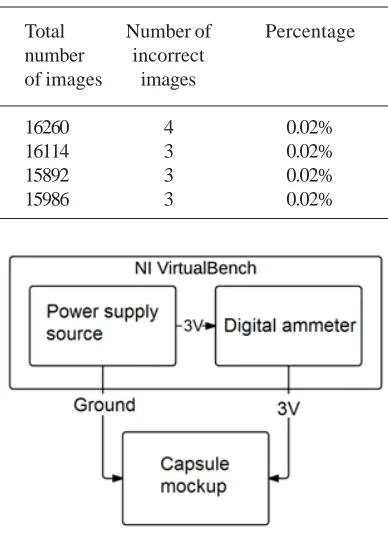
Table 6. The experiment with the use of the Reed-Solomon noiseless coding
Total Number of Percentage
number incorrect of images images
16260 4 0.02%
16114 3 0.02%
15892 3 0.02%
15986 3 0.02%
Table 7. The experiment with the use of the noiseless coding and the checksum
Total Number of Percentage
number incorrect of images images
16182 3 0.02%
16410 3 0.02%
16323 3 0.02%
15984 3 0.02%
Fig. 5. Scheme of the experiment to determine the influence of the noiseless coding on the capsule
power consumption
not an endoscopic capsule). To confirm this hypothesis, we repeated an experiment with the images transmission without the checksum in an anechoic chamber, the walls of which absorb the external electromagnetic fields (Table 5).
This experiment confirmed the hypothesis of receiving the data from the air, which are discarded if the checksum is applied. It also showed that the rejection of all control and recovery
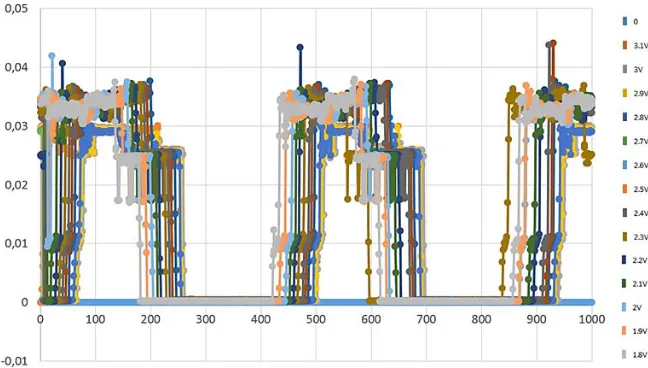
Fig. 6. Capsule consumption at different levels of voltage when using the checksum for radio transmitter
Fig. 7. Capsule consumption at different levels of voltage when using the noiseless coding for radio transmitter
rejection of the control and/or recovery mechanisms is unacceptable.
The third experiment involved the image transmission using the noiseless coding, which allowed to recover the packet in the case of a limited number of errors. The results are shown in Table 6. The result can be interpreted as follows: despite the BER decline, which is predicted for the Reed-Solomon code and a packet length of 32 bytes at the level of the two orders, the percentage of the errors is comparable with the experiment, in which
the checksum was used. This is a consequence of the presence of a small number of incorrect packets, in which there are a large number of incorrect bits. The experiment confirmed the assumption about the uneven distribution of the likelihood of the incorrect bits. In other words, the experiment showedif getting a single incorrect bit the probability of obtaining the second consecutive incorrect bits is significantly higher than BER2.
checksum, however the advantage is insignificant and requires to check other characteristics of the system that are affected by the use of the checksum or the Reed-Solomon code, in particular – the energy consumption, and as a consequence, the battery life of the capsule.
The final experiment was carried out using both the checksum and thenoiseless coding (Table 7).
The result was consistent with the experiment in whichonly the noiseless coding was used. When the recovery was possible (ina few cases), it happened, so the result was slightly better than when using the checksum. However, the main source of the packet‘s loss and, accordingly, the images arethe large groups of invalid bits, which cannot be recovered. Adding the checksum to the noiseless coding has not changed the key indicator– the probability of the image loss.
Now, to select between the noiseless coding and the checksum, compare the consumption of the endoscopic capsule mockup. Since the checksum is implemented strictly at the transmitter crystal and the noiseless coding is programmed, it is energetically more efficient to use the checksum. To confirm this hypothesis and determine the influence of the noiseless coding on the capsule life time, let us carry out an experiment, which scheme is shown in Figure 5.
The first experiment shows a graph of the endoscopic capsule consumption when using the checksum at different levels of the supply voltage (simulating low battery). The graph is shown in Figure 6
The second experiment shows a graph of the consumption when using the noiseless coding (Figure7).
It is clear from the graphs that the excess energy when using the noiseless coding is 5mA during the data transfer (the second “step” in the chart). The average value of the excess is about 2mA. Taking into account the average consumption of the capsule of 16mA, the excess is 12.5%, which, respectively, reduces the endoscopic capsule battery life by 12.5%.
Given the small difference in the number of unrecognizable images it is proposed to use the checksum only.
CONCLUSION
Thus, for the developed wireless capsule and the receiver of the “Landish” capsule endoscopic complex we identified the features for the implementation of the images transmissionprocess. Avalid choice in favor of theunidirectional communication without a wireless capsule configuration was made.
It has been experimentally shown that the non-use of any control mechanisms significantly increases the percentage of “broken” images due to the lack of any software methods of suppression of the high electromagnetic sensitivity of the radio receiving circuit, while the difference between the use of the noiseless coding and the checksums was insignificant (in favor of the noiseless coding ). It was found that the noiseless coding significantly reduces the wireless capsule battery life and the choice was made in favor of the use of the checksums.
In the future it is planned to conduct the testing and the debugging of the data transmission system between the endoscopic capsule and the receiver with the selected in the article approaches. It is expected that the system will have low power consumption and will not yield to the analogues on the efficiency and the quality of the data transfer.
ACKNOWLEDGEMENT
This publication is prepared on the results of scientific research project performed by The NRNU MEPhI and JSC RTI as part of the agreement ¹02.G25.31.0018 on February 12, 2013 between the Joint Stock Company “Radio Engineering Institute named after Academician AL Mints”and the Ministry of Education and Science of the Russian Federation.
This work was performed within the framework of the Cybersecurity Center supported by MEPhI Academic Excellence Project (contract ¹ 02.à03.21.0005, 27.08.2013).
REFERENCES
2. Dmitry Mikhaylov, Andrey Starikovskiy, Vladimir Konev, Andrey Grigorenko, Larisa Shustova. Review of software for automated analysis of digestive tract images. Biosciences Biotechnology Research Asia, December 2014. Vol. 11(3), p. 1109-1114.
3. Barouk J, Sacher-Huvelin S, Le Rhun M, Galmiche JP. Wireless capsule endoscopy: a promising technology? GastroenterolClin Biol. 2002 Oct; 26(10):879-82.
4. KhabibullinTimur, AnpilogovArtem, ShayakovAskar, Konev Vladimir, LebedevGrigoriy, Tolstaya Anastasia and Shinkarenko Anton. Magnetically based hardware-software complex for wireless endoscope capsule control. Biosciences Biotechnology Research Asia, Volume No. 12 Issue No.: 2, 2015. Pages: 1273-1280. 5. Mitselos IV, Christodoulou DK, Katsanos KH,
Tsianos EV. Role of wireless capsule endoscopy in the follow-up of inflammatory bowel disease.
World J GastrointestEndosc. 2015 Jun 10;
7(6):643-51.
6. Mikhaylov Dmitry, Zhukov Igor, Konev Vladimir, Starikovskiy Andrey, KhabibullinTimur, Tolstaya Anastasia, Kukushkin Alexander. Review of features and metafeatures allowing recognition of abnormalities in the images of GIT. 17th IEEE Mediterranean Electrotechnical Conference (MELECON), 2014. 13-16 April 2014. Pages: 231 – 235.
7. A. Karargyris and N.Bourbakis, Detection of Small Bowel Polyps and Ulcers in Wireless Capsule Endoscopy Videos, in IEEE Transactions on Biomedical Engineering, vol. 58, no. 10, pp. 2777-2786, Oct. 2011. 8. Mikhaylov Dmitry, Konev Vladimir,
Starikovskiy Andrey, KhabibullinTimur, KuzminovaAlla. Development of the Software for Recognition of Pathologies in the Images Obtained by the Wireless Endoscopic Capsule and the Atlas of Abnormalities. International Journal of Soft Computing, Volume: 10, Issue: 4, 2015. Pages: 279-286.
9. Kukushkin Alexander, Mikhaylov Dmitry, Ivanova Ekaterina, FedorovEvgeny, Zhukov Igor, Semenov Sergey, Tolstaya Anastasia, Muleys Rami, Starikovski Andrey. Recognition of Hemorrhage in the Images of Wireless Capsule Endoscopy. The 16th IEEE Mediterranean Electrotechnical Conference MELECON 2012. Pages: 899-902.
10. Dmitry Mikhaylov, TimurKhabibullin, Igor Zhukov, Andrey Starikovskiy, LandishGubaydulina, Natalya Romanchuk and
Vladimir Konev. Development of Retention System of the Autonomous Endoscopic Capsule and Its Functionalities. BIODEVICES 2014. Proceedings of the International Conference on Biomedical Electronics and Devices. ESEO, Angers, Loire Valley, France. 3 - 6 March, 2014. Pages 77-84.
11. Mikhaylov D.M., Lebedev G.N., Khabibullin T.R., Shayakov A.F., Zharikov E.S., Anpilogov A.O., Kholyavin V.B., Yokhin M.N. Development of draft design for magnet control system of wireless endoscopic capsule.
Biomedical and Pharmacology Journal, Volume 08, No. 01, 2015. Pages: 495-501.
12. Mikhaylov D.Ì, Khabibullin Ò.R, Shayakov À.F, Shinkarenko À.À, Andryakov D.À, Ovchinnikov I.À, Roslavtsev R.Î. Magnet System Configuration for Wireless Endoscopic Capsule. Biomedical and Pharmacology Journal, Volume 08, No. 02, 2015. Pages: 1049-1057. 13. Mintchev Martin P., Yadid-PechtOrly.
Self-stabilized encapsulated imaging system. US Patent 8,852,083, publication date October 7, 2014.
14. Mikhaylov D.M., Averin A.V., Starikovskiy A.V., Konev V.N. Designing a planar antenna for reading device of the capsule endoscopic complex. Biosciences Biotechnology Research Asia, December 2014. Vol. 11(3), p. 1453-1458. 15. Mikhaylov D.M., Averin A.V., Starikovskiy
A.V., Konev V.N., Kurysheva O.K.
Proposing and modeling a 2.4 GHz antenna for the endoscopic capsule reader. Biosciences Biotechnology Research Asia, April 2015. Vol. 12(1), p. 169-179.
16. Keke Ding, Ying Yu and Hong Lin, Wireless midfield scheme for power transfer and bidirectional data transmission for capsule endoscopy, 2015 IEEE 16th International Conference on Communication Technology (ICCT), Hangzhou, 2015, pp. 522-524. 17. R. Carta and R. Puers, Wireless power and data
transmission for robotic capsule endoscopes,18th IEEE Symposium on Communications and Vehicular Technology in the Benelux (SCVT), 2011, Ghent, 2011, pp. 1-6.
18. C. Feng, P. Mao, T. Bian, L. Yang, X. Zhou and Z. Guan, A medical image transmission system for Wi-Fi based wireless capsule endoscopy,10th International Conference on Computer Science & Education (ICCSE), 2015, Cambridge, 2015, pp. 601-605.
small intestine lesions. Journal of Nobel Medical College (2011), Vol. N.1, pp. 27-39.
20. Liao Z, Gao R, Li F, Xu C, Zhou Y, Wang JS, Li ZS. Fields of applications, diagnostic yields and findings of OMOM capsule endoscopy in 2400 Chinese patients. World J Gastroenterol. 2010
Jun 7;16(21):2669-76.
21. Jit Lim. “Is BER the bit error ratio or the bit error rate?” EDN, 14 December 2010. Retrieved 2015-02-16.