http://www.ijcmph.com pISSN 2394-6032 | eISSN 2394-6040
Original Research Article
Pattern of ocular morbidity in patients attending ophthalmic OPD at
tertiary care hospital, Valsad, Gujarat
Mitali G. Patel
1, Darshan K. Mahyavanshi
1*, Sunil Nayak
1, Aayushi Patel
2,
Brijal Patel
2, Harsh Darji
2INTRODUCTION
Vision is the most important special sense in human being. Normal vision is essential for normal physical, mental, psychological development and education. About 30% of blind population of India lose their eyesight
before the age of 20 years and many of them are under 5 when they become blind.1 This warrants early detection and treatment to prevent permanent disability. The causes of blindness vary widely in different parts of the world although nutritional factors and infections are more common in developing countries, hereditary factors,
ABSTRACT
Background: Vision is the most important special sense in human being. Normal vision is essential for normal physical, mental, psychological development and education. Causes of the preventable blindness are often the result of a combination of factors such as poverty, lack of education and inadequate health-care services. The objectives of the study were to determine the pattern of ocular morbidity in patient attending ophthalmic OPD and to find out the association of most common ocular morbidity with different variables.
Methods: The cross sectional study was conducted in ophthalmic department at GMERS medical college, Valsad, Gujarat, India. It is a part of the research activity during internship period in Community Medicine department. All patients who attended ophthalmic OPD in third week of April at this hospital were enlisted in this study with their consent. The patients were seen in ophthalmic OPD by ophthalmologist, proper anterior and posterior segment evaluation was done. Data includes registration number, name, gender, education, locality, occupation, H/o systemic illness, refractive error and the diagnosis.
Results: In majority of patients attending ophtahlmic OPD were with occular morbidity specifically refractory error and cataract i.e. 54% and 50% respectively. The prevalence of cataract is significantly lesser in <40 years of age, as it is an age related disease. Second most common occular morbidities observed in our study period was conjunctivitis. Cataract has correlation with age, rural locality and female preponderance.
Conclusions: Majority of ocular morbidity were either preventable or treatable. Cataract (65 patients out of 130) being the commonest. If detection is early in the course, prevalence of ocular morbidity can be greatly reduced. The leading causes of ocular morbidity in our study were cataract, a conjunctivitis, and refractive error. A large number of OPD patients were constituted by follow up of cataract surgeries.
Keywords: Ocular morbidities, Eye department, Cataract, Refractive errors and age, Diabetes
1
Department ofCommunity Medicine, GMERS Medical College, Valsad, Gujarat, India
2GMERS Medical College, Valsad, Gujarat, India
Received: 14 September 2017
Revised: 17 January 2018
Accepted: 18 January 2018
*Correspondence:
Dr. Darshan K. Mahyavanshi, E-mail: [email protected]
Copyright: © the author(s), publisher and licensee Medip Academy. This is an open-access article distributed under the terms of the Creative Commons Attribution Non-Commercial License, which permits unrestricted non-commercial use, distribution, and reproduction in any medium, provided the original work is properly cited.
developmental disease and the consequences of prematurity are more frequent causes in countries with better standards of living and health care services.2 Leading causes of blindness in developing countries are trachoma, xerophthalmia, congenital cataract, glaucoma, optic atrophy, retinopathy of prematurity and uncorrected refractive errors Fortunately most of the causes (75%) are either preventable or curable e.g. refractive error, Vit. A deficiency, infections, cataract.3
Objectives
To determine the pattern of ocular morbidity in
patients attending Ophthalmic OPD.
To find out the association of different variables with most common ocular morbidity in these patients.
METHODS
Study design and setting
It is the cross sectional study conducted in ophthalmic department of GMERS Medical College, Valsad, Gujarat, India.
Study duration
April 2017 to October 2017, it is a part of the research activity during internship period in Community Medicine department.
Data collection
Data was collected by pre tested questionnaire which include registration number, name, age, sex, occupation, locality, past history, education and diagnosis were
recorded. The patients were examined by
ophthalmologist and proper anterior and posterior segment evaluation was done. Patients were referred to designated optometrist for refraction correction and given the prescription accordingly. All subjects were tested for vision by Snellen’s E chart for refraction.
Inclusion criteria
All patients who attended ophthalmic OPD in third week of April at this hospital were enlisted in this study with their consent. Study was started only after obtaining permission from institutional ethical committee.
Exclusion criteria
Patients who were not ready for consent has been excluded in present study.
Data analysis
Chi-squared test was applied to study the relationship between ocular morbidities and different variables. P-value less than 0.05 was considered significant.
RESULTS
Table 1 shows age, gender and locality wise distribution of ocular morbidity, it was found that most of the ocular morbidities were observed in >60 years age groups i.e. 30.76% followed by 51-60 age group and which was around 22%. This shows that the prevalence of ocular morbidities is increases with age. When we talk regarding gender related distribution in which it was found that a slightly exceeding number of female 69 (53.08%) patients than male 61 (46.92%), which shows that female are equal aware of their health problems.
Table 1: Age, gender and locality wise distribution of ocular morbidity (n=130).
Characteristics No
(n=130)
Percentages (%)
Age group (in years)
<10 4 03.07
10-20 10 07.69
21-30 17 13.07
31-40 9 06.94
41-50 21 16.15
51-60 29 22.32
>60 40 30.76
Gender
Male 69 53.08
Female 61 46.92
Locality
Rural 92 70.76
Urban 38 29.24
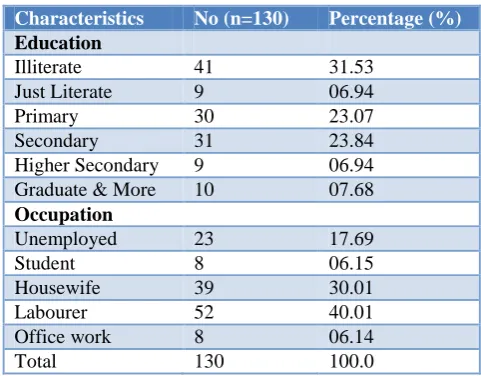
Table 2: Education and occupation wise distribution of ocular morbidity (n=130).
Characteristics No (n=130) Percentage (%)
Education
Illiterate 41 31.53
Just Literate 9 06.94
Primary 30 23.07
Secondary 31 23.84
Higher Secondary 9 06.94
Graduate & More 10 07.68
Occupation
Unemployed 23 17.69
Student 8 06.15
Housewife 39 30.01
Labourer 52 40.01
Office work 8 06.14
Total 130 100.0
found that most of the ocular morbidities were present among labourer 52 (40.01%) followed by housewives 39 (30.01%) and those were unemployed 23 (17.69%). least occular morbidities found those were working like office
work and i.e. 8 (6.14%). It may possible that prevalence of ocular morbidities with low education is confounded by several variables including exposure to sunlight, occupation, hygiene, illnesses and nutritional factors among others.
Table 3: Distribution of patients presence according to different pattern of ocular morbidity (n=130, multiple answer)
Diagnosis No. Percentage (%)
Refractive error 71 54.61
Cataract 65 50.00
Conjuctivitis 15 11.52
Blurred vision 4 03.07
Blindness 2 01.53
Corneal oedema 1 00.77
Corneal opacity 2 01.53
Corneal ulcer 1 00.77
Dacryocystitis 3 02.32
Diabetic retinopathy 1 00.77
Displaced IOL 3 02.32
Episcleritits 1 00.77
Eye pain 2 01.53
Foreign body 3 02.32
Glaucoma 1 00.77
Iridocyclitis 2 01.53
Keratitis 1 00.77
Migrain 1 00.77
Pseudophakia 3 02.32
Pterygium 4 03.07
Retinal Oedema 1 00.77
Squint 1 00.77
Stye 1 00.77
Trauma 3 02.32
Total 130 100
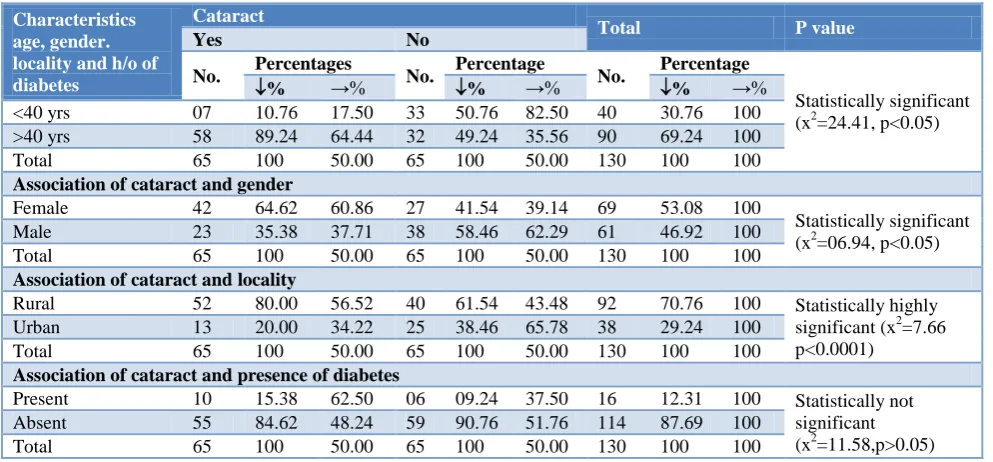
Table 4: Association of occurrence of cataract with age, gender, Locality, and h/o of diabetes (n=130).
Characteristics age, gender. locality and h/o of diabetes
Cataract
Total P value
Yes No
No. Percentages No. Percentage No. Percentage
Statistically significant (x2=24.41, p<0.05)
% →% % →% % →%
<40 yrs 07 10.76 17.50 33 50.76 82.50 40 30.76 100
>40 yrs 58 89.24 64.44 32 49.24 35.56 90 69.24 100
Total 65 100 50.00 65 100 50.00 130 100 100
Association of cataract and gender
Female 42 64.62 60.86 27 41.54 39.14 69 53.08 100
Statistically significant (x2=06.94, p<0.05)
Male 23 35.38 37.71 38 58.46 62.29 61 46.92 100
Total 65 100 50.00 65 100 50.00 130 100 100
Association of cataract and locality
Rural 52 80.00 56.52 40 61.54 43.48 92 70.76 100 Statistically highly
significant (x2=7.66 p<0.0001)
Urban 13 20.00 34.22 25 38.46 65.78 38 29.24 100
Total 65 100 50.00 65 100 50.00 130 100 100
Association of cataract and presence of diabetes
Present 10 15.38 62.50 06 09.24 37.50 16 12.31 100 Statistically not
significant (x2=11.58,p>0.05)
Absent 55 84.62 48.24 59 90.76 51.76 114 87.69 100
Total 65 100 50.00 65 100 50.00 130 100 100
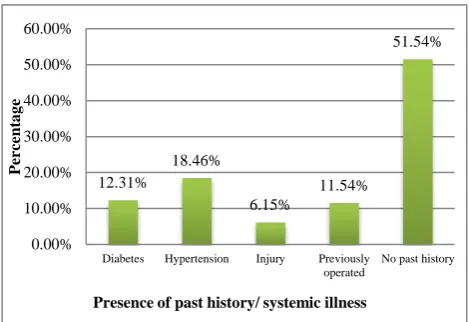
Figure 1: Distribution of ocular morbidity according to presence of past history/systemic illness.
Figure 1 shows distribution of patients ocular morbidity according to presence of any past history / systemic illnessthat, around 52% of patients with no any past h/o or systemic illness while most of the patients presented with past history like hypertension (18.46%) and diabetes (12.31%) followed by other.
Table 3 shows different ocular morbidity observed in 130 patients in which majority of them were came with refractive errors 71 (54.61%) followed by cataract 65 (50%). We found single morbidity or most common morbidity in our study was cataract as refractory error as sign/symptoms of different morbidity like cataract and others. Amongst the refractive error patients almost 92% were with cataract was a leading cause behind their refractive error. We found few cases like pterygium, dacryocystitis, corneal opacity which were around from 2 to 3% of cases.
Table 4 shows the association of occurrence of cataract according to their age, gender, locality, and h/o of diabetes, it was observed that occurrence of cataract is higher in the age group of >40 years above (89.24%) compared to the lower age group and which was statistically significant. Amongst the <40 yrs age group only 17% were with cataract.
As per the Table 4 shows that occurrence of cataract and locality association while done it was found in our study that majority of patients were from the rural locality (80.0%) than urban population, which comes statistically highly significant (x2=7.66, df=1, p<0.0001). This may be due to less awareness, poverty, poor health services availability in nearby easily approachable area and occupation related.
DISCUSSION
Similar study done by Dondona et al also shows that ocular morbidities is more common among female.4 It
was found in our study that most of the patients were belongs to rural population 38 (70.76%) than urban population 92 (29.24%), may be due to more exposure to sun, infections and limited health services availability. Relative study done by Singh et al in rural based settings reported that prevalence of refractive error were more with around 40.80% prevalence.5
In present study it was found that only 6.15% had history of injury while similar study conducted by Sharma et al demonstrated a significant association of cataract with hypertension.6
The prevalence of cataract and gender having some association as is found in table no.4 more in female (64.62%) than compare to male (35.38%) in our present study. However, in our study group majority were females i.e. 54%. Various studies reported from Chandigarh and Maharashtra demonstrated that cataract was commoner in females than males (48.8% vs. 31.9% and 76.6% vs. 67.3% respectively).6,7
A study amongst individuals aged more than 40 years in Maharastra (India) demonstrated that cataract prevalence increased with age; it was just 0.4% in age group of 40-44 years and 24.9% in the age group of 70 years and above.6 Age was found to be significantly associated with cataract in our study (x2=24.41, df=1, p<0.05). The close association of cataract with increasing age has been well documented by studies in India.8
In our present study it was found that there is no association between cataract and diabetes (x2=11.58, df=1, p>0.05). While study conducted in Chandigarh by Sharma M et al in 2009 found that cataract prevalence was more in diabetics than in non-diabetics (81.5% versus 70.1%).6 similar study done even in 80s by Hiller et al reported that diabetes mellitus and cataract was significantly associated as in >65 years age-groups, the association became significant.9
CONCLUSION
Majority of ocular morbidity were either preventable or treatable. Cataract (65 patients out of 130) being the commonest. If detection is early in the course, prevalence of ocular morbidity can be greatly reduced. The leading causes of ocular morbidity in our study were cataract followed by a conjunctivitis, and refractive error. A large number of OPD patients were constituted by follow up of cataract surgeries.
This shows that institute has a good infrastructure to provide surgical treatment for cataracts. The high prevalence of refractive errors and cataracts shows that hospital still requires mobile eye care units to collect cataract patients from rural areas for operating them in hospital as well to provide awareness activity in schools and villages.
12.31%
18.46%
6.15%
11.54%
51.54%
0.00% 10.00% 20.00% 30.00% 40.00% 50.00% 60.00%
Diabetes Hypertension Injury Previously operated
No past history
Pe
rc
en
ta
g
e
Funding: No funding sources Conflict of interest: None declared
Ethical approval: The study was approved by the Institutional Ethics Committee
REFERENCES
1. Vision screening in school children. Training
module. Danish Assistance to the National Programme for Control of Blindness. New Delhi, India: 1.
2. Global Initiative for the Elimination of Avoidable Blindness: action plan 2006-2011. WHO, 2007.
3. Minto H, Gilbert C. Low vision: we can all do more.
Community Eye Health. 2012;25(77):1.
4. Dandona R, Dandona L. Review of findings of the Andhra Pradesh Eye Disease Study: policy implications for eye-care services. Indian J Ophthalmol. 2001;49(4):215-34.
5. Singh MM, Murthy GV, Venkatraman R, Rao SP,
Nayar S. A study of ocular morbidity among elderly population in a rural area of central India. Indian J Ophthalmol. 1997;45:61-5.
6. Sharma M, Kumar D, Mangat C, Bhatia V. An
Epidemiological Study of Correlates of Cataract
Among Elderly Population Aged Over 65 Years In UT, Chandigarh. Internet J Geriatrics Gerontol. 2009;4(2):1-5.
7. Limburg H, Vaidyathan K, Pampativar KN.
Cataract blindness on the rise? Results of a door-to-door examination in Mohadi. Indian J Ophthalmol. 1996;44(4):241–4.
8. Raizada IN, Mathur A, Narang SK. A study of
prevalence and risk factors of senile cataract in rural areas of Western U.P. Indian J Ophthalmol. 1984;32(5):339-42.
9. Hiller R, Robert D. Sperduto, Ederer F.
Epidemiologic associations with cataract in the
1971-1972 National Health and Nutrition
Examination Survey. Am J Epidemiol.
1989;118(2):239-49.