Original Research Article
Utilization of vitamin A supplementation services in high
priority districts of Bihar
Nivedita Sinha,
Rajesh R. Sinha, Ajay Krishna,
Rashmi Singh*
INTRODUCTION
Vitamin A (VA) is an important micronutrient needed for good functioning of immune system, skin, eyes, mucosa and overall growth and development. Its deficiency causes night blindness, xerophthalmia, increased morbidity and mortality. Globally 5.2 million and 190 million preschool children suffer from clinical and sub clinical VA deficiency respectively and 85% of the children with xeropthalmia in the South East Asian regions reside in India.1 Preschool children in developing countries are most vulnerable to VA deficiency (VAD).
To combat VAD, VA supplementation (VAS) programs, through biannual campaigns targeted at children between 6 and 59 months, are implemented in 80 countries of the world.2 India launched the National Prophylaxis Program Against Nutritional Blindness (NPPNB) in 1970. There was a definite reduction in the magnitude of xeropthalmic blindness thereafter and a sharp decline in incidence of Bitot spots.3 The target group for VAS initially was 9 to 36 months, which was later revised to 6 and 59 months in 2006.4 In 2006, Government of India (GOI) mandated ‘universal VAS’ to every infant 6 to 11 months and child
ABSTRACT
Background: Vitamin A deficiency (VAD) is a major preventable public health problem. Prevalence of VAD in preschool children was 5.7% (India), and 4.5% (Bihar). India is implementing biannual Vitamin A Supplementation (VAS) since 2007 along with 80 other countries. VAS was originally proposed as a short term measure, followed by dietary improvement. Since vulnerability to VAD is more in high priority districts (HPDs), it was deemed worthwhile to study the extent to which VAS programme is utilized in the 10 HPDs of Bihar with respect to the processes involved and the ultimate outcome of empowering the community with knowledge and capacity to combat VAD on their own.
Methods: Cross sectional observational study conducted in 6 randomly selected blocks and 5 session sites per block of the 10 HPDs. 300 sites sampled for processes and 893 caregivers interviewed for their knowledge.
Results: Out of 300 sites, 269 sites found functional, 30.85% sites had due lists and 30.11% had MCP cards; 20.44% had adequate VA. IEC displayed at 52.78% and 71.3% sessions conducted in shade. In 79.55% sites efforts made to determine age of child before administration. Correct use of recommended spoon known to 80.66%, benefits of VA to 76.57% and diseases due to VAD to 81.7% of FLWs. Knowledge regarding VA good in 33.4% of caregivers, average in 35.5%, and poor in 30.9%.
Conclusions: Crucial gaps found in necessary inputs and conduct of VAS. Community knowledge found lacking for sustainable programme withdrawal. Better programme management will improve utilization.
Keywords: VAS, VAD, Utilization, Frontline workers, Caregivers
Department ofCommunity Medicine, Patna Medical College, Patna, Bihar, India
Received: 02 December 2017
Accepted: 02 January 2018
*Correspondence:
Dr. Rashmi Singh,
E-mail: [email protected]
Copyright: © the author(s), publisher and licensee Medip Academy. This is an open-access article distributed under the terms of the Creative Commons Attribution Non-Commercial License, which permits unrestricted non-commercial use, distribution, and reproduction in any medium, provided the original work is properly cited.
1 to 5 years, every 6 months through policy document as a short term strategy.4
Experiences in Philippines, Bangladesh and South African countries show that high dose VAS is an effective short term means to combat VAD in developing countries.5-7 However, the approaches vary, some using capsules, others VA solutions and some targeted towards high risk groups only.
With the reported VAD prevalence in Bihar of 4.5%, it was clearly a public health problem warranting intervention as per WHO guidelines.8,9 Evidences from some countries support the need for campaign mode of VAS in high priority areas.2 In Bihar, apart from routine immunization (RI), VAS is administered universally in biannual intensive rounds: 2 days at fixed session sites and 2 days house to house for mop ups in community.10
It is important to realize that VAD occurs most commonly in areas with poor health indices and services. Both these factors operate in Bihar. Based on health indicators 10 districts are categorized as high priority districts (HPDs) in terms of health risks.11 It is especially important to examine whether the VAS rounds have been useful in these districts especially when the point of contention in our country remains the quality and utilization of the services provided during these rounds.
More than 10 years have elapsed since the introduction of intensive VAS in Bihar, initially as a short term measure, the process of which was intended to empower the community to prevent VAD themselves by knowledge and practices. Several researches have questioned the utility of continuation VAS.2 Before withdrawing VAS it is important to examine the feasibility of this step. Hence it was deemed worthwhile to study the extent to which VAS program has been utilized in the 10 HPDs of Bihar with respect to the processes involved and the ultimate outcome that is increase in knowledge and capacity to combat VAD on their own.
So the objectives of this study were:
General
To study the utilization of Vitamin A Supplementation services in High Priority Districts of Bihar (HPDs).
Specific
1. To assess the availability of logistics which impact utilization.
2. To observe the activities at fixed VAS sites.
3. To assess the knowledge of community regarding VA & VAS as an indicator of utilization.
METHODS
It was a cross-sectional descriptive study conducted at the fixed VAS session sites in 10 HPDs and exploratory for
assessment of knowledge regarding VAS in the community. The study was conducted during the biannual 4 day intensive VAS round of June 2016. Multistage random sampling method was used to select the VAS sites and beneficiaries attached to the sites. 6 blocks were randomly selected in each of the HPDs; in each selected block, 5 VAS session sites were randomly selected. It was proposed to sample 300 HPD fixed sites for availability of logistics, assessment of activities and knowledge of FLWs.
For assessment of knowledge of caregivers, sample size 893 was calculated considering prevalence of awareness as 32.6%,relative error of 10% plus 5% to take care of the non available caregivers and non-functioning sites.12 Using the microplans of selected sites, 3–4 children aged 9 to 59 months were randomly selected from the households attached to the site.
Study tools and techniques
Checklist used to collect information on availability of logistics and conduct of activities at session sites. Pre tested structured questionnaire was used to assess knowledge of FLWs about VAS and VAD.
Knowledge of caregivers regarding VA and VAS was assessed by Interview schedule using a set of 8 questions.
Study variables
Information was gathered on the number of functional sites. From these sites, information regarding availability of tally sheets, MCP cards, due lists and VA solution were noted. Activities such as conduct of session in shade, proper dosing with correct use of spoon after age determination, dissemination of information, education and communication (IEC) regarding VA were observed and noted. Knowledge of FLWs was assessed regarding dose according to age, benefits and sources of VA, and VAD. Knowledge of caregivers regarding VA benefits, deficiencies, sources, prevention and supplementation were assessed.
Data was collected by team from Patna Medical College which visited and observed the selected sites on scheduled dates and conducted the interviews.
Data analysis
Data from checklists and FLWs questionnaire were entered in MS Excel 2007 and analysed for percentages and proportions.
and prevention. Out of total score of 40, score between 0 to 10 was inferred to be ‘Poor’ knowledge, score between 11 to 30 as ‘Average’ knowledge and score of 31 and
above as ‘Good’ knowledge about VA..
RESULTS
Out of a total of 300 sites visited, only 269(89.66%) were found operational on day of visit. So observations were made on 269 sites only. In 2 districts only about 50% sites were found functional.
Availability of logistics
Tally sheets were available in only 157(58.36%) of operational sites, one district (Jamui) having them in only 6 (20%) sites. Mother and Child Protection (MCP) card was available in only 81 (30.11%) of sites. Due lists (DL) were available in only 83 (30.85%) of sites. In one of the districts (Araria), only 2 (12.5%) of sites were having DL. Adequate amount of VA as per microplan was available in 55 (20.44%) of sites (Table 1).
Table 1: Availability of logistics.
Sl.
No. Name of district
No. of functional sites (%)
Availability of tally sheet (%)
Availability of MCP card (%)
Availability of due list (%)
Availability of adequate amount of vit A (%)
1. Kishanganj N=30 30/30 23 (76.6) 13 (43.3) 13 (43.3) 08 (26.6)
2. Katihar N=26 26/30 13 (50) 06 (23.07) 06 (23.07) 01 (3.8)
3. Motihari N=30 30/30 15 (50) 12 (40) 06 (20) 06 (20)
4. Jamui N=30 30/30 06 (20) 01 (3.3) 10 (33.3) 09 (30)
5. Purnea N=30 30/30 27 (90) 17 (56.6) 14 (46.6) 09 (30)
6. Araria N=16 16/30 08 (50) 04 (25) 02 (12.5) 06 (37.5)
7. Sheohar N=30 30/30 30 (100) 10 (33.3) 12 (40) 06 (20)
8. Gaya N=30 30/30 14 (46.6) 08 (26.6) 05 (16.6) 01 (3.3)
9. Saharsa N=30 30/30 11 (36.6) 07 (23.3) 11 (36.6) 05 (16.6)
10. Sitamarhi N=17 17/30 10 (58.8) 03 (17.64) 04 (23.52) 04 (23.52)
Total 269/300 157 (58.36) 81 (30.11) 83 (30.85) 55 (20.44)
Table 2: Conduct of activities at session sites.
S.
No. Name of District
Display of IEC material (%)
Conduct in Shade (%)
Age determining before giving VA (%)
Use of
Recommended spoon (%)
Key msgs being given to caregivers (%)
1. Kishanganj N=30 16 (53.3) 22 (73.3) 30 (100) 26 (86.6) 14 (46.6)
2. Katihar N=26 26 (100) 12 (46.1) 18 (69.23) 19 (73.07) 04 (15.4)
3. Motihari N=30 17 (56.6) 28 (93.3) 28 (93.3) 30 (100) 30 (100)
4. Jamui N=30 09 (30) 11 (36.6) 14 (46.6) 14 (46.6) 15 (50)
5. Purnea N=30 15 (50) 29 (96.6) 28 (93.3) 29 (96.6) 17 (56.6)
6. Araria N=16 09 (56.2) 03 (18.7) 13 (81.25) 14 (87.5) 08 (50)
7. Sheohar N=30 14 (46.6) 30 (100) 30 (100) 30 (100) 11 (36.6)
8. Gaya N=30 18 (60) 29 (96.6) 25 (83.3) 27 (90) 11 (36.6)
9. Saharsa N=30 15 (50) 15 (50) 15 (50) 15 (50) 06 (20)
10. Sitamarhi N=17 03 (17.6) 13 (76.4) 13 (76.4) 13 (76.47) 03 (17.6)
Total 142 (52.78) 192 (71.37) 214 (79.55) 217 (80.66) 109 (40.5)
Conduct of session
Materials for information education and communication (IEC) like posters, banners and slogans were displayed in 52.78% of sites visited, display in sites of Sitamarhi was lowest (17.6%). Session was being conducted in shade in 71.37% of sites. All sites were adhering to this protocol Sheohar district but only 18.7% sites of Araria district.
The FLWs were determining age of beneficiaries by verifying the MCP card or asking caregivers before
Knowledge of FLWs regarding vitamin A
Encouragingly 76.57% of the FLWs knew of the benefits of VA. The knowledge varied from 33.3% in one district (Jamui) to 100% in others (Motihari and Sheohar). Majority (66.17%) of the FLWs knew about the
difference in dose as per the age of the beneficiaries. This knowledge again varied from as low as 33.3% in some districts to 86.6% in the best district. VAD diseases were known to overall 81.7% of FLWs but to only 50% of them in Jamui (Table 3).
Table 3: Knowledge regarding Vitamin A among FLWs.
Name of district
Knowledge of FLWs regarding benefits of Vit. A
Knowledge of FLWs regarding correct dose a/c to age
Knowledge of FLWs about VAD
Kishanganj N=30 28 (93.3) 26 (86.6) 30 (100)
Katihar N=26 24 (92.30) 15 (50) 25 (96.15)
Motihari N=30 30 (100) 25 (83.3) 30 (100)
Jamui N=30 10 (33.3) 10 (33.3) 15 (50)
Purnea N=30 28 (93.3) 25 (83.3) 28 (98.3)
Araria N=16 10 (62.50) 10 (33.3) 12 (75)
Sheohar N=30 30 (100) 21 (70) 30 (100)
Gaya N=30 18 (60) 18 (60) 18 (60)
Saharsa N=30 15 (50) 15 (50) 18 (60)
Sitamarhi N=17 13 (76.47) 13 (43.3) 14 (82.35)
Total 206 (76.57) 178 (66.17) 220 (81.7)
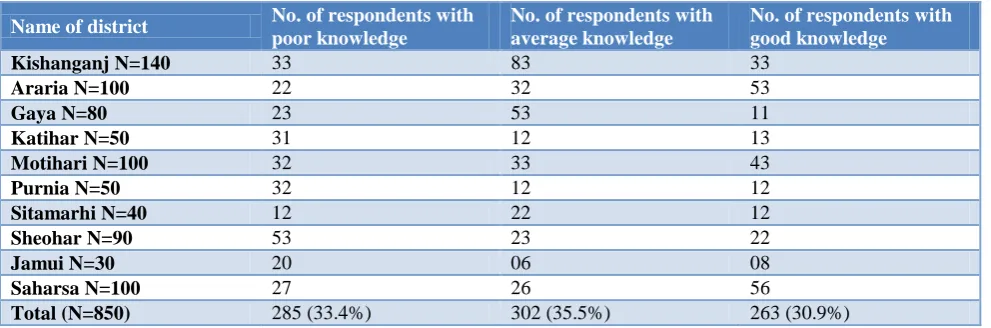
Table 4: Knowledge of caregivers regarding Vitamin A.
Name of district No. of respondents with
poor knowledge
No. of respondents with average knowledge
No. of respondents with good knowledge
Kishanganj N=140 33 83 33
Araria N=100 22 32 53
Gaya N=80 23 53 11
Katihar N=50 31 12 13
Motihari N=100 32 33 43
Purnia N=50 32 12 12
Sitamarhi N=40 12 22 12
Sheohar N=90 53 23 22
Jamui N=30 20 06 08
Saharsa N=100 27 26 56
Total (N=850) 285 (33.4%) 302 (35.5%) 263 (30.9%)
Knowledge of caregivers regarding vitamin A
Interview of caregivers to test their knowledge about sources, benefits, deficiencies of VA, prevention of VAD, and VAS programme showed that 285(33.4%) of them had ‘Poor’ knowledge; 302(35.5%) had ‘Average’ knowledge and 263(30.9%) had good knowledge (Table 4).
DISCUSSION
There is lack of data regarding VAS and VAD.2 However on evaluating the effectiveness of the Bihar model of biannual intensive VAS some salient observations regarding its processes which affect utilization emerged for discussion.
Availability of logistics
All sites were functioning in only 7 of the 10 districts. Since this affects accessibility of the service, utilization of VAS program is likely to be impaired. In some districts, the District Health Managers ensured the opening of several sites after the visit. This points to importance of supportive supervision in the success of a public health program.
Tally sheets are important documents in any
immunization drive because they help to identify the target children and also estimate the coverage in high
priority and marginalized groups. However its
MCP cards were in available in less than a third of the sites. Reasons cited varied from ‘no prior knowledge of the session’ to ‘will arrange the cards’ to ‘personal engagements’ to ‘some other staff have been trained for the purpose.’ The last plea was mostly given by the Anganwadi workers who had shifted the responsibility of the whole process of conduct of VAS session to the ASHA workers. This in turn meant that in more than two-thirds of sites the documentation of the VAS was weak. Even among the caregivers, very few came with their MCP cards. It can also be inferred therefore that the recording of age of the beneficiary was verbal and unreliable.
Due List (DL) is the instrument for identifying the beneficiaries, micro-planning and estimation of coverage. It was sadly lacking in most sites. Many of the FLWs cited lack of DL to lack of coordination with ANMs and administrative delays. However, the impression of the study- team was that it was mainly due to apathy on part of the Anganwadi workers in the preparing the DL. This also raised doubts on the correctness of the reporting to the district headquaters. The random selection of households for interview of caregivers of eligible children helped the study team to confirm administration of VA and to find gaps in coverage. However it was not possible to find all children who had missed the dose on this account. Officials from state, district and block are mandated to conduct supervision of 10% of sites during biannual rounds.13 Additional monitoring and supervision by third parties is also done and coverage reported after triangulation. However availability of DL in only approximately 30%of sites raises doubts about the correctness of reported coverage.
Since the availability of DL was poor, hence verification of the adequate amount of VA as per DL logically is unsatisfactory. Overall less than the required amount had been procured and supplied. There were also bottlenecks in the supply chain, at some sites only partial amount of VA was supplied. In Odisha, procurement of VA has been managed since 2006 by the state government. The supply is received within 60 days of tendering. From the districts, they are distributed to blocks and thereafter to ANMs during routine meetings prior to the round. Supply order is placed for the two rounds (biannual) at once. On the other hand procurement in Bihar is decentralized – districts place the order and make their own payments while the state is responsible for the tendering process.13 This leads to delays and hampers the program.
It is also worth mentioning here that since MCP cards were available in overall 27% of sites only, so in the rest that is about 73% of the sites, the FLWs were determining the age by verbal interrogation from caregivers.
Conduct of activities at session sites.
Media and inter personal communication (IPC) are used to promote public health programs. IEC materials are to
be provided at sites to create background awareness about sources and benefits of VA. Through IPC, FLWs are to reinforce information in caregivers. Increase in awareness and capacity in community to prevent VAD is the ultimate validation of the utilization of VAS services.
Most of the sites however were found wanting in this regard. Materials had not been delivered to many sites. Even though the FLWs were themselves aware, only 40.5% were conveying this knowledge to the caregivers. While at some busy sessions, the load of beneficiaries was the reason cited, in others, a generalized apathy towards counseling was observed. The FLWs believed that their responsibility was confined to administration of VAS only. In a few sites, it was observed by the study team hat the banners given for display were being used as table cloths and spread on the ground for sitting upon.
An important component of VAS rounds is age determination and confirming that the vitamin has not been administered within last six months. MCP cards are the best tool for this purpose but as stated, MCP card was available in less than a third of the sites. Most caregivers also had not retained the card. However in the absence of MCP card, the correctness of age was questionable. In these circumstances, there was a serious danger that a child could be re-administered even before the recommended gap of six months, which could further result in features of hypervitaminosis. It was disturbing that most of the FLWs were not aware of the seriousness of this lapse. The visit of study team presented a window of opportunity for communication in this regard.
Administering age-specific dose of VA is important for which calibrated spoon is recommended. FLWs were using the recommended spoon in only 46.6% sites. The reason given was mostly ‘no knowledge’ regarding use of the spoon. In Nepal and Africa14,15 capsules are used instead of solution which is more convenient. 2
Knowledge of FLWs regarding vitamin A
The knowledge expected was regarding benefits of VA, its role in prevention of VAD, correct dose as per age, and food sources. It was encouraging that in most of the districts, the majority of the FLWs had the knowledge. It is noteworthy that those districts where this knowledge was reinforced in the mandatory workshop held a few days prior to the intensive VAS round, performed better.
Unfortunately only two thirds of FLWs knew about dose according to age. The team therefore took the opportunity to tell them about the correct dose and its importance. Pre-round trainings are given in Bihar but as per observations of our study, they need to be improved. Close monitoring using objective indicators as in as concluded in a study conducted in Haryana could be effective.18
Knowledge of caregivers regarding vitamin A
Caregivers knowledge was tested on crucial domains of knowledge and practices regarding VA & VAD. About 66.5% respondents had average to good knowledge.
A study in Bangladesh concluded that although VA capsule distribution program is the most effective strategy to reduce VAD, awareness of community needs to be ascertained before withdrawal. 6 A study conducted in Nepal 15 found that about 79% mothers knew about the first signs of VAD and 95% mothers knew about night blindness. Also 91% mothers grew VA rich foods in their kitchen gardens for consumption. The FLWS were main sources of information.
Knowledge of caregivers was incentivized in Tanzania 17 where only 49% of caregivers knew the benefits of VA and 45% knew about its sources. Similar study in Ghana revealed that 67.7% did not know about any natural sources of Vit A while 62.7% did not know about any medical effect of vitamin A deficiency.16 These observations show that though majority caregivers have some knowledge, it needs to be reinforced and it is not sufficient to makes them self-reliant with regards to VAD.
CONCLUSION
The ultimate long term strategy for combating VAD is dietary improvement through rich sources of VA. Our study shows, that knowledge and practices in this regard are deficient in target caregivers of HPDs. This points to weak program management also endorsed by crucial gaps in availability of logistics and conduct of sessions. This is a strong reason to continue VAS program. However, the program needs strengthening and monitoring. Incentives to FLWs as well as caregivers could be given. Cash/valediction incentives for those workers who objectively impart better nutrition education strengthen the program. Studies also support this view. Availability of MCP cards, tally sheets and DLs are crucial indicators of utilization. Monitoring of intensive VAS rounds by Government and NGOs should be pepped up.
Limitations
Coverage of VAS which is an important indicator of utilization could not be ascertained. Study of clinical and subclinical VAD also needed.
ACKNOWLEDGEMENTS
We are grateful to State Health Society, Bihar for their administrative and logistic support in conducting the study.
Funding: No funding sources Conflict of interest: None declared
Ethical approval: The study was approved by the Institutional Ethics Committeeof Patna Medical College
REFERENCES
1. World Health Organization. Global prevalence of vitamin A deficiency in populations at risk 1995-2005: WHO global database on vitamin A deficiency. Geneva: World Health Organization; 2009: 17. Available at: http://www.whqlibdoc. who.int/publications/2009/9789241598019eng.pdf. Accessed on 10 November 2017.
2. Wirth JP, Petry N, Tanumihardjo SA, Rogers LM,
McLean E, Greig A et al. Vitamin A
Supplementation Programs and Country- Level Evidence of Vitamin A Deficiency. Nutrients. 2017;9:190.
3. Kapil U, Sachdeva HP. Massive Dose Vitamin A Programme in India-Need for a Targeted Approach. Indian J Med.Res.2013;138(3):411-7
4. Policy on Micronutrient – Vitamin A. No. N.Z 28020 30/2003-CH Government of India, MOHFW, 2006.
5. Pedro MR, Madriaga JR, Barba CV, Habito RC, Gana AE, Deitchler M et al. The National Vitamin A Supplementation Programme and Subclinical Vitamin A deficiency Among Pre school children in Phillipines. Food, Nutr Bull. 2004;25(4):319-29.
6. Bloem MW, Hye A, Wijnroks M, Ralte A. The Role
of Universal Distribution of Vitamin A Capsules In Controlling Vitamin A Deficiency In Bangladesh. Am J Epid. 1995;142(8):843-55.
7. Press Centre, Unicef. Available at
https://www.unicef.org. Accessed on 11 November 2017
8. Strategies For Vitamin A Administration :Report of the Expert Committee, ICMR; MOHFW, GOI, 2002
9. WHO recommendations. Available at www.who.int.
Accessed on 15 July 2017.
10. Letter No SHSB /1751 dated 9th March 2016/ File no /11/MI/2001/IV/ Part file.
11. Source-Press Information Bureau GOI, MOHFW- 24th April 2015.
12. Sheth AM, Rangoonwala MM, Lodhiya KK,
Zalavadiya DD, Joshi NB. A Study On Awareness And Practice Regarding Vitamin A Intake and Its Deficiency Disorders Among Mothers of Preschool Children In Khirasara Village, Rajkot, Gujarat. Ntl J Community Med. 2016;7(6):505-9.
Reasons For success In States of Bihar and Odisha. Food Nutr Bull. 2014;35(2):203-10
14. Rahman A, Saptoka M. Knowledge of Vitamin A Rich Foods Among Mothers of Preschool Children in Nepal: Impacts On Public Health and Policy Concerns. Sci J Public Health. 2014;2(4):316-22. 15. Hadzi D, Asalu GA, Avedzi HM, Appiah PK,
Tarkang EE. Vitamin a Supplementation Coverage and Correlates of Uptake Among Children 6-59 Months in the South Dayi District, Ghana. Central African J Public Health. 2016;2(2):89-98.
16. Nyhus DC, Dhillon CN, Subramaniam H, Mulokozi
G, Rambelosone Z, Klemm R. Overestimation Of Vitamin A Supplementation Coverage From District
Tally Sheets Demonstrates Importance Of
Population –Based surveys For Program
Improvement: Lessons from Tanzania. PLOS ONE. 2013;8(3):e58629.
17. Oyunga MA, Omondi DO, Grant FKE. Awareness in the Context of Prevalence of Vitamin A Deficiency Among Households in Western Kenya Using a Cross-Sectional Study. J Food Nutrition Sci. 2016;4(3):55-64.
18. Singh MM, Devi R, Gupta S. Effectiveness of training on the knowledge of vitamin A deficiency among Anganwadi workers in a rural area of north India. Indian J Public Health. 1999;43(2):79-81.