Original Research Article
Knowledge and practices pertaining to menstruation among the school
going adolescent girls of UHTC/RHTC area of Government
Medical College, Kota, Rajasthan
Preeti Gupta
1, Jini Gupta
2*, Govind Singhal
3, Bharat Meharda
4INTRODUCTION
Adolescents are a large and growing segment of the world’s population where more than half of the world’s population is below the age of twenty five defined as a
UNICEF report (The State of World’s Children 2011), it is estimated that there are 1.2 billion adolescents aged 10- 19 years in the world, forming 18% of world population and about 88% of them live in developing countries. In India, adolescent accounts for 20% of countries
ABSTRACT
Background: To achieve the goal of Millennium Development Goal 2 (universal education), 3 (gender equality and women empowerment) and, 5 (improving maternal health), it is important that there is effective menstrual hygiene and knowledge among adolescent girls since it has direct and indirect effects both to achieve the MDG and to promote the reproductive health. A study was carried out among the school going adolescents in UHTC (Urban Health Training centre) and RHTC (Rural Health Training centre) area of Department of Community Medicine, Government Medical College, Kota, Rajasthan with the following aims and objectives, Status of knowledge of school going adolescent girls about menstruation and their practice during menstruation. The objective of the study was to assess the knowledge and practices regarding menstruation among school going adolescents.
Methods: It was a school based descriptive cross sectional study conducted from November 2016 to March 2017. The school was selected randomly in RHTC and UHTC area of GMC, Kota. A pretested and structured questionnaire was used. Data was entered, processed and analyzed using SPSS version 20.
Results: In this study there were 300 girl students (150 each from RHTC and UHTC area schools), of which 55.33% had menarche at the age of 13 years, 66.00% of girls were aware about menstruation before the menarche whereas 91.67% of girls heard about the sanitary napkins, most of the girls (81.00%) had got the knowledge about menses from their mother, 62.67% of girls heard about the menstrual hygiene and for practices observed, 65.67% girls were using sterilized sanitary napkins and 42.00% of girls burn the waste material.
Conclusions: Traditional beliefs regarding menstruation still persist and menstrual hygiene among the adolescents was found to be unsatisfactory. It highlights the need of targeted interventions to raise awareness and provision of family health education package to all girls. Menstrual hygiene is an issue that needs to be addressed at all levels.
Keywords: Knowledge, Menstrual hygiene, Millennium development goal, Intervention
1
Associate Professor & Head of Dept, 3Assistant Professor, Department of Community Medicine, Government Medical College, Kota, Rajasthan, India
2Department of Obstetrics and Gynaecology, Pacific Institute of Medical Sciences, Umarda, Udaipur, Rajasthan, India 4Assistant Professor, Department ofCommunity Medicine, JLN Medical College, Ajmer, Rajasthan, India
Received: 30 November 2017
Accepted: 29 December 2017
*Correspondence:
Dr. Jini Gupta,
E-mail: [email protected]
Copyright: © the author(s), publisher and licensee Medip Academy. This is an open-access article distributed under the terms of the Creative Commons Attribution Non-Commercial License, which permits unrestricted non-commercial use, distribution, and reproduction in any medium, provided the original work is properly cited.
rapid growth and development. Although adolescence is an important era and healthy period of life, many are often less informed, less experienced, and less comfortable in accessing reproductive health information and services, which may affect their entire life span. Adolescence in girls has been recognized as a special period which signifies the transition from girlhood to womanhood due to Menarche, which is the most important event in the life of an adolescent girl.
By year 2025, the population of adolescents in developed and developing countries would be around 19% and 27% respectively. Adolescents have to face a challenge during puberty due to hormonal, psychological, cognitive and physical changes.2
Menstruation and its practices are still clouded by taboos and socio-cultural restrictions resulting in adolescent girls remaining ignorant of the scientific facts and hygienic health practices.3,4
As a result many young girls lack appropriate and sufficient information regarding menstrual hygiene, which may result in incorrect and unhealthy behaviour during their menstrual period. Poor personal hygiene and unsafe sanitary conditions may contribute the situation to become worse in the girls facing many gynaecological problems.
METHODS
A school based descriptive cross sectional study was done with the questionnaire distributed to be filled by participants on the basis of their recall memory. RHTC, Digod and UHTC, Mahaveer Nagar, Kota was chosen for rural and urban area respectively under GMC, Kota, Rajasthan. The study was conducted in four schools of
Digod RHTC area and three schools of UHTC area which were selected randomly to complete the desired sample size of 150 from each RHTC and UHTC area. The study was done during the period of November 2016 to March 2017. Girls of class 5th to 12th were included and those who had not given consent and those who had not completed questionnaires were also excluded from study. Total 300 girl students from the age group 10 to 19 years and those who already had menarche and completed the questionnaire were included in the study.
Due care was taken for gender sensitivity and data was collected by the team comprising of doctor, nurse, social worker and school teacher through a scheduled visits. The questions were administered in Hindi and properly explained to avoid any form of misunderstanding and to facilitate accurate response by the subjects. The questionnaires were distributed and collected immediately after completion to prevent interpersonal communication and influence of peers on individual responses amongst the girls. Data was collected from students who were available at the time of data collection. A predesigned, pre-tested structured self- administered questionnaire was used for data collection. Data were entered into Microsoft Excel and then transferred to Statistical Package for Social Sciences (SPSS) 20.0 version. Descriptive statistics like frequency, mean, standard deviation and percentage were determined. Chi- square value was used for significance level. P<0.05 was considered significant.
RESULTS
In this study there were 300 girl students (150 each from RHTC and UHTC area schools), of which 52.67% were from 13 – 15 years of age group followed by 16 years and above with 30.33% of students (Table 1).
Table 1: Distribution of study subjects according to age and area (n=300).
Age group UHTC (n=150) No. (%) RHTC (n=150) No. (%) Total (n=300) No. (%)
10–12 30 (20.00) 21 (10.40) 51 (17.00)
13–15 85 (56.67) 73 (40.20) 158 (52.67)
16 and above 37 (24.67) 44 (29.33) 91 (30.33)
Total 150 (100.0) 150 (100.0) 300 (100.0)
Table 2: Distribution of study subjects according to age of menarche and area (n=300)
Age group UHTC (n=150) No. (%) RHTC (n=150) No. (%) Total (n=300) No. (%)
09 1 (0.67) 0 (0.00) 1 (0.33)
10 3 (02.00) 3 (02.00) 6 (02.00)
11 4 (02.67) 2 (01.33) 6 (02.00)
12 21 (14.00) 23 (15.33) 44 (14.67)
13 80 (53.33) 86 (57.33) 166 (55.33)
14 41 (27.33) 36 (24.00) 77 (25.67)
Total 150 (100.0) 150 (100.0) 300 (100.0)
*Multiple responses, total not additive χ2
Table 3: Distribution of study subjects according to knowledge and area (n=300).*
Response questionnaire UHTC (n=150)
No (%)
RHTC (n=150) No. (%)
Total (n=300) No. (%)
Awareness about menstruation before
menarche 109 (73.67) 89 (59.33) 198 (66.00)
Heard about Sanitary Napkins 143 (95.33) 132 (88.00) 275 (91.67)
Knew about free supply of sanitary
napkins 109 (72.67) 116 (77.33) 225 (75.00)
Heard about menstrual hygiene 109 (72.67) 79 (52.67) 188 (62.67)
Heard about RTI/STI 74 (49.33) 56 (37.33) 130 (43.33)
Source of information before menarche*
Mother 127 (84.67) 116 (77.33) 243 (81.00)
Sister 29 (19.33) 16 (10.67) 45 (15.00)
Friends 40 (26.67) 68 (45.33) 108 (36.00)
Mass media 48 (32.00) 48 (72.67) 157 (52.33)
*Multiple responses, total not additive.
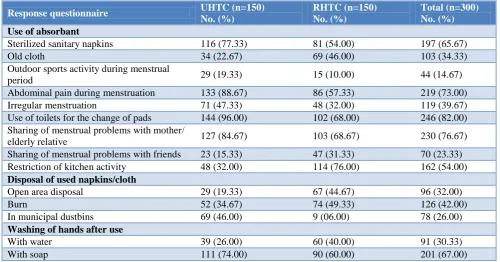
Table 4: Distribution of study subjects according to practice and area
Response questionnaire UHTC (n=150)
No. (%)
RHTC (n=150) No. (%)
Total (n=300) No. (%)
Use of absorbant
Sterilized sanitary napkins 116 (77.33) 81 (54.00) 197 (65.67)
Old cloth 34 (22.67) 69 (46.00) 103 (34.33)
Outdoor sports activity during menstrual
period 29 (19.33) 15 (10.00) 44 (14.67)
Abdominal pain during menstruation 133 (88.67) 86 (57.33) 219 (73.00) Irregular menstruation 71 (47.33) 48 (32.00) 119 (39.67) Use of toilets for the change of pads 144 (96.00) 102 (68.00) 246 (82.00) Sharing of menstrual problems with mother/
elderly relative 127 (84.67) 103 (68.67) 230 (76.67) Sharing of menstrual problems with friends 23 (15.33) 47 (31.33) 70 (23.33) Restriction of kitchen activity 48 (32.00) 114 (76.00) 162 (54.00)
Disposal of used napkins/cloth
Open area disposal 29 (19.33) 67 (44.67) 96 (32.00)
Burn 52 (34.67) 74 (49.33) 126 (42.00)
In municipal dustbins 69 (46.00) 9 (06.00) 78 (26.00)
Washing of hands after use
With water 39 (26.00) 60 (40.00) 91 (30.33)
With soap 111 (74.00) 90 (60.00) 201 (67.00)
*Multiple responses, total not additive.
The average age of menarche came out to be 12.99 ± with more than half of the participants (55.33%) having menarche at the age of 13 years followed by (25.67%) for 14 years and the least 0.33% at the age of 9 years. Difference in age of menarche between rural and urban area was insignificant (p<0.01) (Table 2).
When we saw for the knowledge of girls regarding the menstruation, we found that 66.00% of girls were aware about menstruation before the menarche, 91.67% of girls had heard about the sanitary napkins. Most of the girls (81.00%) had got the knowledge about menses from their mother, 52.33% of girls got the knowledge from mass media. On the other hand 62.67% of girls had
information about menstrual hygiene and 43.33% of girls were aware about RTI / STI (Table 3).
DISCUSSION
This study reveals that the age of the menstruating girls ranged from 09 -14 years, with the mean of 12.99 years of age. Ghattargi et al reported that the age of the menstruating girls ranged from 12-17 years, with the maximum number of girls being between 13-15 years of age,whereas the mean age for menarche was calculated to be 12.8 by Dasgupta et al and 13.16 year as reported by Kajal et al.5-7 Thakre et al in Nagpur and Kamath et al in Manipal, documented that the mean age of menarche was 12.85±0.867 years and 13.98 year respectively.8,9 Whereas mean age was found to be same in both urban and rural areas which was quite similar to reported by Satyavathi et al and Bhalla et al, this may be because of the RHTC area is quite near to District and with similar living conditions, nutrition.10,11
Mass media plays a prominent role in the dissemination of reproductive health information including menstruation and menstrual hygiene. The knowledge about menstrual hygiene appears to be increasing with an increase in time spent on watching TV/listening to radio.12 Thus the finding of this study showed that the availability of mass media (Radio/ TV) at home as the highest predictor of good knowledge of menstrual hygiene. In fact, the reason might be mass media may be endorsed to the effect of technology on increasing knowledge and gaining needed information about menstrual hygiene. In our study 66.00% of students had previous awareness about menstruation and this result is in accordance with other studies.6 Girls of rural area were less aware about menstruation before menarche in comparison to urban (59.33% v/s 73.67%) in this study, which is also evident from a study done by Kalpana Katiyar et al 2013 in Meerut.13 The possible reason for less awareness among rural girls is lack of educational background of their mother which goes in coherence with the finding of our study about mother being the greatest source of information for menarche.
There were 65.67% of adolescent girls were using commercially available absorbent material as sanitary pad in our study similar to 66.20% in Ethiopia and only 26.0% of adolescent girls were using dustbins for disposal which is higher from a study in Ethiopia (20.0%).14 The reason behind this may be the awareness with the Swachh Bharat Abhiyan in India.
CONCLUSION
Still there is persistence of some traditional beliefs among the adolescents regarding menstruation and menstrual hygiene which should be unacceptable in the present scenario. Social stigma is still attached as the girls were having restriction to the kitchen activity and even more restriction to outdoor activities such as sports during menstruation. Mother and mass media are the main source of information regarding menstruation in the pre-menarche age. The old system of unhygienic cloth is still
being used which needs to be checked to prevent infection which may result in disease.
Recommendation
There is a need of targeted interventions among the adolescent girls to raise awareness regarding healthy menstrual practices and provision of family health education package and a mechanism to address universal accessibility of healthy menstrual knowledge is essential at all levels. In India, all organizations related to reproductive health should work adequately and in coordination to achieve “Sanitation for dignity and health” for all women and on the neglected issue of menstrual hygiene and its management (The Delhi Declaration, SACOSAN III 2008). This essentially will contribute to the attainment of some MDG, particularly 2, 3, and 7.
ACKNOWLEDGEMENTS
We pay our sincere thanks to the principal and controller of Government Medical College, Kota Rajasthan for the support. We also admire the contribution and valuable advices by the faculty members, staff of RHTC and UHTC, Kota.
Funding: No funding sources Conflict of interest: None declared Ethical approval: Not required
REFERENCES
1. Series WTR. Programming for Adolescent Health and Development. 1999: 7–9.
2. Gaudineau A, Ehlinger V, Vayssiere C, Jouret B, Arnaud C, Godeau E. Factors associated with early menarche : results from the French Health Behaviour in School-aged Children (HBSC) study. 2010;10:175.
3. Shokry E, Allah A, Elsayed E, Elsabagh M. Impact of Health Education Intervention on Knowledge and practice about Menstruation among Female Secondary School Students in Zagazig City. J Am Sci. 2011;7(9):737–47.
4. Shanbhag D, Shilpa R, Souza DN, Josephine P, Singh J, Br G. Perceptions regarding menstruation and Practices during menstrual cycles among high school going adolescent girls in resource limited settings around Bangalore city, Karnataka. Int J Collaborative Res Intern Med Pub Health. 2012;4(7):1353–62.
5. Ghattargi CH, Deo DS. Preparation and Practices regarding Menstruation: A comparative study in Rural and Urban Adolescent Girls. Indian J Community Med. 2005;30(1):10-4
7. Kajal J, Garg SK, Singh JV, Bhatnagar M, Chopra H, Bajpai SK. Reproductive health of adolescent girls in an urban population of meerut, Uttar Pradesh. Health and Population: Perspectives and Issues. 2009;32(4):204-9.
8. Thakre SB, Thakre SS, Reddy M, Rathi N, Pathak K, Ughade S. Menstrual Hygiene: Knowledge and Practice among Adolescent School Girls of Saoner, Nagpur District. J Clin Diagnos Res. 2011;5(5):1027-33.
9. Kamath R, Ghosh D, Lena A, Chandrasekaran V. A study on knowledge and practices regarding menstrual hygiene among rural and urban adolescent girls in Udupi Taluk, Manipal, India. GJMEDPH. 2013;2(4):1-9.
10. Satyavathi K, Agarwal KN, Khare BB. The growth pattern of weight and height during adolescent. Indian J Med Res. 1981;74:857-65.
11. Bhalla M. Age of Menarche. A Review, Indian Journal of Pediatrics. 1975;12(329):166-73.
12. Rani P. Knowledge and practices of menstrual hygiene among married adolescents and young women in chittoor district of Andhra Pradesh: India. J Nurs Health Sci. 2014;3(2):06–15.
13. Katiyar K, Chopra H, Garg SK. KAP study of menstrual problems in adolescent females in an urban area of Meerut. Indian J Community Health. 2013;25(3):217-20.
14. Upashe SP, Tekelab T, Mekonnen J. Assessment of knowledge and practice of menstrual hygiene among high school girls in Western Ethiopia. BMC Womens Health. 2015;15:84.