Original Research Article
Epidemiological investigation of an acute gastroenteritis outbreak in a
tribal village near Madhya Pradesh-Maharashtra border
Mukesh S. Bawa, Amol D. Kinge*, Ananta Borde, Sarika Patil, Shriram Gosavi,
Vikrant Pagar, Mamata Rathod, Sushant Chavan, Mangesh Shirpurkar
INTRODUCTION
An outbreak or epidemic is defined as the unusual occurrence in a community or region of disease, specific health-related behaviour or other health related events clearly in excess of “expected occurance”.1
Diarrhoeal diseases represent a major health problem in developing countries. Conservative estimates place the global death toll from diarrhoeal diseases at about two million deaths per year (1.7 - 2.5 million deaths), ranking
third among all cases of infectious disease death worldwide.2
Most of the pathogenic organisms that cause diarrhoea are transmitted primarily or exclusively by the faecal-oral route. Faecal-oral transmission may be water-borne; food-borne, or direct transmission which implies an array of other faecal-oral routes such as via fingers, or fomites, or dirt which may be ingested by people.3
Cholera has existed in India for centuries, and is an important public health problem in several parts of the
ABSTRACT
Background: Diarrhoeal diseases represent a major health problem in developing countries. Conservative estimates place the global death toll from diarrhoeal diseases at about two million deaths per year (1.7 - 2.5 million deaths), ranking third among all cases of infectious disease death worldwide. The prime purpose of an outbreak investigation is to control the outbreak, limit its spread to other areas and assess how preventive strategies could be further strengthened to reduce or eliminate the risk of such outbreak in future.
Methods: It was a descriptive cross sectional study of epidemic occurred in Khetiya village, Dist Barwani (MP), population of 67,500 during 17 October 2016 to 17 November 2016. All the cases reported within last one week around the market place village in Khetiya, presenting with symptoms and signs of AGE (as per standard case definition of IDSP) and willing to participate in the investigation.
Results: Males were 56.96%, & female cases were 43.03%. Majority of the study subjects lied between 20-40 years. The mean age was 30.15±5 years. Majority of the cases belonged to lower middle class SES (38%). 87% population was tribal, 48% cases were labourers, 42% were farmers and 10% were others.
Conclusions: Males were 56.96%, & female cases were 43.03%. Majority of the study subjects lied between 20-40 years. The mean age was 30.15±5 years. Majority of the cases belonged to lower middle class SES (38%). 87% population was tribal, 48% cases were labourers, 42% were farmers and 10% were others.
Keywords: Acute gastrointestinal diseases, Outbreak, Epidemic, Tribal
Department of Community Medicine, SBH Government Medical College, Dhule, Maharashtra, India
Received: 01 March 2019 Revised: 16 April 2019 Accepted: 18 April 2019
*Correspondence: Dr. Amol D. Kinge,
E-mail: [email protected]
Copyright: © the author(s), publisher and licensee Medip Academy. This is an open-access article distributed under the terms of the Creative Commons Attribution Non-Commercial License, which permits unrestricted non-commercial use, distribution, and reproduction in any medium, provided the original work is properly cited.
country.4 Based on a ten year review from 1997 to 2006, 21 states reported cholera and 12 had multiple outbreaks.5 During the 10-year period studied, the states having the highest number of reported outbreaks were West Bengal, Odisha, Maharashtra and Kerala.5 These data illustrate that cholera occurs over a wider geographic area in India than is commonly perceived and is not restricted only to the Gangetic Delta.5 During a single year (2011–2012), nine states sent strains of V. cholerae to the National Institute of Cholera and Enteric Disease, Kolkata.6 Clearly, control efforts are needed urgently to control this public health problem in the country.
An outbreak of diarrhoea & vomiting was reported by authority of primary health centre, Khetia Dist. Barwani with total 219 cases on 17th, 18th & 19th October 2016. The prime purpose of an outbreak investigation was to prevent morbidity and mortality due to AGE among diagnosed cases. To find out the source of infection, to control the outbreak, and limit its spread to other areas, recommend preventive strategies to reduce or eliminate the risk of such outbreak in future.7
Epidemiological description of an area
Khetia is a town with Nagar parishad, under Pansemal Tehsil, Barwani District in Madhya Pradesh, with population of 67,500 and average literacy rate of 66% (census 2012). This is predominantly a tribal area inhabited by Bheel, Bhilala and Bariya community. People are mostly engaged in Farming and Labor. Most of the people migrate to Surat and Ahemadabad for working in industrial units. Pansemal Tehsil caters for more than 90 nearby villages, most of them take part in weekly Bazar Haat. About 19 nearby villages have been found to be affected by this recent outbreak. Khetia village receives water supply mostly form 8 tube wells and 1 overhead tank. Disinfection and chlorination of water resources is carried out every 4 monthly, however no records were found regarding chlorination and disinfection. The problem of Open defecation is a public health concern in the area.
METHODS
It was a descriptive cross sectional study of epidemic occurred in Khetiya village, Dist Barwani (MP), population of 67,500 during 17 October 2016 to 17 November 2016. All the cases reported within last one week around the market place village in Khetiya, presenting with symptoms and signs of AGE (as per standard case definition of IDSP) and willing to participate in the investigation. Universal sampling method was used (as many as possible cases were taken with active search). Cases not willing to participate were excluded from the present study.
Socio-demographic characteristics, clinical history, examination findings were recorded using standard, pre-validated, semi-structured case record proforma. Water
samples, food samples, Stool samples were collected to ascertain the cause and source of infection.
The data was entered using MS-Excel version 2010. Frequency analysis was performed for socio-demographic variables. Appropriate test of significance was applied to ascertain the relationship between water consumption and diarrhea.
The data was presented in tables and chart formats for frequency analysis. Number of cases was shown with the help of line diagram. Relationship between water consumption and age was assessed with the help of Chi-square test. P value less than 0.005 was considered to be significant.
RESULTS
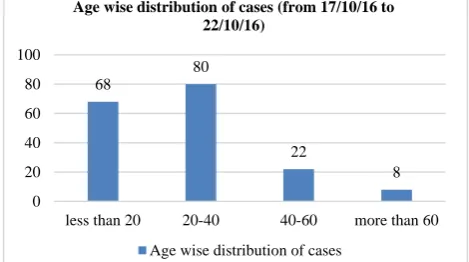
In the present study, the epidemiological investigation team assessed hospital data in Khetia village related to AGE cases during the outbreak. After the analysis of the data provided by Primary Health Centre Khetia, we found that maximum cases were below age of 40 years (young population) Males were 56.96%, & female cases were 43.03%. Majority of the study subjects lied between 20-40 years. The mean age was 30.15±5 years (Figure 1, 2). Majority of the cases belonged to lower middle class SES (38%). 87% population was tribal, 48% cases were labourers, 42% were farmers and 10% were others. Date-wise analysis of number of cases revealed that number of cases were at its peak on 18/10/2017 followed by sharp fall on subsequent days, this finding supports point source nature of the epidemic with single incubation period (Figure 3).
Figure 1: Age wise distribution of cases.
We assessed the severity of acute gastroenteritis among cases. We observed that majority of cases were mild dehydrated (92.12%), while 7.87% cases were severely dehydrated (Table 1).
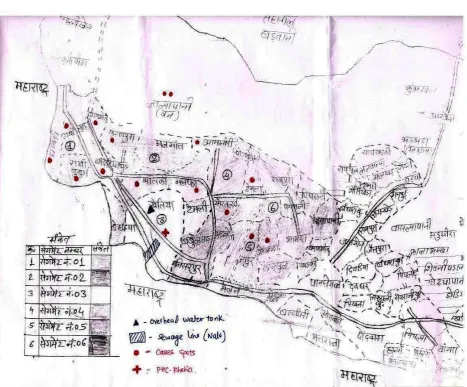
Results are supported by spot map of the area which shows residence of the cases and a village where people from all nearby villages used to come for weekly bazar-haat for routine shopping and used to enjoy food which is being sold in nearby hotels. The spot map was obtained
68
80
22
8
0 20 40 60 80 100
less than 20 20-40 40-60 more than 60
Age wise distribution of cases (from 17/10/16 to 22/10/16)
from the chief medical officer in the primary healthcare center in the village (Figure 4).
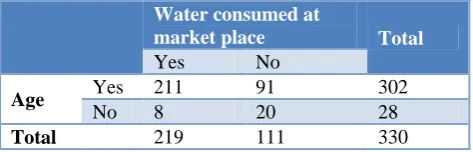
We analyzed the history of consumed water and food at market place in the study area with occurrence of age cases. We found statistically significant association between consumption of water at market place and occurrence of age among cases (Chi-square value 17.77. The p value is 0.000025) (Table 2).
Figure 2: Distribution of cases according to mode of presentation.
Figure 3: Date wise distribution of cases.
Table 1:Severity of age cases.
Severity of age Number of cases %
Mild 304 92.12
Severe 26 7.87
Death 2 ---
Figure 4: Spot map of Pansemal Tehsil showing cases from nearby villages.
94.37%
6.80% 1.20%
0.60% 0.00%
20.00% 40.00% 60.00% 80.00% 100.00%
Diarrhea, Vomiting
Fever Pain in
abdomen
Death Clinical presentation of cases
28 85
31 21
15
6 0
10 20 30 40 50 60 70 80 90
Table 2:Relationship between water consumption and age.
Water consumed at
market place Total
Yes No
Age Yes 211 91 302
No 8 20 28
Total 219 111 330
Chi-square value: 17.77. The p=0.000025
Our team collected 15 water samples from storage tanks, sewage water, hand pumps etc, and 15 food samples from the market place and were sent for qualitative analysis to district public health laboratory. 4 water storage tank samples from the market place and 36 stool samples were found positive for Vibrio Cholerae. Rest of the samples were found negative.
DISCUSSION
Diarrhoeal diseases represent a major health problem in developing countries. An outbreak of acute gastroenteritis was reported by authority of primary health centre, Khetia Dist. Barwani with total 230 cases on 17th to 19th October 2016.
The prime purpose of our outbreak investigation was to prevent morbidity and mortality due to AGE among diagnosed cases, to find out the source of infection, to control the outbreak, and limit its spread to other areas. As most of the pathogenic organisms that cause diarrhoea are transmitted primarily or exclusively by the faecal-oral route, we analyzed water and food samples in the study area.
After detailed enquiry regarding occupational and social history of village residents we found that majority of young age group might be working outside the affected area and from outside they might have brought the source of infection.
In an outbreak investigation of cholera in western Kenya, 2015 by Oyugi, it was observed that females constituted 61% (95/156) of all participants, The ages of 939 (96%) cases were recorded and their median age was 16 years (Range <1 to 100 years).8 The age group 6-15 years had the highest number of cases at 27% (256), while the least cases were in the age group <2 years at 7% (72).
Bwire et al, conducted a study of cholera outbreaks and socio-economic characteristics of the communities in the fishing villages of Uganda (2011-2015).9 The mean age was 21.2 years (range 0.1–81) and median age 20 years (Interquartile range [(IQR] 7–30), with significant differences between outbreaks (p<0.001) from a mean age of 18 years in Namayingo district in 2014, to mean age of 40.2 years in Moyo district during the second outbreak in 2014. A total of 537/1,827 cases (29.4%) were children below age 10 years, with 311 children
under 5 years and 226 children age 5–9 years. Outbreaks with the highest proportions of under the age of 10 years were in Hoima district during 2015 (37.2%), 2013 (34.6%) and 2012 (34.1%) and the 2015 Kasese KKTC outbreak (36.7%).
Diarrhea and vomiting were the most common modes of presentation of the outbreak followed by fever and pain in abdomen in minimal cases. Two deaths were also reported but details were not available. In an outbreak investigation of cholera in western Kenya, 2015 by Oyugi, observed that 69% (36) reported having suffered abdominal pain and fever while 12%.8
Date-wise analysis of number of cases revealed that number of cases were at its peak followed by sharp fall on subsequent days, this finding supports point source nature of the epidemic with single incubation period.
We assessed the severity of acute gastroenteritis among cases. We observed that majority of cases were mild dehydrated (92.12%), while 7.87% cases were severely dehydrated.
Results are supported by spot map of the area which shows residence of the cases and a village where people from all nearby villages used to come for weekly bazar-haat for routine shopping and used to enjoy food which is being sold in nearby hotels (Figure 5).
We analyzed the history of consumed water and food at market place in the study area with occurrence of age cases. We found statistically significant association between consumption of water at market place and occurrence of age among cases (Chi-square value 17.77. The p=0.000025)
Our team collected 15 water samples from storage tanks, sewage water, hand pumps etc, and 15 food samples from the market place and were sent for qualitative analysis to district public health laboratory. 4 water storage tank samples from the market place and 36 stool samples were found positive for Vibrio Cholerae. Rest of the samples were found negative.
In an outbreak investigation of cholera in western Kenya, 2015 by Oyugi, Rectal swabs for culture were collected for 11% (105) of the suspected cases and V. Cholerae 01 serotype Ogawa was isolated from 18 (17%) samples.8
Bwire et al, in their study observed that Vibrio cholerae O1 was responsible for all outbreaks.9 The two serotypes Inaba (8 out of 10 outbreaks) and Ogawa (responsible for 2 out of 10 outbreaks, in Namayingo and Wakiso districts) were isolated from stool samples.
CONCLUSION
source epidemic caused by Vibrio cholarae through feco-oral route (water borne) probable source may be drinking water served at market place. Laboratory investigations confirmed above findings.
Recommendations
Screening of diarrhea cases in surrounding community and isolation of diagnosed cases with appropriate management by trained healthcare personell.
Immediate and periodic on site disinfection of all drinking water sources, with residual chlorine level 1 ppm under stringent supervision.
Organization of awareness campaign about diarrheal diseases, transmission, prevention and control, food water hygiene and ORS therapy.
Compulsory registration and periodic examination of all food handlers in the market area.
Stringent implementation of IDSP in the concerned area.
Funding: No funding sources Conflict of interest: None declared
Ethical approval: The study was approved by the Institutional Ethics Committee
REFERENCES
1. Park K. Park’s Textbook of Preventive and Social Medicine. 20th ed. Jabalpur: Bhanot Publisher; 2009;03:88.
2. Kosek M, Bern C, Guerrant RL. The global burden of diarrhoeal disease, as estimated from studies
published between 1992 and 2000. Bull World Health Organ. 2003;81:197-204
3. Park K. Epidemiology of Communicable Diseases: Acute Diarrhoeal Diseases. Park’s textbook of Preventive and Social Medicine.20th ed. Jabalpur: Bhanot Publisher;2009,p.196.
4. Sarkar BL, Kanungo S, Nair GB. How endemic is cholera in India? Indian J Med Res 2012;135:246–8. 5. Kanungo S, Sah BK, Lopez AL, Sung JS, Paisley AM, Sur D, et al. Cholera in India: an analysis of reports, 1997–2006. Bull World Health Organ.. 2010;88(3):185–91.
6. Annual Report 2012–2013 NICED. Kolkata, India: National Institute of Cholera and Enteric Disease 7. Sokhey J, Farley K. Investigation of Outbreaks of
Vaccine Preventable Diseases. A Field Guide. WHO; Regional office for South-East Asia, New Delhi, 1988.
8. Bwire G, Munier A, Ouedraogo I, Heyerdahl L, Komakech H, Kagirita A, et al. Epidemiology of cholera outbreaks and socio-economic characteristics of the communities in the fishing villages of Uganda: 2011-2015. PLoS Negl Trop Dis. 2017;11(3):e0005407.
9. Oyugi EO, Boru W, Obonyo M, Githuku J, Onyango D, Wandeba A, et al. An outbreak of cholera in western Kenya, 2015: a case control study. Pan Afr Med J. 2017;28(Suppl 1):12.