www.astrophys-space-sci-trans.net/4/51/2008/ © Author(s) 2008. This work is distributed under
the Creative Commons Attribution 3.0 License. Astrophysics and Space Sciences
Transactions
Self-initialised Fermi-1 acceleration by pitch-angle re-scattering of
solar wind ions reflected from the parallel termination shock
D. Verscharen and H.-J. Fahr
Argelander Institute for Astronomy, University of Bonn, Auf dem H¨ugel 71, 53121 Bonn, Germany
Received: 3 June 2008 – Revised: 13 August 2008 – Accepted: 1 September 2008 – Published: 27 October 2008
Abstract. In a recent kinetic calculation a rather high amount of reflected ions was shown to occur at the solar wind ter-mination shock under a parallel magnetic field orientation. The fate of these reflected ions is analysed within the scope of this paper. In the inner heliosphere their further trans-port is expected to be mainly influenced by pitch-angle scat-tering similar to the process governing pick-up ions (PUIs). This diffusive scattering isotropises the ions on a shell-like distribution in the comoving upstream solar wind reference frame. The resulting distribution is calculated and the re-sult is applied on our earlier kinetic model. The isotropised ions, when again convected into the shock, tend to attenu-ate the shock a little and lead to an additional energetic tail population in the downstream distribution function. A con-sistent incorporation of the reflected ions into the model is iteratively possible. It turns out that a part of the reflected and isotropised ions offer properties which allow for the ac-celeration to the anomalous cosmic ray (ACR) regime as an additional contribution to the injection by pick-up ions (i.e. we propose a self-injection mechanism to the Fermi-1 accel-eration process).
1 Introduction
Magnetohydrodynamic shock waves are known to offer an efficient reflection mechanism for plasmas (Potgieter and Moraal, 1988; Donohue and Zank, 1993). The mainly act-ing process is the Fermi-1 acceleration mechanism, which describes the kinetic energy transfer from a shocked mag-netised background plasma to individual charged particles. Necessary ingredients for this acceleration process are par-ticle and wave motions relative to the plasma background
Correspondence to: D. Verscharen ([email protected])
flow. Detailed and quantitative analyses of Fermi-1 accel-eration can be found at Drury (1983) and Gaisser (1990), a shorter introductive excerpt in Fichtner (2000).
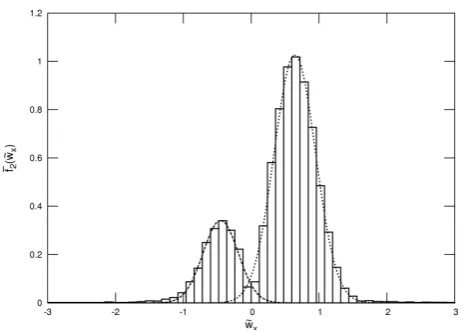
Our recent kinetical model calculations (Verscharen and Fahr, 2008) describe the solar wind termination shock under a parallel magnetic field orientation. In this model, the decel-erating force, which acts on the plasma flow, is assumed to be given by a stationary electric potential. The ions run against this potential and are decelerated. On the other hand the elec-trons of the quasi-neutral solar wind plasma are strongly ac-celerated. This situation represents a two-stream-instability, which excites turbulent interaction with electrostatic plasma waves. The transport equation for this problem can be solved by using It¯o’s calculus of stochastic differential equations (SDEs). The resulting downstream ion distribution func-tion (see Fig. 1) shows a characteristic double-hump struc-ture with a negative particular velocity branch. This means that particles are reflected by the shock structure and pene-trate backwards into the upstream regime, i.e. the inner he-liosphere. Further calculations show that the amount of re-flected solar wind ions due to stochastic wave-particle inter-actions is rather high (about 18 percent of the incident solar wind) and that this reflected beam is equipped with a velocity comparable in magnitude to the incident solar wind velocity but with opposite direction (Fahr and Verscharen, 2008).
Fig. 1. Normalised ion distribution function in one-dimensional
velocity space on the downstream side of the solar wind termina-tion shock. The velocityw˜x in the direction of the shock
nor-mal is scaled in units of the upstream solar wind bulk velocity
U1=400 km/s. From Verscharen and Fahr (2008).
An observational hint to the existence of such a reflected particle species is provided by VOYAGER measurements, which have been at first misinterpreted as the termination shock transit in 2003 (see Krimigis et al., 2003; McDon-ald et al., 2003; Burlaga et al., 2003). Later, however, it turned out that these early data have shown the precursor re-gion of the solar wind termination shock, whereas the real shock transit happened in December 2004 (Fisk, 2005). This reflected beam is subject to several interactions with the in-coming solar wind and its co-convected MHD turbulences. Similar to the behaviour of newly generated pick-up ions (PUIs) in the outer heliosheath (see e.g. Chalov and Fahr, 1996; Chalov et al., 1995), the reflected solar wind ions are expected to undergo very effective and rapid pitch-angle scattering (cf. Schlickeiser, 1989). The MHD turbulence in the inner heliosheath is responsible for this fact. For exam-ple ion-selfgenerated magnetoacoustic turbulence (Chashei et al., 2003) or Alfv´en turbulence leads to this behaviour (see for an extensive review Decker, 1988). This likewise called pitch-angle diffusion isotropises the distribution function till it reaches a shell-like distribution in the solar wind rest frame. The abundance of certain elements in the cosmic ray spec-trum below 100 MeV (later referred to as ’anomalous cos-mic rays (ACRs)’) was found to be higher than expected on the basis of galactic cosmic ray (GCR) extrapolation from the higher energy range by Garcia-Munoz et al. (1973) for the first time. The first observation of anomalous hydrogen took more than a decade since this early date (Christian et al., 1988). Very soon after the detection of anomalous cosmic rays (ACRs), the paradigmatic interpretation of these low-energy particles in cosmic ray observations by Fisk et al. (1974) connected PUIs directly with the origin of ACRs. The
details of the mechanisms which are responsible for the ac-celeration of pick-up ions to ACRs are still an open ques-tion in space physics (Zank and Matthaeus, 2001). Different approaches try to explain the injection and pre-acceleration by the interaction with propagating or co-rotating shocks in the inner heliosphere (Jokipii and Giacalone, 1998). The injection efficiency of PUIs and even the acceleration itself strongly depend on the magnetic field orientation (Jokipii, 1987; Chalov and Fahr, 1996; Fahr et al., 2008), but never-theless for the parallel case it is not sufficiently studied. Here one should remark that the pick-up ion injection efficiency is hitherto a not consistently achieveable crucial factor for these calculations. The literature provides a very wide range for this parameter between 0.0003 and 0.9 (Le Roux and Ficht-ner, 1997).
Serious hints towards PUIs as really being the seed of ACRs always came from considerations of the elemental abundances. The elemental abundances that appear in the lo-cal interstellar medium (LISM) should also reasonably well characterise the elemental abundances of PUIs – besides of heliosheath filtering effects(see Rucinski et al., 1993) – and originate from LISM neutral atoms penetrating into the inner heliosphere. The elemental composition indeed appears to be fairly consistent with that of the neutral component of the LISM (see Cummings and Stone, 1990, 1995). One should, however, bear in mind that the ionisation degree of the LISM and filtration functions for the neutral LISM species in fact even nowadays are not well known. This is because the ion-isation state of the LISM neither is characterised as a ther-modynamical equilibrium nor perhaps even a quasistationary state (see Frisch, 1990; Reynolds, 1990; Frisch and Slavin, 2006; Breitschwerdt and de Avillez, 2006).
That means to fix the LISM neutral abundances needs the knowledge of its poorly known ionisation state, otherwise relative abundances with respect to hydrogen are a widely open number due to unknown LISM ionisation degrees. This somehow seems to open up the look for ACR seed parti-cle candidates a little and may let it appear worthwhile to also consider contributors to the ACR population different from PUIs.
2 Theoretical approach
refer-ence frame which is co-moving with the solar wind bulk ve-locity (Chalov and Fahr, 1996, 1999). In the following con-sideration we calculate the corresponding distribution func-tion and attain the possibility to incorporate these ions con-sistently into the model.
In a general form the diffusive temporal change of the dis-tribution function due to pitch-angle scattering is given by
δf (x,w, t ) δt PA = ∂
∂µDµµ
∂f (x,w, t )
∂µ , (1)
where µ indicates the pitch-angle cosine and (x,w) the phase-space coordinates. The coordinate system is chosen in a way, that thex-direction is parallel to the shock normal. Therefore, the velocity componentwxis parallel to the bulk
flow with the ion bulk velocityU (x). Due to the assumption of locally planar geometry of the shock, the distribution is expected to be axially symmetric with respect to thex-axis. The model calculations take place in the shock frame, i.e. the reference frame in which the shock is at rest. However, for the first considerations the solar wind bulk frame (i.e. the frame which is comoving with the ion bulk velocityU) ap-pears more convenient because pitch-angle diffusion can be better described in this frame. In the solar wind bulk frame the reflected ions have a bulk velocity ofU1+U1refl. 2.1 The mean-free-path for pitch-angle scattering
The quantityλk is denoted as the mean free path for parti-cles moving parallel to the magnetic field in a supersonic and super-Alfv´enic background plasma and is given by (see Has-selmann and Wibberenz, 1970)
λk= 3v
8 +1 Z
−1
(1−µ2)2dµ
Dµµ (2)
Here Dµµ denotes the pitch-angle diffusion coefficient
(µ=cosϑ denoting the pitch-angle cosine) describing the effect of quasilinear ion interactions with Alfv´enic MHD tur-bulences corresponding to Eq. (1). This diffusion process was extensively studied by Schlickeiser (1989). Hereby the ion velocityvis measured in the reference frame of the back-ground plasma flow (solar wind bulk frame). The pitch-angle diffusion coefficientDµµis related to the velocity diffusion coefficient and can be evaluated for the inner heliosphere in the form given by Chalov and Fahr (1998, 1999)
Dµµ∼Dvv,0VA−2
U3 rE ! v U rE r
3/4
(3) withVAbeing the Alfv´en velocity which due toVA∼B/
√
ρ
at distancesr≥r0withB∼r−1andρ∼r−2can be taken as fairly constant. This clearly shows thatλkis independent of the particle velocity and roughly is given by
λk= 3v
8 +1 Z
−1
(1−µ2)2dµ Dvv,0VA−2
U3 rE v U rE r
3/4 (4)
= 3V
2 Ar 8U2 rE
r
−1/4 +1 Z
−1
(1−µ2)2dµ Dvv,0
(5)
simply yielding
λk= 3rE
8
VA2 U2
r
rE
3/4Z+1
−1
(1−µ2)2dµ Dvv,0
=λk,E r
rE 3/4
(6)
and reminding that the reference value λk,E for average MHD turbulence levels at r=rE has been found with
λk,E'0.3 AU (see Chalov and Fahr, 1999) then leads us to the result that at the termination shock distance of
rTS'90 AU one finds the mean free path for the average pitch-angle scattering process given by:
λk,TS=λk,E r
TS
rE 3/4
'8.77 AU (7)
We should mention at this position that the validity of the velocity-independence of the velocity diffusion coefficient is restricted to medium energy ions (1 keV≤E≤50 keV). In this range under the assumptions made by Chalov and Fahr (1996) for the the MHD turbulence in the solar wind on the basis of calculations carried out by Schlickeiser (1989), one obtains a velocity diffusion coefficient Dvv that is
propor-tional to the velocity and mean scattering free pathes which are essentially velocity-independent.
2.2 Distribution of reflected ions after pitch-angle scattering
After pitch-angle scattering the distribution function is as-sumed to represent a shell with a Gaussian cut-profile. This takes into consideration that the underlying shape of the Gaussian beam profile of reflected ions is conserved (energy-conserving pitch-angle scattering). The isotropisation takes place in the frame which is comoving with the upstream solar wind (i.e. the wind frame). Therefore, the radius of the shell isR=U1+U1refl. In the shock frame the distribution centre is shifted towx=U1. This distributionf (w˜ x, wy, wz)hence
is given by
˜
f = 1
a exp −1 2 q
(wx−U1)2+w2y+wz2−R σ 2 .(8)
σ is the width of the reflected ion beam on the upstream side and also the width of the Gaussian shell. It is connected with the beam temperatureT by
σ =pkBT . (9)
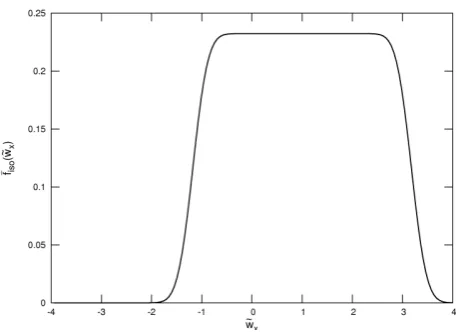
Fig. 2. Result of the integration of the Gauss shell over two
ve-locity space coordinates. The isotropised distribution function is normalised to one.
off by(wx−U1)→wxwithout loss of generality during in-tegration over the full velocity space). It turns out that it is given by
a=12π σ2R·e−
1 2R
2
σ2+p32π3σ·σ2+R2·8 R
σ
,(10) where8denotes the Gauss error integral which is related to the error function by
8
R
σ
≡ √1
2π
R σ Z
−∞ e−12z
2
dz=
erf√R 2σ
+1
2 . (11)
This result can be confirmed by melting the shell to a three-dimensional Gaussian distribution (i.e. R→0). Ob-viously, Eq. (8) changes to the correct form. Then, with
8(0)=1/2, the normalisation factor changes to
a=p8π3σ3, (12)
which is the correct value for a standard Gauss distribution in three dimensions.
For large values ofRσthe left part of Eq. (10) becomes small and negligible and8(Rσ)becomes 1. Under these con-ditions, the factoracan be simplified to
a≈p32π3σ R2. (13)
This takes into account that for a larger shell, due to the larger shell surface, the norm of the distribution function must be smaller to satisfy normalisation to 1.
To obtain the one-dimensional isotropised distribution function fiso(wx), the Gauss shell is integrated over wy
andwz:
fiso(wx)= +∞ Z
−∞ +∞ Z
−∞
˜
f (wx, wy, wz)dwydwz (14)
The result of this integration is shown in Fig. 2.
Evidently,fisois a rather constant distribution over a wide velocity range. After isotropisation due to pitch-angle diffu-sion there is a certain amount of ions with a velocity up to about three times the solar wind bulk velocity in the shock rest frame, which have been provided again with a veloc-ity into the shock direction on the upstream side. This means that the parallel shock configuration with reflection and pitch-angle diffusion of selected ions presents an effec-tive acceleration mechanism for ions.
For the detailed calculation the thermal upstream solar wind distributionfSWis added to the isotropised distribution
fisowith the correct proportion:
¯
f1=pr·fiso+(1−pr)·fSW (15)
Both distribution functions and f¯
1 are normalised to 1.
pr'0.18 is the amount of the reflected ions. The resultingf¯1 consists of the flat basefisowith a superimposed Maxwellian hat (fromfSW) in the middle atwx=U1with the tempera-tureT1.
Single test particles with a velocity corresponding to this complete distributionf¯1are obtained by applying von Neu-mann’s method of rejection sampling (see Knuth, 1981, p. 120–121). With this Monte Carlo method, a random variable X, which obeys the probability density function
p(t ), can be derived from computer-generated, uniformly distributed pseudo random numbers and a given probabil-ity densprobabil-ity function g(t ). Let ui be uniformly distributed random numbers. vi are random numbers which are dis-tributed according tog(t ). Then one chooses a realk with
p(t )≤k·g(t )for every t. Ifk·ui·g(vi) < p(vi), the ran-dom variableXi is set to vi. Otherwise the set(ui, vi)is rejected. After several executions the random variablesXi
are distributed according top.
In this special case p is given by the initial distribution
¯
f1,gis a Gaussian normal distribution, which envelops the distribution functionf¯1, and, with this choice, the random variableXi corresponds to the initial velocitywxof one test
particle.
After isotropisation a small amount of ions has got neg-ative velocities (see Fig. 2). We do not expect a further in-fluence of these ions on the shock. Thus, the distribution functionf¯1is cut atwx=0 and only the ions with a motion into the shock direction are taken into account. Of course, a new re-normalisation is then necessary.
The shock parameters (even the shock compression ra-tio) are kept as before to realise that the shock is mainly established by the bulk flow of the solar wind ions and to treat the small amount of isotropised particles as additional test-particles. Therefore, only one iteration with a fixed
3 Results
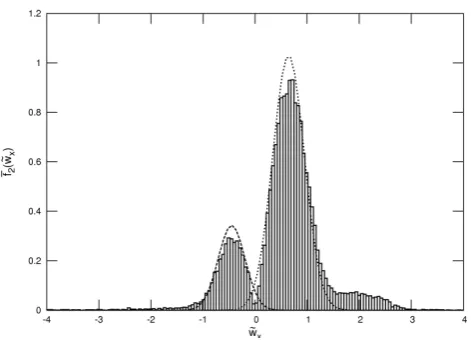
A newly distributed set of 30 000 ions is sent over the shock under a typical parameter choice (upstream bulk veloc-ityU1=4×107cm/s, compression ratior=2.5, upstream ion densityn1=5×10⁻⁴cm−3, upstream ion and electron temperatureT1=1×10⁴K, size of the electric field region
λ=5×105cm and size of the turbulent interaction region
b=2×106cm (see Verscharen and Fahr, 2008)). In the first execution, the reflected particle properties are taken from the results in Fahr and Verscharen (2008). Their amount is given bypr=0.18 and the bulk velocity of the reflected ions is taken as U1refl= −4.6×107cm/s. The parameter
σ is taken from the value of the reflected ion temperature
T1refl=1.1×10⁶K on the upstream side. The result of this treatment is shown in Fig. 3.
Additionally to the known behaviour (broadening, double-hump), a tail distribution at high downstream velocities oc-curs. At the primary model the highest velocities were in the range of about 1.5 times the solar wind upstream bulk ve-locity. Now after pitch-angle diffusion of the reflected ions, the positive velocity tail reaches values up to 3 timesU1. This means that reflection and subsequent pitch-angle diffu-sion leads to the occurence of high particle velocities on the downstream side. The width of the reflected branch, how-ever, does not change significantly. In comparison to the primordial distribution function, which is represented by the dotted lines in Fig. 3, the level of the reflected ions is smaller, whereas the amount of ions with positive proper velocities is higher.
As one can see in comparison with the first calculations, the amount of reflected ions was over-estimated. Thus, there are less reflected ions, which are able to become an isotropised ion population after pitch-angle scattering. This means that the true downstream ion distribution must lie somewhere between both extreme cases: the one without incorporation of the reflected and isotropised ions and the other as given by the first calculation (Fig. 3). A stable de-scription of the shock situation can be obtained by changing the amount of reflected ions till, after several iterations, no further change of the downstream distribution function (re-spectively, the compression ratio and the area of the hump with negative velocity) occurs. The artifical reduction of the reflected ions in the model code will essentialy lead to an immediate shrinking of the high-velocity tail of the down-stream distribution function connected with a lower value
U2 after evaluation of the first moment of the distribution function. The shock is stable if the reflected ions reproduce themselves after isotropisation. The stable self-reproducing downstream distribution function essentially describes the consistent solution of the shock. This situation is found, if the amount of the reflected ions is reduced topr=0.15 and the reflected bulk velocity on the upstream side is set to
U1refl= −1.15·U1= −4.6×107cm/s.
Concluding, we want to remind here that these particles
Fig. 3. Distribution function on the downstream side of the shock. A
remarkable result is the high-velocity tail on the right hand side. The primordial distribution function on the downstream side without the treatment of the reflected ions after pitch-angle diffusion is plotted with the dotted lines for a better comparison (cf. Fig. 1).
are not assumed to replace the pick-up ions; but, they must be taken into consideration as an additional particle species in the inner heliosheath.
4 Discussion
4.1 Dissipative Entropisation
The appearence of a high-energy tail in the distribution of the downstream ions is the most conspicuous result of our extended model. These tail ions possess higher than sonic particular velocity in the downstream regime. Because of the difference between their velocity and the bulk flow, a fur-ther interaction will take place on the downstream side of the shock. For example, a certain set of different wave modes will be excited, which brings the distribution to a higher en-tropy. By the H-theorem, the entropyScan be calculated by
S=N kB Z
f lnfd3w≈N kB X
i
pilnpi, (16)
whereNdenotes the number of particles andpithe
probabil-ity for a particle in the velocprobabil-ity celli(i.e.pi= ¯f (wx)1wx)
4.2 Particle injection into the Fermi-1 acceleration process A certain amount of the isotropised ions has got a parallel velocity componentwxwhich is too small to overcome the
shock potential. They must be reflected again. The constance of the total energy and the fact that both particle species are affected by the same potential8
1 2mpU
2 1 =
1 2mpU
2
2 +e8 (17)
1 2mpw
2 1=
1 2mpw
2
2+e8 (18)
leads to
w22=w21+U22−U12. (19)
The particle velocityw2is expected to be negative (i.e. re-flection at the potential) if w1 is small enough but greater than zero. This corresponds to the necessary condition 0< w1<
q
U12−U22 (20)
for the injected ions. WithU1=4×107cm/s and a compres-sion ratio ofr=2.5 this leads to 0< w1<3.67×107cm/s, which corresponds to 0.91·U1. Because of their isotropisa-tion, the particles with a small value ofwx(close to 0) have
a rather high tangential velocity component.
These particles undergo a successively accelerating pro-cess with subsequent reflection and diffusion, whereby they climb-up to systematically higher kinetic energies. This mechanism provides the possibility to reach a sufficient high energy level for diffusive shock acceleration (Fermi-1 ac-celeration) for anomalous cosmic rays (Pesses et al., 1981; Fichtner et al., 1996). This can be seen as a new kind of a self-initialised Fermi-1 acceleration process.
The amount of the reflected ions which can undergo the first acceleration process after isotropisation can be estimated. On the first view, the isotropised tion function can be treated like a rectangular distribu-tion with a width of aboutatot=4.5 (see Fig. 2) in scaled units (i.e. a range of 4.5·U1=1800 km/s). The ions with 0< w1<3.67×107cm/s correspond to a rectangle with a width of aacc=0.91 (i.e. a range of 0.91·U1=364 km/s). Due to the correct normalisation offiso, this leads to an esti-mation for the trapped ions of
pacc=pr·
aacc
atot
=0.15·0.91
4.5 =0.03. (21)
This means that 3% of the incoming solar wind ions are able to undergo the acceleration mechanism as it is described above. Converted into particle density, this corresponds to
nacc=pacc·nSW=0.03·5×10−4cm−3=1.5×10⁻⁵cm−3. One can compare this density with a pick-up ion injection efficiency, if the same number of ions was injected by pick-up ions.
If a pick-up ion population with this number den-sity nacc occured in the velocity range of 0 to 0.91·U1, this would correspond to a mean pick-up ion flux of FiPUI=nacc·12364 km/s for injected PUIs. The flux of in-coming neutrals from the local interstellar medium can be estimated with FHn=nHn·uHS with the neutral hydrogen
number density nHn=0.14 cm
−3 and the relative velocity
uHS=25 km/s of the heliosphere with respect to the LISM. The corresponding pick-up ion efficiency can be defined by the ratio of these fluxes. This means that – in our case – the injected solar wind particles would correspond to a pick-up ion efficiency of
η= FiPUI
FHn
=nacc·
1
2364 km/s
nHn·uHS
=0.0008 (22)
in the classical understanding. This shows that the flux of the isotropised ions is rather low in comparison to the usually assumed PUI fluxes. However, it lies sufficiently within the possible range of values as mentioned above (Le Roux and Fichtner, 1997). Therefore, we do not interpret the herein proposed mechanism as the dominant acceleration effect for ACRs but rather as an additional possibility, especially for the case of the parallel MHD shock.
5 Conclusions
Hitherto, a partially neutral interstellar medium for the gen-eration of pick-up ions was necessary to produce ACRs. In our model a self-generation of ACRs by solar wind particles and their interaction with the shock is shown to be possible. This means that the parallel termination shock is able to pro-duce particles with a high kinetic energy similar to ACR par-ticles analogous to the contribution by PUIs. The injection is a result of subsequent diffusive acceleration by wave-particle interaction and pitch-angle scattering on the upstream side.
For the classical pick-up ion acceleration process it is known that the injection efficiency strongly depends on the magnetic field orientation at the shock (Chalov and Fahr, 1996; Kucharek and Scholer, 1995; Fahr et al., 2008). There-fore, it is of great interest to study the dependence of the new injection process on the magnetic field orientation. For this investigation, the primary model should be extended for a more general magnetic field configuration. Even though the solar wind termination shock for the largest region is as-sumed to be quasi-perpendicular, the study of oblique shocks is important to provide a higher generality (see also Liewer et al., 1993).
not filter the less abundant elements, maybe another selec-tive process will become necessary.
For further studies this model should be applied on other astrophysical shocks. The interplanetary shock waves behave rather similar to the termination shock. Maybe even relativis-tic shock waves with high compression ratios – for example like supernova shocks – show a similar self-initialised accel-eration process. Then this mechanism could contribute to the energisation of galactic cosmic rays (see also Scherer et al., 2008).
Acknowledgements. We are grateful for financial support to the
Deutsche Forschungsgemeinschaft (DFG) within the frame of the DFG-Project Fa 97/31-2.
Edited by: K. Scherer and T. Laitinen Reviewed by: two anonymous referees
References
Breitschwerdt, D. and de Avillez, M. A.: The history and future of the Local and Loop I bubbles, Astron. Astrophys., 452, L1–L5, doi:10.1051/0004-6361:20064989, 2006.
Burlaga, L. F., Ness, N. F., Stone, E. C., McDonald, F. B., Acu˜na, M. H., Lepping, R. P., and Connerney, J. E. P.: Search for the heliosheath with Voyager 1 magnetic field measurements, Geophys. Res. Lett., 30, 9–1, 2003.
Burlaga, L. F., Ness, N. F., Acu˜na, M. H., Lepping, R. P., Con-nerney, J. E. P., and Richardson, J. D.: Magnetic fields at the solar wind termination shock, Nature, 454, 75–77, doi:10.1038/ nature07029, 2008.
Chalov, S. V. and Fahr, H.-J.: Reflection of Pre-Accelerated Pick-up Ions at the Solar Wind Termination Shock: The Seed for Anomalous Cosmic Rays, Sol. Phys., 168, 389–411, doi:10. 1007/BF00148064, 1996.
Chalov, S. V. and Fahr, H.-J.: Phase space diffusion and anisotropic pick-up ion distributions in the solar wind: an injection study, Astron. Astrophys., 335, 746–756, 1998.
Chalov, S. V. and Fahr, H.-J.: Interplanetary Pick-Up Ion Accel-eration, A Study of Anisotropic Phase-Space Diffusion, Astro-phys. Space Sci., 264, 509–525, 1999.
Chalov, S. V., Fahr, H.-J., and Izmodenov, V.: Spectra of energized pick-up ions upstream. of the heliospheric termination shock I. The role of Alfvenic turbulences., Astron. Astrophys., 304, 609– 616, 1995.
Chashei, I. V., Fahr, H.-J., and Lay, G.: A consistent thermodynam-ics of the MHD wave-heated two-fluid solar wind, Ann. Geo-phys., 21, 1405–1418, 2003.
Christian, E. R., Cummings, A. C., and Stone, E. C.: Evidence for anomalous cosmic-ray hydrogen, Astrophys. J., 334, L77–L80, doi:10.1086/185316, 1988.
Cummings, A. C. and Stone, E. C.: Composition of Anomalous Cosmic Rays and Implications for the Heliosphere, Space Sci. Rev., 78, 117–128, doi:10.1007/BF00170798, 1996.
Cummings, C. A. and Stone, C. E.: Elemental Composition of the Very Local Interstellar Medium as Deduced from Observations of Anomalous Cosmic Rays, in: Intern. Cosmic Ray Conf., 6, 202–205, 1990.
Cummings, C. A. and Stone, C. E.: Elemental Composition of the Anomalous Cosmic Ray Component, in: Intern. Cosmic Ray Conf., 4, 497–500, 1995.
Decker, R. B.: Computer modeling of test particle acceleration at oblique shocks, Space Sci. Rev., 48, 195–262, 1988.
Donohue, D. J. and Zank, G. P.: Steady state and dynamical struc-ture of a cosmic-ray-modified termination shock, J. Geoph. Res., 98, 19 005–19 025, 1993.
Drury, L. O.: An introduction to the theory of diffusive shock acceleration of energetic particles in tenuous plasmas, Rep. of Progress in Physics, 46, 973–1027, 1983.
Fahr, H.-J. and Verscharen, D.: Ion reflections from the parallel MHD termination shock and a possible injection mechanism into the Fermi-1 acceleration, Astron. Astrophys., 487, L21–L24, doi: 10.1051/0004-6361:200810217, 2008.
Fahr, H.-J., Scherer, K., Potgieter, M. S., and Ferreira, S. E. S.: Lon-gitudinal variation of the pickup-proton-injection efficiency and rate at the heliospheric termination shock, Astron. Astrophys., 486, L1–L4, doi:10.1051/0004-6361:200809561, 2008. Fichtner, H.: Anomalous cosmic rays, in: The Outer Heliosphere:
Beyond the Planets, edited by Scherer, K., Fichtner, H., and Marsch, E., 191–215, 2000.
Fichtner, H., Le Roux, J. A., Mall, U., and Rucinski, D.: On the transport of pick-up ions in the heliosphere., Astron. Astrophys., 314, 650–662, 1996.
Fisk, L. A.: Journey into the Unknown Beyond, Science, 309, 2016–2017, doi:10.1126/science.1118762, 2005.
Fisk, L. A., Kozlovsky, B., and Ramaty, R.: An Interpretation of the Observed Oxygen and Nitrogen Enhancements in Low-Energy Cosmic Rays, Astrophys. J., 190, L35–L37, 1974.
Frisch, P. C.: Characteristics of the local interstellar medium, in: Physics of the Outer Heliosphere, edited by Grzedzielski, S. and Page, D. E., 19–22, 1990.
Frisch, P. C. and Slavin, J. D.: The Sun’s journey through the local interstellar medium: the paleoLISM and paleoheliosphere, As-trophys. Space Sci. Trans., 2, 53–61, 2006.
Gaisser, T. K.: Cosmic rays and particle physics, Cambridge and New York, Cambridge University Press, 1990, 292, 1990. Garcia-Munoz, M., Mason, G. M., and Simpson, J. A.: A New Test
for Solar Modulation Theory: the 1972 May-July Low-Energy Galactic Cosmic-Ray Proton and Helium Spectra, Astrophys. J., 182, L81–L84, 1973.
Hasselmann, K. and Wibberenz, G.: A Note on the Parallel Diffu-sion Coefficient, Astrophys. J., 162, 1049–1051, 1970.
Isenberg, P. A.: Evolution of interstellar pickup ions in the solar wind, J. Geophys. Res., 92, 1067–1073, 1987.
Jokipii, J. R.: Rate of energy gain and maximum energy in diffusive shock acceleration, Astrophys. J., 313, 842–846, doi:10.1086/ 165022, 1987.
Jokipii, J. R. and Giacalone, J.: The Theory of Anomalous Cosmic Rays, Space Sci. Rev., 83, 123–136, 1998.
Knuth, D. E.: The art of computer programming. Vol.2: Seminu-merical algorithms, Atmos. Chem. Phys., 1981.
Krimigis, S. M., Decker, R. B., Hill, M. E., Armstrong, T. P., Gloeckler, G., Hamilton, D. C., Lanzerotti, L. J., and Roelof, E. C.: Voyager 1 exited the solar wind at a distance of
∼85 AU from the Sun, Nature, 426, 45–48, 2003.
Geo-phys. Res., 100, 1745–1754, 1995.
Landau, L. D. and Lifshitz, E. M.: Statistical physics. Pt.1, Pt.2, Course of theoretical physics, Pergamon International Library of Science, Technology, Engineering and Social Studies, Oxford: Pergamon Press, 1980—c1980, 3rd rev. and enlarged, 1980. Le Roux, J. A. and Fichtner, H.: The Influence of Pickup,
Anoma-lous, and Galactic Cosmic-Ray Protons on the Structure of the Heliospheric Shock: A Self-consistent Approach, Astrophys. J., 477, L115–L118, doi:10.1086/310525, 1997.
Liewer, P. C., Goldstein, B. E., and Omidi, N.: Hybrid simulations of the effects of interstellar pickup hydrogen on the solar wind termination shock, J. Geophys. Res., 98, 15 211–15 220, 1993. McDonald, F. B., Stone, E. C., Cummings, A. C., Heikkila, B.,
Lal, N., and Webber, W. R.: Enhancements of energetic parti-cles near the heliospheric termination shock, Nature, 426, 48–51, 2003.
Pesses, M. E., Eichler, D., and Jokippi, J. R.: Cosmic ray drift, shock wave acceleration, and the anomalous component of cos-mic rays, Astrophys. J., 246, L85–L88, doi:10.1086/183559, 1981.
Potgieter, M. S. and Moraal, H.: Acceleration of cosmic rays in the solar wind termination shock. I - A steady state technique in a spherically symmetric model, Astrophys. J., 330, 445–455, doi: 10.1086/166482, 1988.
Reynolds, R. J.: A lower limit on the ionization fraction of the very local interstellar medium, in: Physics of the Outer Heliosphere, edited by Grzedzielski, S. and Page, D. E., 101–104, 1990.
Richardson, J. D., Kasper, J. C., Wang, C., Belcher, J. W., and Lazarus, A. J.: Cool heliosheath plasma and deceleration of the upstream solar wind at the termination shock, Nature, 454, 63– 66, doi:10.1038/nature07024, 2008.
Rucinski, D., Fahr, H.-J., and Grzedzielski, S.: The production of different pick-up ion species in the heliosphere and their con-vection towards the three-dimensional termination shock, Planet. Space Sci., 41, 773–783, doi:10.1016/0032-0633(93)90120-Q, 1993.
Scherer, K., Fichtner, H., Ferreira, S. E. S., B¨usching, I., and Potgi-eter, M. S.: Are Anomalous Cosmic Rays the Main Contribution to the Low-Energy Galactic Cosmic Ray Spectrum?, Astrophys. J., 680, L105–L108, doi:10.1086/589969, 2008.
Schlickeiser, R.: Cosmic-Ray Transport and Acceleration. II. Cos-mic Rays in Moving Cold Media with Application to Diffusive Shock Wave Acceleration, Astrophys. J., 336, 264–293, doi: 10.1086/167010, 1989.
Steenkamp, R. and Moraal, H.: Acceleration and Modulation of Anomalous Helium and Oxygen in 1977 and 1987, in: Intern. Cosmic Ray Conf., 3, 419–422, 1993.