Attacking A PUF Based Mutual Authentication Protocol Designed For
Internet of Things
Mehmet Hilal Özcanhan1 and Semih Utku2
1, 2 Computer Engineering, Dokuz Eylul Universitesi, Faculty of Engineering, Izmir, 35390, Turkiye
1
[email protected], [email protected]
ABSTRACT
The security of the message exchanges among Internet of Things (IoT) devices is a big concern, in the field of information security and privacy. Due to the limited resources of IoT devices and their unsecure environments, strong authentication protocols are needed for the machine to machine (m2m) conversations. The physically unclonable functions (PUFs) inherent in the integrated circuits of the IoT devices are seen as an answer, for the security and privacy of the m2m communication. Although PUFs have strong advantages, the authentication protocols can show weaknesses, if not well-designed. In present work a mutual authentication protocol proposed for IoT devices is analyzed. It is demonstrated that with the same attack model of the authors, multiple attacks can be launched on the proposed protocol. A recommendation is also made for providing stronger security to the proposed protocol.
Keywords: Authentication, Disclosure Attack, Internet of Things, Machine to Machine, Security.
1. INTRODUCTION
Internet of Things (IoT) is the present day’s buzz word. Simply, IoT are devices which enable machine to machine: communication, information sharing and taking action over the Internet. Without active intervention, the humans gain the capability of making better decisions and taking faster action, through IoT. Latest reports disagree in the range of billions about the number of IoT devices (devices) that will be connected to the Internet, by the year 2020. Figure 1 shows the m2m/IoT, Sector Map [1]. As it can be seen, there are numerous types of devices at every possible location, in all sectors. Some devices, such as low cost tags in the retail sector, contain 8 or 16 bit microcontrollers and have very limited memory. In fact, there are many types
of devices with limited resources [2, 3]. This characteristic brings about a serious handicap to the security of IoT communication; because resources are needed for providing security, while authentication or sharing of data. Furthermore, devices are expected not to leak any secrets, even if captured. Therefore, it is no surprise that bridging the gap between limited device resources and secure communication is the subject of many research work [2].
Fig. 1 Beecham Research’s M2M/IoT Sector Map© [1].
2. PROPOSED ANALYSIS
The authentication protocol analyzed is shown in Figure 2. Due to the first name letters of its authors, the analyzed protocol will be named as MKB protocol, for simplifying explanations. Concisely, MKB protocol proceeds and ends as follows: The device reporting data has a unique constant identification number IoTID. Similarly, the server has SID. To initiate a new session of communication the device sends its IoTID and a fresh
nonce nonceiIoT. The authentication session number is indicated as a superscript over the parameters, indicating that the value changes every session.
IoT Device:= IoT Server:= S Memory: IoTID, SID
Using IoTID find the pair: (Gi,Pi)
Memory: IoTID, SID, (Gi-Pi)
(2) Gi , Pi
noni S , MACiS-1
Compute: Pi
noni S
(4) MACi S-2
(3) IoTID , noniIoT noniS , Pi+1 noniS ,MACiIoT
Generate noni S
Compute: MACi
S-1 = (IoTID, Pi||nonceiIoT||Pi noniS||noniS)
Calculate: Pi = PUF IoT(Gi)
Compute Gi+1 = H(noni S|| noniIoT)
; Generate noni IoT
Compute MACi
IoT = (SID, Pi+1 noniS||Pi+1||noniIoT noniS||noniIoT)
Compute noni
S = Pi [Pi noniS]
Verify: MACi S-1
Calculate: Pi+1
= PUFIoT(Gi+1)
Compute noni
IoT = noniS [noniIoT noniS]
Compute Pi+1 = noni
S [Pi+1 noniS]
Verify: MACi IoT
Compute Gi+1
= H(noni S|| noniIoT)
Compute MACi
S-2 = (IoTID ,H(noniS) H(noniIoT))
Verify: MACi S-2
Fig. 2 The analyzed MKB protocol [3].
Using the device IoTID, the server finds two values G
i and Pi. Parameter Pi is a value computed by the device using its unique PUFIoT. The server never calculates Pi. Gi is a value calculated by both sides through a hash function H(). Gi is the seed value for the PUF uniqueness verification, in the protocol. After generating its own nonce noniS, the server hides Pi in (Pi noniS). Finally, the server computes a message authentication
code (MAC) MACiS-1 by using a standard, public MAC function to provide integrity and freshness to the message sent in step 2. Using the Gi value supplied by the server, the device calculates the corresponding Pi value, by the help of its unique PUFIoT. XORing the
computed Pi value with received (Pi⊕noniS) value, the
device obtains the noniS of the server. Using the same
public MAC function, the device calculates a MACiS-1
value and compares it with the received MACiS-1 value.
If the two values match, the device verifies the integrity of the received message. Then, it generates its own nonce noniIoT to obtain a new seed value for the next session’s Gi+1, by hashing the concatenation of the two nonces of either side, through a standard public hash function H(). Hash functions are one way functions that produce a unique output for a unique input [7]. Although it is easy to compute the output of a given input; it is hard to reverse the function to obtain the input, given an output [9]. In the next two calculations, the device calculates the device specific Pi+1value and a MACiIoT. Notice the SID of the server in the calculation of the
MACiIoT value. For the challenge of step 2, the device
sends its response message in step 3. The server obtains the noniIoT through XORing its own noniS with the
received (noniIoT⊕ noniS) value. With a similar noniS
XOR operation, the Pi+1 value is obtained from the received Pi+1⊕ noniS value. Using the above obtained
two values, the server calculates and matches received MACiIoT to verify the integrity of message 3 and the
identity of the device. In the next two steps, the server computes the Gi+1 value and its second MACiS-2. To prove its identity to the device, the server sends MACi
S-2, in step 4. After receiving the MACiS-2 value, the
device checks and verifies the identity of the server, proving that the opposite side has successfully isolated its nonce value and has the secret SID to verify its message 3. That ends the mutual authentication process and data transfer can start. In the rest of work [3], after a series of proofs the MKB protocol is declared secure.
2.1 Attack Model and Tool Used
The attack model:
In order to work under fairThe attack tool used:
The method of our attack is the exploitation of rainbow tables prepared for public hash functions [7]. Rainbow tables are created by offline hashing of every possible input and storing the results in a look-up table, to be used later in attacking authentication protocols. By finding the output value of a hash operation in the rainbow table and then reading the corresponding input value, exposes the input value of hash function in the protocol analyzed. For an input of l bits long, the rainbow table length is 2l. Hardwareimplementations using high-end Field Programmable Gate Arrays has been proposed for fast creation of rainbow tables, for hash functions such as MD5 and SHA-1 [8].
2.1 The Analysis of MKB Protocol
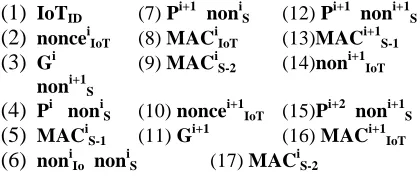
As in the attack model an adversary eavesdrops and saves the messages exchanged for two consecutive ith and i+1th sessions. From Figure 2, the recorded messages in order:
(1)
IoTID (7) Pi+1 noniS (12) Pi+1 noni+1S(2)
nonceiIoT (8) MACi
IoT (13)MAC i+1
S-1
(3)
Gi (9) MACiS-2 (14)noni+1IoTnoni+1S
(4)
Pi noniS (10) noncei+1IoT (15)Pi+2 noni+1S(5)
MACiS-1 (11) Gi+1
(16) MACi+1IoT
(6)
noniIo noniS (17) MACiS-2While capturing the exchanges, the saved exchanges can be searched for an instance when the value of the XOR (noniIoT⊕ noniS) in (6) is equal to one of the values in the set {all zeros (00….000), or all ones (FF….FFF), or a value with only a single bit with value “1” (i.e. 000…001 or 0010..000 etc.); or a value with only a single bit with value “0” (i.e. 111…110 or 1101..111 etc.)}. Capturing exchanges and analyzing saved sessions can be easily carried out in parallel, with a high end notebook. For simplicity, assume the instance of all zeros values for (6). Such a value indicates that noniIoT =
noniS, due to the property of XOR operation. The Gi+1 value is available in cleartext, during the next session at (11). Searching through a pre-calculated rainbow table of length 2l (l:= length of noni
S) such as one shown in
Table 1, the row entry where the Gi+1 value is found, exposes noniS.
Table 1: A typical rainbow table for the hash function H() of Figure 2
noniS Gi+1=H(noniS||noniS)
0000……..0000 ………..
0000……..0000 ………..
nonjS Gj+1
………….. …………..
1111……..1111 …………..
Using the recorded values, the attack proceeds as follows:
Since noniIoT =noniS, noniIoT is captured. (18)
XORing the captured noniS with (4), P i
is exposed. (19)
XORing the captured noniS with (7), Pi+1 is exposed. (20)
XORing Pi+1 (20) with (12) noni+1S is exposed. (21)
XORing noni+1S (21) with (14) noni+1IoT is exposed. (22)
XORing noni+1S (21) with (15) Pi+2 is exposed. (23)
Using MACiS-1 and MACiS-2 all captured values are verified. After the verification of the values, Gi+2 is calculated using Gi+2=H(noni+1S||noni+1IoT). The adversary now has consecutive (Gi, Pi), (Gi+1, Pi+1), (Gi+2, Pi+2) pairs, noniS, noniIoT, noni+1S, noni+1IoT. The
only unknown left is SID, at this stage.
For simplicity of step explanations, the instance of all zeros values for (noniIoT⊕noniS) was assumed. But this
is not the only case where noniIoT is exposed. For the
case when Eq. (6) is equal to { all ones (FF….FFF)}, noniIoT = ¬noniS (inverse of noniS), or vice versa. The
attack proceeds as before. A value is derived for noniIoT,
from the rainbow table of Table 1. The value of noniIoT
and noniS are verified by the value that matches the
constructed MACiS-1 and the received MACiS-1. For the
case when Eq. (6) is equal to {a value with only a single bit with value “1”; or a value with only a single bit with value “0”}, the analysis is just a few easy steps longer. The case indicates that noniIoT is different from noniS
only at the single “mismatches” bit, by the property of ⊕
operation. As in the previous cases, the derived value of noniIoT from Table 1is accepted as true. For the value of
noniS, the “mismatched” bit value is flipped. The values
are tested using MACiS-1. If they are not verified, the
“mismatched” bits of both noni
IoT and noniS are flipped.
This time MACiS-1 match verification is obtained and the
analysis ends. Therefore, there are 4 cases when the analysis produces exposed values. In fact, the attack can be extended over to two “mismatched” bits, but we will not pursue multiple bit analysis as the point is made. But, it is obvious that the public hash functions short rainbow table (256 for l =8 and 65536 for l =16) is definitely a weakness.
2.1 Successful Attacks on MKB Protocol
Forward secrecy:
Since all successive (Gi, Pi), (Gi+1,definitely breached. But at this stage only forward secrecy is not at stake.
Session Hijacking:
Consider the absence of the serveror its deliberate blocking from receiving IoT device messages. Having captured the secrets above, a clandestine server generates a fake nonce noni+2Sfake and
plays it with the easily calculated Pi+2⊕ noni+2Sfake and
MACi+2S-1fake = (IoTID, P
i+2
||noncei+2IoT||P
i+2⊕
noni+2Sfake||noni+2Sfake), at step 2 of Figure 2. The device
takes the value of Gi+2 and calculates Pi+2 to extract the
noni+2Sfake. Then, using the two values the device verifies
MACi+2S-1fake, without suspecting any foul play. Next the
device generates noni+3IoT to calculate the next session’s
Gi+3, Pi+3 values and its own MACi+2IoT. After receiving
message 3, the clandestine server exposes noni+2IoT and
Pi+3, easily. Next, verification of MACi+2IoT is simply
skipped. Then, Gi+3 and MACi+2S-2fake are calculated.
MACi+2S-2fake is sent in message 4 which is verified by
the device, without any complaint. Thus a full session is hijacked and the adversary has successfully mimicked a server.
In fact, any valid (Gk, Pk) pair can be replayed with a fake nonkS to the device because, the device does not
have a memory of the last session and simply recalculates Pk. Once a fake nonkiS is forged into the
device, the attack succeeds as it leads to the capture of the device nonkIoT. Session hijack can continue, as long
as the server does not reply message 1 of the device. Now, assume the authentic server comes alive and responds the device with an old (Gi, Pi) pair. The protocol runs flawlessly and the server detects no past malicious activity. Hence, the aim of the adversary to launch an undetectable attack to authenticate itself with the device has succeeded.
Full Disclosure attack:
If the attack model of possibletampering is accepted, the MKB protocol has one last big weakness. The authors claim that no secret is kept at the IoT device memory. But, on the contrary a parameter SID is silently used in the protocol’s MACiIoT
message. In order to use SID in its every session
calculations, the device has to have it in its memory. According to the attack model, this value can be captured through tampering with the device. But, another way of exposing the SID is analyzing the
MACiIoT value. If the public MAC function used is
similar to the used hash function H(),a similar rainbow table analysis can expose the SID value; since it is the
only unknown in the Eq. of MACiIoT. Even a table with
an entry space of 246 rows can be searched by an off-the-shelf CPU, within a couple of hours [5]. The disclosure of SID is a disastrous development, since it opens the
way to device mimicking or cloning. This is against the original claim of MKB authors that their IoT device provides security, even if captured by an adversary.
3. DISCUSSION
3.1 Attack Success Probability
It has been demonstrated that MBK protocol proposed for IoT information transfer can be successfully attacked. But, the probability of the success of the attack in a real IoT environment has to be provided. Therefore, the probability of our attack’s success is calculated, next. The set of values necessary for our analysis has been given, in the above section. There may be m
devices that report to the server, r times per hour (r
sessions/hour). The bit length of popular low cost IoT device microcontrollers is either 8 or 16. Thus, generated nonce (Figure 2) length l = 8 or 16. Using these parameters:
Probability of Eq. (6) to be all zeros is P1 = 1/2l
Probability of Eq. (6) to be all ones is P2 = 1/2l
Probability of a single bit of (6) to be 1 is P3 = l /2l
Probability of a single bit of (6) to be 0 is P4 = l /2l
Total Probability:
PT = P1 + P2 + P3 + P4 = (2l + 2)/2l
(24)
For m devices present in the environment: PmT = [m x (2l +2)/2l]
(25)
For m devices with r/hour:
PmTr = [r x m x (2l +2)/2l]
(26)
For probability PmTr = 1 (a successful attack), r=1/hour:
For l =8 bits, 𝑚 =25618 = 14; (every 14 device authentications a device is exposed/hour). For l =16 bits, =65536
3400 ; every 1927 device authentications a device is exposed/hour.
For r = 100 sessions/hour, l =16 bits:
𝑚 =655363400 ; every 19 device authentications a device is exposed/hour.
Every week, 168 (24 hours x 7 days) devices are guaranteed to be exposed, totaling to 5040 in a month. Therefore, it is obvious that with the use of the MKB protocol, a complete IoT environment of approximately 5000 devices can be breached, within one month.
3.2 Cracking Unique PUFs of IoT Devices
becomes trivial. Then, exposing nonkS from the cleartext Pk nonkS sent in step 2, becomes easy. Low cost devices like Radio Frequency Identification (RFID) tags are also in the IoT device category. And their microcontroller architecture is mostly 8 or 16 bits. Therefore, the nonces used in the authentication protocols are not adequately long for strong security. This is depicted in the short length of the rainbow table for the used public hash function in the analyzed MKB protocol. Instead, an elliptic curve cryptography supported PUF protocols can provide better resistance to our attack [10]
4. CONCLUSIONS
Multiple known attacks on a mutual authentication protocol designed for IoT devices have been demonstrated. The attack can expose thousands of IoT devices in a system, within a month. The existence of rainbow tables for hash functions has to be accepted as a reality. As such, authentication protocols using 8 or 16 bit length message-exchange words should consider using strong cryptographic encryption functions.
REFERENCES
[1] Beecham Research’s M2M/IoT Sector Map©, http://www.beechamresearch.com/
download.aspx?id=18, (Accessed on 29 th October 2018).
[2] D. Miorandi, S. Sicari, F. Pellegrini, and I. Chlamtac, “Internet of Things: Vision, Applications and Research Challenges”, Ad Hoc Networks, Vol. 10, No. 7, 2012, pp.1497-1516.
[3] A. M. Naveed, K. C. Chua and B. Sikdar, "Physically secure mutual authentication for IoT", in Conference on Dependable and Secure Computing, IEEE, 2017.
[4] A. Cherkaoui, L. Bossuet, L. Seitz, G. Selander and R. Borgaonkar, "New paradigms for access control in constrained environments", in International Symposium on Reconfigurable and Communication-Centric Systems-on-Chip, 2014, IEEE, 2014. [5] D. Mukhopadhyay, "PUFs as promising tools for
security in Internet of things", IEEE Design & Test, Vol. 33, No. 3, 2016, pp. 103-115.
[6] R. Maes, “Physically Unclonable Functions: Constructions”, Properties and Applications, New York USA: Springer-Verlag, 2013, pp. 1–172. [7] M. H. Özcanhan, "Analysis of a Recent Hash Based
RFID Authentication Protocol Intended for Telecare Medicine", International Research Journal of Engineering and Technology, Vol. 2, No. 4, 2015, pp, 1520-1524.
[8] K. Theocharoulis, I. Papaefstathiou and C. Manifavas, "Implementing rainbow tables in high-end FPGAs for super-fast password cracking",
International Conference on Field Programmable Logic and Applications, IEEE, 2010.
[9] M. H. Özcanhan, "Improvement of a Weak RFID Authentication Protocol Making Drug Administration Insecure", Life Science Journal, Vol. 11, No. 10, 2014, pp. 269-276.
![Fig. 1 Beecham Research’s M2M/IoT Sector Map© [1].](https://thumb-us.123doks.com/thumbv2/123dok_us/1326096.1640752/2.612.77.306.448.573/fig-beecham-research-m-m-iot-sector-map.webp)