www.astrophys-space-sci-trans.net/4/59/2008/ © Author(s) 2008. This work is distributed under
the Creative Commons Attribution 3.0 License. Astrophysics and Space Sciences
Transactions
Forbush decrease of the galactic cosmic ray intensity: experimental
study and theoretical modeling
M. V. Alania1,2and A. Wawrzynczak3
1Institute of Math. and Physics of University of Podlasie, Siedlce, Poland 2Institute of Geophysics, Georgian Academy of Sciences, Tbilisi, Georgia 3Institute of Computer Science of University of Podlasie, Siedlce, Poland
Received: 16 November 2007 – Revised: 17 March 2008 – Accepted: 7 July 2008 – Published: 4 December 2008
Abstract. We study the temporal changes of the power law rigidity spectrum of the Forbush decrease (Fd) of the galac-tic cosmic ray (GCR) intensity. We show that the power law rigidity spectrum of Fd for the period of 6–20 Novem-ber 2004 found by neutron monitors and ground muon tele-scopes experimental data, gradually is hardening during the decreasing phase of the intensities and then steadily is soft-ening during the recovery phase. A relation of the rigidity spectrum exponent of the Fd of the GCR intensity with the exponent of the power spectral density (PSD) of the compo-nents of the interplanetary magnetic field (IMF) turbulence is established. We develop three dimensional (3-D) non sta-tionary model of the Fd and show that the results of the theo-retical modeling are in good agreement with the experimen-tal data. We suppose that temporal changes of the rigidity spectrum exponent of the Fd of GCR intensity can be used to calculate the exponent of the PSD of the IMF turbulence for the arbitrary period, which is not achievable by the in situ measurements of the IMF.
1 Introduction
A fast decreases of GCR intensity during one-two days and then its gradually recovery in 5–7 days are called the For-bush decreases (Fds) (ForFor-bush, 1937). They are formed after the outstanding flares on the Sun and intensive solar coronal mass ejecta (CME) (Burlaga, 1995; Cane, 2000). These phe-nomena appear randomly in time, sporadically without any regularity, increasing its frequency in maxima of the solar activity. Fd are of three basic types, (1) caused by a shock and ejecta, (2) caused by a shock only, and (3) caused by an ejecta only (Cane, 2000). Amplitude of the Fd of the GCR
Correspondence to: M. V. Alania ([email protected])
intensity is found as the difference between the intensities at the onset and the minimum point of Fd. A dependence of the amplitude on the rigidity of GCR particles is one of the fundamental characteristics of the Fd. Lots of papers are devoted to this problem. Cane (2000) notes that if rigidity de-pendence of the amplitude of Fds is given by power lawR−γ, γranges from about 0.4÷1.2. The recently published paper Ahluwalia and Fikani (2007) is many-sided from the method-ological, explanation, discussion, and even historical points of view. A selection of the response functions proposed by various authors (e.g. see in book Dorman, 2004), and calcu-lation of the median rigidities of detectors to use them for the finding of the rigidity dependence of Fd (Ahluwalia and Fikani, 2007) need further study.
2 Motivation
0
-2
-4
-6
-8
AF [%]
Nagoya N0VV Calgary Kiel
1.4
1
0.6
18/11 15/11
12/11 09/11
06/11
Exponent
γ
Date, Year 2004 γ Rmax=200GV γ Rmax=100GV
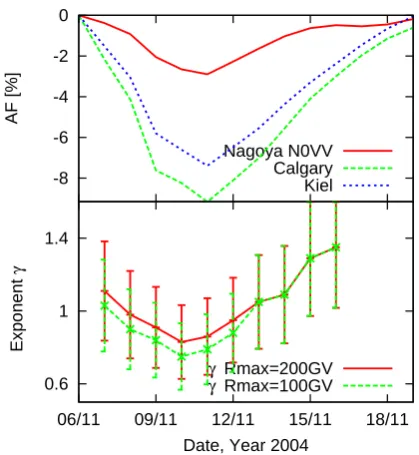
Fig. 1. Temporal changes of the GCR intensities (top panel) and temporal changes of the rigidity spectrum exponent γ (bottom panel) during the Fd of 6–20 November 2004
nentνof the PSD of the IMF turbulence (Wawrzynczak and Alania, 2005, 2008) exists owing to the dependence of the diffusion coefficientKof GCR particles on the rigidityRas, K∝Rα, i.e. that the exponentγ should be proportional to theα. According to the quasi linear theory (QLT), the coef-ficientαdepends on the exponentν of the PSD of the IMF turbulence, asα=2−ν(Jokipii, 1966; Hasselman and Wib-berenz, 1968; Jokipii, 1971; Toptygin, 1985). So, it is obvi-ous that a correlation of the power spectrum of the IMF with diffusion coefficient (with the mean free path of the GCR particles along the IMF) is expected from QLT. It should be noted that a conclusion of Jokipii (Fig. 4 in Jokipii, 1971) about transition rigidity 2 GeV, above which diffusion coef-ficientK is proportional toR2 (K∝R2), of course, needs correction. This result was obtained based on the poor data of the PSD of the IMF for the period before 1966. Generally data of the PSD of the IMF show that (e.g. Burlaga, 1995) the exponentν of PSD of the IMF does not tend to zero for the frequency less than 10−7Hz of the IMF turbulence. So, averagely, a dependenceK∝R2is expected for the energy greater than 100 GeV.
QLT has undergone revision and development, espe-cially during last 10–15 years. Bieber et al. (1994) found good agreement between theoretical results and observa-tions, which was confirmed by Droge (2003) assuming the composite slab/two-dimensional model for turbulence geom-etry. Matthaeus et al. (2003) proposed a Nonlinear Guiding Center (NLGC) theory. This model includes the influence of parallel scattering and dynamical turbulence. Shalchi et al.
(2004) presented a weakly nonlinear theory (WNLT) being a nonlinear extension of QLT. Recently, Qin (2007) developed a nonlinear parallel diffusion theory (NLPA) and demon-strated that the combination of the new NLPA and NLGC theories shows good agreement. In general, the significant differences between the expected results from the QLT on the one hand, and the expected results from the NLGC the-ory (Matthaeus et al., 2003) and WNLT (Shalchi et al., 2004) on the other, were found for the energy of the GCR particles up to few hundred MeV. For the energy>1 GeV all theories (QLT, NLGCT and WNLT) give the same results (Droge, 2003; Shalchi and Schlickeiser, 2004). So, for the energy of the GCR particles 5–50 GeV, to which neutron monitors and ground muon telescopes respond, the QLT approach is acceptable i.e. thatα=2−ν; then the relationship between the exponentsγ andν(γ≈2−ν), found for 11-year GCR variation in Alania and Iskra (1995); Alania et al. (2008); and for Fd in Wawrzynczak and Alania (2005, 2008) should be valid.
In this paper our aim is threefold: (1) to study the rigidity spectrum of the Fd of the GCR intensity using neutron mon-itors and ground muon telescopes experimental data, (2) to develop new 3-D time dependent model of Fd based on the Parker’s transport equation, and (3) to establish a relationship between the rigidity spectrum of the Fd of the GCR intensity and PSD of the IMF.
3 Experimental data
We study Fd 2004, 6–20 November related with the series of the solar flares in period of 4–10 Novem-ber having resulted in shocks waves and CME (ftp://ares.nrl.navy.mil/pub/lasco/halo). We use daily average data of the 22 neutron monitors (Alma-Ata, Apatity, Athens, Calgary, Climax, Haleakala, Irkutsk, Jungfraujoch, Kergelungen, Kiel, Larc, Lomnicky Stit, McMurdo, Mexico, Moscow, Oulu, Potchefstroom, Roma, South Pole, Tbilisi, Thule, Yakutsk) and 13 channels of Nagoya muon telescope (N0VV, N1WW, N1SS, N1EE, N1NN, N3EE, N3NN, N3SS, N3WW, N4NE, N4NW, N4SE, N4SW). Our aim is to find temporal changes of the rigidity dependence of the Fd. In connection with this to increase reliability of the calculations we use neutron monitors and muon telescopes data smoothed over 3 days. As an example, 3 days smoothed data of neutron monitors Calgary, Kiel and Nagoya N0VV muon telescope are presented in Fig. 1 (upper panel). The exponentγ of the power law rigidity spectrum was found using the expression (Dorman, 2004):
δD(R) D(R) =
AR−γ R≤Rmax 0 R > Rmax
4e-005 2.5e-005 1e-006
PS Bz [nT
2 ]
Hz I II III
4e-005 2.5e-005 1e-006
PS By [nT
2 ]
Hz I II III 400
300
200
100
0
4e-005 2.5e-005 1e-006
PS Bx [nT
2 ]
Hz I II III
Fig. 2. Power Spectra of theBx, By and Bz components of the IMF for the periods before (I), during (II) and after (III) the Fd in November 2004.
Table 1. The values of the exponentν of the PSD of the IMF’s components Bx, By and Bz for periods: before the Fd (I), during (II) and after (III) the Fd
Exponentνof the PSD of the IMF
IMF I period II period III period
components 24 Oct - 6 Nov 7 - 20 Nov 21 Nov -4 Dec
Bx 1.48±0.05 1.51±0.05 1.80±0.07 By 1.48±0.05 1.63±0.05 1.50±0.05 Bz 1.42±0.05 1.83±0.05 1.50±0.05
temporal changes of the exponentγ were calculated using above mentioned all 22 neutron monitors and Nagoya muon telescopes data (13 channels). We takeRmax=100 GV, con-sidering that beyond 100 GV the Fd of the GCR intensity vanishes. To demonstrate validity of our assumption the tem-poral changes of the exponent were calculated for two values ofRmax=100 GV andRmax=200 GV; results are presented in Fig. 1 (bottom panel). It is seen that there is not any differ-ence in scope of accuracy of calculations forRmax=100 GV andRmax=200 GV. Figure 1 shows that rigidity spectrum for the beginning and recovery phases of the Fd is rela-tively soft (γ100≈1.03±0.25,γ200≈1.11±0.27) with re-spect to the rigidity re-spectrum in the minimum and near minimum phases of the GCR intensity (γ100≈0.75±0.18, γ200≈0.83±0.20). The temporal changes of the rigidity spectrum exponent γ we ascribe to the conversion of the structure of the IMF turbulence during the Fd. Particularly, the hardening of the rigidity spectrumδD(R)/D(R)∝R−γ of the Fd (the exponent γ gradually decreases in the min-imum and near minmin-imum phases of the Fd) should be ob-served owing to the increases of the exponentνof the PSD in the energy range of the IMF turbulence (10−6÷10−5Hz). We assume that the increase of the exponentνduring the Fd
is generally caused by the creation of new, relatively large scale irregularities, i.e. a power of the PSD preferentially should be increased in the lower frequency part of the range
∼10−6÷10−5Hz of the IMF turbulence (Wawrzynczak and Alania, 2005, 2008). The new created large scale irregu-larities can be connected with scattering of the convected structure of the IMF (E. Marsch, private discussion) or/due to the nonlinear interaction of high speed disturbances with the background solar wind in the interplanetary space.
of the exponentν. As far we use Parker’s transport equation (Parker, 1965) to describe long period (11-year) and short period (Forbush effects) variations, a relationship betweenγ andν found for the long period (Alania and Iskra, 1995); Alania et al. (2008) should be extended for the short period, too. Thus, we can suppose that the relation (Wawrzynczak and Alania, 2005, 2008) between the exponentνof the PSD of the IMF turbulence and the exponent γ of the rigidity spectrum of the Fd (when theνincreases theγdecreases) is related with the changes of the IMF turbulence during the Fd.
4 Model of the Forbush decrease
To describe the Fd of the GCR we use the Parker’s transport equation (Parker, 1965):
∂N
∂t = ∇i(Kij∇jN )− ∇i(UiN )+ 1 3
∂
∂R(N R)(∇iUi) (2)
Where N and R are density and rigidity of cosmic ray par-ticles, respectively; Ui - solar wind velocity, Kij is the
anisotropic diffusion tensor of cosmic rays. The size of the disturbed vicinity where the Fd take place equals ∼6 as-tronomical unites (AU). Size of modulation region equals
∼30 AU, which is 5 times greater than the vicinity respon-sible for the Fd. This vicinity is restricted in heliolongi-tudes, heliolatitudes and distance as: ϕ∈(140◦,220◦) and θ∈(60◦,120◦),r≤6 AU, the solar wind velocity is constant and equalsU=400 km/s. Our aim is to confirm by numeri-cal solution a relation of the expected rigidity spectrum expo-nentγof the Fd with the exponentνof the PSD of the IMF turbulence. For this purpose in the change of the parallel dif-fusion coefficientKkpresented asKk=K0K(r)K(R, t ), we assume:
K(R, t )=Rα(t )=R2−ν(t ),
ν(t )=0.8+15(7t−30.7)1.5exp(−8(t−0.1)), K0=4.5×1021cm2/s,
K(r)=1+0.5(1AUr )
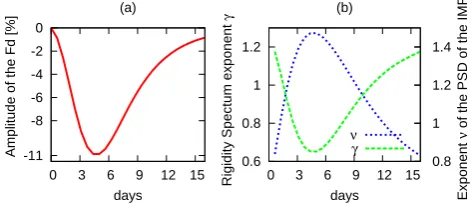
here r is heliocentric distance, t-time. The normalized parallel diffusion coefficient Kk=K0K(r)K(R, t ) equals 1023cm2/s for 10 GV at Earth orbit; perpendicular and drift diffusion coefficients have a standard form (Wawrzynczak and Alania, 2008). Changes of the relative density and the calculated expected power lawR−γ rigidity spectrum
expo-nentγof the Fd are presented in Fig. 3a,b, respectively. Also, the assumed temporal changes of the exponentνof the PSD of the IMF turbulence is presented in Fig. 3b. We see that the simulated Fd (Fig. 3a) satisfactorily describes the experimen-tal data (Fig. 1), and there is an inverse dependence between the changes of the exponentγ and the exponentν(Fig. 3b), as we expected according to the assumption.
0
-2
-4
-6
-8
-11
0 3 6 9 12 15
Amplitude of the Fd [%]
days (a)
0.6 0.8 1 1.2
0 3 6 9 12 15
0.8 1 1.2 1.4
Rigidity Spectum exponent
γ
Exponent
ν
of the PSD of the IMF
days (b)
ν γ
Fig. 3. (a) Changes of the expected amplitudes of the Fd of the GCR intensity for the rigidity of 10 GV based on the solutions of the transport equation for the Fd; (b) Temporal changes of the expected rigidity spectrum exponentγbased on the solutions of the transport equation for the Fd and the exponentν(t )of the PSD of the IMF turbulence
5 Conclusions
1. The hardening of the rigidity spectrum δD(R)D(R) ∝R−γ of the Fd of the GCR intensity (the exponentγ gradually de-creases) in the minimum phase of the Fd takes place owing to the increase of the exponentνof the PSD of the IMF tur-bulence caused by the creation of the new, relatively large scale irregularities in the 10−6÷10−5Hz range of IMF tur-bulence.
2. The relation of the exponentγ with the exponentνis ob-served owing to the dependence of the diffusion coefficient Kof GCR particles on the rigidity R as,K∝Rα where, ac-cording to the QLTα=2−ν(forR≥1 GV).
3. The rigidity spectrum exponentγ of the Fd can be used to estimate an exponentνfor the arbitrary period, which is not achievable by the in situ measurements of the IMF.
4. The proposed time dependent three dimensional model reasonably describes the behavior of the exponentγ during the Fd, being compatible with the experimental data.
Acknowledgements. Authors thanks the investigators of neutron monitors used in calculations, Nagoya muon telescope and Ad-vanced Composition Explorer spacecraft for possibility to use their data.We thank referees for help in improving our paper.
Edited by: K. Scherer
Reviewed by: two anonymous referees
References
Ahluwalia, H. S. and Fikani, M. M.: Cosmic ray detector response to transient solar modulation: Forbush decreases, J. Geophys. Res., 112, A08105, 2007.
Alania, M. V., Iskra, K., and Siluszyk, M.: New index of long-term variations of galactic cosmic ray intensity, Adv. in Space Res., 41, 267–274, 2008.
Bieber, J. W., Matthaeus, W. H., Smith, C. W., Wanner, W., Kallen-rode, M.-B., and Wibberenz, G.: Proton and electron mean free paths: The Palmer consensus, Revised Astrophys. J., 420, 294– 306, 1994.
Burlaga, L. F.: Interplanetary Magnetohydrodynamics, Oxford Univ. Press, New York, 1995.
Cane, H. V.: Coronal Mass Ejections and Forbush Decreases, Space Sci. Rev., 93, 55–77, 2000.
Dorman, L.: Cosmic Rays in the Earth’s Atmosphere and Under-ground, Kluwer Academic Publishers, Dordrecht, 2004. Droge, W.: Solar Particle Transport In A Dynamical Quasi-Linear
Theory, Astrophys. J., 589, 1027–1039, 2003.
Forbush, S. E.: On the Effects in Cosmic-Ray Intensity Observed During the Recent Magnetic Storm, Phys. Rev., 51, 1108–1109, 1937.
Hasselman, K. and Wibberentz, G.: Scattering of charged particles by random electromagnetic field, Z. Gephys., 34, 353–388, 1968. Jokipii, J. R.: Cosmic-Ray Propagation, I. Charged Particles in a
Random Magnetic Field, Astrophys. J., 146, 480–487, 1966. Jokipii, J. R.: Propagation of Cosmic Rays in the Solar Wind, Rev.
Geophys. Space Phys., 9, 27–87, 1971.
Kudela, K., Storini, M., Hofer, M. Y., and Belov, A.: Cosmic Rays in Relation to Space Weather, Space Science Rev., 93, 153–174, 2000.
Matthaeus, W. H., Qin, G., Bieber, J. W., and Zank, G. P.: Nonlin-ear Collisionless Perpendicular Diffusion Of Charged Particles, Astrophys. J., 590, 53–56, 2003.
Parker, E. N.: The passage of energetic charged particles through interplanetary space, Planet. and Space Sci., 13, 9–49, 1965. Qin, G.: Nonlinear Parallel Diffusion of Charged Particles:
Exten-sion to the Nonlinear Guiding Center Theory, Astrophys. J., 656, 217–221, 2007.
Shalchi, A. and Schlickeiser, R.: The parallel mean free path of heliospheric cosmic rays in composite Slab/two-dimensional ge-ometry, I. The damping model of dynamical turbulence, Astro-phys. J., 604, 861–873, 2004.
Shalchi, A., Bieber, J. W., Matthaeus, W. H., and Qin, G.: Nonlinear Parallel and Perpendicular Diffusion of Charged Cosmic Rays in Weak Turbulence, Astrophys. J., 616, 617–629, 2004.
Toptygin, I. N.: Cosmic rays in interplanetary magnetic fields, Dor-drecht, D. Reidel Publishing Co., 1985.
Wawrzynczak, A. and Alania, M. V.: Peculiarities of galactic cos-mic ray Forbush effects during October–November 2003, Adv. in Space Res., 35, 682–686, 2005.