Original Research Article
Survey of compliance with the cigarettes and other tobacco products
act, 2003 at schools in Mangalore, Dakshina Kannada district,
Karnataka
Jennifer Mathias
1, Pratap Kumar Jena
2, Sanjeev Kumar Shah
3*, Jay Prakash Sah
4,
Koshish Raj Gautam
3, Abinash Upadhayay
3INTRODUCTION
Tobacco is the second major cause of death in the world today. Tobacco is a known risk factor for six of the eight leading causes of death worldwide. Globally, tobacco kills six million people every year and most of the deaths
occur in the developing world, one in every six will die from tobacco use. It is the cause of at least 30% of all deaths due to cancer and 87% of lung cancer deaths in men and 70% of deaths due to lung cancer among women.1
ABSTRACT
Background: Tobacco use is a major problem of public health significance as the tobacco smoking causes a wide range of diseases and adverse health impacts that affect nearly every organ of the body. The COTPA, 2003 i.e., the Indian smoke-free legislation “Prohibition of smoking in Public places” which forbids smoking in public places, including educational institutions. The main objective of this study is to assess the compliance of Section 4 and Section 6(b) of cigarettes and other tobacco products act (COTPA), 2003 in schools, to observe compliance of smoking ban at public places, to observe compliance of display of signboards at prominent places, to observe for direct and indirect evidence of smoking and other tobacco products used in school buildings and premises, to study the availability of tobacco products within 100 yards of school premises.
Methods: A cross sectional survey in 100 schools in Dakshina Kannada district using compliance guide developed by partners of Bloomberg School of Public health to reduce tobacco use.
Results: In 100 schools, 55 were rural area and 45 from urban area, further division shows government/semi-government schools were 44 and Private schools were 56. Section 4 for the presence of signboard, there is an association between the Management wise schools and presence of signboards (p=0.001), for section 6(b) of COTPA, there is an association between this Section and type of management (p=0.004).
Conclusions: The schools depending upon the location show varied compliance towards the law. The Section 6(b) shows better compliance than Section 4.This study will help to address the implementation issues of COTPA.
Keywords: COTPA, Educational institution, Cigarettes and other tobacco products acts, Compliance
1
School of Nursing, Queensland University of Technology, QLD, Australia
2
School of Public Health, Kalinga Institute of Industrial Technology (KIIT), Bhubaneswar, Odisha, India
3
Department of Public Health, KS Hedge Medical Academy, Nitte University, India
4
School of Health Sciences, Pokhara University, Nepal
Received: 17 May 2019
Revised: 15 July 2019
Accepted: 16 July 2019
*Correspondence:
Sanjeev Kumar Shah,
E-mail: [email protected]
Copyright: © the author(s), publisher and licensee Medip Academy. This is an open-access article distributed under the terms of the Creative Commons Attribution Non-Commercial License, which permits unrestricted non-commercial use, distribution, and reproduction in any medium, provided the original work is properly cited.
Ten lakh Indians die every year due to tobacco use, one-fifth of worldwide deaths. According to the Global Adult Tobacco Survey 2009-10 India Report (GATS), 34.6% adults currently use tobacco in the country.2 Out of the 1.3 billion people who smoke worldwide; more than 10% are in India. According to the Global Youth Tobacco Survey India Report 2009 (GYTS) reveals that nearly 15% youth (19% boys and 8.3% girls) are using tobacco in any form in India.3
The Smoke free legislation is based on scientific evidence that there is no risk or safe level of exposure to tobacco smoke. There are direct laws that prohibit the use of tobacco or directly ban the use of tobacco and also there are the laws which reinforce and indirectly help with implementation of smoke free policies.
The Cigarettes and Other Tobacco Products (Prohibition Of Advertisement And Regulation Of Trade and Commerce, Production, Supply and Distribution) Act, 2003 and this extends to whole of India.4 Smoke free law, according to the section 4 in COTPA 2003, “The prohibition of smoking in Public Places Rules, (2008) prohibits smoking in public places with the aim to protect people from tobacco smoke.4
There are the State specific laws based on the components of the major tobacco prevention strategy, Government of Delhi, Tamil Nadu, Madhya Pradesh and others enacted smoke free laws and the Apex Court of India authorized all public places to be smoke free, The Prohibition of Smoking and Non-smoker‟s Health Act.1 And in this study the main aim is to assess the compliance of the smoke free law in the schools and it comes specifically in the section 6 of COTPA which stresses on Protecting Minor from Tobacco use and its influence. The section 6(a) is aimed to restrict the access of a minor to tobacco product: “Prohibition on sale of tobacco products to and by persons below the age of 18 years.” The section 6(b) is targeted to restrict the sale of tobacco within 100 yards of the school, “Prohibition on sale of cigarette and other Tobacco Products around Educational Institutions.”4,5
During adolescence, it is observed that there is a greater chance for initiating tobacco use, as they may be influenced by peers, mass media and other adults.6 During these years, it is very important to learn a good message regarding the prohibition of tobacco use and the harmful effects of tobacco on one‟s health. It is easy to reach the students during childhood and adolescence, as it is the influential stage in their when the lifelong behaviours are formed. The successful implementation of smoke free laws in schools will benefit their present as well as future. Hence this study is planned to assess the compliance with the law among the school students of Mangalore.
Tobacco use is a major problem of public health significance as the tobacco smoking causes a wide range
of diseases and adverse health impacts that affect nearly every organ of the body. The smoke from a smoker, second-hand smoke (SHS) also causes serious health problems to those exposed to it. According to the GYTS, the use of tobacco in any form is estimated to be 14.6%. Also, it is observed that in India adolescence is the most susceptible age for initiating tobacco use. While considering the present situation, this assessment will help in identifying the gaps in the way of implementation of the laws at the schools. The mean age of initiation of these habits was around 12.4 years, mainly from private school students as compared to government school students.7 A study conducted by Narain et al at Noida, India, in 2011 showed that any kind of tobacco use was found in 537 (11.2%) students, 419 (8.8%) were „ever smokers (including current smokers)‟, 219 (4.6%) were „ever tobacco chewers (including current chewers)‟, 179 (3.7%) were „exclusive smokers‟, and 118 (2.5%) were „exclusive tobacco chewers‟.7,8
The findings of this compliance study will be of help to the decision makers of the Education Authority to address the gap and take a step towards a tobacco free school environment.
Objectives
The main objective of this study is to assess the compliance of Section 4 and Section 6(b) of COTPA, 2003 in schools in Dakshina Kannada District of Karnataka, to observe compliance of section 4 of COTPA, 2003 i.e., smoking ban at public place and display of warning sign boards at prominent places, to observe for direct and indirect evidence of smoking and other tobacco products used in school buildings and premises and to study the availability of tobacco products within 100 yards of school premises.
METHODS
This was a school based cross sectional study. Study area was Mangalore city, Dakshina Kannada district, Karnataka. The schools from Mangalore were selected for the study. There were a total of 218 high schools in Mangalore. In this study the main components assessed were for observing Prohibition of smoking in Public places and specifically in educational Institutions. The section 4 and 6 COTPA Act, 2003 are highlighted here.
Sample size
The following formula was used for the calculation, considering p as 97.7% obtained by Goel et al:9
where, Z1-α/2=standard normal variate (1.96); p=expected
proportion in the population (0.977); d=absolute error of precision (0.03).
2 2 / 1 21
d
p
p
Z
Therefore the sample size obtained is 96 and it is rounded to 100 as the desired sample size. High schools are the ones having grades from VIII to X. the number of schools from the rural and urban area as well as government/ semi-government and private schools were selected using probability proportionate to size.
Stratified random sampling technique was used to select the schools, i.e. at first the schools were categorized into rural and urban and accordingly representative schools were selected by random selection, and then the schools are stratified into private schools and
government/semi-government schools and then accordingly the
representative sample from each stratum are selected. The schools selected are representative of the total number of schools.
The tool used for the study was adapted from the guide on “assessing compliance with smoke free law” which was developed jointly by the Campaign for Tobacco Free Kids, John Hopkins Bloomberg School of Public Health and International Union against Tuberculosis and Lung Disease.10 High school and secondary school of Government and private schools were included for the study .The duration of the data collection was from 1st January to 28th August 2015.
All the information which was collected from the observation was verified before data entry. Data were organized in the computer, SPSS 16.0 version was used for data analysis. After entering data, it was rechecked by randomly selecting 100 samples and verified. Descriptive statistics using a table of frequency distribution were used to summarize.
Ethical considerations
Approval was obtained from the Institutional Ethical Committee (IEC) of K.S Hegde Medical Academy, Nitte
University before the beginning of the study. Permission from the District Education Authority as well as from the Block Education Authority to carry out the studies in school was taken. Strict privacy and confidentiality was maintained during the interview.
RESULTS
Socio-demographic information
The socio-demographic profile of the school is summarized below. The total number of schools was, from rural area 55(55%) and from urban area were 45(45%) and among them there were a total of 44 schools which were run by government/ semi-government and 56 run by Private management.
Observations at the school
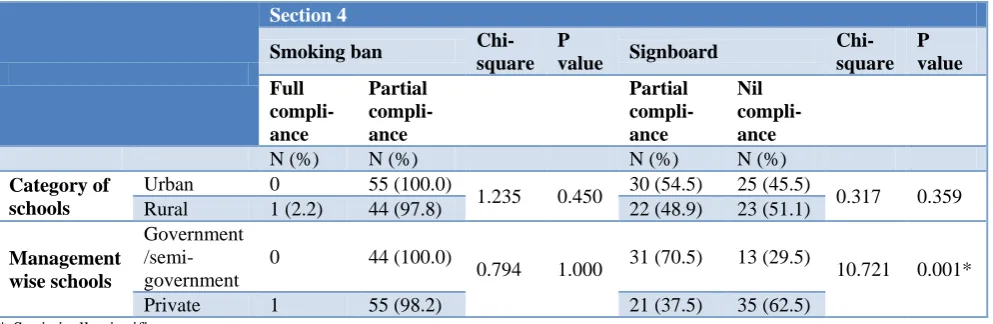
During the Indoor observations at the school, it was found that only one school had displayed signboard with “No smoking area” or “Smoking here is an offence”, two of them had warning signage board at every entrance of the school and two of them had one or more non-smoking signs in the venue/location. Similarly, during the outdoor observations, it was found that almost all of the schools (99) do not have anyone smoking within the campus, 8 of them have tobacco selling outlet within the radius of 100 yards near the institution, nearly half of the total schools have signboards saying “Sale of cigarettes or any other tobacco products in an area within the radius of 100 yards of the educational institution is strictly prohibited”.
From the Table 1, it is clear that the chi square test p value for the compliance of section 4 i.e., for the presence of signboard is less than 0.05. Hence there is association between the type of school management and presence of signboard at 5% level of significance.
Table 1: Association between compliance of section 4 and study characteristics.
Section 4
Smoking ban Chi-square
P
value Signboard
Chi-square
P value Full
compli-ance
Partial compli-ance
Partial compli-ance
Nil compli-ance
N (%) N (%) N (%) N (%)
Category of schools
Urban 0 55 (100.0)
1.235 0.450 30 (54.5) 25 (45.5) 0.317 0.359
Rural 1 (2.2) 44 (97.8) 22 (48.9) 23 (51.1)
Management wise schools
Government /semi- government
0 44 (100.0)
0.794 1.000 31 (70.5) 13 (29.5) 10.721 0.001*
Private 1 55 (98.2) 21 (37.5) 35 (62.5)
*-Statistically significant.
There are a total of four items to be complied with under section 6(b) i.e., whether anyone is selling tobacco within the radius of 100 yards near the institution, whether there
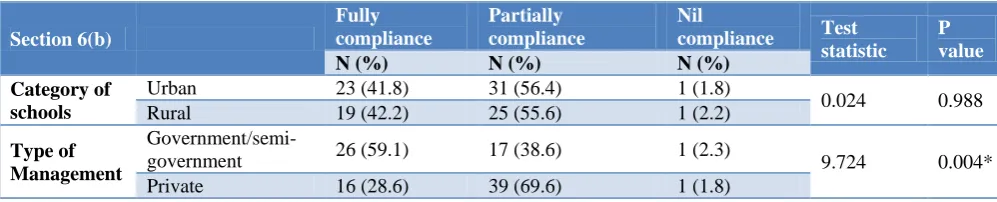
offence is punishable with a fine upto Rs. 200”, whether the board is prominently displayed at the entrance of the school and whether the board is according to the specified size. Among these it is evident that all the four items are observed to be complied in majority of the schools.
From the Table 2 it is evident that the chi square test P value for the compliance of section 6(b) is less than 0.05. Hence there is association between the type of school management and section 6(b).
Table 2: Association between compliance of section 6(b) and study characteristics.
Section 6(b)
Fully compliance
Partially compliance
Nil
compliance Test statistic
P value
N (%) N (%) N (%) Category of
schools
Urban 23 (41.8) 31 (56.4) 1 (1.8)
0.024 0.988
Rural 19 (42.2) 25 (55.6) 1 (2.2)
Type of Management
Government/semi-government 26 (59.1) 17 (38.6) 1 (2.3) 9.724 0.004*
Private 16 (28.6) 39 (69.6) 1 (1.8)
*-Statistically significant.
DISCUSSION
In this study, the compliance with the provisions under section of COTPA were classified into three categories i.e., fully compliant, partially compliant and nil compliance. The relevant sections included the section 4 and 6(b). The section 4, i.e., prohibition of smoking in public places was specified into the presence of signages and the observation of smoking ban. Results show none of the schools are fully compliant, all the 100 schools show partial compliance for section 4. The section 6(b) prohibits sale of cigarettes and other tobacco products within 100 yards, whether there is the presence of signboards at the entrance of the schools, the results reveal that 42% of them are fully compliant and the rest of it, 58% are partially compliant to the section.
While comparing the results from previous studies, Kumar et al assessed compliance to smoke free legislation in Himachal Pradesh, comparing across states of India, reveals that signage display was found to be least in educational institutions.11 Educational institutes (n=218) displayed signages were only 58 (26.6%) and yet there was a high compliance to the act of smoking, as 212 (97.2%) exhibited no active smoking.11 The results of the above mentioned study and the present study show a similarity that is even though there is no display of signages, there is no evidence of active smoking and this might be due to the location around the educational institution. In another similar study conducted among 287 schools in Chennai revealed that only 8 (2.8%) had signage displayed on probation of smoking, and only 2 (0.7%) had the signage for ban on sale of tobacco products. 12 In a study done around two schools in Gujarat also had revealed similar findings.13
Another similar study conducted by Goel et al in SAS Nagar Mohali of North India, the overall compliance shown by the educational institution was 97.7% (n=52), that was based on no active smoking 51 (98.1%), signage display complying with law 49 (94.2%), absence of
smoking aids 50 (96.2%), absence of cigarettes/beedi stubs 52 (100.0%), free from recent tobacco smell 52 (100.0%).9 Thus, it is very important to focus on restricting access to tobacco products among adolescents.
CONCLUSION
The study will help to address the implementation issues of COTPA. The schools depending upon the location show varied compliance towards the law. This study is not addressing all the issues of the Section 4 and Section 6(b). The study identified that the section 6(b) showed a better compliance when taken across category of schools i.e. full compliance seen in 42 schools, as well as type of management i.e., full compliance seen in 42 schools. For the Section 4 of COTPA, as observed even in the absence of display of signboards, there was no smoking observed.
Recommendations based on observations from this study are: the compliance of Section 6(a), which is the prohibition of sale to and sale by minors can be also included as a component and assessed in detail and the detailed assessment of the shops or kiosks selling cigarette and tobacco products surrounding the schools can be assessed.
As tobacco is becoming the rising issue of concern, it is very important for the legislation to strengthen and enforce the law strictly at the school level, with proper enforcement the compliance can improve to a greater extent.
ACKNOWLEDGEMENTS
Funding: No funding sources Conflict of interest: None declared
Ethical approval: The study was approved by the Institutional Ethics Committee, Nitte University, India
REFERENCES
1. Centre for Disease control and prevention.
Smoking-attributable mortality, years of potential life lost, and productivity losses--United States, 2000-2004. MMWR Morbidity and mortality weekly report. 2008;57(45):1226-8.
2. International Institute for Population Sciences (IIPS), Ministry of Health and Family Welfare (MoHFW), India Go. Global Adult Tobacco Survey India Report (GATS India), 2009-10. 2010.
3. World Health Organization. India (Ages 13-15) Global Youth Tobacco Survey (GYTS) 2009. Available from: https://www.who.int/fctc/reporting/ Annexoneindia.pdf. Accessed on 20 July 2019. 4. The Gazette of India. The Cigarettes and Other
Tobacco Products (Prohibition of Advertisement
and Regulation of Trade and Commerce,
Production, Supply and Distribution) Act, 2003. In: Justice MoLa (ed). New Delhi; 2003.
5. Ministry of Health and Family Welfare (MoHFW). Operational Guidelines: National Tobacco Control Programme. In: Cell NTC, editor. 2012.
6. Kaur J, Jain D. Tobacco control policies in India: implementation and challenges. Indian J Pub Health. 2011;55(3):220.
7. Narain R, Sardana S, Gupta S, Sehgal A. Age at initiation and prevalence of tobacco use among school children in Noida, India: A cross-sectional questionnaire based survey. Indian J Med Res. 2011;133(3):300.
8. Shenoy RP, Shenai PK, Panchmal GS, Kotian SM. Tobacco use among rural schoolchildren of 13-15 years age group: A cross-sectional study. Indian J Community Med. 2010;35(3):433-5.
9. Goel S, Ravindra K, Singh RJ, Sharma D. Effective
smoke-free policies in achieving a high level of compliance with smoke-free law: experiences from a district of North India. Tobacco control. 2014;23(4):291-4.
10. Birckmayer J, Feighery E, Carmona M, Friend K, Apelberg B, Hepp L, et al. Assessing Compliance with Smoke Free Laws, A “How-to” Guide for Conducting Compliance Studies. Second edition. 2014.
11. Kumar R, Chauhan G, Satyanarayana S, Lal P, Singh RJ, Wilson NC. Assessing compliance to smoke-free legislation: results of a sub-national survey in Himachal Pradesh, India. WHO South-East Asia J Pub Health. 2013;2(1):52.
12. Kaur P, Thomas DR, Govindasamy E, Murhekar
MV. Monoitring smoke-free laws in restaurants and educational institutions in Chennai, India. National Med J India. 2014;27(2).
13. Patel D, Kassim S, Croucher R. Tobacco promotion
and availability in school neighborhoods in India: a cross-sectional study of their impact on adolescent
tobacco use. Asian Pac J Cancer Prev.
2012;13(8):4173-6.
Cite this article as: Mathias J, Jena PK, Shah SK,
Sah JP, Gautam KR, Upadhayay A.Survey of
compliance with the cigarettes and other tobacco products act (COTPA), 2003 at schools in Mangalore, Dakshina Kannada district, Karnataka. Int J