Environmental Management: Development
Feasibility of New Product
Vicente Fernando Pozzebon University of Caxias do Sul, Brazil
Marta Elisete Ventura da Motta University of Caxias do Sul, Brazil
Maria Emilia Camargo University of Caxias do Sul, Brazil
Alice Munz Fernandes
Federal University of Rio Grande do Sul, Brazil
Ademar Galelli
University of Caxias do Sul, Brazil
Beatriz Lúcia Salvador Bizotto University of Caxias do Sul, Brazil
Raquel Viviane Fiamenghi Prusch University of Caxias do Sul, Brazil
Abstract
The productive activities of the recycling of plastics generate solid waste that must be environmentally correct destinations, to minimize the impacts to the environment. The present study sought to identify the environmental costs, using the environmental management for the development of a new product that used recycled solid waste as raw material. For your realization took the deductive method, with the qualitative and descriptive approach, operationalized by a case study that enabled the survey and the analysis of the data selected. As a result, the relevant importance of environmental accounting and enforcement costs in the prospect of the formation of the selling price and profitability analysis. Environmental management enabled support initially deploying a system capable of measuring information inside and outside the company, targeting the use of drops. Such a practice has highlighted the positive results obtained from the application of the recovery of solid waste generated by the company because the return on investment of five months and fifteen days, the period of five years has presented the TIR 101% and provided the profit increase of 1%. With the development of the new product. You can see increased environmental results because the company failed to deposit the waste in the landfill. In this way, the company is acting sustainably reducing your impact activity allowing even the reduction of expenses and costs. It is suggested for future studies observe the disposal of waste, the consequences that bring businesses and the type of environmental impact which causes..
Keywords: environmental accounting, costs, environmental management, recycling, waste.
1.INTRODUCTION
The industrial growth along with the increased demand for products have committed considerable natural resources. In this scenario the accumulation of solid wastes, mostly discarded improperly, has collaborated to worsen environmental degradation (PAIVA, 2003).
In the search for solutions to this problem, were created the Environmental Management Systems (EMS), which contribute to the control and reduction of environmental impact, creating opportunities for sustainable growth at a lower cost (CARVALHO, 2012).
To Schiockt (2006) environmental practices such as the implementation of EMS, generate costs that must be identified and subsequently allocated in the formation of the selling price of the products. In this way, the environmental accounting for studying and controlling environmental aspects, provides a better use of resources, and may also contribute to the measurement of records, disclosure of expenses and costs.
2. THEORETICAL FRAMEWORK
The United Nations (ONU), promoted the International Convention II of environment and development in Rio de Janeiro (ECO/92) which resulted in AGENDA 21, with the purpose of establishing an international agenda of cooperation, aiming at sustainable development, warned of the need "to which countries and international organizations to develop an accounting system that integrates the social, environmental and economic issues" (ONU, 1992).
Carvalho (2012) stresses that although agenda 21 refers to governmental accounting, many companies have created systems to monitor environmental effects of their productive processes aiming at the preservation of their heritage and sustainable growth on the environment.
Christophe (2003), defines environmental accounting as a system intended to provide information about the rarefaction of the natural elements, engendered by the companies ' activities and on the measures adopted to prevent this rarefaction. In this way, the environmental accounting aims to study and control the environmental aspects of the companies providing an improved use of environmental resources.
As Carvalho (2012), although this science can register for events that may harm the company's image vis-à-vis its stakeholders, also assists in demonstration of their actions towards preservation of the environment.
According to Stark (2007) by meet accounting principles the absorption costing method allows you to improve the management information that will serve as a basis for the formation of the selling price, as it recovers the costs incurred by the company/ activity.
Dutra (2010), points out that the variable costing is based on contribution margin, which is the difference between total revenue and the sum of variable costs and expenses, making visible the absorption of costs and consequently the profit provided.
3. METHODOLOGY
To carry out this research, we used the deductive method, since it provides the action in concrete steps or not, considering the time in which these are located to the incidence of deduction (MARCONI; LAKATOS, 2009). As to the purpose, set up as a descriptive and exploratory research, which at the same time describes the characteristics of a given phenomenon (COLLIS; HUSSEY, 2005) and raises the investigator's knowledge about this (TRIVINÖS, 1990).
In the case of the approach to the problem, consisted of a quali-quantitative research. Qualitative research enables the deepening of the understanding of reality (MALHOTRA; Rock; LAUDISIO, 2005) and, thus, is consistent in its priorities of singularity and context (STAKE, 2011). For your time, the quantitative approach consists in measuring the results (RICHARDSON, 1999) and application of statistical techniques (BRYMAN, 1988).
In relation to the search procedure, we used the case study which, according to Yin (2015), refers to the empirical research of the given phenomenon considering your context. To Hartley (2004, p. 323), the case study aims to "provide an analysis of the context and processes that illuminate the theoretical questions that are being studied".
The company object of this study called fictitiously as Alpha Company is located in the municipality of Gate-RS, where he plays the activity of recycling of domestic waste plastics scraps, turning it into reusable raw material for injection of organizations plastics, since 2007.
Your consumer market consists of manufacturers of brooms, squeegees and similar, located in the region of Vale do Caí. Is considered as micro enterprise according to criteria for classification of the National Bank of economic and Social Development (BNDES, 2015), whose tax is governed by the national simple. Currently manufactures and markets monthly 28,000 kg of recycled plastic (white and colored) and, for both, your staff is composed of four employees in production and in the administrative area.
"As a source of evidence collection, documents and records in files, which, according to Yin (2015, p. 130), play an explicit role in any data collection in the realization of case studies". The non-participant observation was also adopted, since it allows the verification of non-written, by means of perception (FLICK, 2009).
It should be noted that the survey was conducted between August and November 2014. The data analysis procedure was through the use of economic indicators and financial calculations, structured through electronic spreadsheets.
4. ANALYSIS AND DISCUSSION OF THE RESULTS
The plastics recycling San Francisco, began operations in 2007, in the municipality of Portão/RS. Opting for Simple taxation system nationwide, has as its main activity the plastics recycling of domestic origin, turning it into reusable raw material for plastic injection businesses.
search for a new alternative for the company that proposed to develop a new product, recycling polypropylene (PP) found in domestic scrap.
During the research the company acquired the nine raw material suppliers located in the region of Porto Alegre. The withdrawal of the material was made using the own transport that travels to the headquarters of the suppliers, obeying a weekly schedule.
The opening of new customers located in Mountainous Regions and the Valley of Fell and made possible the use of PP for the manufacture of rodos, dustpans, pieces of broomsticks and sanitary brush. The increased demand has resulted in the need for investments that the production was 500 kg to 1,400 kg on average per day. Incidentally to investment, the monthly manufacturing and trading of recycled plastic reached 28,000 kg, being white product 14000 kg product 14000 kg and colorful. This process included five employees; four for production and a contributor to the administrative area.
The production process is divided into two systems; the grind and extrusion of materials. The activity begins with the storage of the raw material which passes through a manual sorting for detecting materials that cannot be used (iron, wood) and those that have dimensions that are in the mill measures, these should be cut in a bandsaw.
The selling price determined for the white product, considering the Simples Nacional (8.78%); Expenses (10.90%); Desired Profit (20.00%), totaling 39.68% product cost R$1.95 using Mark-up-splitter 0.6032, resulted in the white product selling price of R$3.23.
Referring to the colored product with the only difference in the amount of R$ 1.65 clears up the selling price of R$ 2.73.
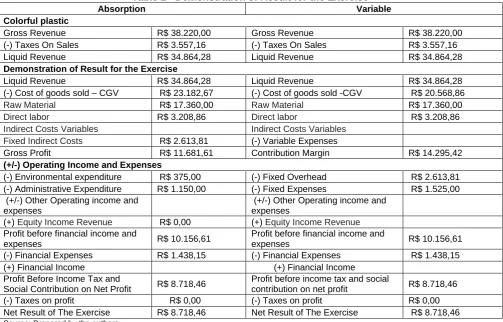
In tables 1 and 2, presents itself to demonstration of the result of the exercise (DRE) for the white and colored plastic by method of absorption and variable method.
Table 1 - Demonstration of Result for the Exercise
Absorption Variable
White Plastic Gross Revenue
R$ 45.220,00 Gross Revenue R$ 45.220,00
(-)Taxes s/Sales R$ 3.970,31 (-) Taxes s/Sales R$ 3.970,31
Liquid Revenue R$ 41.249,68 Liquid Revenue R$ 41.249,68
Demonstration of Result for the Exercise
Liquid Revenue R$ 41.249,68 Liquid Revenue R$ 41.249,68
(-) Cost of goods sold R$ 28.082,67 (-) Cost of goods sold R$ 25.468,86
Raw Material R$ 22.260,00 Raw Material R$ 22.260,00
Direct labor R$ 3.208,86 Direct labor R$ 3.208,86
Variable Indirect Costs Variable Indirect Costs R$ 0,00
(-) Fixed Overhead R$ 2.613,81 - (-) Variable Expenses R$ 0,00
Gross Profit R$ 13.167,01 Contribution Margin R$ 15.780,82
(+/-) Operating Income And
Expenses
(-) Environmental expenditure R$ 375,00 (-) Fixed Indirect Overhead
(-) Fixed Expenses R$2.613,81 (-) Administrative Expenditure R$ 1.150,00 (-) Fixed Expenses R$ 1.525,00 (+/-) Other Operating Income and
Expenses
(+/-) Other Operating Income and Expenses
(+) Equity Income R$ 0,00 (+) Equity Income R$ 0,00
Profit Before Financial Income And
Expenses R$11.642,01
PROFIT BEFORE Financial Income
And Expenses R$11.642,01
(-) Financial Expenses R$ 1.438,15 (-) Financial Expenses R$ 1.438,15
(+) Financial Income (+) Financial Income R$ 0,00
Profit Before Income Tax And Social
Contribution On Net Profit R$ 10.203,78
Profit Before Income Tax And Social
Contribution On Net Profit R$ 10.203,78
(-) Taxes on Profit R$ 0,00 (-) Taxes on Profit R$ 0,00
Net Result of the Exercise R$ 10.203,78 Net Result of the Exercise R$ 10.203,78
Table 2 - Demonstration of Result for the Exercise
Absorption Variable
Colorful plastic
Gross Revenue R$ 38.220,00 Gross Revenue R$ 38.220,00
(-) Taxes On Sales R$ 3.557,16 (-) Taxes On Sales R$ 3.557,16
Liquid Revenue R$ 34.864,28 Liquid Revenue R$ 34.864,28
Demonstration of Result for the Exercise
Liquid Revenue R$ 34.864,28 Liquid Revenue R$ 34.864,28
(-) Cost of goods sold – CGV R$ 23.182,67 (-) Cost of goods sold -CGV R$ 20.568,86
Raw Material R$ 17.360,00 Raw Material R$ 17.360,00
Direct labor R$ 3.208,86 Direct labor R$ 3.208,86
Indirect Costs Variables Indirect Costs Variables
Fixed Indirect Costs R$ 2.613,81 (-) Variable Expenses
Gross Profit R$ 11.681,61 Contribution Margin R$ 14.295,42
(+/-) Operating Income and Expenses
(-) Environmental expenditure R$ 375,00 (-) Fixed Overhead R$ 2.613,81 (-) Administrative Expenditure R$ 1.150,00 (-) Fixed Expenses R$ 1.525,00 (+/-) Other Operating income and
expenses
(+/-) Other Operating income and expenses
(+) Equity Income Revenue R$ 0,00 (+) Equity Income Revenue Profit before financial income and
expenses R$ 10.156,61
Profit before financial income and
expenses R$ 10.156,61
(-) Financial Expenses R$ 1.438,15 (-) Financial Expenses R$ 1.438,15
(+) Financial Income (+) Financial Income
Profit Before Income Tax and
Social Contribution on Net Profit R$ 8.718,46
Profit before income tax and social
contribution on net profit R$ 8.718,46
(-) Taxes on profit R$ 0,00 (-) Taxes on profit R$ 0,00
Net Result of The Exercise R$ 8.718,46 Net Result of The Exercise R$ 8.718,46
Source: Prepared by the authors
Table 3 - Demonstration of Result for the Exercise
Absorption Variable
White plastic, colorful and new product
GROSS REVENUE R$ 88.990,00 GROSS REVENUE R$ 88.990,00
(-) Taxes on sales R$ 7.813,32 (-) Taxes on sales R$ 7.813,32
LIQUID REVENUE R$ 81.176,67 LIQUID REVENUE R$ 81.176,67
Demonstration of Result for the Exercise
LIQUID REVENUE R$ 81.176,67 LIQUID REVENUE R$ 81.176,67
(-) Cost of goods sold – CGV R$ 55.317,01 (-) Cost of goods sold -CGV R$ 49.889,39
Raw Material R$ 42.370,00 Raw Material R$ 42.370,00
Direct labor R$ 7.519,39 Direct labor R$ 7.519,39
Indirect Costs Variables Indirect Costs Variables Fixed Indirect Costs R$ 5.427,62 (-) Variable Expenses
GROSS PROFIT R$ 25.859,66 CONTRIBUTION MARGIN R$ 31.287,21
(+/-) OPERATING INCOME AND EXPENSES
(-) Environmental expenditure R$ 2.300,00 (-) Fixed Overhead R$ 5.427,62
(-) Administrative Expenditure (-) Fixed Expenses R$ 2.300,00
(+/-) OTHER OPERATING income and expenses
(+/-) OTHER OPERATING income and expenses
(+) Equity Income Revenue (+) Equity Income Revenue
Profit before financial income and
expenses R$ 23.559,66
Profit before financial income and
expenses R$ 23.559,66
(-) Financial Expenses R$ 3.114,65 (-) Financial Expenses R$ 3.114,65
(+) Financial Income (+) Financial Income
PROFIT before income tax and
social contribution on net profit R$ 20.445,01
PROFIT before income tax and social
contribution on net profit R$ 20.445,01
(-) Taxes on profit (-) Taxes on profit
NET RESULT OF THE EXERCISE R$ 20.445,01 NET RESULT OF THE EXERCISE R$ 20.445,01
4.1 Environmental Management in Reuse Of Solid Wastes
The object of the study is to highlight the environmental costs and solid waste generation from grinding, whereas the use of water for washing, decanting and separation of waste. Due to non-use of statistical method on the part of the company to meet the percentage of loss of raw materials-being that such "breaks" (loss) is calculated in the confrontation between consumption and the total monthly production, whereas a variation on the origin of the scrap-for purposes of calculating the cost has been estimated a loss of 20%.
Table 3, finally, presents the consolidated company Demonstration of Result for the Exercise (DRE) object of study, considering the incorporation of the new product line of the organization. Thus, details the costs and expenses, as well as the inputs and outputs of the box as the business strategies.
In the absorption method, also considering the new product, it was observed that the turnover has reached the amount of R$ 88,990.00, increasing 6.20% with innovation. Gross profit stood at 29.05%; the cost and fixed expenditure reach together the percentage of 71.72% on the billing. Financial expense increased by 5.95% with the addition of the new product, however fixed expenditure decreased in 10.09% for environmental expenditure which had ceased to exist, providing an income of R$ 20,445.01, representing a 22%.
5. FINAL CONSIDERATIONS
Globalization, technological advances and the diversity of economic activities combined with the rapid growth of the world population, led to transformations in all the scenarios of society, including maximizing the consumption of solid wastes, among these resins plastic.
In this sense, environmental accounting and management have emerged in an attempt to minimize and manage the environmental impacts arising from these factors. Thus, the costs and expenses of such nature acquire significance in the composition of financial indicators of contemporary organizations.
With a view to this, this study aimed to analyze the environmental costs in the formation of the selling price of recycled plastics, as well as verify the existence of the economic and financial feasibility of creating a new product from the reuse of process waste generated by recycling, in order to minimize the costs and environmental costs.
Through the application of a case study, it was found that the new proposed product is economical and financially viable, whose investment return would occur in the first year of the project. Also found that the costs and environmental costs were minimized, and the opportunity to leverage revenue through the marketing of a new product.
Another important aspect is to decrease the amount of residues considered to be rejected and therefore intended to deposit in the area. Thus, the environmental impacts are minimized in two moments, namely: Economics of natural resources for the production of plastics with Virgin raw material and the need for less vegetable area for rejected waste deposit.
Recognize the limitations of this research as to the impossibility of generalization of the results, due to the specificities of the company object of study, as well as projections and defined conditions for the realization of the economic and financial projections of the enterprise.
For future studies, it is recommended to conduct quantitative research, by means of survey in order to identify work practices and perception of scavengers and/or recyclers about the costs, revenues and environmental impacts of the activities they perform. Also suggested the application of multiple case studies on recycling companies, aiming to check variables related to economic and financial indicators of the activity.
It is suggested for future work to verify the viability of the company improve quality by improving the process of reuse, aiming at greater gain whereas, in this case, the new costs and investments.
REFERENCES
ABIPLAST – ASSOCIAÇÃO BRASILEIRA DA INDÚSTRIA DO PLÁSTICO. Perfil: 2014. Disponível em http://file.abiplast.org.br/download/links/2015/perfil_abiplast_2014_web.pdf Acesso em: 20/10/215.
BNDES – BANCO NACIONAL DE DESENVOLVIMENTO ECONÔMICO E SOCIAL. Classificação de porte de empresa.
2015. Disponível em http://www.bndes.gov.br/SiteBNDES/bndes/bndes_pt/Institucional/Apoio_Financeiro/porte.html Acesso em:
15/10/2015.
BRASIL. (1988). Caderno de diagnóstico: resíduos sólidos urbanos. Conselho Nacional de Recursos Hídricos (CNRBRYMAN, A. Quantity and quality in social research. London: Routledge.
COLLIS, J.; HUSSEY, R. (2005). Pesquisa em Administração: um guia prático para alunos de graduação e pós-graduação. 2. ed. Porto Alegre: Bookman.
COSTA, C. A. G. (2012). Contabilidade Ambiental. São Paulo: Atlas. FLICK, U. (2009). Desenho da pesquisa qualitativa. Porto Alegre: Artmed.
HARTLEY, J. (2004). Case study research. In. Catherine Cassel e Gilian Symon (Eds.), Essential guide to qualitative methods in organizational research. London: Sage, p. 223-2333, 2004.
MALHOTRA, N.; ROCHA, I.; LAUDISIO, M.C. (2005). Introdução à Pesquisa de Marketing. São Paulo: Pearson Prentice Hall.
MARCONI, M. de A.; LAKATOS, E. M. (2009). Metodologia do Trabalho Científico. 7. ed. São Paulo: Atlas.
MONTEIRO, J.H.P. ET, AL. (2001). Manual gerenciamento integrado de Resíduos Sólidos. Rio de Janeiro. Instituto Brasileiro de Administração Municipal.
PAIVA, P. R. (2003). Evidenciação dos Gastos Ambientais com Transparência e Focada na Prevenção. São Paulo: Atlas.
PEREIRA, A. L.; MAIA, K. M. P. (2012). A contribuição da gestão de resíduos sólidos e educação ambiental na durabilidade de aterros sanitários. Sinapse Múltipla, Betim, v. 1, n. 2, p. 68-80.
RICHARDSON, R. J. (1999). Pesquisa social: métodos e técnicas. São Paulo: Atlas.
RODRIGUES, R. B.; GARUTTI, S.; D’OLIVEIRA, P. S. (2008). Estudo da viabilidade econômica da reciclagem de resíduos sólidos urbanos em Maringá, PR. Revista em Agronegócios e Meio Ambiente, v. 1, n. 3, p. 367-379.
STAKE, R. E. (2011). Pesquisa qualitativa: estudando como as coisas funcionam. Porto Alegre: Penso.
TRIVIÑOS, A. N. S. (1990). Introdução à pesquisa em ciências sociais: a pesquisa qualitativa em educação. São Paulo: Atlas.