121
Planar Molecular Dynamics Simulation of Au Clusters
in Pushing Process
S. H. Mahboobi
1,2*, A. Meghdari
1,2, N. Jalili
3and F. Amiri
21- Institute for Nanoscience and Nanotechnology, Sharif University of Technology,
Tehran, I. R. Iran.
2- Center of Excellence in Design, Robotics and Automation, School of Mechanical Engineering,
Sharif University of Technology, Tehran, I. R. Iran
3- Piezoactive Systems Laboratory, Department of Mechanical and Industrial Engineering,
Northeastern University, Boston, Massachusetts 02115, USA
(*) Corresponding author: [email protected]
(Received: 05 Aug. 2011 and Accepted: 29 Sep. 2011)
Abstract:
Based on the fact the manipulation of fine nanoclusters calls for more precise modeling, the aim of this
paper is to conduct an atomistic investigation for interaction analysis of particle-substrate system for pushing
and positioning purposes. In the present research, 2D molecular dynamics simulations have been used to
investigate such behaviors. Performing the planar simulations can provide a fairly acceptable qualitative tool
for our purpose while the computation time is reduced extremely in comparison to 3D simulations. To perform this study, Nose-Hoover dynamics and Sutton-Chen interatomic potential are used to investigate the behavior
of the aforementioned system. Pushing of Au clusters on Au substrate has been chosen as illustrative examples.
Dependency of the aforementioned behavior on temperature has been investigated. Higher temperature affects
the pushing success level considerably. In addition, the simulation was performed for Ag cluster as well to compare the performance to one for Au cluster.
Keywords: Molecular dynamics, Transition Metals, Nano-clusters, Nano-scale manipulation.
Int. J. Nanosci. Nanotechnol., Vol. 7, No. 3, Sep. 2011, pp. 121-126
1. INTRODUCTION
Today, there is a growing interest in nanoassembly to create nanometer scale sensors, actuators and mechanisms. It is difficult to use the lithography method to create complex nano-objects [1], but this goal can be achieved by nanomanipulation. Nanomanipulation includes lifting, placing, arranging, and pushing of nanoscale objects with nanometer precision [2]. Hence, many researchers have addressed nanomanipulation during the past decade [3-6]. Scanning tunneling microscope (STM) has become popular not only as an imaging device, but also as a simple and precise manipulation tool
122
mechanics and approximate long-rage atomic forces [3]. Recently, Grobelny et al. [10] have investigated the mechanism of nanoparticle manipulation by scanning tunneling microscopy.
Considering rapid growth of the field and its applications, the need for handling ultra fine nanoparticles (having a diameter under 10 nm) seems to be inevitable. To this date, atomistic modelling of the nanomanipulation process has not been addressed in a comprehensive manner. In our previous works, we have investigated the particle/ substrate interactions under the influence of external forces [11, 12]. Since the physical phenomena at the aforementioned scale have not yet been completely understood, the aim of this research is to conduct planar MD (Molecular Dynamics) simulations of the nanomanipulation process [13, 14]. Our investigations are focused on small metallic clusters as case studies. As an application, one can mention the near-field optical effects that can be studied by the precise positioning of such particles. Prototype fabrication of tiny electrodes and metallic contact points, are another applications for the nanomanipulation processes.
2. MOLECULAR DYNAMICS
Molecular dynamics method is the most common numerical method for modelling of material behaviors at the nano-scale. In MD, the motions of the molecules under the action of internal and external force fields are determined separately [15]. The motions of the molecules are caused by the potential energy between the particles and external force fields. The scope of our study is FCC metals. Therefore, an appropriate inter-atomic potential for this kind of materials must be chosen. Simple two-body potentials like the Lenard-Jones potential cannot be used in the study of FCC metals, especially in nanomechanics, since they do not have an acceptable capability for estimating the physical properties of these metals. Therefore, a multi-body long-range potential proposed by Sutton-Chen [16], which has been used in many physical investigations of FCC metals [17-21] is applied in our study. The general form of the SC potential is [16]:
∑
∑
∑∑
≠ ≠ = = − = i j m ij i n ij ij i i i j i ijij r a r a r V c r V r U ) ( , ) ( ) ( ) ( 2 1 ) ( 2 1
ρ
ρ
e
(1)where e is a parameter with the energy dimension, a is a parameter with the dimension of length and is normally taken to be the equilibrium lattice constant, m, n (n>m) and c are positive constants. The use of SC potential has been extended to binary alloys by Rafii-Tabar and Sutton [22] which will be utilized to model the interactions of unlike materials (e.g. between particle and substrate) in our studies.
3. SIMULATION METHODOLOGY
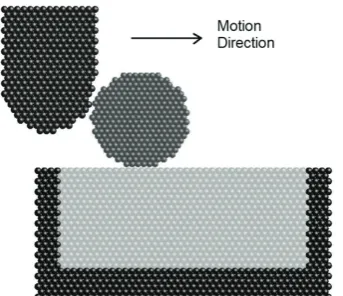
Figure 1 depicts the configuration of tip/particle/ substrate during the nanomanipulation process by STM as a manipulator. The simulations are 2-dimentional, i.e. the motion of each atom is confined to the (111) plane in the FCC lattice. Hence, the simulation time will be much less than its 3D counterpart [23] while most of the qualitative and physical phenomena may be revealed by current 2D investigations. However it should be noted that the present approach eliminates the relaxation modes which are normal to the simulation plane for the systems with limited third dimension. Therefore, the cluster shapes will be less changed during the relaxation process. In 2D computations, the motions of the atoms are confined to the simulation plane. Such confinement to the 2D environment stiffens the cluster structure and leads to less deformation in comparison to the real structures.
In contrast with the aforementioned cases, there are structures such as nanowires having very higher third dimension in comparison to the simulated section. For such systems that sometimes are called “2.5D structures” by the mechanical science community, these 2D approximations are commonly used and highly informative. In such systems, the motion of the atoms in the plane normal to long dimension is approximately negligible. Hence, the proposed 2D simulations can resemble the case of nanowire manipulation to a more acceptable level
123
than the cluster manipulation. In the simulations,Nose-Hoover dynamics is utilized as a heat bath to impose the environment temperature on the system. Accordingly, equations of motions in the velocity Verlet form have been used for the simulations [15]. The time step is set to be 2 fs, and the simulation time scale is at the nanosecond order.
First, the system passes through the relaxation phase in which atoms of the nanoparticle and substrate take their minimum-energy configuration. In the relaxation phase, the outermost layers in two sides are constrained to move only in a vertical direction. After relaxation, the nanoparticles will be pushed by the manipulator tip, which moves behind it at a constant speed. As the manipulator moves with a constant velocity, the nanoparticle is forced to move in the same direction. For simplicity, the atoms of tip are firmed together and constrained to move in a lateral direction (i.e. pushing direction). Outer layers
of the substrate are constrained to have no movement in both vertical and horizontal axes in order to implement realistic conditions due to bulk material properties (the atoms colored in black in Figure 1). The substrate and STM tip are made of Au and Ag respectively, while the nanoparticle is made of different transition metals for each case study. Particle size and environment temperature are the simulation parameters as well. The particle behavior may be completely different for each case based on changes in material type, size and environment temperature. The main goals of the performed simulations are the qualitative study of the manipulation process and making judgment on their level of success.
4. SIMULATION RESULTS
As mentioned earlier, our main goals are the qualitative investigation and determination of success in different manipulation cases. Hence, ١١
Figure ١. Tip/particle/substrate configuration in the manipulation process
١٢
Figure ٢. Manipulation of the Au nanoparticle
Figure 1: Tip/particle/substrate configuration in
manipulation process
Figure 2: Manipulation of the Au nanoparticle
١٣
Figure ٣. Manipulation of the Ag nanoparticle
١٤
Figure ٤. Manipulation of the Au nanoparticle in presence of Cu thin film to Au
substrate as lubricant
Figure 3: Manipulation of the Ag nanoparticle
Figure 4: Manipulation of the Au nanoparticle in presence of Cu thin film to Au substrate as lubricant
124
١٧
Figure ٧. Manipulation of the Cu nanoparticle with size (a) at ٢٠٠K
١٥
Figure ٥. Manipulation of the Au nanoparticle in presence of Cu thin film to Au
substrate as lubricant
١٦
Figure ٦. Manipulation of the Cu nanoparticle with size (a) at ١٠٠K
Figure 5: Manipulation of the Au nanoparticle in presence of Ni thin film to Au substrate as lubricant
Figure 6. Manipulation of the Cu nanoparticle
with size (a) at 100K
Figure 7. Manipulation of the Cu nanoparticle
with size (a) at 200K ١٨
Figure ٨. Manipulation of the Cu nanoparticle with size (b) at ١٠٠K
١٩
Figure ٩. Manipulation of the Cu nanoparticle with size (b) at ٢٠٠K
٢٠
Figure ١٠. Manipulation of the Ni nanoparticle with size (b) at ١٠٠K
Figure 8: Manipulation of the Cu nanoparticle
with size (b) at 100K
Figure 9: Manipulation of the Cu nanoparticle
with size (b) at 200K
Figure 10: Manipulation of the Ni nanoparticle
with size (b) at 100K
125
the effect of versatile working parameters on themanipulation quality will be revealed. Based on the nanopositioning purpose of the process, to be a successful manipulation, the average distance traveled by the atoms of nanoparticle should be very close to one for the manipulator tip. In addition, the intactness of the particle during the process is another success criterion. A variety of simulations have been conducted to investigate the nanomanipulation process regarding different working conditions. The distance traveled by the tip has been set to 4 nm for all cases. All of the following snapshots were captured at the final station.
First, the manipulation of Au or Ag were investigated (refer to Figures 2 and 3 respectively). As can be seen in the reported snapshots, the process has failed for both cases and the particles are deformed. This phenomenon is due to the creation of powerful joints with the tip and substrate. In the case of Au, two candidate materials as solid lubricants have been added to the substrate. These candidates are Cu and Ni. The thin film consists of a three-atom layer. As illustrated in figures 4 and 5, these additive layers deeply improved the manipulation quality and particle intactness for both cases.
Manipulation of Cu nanoparticles has been simulated considering different conditions that include two sizes and two temperatures. Particle sizes are named as (a) and (b) with diameter of 3.5 and 4.2 nm , respectively. The environment temperature is between 100 and 200 K for different cases. Figures 4 to 7 depict the final situation regarding four test conditions.
As seen in the figures, the Cu nanoparticles could be manipulated in such conditions, but the quality of the process may be variable for different cases. The smaller particle was more subjected to plastic deformations. In addition, the higher temperature caused more fluctuations and imperfections in the particle form as it was predictable.
Similar simulations have been performed for Ni and the snapshots regarding the manipulation of particles with size (b) are illustrated in Figures 8 and 9 for two environment temperatures. Based on the results, the Ni particles showed far better behaviors in the process. These behaviors can be explained with the high amount of cohesive energy of Ni in comparison with other transition metals
International Journal of Nanoscience and Nanotechnology
٢١
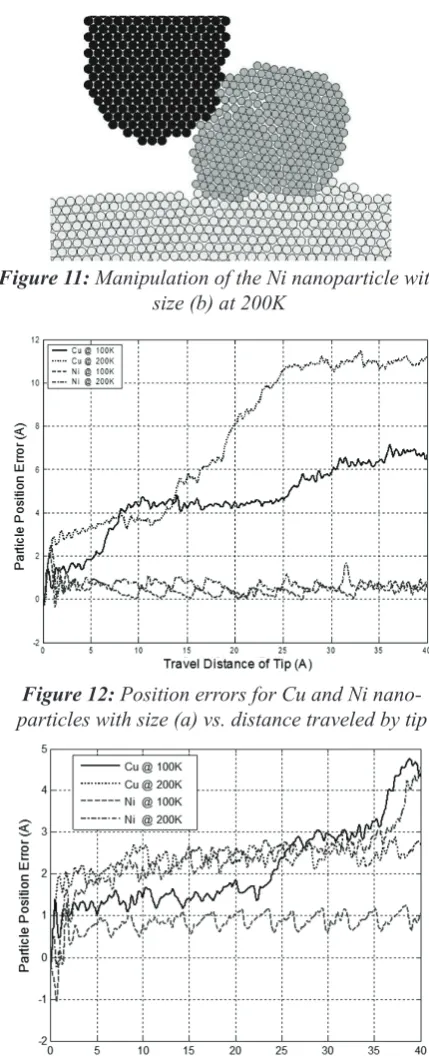
Figure ١١. Manipulation of the Ni nanoparticle with size (b) at ٢٠٠K
٢٣
Figure ١٣. Position errors for Cu and Ni nanoparticles with size (b) vs. distance
traveled by tip
٢٢
Figure ١٢. Position errors for Cu and Ni nanoparticles with size (a) vs. distance
traveled by tip
٢٣
Figure ١٣. Position errors for Cu and Ni nanoparticles with size (b) vs. distance
traveled by tip
٢٣
Figure ١٣. Position errors for Cu and Ni nanoparticles with size (b) vs. distance
traveled by tip
Figure 13: Position errors for Cu and Ni nano-particles with size (b) vs. distance traveled by tip Figure 11: Manipulation of the Ni nanoparticle with
size (b) at 200K
Figure 12: Position errors for Cu and Ni nano-particles with size (a) vs. distance traveled by tip
126
is inversely proportional to the particle position error relative to the travel distance of the tip. This quantity is illustrated for different cases in figures 10 and 11 for sizes (a) and (b) respectively. As mentioned earlier, the tip has been assumed to be rigid in comparison with the studied particles. This assumption moderates the positioning error of the nanoparticle. Position error graphs confirm the previous qualitative achievements regarding the effect of temperature. The only exception is depicted in figure 11 for Cu particles of size (b). The observed jump in the error seems to be due to the deformation of nanoparticle because of partial welding to the substrate.
5. CONCLUSIONS
Regarding to the performed simulations, the detailed particle nature of the phenomena occurring in the interfaces have been illustrated for different cases of nanomanipulation. This atomistic approach seems to be promising as a rapid investigation tool before high investment on experimental studies. According illustrated examples, the manipulation of Ag, Au, Cu and Ni nanoparticle by Ag tip on Au substrate has been studied. Although the manipulation of Au leads to failure, addition of Cu or Ni thin films to Au substrate as lubricant can solve the issue. The last two metals showed far better success while the higher temperature reduced the success in most cases. For Cu, the particle with smaller size showed worse results, while this factor did not affect Ni considerably.
ACKNOWLEDGMENTS
The authors would like to acknowledge Dr. H. N. Pishkenari for his help and advice in programming issues.
REFERENCES
1. Rubio-Sierra, F. J., Heckl, W. M. and Stark, R. W., Advanced Engineering Materials 7 (2005) 193. 2. Sitti, M, Proc. of IEEE-NANO, USA, (2001) 75. 3. Sitti, M. and Hashimoto, H., IEEE/ASME
Transactions on Mechatronics 5 (2000) 199.
4. Sitti, M., IEEE/ASME Trans. Mechatronics 9 (2004) 343.
5. Lagoute, J. , Kanisawa, K. and Fölsch, F., Phys. Rev. B., 70 (2004) 245415.
6. Rollot, Y., Regnier, S. and Guinot, J. -C., Int. J. Adhesion & Adhesives, 19 (1999) 35.
7. Hla, S.-W., Braun, K.-F., Iancu, V. and Deshpande, A., Nano Lett. 4 (2004) 1997.
8. Hla, S.-W., Braun, K.-F., Wassermann, B. and Rieder, K.-H., Phys. Rev. Lett. 93 (2004) 208302. 9. Bhushan, B., Israelachvili, J. N. and Landman, U.,
Nature 374 (1995) 607.
10. Grobelny, J., Tsai, D-H, Kim, D-I, Pradeep, N., Cook, R. F. and Zachariah, M. R., Nanotechnology 17 (2006) 5519.
11. Mahboobi, S.H., Meghdari, A., Jalili, N. and Amiri, F., Int. J. Nanomanufacturing 5 (2010) 288.
12. Mahboobi, S.H., Meghdari, A., Jalili, N. and Amiri, F., Modern Physics Letters B 23 (2009) 2695. 13. Mahboobi S. H., Meghdari A., Jalili N., Amiri F.,
Scientia Iranica 17 (1 F) (2010) 1.
14. Mahboobi, S.H., Meghdari, A., Jalili, N. and Amiri, F., Current Applied Physics 9 (2009) 997.
15. Rafii-Tabar, H., Physics Reports 325 (2000) 239. 16. Sutton, A. P. and Chen, J., Philosophical
Magazine Letters 61 (1990) 139.
17. Mahboobi S. H., Meghdari A., Jalili N., Amiri F., Physica E 42 (2010) 2364.
18. Mahboobi S. H., Meghdari A., Jalili N., Amiri F., Physica E 42 (2009) 182.
19. Nayak, S. K., Khanna, S. N. and Jena, P., J. Phys.: Condensed Matter 10 (1998) 10853.
20. Todd, B. D. and Lynden-Bell, R. M., Surface Science 281 (1993) 191.
21. Doye, J. P. K. and Wales, D. J., New J. Chem. 22 (1998) 733.
22. Rafii-Tabar, H. and Sutton, A. P., Philosophical Magazine Letters 63 (1990) 217.
23. Mahboobi S. H., Meghdari A., Jalili N., Amiri F., Micro and Nano Letters 5 (2010) 286.
24. Bilaniuk, M. and Howe, J. M., Interface Science 6 (1998) 317.
25. Philipsen, P. H. T. and Baerends, E. J., Phys. Rew. B, 54 (1996) 5326.