Original Research Article
Smoking cessation practices and perspectives among in-patients
in a tertiary teaching hospital setting
Mohammed Saud, Madhu Basave Gowda
*
, Srinath Kenkere Marulaiah
INTRODUCTION
Smoking has been established as a risk factor for premature morbidity and mortality. Smoking is a leading risk factor for six out of the top ten global causes of deaths, in 2016.1 In India, an estimated one million deaths/year were attributable to tobacco smoking in the first half of this decade, in the age group of 30-69 years.
2-4 The total economic costs due to tobacco use, from all
diseases in India in the year 2011 for persons aged 35-69, amounted to Rs. 1,04,500 crores (US$ 22.4 billion), of which 16% was direct cost and 84% was indirect cost.4 Despite this, the prevalence of current tobacco smokers in India is 10.6% of adults. The number of daily smokers in India in 2015 was 100 million.5
Quitting smoking has shown to improve health and life expectancy. Though it is difficult to quit smoking, primarily because of its addictive nature.6 Studies have shown that only 3-5% of self-quitters achieve prolonged abstinence for 6-12 months after a given quit attempt.7 Thus, the role of healthcare providers in smoking cessation is essential. Every healthcare visit is an opportunity to asses, emphasise and aid smokers to quit. Furthermore, in-patients allow for a unique opportunity as they are in a smoking free environment and with help available. Thus, this study made an effort to assess the patient’s perspectives about smoking cessation, and the services they received in an in-patient setting, in a tertiary care teaching hospital in India.
ABSTRACT
Background: The objective of the present study was to assess the in-patient’s perspectives about smoking cessation and the services they received.
Methods: A descriptive study was carried out in a hospital attached to a Medical College. An interview schedule was administered in person to in-patients to assess their perspectives towards smoking cessation and services received.
Results: Of the 141 in-patients interviewed, 40% were active smokers. Almost 3/4th of active smokers had moderate to high nicotine dependence. About 92% of active smokers reported being asked about smoking status and being advised to quit, but only 23% received assistance, and 8% had a follow-up arranged. Health was the top reason for the willingness to quit. Around 90% of study participants had no awareness about tobacco cessation centres and services.
Conclusions: An in-patient setting has a higher proportion of smokers than the general population. These in-patients should be a prime target for cessation programs as there are relatable health reasons and opportunity for the delivery of comprehensive smoking cessation services based on 5 A’s protocol, which is currently lacking. Creating better awareness regarding smoking cessation centres and services available is necessary.
Keywords: Smoking, Cessation services, In-patients
Department ofCommunity Medicine, JSS Medical College, JSS Academy of Higher Education and Research, Mysuru, Karnataka, India
Received: 01 July 2019
Revised: 03 September 2019
Accepted: 04 September 2019
*Correspondence:
Dr. Madhu Basave Gowda, E-mail: [email protected]
Copyright: © the author(s), publisher and licensee Medip Academy. This is an open-access article distributed under the terms of the Creative Commons Attribution Non-Commercial License, which permits unrestricted non-commercial use, distribution, and reproduction in any medium, provided the original work is properly cited.
METHODS
A descriptive study was carried out in JSS hospital which is attached to a Medical College in Mysuru City. The oral interview schedule was conducted among 141 in-patients, who were selected in random from specialities of medicine, surgery, pulmonology, ENT and orthopaedics. All the 141 in-patients interviewed were males, as the prevalence of tobacco smoking is generally much higher for men (16-24%) compared to women (2-3%) in India.2,5,8 Participants had to be 18 years or older to be included in the study. In-patients who were in critical care units and day care units were excluded.
They were administered oral interview schedule in person. The interviews took place from July 2013 to September 2013. It consisted of general details (such as name, age, sex and occupation), disease status if any and smoking status. Smokers (active and former) were further interviewed regarding their smoking habits including tobacco product smoked, number and duration of smoking. The services they received regarding smoking cessation were assessed using the 5 ‘A’s.6
Details regarding time spent by the doctor towards cessation activities, pharmacotherapy advised and type of counselling they received, if any, were asked. Patient’s perspectives towards smoking cessation such as quit attempts, reasons for quitting or attempting to quit smoking, current willingness to quit among active smokers, awareness regarding the presence of tobacco cessation centres was assessed. Nicotine dependence was assessed using the Fagerstrom Nicotine Dependence Scale for active smokers.
Active smoker was defined as an individual who has smoked at least 100 cigarettes or beedis in their lifetime and currently smokes on at least some days. Former smoker was defined as someone who has smoked greater than 100 cigarettes or beedis in their lifetime but had successfully abstained from smoking for the past six months or longer, at the time of interview. Quit attempt was defined as having stopped smoking for one day or longer with the intention of quitting.
Ethical clearance was obtained from the Institutional Ethics Committee of JSS Medical College, Mysuru. Free and informed consent was obtained from all individual participants included in the study before administering the interview schedule. Descriptive statistics like proportion (percentage) for nominal and categorical data was calculated. Median and Interquartile range was calculated for the average number of beedis or cigarettes smoked per day. To test the association between categorical variables Chi-square test was applied and p<0.05 was considered to be statistically significant. The analysis was performed with SPSS statistical software version 22.
RESULTS
Mean age of the study participants was 48.078±14.74 years. Majority of them were from departments of
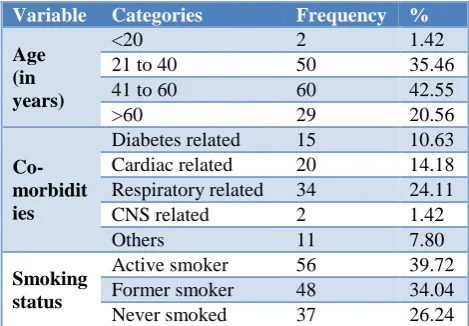
Medicine (40%), Surgery (25%), Pulmonology (20%), and with the rest from the departments of Orthopaedics and ENT. Majority of them were farmers (44.68%) by occupation. Around 10.6% were diabetics, 14.1% suffered from cardiac disease, and 24.11% of admitted had respiratory problems. Out of the 141 in-patients in the study, 40% were active smokers, and 34% were former smokers (Table 1).
Table 1: Patient profile and smoking status.
Variable Categories Frequency %
Age (in years)
<20 2 1.42
21 to 40 50 35.46
41 to 60 60 42.55
>60 29 20.56
Co-morbidit ies
Diabetes related 15 10.63
Cardiac related 20 14.18
Respiratory related 34 24.11
CNS related 2 1.42
Others 11 7.80
Smoking status
Active smoker 56 39.72
Former smoker 48 34.04
Never smoked 37 26.24
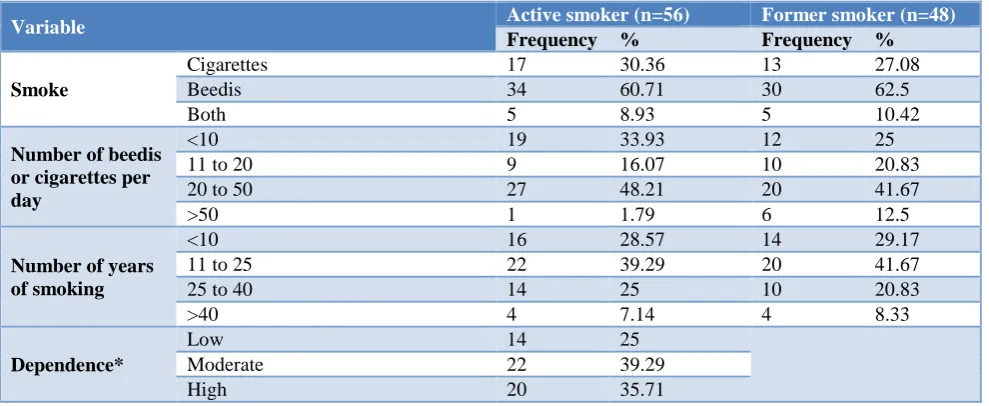
Among the active smokers, 61% smoked beedis, 30% smoked cigarettes, whereas 10% smoked both. A similar trend was seen among the former smokers too. Among the active smokers, nearly half (48%) said that they smoked 20 to 50 beedis or cigarettes per day compared to 42% of the former smokers who did so. The median number of beedis or cigarettes smoked per day for the active smokers' group was 20±15 (IQR), and the former group was 24±15 (IQR). Interestingly, the locally available beedi brands in the city used by the participants are sold as a pack containing 25 beedi sticks each. More than 2/3rd of both active and former smokers said they had smoked for more than ten years. The overall mean duration of smoking for active smokers was 21.65±12.56 years, and for former smokers was 20.42±13.78 years. Among the active smokers, 39% showed moderate dependence, 36% showed high dependence, and the remaining 25% showed low dependence. No major difference was observed between active and former smokers concerning with type, amount and duration of smoking (Table 2).
receiving assistance to quit and 18% having a follow-up arranged. More active smokers (78.5%) said that they received counselling towards cessation in comparison to former smokers (60.8%), but the former smokers group (28.57%) reported higher offering of intensive counselling or motivational counselling compared to active group (11.36%). In this study even though a higher
percentage of former smokers received intensive or motivational counselling compared to active smokers, it was not statistically significant (p=0.0594).
Among the active smokers, around 36% attempted to quit smoking, with 70% of them reporting to have tried 2 to 5 quit attempts.
Table 2: Smoking pattern and nicotine dependence among study subjects.
Variable Active smoker (n=56) Former smoker (n=48)
Frequency % Frequency %
Smoke
Cigarettes 17 30.36 13 27.08
Beedis 34 60.71 30 62.5
Both 5 8.93 5 10.42
Number of beedis or cigarettes per day
<10 19 33.93 12 25
11 to 20 9 16.07 10 20.83
20 to 50 27 48.21 20 41.67
>50 1 1.79 6 12.5
Number of years of smoking
<10 16 28.57 14 29.17
11 to 25 22 39.29 20 41.67
25 to 40 14 25 10 20.83
>40 4 7.14 4 8.33
Dependence*
Low 14 25
Moderate 22 39.29
High 20 35.71
*: Fagerstrom nicotine dependence scale.
Table 3: Smoking cessation related services received by study participants.
Services received Active smoker Former smoker Never smoked
N f % N f % N f %
Patients who were asked about tobacco use
status (Ask) 56 52 92.85 48 34 70.83 37 16 43.24 Patients assessed for readiness to quit
tobacco use (Assess) 52 36 69.23 34 22 64.71
Not applicable
Patients who were advised to quit tobacco
(Advise) 52 48 92.31 34 30 88.23
Patients assisted towards a quit attempt
(Assist) 52 12 23.07 34 14 41.17
Patients for whom follow-up contact was
arranged (Arrange) 52 4 7.69 34 6 17.64 Patients who were advised
pharmacotherapy 52 4 7.69 34 1 2.94 Patients offered counselling towards
tobacco cessation
56 44 78.57 46 28 60.86
Brief counselling 44 38 86.36 28 19 67.85
Intensive counselling 44 5 11.36 28 8 28.57
Support group 44 1 2.27 28 1 3.57
Among the former smokers, 54% said they failed on the first attempt to quit, with 69% of them reporting success on their second attempt. About 60% of active smokers said that they were currently willing to quit smoking. Health was the top reason for the willingness to quit or
Figure 1: Time spent by doctor related to tobacco cessation (in minutes) (n=104).
Figure 2: Awareness regarding presence of tobacco de-addiction centres (n=141).
Table 4: Patients perspective towards tobacco cessation.
Active smoker Former smoker
N Frequency % N Frequency % Patients with at-least one unsuccessful quit attempt 56 20 35.71 48 26 54.17
No. of previous unsuccessful quit attempts
One attempt 20 6 30 26 18 69.23
2-5 20 14 70 26 6 23.08
>5 20 0 0 26 2 7.69
Currently willing to quit (yes) 56 34 60.71 Not applicable
Reasons for quitting or willing to quit smoking
Health reasons 34 30 88.24 48 32 66.67
Social reasons 34 1 2.94 48 7 14.58
Financial reasons 34 0 0 48 3 6.25
Health and social 34 3 8.82 48 6 12.5
Who do you think is of most assistance to you to quit smoking?
Self 56 42 75 48 33 68.75
Family 56 15 26.78 48 16 33.33
Doctor 56 11 19.64 48 9 18.75
DISCUSSION
Tobacco smoking harms both the health and wealth of the individual, as well as of the country. In-spite of this, the truth is that smoking tobacco is very easy to start and get addicted to, but it is tough to quit. Thus efforts need to be made to reverse this trend, where starting is made difficult through education and laws, and those who are already smoking tobacco have proper assistance to quit. Medical care providers have a crucial role to play in the latter part. Beedi is a native tobacco product, containing 0.2 to 0.3 g of tobacco flake wrapped in a temburini (Diospyros melanoxylon) leaf. Beedis contain three times more nicotine and five times more amount of tar than the regular cigarette.9
In an in-patient hospital setting, as seen in this study, the proportion of active smokers is higher (39%) than the general population, and many of those who quit (66%) or were willing to quit (88%) identified health as the most important reason for their decision. Other studies have also identified health as an important reason for quitting
among smokers.10,11 This presents a unique opportunity for smoking cessation activities.
Among the active smokers, around 36% attempted to quit smoking, with 70% of them reporting to have tried 2 to 5 quit attempts. In comparison, a study published by Borland et al, the ever-quit rates varied from just over 50% to under 90% across 15 countries.12
Even though over 90% of the active smokers in the study said that they were asked and advised to quit smoking, only 1 in 5 were assisted and only 1 in 10 received intensive or motivational counselling. This higher level of performance with ask and advise, compared to a lower level of performance when it comes to assist and arrange follow-up, is consistent with other studies.13,14 Thus, even though efforts to quit tobacco use have increased, successful quitting remains low. Interestingly only 1/5th perceived doctor could be of assistance to help them quit. This observation could be explained by that 90% of participants had no awareness regarding presence of tobacco cessation centres, and the counselling and pharmacotherapy that is available. This lack of 17%
34% 20%
13% 16%
None <2 mins 2 to 5 mins 5 to 10 mins > 10 mins
8.5%
91.5%
knowledge hampers their ability to ask for help to quit, as they assume that it is up to them to quit.
Among the former smokers, 54% said they failed on the first attempt to quit, with 69% of them reporting success on their second attempt. About 60% of active smokers said that they were currently willing to quit smoking. This is similar to a study done by Islam et al (63.3%), although it was higher than in a study by Surani et al (35%).15,16
A Cochrane meta-analysis (Nicola Lindson‐Hawley et al) showed that motivational interviewing delivered by general practitioners or in a general practice setting might deliver higher success rates.17 A similar meta-analysis by Lancaster et al showed a small increase in success rates with intensive counselling compared to brief counselling.18
Smoking is not just a habit but chronic addictive relapsing disorder.19,20 This is evident with 75% of smokers in the study showing moderate to high nicotine dependence, and multiple unsuccessful quit attempts. Thus, it needs to be treated like one, with proper counselling, pharmacotherapy and regular follow-up. The services need to be patient centric.21 More tobacco cessation centres are needed, and better awareness needs to be created regarding smoking cessation and services available for the same, among medical care providers and the general population.
This study is patient-centric and looks into in-patient’s practices and perspectives towards quitting smoking. However, all the participants were men, and the findings may not be applicable to women who smoke. Also, outpatient encounters were not included. This study was conducted in a teaching tertiary care hospital, and the findings may not necessarily reflect other in-patient settings.
In-patients should be a prime target for smoking cessation programs as there are relatable health reasons from smoking, ample time for intensive/motivational counselling, opportunity for starting therapy under supervision and expertise, and chance to follow-up on a quit attempt when they come back for follow-up of their primary illness, which is currently lacking. Training of healthcare professionals and public awareness regarding comprehensive smoking cessation services is necessary to increase successful outcomes.
Funding: No funding sources Conflict of interest: None declared
Ethical approval: The study was approved by the Institutional Ethics Committee
REFERENCES
1. Global Health Estimates 2016: Deaths by cause, age, sex, by country and by region, 2000-2016.
Geneva, World Health Organization, 2018. Available at: http://www.who.int/healthinfo/global _burden_disease/estimates/en/. Accessed on 24 October 2018.
2. Tata Institute of Social Sciences (TISS), Mumbai and Ministry of Health and Family Welfare, Government of India. Global Adult Tobacco Survey
GATS 2 India 2016-17. Available at:
https://mohfw.gov.in/sites/default/files/Globaltobac oJune2018.pdf . Accessed on 24 October 2018. 3. Jha P, Jacob B, Gajalakshmi V, Gupta PC, Dhingra
N, Kumar R, et al. A nationally representative case-control study of smoking and death in India. N Engl J Med. 2008;358:1137-47.
4. John RM, Rout SK, Kumar BR, Arora M. Economic
burden of tobacco-related diseases in India, New Delhi: Ministry of Health and Family Welfare, Government of India; 2014. Available at: https://mohfw.gov.in/sites/default/files/Report%20o n%20Economic%20Burdent%20of%20Tobacco%2 0Related%20Diseases%20in%20India.pdf. Accessed on 24 October 2018.
5. Institute for Health Metrics and Evaluation (IHME). Tobacco Visualization. Seattle, WA: IHME, University of Washington, 2017. Available at: http://vizhub.healthdata.org/tobacco/. Accessed on 24 October 2018.
6. Hatsukami DK, Stead LF, Gupta PC. Tobacco addiction. Lancet. 2008;371(9629):2027-38. 7. Hughes JR, Keely J, Naud, S. Shape of the relapse
curve and long-term abstinence among untreated smokers. Addiction. 2004;99(1):29-38.
8. Asma S, Mackay J, Song SY, Zhao L, Morton J, Palipudi KM, et al. The GATS Atlas. 2015. CDC
Foundation, Atlanta, GA. Available at:
http://gatsatlas.org/. Accessed on 24 Oct 2018. 9. Joshi, SR. Tobacco free India: save our children.
JAPI. 2006;54:605-7.
10. Garg A, Singh MM, Gupta VK, Garg S, Daga MK,
Saha R. Prevalence and correlates of tobacco smoking, awareness of hazards, and quitting behavior among persons aged 30 years or above in a resettlement colony of Delhi, India. Lung India. 2012;29:336-40.
11. Jindal SK, Aggarwal AN, Chaudhry K, Chhabra SK, D'Souza GA, Gupta D, et al. Tobacco smoking in India: Prevalence, quit-rates and respiratory morbidity. Indian J Chest Dis Allied Sci. 2006;48:37-42.
12. Borland R, Li L, Driezen P, Wilson N, Hammond D, Thompson ME, et al. Cessation assistance reported by smokers in 15 countries participating in the International Tobacco Control (ITC) policy evaluation surveys. Addiction. 2012;107(1):197-205.
14. Tong EK, Strouse R, Hall J, Kovac M, Schroeder SA. National survey of U.S. health professionals’ smoking prevalence, cessation practices, and beliefs. Nicotine Tob Res. 2010;12(7):724-33.
15. Islam K, Saha I, Saha R, Khan SA, Thakur R, Shivam S. Predictors of quitting behaviour with special reference to nicotine dependence among adult tobacco-users in a slum of Burdwan district,
West Bengal, India. Indian J Med Res.
2014;139(4):638-42.
16. Surani NS, Gupta PC, Fong TG, Pednekar MS, Quah AC, Bansal-Travers M. Intention to quit among Indian tobacco users: Findings from International Tobacco Control Policy evaluation India pilot survey. Indian J Cancer. 2012;49:431-7. 17. Lindson‐Hawley N, Thompson TP, Begh R.
Motivational interviewing for smoking cessation. Cochrane Database of Syst Rev 2015;3:CD006936. 18. Lancaster T, Stead LF. Individual behavioural
counselling for smoking cessation. Cochrane Database of Syst Rev. 2017;3(3):CD001292.
19. ICD-10 Classifications of Mental and Behavioural Disorder: Clinical Descriptions and Diagnostic Guidelines. Geneva. World Health Organisation; 1992.
20. Fiore MC, Jaén CR, Baker TB. Treating Tobacco Use and Dependence: 2008 Update. Clinical
Practice Guideline. Rockville, MD: U.S.
Department of Health and Human Services. Public Health Service. May 2008. Available at: https://www.ncbi.nlm.nih.gov/books/NBK63952/ Accessed on 25 October 2018.
21. Halladay JR, Vu M, Ripley-Moffitt C, Gupta SK, O’Meara C, Goldstein AO. Patient perspectives on tobacco use treatment in primary care. Prev Chronic Dis. 2015;12:14.