Themed Section: Engineering and Technology
Developing Appropriate Labour Constants for Building Construction
Processes in Nigeria
Ngwu Chukwuemeka1, Okolie, K.C2 and Ogunoh P. E2 1 Department of Surveying Quantity, Nnamdi Azikiwe University, Awka
2 Department of Building, Nnamdi Azikiwe University Awka
ABSTRACT
Labour is one of the key components of unit rates for bill of quantities items. One of the major challenges facing estimators when pricing bills of quantities for tendering is their inability to quickly lay hands on proper information about labour thereby resulting in high variability of tender prices among contractors bidding for building contracts in Nigeria. These information are the standards, usually given as constants in the form of time necessary for the manual completion of a defined quantity of work (standard time (st), or in the form of unit output, standard output (sop) for a specified working time). The aim of this study was to improve the reliability of tendering among contractors and assist in effective project planning and control. Consequently, a survey was carried out in ten organized building sites in the south east states of Nigeria with a view to evolving appropriate labour constants for building processes (concrete work and block work). The sites were selected using purposive/judgmental sampling technique. Work study was used to evolve appropriate labour constants and this involved a full scale time study for each of the operations that make up the activity for a process. This was done by observing and recording the operations using stopwatches; the start and finish durations of each operation per shift for different cycles as well as measuring the quantity of work carried out by each gang for eight-hour working day. A three-time estimate using the formula for most probable time to complete each operation that makes up an activity relative to the quantity of work performed. Students t-statistic and mean score index were used for the analysis. The tradesmen were also required to estimate their outputs in selected tasks. The evolved labour constants were more realistic and appropriate for pricing than the claimed outputs by the tradesmen and, therefore recommended as veritable tools for realistic pricing. This will reduce the level of variability in tender sum among contending contractors. It will further assist in effective project planning and control through realistic determination of optimal labour force in the execution of building projects.
Keywords: Standard time, standard output, labour, unit rates, work study, estimators
I.
INTRODUCTION
A Bill of Quantities prepared for any given project normally contains several items of work to be carried out by the contractor. Each tendering contractor is usually required to insert a rate against each of such items before arriving at the tender figure. When computing such rates, certain ingredients that make up such rates must be considered. These include; labour, materials, plant, overhead, and profit.
For labour, the unit rate requires the provision of a labour constant which when multiplied by the
appropriate hourly rate supplies the cost of labour for the item. The determination of labour constants is one of the major functions of estimating, and should be obtained from reliable sources such as work study.
The term labour refers to the energy or work expended through the activities of men. These men are contractor‟s operatives on the site executing the project. These include tradesmen who are known to be qualified artisans (non-trade tested); that is, artisans without certificates, apprentices of various cadres learning trade under qualified tradesmen; labourers performing all kinds of work on the site including the foremen of trade groups and gangs of the labourers.
The overall cost of the combination of these manual hands will be considered in terms of unit cost of the work, which will then be the labour cost for a given unit of work. This is based on the calculation of all in rate in respect of each category of the main operatives.
The cost of building a house is high and this principally depends on cost of labour and materials. Labour cost represents a considerable proportion of the final cost of a building. This, according to Buchan et al. (1993) is usually between 40 – 60 precent of the building cost.
According to Olomolaiye and Ogunlana (1989), the output of a building trade can be defined as the quantity of work done over a period of time. This definition is rather simplistic because it does not reflect the resources in the process of getting the work done. Construction resources include all factors of production (men, management, materials, money and machine). When production output is measured in relation to all these factors of production, it is termed total factor output or simply total output. This is often used to measure the efficiency of an industry or organization. Other measures of productivity consider the relationship between output and a particular input or a combination of inputs, e.g. labour or labour and capital. This is called partial output. Output of building trades can, therefore, be taken either in relation to the total or partial concepts.
A. Statement of the Problem
A major problem in using the total output/input concept is the difficulty involved in expressing all the resources in the same unit. Often, resource inputs are all expressed in monetary terms. This results in „economic output‟ which is of little use to construction estimators and planners, who are more interested in actual outputs for planning and estimating purposes. The partial concept is therefore, of more use in this study with the labour input as the main focus.
Standardization in construction is primarily aimed at establishing standards in the use of labour, materials and machines. These three elements in standardization are sometimes referred to as technological standards or constants. Standards in the use of labour are standard time (St) and standard output (Sop). Standard time is the quantum of time which it takes a workman or group of workmen to produce a good quality product under an
ideally organized labour force and working condition. Its unit of measure is hrs/m, hrs/m2 and hrs. /m3. Standard output is the quantum of good quality work accomplished by a workman or group of workmen in one working shift or working hour or day under an ideally organized labour and working condition. The unit is usually m2/hr or m2/day and m3/hr or m3/day (Okereke, 2002).
Labour constants for establishing the cost of labour in an item of work in the Bills of Quantities need not be guessed, imagined or thought (Wood, 1976). This is the problem with our estimating principles in Nigeria. This state of affair has resulted in very high variability of tender prices among contractors bidding for jobs in the building industry. Also analyses of contract sums for completed projects show very high coefficient of deviation from the original contract sums. According to Olomoliaye & Ogunlana (1989), there is a dearth of information on the output levels of building operatives in Nigeria, and sometimes estimators base their labour constants for estimating on experience which at best are educated guesses. Without adequate knowledge of standards, it is impossible to draw reliable construction programmes or make accurate cost estimates for tendering purposes. Unrealistic cost estimates and inadequate job programming soon result in cash flow problems and subsequently delays; cost overrun and project abandonment.
Anecdotal evidence shows that the Nigerian worker‟s production is low; however, the challenge to researchers is to evaluate the effect of the factors affecting productivity and how to improve the effectiveness and efficiency of Nigerian construction labour-crew performance (output). To optimize productivity, its relationship with the factors which affect it must be quantified and established (Iyagba & Ayandele, 2005).
B. Aim and Objectives of Study
Given the problem as detailed above, the aim of this study was to improve the reliability of tendering among contractors and assist in effective project planning and control. Consequently, the specific objectives of the study include:
To evolve appropriate labour constants for building processes (concrete work and block work) using work study; and
To recommend measures that will improve tendering as well as the effectiveness and efficiency of Nigerian construction labour-crew performance in building delivery process.
C. Review of Related Literature
Assessment of Labour Productivity
Generically, there is no universally accepted productivity measurement standard. This is the main reason for the existence of money measurement methods (Oglesby et al., 1989). Existing techniques used for measuring productivity extends from time-lapse photography and video analysis in combination with statistics to models using historical data (Song & AbouRizk, 2008), Neural Networks (Chao & Skibniewski, 1994; Ezeldin & Sharara, 2006), and techniques from other industries like manufacturing (Alarcon et al., 2003). A literature scan on productivity measurement reveals that some of the techniques used are designed to measure the productivity of specific crafts for different kinds of construction work (Song et al., 2003), while others measure productivity at firm or site level and include every participant involved in construction (Alarcon & Calderon, 2003).
Evidence from the traditional productivity improvement techniques shows that construction productivity can be boosted with the use of information technology advancements which enable project participants to collect and share important field data in a timely and accurate manner (LeMenager, 1992; Chao & Skibniewski, 1994; Hewage & Ruwanpura, 2009). Examples of such technology applications are mobile computing, 3D Laser Scanning, digital close-range photogrametry, GPS sensors, and wireless communication (Eldin & Egger, 1990; LeMenager, 1992; Song et al., 2004). Moreover, many researchers (Alarcon & Calderon, 2003; Forsberg & Saukkoripi, 2007; Salem et al., 2006) are trying to utilize methods from other industries to improve productivity.
The assessment of labour productivity used in this study is work study particularly work measurement because it provides;
i. Method of assessing human effectiveness;
ii. Output data resulting to improved estimating; and iii. Production planning and incentive schemes.
II.
METHODS AND MATERIAL
Due to the nature of the study, a judgmental/purposive sampling technique was adopted in choosing the building sites from where field survey and work study were carried out. This is because purposive sampling is justified where the researcher wishes to study a small subset of a larger set.
The population is such that members of the subset are easily identified but the enumeration of all would be nearly impossible. In this case, the sample was selected purposively on the basis of the researcher‟s knowledge of the population, its elements, and the nature of the research aim. In this case, it will be impossible to enumerate all the building sites in the states under study.
Some of the factors that influenced the choice of building sites in this study include; sites located in a planned environment; organized sites with almost the same working practices; sites made up of quantifiable construction activities; reputable indigenous contractors with good track records; on-going public building project sites; and sites in stages of construction suitable to the processes under investigation.
Concrete work and block work in superstructure were the building processes studied. They were broken down into operations to facilitate subsequent synthesis. Concrete work involved such operations as batching of materials into a mixer, transportation, placing and compaction. For block work; operations included batching of materials into a mixer, transportation of mortar, placing of mortar and setting of blocks in place. Each operation involved certain number of tradesmen and labourers to carry them out.
and not working at a given time were observed and recorded. An indication of the performance such as
In each case, the average activity rating from the observations was greater than forty percent (> 40%).
Thereafter, a full scale time study was carried out using stop watch for each operation that makes up the activity for each process by observing and recording the start and finish duration of each operation per shift for different cycles. The quantity of work carried out by each gang per eight-hour working day was subsequently measured and recorded in the time observation sheet.
The ratio of masons to labourers for reinforced concrete floor slab was two masons to thirteen labourers, seven labourers to two masons for reinforced concrete columns, two iron benders for reinforcements; seven carpenters for formwork to suspended slab; two carpenters for formwork to sides of column and one labourer to two masons for block work. The uniformity of gang size and mode of operation made comparative analysis possible. For each operation that makes up an activity and on each site, time study was carried out randomly on chosen days (not less than three times) during the entire investigation period in order to obtain different durations and quantity of work completed.
The site management informed their workers that the research was an academic exercise and would not be used for or against them in any way. This explanation was necessary to prevent workers from increasing or decreasing their rate of work arbitrarily.
The tradesmen through the site engineers were asked to respond through the questionnaire on the estimated quantity of work they carried out randomly on chosen days and the time it took them to carry out such works for an eight-hour working day. This was to enable data to be generated, computed and analysed for the existing or claimed labour constants. The questionnaire was in the following form:
i.
Area of floor slab;
ii.
Height of designated columns;
iii.
Number of planks used for the designated
columns and slab;
iv.
Lengths
of reinforcements
and their
diameter, cut and fixed in position;
v.
The number of cut and bent stirrups; and
vi.
The number of blocks lay.
Was used to calculate the expected time (t), that is, the most probable duration to complete each operation that makes up an activity relative to the quantity of work performed. According to Okereke (2002), the measurement of the quantum of time spent for a given process or operation is subject to uncertainties, it is a probabilistic quantum. In order to eliminate inaccuracies beyond tolerable limits, the duration of operation consists of the following components:
te = Optimistic time, the probable earliest or shortest
completion time if all goes well;
to = Most likely time, the most probable completion
time;
t1 = Pessimistic time, the probable longest completion
time if everything goes wrong (or worst).
For manually executed activities, the duration of the key (major) process is determined from the formula
tka = t1 + t2 + t3 + ………tm ………..…….… (3)
Where (m = 1, 2 ……) and t1, t2 ….. tm are observed
duration of the individual operations that make up the activity relative to a unit quantity of work performed.
The standard time (st) is obtained by adding up the duration of the key activity (tka), the time spent for break and workmen individual needs or rest.
Standard time
(St) =
Q
t
……….……….………... (4)
Where, t is the time taken to accomplish Q quantum of work in an eight-hour working day.
Standard output
(Sop) =
t Q
Site analysis sheet was used to compute the average standard time and standard output for concrete work and block work.
In order to ascertain if there were significant differences between the evolved and claimed labour constants, student t-statistic was applied. The calculation was based on t-tabulated at 5% significance level and degree of freedom of 10 (that is, t (0.005, 10) = 3.169.
III.
RESULTS AND DISCUSSION
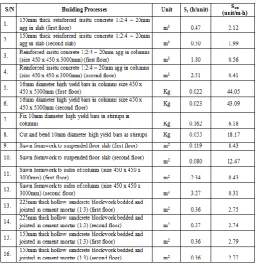
The summary of the evolved labour constants are shown in Tables 1 and 2 respectively.
Table 1: Summary of evolved or actual labour constants
Table 2: Summary of existing or claimed labour constants
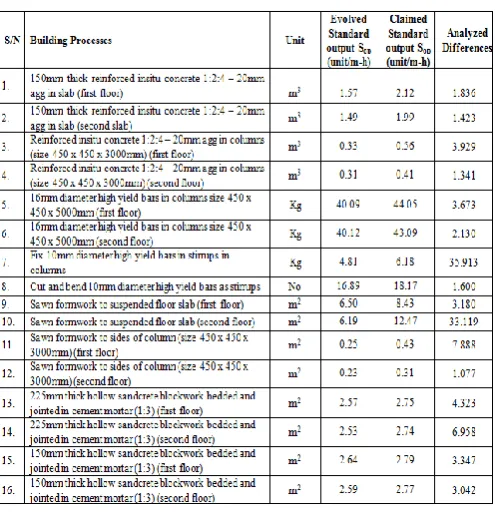
In each constant, calculated was greater than t-tabulated (3.169). The analysed differences are shown in Tables 3 and 4.
Table 4: Analysed differences in standard output
Using 150mm thick reinforced in situ concrete slab in first floor as an example, the implication in the differences is that it took the gang 0.47 hours to cast 1.00m3 of concrete for the claimed standard time and 0.64 hours to cast 1.00m3 for the evolved standard time. This was because the tradesmen claimed that they worked for lesser hours and achieved the same output, but this was not so when they were properly timed. Actually they ought to have spent 0.64hrs to produce 1.00m3 of concrete and not 0.47hrs. For the same reason, 1.57m3 of concrete ought to have been casted per man hour for the evolved standard output and not 2.12m3 of concrete as claimed by the tradesmen. The trend is the same across the board, though with varying differentials.
The results have confirmed the views of (Olomolaiye & Ogunlana, 1989); (Iyagba & Ayandele, 2005), on production outputs in key building trades in Nigeria. According to Olomolaiye & Ogunlana (1989), the differences between claimed and actual labour constants vary between 3% to 42%. The operatives‟ estimates of what they can do (claimed) was consistently higher than what they are doing (actual). These differences, according to them are a clear manifestation of human characteristics to over-estimate one‟s capability in many circumstances. Another reason could be that the estimated constants are achievable, but these workers
were restricting outputs due to lack of motivation. In a similar view, Iyagba & Ayandele (2005) believe that the output of an artisan is as a result of the driving (motivation), induced (human capacity) and restraining forces (management and religion) acting upon the worker.
IV.
CONCLUSION
This study has demonstrated that the building operatives‟ claim of what they do was consistently different from their actual site productivity. This has brought to fore one of the major reasons of variability of tender prices during contractors‟ bidding for building projects in Nigeria. Coupled with this is the high frequency of contract variation resulting in high cost of building projects, hence the need for concerted efforts at redressing the situation. This study is one of such efforts aimed at effective construction management in the country.
While conceding that experiences of the estimators and construction planners should not be discounted, outputs need not remain in the realm of guesses. According to Wood (1976) the subject of labour constants really covers a tremendous territory and becomes for the practicing estimator, a life-long study of human endeavour. “Beware of readily accepting any information from an operative without being completely satisfied that he understands precisely what is meant by your question”, Wood warned estimators.
Recommendations
In view of the findings and conclusion discussed earlier in this study, the following recommendations are provided by the study:
i. The evolved labour constants in this study are strongly recommended as veritable tools for realistic pricing because it will reduce the level of variability in tender sum among contending bidders.
iii. Contractors should always employ work study officers who should ensure a reliable reporting back to the estimating and costing department of the latest production figures. These figures, when properly evaluated provide data for compiling fresh, up-to-date labour constants.
iv. The federation of Building Contractors or the Nigerian Institute of Quantity Surveyors should sponsor and subsequently publish research on established constants on various sites in the zones for use by the estimators.
V.
REFERENCES
[1] Adeyemi, A. Y., Alli, O. R. (2000). Cost Implications of Alternative Staircase Design in Residential Buildings. Proceedings at the Workshop on Effective Housing in the 21st Century. Akure, Nigeria. p. 15 – 25.
[2] Alarcon, L. F., Calderon, R. (2003), "Implementing Lean Production Strategies in Construction Companies": Proceedings of the 2003 Construction Research Congress, ASCE, Honolulu.
[3] Chao, L. C., Skibniewski, M. J. (1994), "Estimating Construction Productivity: Neural-Network-Based Approach", Journal of Computing in Civil Engineering, 8(2), 234-251.
[4] Eldin, N. N., Egger, S. (1990), "Productivity Improvement Tool: Camcorders", Journal of Construction Engineering and Management, 116(1), 100-111.
[5] Ezeldin, S. A., Sharara, L. (2006), "Neural Networks for Estimating the Productivity of Concreting Activities", Journal of Construction Engineering and Management, 132(6). 650-656.
[6] Forsberg, A., Saukkoriipi, L. (2007), "Measurement of Waste and Productivity in Relation to Lean Thinking", in: Pasquire, C. L. and Tzortzopoulos, P. (ed.), Proceedings of 15th Annual Conference of the International Group for Lean Construction, East Lansing, Michigan, 67-77.
[7] Hewage, K. N., Ruwanpura, Y. J. (2009), "A novel solution for construction on-site communication - the information booth", Canadian Journal of Civil Engineering. 36(4). 659-671.
[8] Iyagba R., Ayandele O. (2005): Analysis of factors Affecting Nigerian Construction Workers‟ Productivity. The Quantity Surveyor, Journal of the Nigerian Institute of Quantity Surveyors, 54(3): 2 – 7.
[9] LeMenager, P. A. (1992), “Technology is Here-Are You Ready?”, Journal of Management in Engineering, 8(3), 261-266.
[10]Oglesby, C. H., Parker, H. W. and Howell, G. A. (1989), "Productivity Improvement in Construction". McGraw-Hill Book Co., New York.
[11]Okereke P. A (2002). Basic Principles in the Organization of Construction Processes. FUTO Press, Owerri.
[12]Olomolaiye P. O., Ogunlana S. O. (1989): An evaluation of Production outputs in Key Building Trades in Nigeria, Journal of Construction Management and Economics, 7 75 – 86.
[13]Park H. S., Thomas S. R. and Tuckler R. L. (2005): Benchmarking of Construction Productivity. Journal of Construction Engineering and Management, 131 (7), 772 – 778.
[14]Salem, O., Solomon J., Genaidy A., and Minkarah, I. (2006), "Lean Construction: From Theory to Implementation", Journal of Management in Engineering, 22, 168 – 175.
[15]Song, L., AbouRizk, S. M. (2008), “Measuring and Modeling Labor Productivity Using Historical Data”, Journal of Construction Engineering and Management, 134(10), 786-794.
[16]Song, L., Allouche M. and AbouRizk, S. (2003), "Measuring and Estimating Steel Drafting Productivity", in: Molenaar, K.R. and Chinowsky, P.S. (ed.), Proceedings of the Construction Research Congress, ASCE. Honolulu.