IJSRSET1844334 | Received : 25 March | Accepted :10 April 2018 |March-April-2018 [(4)4: 963-969]
Dynamic Time Quantum Approach to Improve Round Robin
Scheduling Algorithm in Cloud Environment
Bhavin Fataniya1, Manoj Patel2
1M.E(I.T) Student, I.T Department, L.D College of Engineering, Ahmedabad, Gujarat, India 2Assistant Prof., I.T Department, L.D College of Engineering, Ahmedabad, Gujarat, India
ABSTRACT
Resource allocation or process scheduling in cloud environment is one of the main task of system.Round Robin (RR) scheduling algorithm is the widely used scheduling algorithm in multitasking and real time environment for that purpose. Its performance highly depends on a Time Quantum, which is a predefined amount of time assigned by system to every task to be executed. If we chose the less time quantum then context switch is high and if we chose the high time quantum then its leads to First-Come-First-Serve (FCFS). So, the performance of the system totally depends upon the choice of optimal time quantum. In this Paper,We will proposed a New approach of RR scheduling algorithm using dynamic time quantum, which will reduce waiting time, turnaround time and the number of context switches in order to improve the system overall performance. Keywords : Round Robin,Dynamic Time Quantum,FCFS, Cloud Environment.
I.
INTRODUCTIONIf you're unsure about what Cloud Computing is, you are probably among the 95% of people that are already using cloud services, like online banking and social networks, but don't realize it.The "cloud" is a set of different types of hardware and software that work collectively to deliver many aspects of computing to the end-user as an online service.Cloud Computing is the use of hardware and software to deliver a service over a network (typically the Internet). With cloud computing, users can access files and use applications from any device that can access the Internet.An example of a Cloud Computing provider is Google's Gmail. Gmail users can access files and applications hosted by Google via the internet from any device. so major task of cloud is resource allocation to process or process scheduling.In cloud computing,Resource Allocation2 (RA) is the process of assigning available resources to the needed cloud applications over the internet. Resource
allocation starves services if the allocation is not managed precisely. Resource provisioning solves that problem by allowing the service providers to manage the resources for each individual module Resource Allocation Strategy (RAS)is all about integrating cloud provider activities for utilizing and allocating scarce resources within the limit of cloud environment so as to meet the needs of the cloud application. It requires the type and amount of resources needed by each application in order to complete a user job. The order and time of allocation of resources are also an input for an optimal RAS. From the perspective of a cloud provider, predicting the dynamic nature of users,user demands, and application demands are impractical. For the cloud users, the job should be completed on time with minimal cost. Hence due to limited resources,
resource heterogeneity,locality restrictions,
allocation system that suits cloud environments.There are following Different Resource Allocation Policies. First Come First Serve (FCFS) [9]: As obvious from the name,FCFS processes the jobs in the order in which they arrive in the ready queue.
Shortest Job First (SJF) [9]: In this algorithm, the ready queue is first sorted on ascending order of burst times of the processes arrived in it. Then the processes are assigned CPU in sequence.This algorithm is optimal than others in most cases. But in SJF,we must be able to have a pre-knowledge of burst times of all the processes which is difficult practically. Moreover, it can cause starvation for longer processes.
Priority Scheduling (PS) [9]: In priority scheduling, the processes come in ready queue along with assigned priorities to them. OS assigns CPU to the process with highest priority. Then the CPU is assigned to a process with lower priority and so on. Priority scheduling algorithm respects the priority of a process rather than focusing on efficiency constraints of CPU. So, it may cause best and worst cases depending on burst times of corresponding processes. FCFS and SJF, both are non-preemptive algorithms. But PS can be of both typei.e. preemptive or non-preemptive. If the currently executingprocess can continue its execution on arrival of a higher priority process, then it is a non-preemptive priority scheduling .On the other hand, if the process is blocked on arrival of a higher priority process, it is a preemptive priority scheduling.
Round Robin (RR) [9]: This algorithm allocates CPU to all processes for an equal time interval. A process is blocked and put at the end of ready queue after a constant time slice, known as Time Quantum. This process is assigned CPU time again once the execution of all other processes in their respective time quanta. The efficiency of Round Robin depends entirely on the time quantum selected. If the time quantum is selected too large, the algorithm will become FCFS. While on the other hand, if the quantum is much
small, it will yield much overhead and larger average waiting and turnaround times .With advancement in technology, many Round Robin algorithms based on dynamic time quantum have been developed. In this, a dynamic time quantum is chosen instead of a constant time quantum. It may be changed after a cycle or just after an arrival of next process in ready queue .In next section we will see the original round robin algorithms, some of the problem of round robin algorithms and survey of different method to improve performance of the round robin scheduling algorithm using dynamic time quantum and also see our proposed method which will improve the system overall performance.
II.
ROUND ROBIN ALGORITHMIt is one of the oldest, simplest, fairest and most widely used scheduling algorithms, designed especially for time-sharing systems. A small unit of time, called time slice or quantum is defined. All run able processes are kept in a circular queue. The CPU scheduler goes around this queue, allocating the CPU to each process for a time interval of quantum. New processes are added to the tail of the queue. The CPU scheduler picks the first process from the queue, sets a timer to interrupt after time quantum, and dispatches the process. If the process is still running at the end of the quantum, the CPU is pre-empted and the process is added to the tail of the queue. If the process finishes before the end of the quantum, the process itself releases the CPU voluntarily. In either case, the CPU scheduler assigns the CPU to the next process in the ready queue. Every time a process is granted the CPU, a context switch occurs, which adds overhead to the process execution time.
An example of round robin algorithm is given below:
Process AT BT
P1 0 40
P3 0 60
P4 0 90
P5 0 102
Time quantum=25.
Gantt chart for round robin
Turn-around time and waiting time for above example is calculated in below table.
PROCESS T.A.T W.T
P1 140 100
P2 245 190
P3 255 195
P4 320 230
P5 347 245
Round Robin problem
The performance of RR depends on the size of the time quantum.In some case, additional context-switch is required even if only small amount of BT is remaining.For example in above Gantt chart at last only p5 process is remaining and remaining B.T is 2 m.s so for execution of only 2 m.s ,additional context switch is required. Turn-around time also depends on time quantum.Increase in quantum time - cause less context-switch,lesser turn-around time but can cause high response time, and waiting time. Decrease in quantum time-cause less waiting time and response time but can cause high turn-around time and high no of context-switch Hence a medium sized time quantum can reduce all the factors to some extent. medium sized time quantum can be achieved by using dynamic time quantum method. now we will see different method based on dynamic time quantum.
III.
LITERATURE REVIEW OF DIFFERENT ROUNDROBIN ALGORITHM BASED ON DYNAMIC TIME QUANTUM.
MRRA algorithm[1]
Method Used:- Sort the process and Average of B.T is calculated and used as a time quantum.
Advantages:- Easy to implement and improve performance compare to original Round Robin
Disadvantages:- Sorting cost is high. SRBRR algorithm[2]
Method Used:- Median of B.T is calculated and used as a time quantum without sorting the process
Advantages:- Better in terms of number of context switch compare to MRRR[1] algorithm
Disadvantages:- In some case it’s leads to FCFS.. AMBRR algorithm[3]
Method Used:- Initially two time quantum is calculated
T.Q1=median(B.T of process)
T.Q2=(T.Q1-high B.T) T.Q1 is used if even number of cycle completed and T.Q2 is used if odd number of cycle completed.
Advantages:- Initially only two time quantum is calculated and used as a time quantum so computational cost of finding the median in each cycle is reduced compare to SRBRR[2].
Disadvantages:- Again quick short is used to sort the process so sorting cost is high.
DRR algorithm[5]
Method Used:- Average of two high B.T is computed and then subtract from average of two lowest arrival time.
Advantages:- Give best result in terms of A.T.A.T,A.W.T, and Number of C.S .
Disadvantages:- Leads to FCFS In some case IRR algorithm[6]
Method Used:- Time quantum is calculated using median and high B.T of process.
Disadvantages:- Quick sort is used so Again sorting cost is high in worst case if B.T is already sorted
IV.
PROPOSED ALGORITHMThe Proposed algorithm has been devised on the basis of two scheduling algorithms namely MRRA[1] algorithm and SRBRR[2] algorithm. Our proposed algorithm gives results intermediate between the results given by the SRBRR[2] algorithm and the MRRA[1] algorithm. The proposed algorithm offers the least compromise on the reduction of waiting time, number of context switches and response time simultaneously.Time Quantum is Calculated using below formula.
Time Quantum = (Mean of processes + Median of processes) / 2 ... Equation-1
Mean is simply the average of B.T of process which is present is ready queue.
To find the median number:
If there is an odd number of results, the median is the middle number.
If there is an even number of results, the median will be the mean of the two central numbers.
This time quantum is calculated in each new cycle until all processes is completed.
In our Analysis we have compare our proposed method with Base method[1] which is MRRA algorithm.
Methodology
Step-1: Process arrive in cloud.
Step-2: Load distribution load the process in data
center using circular load distribution algorithm.
For All Data Center,
Step-3: Process arrived in ready queue.find time
quantum using (mean+median)/2 of process
which is placed in ready queue.
Step-4: Now assign this time quantum to all
process which is placed in ready queue.
Step-5: If process burst time(B.T) - time
quantum=0 then terminate that process and go
to step-7
Step-6: IF process burst time(B.T) - TIME
QUANTUM != 0 then put that process at end of
ready queue. Continue with step:3 to step:6 until
all process completed.
Step-7: Calculate T.A.T,W.T
Flowchart Of proposed Algorithm is given below.
Mathematical Analysis Of Algorithm Assumptions
AT=Arrival Time, BT=Burst Time, T.A.T=Turn-Around Time, W.T=Waiting Time, CS= Context Switch, C.T=Completion Time.
During analysis we have considered CPU bound processes only. In each test case 5 independent processes are analyzed in uni-processor environment. Corresponding burst time and arrival time of processes are known before execution. All the arrival time and burst time is in M.S(milli second).Arrival time and burst time of different case is below.
Case-1 Arrival time is same [8] Case-2 Arrival time is different [8]
Table for Arrival time and Burst time of 5 ndependent process for same& different arrival time
In our analysis for various algorithm,we have used above two table(case:1,case:2) to see the performance of particular algorithms.Turn-around time and waiting time can be calculated using below formula. T.A.T=C.T - A.T.
W.T=TA.T - B.T.
Example
Case 1-Arrival time is same[8]
Gantt chart for Proposed algorithm for same arrival time of process.
Turn-around time and waiting time for above example is calculated in below table.
T.A.T And W.T for Proposed algorithm for same arrival time of process.
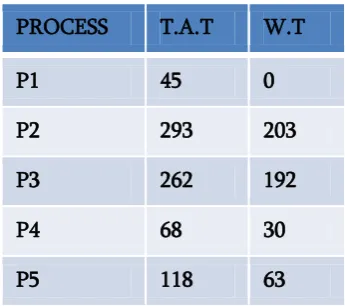
Case 2-Arrival time is different[8]
Gantt chart for Proposed algorithm for different arrival time of process.
Turn-around time and waiting time for above example is calculated in below table.
PROCESS T.A.T W.T
P1 45 0
P2 293 203
P3 262 192
P4 68 30
P5 118 63
T.A.T And W.T for Proposed algorithm for different arrival time of process.
V.
ANALYSIS OF BASE METHOD[1] ANDPROPOSED METHOD
Case-1 arrival time is same
Algorithm Time
Quantum
AVG T.A.T
AVG W.T
Round Robin Algorithm[8]
25 205.6 144.4 15
MRRA(Base) Algorithm[1]
45,63,17,10 223.2 141.6 7
Proposed Algorithm
45,62,18,10 222.6 141.0 7
AVG T.A.T&W.T of MRRA[1] and proposed Algorithm when arrival time is same
Case-2 arrival time is Different
Algorithm Time
Quantum
AVG T.A.T
AVG W.T
NO OF C.S Round
Robin Algorithm[8]
25 205.6 144.4 15
MRRA(Base) Algorithm[1]
45,63,17,10 157.4 97.8 7
Proposed Algorithm
45,62,18,10 157.2 97.6 7
AVG T.A.T of MRRA[1] and proposed Algorithm when arrival time is different.
AVG W.T of MRRA[1] and proposed Algorithm when arrival time is different.
VI CONCLUSION
Resource allocation in cloud environment is one of the main task of system.Round robin algorithm is one of the algorithm used for that purpose.MRRA[1] is variation of round robin algorithm which will improve the result.Our proposed algorithm used both mean and median to find the time quantum and our proposed algorithm significantly give less AVG T.A.T , less AVG W.T compare to MRRA[1] algorithm.
VI.
REFERENCES[2]. Rami J. Matarneh,"Self-Adjustment Time
Quantum in Round Robin Algorithm
Depending on Burst Time of Now Running Processes", American J. of Applied Sciences 6(10): 1831 -1837,2009.
[3]. Salman Arif,Naveed Ghaffar,Ali Javed
"Implementation of Alternating Median Based Round Robin Scheduling Algorithm",IEEE, International Conference on Computer and Information Technology,2016.
[4]. Salman Arif, Saad Rehman and Farhan Riaz "Design of A Modulus Based Round Robin Scheduling Algorithm",IEEE, 9th Malaysian Software Engineering Conference, Dec. 2015 [5]. Alsheikhy, R. Ammar, and R. Elfouly, "An
improved dynamic Round Robin scheduling algorithm based on a variant quantum time",IEEE, 2015 11th International Computer Engineering Conference (ICENCO), 2015, pp. 98-104.
[6]. Debashree Nayak, Sanjeev Kumar Malla and Debashree Debadarshini "Improved Round Robin Scheduling using Dynamic Time Quantum", International Journal of Computer Applications (0975 – 8887) Volume 38– No.5, January 2012
[7]. Noon,A. Kalakech and S. Kadry,"A New Round Robin Based Scheduling Algorithm for Operating Systems: Dynamic Quantum Using the Mean Average", International Journal of Computer Science Issues (T.TSI),Vol.3,Issue 3,No. 1,pp. 224-229,May 2011.
[8]. Amar Ranjan Dash, Sandipta kumar Sahu and Sanjay Kumar Samantra"AN OPTIMIZED
ROUND ROBIN CPU SCHEDULING
ALGORITHM WITH DYNAMIC TIME
QUANTUM" International Journal of Computer
Science, Engineering and Information
Technology (IJCSEIT), Vol. 5,No.1, February 2015.
[9]. H.S.Behera R. Mohanty and Debashree Nayak "A New Proposed Dynamic Quant with Re-Adjusted Round Robin Scheduling Algorithm
and Its PerformanceAnalysis"International Journal of Computer Applications (0975 – 8887) Volume 5– No.5 August 2010.
[10]. Sonia Zauaoui,lotfi Boussaid and Abdellatif Mtibaa, "CPU scheduling algorithms case and comparative study",17th international conference on sciences and techniques of automatic control & computer engineering=STA 2016,sousse,Tunisia,Decmber,2016.
[11]. Ishwari Singh Rajput. "A Priority based Round Robin CPU Scheduling Algorithm for Real Time Systems", International Journal of Innovations in Engineering and Technology (IJIET), ISSN: 2319 – 1058, Vol. 1 Issue 3 Oct 2012.