Towards Understanding of
Classes versus Data Types in
Conceptual Modeling and UML
Dragan Milićev
University of Belgrade
Faculty of Electrical Engineering, Department of Computing P.O. Box 35-54, 11120 Belgrade, Serbia
Abstract. Traditional conceptual modeling and UML take different vague, ambiguous, and apparently incompatible approaches to making a distinction between two different entity types – classes and data types. In this paper, an in-depth theoretical study of these ambiguities and discrepancies is given and a new semantic interpretation is proposed for consolidation. The interpretation is founded on the premise that populations of the two kinds of entity types are defined in two substantially different ways: by intensional (for data types) and extensional (for classes) definitions. The notion of a generative relationship set is introduced to explain the role of specific relationship types that are used to define populations of structured data types by cross-combinations of populations of the related entity types. Finally, some important semantic consequences are described through the proposed interpretation: value-based vs. object-based semantics, associations vs. attributes, and identity vs. identification. The given interpretation is based on runtime semantics and allows for fully unambiguous discrimination of the related concepts, yet it fits into intuitive understanding and common practical usage of these concepts.
Keywords: conceptual modeling, Unified Modeling Language (UML), formal semantics, class, data type, entity, relationship, object identity, identification, association, attribute.
1.
Introduction
this paper, this distinction does not seem to be precise enough to allow clear separation and proper use of the two kinds of entity types. The lack of unambiguous criteria for discriminating between data types and the other entity types inevitably causes uncertainty to modelers about which of the two concepts should be used in each particular case, or about what the original semantic intent was behind a particular use of one or the other in a model.
On the other hand, the Unified Modeling Language (UML) has adopted the analogous separation of classes and data types in a yet more explicit way, clearly emphasizing a few distinctive characteristics of classes versus data types [16]. However, as it will be discussed in this paper, the definitions of the distinction between classes and data types appear to be completely different from those widely used in classical conceptual modeling. Such a situation unnecessarily increases the confusion in understanding of these notions and their use in practice. This is yet another of many existing parts of the UML’s definition that contributes to its main drawback – the lack of a complete semantic formalization. Many concepts of UML, especially in its early versions, have not had definitions precise enough to be interpreted unambiguously. In other words, many parts of a syntactically correct UML model can still be interpreted in different ways by different readers. This has been recognized as the main obstacle for UML to become a machine-interpretable, i.e., executable language. Instead, UML served predominantly for recording ideas, sketches, and design decisions in early phases of software analysis and design, without an ambition of encouraging unambiguously interpretable models.
Recent model-driven development (MDD) trends in software engineering [22, 23, 14] have dramatically increased the importance of formalizing the semantics of UML, as the key prerequisite for its switch from a solely descriptive to an unambiguously interpretable and executable language. As a result, a major revision of UML has emerged in its version 2 [16], making a significant step towards precise semantics of concepts. Much effort has been made to clarify the meaning of the widely adopted concepts in the very UML 2 specification, as well as in other attempts before and around it [1, 3, 5, 7, 8, 9, 14, 15, 17, 18, 19, 24]. However, the distinction between classes and data types has not yet been fully clarified and consolidated with the conception in classical conceptual modeling.
UML The rest of the paper is organized as follows. The next section gives basic definitions and assumptions in the field as the foundations for the discussions that follow. Section 3 brings an overview of the treatment of the concepts relevant for the subject matter in classical conceptual modeling and in UML, and reveals some ambiguities, discrepancies, or seeming contradictions. Section 4 gives an informal analysis of the subject matter that leads to the proposed solution in an intuitive way. Section 5 formalizes the proposed interpretations through precise definitions. Section 6 summarizes some semantic and practical consequences of the presented interpretations. The paper ends with conclusions.
2.
Basic Concepts and Assumptions
2.1. Entity Types
To avoid terminological confusion and ambiguity, we will use the terms class
and data type adopted from UML to refer to the two different kinds of
classifiers of relevance in this discussion, and the term entity type from classical conceptual modeling and ER [4, 17] to refer to both (or any). In other words, entity type will be used to refer to a generalization of the concepts of class and data type, while the division of entity types into classes and data types is assumed to be a partition, i.e., a covering and disjoint specialization.1
As a starting definition, we can say that an entity type is a concept whose instances at a given time are individual entities that exist in the domain at that time. This is a reasonably precise and, with some variations, widely adopted definition. For example, this is a variation of the definition from classical conceptual modeling [17], with one intentional modification: the definition in [17] requires that instances of every entity type be identifiable, while we will revisit this aspect in this paper. Put another way, entity types represent sets of individual entities. These sets are generally variable in time. Variability of entity types over time is one of the fundamental assumptions in conceptual modeling. Entities can begin or cease to exist, or they can be reclassified to other entity types [17, 6, 14]. A more formal definition of entity types as variable sets can be found in [6].
1 We will not use the UML term classifier for such a generalizing concept, because
In order to make this definition slightly more practical and allow some more precise semantic interpretations that will be given in the paper, we will refine this definition and say that an entity type represents a set of entities that exist in the system or in the domain in runtime. By referring to runtime, we imply an inherent dichotomy between design time (or modeling time) and runtime
that exists in practice. The exact practical meaning of these two terms certainly depends on a concrete framework or tooling in case, but traditionally, they refer to the activities of data schema design or modeling (for design time), and data manipulation or model execution (for runtime). It should be noted that the distinction between the two is mostly ontological and does not necessarily imply different physical times; in reality, these two may refer to the same physical time, meaning that the two activities (of system design and its execution) may take place simultaneously. For example, many database management systems and other frameworks allow modifications of the database schema or model during the exploitation of the system; others may need to interrupt the exploitation of the system in order to recompile and redeploy the schema/model, and to restart the execution environment, but without affecting the existing entities that survived the interruption. Anyhow, we consider the runtime as an absolute temporal scope of all entities that may exist in a certain system, and outside which the entities cannot exist due to the very nature of the considered system or the technology used. That might be, for example, the lifetime of a certain installation of a database system, or an execution of a program in the classical sense.
A constant entity type is an entity type whose set of instances is constant,
i.e., invariable (immutable) in runtime [17, 6].
2.2. Relationship Types
For similar reasons as for entity types, before we discuss and clarify the semantics of attributes and associations in UML, we will use a generic term
relationship type taken from classical conceptual modeling and ER. A
relationship type is a concept whose instances at a given time are individual relationships between entities that are considered to exist in the domain at that time [17]. Again, we have omitted the requirement in the definition given in [17] that individual instances of a relationship type be identifiable in order to allow interpretations like the one given in [14, 15] and to align it with the definition given in UML 2 [16], where instances of relationship types (i.e., associations in UML) cannot be identified. We do not see any significant semantic or practical impact of this modification.
A relationship type of degree n≥2 consists of an ordered set of n
participants, whereby a participant is an entity type that plays a role in the relationship type [17]. We will write R(p1:E1, ..., pn:En) to denote a relationship
UML type. Roles must be, naturally, pairwise different. We may omit the role pi played by participant pi:Ei either because it is obvious or it is the same as the name of Ei; then it is assumed that pi is the same as Ei. For example,
Reads(reader:Person, Book) is the same as Reads(reader:Person,
book:Book).
A relationship of type R has a form of a set {<p1:e1>, ..., <pn:en>},
sometimes also referred to as a tuple, where e1, ..., en are instances of their
corresponding entity types E1, ..., En. In classical conceptual modeling, all
relationships of a certain relationship type that exist at a certain moment in runtime form a set of distinct tuples [17]. A more recent interpretation [14, 15] defines relationship types as concepts whose instances at a certain moment in runtime form a bag of tuples (i.e., a multiset), in order to support advanced notions of uniqueness of roles in UML 2. The discussions in this paper are independent of the interpretation used.
A binary relationship type R(p1:E1, p2:E2) defines two inverse mappings [5,
6, 14, 15]:
p1 that maps an instance e2 of E2 to a set (or bag in [14, 15]) of all those
and only those instances e1 of E1 for which {<p1:e1>, <p2:e2>} is in R at
any particular moment in runtime;
p2 that maps an instance e1 of E1 to a set (or bag) of all those and only
those instances e2 of E2 for which {<p1:e1>, <p2:e2>} is in R at any
particular moment in runtime.
It is easy to see that e1 is in p1(e2) if and only if e2 is in p2(e1). The dynamicity
of the sets of instances of entity and relationship types during runtime implies that these mappings are generally also variable in time [5, 6].
A relationship type R(p1:E1, ..., pn:En) is constant with respect to a
particular participant pi if the instances of R in which an instance ei of Ei participates are the same during the temporal interval in which ei exists, for each ei of Ei. A relationship type is constant if it is constant with respect to all its participants [17]. Obviously, when a binary relationship R(p1:E1, p2:E2) is
constant with respect to e.g. p1, it means that the mapping p2(e1) is constant
during the lifetime of e1 for each e1 of E1.
2.3. Populations and Actions
We will refer to the set of instances of an entity type E that exist at a certain moment in runtime as the population of E.2 Similarly, the set or bag of
instances of a certain relationship type R that exist at a moment in runtime will be referred to as the population of the relationship type.
2 Sometimes also called the extent of E. However, we will use the term extent for a
Populations of entity and relationship types are assumed to be dynamically changed during runtime by means of actions. Actions are atomic units of behavior that affect populations of entity and relationship types. In this context, we are focused on a generic set of elementary actions on entity and relationship types, without going deeper into their formal semantics as they are not directly relevant to the conclusions of this paper:
Create a new instance of one or more given entity types, which adds a
new entity e to the system and to the populations of the given entity types. (In general, an entity can be an instance of more related or unrelated entity types.)
Delete an existing entity e, which removes e from the populations of its
entity types and from the entire system. Deletion of an entity implicitly removes all relationships in which that entity participates.
Reclassify an existing entity e, by removing the entity from the
population of zero or more given entity types and adding it to the population of zero or more entity types. Removing an entity from the population of an entity type implicitly removes all relationships in which that entity participates with a role of that entity type.
Create a new instance of the given relationship type R, which adds a
new relationship {<p1:e1>, ..., < pn:en>} to the population of R.
Delete an existing relationship, which removes a given relationship
{<p1:e1>, ..., < pn:en>} from the population of its relationship type.
While the system’s overall state is defined in terms of populations of its entity and relationship types, the system’s behavior is defined in terms of executed actions. More detailed and formal treatments of actions and their semantics can be found in [6, 14].
Constant entity and relationship types have immutable populations. This means that actions on constant entity or relationship types that would change their populations are illegal.
2.4. Identification
An identifier of an entity e is an expression, written in some language, that unambiguously denotes e [17].3 In this paper, most relevant are identifiers
built from binary relationship types that have particular properties, referred to
as reference relationship types, as defined in [17]. A more general approach
to building identifiers through so-called observation terms is presented in [10].
3 In general, identifiers may have temporal or other kinds of scopes, meaning that the
UML We will here provide a semi-formal definition of observation terms, which is sufficient for the discussions given in this paper; for a fully formal definition, the reader is referred to [10].
Definition (Observation term).Observation term of E (denoted with (E)) is an injective function : (E)S, where (E) is the population of an entity type
E at any moment in runtime, and S is a certain fixed set: (e1, e2(E))((e1)=(e2) e1=e2).4
Even less formally, (E) is a function that maps an entity e(E) to an atomic or structured value (formally bound by a certain set S) so that (e)
uniquely identifies e. Observation terms are more general than simpler identifiers normally used in practice, such as reference relationship types, because (E) may map an e to an arbitrarily deeply structured value whose components may be obtained by more complex mappings than simple relationships, like queries. Of course, reference relationship types (both simple and compound) are special cases of observation terms. In [10], Gogolla gives a detailed definition of how (E) can be constructed, i.e., how
S can be defined.
By its definition, (e) represents an identifier of e, meaning that it implies an inverse function f: S (E) that maps a value from S to an entity e, for
a subset of S for which it is defined. It is important to note that (E) is an
injection that does not have to be a surjection, meaning that there does not have to be an e(E) for each element s of S so that (e)=s. This is trivially
true because the set (E) can be dynamically changed in runtime, while S is fixed. Therefore, in general, f is a partial function, defined for a subset of S.
The function f is the identification function that can be used for identifying
entities in (E).
For a comprehensive study of identification and formalization of conceptual modeling in general, the reader is referred to [17, 10].
4 The formal semantics of equality is a very subtle and difficult topic; for exam ple, see
a very interesting perspective and conclusions described in [13]. This is why we do not go deeper into that matter. We may simply note that the operation “=” may mean equality (up to isomorphism) or identity in different contexts. It seems that our observations do not require a fully formal clarification of this issue and that the interpretation of e1=e2, where e1 and e2 are (references to) entities, is that e1 and e2
3.
Overview of the Matter
3.1. Classes vs. Data Types in Classical Conceptual Modeling
Classical conceptual modeling defines data type as a constant entity type whose instances, called values, can be identified by literals, whereby literals are strings (i.e., sequences) of some symbols (e.g., characters) [17, 6]. The same value of a certain data type can often be identified by several different literals; for example, both 1.0 and 0.1E+1 denote the same value one of a floating point data type. Although this definition sounds intuitively clear and reasonably practical, it is still formally vague and conceals several important issues.
First, isn’t it possible that an instance of a class (i.e., of an entity type that is not a data type) be identifiable by a literal? For example, one can imagine a system where each instance of a constant class is assigned (e.g., at design time) a literal that identifies it, so identifiability through literals is not a sound discriminator between the two notions. (It will be shown later that this is exactly the case with enumerations.) On the other hand, is it really necessary that each instance of every possible data type (e.g., a structured one) be identifiable by a literal? What is the real difference between data types and constant classes then?
<<class>>
Product
<<datatype>>
Money
price
<<datatype>>
Decimal
<<enumeration>>
Currency
amount
currency
product Costs
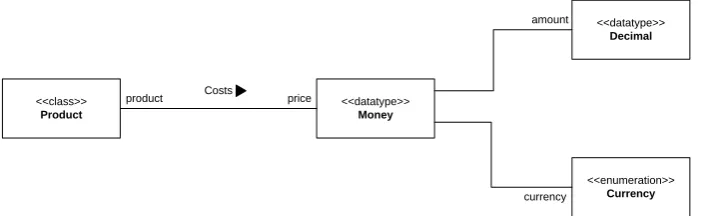
Figure 1. A constant entity type Money with a non-constant relationship type with Product and constant relationship types with Decimal and Currency
Just being a constant entity type is not a sufficient discriminator for data types, simply because classes can also be constant. Data types often imply constancy of some (but not all) relationship types. Figure 1 gives an example. The data type Money is a structured entity type that represents a certain amount of money expressed in a given currency; these two properties of
UML
and Currency data types.5 Obviously, these two relationship types are
constant with respect to Money. One should not change the pair of instances
of Decimal and Currency related to a certain instance of Money, because it
would change the very identity of that instance of Money. Indeed, if it were the opposite, one could relate two instances of Money with the same pairs of
Decimal and Currency, thus making two undistinguishable and fundamentally
the same instances of Money. In fact, these two relationship types form a compound reference [17] of Money, so this situation should not occur. On the other hand, however, there are usually non-constant relationship types in which a data type participates. The relationship type Costs is obviously non-constant with respect to Money. However, to the best of the author’s knowledge, there is not a clear explanation and understanding of these aspects in the open literature, especially of which relationship types of a data type are or are not constant (with respect to that data type).
Beeri [2] gives one of the most profound analyses on the difference between classes (i.e., objects as their instances) and data types (i.e., values as their instances) in the context of a formal foundation of object-oriented databases. However, his discussion is mostly restricted to primitive data types. Using the example of numbers, Beeri gives a few criteria for differentiating data types from classes (referred to as abstractions in his discussions); we first quote each criterion and then give our comments on it: “1. Numbers are a universally known abstraction, and have the same meaning to all people. Abstractions such as employees are application specific.”
This is correct for the case of most general and application-independent data types. However, applications very often introduce quite specific, derived data types, typically structured ones.
“2. Numbers have names in the name space. In contrast, application specific abstractions normally do not have names.”
We agree that objects of application-specific abstractions (classes) normally do not have names as their identifiers, but as discussed above, there is not any practical or formal reason against having names, as also clearly indicated in the same Beeri’s paper. There are many examples of such cases, and this paper will later argue that enumerations are actually constant classes with named objects.
5 One can notice that Money is actually a reified ternary relationship type between
“3. Numbers (and their names) are built into the system; they need not be defined. Object abstractions need to be introduced to the system by definitions.”
This is actually a distinction between built-in and user-defined (application-specific) entity types, primarily determined by the construction of a particular language or model, but not a distinction between data types and classes. We believe that this distinction is orthogonal to the distinction between classes and data types, as both classes and data types can be built-in as well as user-defined. For example, a structured derived data type such as Money in Figure 1 can be either built-in or user-defined, depending on the concrete implementation of the language or framework.
“4. The information carried by a number is in itself. ... In contrast, the interesting information about application specific abstractions is carried in relationships they have with other objects and values.”
We argue that this is a correct distinction between primitive data types on one hand and both classes and structured data types on the other, but not between classes and data types. For example, a structured derived data type such as Money in Figure 1 is an example of a data type whose interesting information is truly in its relationships with Decimal and Currency and not in itself.
Beeri also concludes that “none of these distinctions is absolute” and that “both objects and values are objects in the general intuitive sense.” In this paper, we will stay aligned with this conclusion, but will try to provide a more precise and unambiguous distinction between classes and data types.
3.2. Classes vs. Data Types in UML
The confusion becomes even worse when the definitions of data types in UML get involved [16]. In UML, instances of classes are entities (called
objects) with inherent identity, while instances of data types are “pure values”
that have no identity: “A data type is a special kind of classifier, similar to a class. It differs from a class in that instances of a data type are identified only by their value. All copies of an instance of a data type and any instances of that data type with the same value are considered to be the same instance. Instances of a data type that have attributes (i.e., is a structured data type) are considered to be the same if the structure is the same and the values of the corresponding attributes are the same. If a data type has attributes, then instances of that data type will contain attribute values matching the attributes.” [16, p. 60]
UML it is unclear which relationship types have to relate the given two instances of a data type to the same sets of other instances in order to be treated as “having the same value.” For example, for the data type Money in Figure 1, if two instances of Money have relationships with the same instances of
Decimal and Currency, respectively, they obviously have to be interpreted as
having the same “value”. However, these two same instances of Money
obviously may be related to different instances of Product, stating simply that these two products have the same price, but the two instances of Money are still having the same value, although they do not have the same relationships (structure). This observation indicates a certain hidden difference between the meaning and purpose of different relationship types relating the data type
Money.
An elaborate discussion and clarification of the meaning of these statements and their practical implications can be found in [14]. In brief, every object of a class has its own identity, which is an inherent characteristic of that object that distinguishes it from any other object of the same or any other class. The identity of an object is inherent, meaning that it is ensured by the very existence of the object, and does not require any special activity by the modeler or user in design or runtime. For example, one instance of class
Person is, by default, different and can be distinguished from any other
instance of the same class or any other class. How it can be distinguished is a matter of a concrete technique, notation, and implementation. It is only important to emphasize that two objects are distinguishable simply because they are two separate identities by their nature and existence (that is, because they have been created by two separate executions of the Create Entity action). The identity of an object is its inherent characteristic, and is independent of any relationships (e.g., properties of the object or any other part of its state). In other words, two objects can have exactly the same relationships and exactly the same state, but they are still two different identities. For example, two instances of the class Person may have the same name, home address, date of birth, and all other properties, but they are still treated as two different and independent entities. In addition, the identity of an object is not affected by any modification of its properties.
Unlike class instances, instances of data types do not have their identity in UML's interpretation — that is, they are pure values. Two instances of the same data type with all properties having equal values cannot be distinguished. Being pure values without identity, instances of data types in UML are immutable, meaning that operations of data types do not have side effects and do not change values of their owner instances, but are pure functions that can only produce new instances and not change the existing ones.
types are constant in classical conceptual modeling and such actions should be treated as illegal.
3.3. Associations vs. Attributes
The confusion is similar with distinguishing associations and attributes as different subkinds of relationship types.
Olivé [17] clearly points out that attributes are very similar to binary relationship types and are not really needed at the conceptual level. In fact, an attribute is a binary relationship type R(p1:E1, p2:E2) in which participant p2
is considered to be a characteristic (or property) of E1 (with E2 being the type
of the attribute), or p1 a characteristic of E2 (with E1 being the type of the
attribute). Therefore, an attribute is like a binary relationship, except that users and designers add the interpretation that one participant is a characteristic of the other. In associations, on the other hand, the order of the participants does not imply any priority or subordination between them.
Obviously, except from the rather subjective interpretation by the humans, there is not any formal distinction between attributes and associations. “Thus it is not clear whether attributes should be used or when,” concludes Olivé [17, p. 76].
Quite similarly, standard UML [16] does not impose any significant semantic difference between binary associations and attributes either. It simply provides them as different kinds of modeling elements, without giving any clear and formal difference in their runtime semantics. For example, one can use either or even both at the same time to model a specific binary relationship type between certain entity types. In other words, mostly similarly to classical conceptual modeling, standard UML treats attributes and associations just as two syntactic variations of the same background concept of a binary relationship type. Obviously, having such a situation does not help modelers and model readers too much, because it increases confusion in which modeling concept to apply or how to interpret the intention of the model designer when reading a model.
Instead of sound criteria on the use of attributes, some guidelines exist only. One guideline, well known in conceptual modeling and also suggested by standard UML [21], is that types of attributes should be entity types defined outside the scope of the considered model, while associations should be used to relate entity types that are defined within the considered model. This is, however, not a strict guideline; it just helps modelers make models easier to understand.
UML type. The profile also describes some additional semantic implications, briefly summarized as follows:
Objects of classes are compared for equality by reference, while instances of data types are compared for equality by value.
As they can have only attributes, instances of data types have implicit copy semantics that deeply (recursively) copies values of their attributes. Objects of classes do not have implicit copy semantics.
Objects of classes have an explicit lifetime – they are explicitly created and destroyed by executing actions. Instances of data types have an implicit lifetime – they are created by executing actions, but are destroyed implicitly, when they are not referred to any more.
Operations of classes may modify the objects’ state. Operations of data types must not modify values of their attributes; they must be pure functions that possibly produce new values.
The semantics given in [14] is strict, clear, and unambiguous. The author has applied the profile and the rules in many industrial projects and has found the interpretation practically useful. However, it is not obvious whether the described two approaches are compatible and how they relate to each other. Although there are practical and intuitive rationales behind the definition given in [14], its formal background was still unclear.
All the described approaches agree that data types can have attributes too. Such data types are called structured in UML. Attributes of data types are considered to be immutable characteristics of their owner instances.
3.4. Summary
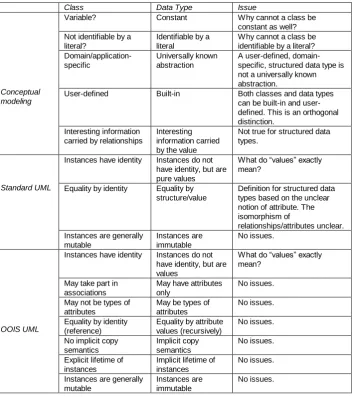
The presented discussions are summarized in Table 1 that gives an overview of the criteria used to discriminate classes vs. data types in classical conceptual modeling (including Beeri’s guidelines), standard UML, and OOIS UML.
It is useful to mention briefly that a similar confusion exists in programming in classical object-oriented programming languages, such as C++ or Java. There, objects of classes (as the only kinds of supported entity types) have their inherent identity that is based on their very existence in time and space – the computer memory. Unrelated to their state, objects can be distinguished by their technical identifiers – references (pointers) that conceptualize objects’ physical location in computer memory. However, programmers usually feel a need for what is clearly recognized in conceptual modeling and UML as a data type, so they introduce “special kinds of classes” that they usually call “immutable,” rely on their “value-based equality comparison, copying, argument passing, etc.,” and must deal with implicit lifetimes of data type instances or explicit lifetimes of objects (although the language sometimes supports only one of them).
as well as between associations and attributes on the other, may seem unrelated or even contradictory, or at least vague and confusing at first sight. We will try to consolidate them and form a unified and consistent understanding of the notions. In fact, we will show that both approaches are actually correct and compatible, although not complete and fully formal, and will provide complete formalizations of all related notions.
Table 1. Summary of the discriminators of classes vs. data types used in classical conceptual modeling and UML
Class Data Type Issue
Conceptual modeling
Variable? Constant Why cannot a class be constant as well? Not identifiable by a
literal?
Identifiable by a literal
Why cannot a class be identifiable by a literal?
Domain/application-specific
Universally known abstraction
A user-defined, domain-specific, structured data type is not a universally known abstraction.
User-defined Built-in Both classes and data types can be built-in and user-defined. This is an orthogonal distinction.
Interesting information carried by relationships
Interesting information carried by the value
Not true for structured data types.
Standard UML
Instances have identity Instances do not have identity, but are pure values
What do “values” exactly mean?
Equality by identity Equality by structure/value
Definition for structured data types based on the unclear notion of attribute. The isomorphism of
relationships/attributes unclear. Instances are generally
mutable
Instances are immutable
No issues.
OOIS UML
Instances have identity Instances do not have identity, but are values
What do “values” exactly mean?
May take part in associations
May have attributes only
No issues.
May not be types of attributes
May be types of attributes
No issues.
Equality by identity (reference)
Equality by attribute values (recursively)
No issues.
No implicit copy semantics
Implicit copy semantics
No issues.
Explicit lifetime of instances
Implicit lifetime of instances
No issues.
Instances are generally mutable
Instances are immutable
UML
4.
Analysis
Before reaching precise definitions, we will carefully analyze the practical use and intents behind of what are traditionally referred to as classes and data types (including primitive and derived data types, structured data types, and enumerations).
4.1. Populations of Classes and Data Types
We deem that the central difference between different subkinds of entity types is the way how the population of an entity type is defined.
For entity types that we traditionally treat as data types, the population is typically defined intensionally. That is, the set of instances of a data type is defined by a formula or a set of rules or constraints that are necessary and sufficient conditions for belonging to the set. For example, the population of a primitive type Integer can be defined as the set of integer numbers that can be represented with a certain binary format, e.g., a 32-bit two’s complement, which defines the set of integers in the range from -231 to +231-1. Similarly, the population of the data type String is the set of all logically unlimited arrays of characters, including the empty array.
On the other hand, the population of a typical class is defined
extensionally: for each particular instance of a class in its population, it is directly and explicitly stated that the instance belongs to the population, basically by executing a Create Entity or Reclassify Entity action; the instance belongs to the population of the class until it is destroyed or reclassified by another action.
4.2. Structured Data Types
The given simple example of data type Integer addresses only a subset of simple data types that are traditionally called primitive data types. These are types that are not defined in terms of other data types; they exist ab initio.
Derived data types are those that are defined in terms of other data types.
The way how (populations of) derived data types are defined predominantly depends on the language constructs and features, but we can list some of the most general approaches:
1) Defining a subset of another data type or of a union of other data types. The subset can be defined intensionally, by a rule, or extensionally, by enumerating instances that form the subset.
3) Defining structured data types by composition of other entity types. In this paper, we will focus on and confine to the semantics of the third subcategory – structured data types only, as they are most typical derived data types used in conceptual modeling. There, a derived data type is defined in terms of relationship types with other entity types. The data type
Money in Figure 1 represents one such example. Another simple and intuitive
example is a data type Point with two relationship types (Point, x:Decimal) and (Point, y:Decimal) that define the coordinates of a point in a two-dimensional space.
Let us carefully consider the semantics of structured data types, actually, the intent of the modeler who defined them and the meaning she obviously had in mind. The populations of such entity types are defined intensionally, in terms of a set of some other entity types and relationships with them. For the two given examples, this looks like the following:
For each pair of existing instances of Decimal and Currency, there exists exactly one (one and only one) instance of Money that is related to the two instances of Decimal and Currency.
For each pair of two existing instances (possibly the same) of Decimal, there exists exactly one (one and only one) instance of Point that is related to the two instances of Decimal that play the x and y roles. Optionally, in a more general case, such a definition may include a constraint that reduces the set of instances obtained by a simple Cartesian product of the related populations.
Consequently, unlike other relationship types in which a certain data type participates, such relationship types have a special meaning: they are used to define the population of the entity type by the (optionally reduced) Cartesian product of populations of the related entity types. Due to their special role in the definition of an entity type E, we will call such a set of relationship types
the generative set ofE and denote it with (E). Consequently, the relationship
types in (E) are always constant with respect to E. For the example shown in Figure 1, the relationship types of Money with Decimal and Currency form the generative set of Money, because they are used to “generate” and identify
instances of Money, and are therefore significantly different from other relationship types of Money, such as the one with Product whose instances do not affect the population of Money.
It can be easily concluded that if all other entity types that participate in the relationship types in (E) are constant, E is also constant. However, one can imagine a more general case where there is a relationship type R in (E)with a non-constant class C whose instances are dynamically created and destroyed by actions during runtime. The definition of E’s population remains
the same, but the population is not constant any more. Namely, when an instance c of C is removed from C’s population, all instances e of E related to
UML conclusion, an entity type E is constant if and only if (E) relates E with constant entity types only.
Consequently, if the notion of the generative set is to be taken as the basis for defining populations of structured data types, then the previous conclusion calls for:
either a restriction that (E) for a structured data type E cannot relate E
with a non-constant entity type; in that case, structured data types are constant entity types;
or for a revision of the claim that data types have to be constant entity types; as just shown, if (E) for a data type E relates E with a non-constant entity type, then E is also non-constant.
We will take the first approach in this paper in order to stay aligned with a commonly accepted conception that data types are constant entity types.
4.3. Constant Classes
In a traditional sense, as well as in UML, an ordinary, non-constant class specified in a conceptual model designates a set of objects that can potentially exist in the system’s object space in runtime. This (typically infinite) set of potential objects is basically defined by intensional semantics, in terms of the features that objects of the class will have; all objects and only objects that have the features of a specified class are potential instances of that class. On the other hand, the actual set of objects that exist in the system’s object space at a particular point in runtime is defined by extensional semantics, in terms of explicit Create, Reclassify, and Destroy Entity actions that have been executed up to that point. Such set of objects is always finite. In order to ensure clear disambiguation, we will refer to the former (the usually infinite set of potential objects defined intensionally) as the extent of the class or entity type in general, and to the latter (the set of actually existing objects at a certain point in runtime) as the population. One important corollary of this definition is that the population of a data type is always equal to its extent, that is, the population covers the entire extent and is constant. This is a fundamental observation and assumption that underpins the further ideas presented in this paper.
modifies the population of the entity type. However, if a class is constant, it does not allow such actions. Therefore, totally constant classes, in this purely theoretical sense, actually cannot exist.
It seems that this inconsistence, however, is purely conceptual and does not have a significant practical impact. Constant classes may be defined as those whose instances are created in some strictly defined and controlled periods of runtime, e.g., at system’s startup or by certain restricted administrative, initialization, or configuration procedures only.
An alternative resolution could be a relaxation of the notion of extensional population definition: an instance specification, made in a model and in design time, does not have to result in an action of creating an instance in runtime, but may be conceptually treated as a formal statement that such an instance (with its optionally specified relationships) merely exists, with the lifetime that has not its “creational beginning nor ending during runtime” but spans over the entire system’s lifetime, and is a member of the population of its entity type ab initio.
This is just the case with enumerations: in essence, an enumeration is nothing more than a constant class whose instances can be referred to by literals specified in design time. Indeed, if an enumeration can take part in relationship types (either constant or non-constant with respect to itself) and can have other features (such as operations), there is not any semantic difference between a constant class and an enumeration, as both must have populations defined extensionally, in design time. This is really the case in some languages, such as Java, where an enumeration is nothing but a constant class with objects enumerated in the program and identified by literals. UML does not prevent enumerations from having relationship types and other features as well. However, in UML, “enumeration is a kind of data type, whose instances may be any of a number of user-defined enumeration literals” [16, p. 67]. Except from being influenced from some older programming languages, such as C/C++, and the semantics and implementation of enumerations in them, there seems to be no rationale behind the decision that enumerations are data types. We argue that this is yet another design flaw of UML that makes its semantics vague. From our perspective, the extensional nature of the definition of an enumeration’s population is a much stronger qualifier that classifies it into classes, as opposed to the identifiability of its constant set of instances through literals, which is a characteristic applicable to constant classes as well.
UML
5.
Definitions
In this section, we provide a summary of the conclusions from the previous analysis in a form of precise definitions. Our definitions are based on the following observations described informally so far:
Extents of both kinds of entity types are defined intensionally. Populations, on the other hand, are defined differently: extensionally for classes and intensionally for data types. This reflects our basic orientation to providing clear runtime semantics.
Data types are constant entity types and their populations are equal to their extents.
Populations of structured data types are defined as all allowed cross-combinations of different relationships of the relationship types from a generative set.
In the discussions that follow, we use the following notation:
(T) denotes the extent of an entity or relationship type T, that is, the (possibly infinite) set of all possible instances of T allowed by the model and constraints in it.
(T) denotes the population of an entity or relationship type T, that is, the set of all existing instances of T at a certain moment in runtime; (T)
obeys all implicit and explicit constraints defined by the model.
(S) denotes the entire system’s population, that is, populations of all
entity and relationship types from the considered conceptual model at a certain (but the same) moment in time; the populations altogether obey all implicit and explicit constraints defined by the model.
In symbols for entities, subscripts differentiate types of those entities, while superscripts differentiate instances within the same entity type.
E2 E
p2 p2,1
0..2
E1
p1 p1,1
1..1 R1
R2
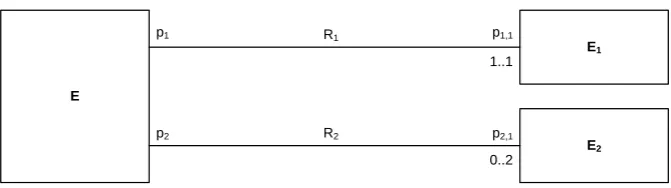
Figure 2. An example of an entity type E and its generative set (E)={R1, R2}
Prior to giving a general definition of generative set, we first develop it for a simpler case with binary relationship types shown in Figure 2. The example shows an entity type E and its generative set (E) consisting of two binary relationship types R1 and R2. There are also some cardinality constraints
(called multiplicities in UML) associated with the relationship types, so that R1
is total and functional with respect to E (p1,1: (E)(E1)), while R2 is neither
constraint). In addition, we may assume a set C of domain-specific constraints defined in the model, in a form of predicates that take entities as parameters.
The idea of the generative set (E)={R1, R2} is that there is exactly one e(E) for each valid combination of relationships with all existing entities of
E1 and E2 so that all cardinality constraints and all predicates in C are also
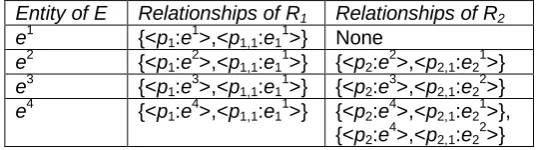
satisfied. For example, if there is only one existing instance e1 1
of E1 and two
existing instances e21 and e22 of E2, there are exactly four instances of E,
related to instances of E1 and E2 as given in Table 2, assuming that C holds
for all of them.6
Table 2. The population of entity type E defined by its generative set (E) in Fig. 2
Entity of E Relationships of R1 Relationships of R2
e1 {<p1:e 1
>,<p1,1:e1 1
>} None
e2 {<p1:e2>,<p1,1:e11>} {<p2:e2>,<p2,1:e21>} e3 {<p1:e
3
>,<p1,1:e1 1
>} {<p2:e 3
>,<p2,1:e2 2
>}
e4 {<p1:e 4
>,<p1,1:e1 1
>} {<p2:e 4
>,<p2,1:e2 1
>}, {<p2:e
4
>,<p2,1:e2 2
>}
Just as another example, if the constraint at p1,1 were 0..1, the number of
instances of E would be eight: four of them would be related as shown in the given table, and the other four would be unrelated to any instance of E1 and
related to the instances of E2 as shown in the table.
In our formal definitions, we introduce the notion of relationship projection: informally, this is a tuple obtained from a relationship by omitting a certain role. For example, the projection of the relationship {<p1:e
1
>,<p1,1:e1 1
>} from Table 2, for the role p1, denoted with ({<p1:e
1
>,<p1,1:e1 1
>},p1), is {<p1,1:e1 1
>}, while ({<p2:e4>,<p2,1:e22>}, p2)= {<p2,1:e22>}.
Similarly, the projection of an entity e for the given role p, denoted with (e,p), is the set of projections of all relationships in which e participates with the role p. For the same example in Table 2, (e3,p2)={{<p2,1:e22>}}, while
(e4, p2)={{<p2,1:e2 1
>}, {<p2,1:e2 2
>}}.
Finally, the projection of the given entity e for the entire ordered set of given roles p1, p2, ..., pn, is an n-tuple consisting of projections for each role:
(e, <p1, p2,..., pn>)=<(e,p1), (e,p2), ..., (e,pn)>. For the same example in
Table 2, (e4,<p1,p2>)=<{{<p1,1:e1 1
>}}, {{<p2,1:e2 1
>},{<p2,1:e2 2
>}}>.
The purpose of the notion of projections is to allow for considering and comparing different possible and well-formed configurations of relationships
6 We assume that the roles have the semantics of unique association ends in UML as
UML for the generative set of a certain entity type E, independently of concrete entities of E that take part in them.
E
R1
E1,1 E1,2 ... E1,m1 p1
p1,1 p1,2 p1,m1
R2
E2,1 E2,2 ... E2,m2 p2
p2,1 p2,2 p2,m2
Rn
pn
...
...
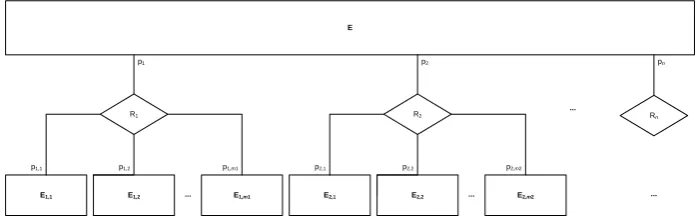
Figure 3. A general case of an entity type E and its generative set (E)={R1, R2, ...,
Rn}
Now we can get to general definitions. In the following definitions, these assumptions and notations are used (Figure 3):
Let E be an entity type.
Let ={R1, R2, ..., Rn} be a finite set of relationship types such that E
participates in each, where Ri(pi:E, pi,1:Ei,1, pi,2:Ei,2, ..., pi,mi:Ei,mi), mi≥1,
1in.
Definition (Projections). (See Figure 3 for assumptions and notation.) Let ri(Ri) be a relationship from the extent of Ri, ri={<pi:e>,
<pi,1:ei,1>, <pi,2:ei,2>, ..., <pi,mi:ei,mi>}, e(E), ei,j(Ei,j), 1in, j=1,...,mi. The projection of ri for pi, denoted with (ri, pi), is the set: (ri, pi)={<pi,1:ei,1>, <pi,2:ei,2>, ...,<pi,mi:ei,mi>}.
Let e(E) be an entity from the extent of E and pi the role played by
E in a relationship Ri, 1in. The projection of e for pi, denoted with (e, pi), is the set of projections of all relationships with existing entities of Ei,j in which e plays the role pi:
(e, pi)={(ri, pi)| ri={<pi:e>, <pi,1:ei,1>, <pi,2:ei,2>, ...,<pi,mi:ei,mi>}, ri(Ri), ei,j(Ei,j), j=1,...,mi}.
Let e(E) be an entity from the extent of E. The projection of e for the roles p1, p2, ..., pn played by E is an n-tuple consisting of
projections for each role:
Definition (Generative set). (See Figure 3 for assumptions and notation.)
is a generative set of E, denoted with (E), if and only if (by definition):
i) In any system’s population, there are no two different entities of E
with the same projections for the roles of E in the relationship types from :
((S))(e1, e2(E))((e1, <p1, p2,..., pn>)=(e 2
, <p1, p2,..., pn>) e 1
=e2).
ii) For any system’s population, and for any possible well-formed configuration of relationships for , that is, for any legal projection, there is an existing entity of E in that population with that projection:
((S))(e1(E))(relationships of e1 satisfy all model constraints
(e2(E))((e1,<p1, p2, ..., pn>)=(e 2
,<p1, p2, ..., pn>))).
These definitions imply a function that maps (E) on all possible projections of relationships allowed by the model and its constraints, defined as (e)=(e, <p1, p2,..., pn>). The clause i) of the latter definition means that
is injective, while the clause ii) means that is surjective.
Being both injective and a surjective, is a bijection. Being injective, is
an observation term. As it is also a surjection, its corresponding identification function f is total and is equal to -1. It can be shown that the statement ii) of the given definition implies that there is not any potential true extension of the population of E and of the populations of some or all of the relationship types from (E) that satisfies all model constraints and preserves injectivity of .
It should be noted that surjectivity differentiates from an observation
term in general. For the example in Figure 2, if (E) were a simple observation term that is not also a generative set, then instances of E would not have to exist for each combination given in Table 2; for a generative set, this is mandatory (i.e., f is total for a generative set). In addition, the
relationship types from a generative set do not have to be reference types as defined in [17], because the participation of E in reference relationship types has to be total, while this is not necessary for a generative set; an example is the participation of E in R2 in Figure 2 with the lower multiplicity bound equal
to 0 at the oppositeend.
Now we can formulate the definitions of different kinds of data types and classes.
UML
Definition (Structured data type). A structured data type is an entity type E
whose population definition is intensional and has a generative set (E), where any R(E) has all participating entity types other than E constant.
Definition (Class). A class is an entity type without a generative set, whose population definition is extensional.
Definition (Enumeration). An enumeration is a constant class whose instances can be identified by literals.
We will illustrate the meaning of the given definitions, especially of the one of a generative set, on two examples.
Point <<datatype>>
Decimal
x
y X
Y
1..1
1..1
Figure 4. Example of entity type Point
Example (Point). The example in Figure 4 shows the entity type Point with two relationship types: X(Point, x:Decimal) and Y(Point, y:Decimal) with 1..1 cardinality constraints on x and y. If these two relationship types form the generative set for Point, then Point is a data type. In that case, the population
of Point is defined intensionally and consists of one and only one instance of
Point for each pair of existing instances of Decimal (it is basically isomorphic
String <<datatype>> Char
tail
Head
0..1
0..1 Tail
head
{context String inv: self.tail<>self and
self.tail->size()+self.head->size()<>1}
Figure 5. Example of entity type String
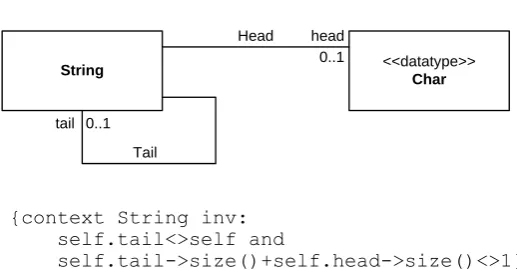
Example (String). The example in Figure 5 illustrates another, more interesting case, where instances of entity type String can be recursively constructed from other instances of the same type. The constraint given below the diagram, along with the implicit constraints given in the multiplicities of the roles head and tail, specifies that only the following cases are allowed:
i) A String can have an empty head and an empty tail. This is the case of
an empty string.
ii) A String can have one character as its head and another string as its tail.
(Note that the tail can be an empty string.) This defines the recursive nature of constructing strings.
If the two relationship types are treated as a generative set and String as a data type consequently, there will be a logically infinite population of String, defined conceptually as follows:
there is one and only one instance with no head and no tail, the “empty string;”
for each existing instance of Char and each existing instance of
String, there is another instance of String that is constructed by
concatenating the character and the former string.
As before, in the opposite case when the two relationships do not have the semantics of a generative set, String is a class and its population has to be managed explicitly, by creating and destroying instances with actions. In that case, there can be two instances of String that are different identities, but which can be treated as equal strings with respect to their isomorphic structure, when they have the same character as their heads and (recursively) equal tails.
UML There are several interesting implications and properties that can be observed from the presented definitions:
The extent and the population of a data type do not have to be finite. Since the definition of a primitive data type’s population is intensional, it can be logically infinite.7 The described example of the
data type String is an example of a structured data type with an infinite population. The similar holds for a data type
BinaryLargeObject (BLOB), which can be treated as primitive, and
whose instances are finite but unlimited strings of bits.
The population of a structured data type can be either finite or infinite, depending on the finiteness of the populations of other entity types that take part in its generative set, and on the way the generative set is defined.
Due to the limitation that all entity types other than the considered structured entity type that take part in its generative set are constant, the extent and the population of the structured data type are equal, i.e., it is also constant.
If all other entity types that take part in the generative set of a structured data type E are identifiable, then E is also identifiable through the observation term . For example, in a typical (but not
necessary) case when the relationship types in (E) relate E only with primitive types, other identifiable structured data types, or enumerations, E is identifiable. E is not identifiable if, for example, it depends on a non-identifiable constant class.
Due to its extensional definition, the population of a class is always finite, but generally unlimited.
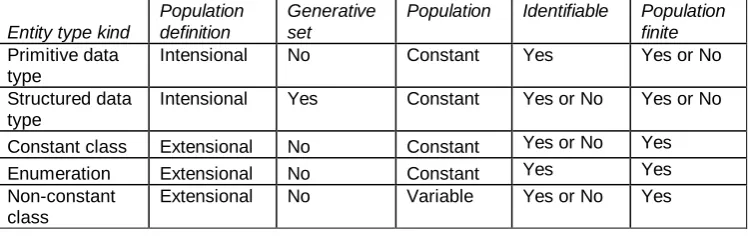
Table 3. Summary of the main characteristics of different kinds of entity types Entity type kind
Population definition
Generative set
Population Identifiable Population finite Primitive data
type
Intensional No Constant Yes Yes or No
Structured data type
Intensional Yes Constant Yes or No Yes or No Constant class Extensional No Constant Yes or No Yes
Enumeration Extensional No Constant Yes Yes
Non-constant class
Extensional No Variable Yes or No Yes
7 Typically, all such populations are physically finite, because they are limited by the
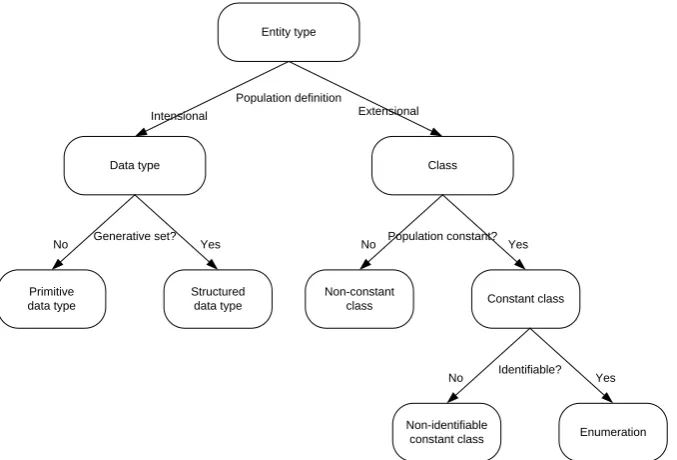
All these definitions and conclusions can be summarized in Table 3 and Figure 6.
Population definition
Intensional Extensional
Data type Class
Entity type
Primitive data type
Structured data type Generative set?
No Yes
Non-constant
class Constant class
Population constant?
No Yes
Non-identifiable
constant class Enumeration
Identifiable?
No Yes
Figure 6. Classification of different kinds of entity types
6.
Consequences
In this section, we analyze some consequences of the given semantic interpretations: how they relate to the definitions in UML, the value-based semantics, and the distinction between attributes and associations.
6.1. Classes vs. Data Types in UML
UML actually identifiers or references to those external instances, in all places such as relationships. For example, a 32-bit two’s complement binary representation with all digits equal to one is a value that refers to the conceptual notion of minus one. Such values are then stored and manipulated wherever needed. Of course, this interpretation does not prevent an implementation to store each physical instance of a data type and use compact references to it in all other places, if this is cost-effective. The decision, of course, depends on different engineering trade offs but is certainly an implementation, not a conceptual concern. For example, if the space required for storing a reference or a key to the instance in a map is comparable to the space of storing the actual instance, the system may opt not to store physical instances. If, on the other hand, the system opts to store particular instances of a data type, when the population of a data type is huge or unlimited, the system may also opt to store only instances that are referred to from relationships with other entities. For example, if an implementation estimates that only a tiny subset of the entire extent of 64-bit integers will be referred to in the system, it can store only the used instances in a central repository and provide short integer keys to those values in a map; it is then much more cost-effective to manipulate with those shorter keys instead of “original” 64-bit values throughout the system.
These observations bring us to the rationale behind defining data types in standard UML as well as in OOIS UML [14] as described in Section 3. There, instances of data types are actually only typed references to external entities, but not real entities. The remaining semantic implications follow directly from that observation:
“Instances of data types in UML do not have their identity, they are pure values; equal values represent the same instance. Instances of data types are compared for equality on value base.” Indeed, values are typed references to entities and do not have identity themselves; instead, they refer to external entities with identity. Obviously, equal references refer to the same entity, because references are inherently unique identifiers.
“Instances of data types can be arbitrarily copied and passed by value (e.g., as parameters),” again because they are simple typed references. “Instances of data types are immutable, and operations of data types
cannot change any instance; instead, they are pure functions that can create and return new values.” Really, values in UML serve as references to and proxies of external entities, while data types are constant entity types. Therefore, operations on such values are operations called on proxies. They cannot create new entities of constant entity types, but can create and return references to external, already existing entities.